International Journal of Advances in Engineering Research http://www.ijaer.com (IJAER) 2015, Vol. No. 10, Issue No. II, August e-ISSN: 2231-5152/ p-ISSN: 2454-1796
WORMHOLE ATTACK DETECTION AND PREVENTION
IN MOBILE AD-HOC NETWORK USING
AUTHENTICATION BASED DELPHI
*Shraddha S. Mahajan, **Dr. Hitendra D. Patil
*Master Student, Computer Engineering, SSVPS’S B.S.Deore College of Engineering, India **Professor and Head, Computer Engineering, SSVPS’S B.S.Deore College of Engineering, India
ABSTRACT
As Mobile Ad-hoc network is infrastructure less network in which every node can take part in data transmission and reception process. Various kinds of attacks have been arises in the network during transmission, which affects on the performance of the network. Wormhole attack is one attack from them which is created by collaborative attackers. Different techniques have developed to detect & prevent wormhole. But perfect solution is yet to be covered. Delay per Hop Indication (DelPHI) is a technique for wormhole detection in which authentication is essential in order to provide prevention. This is an effective approach to detect the fake route and also adopt preventive measure against wormhole nodes so that it will not appear in the route discovery phase. The focus of this paper is to provide a better solution in terms of wormhole detection of wormhole and to take some preventive measurement against the wormhole by considering the pros and cons.
Keywords—Mobile Ad-hoc Network, Wormhole Attack, AODV protocol, DSR protocol
INTRODUCTION
International Journal of Advances in Engineering Research http://www.ijaer.com (IJAER) 2015, Vol. No. 10, Issue No. II, August e-ISSN: 2231-5152/ p-ISSN: 2454-1796
40
1. Ad hoc On Demand Distance Vector Routing (AODV)
AODV is basically an improvement of DSDV (Destination Sequence Distance Vector). As DSDV is proactive in nature, AODV is not so. Ad hoc On Demand Distance Vector Routing (AODV) is reactive routing protocol. Based on demand, it minimizes the number of broadcasts by making routes available. This thing is not done in DSDV routing protocol [3].
2. Dynamic Source Routing (DSR)
Dynamic Source Routing (DSR) is a reactive protocol based on the source route approach. Dynamic Source Routing (DSR) protocol is based on the link state algorithm in which source initiates route discovery on demand basis. As MANET works with infrastructure less network that is untrusted environment, various attackers tries to reduce the performance of the network [2].
Attacks in MANET
As use of networking is grown up, security related issue is also increases. During utilization of network for data transmission and reception process, it is responsibility of the user to take care that performance of the network should not degrade. Hackers always try to add intrusion into authorized data in the network. Black hole attacks, white hole attacks, wormhole attack is attacks which affects on the performance of the network. In white hole attack, large amount of traffic floods in the network which creates collusion inside the network. In black hole attack, attacker drops the traffic which is passing through it. Black hole attack and white hole attack s created by single attacker.
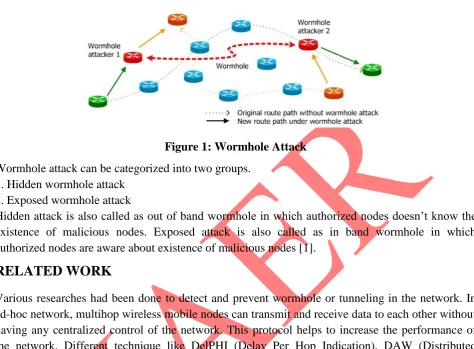
WORMHOLE ATTACK
International Journal of Advances in Engineering Research http://www.ijaer.com (IJAER) 2015, Vol. No. 10, Issue No. II, August e-ISSN: 2231-5152/ p-ISSN: 2454-1796
Figure 1: Wormhole Attack
Wormhole attack can be categorized into two groups. 1. Hidden wormhole attack
2. Exposed wormhole attack
Hidden attack is also called as out of band wormhole in which authorized nodes doesn’t know the existence of malicious nodes. Exposed attack is also called as in band wormhole in which authorized nodes are aware about existence of malicious nodes [1].
RELATED WORK
Various researches had been done to detect and prevent wormhole or tunneling in the network. In ad-hoc network, multihop wireless mobile nodes can transmit and receive data to each other without having any centralized control of the network. This protocol helps to increase the performance of the network. Different technique like DelPHI (Delay Per Hop Indication), DAW (Distributed Antiworm Detection), WAP (Wormhole Attack Prevention), Packet Leashes has developed which work effectively against wormhole attack by using different routing protocols like, AODV, DSR, DSDV etc. Number of techniques has developed to detect the wormhole and to take preventive measurement against wormhole [2].
International Journal of Advances in Engineering Research http://www.ijaer.com (IJAER) 2015, Vol. No. 10, Issue No. II, August e-ISSN: 2231-5152/ p-ISSN: 2454-1796
42 Yih-Chun Hu, Adrian Perrig David B. Johnson introduced this technique called “Packet Leashes: A Defense against Wormhole Attacks in Wireless Networks”. In this technique they present an effective protocol called as TIK (TELSA with Instant Key Discloser) leashes. Two types of leashes are presented in this technique such as temporal leashes & geographical leashes. TELSA used symmetric cryptographic primitives for wormhole detection. Drawback is that, this mechanism is not designed to replace cryptographic authentication [7].
Lijun Qian and Ning Song, Xiangfang Li introduced a new technique called as “Detecting and Locating Wormhole Attacks in Wireless Ad Hoc Networks through Statistical Analysis of Multi-path (SAM)”. This system use Statistical Analysis of Multipath approach for wormhole detection. By just analyzing the information collected by multi-path routing statistically, it detects wormhole attacks and identifies the attackers. Its drawback is fixed positions of two attackers which make them enable to tunnel RREQ between each other during all simulations. Node mobility is not considered here [3].
Wormhole can also detected by using Hound Packet. Saurabh Gupta, Subrat Kar & S. Dharmaraja had developed this mechanism. This mechanism is generally developed for the discovery of wormhole which has large tunnel length. In established path, source node initiate wormhole detection process after the phase of route discovery. Route difference between neighbor node and one hop away node is counted in the route. Ann if the hop difference between neighbors exceeds than acceptable level then destination node detects the wormhole. Drawback is that if tunnel length is smaller than 4 then detection rate of normal path is less [10].
Choi, Kim, Lee & Jung had also presented a new technique called as WAP (Wormhole Attack Prevention. This mechanism is work with two phases such as Neighbor Node Monitoring and Wormhole Route Detection. In first neighbor node table is created for each node entry. It checks for malicious behavior of neighbors. Wormhole Prevention timer detects the wormhole using WPT timer. In second phase wormhole route is detected and wormhole entry is done in Wormhole Node List so that it will not appear in the list again [2].
ANALYSIS OF PROBLEM
International Journal of Advances in Engineering Research http://www.ijaer.com (IJAER) 2015, Vol. No. 10, Issue No. II, August e-ISSN: 2231-5152/ p-ISSN: 2454-1796 increase the performance. Some techniques required special types of hardware as well as clock synchronization which may lead better results but can be costly [4][5].
PROPOSED METHOD
Proposed method is developing to resolve all the problems which have occurred in previous
method. Proposed method is based on DelPHI (Delay per Hop Indication). By considering the base
of this mechanism a new method is proposed that is authenticated DelPHI. As DelPHI is AODV based method, proposed method is also AODV based in which routes are obtained as demand or needed. The entire route set up procedure of this technique is based on AODV protocol. Therefore proposed system is divided into two modules.
I.DelPHI
II.Authenticated DelPHI
For wormhole detection, DelPHI is used and for prevention of wormhole proposed system that is authenticated based DelPHI is used. Let see these two phases in details.
I. DelPHI
DelPHI can detect both, hidden and exposed attack. It has ability to detect wormhole by just observing delay and hop count information from each node. DelPHI works with three different modules given below.
1. Data Collection
International Journal of Advances in Engineering Research http://www.ijaer.com (IJAER) 2015, Vol. No. 10, Issue No. II, August e-ISSN: 2231-5152/ p-ISSN: 2454-1796
44
2. Data Analysis & Detection
The sender initiates the detection broadcast the DREQ packet at the time ts, then it receives DREP
packet from its neighbor node at ti time. Round trip time of the path through node is given by RTT =
ti - ts. DPHi value is then calculated using this RTT value. If the hop count field in the DREP from
node is hi then the delay hop value of the path to the path to the receiver through node is given by
DPHi =
(1)
Smaller h provides smaller RTT value in normal path. Shorter path have shorter RTT value. Hence the DPHi value of normal paths should have similar values independent to h.
3. Measurement of Delay & Hopcount
In this phase collected information is analyzed by the sender that is whether wormhole is located in the path or not. It is observed that path in which wormhole is located has a larger network size than normal path. That means that the path in which wormhole is resides, its hop count and delay value has increases than normal path. So that it may be indirectly degrade the performance of the network. The DPHi values usually appear smaller than tunneled path. DPH values of normal and tunneled paths can be observed easily from two separate groups. The difference between the smallest DPH value in the tunneled group and the largest DPH value in the normal group is always larger than the gap between any two DPH values within the same group. If the DPH is larger than the next DPH value by a threshold then the path through node and all other paths with DPH values larger than
DPHi are treated as wormhole attack.
II. Authenticated DelPHI
As like DelPHI, Authenticated DelPHI is also used AODV protocol for route set up procedure. DelPHI can only used to detect the wormhole. But this method is able to take some preventive measurement against wormhole attack so that it will not reappear in the network. DelPHI used delay and hopcount parameter for performance evolution. In order to increase the performance factor of the network four more parameters are added in proposed mechanism that is throughput, packet delivery ratio, dropped packet and overhead which create this technique more effective. Authenticated DelPHI works with two different modules given below.
1. Authentication and Forwarding
International Journal of Advances in Engineering Research http://www.ijaer.com (IJAER) 2015, Vol. No. 10, Issue No. II, August e-ISSN: 2231-5152/ p-ISSN: 2454-1796 is matching then its proved that node is authenticated, otherwise node is unauthenticated. At the end authenticated user and unauthenticated user is classified using RSA algorithm. Of course the path in which wormhole is located is unauthorized path. Valid data is forwarded through authenticated that are normal path.
2. Performance Evaluation
For evaluating the performance of the network some performance factor is used like Delay, Packet drops, Throughput, Packet Delivery Ratio and Overhead. Let see them in details.
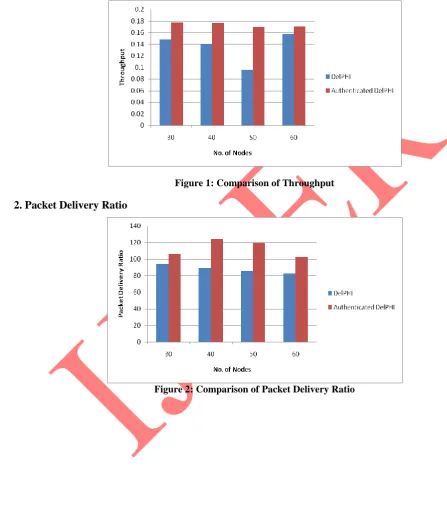
Throughput is the amount of time taken by the packet to reach the destination.
Throughput (bits/s) = Total Data / Data Transmission duration
Delay is nothing but the average time taken by data packet to arrive in the destination. It includes the delay caused by queue in data packet transmission and route discovery process. Only the data packets that successfully delivered to destinations that counted.
End to End delay = ∑ (arrive time – send time) / ∑ Number of connections
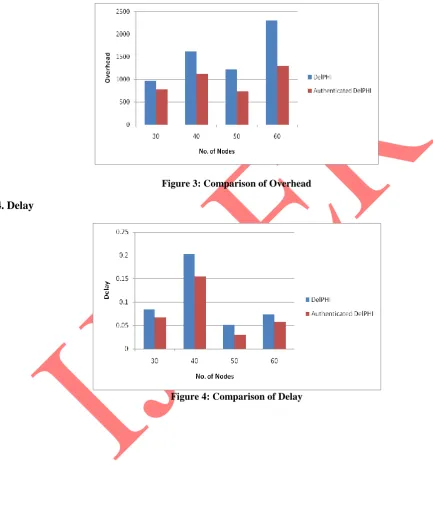
Packet delivery ratio is the ratio of the number of delivered data packet to the destination. It indicates the level of delivered data to the destination.
Packet delivery ratio = ∑ Number of packet receive / ∑ Number of packet send
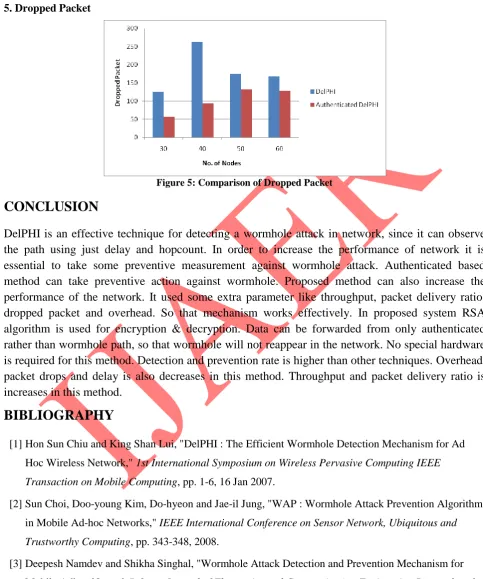
Packet drop is the total number of packets which drops during the communication process. Packet drops should be less in order to increase the performance of the network.
Overhead is defined as total number of beacon update messages involved in the communication. Data that you send across a wireless network is housed in a data envelope called a packet. Each data transmission includes additional information which is nothing but overhead, It is essential to route the data to the proper location. Network overhead can be easily calculated by sending a fixed-size data transmission across the network and observing the number of extra bytes of data transmitted for the action to be completed.
Overhead = Number of messages involved in beacon update process.
SIMULATION SCENARIO
International Journal of Advances in Engineering Research http://www.ijaer.com (IJAER) 2015, Vol. No. 10, Issue No. II, August e-ISSN: 2231-5152/ p-ISSN: 2454-1796
46 Simulation model is as follows:
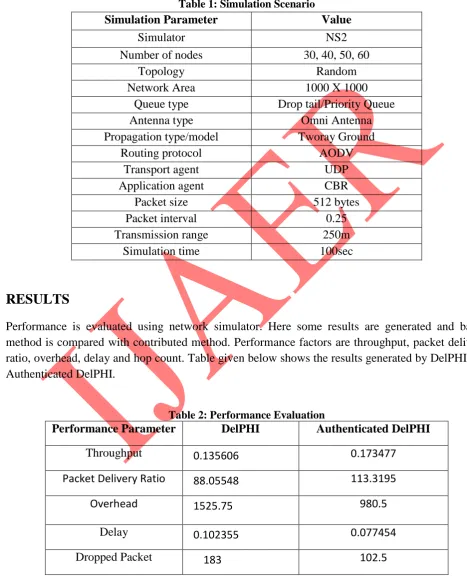
Table 1: Simulation Scenario
Simulation Parameter Value
Simulator NS2
Number of nodes 30, 40, 50, 60
Topology Random
Network Area 1000 X 1000
Queue type Drop tail/Priority Queue
Antenna type Omni Antenna
Propagation type/model Tworay Ground
Routing protocol AODV
Transport agent UDP
Application agent CBR
Packet size 512 bytes
Packet interval 0.25
Transmission range 250m
Simulation time 100sec
RESULTS
Performance is evaluated using network simulator. Here some results are generated and based method is compared with contributed method. Performance factors are throughput, packet delivery ratio, overhead, delay and hop count. Table given below shows the results generated by DelPHI and Authenticated DelPHI.
Table 2: Performance Evaluation
Performance Parameter DelPHI Authenticated DelPHI
Throughput 0.135606 0.173477
Packet Delivery Ratio 88.05548 113.3195
Overhead 1525.75 980.5
Delay 0.102355 0.077454
International Journal of Advances in Engineering Research http://www.ijaer.com (IJAER) 2015, Vol. No. 10, Issue No. II, August e-ISSN: 2231-5152/ p-ISSN: 2454-1796
1. Throughput
Figure 1: Comparison of Throughput
2. Packet Delivery Ratio
International Journal of Advances in Engineering Research http://www.ijaer.com (IJAER) 2015, Vol. No. 10, Issue No. II, August e-ISSN: 2231-5152/ p-ISSN: 2454-1796
48 3. Overhead
Figure 3: Comparison of Overhead
4. Delay
International Journal of Advances in Engineering Research http://www.ijaer.com (IJAER) 2015, Vol. No. 10, Issue No. II, August e-ISSN: 2231-5152/ p-ISSN: 2454-1796 5. Dropped Packet
Figure 5: Comparison of Dropped Packet
CONCLUSION
DelPHI is an effective technique for detecting a wormhole attack in network, since it can observe the path using just delay and hopcount. In order to increase the performance of network it is essential to take some preventive measurement against wormhole attack. Authenticated based method can take preventive action against wormhole. Proposed method can also increase the performance of the network. It used some extra parameter like throughput, packet delivery ratio, dropped packet and overhead. So that mechanism works effectively. In proposed system RSA algorithm is used for encryption & decryption. Data can be forwarded from only authenticated rather than wormhole path, so that wormhole will not reappear in the network. No special hardware is required for this method. Detection and prevention rate is higher than other techniques. Overhead, packet drops and delay is also decreases in this method. Throughput and packet delivery ratio is increases in this method.
BIBLIOGRAPHY
[1] Hon Sun Chiu and King Shan Lui, "DelPHI : The Efficient Wormhole Detection Mechanism for Ad Hoc Wireless Network," 1st International Symposium on Wireless Pervasive Computing IEEE Transaction on Mobile Computing, pp. 1-6, 16 Jan 2007.
[2] Sun Choi, Doo-young Kim, Do-hyeon and Jae-il Jung, "WAP : Wormhole Attack Prevention Algorithm in Mobile Ad-hoc Networks," IEEE International Conference on Sensor Network, Ubiquitous and Trustworthy Computing, pp. 343-348, 2008.
International Journal of Advances in Engineering Research http://www.ijaer.com (IJAER) 2015, Vol. No. 10, Issue No. II, August e-ISSN: 2231-5152/ p-ISSN: 2454-1796
50 2, no. 6, pp. 7-16, 7-July 2014.
[4] Anil Kumar Fathepura and Sandeep Raghuwanshi, "An Efficient Wormhole Prevention in MANET through Digital Signature," Inteand Advancedrnational Journal of Emerging Technology anced Engineeringnd Adv, vol. 2, no. 6, pp. 360-367, March 2013.
[5] Motjaba Ghanaatpisheh Sanaei, Babak Emami Abarghouei, Hadi Zamani and Miranda Dabiranzohouri, "An Overview on Wormhole Attack Detection in Ad-Hoc Network," Journal of Theorotical and Apllied Information Technology, vol. 5, no. 3, pp. 291-300, 30 Jun 2013.
[6] Shigang Chen and Yong Tang , "DAW : A Distributed Antiworm System," IEEE parallel an Distributed System, vol. 18, no. 7, pp. 893-906, July 2007.
[7] Yih-Chun, Adrian Perrig and Daavid B. Johnson, "Packet Leashes : A Defense against Wormhole Attacks in Wireless Networks," in In Proceeding of IEEE INFOCOM, April 2003, pp. 1976-1986. [8] S. Capcum and I. Buttyan, "SECTOR : Secure Tracking of Node Encounters in Multihop Wireless
Network," in In Proceeding of the ACM Workshop on Security of Ad-hoc and Sensor Network, 2003, pp. 21-31.
[9] Pushpendra Niranjan, Prashant Srivastav, Rajkumar Soni & Ram Pratap, "Detection of Wormhole using Hope-count and Time delay Analysis," International Journal of Scientific & Research Publication, vol. 2, no. 4, pp. 1-4, April 2012.