Talent Explorer using Data Mining
Anandkumar Jha Amit Dichwalkar
Department of Computer Engineering Department of Computer Engineering Padmabhushan Vasantdada Patil Pratishthan’s College of
Engineering, Mumbai University, India
Padmabhushan Vasantdada Patil Pratishthan’s College of Engineering, Mumbai University, India
Afsar Shaikh Ganesh Pawar
Department of Computer Engineering Department of Computer Engineering Padmabhushan Vasantdada Patil Pratishthan’s College of
Engineering, Mumbai University, India
Padmabhushan Vasantdada Patil Pratishthan’s College of Engineering, Mumbai University, India
Abstract
Our proposed application, „Talent explorer using data mining‟ is based on educational data mining and can be operated using client-server architecture. It would take into account the previous performances of a student and predict whether a student is hardworking, aspiring and has a correct attitude or not based on analysis. So if the answer obtained is yes then the teaching staff can use this data to nurture the students in an effective manner if they wish to. The same data can also be used by the companies for recruiting students as employees by considering their overall past performances. The application can act as an assistant to the human resource department for taking decisions more effectively related to recruitment of students and also assist the placement cell in identifying and strengthening the weak candidates for placements.
Keywords: Hardworking, data mining, aspirational, attitude, punctuality, honest creativity, attitude, extra-curricular, initiatives, innovativeness
_______________________________________________________________________________________________________
I.
I
NTRODUCTIONA study has shown that 85% of the HR executives state that the single greatest challenge in workforce management is creating or maintaining their company‟s ability to compete for talent [1]. High-potential talent as an employee is one who is assessed as having the ability, organizational commitment and motivation to rise to and succeed in more senior positions in the organization [2]. The challenge of educators is to address the needs of each student. Every individual requires opportunities to learn, grow, and be challenged to strive for excellence. Students with exceptional gifts, talents and learning potential have needs that require specific attention. With careful nurturing and appropriate education, gifted and talented students have the potential to make a unique contribution to their communities and then world. When this does not happen, the price we and they pay is “lost academic growth, lost creative potential and sometimes lost enthusiasm for educational success and eventual professional achievements and substantial contributions to society” [3].
It is no secret that several deserving, aspirational, hardworking and talented people have failed to achieve something significant because the world failed to take cognizance of their talent. Putting it in another way, they could never use their talent for a big discovery or invention because the world never came to know of it or it remained untapped. Few people believe that genius is born talented. Some people believe that through sheer hardwork, even the weak minded can become a genius. Both the above statements are correct.
At the same time, lack of proper guidance can turn a born genius into nothing and proper guidance can turn a weak minded hardworking person into a great. Proper guidance is necessary at young age. That is why our software „Talent explorer using data mining‟ for the students intends at extracting the good qualities of a student and based upon that deciding whether a student is talented or not.
After acquiring basic knowledge, the best way to explore talented students is to find out whether a student is hardworking, aspiring and has a correct attitude or not. These three attributes are of high importance because it has been seen that students entering a field with these attributes have done reasonably well despite not having any prior interest in that field .Those having a past background in a certain field, in order to flourish have to do hard work, possess a strong aspiration to keep on learning new things and demonstrate a correct attitude towards their colleagues and work environment as well. Therefore out of all the attributes required to become a successful person, hardworking, aspirational and a correct attitude are the most important. The story of Michael Faraday, (the discoverer of electromagnetic induction) [4] is a fine example of our claim.
II.
O
UR MODEL TO EXPLORE TALENTPunctuality: A.
Punctuality here refers to the timely performance of the assigned tasks to the students.
Honest Creativity: B.
Honest creativity here refers to the creative effort put up by the students in order to perform their assigned tasks. This can be best judged by the teachers by properly examining the essays, stories, reports and dialogues written by the students during the exams. Answers to the questions written can also be considered. The common problem here is that everyone is dependent on others for copying things from them, once others have prepared it .This is what teacher should check.
Attitude Shown Towards Colleagues and Faculties: C.
Attitude shown towards colleagues and faculties while completing assigned tasks. This can be judged by observing the discipline of the student and their performances while working in a team
Performance In Extra-Curricular Activities: D.
Participation of students should be observed here.
Initiatives Taken and Desire Shown To Learn New Things: E.
The former can be judged by observing whether a student likes to lead or not. Latter can be best judged by evaluating the evolving ideas of the students and their actions taken in accordance with their evolving ideas such as speeches made, dialog with companions, faculties and also enquiring from parents about their behavior.
We don‟t believe at being rigid with parameters. Flexibility of parameters is one of the biggest features of our software. Now consider the example of extra-curricular activities, some school might not have the necessary infrastructure as like other school. So we have left the option to configure the activities by the concerned school. The teacher would be responsible for carrying out data entry and ultimately the report would be generated. The detailed description about the above parameters is as follows:-
Punctuality:
1)
Here record to be maintained would deal with the daily attendance of students along with whether they come on time or not. Second part of this would deal with the timely submissions and here the task specification would have to be specified by the teachers such as assignments or any other tasks. So this would be flexible as different subjects can have different number of assignments. Different states can have different subjects as well. So flexibility has to be there.
Table -1:
Database structure for attendance
Present Late
Table -2:
Database structure for book completion
On time submission
Honest Creativity:
2)
Here we have decided it to leave upon the teacher to decide the subjects for which they feel that creativity can be judged. Though we would suggest the criteria as already mentioned earlier. Here marks would have to be allocated for creativity based on the total marks scored. One example can be any language paper. Suppose it is of 100 marks, out of which 25 marks would be for essay, letter, etc. Now out of these the teacher has to consider only for these 25 marks to judge the creativity of students. Similarly any other test can be organized. We leave it upon the discretion of teachers to decide.
Table -3:
Database structure for maintaining marks related record
Total marks Marks for creativity (out of 10)
Attitude Shown Towards Colleagues and Faculties:
3)
Table -4:
Database structure for maintaining record related to behavior
Marks at the end of year (out of 10) Text area for misconduct(if any)
Table -5:
Database structure for maintaining record related to team work
Commitment (10) Enthusiasm (10) Solution oriented (10) Average (out of10)
Performances in the Extra-Curricular Activities:
4)
Here the teacher would have to first specify the parameters as stated earlier to the administrator for configuration and later keep track of the events in which the student participated and whether they have managed to win a prize or not. Here attention must be paid to ensure that only those activities are considered which are open to all.
Table -6:
Database structure for extra- curricular activities
Participated or not Prize won or not
Initiatives Taken And Desire Shown To Learn New Things:
5)
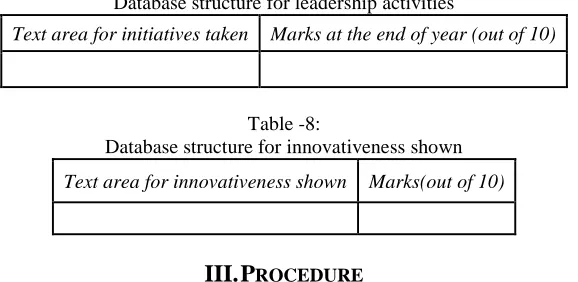
Here teacher would have to keep track of initiatives taken and innovativeness shown and maintain a list for it and allot marks at the end of the year. Teachers should not confuse innovativeness with creativity because honest creativity aspect should deal with only formal exams and innovativeness deals with acts other than exams. Similarly leadership or initiativeness should not be confused with ability to work in a team. Leadership can be judged at an individual level also. For example, if the teacher puts up a challenge and a student willingly accepts it without any persuasion. This can be seen as leadership as well. That‟s why we have left it to teacher to decide.
Table -7:
Database structure for leadership activities
Text area for initiatives taken Marks at the end of year (out of 10)
Table -8:
Database structure for innovativeness shown
Text area for innovativeness shown Marks(out of 10)
III.
P
ROCEDUREData mining (the analysis step of the "Knowledge Discovery in Databases" process, or KDD), an interdisciplinary subfield of computer science, is the computational process of discovering patterns in large data sets involving methods at the intersection of artificial intelligence, machine learning, statistics, and database systems. The overall goal of the data mining process is to extract information from a data set and transform it into an understandable structure for further use [5] .
Educational Data Mining refers to techniques, tools, and research designed for automatically extracting meaning from large repositories of data generated by or related to people's learning activities in educational settings.
Cluster analysis or clustering is the task of grouping a set of objects in such a way that objects in the same group (called a cluster) are more similar (in some sense or another) to each other than to those in other groups (clusters). It is a main task of exploratory data mining, and a common technique for statistical data analysis, used in many fields, including machine learning, pattern recognition, image analysis, information retrieval, and bioinformatics.
As per the definition of data mining, we would store the records of a student and at the end convert that raw data into meaningful information in the form of graphs and reports.
In our project we have decided to use data mining‟s clustering technique by clustering those parameters where scores would be similar for a particular year by using simple analysis technique.
IV.
A
LGORITHM AND STRUCTURE OF OUTPUTPunctuality: A.
1) Calculate the total number of working days(WD), total number of days present(DP), number of days where the student did not come late(DCL).
2) Now calculate the out of 10 score as PUN1= (((DP/WD)*10) + ((DCL/DP)*10))/2
3) Calculate the total number of assessment(TA) and timely submission(TS) and calculate PUN2=.(TS/TA)*10 4) Now calculate out of 10 score for punctuality= (PUN1 + PUN2)/2.
Honest Creativity: B.
1) Calculate the aggregate marks (HAM), total marks scored (HMS). 2) Now calculate the out of 10 score for honcreativity = (HMS/HAM)*10
Attitude towards Colleagues and Faculties: C.
1) Calculate the aggregate marks (AAM), total marks scored (AMS) for behavior.
2) Calculate the average for team work (TMW) by adding up the marks for commitment, enthusiasm and solution-orientedness and also calculate the aggregate marks (ATMW).
3) Now calculate AT1= (AMS/AAM)*10 and AT2= (TMW/ATMW)*10. 4) Now calculate the out of 10 score for atttc= (AT1+AT2)/2.
Performances in Extra-Curricular Activities: D.
1) Calculate the total number of activities (ETA), total number of participations (ETP), total prizes won (ETW). 2) Now calculate the out of 10 score as extra= (((ETP/ETA)*10) + ((ETW/ETP)*10))/2.
Initiatives Taken and Innovativeness Shown: E.
1) Calculate the aggregate marks for initiatives taken (AIT), total marks scored for it as (MIT), aggregate marks for innovativeness shown (AIS), total marks scored for it as (MIS).
2) Now calculate the out of 10 score as inileap= (((MIT/AIT)*10) + ((MIS/AIS)*10))/2.
Hardworking:
1)
Hardworking = (punctuality + inileap)/2
Aspirant:
2)
Aspirant = (honcreativity+ ((MIS/AIS)*10) + extra)/3
Attitude:
3)
Attitude = ( attc+((MIT/AMIT)*10))/2 Here‟s the detailed output structure:-
The output of our application would be in the form of graphs and tabular reports. Wherever marks have to be allotted, they have to be out of 10. So at the end, bar graph would indicat performance on the scale of 0 to 10. For the sake of reports, we have decided to convert the marks into remarks such as good, very good, etc. Here is the detailed scale:-
Table -9:
Scale for performance indicator
Marks Remark 0-3.99 Poor 4-5.99 Average 6-7.99 Good 8-9.50 Very Good 9.51-10 Excellent
Here is a detailed description about the graphs and reports:-
1) The first graph would be a bar graph indicating performance for the above specified five parameters.
2) The second graph would be a bar graph indicating the out of 10 marks for a student as to whether they are hardworking, aspirant and whether they have a correct attitude or not.
3) The first report would be a report indicating the key areas of interest of the student extracted from the extra-curricular activities section. Here non-repeated activities would be shown in which the student would have participated.
4) The second report would be a report based on clustering indicating that for a particular year, which parameters were given similar marks. Consider for example the below table for only one class.
V.
F
RONT END AND BACK ENDVI.
C
ONCLUSIONSo we have laid down a complete blueprint of our proposed application along with the need and the areas in which our application can prove to be useful.
VII.
F
UTURE WORKOur future work would be to initially execute our idea in the above mentioned environment. We would also consider cloud hosting in future.
A
CKNOWLEDGEMENTSWe acknowledge the contributions directly made by several faculties at Padmabhushan Vasantdada Patil Pratishthan‟s College of engineering, Mumbai. We also acknowledge the significant contribution indirectly made by several technical papers and online content published on several websites.
R
EFERENCES[1] “Talent Management: Drive for Organizational Success” by Nancy R. Larwood from SPHR, GPHR [2] "High-potential Talent: A View from Inside the Leadership Pipeline" by Michael Campbell and Roland Smith
[3] "TEACHING STUDENTS WHO ARE GIFTED AND TALENTED" by Department of Education , Newfoundland and Labrador [4] "The Genius of Michael Faraday" by Sir .John Meurig Thomas