Copyright © The Author(s). All Rights Reserved. Published by American Research Institute for Policy Development DOI: 10.15640/jppg.v7n1a2 URL: https://doi.org/10.15640/jppg.v7n1a2
The Subsistence Logic of the Weak
:
A Study of Disadvantaged Groups in Urban China
An Chen & Jiguang Guo1
Based on field research and a number of personal interviews in China (mostly in Beijing and Anhui), this study attempts to explore the conditions of China‘s ―urban disadvantaged groups‖ (chengshi ruoshi qunti). It addresses four questions. How should we define and classify this social category in China today? How did urban disadvantaged groups take shape under the impact of the market reform? How has the Chinese government handled this potentially explosive social issue? How do the urban disadvantaged people struggle to survive in the highly competitive market economy? We argue that aside from depending on the government‘s assistance and social security system, China‘s ur-ban disadvantaged groups have exhibited an amazing ability of survival by exploiting the flaws and loopholes of the changing social and economic system. To the extent that they are compelled to seek illegitimate and illegal means for survival, the government fails to fulfill its responsibility and thus has to take a lenient or tacit approach, which in turn encourages and gives rise to various survival strategies. Many of these strategies, if not illegal, exist in a grey area be-tween legal and illegal.
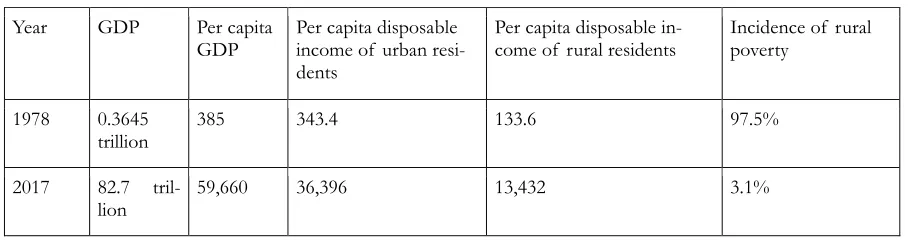
Over the past 40 years, Deng Xiaoping‘s market reform has caused the great transformation of the Chinese economy and society. With the sustained and rapid growth of the economy, the income and living standards of both Chinese urban and rural residents have improved to a significant degree. By comparing the two statistical bulletins in 1978 and 2017, one can see the tremendous changes that had taken place in China‘s socioeconomic development (Ta-ble 1). China‘s GDP increased from 0.3645 trillion yuan in 1978 to 82.7 trillion yuan in 2017. In the meantime, the per capita GDP increased from 385 yuan to 59,660 yuan -- with an average annual growth rate of about 9.5%, reaching the level of middle-income countries. The per capita disposable income of urban and rural residents increased from 343.4 yuan and 133.6 yuan to 36,396 yuan and 13,432 yuan, respectively. The incidence of rural poverty fell sharply from 97.5% to 3.1% -- far below the world average.
Table 1:A Comparison of China’s Economic Development in 1978 and 2017 (unit: yuan)
Year GDP Per capita
GDP Per capita disposable income of urban resi-dents
Per capita disposable
in-come of rural residents Incidence of rural poverty
1978 0.3645
trillion 385 343.4 133.6 97.5%
2017 82.7
tril-lion 59,660 36,396 13,432 3.1%
Source: National Bureau of Statistics of China (NBSC): China Statistical Abstract 2015, 2018
(Beijing: China Statistics Press, 2015, 2018).
Although China‘s market reform has made remarkable achievements, it has also generated multiple social problems, including environmental degradation, worsened income inequality, massive unemployment and poverty.
1 An Chen, National University of Singapore; Jiguang Guo, the Chinese Academy of Social Sciences. The authors would like to
One of the most prominent and serious problems facing the reform regime is the emergence of large disad-vantaged and marginalized social groups. While the overall living standards of Chinese citizens have improved in the era of reform, the distribution of wealth between and within regions has been highly uneven and imbalanced. The income gap among social groups is constantly widening.
Taking Chinese society as a whole, widespread poverty has somehow been replaced by the growing gap of wealth. Based on field research and a number of personal interviews in China (mostly in Beijing and Anhui), this study attempts to explore the conditions of China‘s ―urban disadvantaged groups‖ (chengshi ruoshi qunti). It addresses four questions. How should we define and classify this social category in China today? How did urban disadvantaged groups take shape under the impact of the market reform? How has the Chinese government handled this potentially explosive social issue? How do the urban disadvantaged people struggle to survive in the highly competitive market economy?
To identify and analyze the subsistence logic of disadvantaged groups in Chinese cities is critical to our as-sessment of how far China can transition to a full-fledged market economy and whether or to what extent the socioe-conomic consequences of the market reform may threaten political stability in China. We argue that aside from de-pending on the government‘s assistance and social security system, China‘s urban disadvantaged groups have exhibited an amazing ability of survival by exploiting the flaws and loopholes of the changing social and economic system. To the extent that they are compelled to seek illegitimate and illegal means for survival, the government fails to fulfill its responsibility and thus has to take a lenient or tacit approach, which in turn encourages and gives rise to various sur-vival strategies. Many of these strategies, if not illegal, exist in a grey area between legal and illegal.
Defining and Identifying Disadvantaged Groups in Urban China
In China‘s political discourse, the ―disadvantaged group‖ is a somewhat vague concept. Until the 1990s, Chi-nese scholars and policy makers preferred to use the terms like ―civil affairs objects‖ (minzheng duixiang) and ―difficult masses‖ (kunnan qunzhong) to refer to the citizens covered by social relief programs and welfare services.2 The first time when the central government officially adopted the term ―disadvantaged groups‖ might be traced back to Prier Zhu Rongji‘s ―Government Work Report‖ delivered in March 2002. The report demanded the expansion of em-ployment and re-emem-ployment to increase the income of residents and placed special emphasis on the need to assist the ―disadvantaged groups‖ for seeking jobs.3
The criteria for the “disadvantaged groups”
However, Chinese scholars fail to achieve consensus over how to define the ―disadvantaged groups‖. Li Shi from Beijing Normal University applied three criteria. The first is the income and consumption level. Fordisadvan-taged groups, it should hover around the poverty line. Their employment is typically unstable and insecure or has to work under harsh conditions and without social security. Their life is therefore difficult and vulnerable. The second criterion is social standing, which is measured by the extent to which they are respected in society. The third criterion is related to how their individual rights and interests are protected or discriminated against. Without question, the dis-advantaged groups consist of the people who typically suffer from poverty, unemployment, or low-income jobs. They are the least respectable in society and their rights and interests are often neglected and infringed. Simply put, they are located at the bottom of society and belong to the ―underclass‖ in the Western sense.4
Some scholars divide China‘s urban disadvantaged groups into two categories, namely the physiological and social ones. The former denotes mostly the elderly, physically weak, unhealthy, poorly educated, and disabled people. They lack market power and competitiveness, and can hardly survive on their own. The latter refers to unemployed workers, the employees who retired earlier with small pension, and all those who are impoverished for whatever rea-sons.5
2 2006 China Labor and Security Year Book (Beijing: China Labor and Social Security Publishing House, 2007).
3 Zhu Rongji, ―Report on Government Work: At the Fifth Plenary Session Of the Ninth National People‘s Congress on
March16, 2002,‖ People’s Daily, March 17, 2002.
Some conceptual problems
To understand these criteria or definitions for ―disadvantaged,‖ the conceptual confusion should be clarified in the first place. It is largely a relative concept. One social group may be more ―disadvantageous‖ than another in terms of income, wealth, education, and living conditions. Peasants in China are more disadvantaged than urban citi-zens in all relevant respects except that they are eligible for leasing farmland from village government. Women are mostly more disadvantaged in job markets and salary scheme than men.
The disabled people are obviously more disadvantaged than the healthy people. ―Disadvantage‖ is also a dy-namic concept in the sense that it keeps changing. For instance, under China‘s socialist planning economy, the (tradi-tional) working class was dominant in society in terms of political, economic, and social standing. In China‘s transition toward a market economy, its status has declined significantly. Large numbers of workers of state-owned enterprises (SOE) lost their jobs and thereby fell into vulnerable and miserable social groups.
However, the disadvantaged groups in China, which comprise the people with all kinds of ―disadvantages,‖ are not all cohesive ―social‖ groups in its strict sense. They usually have no fixed group members or group conscious-ness. They are disorganized and have no ability to take collective actions. The emergence of disadvantaged groups in reform China has its unique historical context, resulting from the impact on society of the changes in China‘s eco-nomic system and redistributive policy. Aside from the external factors, however, their disadvantages may also be as-cribed to their own weaknesses, such as poor education and obsolete labour skills, which make it hard for them to adapt themselves to China‘s new economy.
The reasons for the formation of disadvantaged groups are varied, but in general they can be divided into two related or intertwined categories, namely disadvantages caused by personal weaknesses, such as lacking market power, skills, (new) job training, and competitiveness, and by enterprise ownership change that affected SOE em-ployees most seriously.6 China‘s profound socioeconomic transformation over the past 40 years has involved the mas-sive-scale resources reallocation and restructuring of social interests. The implementation of SOE reform, educational system reform, housing policy reform, and medical and health reform, among others, since the 1990s has intensified social stratification and income inequality, causing citizens‘s interests to be increasingly differentiated.
The composition of China’s urban disadvantaged groups
Chinese scholars disagree over who belongs to the urban disadvantaged groups. These groups vary in size and composition, depending on what criteria to be adopted. In fact, the composition of disadvantaged groups in urban China have changed a great deal over time. In 2002, the citizens who enjoyed the ―minimum living allowance‖ (dibao) provided by the Ministry of Civil Affairs were supposed to be ―three-no persons‖ (i.e. with no people to depend on, no source of livelihood, no ability to work). They only accounted for 5% of the ―disadvantaged‖ people as this term was used at that time, whereas the unemployed people and their families made up 95%.7
Now the membership of the urban disadvantaged groups has changed to consist mainly of the following kinds of people. The first kind is generally referred to as the urban poor (chengshi pinmin), including the above noted ―three-no persons.‖ They rely almost entirely on the state‘s welfare and social assistance programs to survive.8 In ef-forts to help the urban poor, the central government has expanded the dibao system based on the registered popula-tion. This system was first tried on an experimental basis in Shanghai in 1993. It was later on spread nationwide in 1999. Although the urbanites who qualify for dibao cannot be equated with the urban disadvantaged groups, the data of the former is still important for the study of the urban disadvantaged groups (Table 2). Many citizens‘ income ex-ceeds the dibao standard and thus are not qualified for it, but they do face a considerable amount of vulnerability and uncertainty. As a scholar noted, ―They run a high risk of poverty as they may fall below the dibao standard at any time and get even poorer than the dibao receivers.”9
Table 2: The number of Minimum Subsistence Allowance (dibao) in Urban China: 2002-2016 (Unit: ten thousand people)
2002 2004 2006 2008 2010 2012 2014 2016
2065 2205 2240 2335 2311 2144 1877 1480
Source: Ministry of Civil Affairs of the People‘s Republic of China: 2017 China Civil Affairs Statistical Yearbook (Beijing: China Statistics Press, 2017).
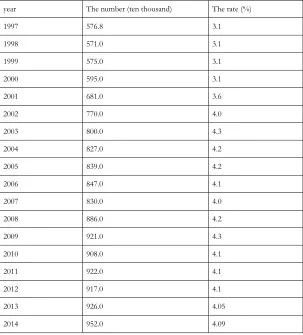
The second kind denotes the laid-off or unemployed workers. China‘s industrial restructuring (mostly owner-ship change) in combination with the market reform and the impact of expanding foreign trade have produced devas-tating consequences for employment. The term ―laid-off worker‖ (xiagang gongren) appeared in China‘s political and academic discourse in the late 1990s, referring to the SOE employees who lost jobs but still maintained the ―employ-ment relations‖ with the SOEs and were required to accept re-employ―employ-ment or other jobs offered. The problems with laid-off workers were expected by the government to be transitional or temporary and would be solved by 2003. The basic security system for them has been integrated into the nationwide unemployment insurance system since 2001.10 Government officials and scholars differ widely on the unemployment rate and number of the urban poor. The offi-cial unemployment rate is cited here as a useful reference (Table 3). The laid-off and unemployed workers shared a few prominent features, such as old age. Most jobless men and women were over age of 50 and 45, respectively. Their employment, if any, is unstable, manual, and low-paid. A combination of factors, such as the schooling of children, illness, and accidents has added even more hardships to their life. The costs of urban life have been increasingly high with inflation. The expenses for the necessities of daily life have risen sharply. A number of consumer items that
Table 3: The number and rate of the registered unemployed in cities and towns.
year The number (ten thousand) The rate (%)
1997 576.8 3.1
1998 571.0 3.1
1999 575.0 3.1
2000 595.0 3.1
2001 681.0 3.6
2002 770.0 4.0
2003 800.0 4.3
2004 827.0 4.2
2005 839.0 4.2
2006 847.0 4.1
2007 830.0 4.0
2008 886.0 4.2
2009 921.0 4.3
2010 908.0 4.1
2011 922.0 4.1
2012 917.0 4.1
2013 926.0 4.05
2014 952.0 4.09
Source: National Bureau of Statistics of China: China Statistical Abstract 2015 (Beijing: China Statistics Press, 2015).
Used to covered by social security and welfare programs now must be burdened by themselves, such as hous-ing, a portion of medical insurance expenditures, and pensions. While having difficulty feeding themselves, many dis-advantaged people have both elderly parents and children to support – with their own meagre income as the main or sole source of family life.
As such, how to struggle for survival in a rapidly changing society is their primary concern. They have to sur-vive anyway and for that purpose find out a variety of strategies and look for diversified sources of income. In that regard, China‘s urban disadvantaged groups can be assigned into four categories to be analyzed below.
Category I: Relying Exclusively on the Government
With the role of the state in the economy diminishing with the ongoing market reform, the Chinese govern-ment still holds the formidable power for resources allocation and the effects of the market should not be overesti-mated. The government‘s measures of allocation have produced a wide and deep impact on the redistribution of so-cial wealth, the life of urban disadvantaged groups in particular. One of the key measures is the institutionalized guar-antee to reduce subsistence risks of the disadvantaged people.
Living on social relief programs
Some kinds of disadvantaged groups, such as the senile, weak, sick, disabled, and other physiologically vul-nerable people, belong to the helpless and poverty-stricken urban population. Because of their lack of ability to work or job opportunities, they have little or no income at all and are therefore unable to maintain a minimum standard of living. If the per capita income of family members living together is lower than the standard stipulated for local urban residents, they are entitled to dibao. So the households taking dibao are supposed to be the most vulnerable and misera-ble urban groups. Many of them virtually live on dibao only.
Some did try to look for jobs but without success, thus being compelled to turn to the government for help. Take Mr. Li from D District, Beijing, as an example. After being laid off by his company, he actively looked for a new job. Because of his age and poor education, however, he could never find a suitable job. He worked in SOEs almost lifetime and was long used to it. All of a sudden, his job was no more. He was so confused and frustrated.
―I do not want to add burden to government finance but I have no alternatives, yielding to the reality, namely my inability to be hired. I simply cannot survive without relying on the government. I applied for dibao and got it.‖11
Mr. Wang, a former SOE employee at X District, Beijing, retired early because of an industrial accident. His wife suffered from chronic illness and had never worked. His only son was attending high school. They had no choic-es but living on government reliefs. He said that he really wanted to work but for health reasons, he needed to take medication every day, and finding a suitable job was highly unlikely. He was obligated to take care of his wife and son, too. He allegedly saw no light in the tunnel and had to apply for dibao through hsi community to support his family. ―Although I feel shamed, what can I do? Without the help of the government, it is hard to imagine how we will sur-vive.‖12
Aside from living on dibao, many disadvantaged families depend on the welfare benefits left over from the old system as well as their own savings. Mr. Yang from Hefei (Anhui), 54, was a laid-off SOE worker. He formerly worked as a firefighter before entering a textile factory, which later merged with the machinery factory. The factory had more than 2000 employees and 5000-plus family members at that time. Many of the employees were veterans. Because of the poor efficiency, the factory went bankrupt and was reorganized in 1994. But the productivity did not improve much. The SOE restructuring caused Mr. Yang to be laid off in 1999. He was offered a one-time compensa-tion of 5,000 yuan, but no medical and pension insurance.
After being laid off, Mr. Yang could not find a job and had to stay at home to escort his children to school every day. He said that his hearing capacity is not good – a problem preventing him from finding a new job. Also, he used to work ―proudly‖ for an SOE and was not willing to take on new jobs. He felt that he would lose face if work-ing in a private enterprise. Now, the main source of his livwork-ing is own savwork-ings plus parental support. As a major relief to him and his family, the SOE he worked for allocated a ―welfare apartment‖ (fuli fang) to him. More luckily, before long, he was offered a much larger 70-square meter new apartment thanks to land requisition.
He expressed his understanding of the government‘s decision to shut down the enterprise and lay off work-ers. He argued that as the economy developed, it was impossible to keep those inefficient and unproductive enterpris-es forever. And the market reform must be made succenterpris-essful at the expense of some people but our next generations will benefit. Some people have to be allowed to get rich first. SOE workers‘ quality of life was also relatively good. His SOE paid a subsidy proportional to the length of service and position of laid-off employees. The difference among fellow workers was not very large with the minimum set at about 3,000 yuan. So the laid-off workers mostly accepted it without much complaining.13
In recent years, there have been news reports that disadvantaged citizens in some areas no longer look for work after obtaining dibao. Some of them are perhaps ―lazy‖ indeed, lacking interest or motives for working. Others see as too low the salary of jobs they could find or the jobs recommended by their community, even though the in-come earned would be at least more than dibao. The low-income or unemployed households have other state-sponsored benefits, which would be lost if they find jobs.
To avoid the waste of labor resources and alleviate the government‘s financial burden, a new legislation en-titled the ―Measures for the Implementation of the Minimum Living Allowance Security System‖ was passed in Guangdong Province. The legislation requires all the low-income, dibao-receiving people who are at the working age and have a working ability to participate in the employment training programs offered by the Civil Affairs Bureau. If they fail to attend twice without acceptable reasons, dibao would be revoked.14
The legislation also stipulates that if poor family adults refuse to accept the jobs recommended by the gov-ernment more than three times, their poverty reliefs and dibao would be reduced or suspended.15 A similar policy was implemented in Zhejiang Province as well. According to it, if the family has a healthy adult who refused to work or accept the offered jobs, they would be disqualified for the government‘s programs for security and poverty allevia-tion.16
Re-employment training
Many people lost their jobs and were compelled by the difficulty of life to receive dibao. At the same time, in efforts to get reemployed or start their own businesses, they take advantage of various training programs offered by the government. These programs cover the training of working skills, entrepreneurship, microcredit, and so on. They also managed to benefit from many of the government‘s preferential and supportive policies which provided them with numerous re-employment opportunities.
More than 10 years ago, Mr. Zhou and his wife, who initially worked at an SOE in Beijing, fell victims to the poor performance and retrenchment of their company. After losing jobs, the couple stayed at home all the day help-less and desperate, worrying about their livelihood. They were both in their 40s and had no skills required by the job market. They took a number of free government-funded training courses for laid-off workers, especially those for entrepreneurship training. The training class targeted those who had no experience with doing business and could not find funding, and taught them how jump-start low-cost entrepreneurial projects. The trainers also helped them get familiar with the banks‘ personal small-sum loan policies. With this training, unemployed people were expected to build self-confidence and make their dreams of ―being a boss‖ come true.
The couple decided to open a small supermarket in the neighbourhood. From the trainers, they learned the expertise, skills and procedures for how to operate and manage their business. With the help of community officials, they applied for small loans and rented a small shop in the area. He recounted his success story proudly. ―Through hard work, our business is getting better and better. It is not easy indeed, but our monthly income reaches at least thousands of yuan, much better than before when we worked in the factory. Of course, the money earned is not much. We are not eligible to apply for dibao anymore.‖17 Many programs for re-employment and poverty relief were
jointly run by the government, the community, and social organizations. The Federation of Disabled Persons at all levels serve the special needs of the disabled. The Women‘s Federations are responsible for assisting women‘s entre-preneurship.
For example, according to the regulations of ―Small Guarantee Loan for Women‘s Entrepreneurship and Employment in Beijing,‖ women aged between 18 and 55 in urban areas are eligible to apply for the small loan with
the maximum of 80,000 yuan.18 One of the problems with disadvantaged groups is that they may be hampered by the
traditional mindset or outdated concepts and thus are reluctant to participate in re-employment training. They would rather be idle at home than look for a job. Just as one of community officials said, some laid-off or unemployed people have problems with their views about re-employment. Prevailing social values in China stress the importance of ‗face- saving‘, particularly among acquaintances and friends. So they feel embarrassed or even humiliated to be seen to participate in job-training and to work with migrant workers. In the process of re-employment, some laid-off SOE workers still keep a complex of superiority and from time to time appear arrogant. They are shamed by working in small enterprises or non-public enterprises.19
In some regions, however, job training and services are still in their infancy and have yet to be improved. Some training courses are limited to explaining basic government policies for the unemployed people and fail to offer useful guidance. Some are seriously divorced from the trainees‘ actual needs or the situation of the job markets and lack pertinence and effectiveness. Many jobless people attended the classes, which are free of charge anyway, only in an attempt to obtain the issued certificates which are often required for re-employment. Still, some people take advan-tage of the government reemployment training to make money. They ask for fees for recommending the programs, and taking or filling in the registration forms on behalf of the applicants. Some local officials frankly admitted that the effect of training for laid-off people has not been tracked and studied They did not know whether or how the training is useful.20
Category II: Self-Reliance
For the vast majority of disadvantaged people, if their economic conditions are not particularly bad, they may not be eligible for dibao or other kinds of state-sponsored poverty relief. Even though they areeligible indeed, they might be hindered by a sense of ―dignity‖ from applying. In this case, they might search for methods to pull them-selves out of poverty on their own. As they often said, ―Frequent shifts make a tree dead but a person prosperous‖ (ren nuo huo, shu nuo si); and ―People cannot hang themselves on one tree‖(ren buneng zai yikeshushang diaosi).
Personal ability
China‘s SOE restructuring involves not only the transformation of ownership and management but the re-shuffle of employees. Many employees were compelled to terminate their labor contracts (i.e., buy off their working years [maiduan gongling]) with the SOEs and break away from the state ownership system, namely changing their identi-ties from ―unit people‖ to ―social people.‖ Problems arose out of this transformation. Many of them were treated unfairly and as a consequence degraded into disadvantaged groups. The meagre compensation for working years was gravely disproportional to their contribution to the SOEs over the years or decades. So when their labor contracts were terminated, they had little savings. In the absence of jobs and new sources of income, their living conditions deteriorated rapidly. They struggled to survive under the heavy pressure of bearing the costs for children‘s education, family medical treatment, and other major expenditures.
Making the situation even worse, without employment or affiliation with any company, they were required to pay their pension insurance and medical insurance premiums at their own expense. The large and rising outlays on these insurances further overburdened them. The problem was the most serious for those laid-off workers whose age, along with their poor education, was a big disadvantage for seeking jobs. Their physical fitness is not as strong as the young migrant workers and their knowledge is not as good as the unemployed university graduates. Unfortunately, it was very often just these workers who had a particularly heavy family burden.
It was not surprising that they complained bitterly about the former SOEs and relevant government agencies and policies. One such worker did not attempt to hide his sadness. He thought that he contributed his lifetime to the country but out of a sudden was thrown out on the street. He applied for dibao for several times but did not obtain it, most likely because he had no connections (guanxi). ―Life goes on anyway. I have a large family to feed. If you cannot depend on the government, you have to depend on yourself. Despite many failures, I am not frustrated but confident that if I persist, I will find a job.‖21
However, for the younger or older but skilled workers, they think a bit differently and tend to see SOE re-structuring or shutdown as an irresistible trend. ―Arms cannot twist the thighs,‖ as they like to say, meaning that one cannot fight against the situation. It would be better to go to the market and live on their own ability. Mr. Huang from Anhui province has such a desire and personal experience. Mr. Huang was born in 1964 and specialized in radio with a technical secondary school degree. He used to work at a department store and did administrative work which had nothing to do with his professional training. In 1992, he decided to quit his job and join his favorite computer indus-try. In retrospect, Huang said that the department store was in bad shape with no much profits. He foresaw its closure sooner or later. But the key reason for his resignation was that he did not like the job but desired to pursue his own dream. In IT industry, he worked as an agent of software sales to which his expertise was useful. The working envi-ronment is nice and the income is satisfactory. Huang believes that doing what he really likes let him recognize his own worth and strengths.
However, Mr. Huang still harbored discontent toward the department store because he was not assigned fare housing when he worked there. The managers were not concerned at all about the employees‘ interests and wel-fare, nor did they care about his resignation. Not until 2005, he ultimately received 50,000-plus yuan as the store‘s compensation form him. By comparison, the amount was a bit too small as he had to pay for the old-age medical in-surance by himself.22
It goes without saying that if the laid-off workers do have the skills and expertise wanted in the job markets, they should have no difficulty at all for reemployment. Mr. Cao used to work as an electrician in a large SOE in Bei-jing. The poor management and excessive corporate burdens caused the company‘s efficiency and productivity to be poor and the sale of its products to plummet. In the subsequent streamlining and personnel diversion (fenliu), Mr. Cao had to leave the SOE and fell into disadvantaged groups. ―Suddenly, I felt like falling from the clouds and crashed onto the ground.‖ He was the main source of the family‘s finance. His parents were senile, his wife worked temporari-ly in a shopping mall, and his son was attending high school. Mr. Cao‘s unemployment triggered horrible chain reac-tions that threw the whole family into panic and drove him desperate. He was lucky. With his experience and skills as an electrician, he was soon hired by a foreign company.23 Needless to say, depending on one‘s own ability and
choos-ing one‘s own career involves risks and challenges. The path of self-employment is difficult and twisted, especially for women.
Ms. Wang, from Hefei, Anhui, was one of the laid-off workers of a large collective enterprise (jiti qiye) under the jurisdiction of the Provincial Labor Bureau of Anhui. Later, his enterprise was divided into different branches and his .workplace moved to the city‘s development zone. It was too far away from her home and too inconvenient for her to escort her children to school. In order to take better care of her children, she decided to quit the enterprise.
During the ten years following her resignation, Ms. Wang looked for employment everywhere and changed several jobs. The problem was that most of the companies she worked for refused to pay pension insurance. She had to pay monthly 900 yuan for medical and pension insurance herself, but her own salary was only 3,000 yuan a month. At the end of the day, she opened a small grocery store but the business was poor, mainly because the physical stores were hard hit by online stores. She pays 900 yuan as taxes per month, as well as the rent and land fees. She could hardly make money and actually lost money. As the profits from running the store failed to meet the family‘s living expenses, at the time of our interview, Ms. Wang was planning to open a craft workshop teaching children to make handicrafts, such as pottery and paper cutting, etc. She conducted market surveys and was quite optimistic about the market potential for this new business.24
Social networks
Aside from relying on their own abilities in search for jobs and self-employment, many people in disadvan-taged groups also tried to use their social networks such as relatives and friends. A study found that the job-hunting of many laid-off workers was successful thanks to their social relations.25 Personal relations or guanxi have been tradi-tionally important in Chinese society. When people encounter difficulties and problems, relatives and friends are usually the first people for them to look to for help. Nowadays, with the increasing rate of unemployment, guanxi has penetrated the job markets.
After graduating from college, Mr. Wang was hired by an SOE which was well managed with high productiv-ity and profits. The SOE assigned his family an 80 square-meter large house. His career and life seemed to be thriving. What he could not foresee then was that like many SOEs, his company went through ownership change. The workers were almost overnight turned from personnel on the state payroll into private employees who, if fortunately not laid off, had a large portion of their salary cut. In recent years, as their products faced a diminished market, the company suffered from serious surplus of production which entailed massive retrenchment and cost Mr. Wang his job, too. ―I used to be administrative staff in SOEs and attempted to seek jobs of a similar nature following laid-off. One of my relatives had just opened an Internet cafe and wanted a manager. Learning that I was jobless, he invited me to join his business. With my experience in management, the Internet bar business is getting prosperous. So my relative tried to replicate his success elsewhere and opened several Internet bars. I was not only promoted but awarded with salary hike and abundant bonus.‖26
Friends are a major channel for reemployment. Because his father was a worker of a large SOE, as per the government policy, Mr. Wu succeeded his father who retired 20 years ago. He had a driver‘s license and was recom-mended by an acquaintance to drive for the company‘s general manager. Shortly after taking on the new job, the SOE declined sharply in profits and struggled on the verge of bankruptcy, resulting in the sacking of three-quarters of its workers. Despite his close relations with his boss, he was among them. The silver lining of losing his job was that the company continued to pay for his social security as a compensation until he reached the age of retirement. Even so, he needed a job anyway to feed his family. He luckily had large social networks or ―social capital‖ at his disposal in search of job opportunities, which proved very useful indeed. He sent emails to or called many of his old friends to report his condition and to request assistance. His socialization efforts paid off. Thanks to a friend‘s help, he was hired as a driver for a private company boss. Of course, this job was not satisfactory. Although his salary was higher than before, the benefits and privileges he was qualified to enjoy as an SOE employee were unavailable. It was just better than no job and no income at all.27 As Mr. Wu recounted it based on his experience, personal relations and social net-works are critical in Chinese society for a couple of reasons. First of all, they are useful channels from which to obtain employment information. ―Your relatives and friends know you personally and thus best know what kind of job is suitable for you. The information obtained from them often exactly fits in with your needs, preference, and condi-tions.‖ Second, interpersonal relationships provide a considerable amount of psychological comfort. When someone is laid off and unemployed, their mood would typically be depressed and desperate. If they have friends around chat-ting with and consoling them, they would feel much comfort and relief. Friends could offer financial aid, too. Mr. Wu value the friendship indeed. ―When you struggle in poverty or when you desire to start up your own business but hav-ing no capital, relatives and friends may lend you a helphav-ing hand.‖28
Category III: The Informal Economy and Hidden Income
Some people in the disadvantaged groups have exploited the loopholes of the legal system and attempted to alleviate pressure of lifeby semi-legal or illegal means. China‘s transition from state socialism to a market economy has no model to follow or experience to learn from, but has been navigating uncharted territory. In the meantime, the informal or underground economy has mushroomed. This kind of economy covers all the businesses which are not regulated or supervised by the state. The earnings from it are not taxed, nor are they calculated into the GDP statis-tics. The state does not provide legal protection for them, either. Despite its virtually illegal nature, the flexibility and diversity of the informal economy has contributed considerably to the employment of disadvantaged groups.
One part of the ―informal economy‖ is the almost omnipresent floating peddlers and ―black-car‖ drivers in cities. With the rapid expansion of urban areas and population, the ranks of floating vendors as a form of ―informal employment‖ are swelling. Thanks to its low investment, low cost, low risk and quick effects, joining vendors is a tempting choice for low-income families, especially for the unemployed urban residents and migrant workers from the countryside. Moreover, since floating vendors do not have to bear the fees for license application, taxes, storefront rental or booth fees and so on, their operating costs are much lower than those of their legally registered counterparts who possess all the required certificates of stores or stalls and need to pay taxes according to law. As such, under the same operating conditions, the money floating and illegal vendors earned far exceeds that for legal ones.
Mr. Lu‘s story offers a glimpse of how floating vendors worked in Beijing. When he was laid-off, he was too old and unskilled to find a stable job. At that time, he saw many people on the streets outside the community selling vegetables, and most of them were not Beijing residents but outsiders. He thought that if they can do it, why cannot he? In the neighborhoods nearby, residents in large numbers walked back and forth, either going to work in mornings or coming back home in evenings. Without these vendors, the residents had to go to the distant markets to purchase necessities of everyday life, such as vegetable, meat, fish, oil, and rice. Aside from that they made life more convenient for the local people, the vegetables the vendors sold were fresher and cheaper than those in markets. So Mr. Lu did not hesitate to join the vendors and sell vegetables by the roadside. ―Each morning, I bought vegetables from the wholesalers and sold them to the community residents by retail. I do not pay taxes and the net profits were good. I found it to be a lucrative business.‖29
Since floating vendors are beyond the reach of the government, the law-enforcement officers and market regulators have much trouble managing them. Urban residents often accuse the vendors of damaging the environ-ment, poor standards of food hygiene, and impeding urban transportation and market order. As the problems wor-sened to a certain extent and caught the attention of mass media, the government was urged to take stern actions to crack down on them. Mr. Lu complained that there was no way for them as small vendors to choose. Good jobs were nowhere to be found. It was also impossible for them to apply for dibao. ―It is just a small business from which to earn some money to support my family. Simply put, we just try to survive. But the government lacks sympathy for our hardships and makes as much trouble as they could to block our business.‖30
Indeed, once caught by the officials from the City Authority (cheng guan ju), the goods and tricycles of these floating vendors would be confiscated and could be fined as well. The City Authority accused them of occupying the road and engaging in illegal operations. According to our interviewees, once caught, the vendors‘ loss might be un-bearable. It could mean that the income from hard work for a few months or even a year would be gone. For instance, It takes thousands of yuan to buy a tricycle.
Mr. Lu had been caught twice. Thanks to his community head‘s pleading on his behalf, citing his plight as a laid-off worker with heavy family burden, the government officials returned the confiscated property to him. Mr. Lu said that he was lucky because he was a Beijing resident. The City Authority is much less lenient toward outsiders (wai di ren).
To avoid being caught, vendors often resort to what they call a ―guerrilla tactic,‖ namely that ―you come and I go; you go and I come back.‖ This tactic often turned into a cat-and-mouse game. Upon the appearance of the mar-ket regulators, vendors quickly went into hiding and re-emerged after they were gone. As we learned from talks with Lu and other vendors, the market regulators did not always perform their duties seriously, presumably because they did sympathize the vendors or they themselves tried to avoid confrontation with vendors. As reported in media, the conflicts between market regulators and vendors could escalate to deadly violence. As long as vendors do not meet market regulators face to face, nothing would happen. The regulators often pretended not to see the vendors.
Recently, in efforts to clean up urban environment and for that purpose to expel the so-called low-end popu-lation, many small restaurants, snack bars, temporary breakfast stalls, and even mobile newsstands have been banned in some cities. All the free markets, shanty towns, and temporary night markets that disrupt social order and taint the city image are shut down, too. However justifiable, the downside of these measures is that they have caused much inconvenience for the urban residents‘ daily life. For floating vendors. It is a nightmare as the measures have stripped many of them of their chance and ability to earn a living.
Like floating vendors, the ―black cars,‖ which are banned by law, are widespread in cities such as Beijing and Shanghai. It is also a major part of the ―informal economy‖ and ―informal employment‖ besides regular taxi services. There are a couple of reasons why ―black cars‖ have thrived. First and foremost, this phenomenon can be ascribed to the underdevelopment of urban public transport system in many areas. Second, driving ―black cars‖ is a feasible strat-egy of survival for the disadvantaged people, mostly migrant workers and local laid-off workers whose market power is the weakest. The so-called ―black car‖ refers to the vehicles that are not registered with the transport administrative departments and have no legal license. Driving ―black cars‖ is a popular job option among disadvantaged people be-cause they do not have to pay taxes, fees and charges which are levied on legally registered tax drivers.
Since the ―black cars‖ drivers usually charge less and offer better service, they are attractive to passengers who are keen to reduce transportation fees. As such, ―black cars‖ is a lucrative business.31 Mr. Li‘s experience shows how drivers of ―black cars‖ in Beijing worked. He was a Beijing resident without a university diploma. Before, he had no proper and stable work but only some temporary jobs. his wife did not earn much, either. So they had to apply for
dibao. He got to learn from a friend, a migrant worker, that driving a ―black car‖ in Beijing could make a lot of money. After engaging in this business for several years, this friend had earned enough to buy a house in Beijing. Although it is located in the remote suburbs, it is a house in the capital after all. Mr. Li was persuaded by his friend and decided to do the same. He bought a cheap used car in Hebei Province and obtained a municipal license plate of Beijing. Then, the lottery of car plate had not yet started in Beijing. He drove a ―black car‖ to look for potential customers around Daxing District (Beijing suburb). That district was close to several neighbourhoods but public transport is underdeve-loped, causing considerable inconvenience for nearby residents. He proudly told us that, with enough customers, money came quickly and could normally reach several hundred yuan a day. It took him only a few years to buy a new house in that district.32
Since driving ―black cars‖ is an ―informal‖ job and the drivers are not registered with the government, they can continue to enjoy dibao. As Mr. Li said, no one knew what he was really doing. This job, however, involves risks too. The district‘s Transportation Commission checked taxes randomly but frequently in efforts to catch ―black cars.‖ Once caught, the car will be detained and fined. Mr. Li was caught several times. Each time, he spent much money to find useful guanxi to get his car back. As a result, the traffic inspectors became his friends. With the rise of Internet dating cars, ―black cars‖ tend to be washed white.
The thriving of the ―informal economy,‖ such as the floating vendors and ―black car‖ drivers, plus many oth-er types of ―hidden employment‖ and ―hidden income,‖ have added a great deal of complexity and ambiguity to the definition of ―disadvantaged groups.‖ The local governments usually work with the community authorities to deter-mine the qualifications of the applicants for dibao. The former have to reply on the latter for the detailed information of the applicants who are the residents of that community. The information include their family members, financial burden, income, and sources of living expenses. But the community authorities often have no way to find out whether or not the applicants have ―hidden income‖ and thus belong to disadvantaged groups. Conducting income investiga-tion or collecting evidence for ―hidden employment‖ is almost impossible.
To identify the disadvantaged groups and its members‘ changing living conditions, many local civil affairs de-partments have formulated strict measures to prevent cheating on dibao. Put it another way, the ―informal economy‖ has made the application for dibao more difficult. The required procedure includes family surveys, community publici-ty, regular review, community appraisal, etc. The key is to make the applications more open, transparent, and publi-cized to be seen by the masses who are supposed to meet hidden employees on a daily basis, so making it easier for the government to catch cheaters. In more and more regions, it is stipulated that the disadvantaged persons with the ability to work must participate in the community‘s public services for at least 40 hours and up to 80 hours per month before qualifying for dibao. If they refuse to accept the recommended jobs three times, the civil affairs department would suspend their dibao.33
Category IV: Exploiting System Loopholes and Illegal Means
Dibao is a welfare benefit the Chinese government only offers to the urban disadvantaged groups in efforts to allow them to meet the minimum living expenses. So to apply for dibao requires the provision and scrutiny of the evi-dence of the per capita income of the applicants‘ families. This requirement has given rise to various means to falsify the application documents and under-report family income, so making them qualified for dibao.
Cheating on dibao through fake divorce
According to media reports some years ago, there were residents in Xinjiekou, Beijing, who resorted to fake divorce for obtaining dibao. The stipulated minimum living standard for each Beijing resident was 310 yuan monthly, which denoted the per capita income of family members. Only those below this poverty line were entitled to dibao. In a family of three with one child, if the wife had no job and the husband earned 1,000 yuan per month, then the per capita income of the family would exceed the poverty line, thus disqualified for dibao.
However, if the husband and wife were divorced and if the wife took the responsibility to raise the child and the husband did not pay or pay only a small amount of money for their living expenses, then the ex-wife who fed the child would meet the criteria for dibao. After divorce, the wife and child received 310 yuan and 341 yuan respectively from the government, with the addition of 40 yuan more earmarked for grain and oil. Single-parent families after di-vorce can enjoy different levels and kinds of welfare benefits, such as medical assistance, low-rent housing programs, and fee reduction for school education. Reports suggest that many families of disadvantaged groups have successfully applied for dibao by adopting this ―strategy.‖34
Separation of people and households
This ―separation‖ is related to the law concerning the ―regulations on the household registration‖ in China. Household registration, which is under the management and supervision of local public security organs, must follow the three principles. First, household registration is based on households. Second, citizens should register as a perma-nent resident in his community. Third, a citizen can only register as a permaperma-nent residence in one community/place only. 35 That means that for Chinese citizens, their permanent residence in China must be where his household is reg-istered. If not, it would be referred to as the ―separation of people and households.‖
With the massive socioeconomic changes, rapid urbanization, and the reform of the household registration system, the relevant law is increasingly out-of-date and difficult to be enforced. To make more space for development, many old urban areas were demolished and transformed beyond recognition. The change in the urban landscape has combined with the greater extent of social mobility and flow of population to make the ―separation of people and households‖ more and more common. It has added even more trouble to the assessment of the applications for dibao. The applicants are normally managed and their application for dibao assessed by the community authorities of their permanent residence. If these people are living and working in other regions, how could the community authorities obtain accurate information about their family wealth and income and employment? Some people of disadvantaged groups take advantage of this institutional loophole that makes it even easier for them to hide their ―hidden employ-ment‖ and ―hidden income‖ as they are living and working in places where no one recognizes them. Cheating for dibao
by means of the ―separation of people and households‖ is particularly common in cities that have gone through large-scale reconstruction or in cities whose residents are too poor to stay but prefer to join the expanding floating population to look for job opportunities.
Mrs. Dai‘s household registration was in X District (Beijing) but she and her family lived in D District. She applied for dibao in D District as a jobless woman and her proof materials required for applications were complete. When the community staff of D District visited her to verify her conditions, she managed not to see them. When the staff asked the neighborhood committee of her residence about her family situation, the committee said that Mrs. Dai‘s household registration was not local and they knew nothing about her family. Even so, the community authori-ties still supported her application for dibao until months later, she was found to work for a supermarket.36
Taking advantage of policy differences
Over the reform years, China‘s urban and rural developments are unbalanced and the gap has been widening. The urban and rural residents have been notoriously treated differently by the state in terms of its social policies, such as education, medical care, and social security. As far as social security policies are concerned, municipal governments provided dibao for urban disadvantaged groups. The urbanites under the poverty line are qualified to enjoy numerous privileges and preferential policies that include but are not limited to entrepreneurship subsidies, tax and rent relief.
However, these preferential policies are not applicable to migrant workers in cities. The status and identities of these workers are located in the grey area between urban and rural: they work in cities but their household registra-tion is with the rural government. Migrant workers are large in number. They have contributed enormously to urban development and the life of the urban people but are treated as peasants who are denied the welfare benefits for ur-banites. The division of the urban and rural residents in terms of the government‘s preferential policies provides the urban disadvantaged groups with another institutional loophole that may be made use of to their advantage.
To assist low-income households in obtaining sources of income, the government provided them with privi-leges for self-employment, such as tax-free booths that are used for installing small shops to do all kinds of business. But some disadvantaged people did not use it to do business but sub-leased it to migrant workers and charge them high rents.
Mr. Wang used to work at the Beijing Light Bulb Factory and was victimized by its declining productivity and profits. The factory gave him a one-time severance payment to let him go. Wang saw the advertisement that a newsstand owned by his community was put out for lease. He was interested and applied. Instructed by the govern-ment to take care of disadvantaged groups, the community authorities decided to lease the newsstand to him ashe had just lost his job and family life was in crisis. The rent was only half of the market price. The community soon received a report that Wang actually did not manage the newsstand himself but sublet it to a migrant worker. Wang initially did not admit it but argued that he was just too busy and needed someone to assist. The investigation found out that he actually sublet the newsstand at a price more than double the rent—a violation of the government regulations. So the community had to take back the newsstand and leased it to someone else.
In our interviews, the practice of this kind is quite common, namely that the disadvantaged people used the government‘s or community‘s offers to make money. In vegetable markets, many stalls were allocated by the authori-ties to disadvantaged people with low rent or free. But these stalls were sublet to migrant workers. Most migrant workers are peasants without urban registration and are located at the bottom of the social hierarchy. Their life is the most miserable in cities. Many have no skills or good education that would allow them to earn a decent life. They usually do the manual jobs possibly with risks and health hazard—the jobs shunned by urbanites. These cases suggest that even the urban disadvantaged people have a complex of superiority over migrant workers and attempted to ―hire‖ them to make money.37
Conclusion
Over the past 40 years of reform, the living standards of the Chinese citizens have been significantly im-proved. Meantime, many social problems have occurred and worsened as well. The reform produces both winners and losers. As the losers, the urban disadvantaged groups constitute a social force that, if not managed well, could pose a threat to China‘s reform regime and social-political stability.
This study comes up with the findings, suggesting that China‘s urban disadvantaged groups have their own ways for survival in a rapidly changing society. Some of these ways are legal or legitimate, some are illegal such as driv-ing ―black cars,‖ and most are somehow in between, such as hidden employment, fake divorce, and sublettdriv-ing.
James Scott's research on peasants in Southeast Asia shows that peasants would resist if their survival is threatened. In addition to overt acts of violence, the strategy of resistance is mostly passive, referred to as the ―wea-pons of weak‖.38 In China, the majority of the disadvantaged groups are atomized and poorly organized. They do have grievances and discontent but do not know how to resist – let alone that organized resistance is highly risky in China‘s political context. It does not mean, however, that China‘s urban disadvantaged groups have reconciled them-selves to what they perceive as unjust or unfair distribution of social wealth.
They are the weak and losers in the market reform indeed, but their ―weapons‖ in pursuit of self-interest are not those Scott described. In a strict sense, they do not really ―resist‖ the government but attempt to manoeuvre or get around government regulations to maximize private gains, or take advantage of the institutional loopholes to make money or simply resort to the illegal means.
The above discussion suggests that the Chinese government has indeed made great efforts to address the needs of the urban disadvantaged groups. Among multiple state-sponsored programs of social security and poverty alleviation, dibao represents the most important subsidy for the people struggling under the line of poverty. The prob-lem with dibao is not only regional differences or that the application process is plagued by patronage and nepotism.