246
International Journal of Science and Business
Email: [email protected] Website: ijsab.comPublished By
Effect of Informational Interface of Mobile
Application Technology on the Growth of
SACCOS in Nairobi County, Kenya
Emily Jerop, Samson Nyang’au Paul & Mwalili TobiasAbstract:
A large proportion of Kenyans relies on SACCO’s to access financial services. However, the use of SACCOs (Savings and Credit Co-operative Societies) by Kenyans as a financial service provider has been declining over the last five years. This trend in loss of customers is attributed to the competition from banks through proactive outreach and offering of easy access transactions accounts as well as consumer loans through financial innovations. It is therefore imperative that the SACCOs invest heavily on the use of Mobile Application Technology. The purpose of carrying out this study therefore was to establish the influence of effect of Informational Interface of Mobile Application Technology on the Growth of SACCOS in Nairobi County, Kenya. Descriptive Survey design was adopted. The study target population included 40 deposit taking SACCOs, 200 section heads and 40 managers. The study sampled 23 SACCOs using Krejcie and Morgan, 23 managers and 116 section heads. Simple random sampling and stratified sampling method was used to select the sampled respondents. The study used questionnaire to collect data. Collected data was coded and analyzed suing descriptive statistics (frequencies and percentages) as well as statistical inferential (regression analysis). The analyzed data was presented in tables, finding discussed, conclusions drawn and policy implications outlined. The study concluded that mobile application provides an interface that allowed the SACCO clients to access information on their balance without necessarily visiting the SACCO physically. It allows client to client payment and therefore ensures that their clients make their payment effectively and on time. The study also recommends that since the use of mobile application technology was found to influence the growth of SACCOs in Nairobi County, there is need to understand the changes that technology is causing on the financial sector in order to examine in detail how the recent and foreseeable advances in technology can affect its future evolution.
IJSB
Accepted 11 May 2018 Published 27 May 2018
DOI: 10.5281/zenodo.1253715
Keywords: SACCO’s, transactions accounts, Mobile Application Technology, Informational Interface, client payment
2018
International Journal of Science and Business
Emily Jerop, (corresponding author),Masters Student, Jomo Kenyatta University of Agriculture and Technology, Kenya.
Samson Nyang’au Paul, Lecturer, Jomo Kenyatta University of Agriculture and Technology, Kenya.
Mwalili Tobias, Lecturer, Jomo Kenyatta University of Agriculture and Technology, Kenya.
247
International Journal of Science and Business
Email: [email protected] Website: ijsab.comPublished By
1.Introduction
Financial institutions have always been trying to improve their technology every time in order to be able to catch up with market ever changing conditions hence competitive position for the financial sector (OECD, 2007). Kurkinen, (2010) noted the use of computers and software programs, financial instructions links automated teller machines, private networks and telephones. This has led to the emergence of mobile platforms in the financial sector. Mobile payments across the globe are growing at a very high rate. According to Michaels, (2011), for last 15 years mobile application technology has flourished throughout the developing world faster than any other technology in history. In the late 1990s 3% and less of the Kenyan households had a telephone and few of those had mobile phones. Ten years later Kenya has experienced a revolution in ICT development with about 93% of the Kenyan households owning a mobile phone in 2012 (Dembyness&Thegeya, 2012). Due to the huge mobile phone industry growth most financial institutions have ventured their opportunity to the untapped members of the public and have partnered with mobile phone network providers to offer banking services to their clients. The study further indicates that by 2012, over 70% of mobile phone owners in Kenya were mobile money customers.
According to Yu (2013) despite the observed advantages that would arise from the use of this service, still the number of mobile banking users hasn’t increased as it was anticipated. They further stated that the lack of trust in m-banking services is among the causes that led to little adoption of mobile banking. While there are 5 billion mobile users globally, the mobile banking users are only about 200 million (Jeongs& Yoon, 2013).Adewoye, (2013) reported that mobile banking improve banks service delivery in a form of transactional convenience, savings of time, quick transaction alert and save of service cost which has recuperate customer’s relationship and satisfaction. Mochere, et al (2016), asserts that information technology has a positive impact on the image, goodwill and growth of Saccos in Kisii County. Information technology has also helped to reduce the rate of risk (fraud) in the Saccos. Information technology has also provided better and well-grounded infrastructure to speed up transaction, increase consistency and enhance Sacco’s operations. Njenga, et al (2015) found that there is a significant relationship between financial innovations and the financial performance of SACCOs and that telephone banking and internet banking were found to be the main drivers of the financial performance of SACCOs.
2. Statement of the Problem
248
International Journal of Science and Business
Email: [email protected] Website: ijsab.comPublished By
SACCOs. The only documented includes; the Effect of Integrating Mobile application technologyin Micro Finance Institutions (Ogwenoet al,2014), influence of financial innovations on financial performance of savings and credit co-operative societies in Nyeri county (Salome et al, 2015), mobile banking and financial performance of commercial banks in Kenya(Boniface & Ambrose, 2015), moderating effect of government policies on the relationship between mobile application technology services and performance of deposit-taking Saccos in Kenya (Muchangiet al., 2017) and the Effect of Integrating Mobile application technology in Micro Finance Institutions in Kisumu County (Ogweno, et al., 2014).From the reviewed empirical studies, it is evident that there is a limited empirical studies on the influence of Mobile technologies on the growth of SACCOS generally and even less on SACCOs in Nairobi County hence a significant research gap. Therefore this study sought to fill the existing research by looking into the effect of informational interface of mobile application technology on the Growth of SACCOS in Nairobi County, Kenya.
3. Literatures
3.1 Theoretical framework
3.1.1 Cognitive Theory of Development
249
International Journal of Science and Business
Email: [email protected] Website: ijsab.comPublished By
3.2 Conceptual Framework
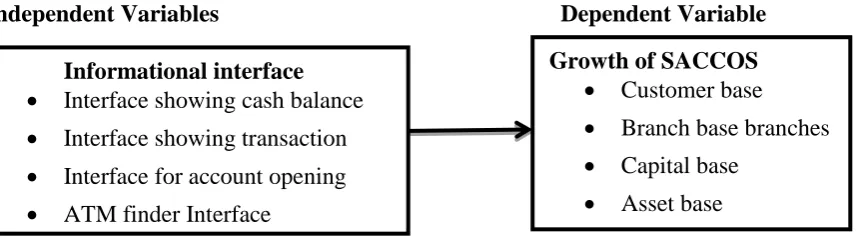
The conceptual framework is the mental picture of the relationship between the independent variables and dependent variable (Oseno, 2012). The framework is presented in Figure 1
Independent Variables Dependent Variable
Figure 2.1 Conceptual Framework
Figure-1
3.3 Empirical Review
According to Amin, (2007), Mobile Operators have a unique advantageous position, as they are the first-point of contact with the customers. They also tap the growing subscriber base with new offerings providing consumers a strong value proposition. Thus, MNOs should be looking at M-banking as an important source of revenue (Cheney, 2008). As the core competence of the mobile operator’s lies in delivering mobility solutions to their customers, it is prudent for them to partner with a financial institution in order to gain access to credit facilities, credit payment management and other financial services. However, with banks not being able to reach the unbanked, who represent half of the world’s population, with their traditional distribution channels of braches and ATMs, mobile phone operators are taking full advantage of that gap and are penetrating to the un-served market (Hayat 2009). With more than 4 billion mobile subscriptions in the world today; according to Wireless Intelligence this deep reach of mobile is a potential launch pad for a considerable commercial opportunity of up to US$7.8 billion in direct and indirect revenues by 2012 (Pickens, 2009). The success of mobile payment and mobile banking systems, such as M-PESA in Kenya, has exceeded expectations, with greater numbers of formal financial sector actors taking notice. Cash transactions, account opening and other transactions can be conducted online. This makes it easy to subscribe and accounts for the high customer concurrence of 91%. Ultimately transformational banking boosts access to formal finance particularly, in rural areas where many poor people live. Of the total 876 branches operated by financial institutions in Kenya 314 are in Nairobi. M-banking has opened a different access door for the unbanked. According to the Central Bank of Kenya (CBK), M-PESA Kenya‘s leading mobile payment system offered by Safaricom may have already made an impact on the formal financial sector, given the increase in formal bank accounts during the period M-PESA has been operational. At the end of 2005, there were 2.6 million formal bank accounts, but by the end of 2008 that number had increased almost 150 percent to 6.4 million accounts. There are over 7,000 M-PESA agents2. Substantially more points of service than the combined number of bank branches (887) and automatic teller machines (1,435).3. In the country serving 6 million customers or 15.3% of Kenya‘s population of 39 million4. The monthly value of person-to-person money transfers as of the end of February 2009 was KES 14.5 billion (USD 190.3 million), and the cumulative value of these money transfers since launch in March 2007 of the service is KES 118 billion (USD 1.5 billion). Safaricom‘s CFO asserted in a June 2008 interview that Safaricom is the biggest generator of cash in Kenya, with the exception of the government
Informational interface Interface showing cash balance
Interface showing transaction
Interface for account opening
ATM finder Interface
Interface showing transaction
Interface for account opening
ATM finder Interface
Growth of SACCOS Customer base
Branch base branches
Capital base
Asset base
Growth of SACCOS Customer base
Branch base branches
Capital base
250
International Journal of Science and Business
Email: [email protected] Website: ijsab.comPublished By
(Hayat 2009). The study further identified the fact that 32.7 percent are financially excluded, though it was a decrease from 38.4 percent in 2006.
The study further notes that almost half (47.5percent) of all Kenyan adults own a mobile phone (up from 26.9 percent in 2006), with the rate of ownership rising to 72.8 percent in urban areas (up from 52.3 percent in 2006) and 80.4 percent in Nairobi (up from 63 percent in 2006). (Kenya, 2009) Further, 52 percent received money in 2009 compared to 16.5 percent in 2006. However, international remittances are still low, but 4.3 percent claimed to have received money in 2009, up from 2.8 percent in 2006.The most popular means of money transfer being M-PESA, now used by 39.9 percent of all adults in Kenya. Twenty six percent of all M-PESA users also save money on their phones. One in six users, store value in their phone for use while travelling; M-PESA is perceived as the least risky by 26.2 percent of respondents, least expensive (31.7 percent), fastest (64.3 percent), easiest to get (47.8 percent) means of money transfer (GoK, 2009).
4 Research Methodology
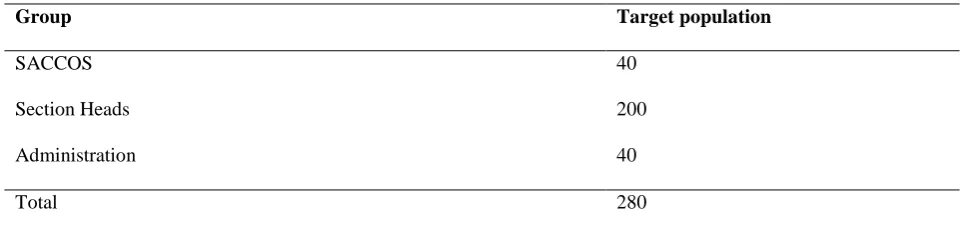
This study employed a descriptive survey research design. Bhattacherjee (2012) defined descriptive research design as a detailed plan for collecting data in an empirical research project with the view of answering research project with the aim of answering research question or testing specific objectives. This research employed mixed paradigm approach that is both qualitative and quantitative methods. Lieber and Weisner (2010) argue that mixed methods approach encourages the use of multiple world view by combining qualitative and quantitative methods which helps to answer questions and provide more comprehensive evidence in number and words for studying research problems than either quantitative or qualitative. A population is any group of institutions, people or objects that have at least one characteristic in common (Ogula, 2005). The accessible populations were staff at SACCOs located within Nairobi County in Kenya. According to SASRA (2011) in their SACCO supervision report for the years 2010 indicate that out of the 3280 active SACCOs in the country, 1371 (42%) are located in Nairobi. Out of the 1371 SACCOs only 40 of them are licensed deposit taking SACCOs (SASRA, 2017), therefore the target population were 40 registered licensed deposit taking SACCOs in Nairobi County, Kenya. The target population is presented in table 1
Table 1 Target population
Group Target population
SACCOS Section Heads Administration
40 200 40
251
International Journal of Science and Business
Email: [email protected] Website: ijsab.comPublished By
The first step in stratified sampling is to divide the population into subgroups (strata) based on mutually exclusive criteria. Random or systematic samples are then taken from each subgroup. The study then used simple random sampling to select SACCOs and individual respondents using lottery method. This is most popular method and simplest method. In this method all the items of the universe are numbered on separate slips of paper of same size, shape and color. They are folded and mixed up in a drum or a box or a container. A blindfold selection is made until the desired respondents are obtained.
To obtain the sample size the study used Krejcie and Morgan, (1970) to calculate the sample size of the study. The Krejcie and Morgan's sample size calculation is based on p=0.05 where the probability of committing type I error is less than 5 % or p <0.05.
S=X2NP (1-P)/d2 (N—])+X2 P(1—P)
where,
s=required sample size.
X2 =the table value of chi-square for 1 degree of freedom at the desired confidence
level(0.05 = 3.841).
N=the population size.
P=the population proportion (assumed to be 0.50 since this would provide the maximum sample size.
d=the degree of accuracy expressed as proportion (0.05).
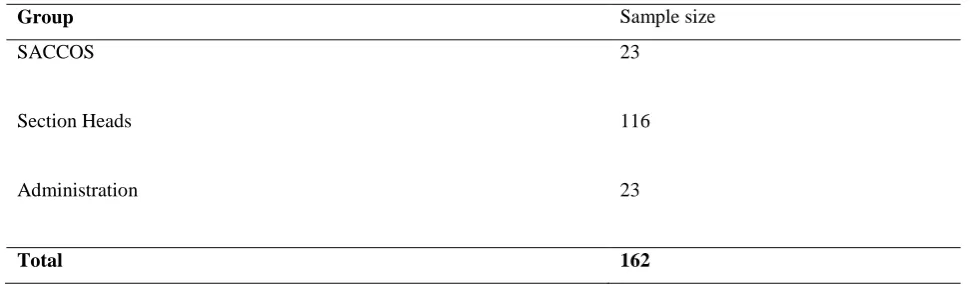
The target population is 40 SACCOs, using the table the sample size of the study is 23 SACCOs. From each SACCOs the study choose section heads (5) and managers (1) to get a sample of 116 section heads and 23 managers. Table 2 shows the distribution of the study sample
Table 2 Sample and Sampling Technique
Group Sample size
SACCOS
Section Heads
Administration
23
116
23
Total 162
252
International Journal of Science and Business
Email: [email protected] Website: ijsab.comPublished By
In this study the researcher discussed the items in the questionnaires with the supervisors, lecturers from the department and colleagues. The advice and critics given helped the researcher determine the validity of the research instruments. An instrument is viewed as reliable when it can measure a variable accurately and reliably and get similar outcomes under similar conditions. An instrument is reliable if it provides consistent results (Kothari, 2011) and whether the procedure is stable over a given period. The reliability of the questionnaire was tested using the Cronbach’s Alpha correlation coefficient with the aid of SPSS software. According Lim, Liong, Khan, & Yuen, 2017) Cronbach Alpha value greater than 0.7 is regarded as satisfactory for reliability assessment. The study Cronbach Alpha value was 0.760 and therefore the questionnaires were reliable.Data analysis refers to the application of reasoning to understand the data that has been gathered with the aim of determining consistent patterns and summarizing the relevant details revealed in the investigation (Zikmund, et al, 2010).According to Miles, Huberman, and Saldana, (2013) the process of analyzing data involves the sorting of collected data into themes and inspection of the data in relation to the research objectives. The presentation of information refers to methods for organizing information to make it clear. Upon the completion of data collection the completed questionnaires were assembled, edited for completeness and consistency, coded and interpreted in relation to the objectives of the research study. The respective questionnaires were assigned numerical scales and analysis of data was done. Data analysis was done with the help (SPSS) version 20. Descriptive statistics was used to analyze qualitative data by use of frequencies and percentages. The study also used inferential statistics which include regression analysis; to test the relationship between the independent variable and the dependent variable. Analyzed data was presented as frequencies with their corresponding frequencies. Both the qualitative and the quantitative data were analyzed by obtaining information from the questionnaires.
The model below was used in the study: Multiple Regression model Y= β0+ β1x1+ β2x2+ β3x3+
Y= Growth of Savings and Credit Cooperative Societies β= Constant
β1,β2and β3= Coefficients of independent variable x1, x2 & x3= Informational interface
= Error term
5. Results and Discussion
5.1 Effect of Informational Interface of Mobile Applications on Growth of SACCOs
253
International Journal of Science and Business
Email: [email protected] Website: ijsab.comPublished By
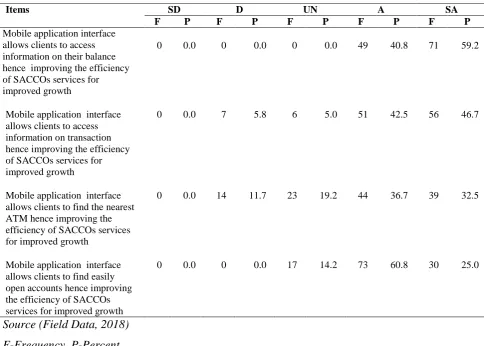
Table 3 Informational Interface of Mobile application and Growth of SACCOs
Source (Field Data, 2018)
F-Frequency, P-Percent,
SD-strongly disagree, D-disagree, UN-Neither agree not disagree, A-agreed, SA-strongly agree
In reference to Table 4.2, 49(40.8%) of respondents agreed that mobile application interface allows clients to access information on their balance hence improving the efficiency of SACCOs services for improved growth, 71(59.2%). The results shows that most of the respondents strongly agreed that mobile application interface allows clients to access information on their balance hence improving the efficiency of SACCO services for improved growth. This implied that mobile interface ensures that clients to access information on their balance quickly and effectively thus they view the SACCOs as efficient and would want to continue being loyal to the SACCO. This in the long run improves the growth of SACCOs in Nairobi County. Similarly, 51(42.5%) respondents agreed that mobile application interface allows clients to access information on transaction hence improving the efficiency of SACCOs services for improved growth, 56(46.7%) strongly agreed while only 7(5.8%) disagreed. The results shows that majority of the respondents strongly agreed that mobile application interface allows clients to access information on transaction hence improving the efficiency of SACCOs services for improved growth. This implies that customers are able to access their transaction using their mobile phones at any place or time. This ensures that they continue being loyal to their specific SACCOs and hence improving the growth of the specific SACCOs.
Items SD D UN A SA
F P F P F P F P F P
Mobile application interface allows clients to access information on their balance hence improving the efficiency of SACCOs services for improved growth
0 0.0 0 0.0 0 0.0 49 40.8 71 59.2
Mobile application interface allows clients to access information on transaction hence improving the efficiency of SACCOs services for improved growth
0 0.0 7 5.8 6 5.0 51 42.5 56 46.7
Mobile application interface allows clients to find the nearest ATM hence improving the efficiency of SACCOs services for improved growth
0 0.0 14 11.7 23 19.2 44 36.7 39 32.5
Mobile application interface allows clients to find easily open accounts hence improving the efficiency of SACCOs services for improved growth
254
International Journal of Science and Business
Email: [email protected] Website: ijsab.comPublished By
The statement that mobile application interface allows clients to find the nearest ATM hence improving the efficiency of SACCOs services for improved growth was rated agreed by 44(36.7%) respondents while 14(11.7%) disagreed. The results therefore showed that most of the respondents agreed that mobile applications allow them to find the nearest ATM which makes it easy for them to transact. Such interface is very instrumental in improving the growth of SACCOs in Nairobi County because it easy the process of transactions. Moreover table 4.4 shows that 73(60.8%) agreed that mobile application interface allows clients to find easily open accounts hence improving the efficiency of SACCOs services for improved growth, 30(25.0%) strongly agreed. This shows that majority of the respondents agreed that mobile application interface allows clients to find easily open accounts. This implies that with the adoption of mobile application technology comes the advantage of opening account easily in the specific SACCOs. In a nutshell the findings as shown in table 4.4 shows that majority of the respondents strongly agreed that Mobile application interface allows clients to access information on their balance and allows clients to access information on transaction hence improving the efficiency of SACCO services for improved growth. They further agreed that mobile application interface allows clients to find the nearest ATM hence and allows clients to easily open accounts hence improving the efficiency of SACCO services for improved growth. The results of the present study tallied with the findings in a study conducted by Amin, (2007), where it was discovered that mobile operators have a unique advantageous position, as they are the first-point of contact with the customers and offer informational platforms. Theoretical the findings relates to Rogers' Diffusion of innovation Theory (Rogers, 1995). The theory explains how a new financial innovation is accepted and proposes are five features of an innovation that affect acceptance: complexity, compatibility, testability, observability and relative advantage. Complying with these five aspects makes it easy for SACCOs to adopt mobile technology. The finding shows that SACCOs have adopted mobile application technology for the past 5 years. Therefore interfaces such as informational interface has been adopt in these SACCOs for quite a while and have played part in improving the growth of SACCOs
5.2 Simple linear Regression analysis
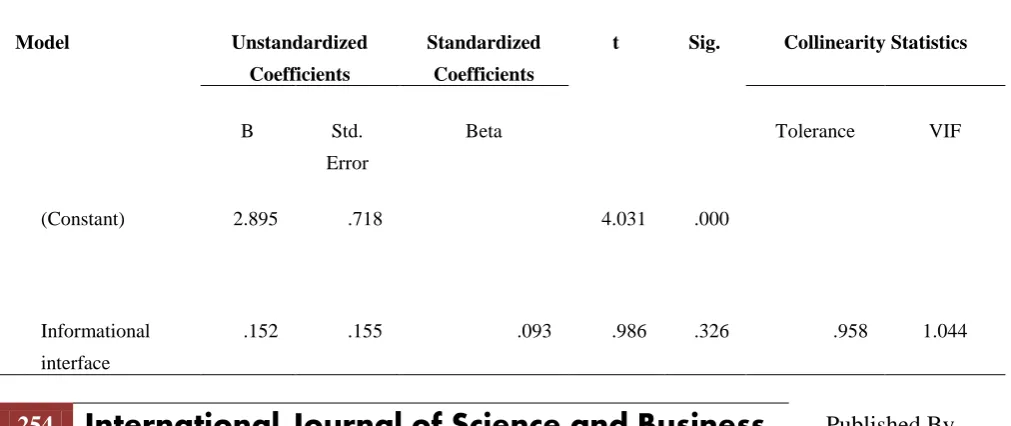
The study also conducted regression analysis to test the hypotheses of the study. The results are presented in table 4
Table 4 Regression between Continuance and employee commitment
Model Unstandardized
Coefficients
Standardized
Coefficients
t Sig. Collinearity Statistics
B Std. Error
Beta Tolerance VIF
(Constant) 2.895 .718 4.031 .000
Informational interface
255
International Journal of Science and Business
Email: [email protected] Website: ijsab.comPublished By
Dependent Variable: Growth of SACCOS
Table 4.8 shows the sign for the four variables. This tests whether the unstandardized (or standardized) coefficients are equal to 0 (zero) in the population. If p<0.05, you can conclude that the coefficients are statistically significantly different to 0 (zero). From the findings in table 4.8 above, at 5% level of significance, informational interface was not a significant predictor of growth of SACCOS (P-value=0.326>0.05.Interpretatively, the model indicates that, holding the selected predictor variables constant, the growth of SACCOs would be 2.895 units. This explains that, without the influence of mobile application technology the growth of SACCO index would be 2.895 units. Moreover the model shows that a unit increase use of informational interface leads would result to 0.152 times increase in the growth of SACCOs. This implies that an increase for example in efficiency and use of informational interface leads to an increase in growth of SACCOs. It can therefore be inferred that growth of SACCOS is associated by use of informational interface of mobile application technology. Similarly Ogweno, Oteyo, & Collins, (2014) found out that SACCO clients are able to receive the banking information promptly with adoption of mobile application technology hence the clientele of SACCOs have grown.
6. Conclusions and Recommendations
The study concluded that mobile application provides an interface that allowed the SACCO clients to access information on their balance without necessarily visiting the SACCO physically. It allowed that clients access information on transaction which improved the efficiency of SACCO’s services. They study further concluded that mobile application provides an interface that allowed clients to find the nearest ATM and allowed clients to easily open accounts hence improving the efficiency of SACCOs services for improved growth.. Moreover from regression analysis the study concluded that growth of SACCOS is affected by informational interface of mobile application technology (β1=+0.152).
The study recommended that it is imperative for SACCO management to intensify investment in ICT products to facilitate speed, convenience, and accurate services, or otherwise lose out to their competitors. There is also need to understand the changes that technology is causing on the financial sector in order to examine in detail how the recent and foreseeable advances in technology can affect its future evolution.
7.
Limitations
256
International Journal of Science and Business
Email: [email protected] Website: ijsab.comPublished By
REFERENCES
Adewoye, J. O (2013) Impact of Mobile Banking on Service Delivery in the Nigerian Commercial Banks. International Review of Management & Business Research, (2)2, 1-12
Bhattacherjee, A. (2012). Social science research: Principles, methods, and practices.
Dembyness R. and Thegeya C., (2012).Kenya’s Mobile Revolution & the Promise of Mobile Savings.The World Bank – Africa Region.
Dembyness R. and Thegeya C., (2012).Kenya’s Mobile Revolution & the Promise of Mobile Savings.The World Bank – Africa Region.
Jeong, B. & Yoon, T.E. (2013).An empirical investigation on consumer acceptance of mobile banking services, Business and Management Research, 2 (1), pp. 31-40.
Krejcie, R. V., & Morgan, D. W. (1970). Determining sample size for research
activities. Educational and psychological measurement, 30(3), 607-610.
Lieber, E. &Weisner, T. S. 2010. Meeting the practical challenges of mixed methods research.Tashakkori, A. &Teddlie, C. (eds). SAGE h &book of mixed methods in social & behavioral research. (2nded). Thous& Oaks, CA: Sage, 559-579.
Lim, R., Liong, M. L., Khan, N. A. K., & Yuen, K. H. (2017).Validity and reliability of the Golombok
Rust Inventory of Sexual Satisfaction in couples with incontinent partners. Journal of
sex & marital therapy, 43(2), 142-146.
Michaels L. (2011). It’s Better Than Cash: Kenya Mobile Money Market Assessment Accenture Development Partnerships.
Miles, M. B., Huberman, A. M., & Saldana, J. (2013). Qualitative data analysis.Sage.
Mlot S. (2012). Info graphic: Mobile Use in Developing Nations.
Mochere P.M, Osoro K., Nyagol M.,&Odoyo F., (2016) Influence Of Information Technology In Enhancement Of Sustainable Competitive Advantage Of Saccos In Kisii County Journal Of Humanities & Social Science, (21) 3,103-117.
Muchangi M.D, Muathe S., &Waithaka S.T (2017) Moderating Effect of Government Policies on the Relationship between Mobile application technology Services & Performance of Deposit-Taking Saccos in Kenya International Journal of Scientific Engineering & Technology, 6(2), 71-74.
Njenga S.M., Kiragu D.N., & Humphrey O.O. (2015) Influence of financial innovations on financial performance of savings & credit co-operative societies in Nyeri county Kenya
257
International Journal of Science and Business
Email: [email protected] Website: ijsab.comPublished By
Nyaga H.J., (2012).Cooperatives as potential channel for enhancing financial inclusion. Duringthe financial innovation and Access forum.Abuja,Nigeria.
OECD (2007) Innovation & growth rationale for an innovation strategy
Ogweno K.,L., Oteyo E.O,&Ondiek A.C., (2014) The Effect of Integrating Mobile application technologyin Micro Finance Institutions. Case of Small & Micro-Enterprise Program (SMEP) In Kisumu County Journal of Business & Management, (16)7, 27-37
Oseno Ben (2012), Conceptual framework, Apic Publishers, Nairobi Kenya.
SASRA (2017) the SACCO society’s regulatory authority SACCO societies act (cap 490b, laws of Kenya): list of SACCO societies licenced to undertake deposit- taking SACCO business in Kenya.
Yu, M. (2013).Operational Efficiency in Taiwan Banks with Consideration of Nonperforming Loans: A dynamic Network DEA, Workshop on DNDEA, PP 106–8677
Zikmund, G.W., Babin, B.J., Carr,C.J. & Griffin, M.(2010). Business Research Methods ( 8thed). South-Western, Cengage Learning.
Cite this article:
Jerop, E., Paul, S. N., & Tobias, M. (2018). Effect of Informational Interface of Mobile Application Technology on the Growth of SACCOS in Nairobi County, Kenya. International
Journal of Science and Business,2(2), 246-257. doi: https://doi.org/10.5281/zenodo.1253715
Retrieved from http://ijsab.com/wp-content/uploads/232.pdf