Mode Choice Models Transferability
Amir Reza Mamdoohi1, Seyedehsan Seyedabrishami2, Amirhosein Baghestani3
Received: 10.11.2013 Accepted; 12.04.2014
Abstract:
Transportation models as tools for transportation planning are critical to such related decisions. Considering the high cost of calibrating and validating such models, effective alternatives are highly sought for; one such alternative being the use of models calibrated for other cities. This calls for transferability analysis which has not been the subject of many researches. Due to criticality of aggregate and disaggregate data in transportation models, this paper tries to compare transferability of models calibrated with data of both groups. Mode choice models for daily work trips in two real-sized cities of Qazvin and Shiraz are analyzed. Models are calibrated employing multinomial logit structure with four modes of private car, taxi, bus, and 2-wheelers. In order to increase reliability of results, the top five best models are selected for each city-data category to be transferred. Based on transferability test statistics, transfer index, and goodness-of-fit of transfer models, aggregate models are not transferable and their results are deceptive. Transferabil-ity measures of these models are not in acceptable range; whereas transferabilTransferabil-ity of disaggregate models have relative proper response. According to transfer index and goodness-of-fit of origin models operate similar to destination mod-els. However transferability test statistics rejects the assumption of equality coefficients in both cities modmod-els. Using personal variables helps to effectively transfer origin models in addition to improve them.
Keywords:
Transferability, mode choice models, aggregate, disaggregate.��������
Corresponding author Email:[email protected]
1-Assistant Professor, Department of Civil and Environmental Engineering, Tarbiat Modares University, Tehran, Iran 2-Department of Civil and Environmental Engineering, Tarbiat Modares University, Tehran, Iran
1. Introduction
Since transportation planning studies are very costly, particularly due to high cost of data collection for mod-eling calibration and validation, model transferability could be a potential alternative [Ortuzar & Willumsen, 2002]. The ability to transfer models from one city to another can help in significant cost and time savings for cities that cannot afford to invest in extensive data-collection procedures. Oftentimes, the cost of collect-ing data through these surveys is so high that it could easily exceed the annual budget of a planning organi-zation responsible for this task [Wilmot and Stopher, 2001]. Also, observing transferability of a model could provide a direct indication of model validity.
Transferability as a tool for predicting travel demand for a certain city using a model developed for another city; is a complex issue since some models are not trans-ferable and some are poorly transtrans-ferable. For instance, models that are dependent on the regional properties or geographical features (like aggregate models) are such models [Ou & Yu, 1982]. On the other hand, since be-havioral models structure is based on causal relation-ships; the results may not be so different in regions of similar economical and social conditions.
According to literature review, model transferability is studied in four different levels. The firs level discusses the transferability of broad behavioral postulates. The second level is for mathematical model class ability. In the third level, specific model form transfer-ability is studied. In the fourth level and the most precise one, which is also the focus of this paper, the model is transferred keeping all coefficients [Sikder et.al, 2011]. Watson and Westin studied spatial transferability of binary logit intercity mode choice models among dif-ferent subareas in the Edinburgh-Glasgow area of Scot-land. Models estimated in the six travel corridors were then compared for similarity in model coefficients, and each was also transferred to the other five corridors to evaluate modal split predictions. Their findings indicate that there is a high level of model transferability be-tween the three models estimated in the corridors with a trip-end in the central city. However, this is not the case for the models estimated in the remaining three corridors that did not have a trip-end in the central city [NCHRP, 2012].
Galbraith and Hensher emphasized the need to consider both level-of-service variables as well as a reasonably extensive set of socioeconomic characteristic in mode choice models before evaluating transferability. They also identified the need to use consistent data (sampling procedures and variable definitions) in the estimation and application contexts.
Their empirical analysis of the spatial transferability of disaggregate mode choice models involved examining the intra-urban transferability of commute binary mode choice coefficients from two suburban areas in Sydney. Results indicated that the model with lowest goodness of fit values in origin performed best in term of transfer-ability measures which are transfertransfer-ability test statistic and goodness-of-fit of transferred model [Galbraith and Hensher, 1982].
Karasmaa explored the spatial transferability of work trip mode choice models in the Helsinki and Turku re-gions of Finland.
The Helsinki region was used as the estimation con-text, and the Turku as the transfer context. Variant mea-sure like transfer index, transferability test statistic, relative sample enumeration error were used to study transferability Also different methods were evaluated for updating the transferred model for making more accordance of results with destination city. The trans-fer procedures examined were the Bayesian updating, combined transfer estimation, transfer scaling, and joint context estimation. The results showed that the joint context estimation was generally the best method [Ka-rasmaa, 2003].
Various researches have been done on model transfer-ability for different model types (aggregate & disag-gregate) and models of different stages of transporta-tion planning. Results show that still no consistent and robust effect of model type on transferability has been detected, which makes this field worth of research. This paper makes a comparison between aggregate and disaggregate mode choice models’ transferability of ur-ban work trips, keeping all coefficients. While a few studies have been done in Iran, limited to trip genera-tion step, this paper tries to compare transferability of aggregate and disaggregate models to approach the is-sue from a different point of view. Criteria of studying transferability are introduced in second part. The case study methodology is described in the third section. The last part includes conclusions and suggestions.
2. Methodology
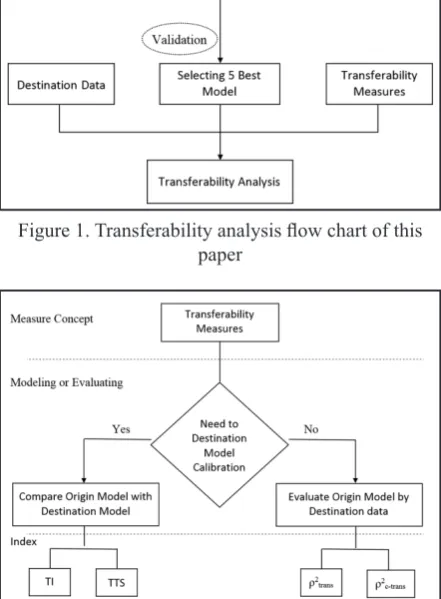
Mode choice transferability procedure conducted in this paper follows that shown in figure 1. In order to in-crease reliability of results and be able to analyze more detailed results, a set of five different best models are selected for each category to be transferred. The five best models calibrated for the origin city are selected based on different indices such as goodness of fit index and variable significance to be applied for the destina-tion city. Models of each city are used for another city and the results are compared to latter city’s own model results. Various indices are defined for evaluating mod-el transferability that are classified in 2 groups in the case of operation mode.
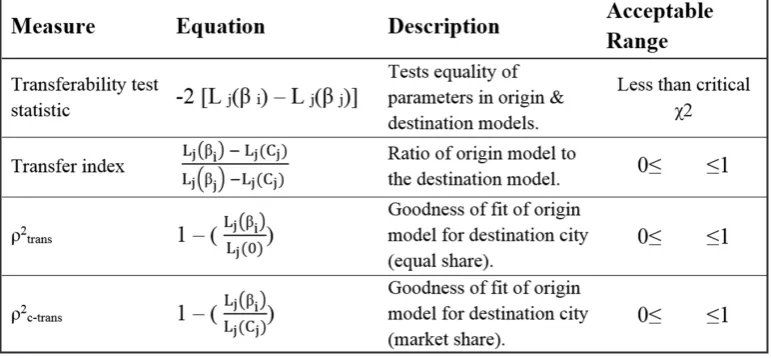
Transferability measures are classified by their need to destination model calibration which is time and effort consuming. However their application provides a much better perspective of transferability analysis as shown in figure 2. Factors of the first group compare the trans-ferred model to the destination city model. For this purpose, first a similar structure of origin model should be developed in destination; so two models which are similar in structure and different in coefficients are compared and the main goal is measuring error of us-ing each model for another city. Factors of the second group asses the transferred model based on its predic-tions of the destination city’s data; so destination model calibration is not required.
Figure 1. Transferability analysis flow chart of this paper
Figure 2. A classification of transferability measures at different levels
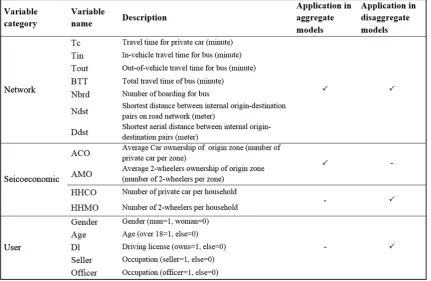
Some of the first group indices are transferability test statistic (TTS) and transfer index (TI) which operate based on the origin model’s ability in describing des-tination city’s observations and likelihood function. The main comparison of these indices is the difference between log-likelihood function of models which one is developped in origin city i and used in destination city j (Lj(β i)) and another is developped and used in destination city j (L j(β j)). Transferability test’s statsti-cal equation that is defined by Atherton and Ben-Akiva is shown in Table 1[Ortuzar & Willumsen, 2002]. The critical value of chi square is used in order to check to models’ parameters matching.
evaluating likelihood logarithm’s acuurance based on a reference model (such as market share model). Lj(Cj) is observations’ likelihood logarithm in the destination city of j which is defined based on market shares model (Table 1) [Koppelman & Wilmot, 1982].
It is expected that Lj(βj) is more than Lj(βi) and Lj(βi) will be more than Lj(Cj). The maximum value of trans-fer index is one, which means origin and destination models operate similarly. There is no minimum value for this index. Negative value of TI means the origin model is weaker than a base model and results will be deceptive and worse than model-less situation.
The second group of transferability indices indicates the origin model’s ability to explain the destination’s trip behavior. Some of these parameters are ρ2
trans and ρ2c-trans
[Galbraith and Hensher, 1982]. Lj(0) in their equations is observation likelihood logarithm in the destination city of j while all model parameters are zero.
3. Modeling and Transferability Analysis
Transferability analysis requires data for both origin and destination cities, and calibration of at least origin city models (for calculation ρ2trans and ρ2c-trans, destination
city model in else required). Due to criticality of ag-gregate and disagag-gregate data in transportation models, both are addressed in this paper.
One purpose of this paper is to analytically implement the theoretical methodology (explained in Section 2) in an empirical context to examine the correspond-ing challenges for real-sized cities in Iran. Since the required detailed data (for the implementation of the methodology for two real-sized cities) is not very read-ily available, two (rather different) cities were selected to study model transferability challenges. The case study includes daily urban work trips of Shiraz and Qa-zvin cities, whose general characteristics are presented in Table 2.
Table 1. Measures used to assess model transferability
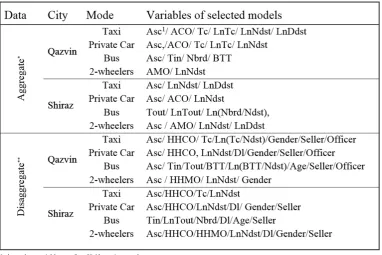
All models (aggregate and disaggregate) are developed as multinomial logit models with four modes of taxi, private car, bus, and 2-wheelers. Since the main goal is using a city’s model for another one, required data for all variables must be available in both cities. Aggregate models’ variables are mostly network properties such as different modes’ travel time, and ground and aerial dis-tance between origin-destination. The only socioeco-nomic variable is vehicle ownership (private cars and 2-wheelers). Beside these variables, age, gender, job, and driving license owning are also used in disaggre-gate models. Table 3 illustrates description of model’s variables.
Developing aggregate models requires that all trips with the same origin and destination zones be aggregat-ed and mode choice shares of origin-destination be cal-culated. Dependent (response) variables in such models are shares on a continuous interval from zero to one [0, 1]. In the disaggregate models, however the dependent (response) variables are each person’s decision to make their trip by respective modes (or not); hence zero or one discrete values {0, 1} for each observation. Good-ness of fit is approximately equivalent in all selected models for each city (5 models) and the difference
de-pends on utilized variables and their significance. Table 4 shows the set variables of selected model in details of mode and city.
Comparing model results in 2 levels indicates that dis-aggregate models are better than dis-aggregate ones (The average ρ2
c for aggregate models of Qazvin and Shiraz are 0.03 and 0.04 whereas for dissaggregate models are 0.29 and 0.33). Using personal information is the most important reason of this. In order to studying transfer-ability in the most precise level, first we need to develop models with similar structures in destination (develop-ing origin model with destination data).
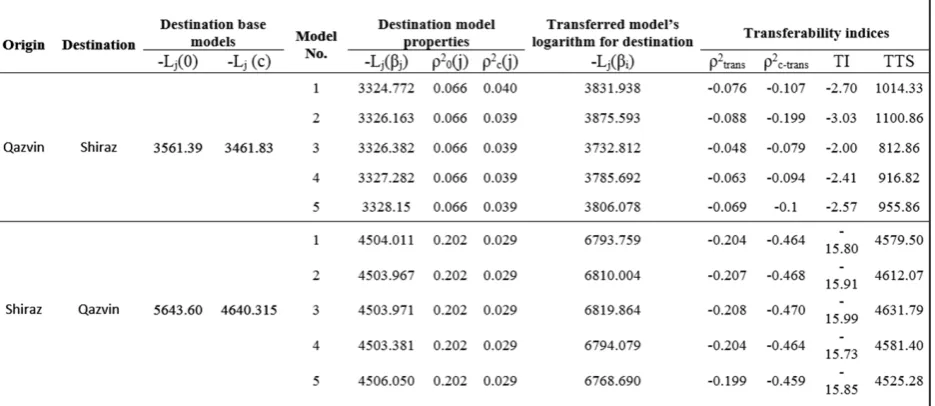
After determining model coefficients using origin data, the model is developed using destination data to de-termine new coefficients. In order to figuring transfer-ability indices, destination city’s likelihood logarithm should be calculated based on origin’s model. There-fore, origin model is applied to destination city’s data keeping all coefficients and variables. Destination model’s properties (under origin structure), transferred model’s logarithm for destination’s data, and finally transferability indices for aggregate and disaggregate models are shown in table 5 and table 6 respectively.
As shown in table 5, log-likelihood of transferred mod-els from Qazvin to Shiraz is even lower than Shiraz’s base models which indicates the transferred model’s weakness. Negative goodness of fit values show the fact that Qazvin’s models do not fit to Shiraz’s data. Moreover, transfer index is negative too which means the transferred model’s results are deceptive. Greater transferability test statistic than critical chi square at level of 95%, rejects the primary assumption of equal coefficients in both models. The total results show that Qazvin’s models are not transferable to Shiraz.
Table 5 indicates that aggregate models’ transferability from Shiraz to Qazvin is not possible either. Negative transfer index indicates weaker transferred model com-pared with market share model; so, Shiraz’s model’s results for Qazvin are deceptive and using this model is worse than no-model situation. ρ2
trans is calculated as %3
and ρ2
trans is negative (as expected) that shows low fitness of Shiraz’s model for Qazvin’s data. Therefore, Shiraz’s model is not suitable for mode choice behavior in Qa-zvin. Greater transferability test statistic comparing to critical value of chi square ignores primary assumption of equal coefficients in both models. Generally, based on investigation of this study, aggregate models are not transferable and their results are deceptive.
Transferability analysis and calculations of Qazvin’s disaggregate model to Shiraz for chosen models are shown in Table 6. ρ2
c-trans range from 0.18 to 0.22 with
an average of 0.20 for transferring Qazvin’s 5 models to Shiraz that are acceptable. Transfer index with a mean of 0.65 suggests a rather acceptable transferable model. However, transferability test statistic rejects the primary assumption of equal coefficients in both cities’ models. According to table 6, transferring Shiraz’s disaggregate models to Qazvin is acceptable too. Shiraz’s transferred models with average values of 0.35 and 0.22 for ρ2
trans
and ρ2
c-trans respectively, not as well as Qazvin’s own
models, could be a proper alternative for describing Qazvin’s travelling behavior. The average value of TI for Shiraz’s models is 0.68 that is more than previous case (transferring Qazvin’s model to Shiraz). Moreover, TTS is greater than chi square.
It is obvious that studied disaggregate models transfer-ability, unlike aggregate models, is not rejected; how-ever, they perform relatively well. According to all in-dices, exept of transferability test statistic, transferred model operates similar to destination’s model. Bearing in mind that it seems unlikely for transferability test statistic’s primary assumption not to be rejected. Using personal variables helps to effectively transfer origin Table 4. Set of variables used in the selected mode choice models
models in addition to improvin them. It’s due to using personal variables but regional data (which depends on geographical features) in behavioral modelling. Also, under 18 years olds are not able to choose private pas-senger car regardless of in which city they are. Results show that some user behavorial variables improves transferability. Another noteworthy point is that de-scriptive staticstics of these variables for Qazvin and Shiraz are closed. Similarity of driving lisence owner-ship, officers and sellers, and over 18 years olds’ shraes are some of effective parameters on these city’s models transferability.
4. Conclusions and Recommendations
Transportation model transferabilty as a simple andcheap alternative to traditional costly transportation planning studies has been a popular research subject. This paper tried to compare spatial transferability of mode choice models at two different data types, namely aggregate and disaggregate for real-sized cities. Trans-ferability is studied in its (at least currently) most pre-sice level of model structure and coefficients. Aggre-gate and disaggreAggre-gate models (5 for each group) were developed using OD data of daily work trips for Qazvin and Shiraz cities as case studies. Table 7 indicates ac-ceptability of mode choice models transferability for both types of aggregate and disaggregate models of the case cities of this reseach. The tick sign (√) shows that transferability is acceptable based on the correspond-ing measures. Results of various transferabilty indices
Table 5. Transferability measures for aggregate mode choice models
(transferability test statistics, transfer index, and good-ness-of-fit) show that aggregate models are generally not transferable while it is possible to transfer disaggre-gate ones with relatively good performance.Goodness of fit values are negative for aggregate models in both cities which indicates inappropriacy of teransferred models. In addition, transfer index shows low fitness of transferred models because of negativity of values. Greater value of transferability test statistics compared with critical chi square also rejects the assumption of equal coefficients of two models (Table 8).
Based on the first two measures (goodness of fit and transfer index), Qazvin disaggregate models were trans-ferable to Shiraz, and vice versa. However, this was not true based on the third (transferability test statis-tic) measure (Table 8). Transferability of disaggregate models (as compared with aggregate ones) could be at-tributed to personal variables improving origin models in the former models. Moreover, it could be attributed to similar descriptive statistics of these models.
Considering the fact that not many studies have been conducted in this field, particulaly in Iran, many sug-gestions could be made for fututre researches. For ex-ample, research on measures of similarity of cities for a better fit, or on other levels of details of model transfer-ability.
5. Endnote
1- Alternative Specific Constant
6. References
-Galbraith, R. A. & Hensher, D. A. (1982) “Intra-met-ropolitan transferabilityof mode choice models”, Jour-nal of Transport Economics and Policy, Vol. 16.
- Golob, T. F., Canty, E. T. & Gustafon, R. L. (1972) “Classification of metropolitan areas for the study of new system of arterial transportation”, General Motors Research Laboratories.
Table 7. Transferability* of mode choice models by model type (aggregate vs. disaggregate) **
Table 8. Overall findings of transferability analysis and their interpretation*
*The tick sign (√) shows that transferability is acceptable based on the corresponding measure.
** These results are only valid for case cities of this study and cannot necessarily be generalized to other cities.*
-Karasmaa, N. (2001) “The spatial transferability of the Helsinkimetropolitan area mode choice models”, Pro-ceedings of the 9th WCTR, Seoul.
- Karasmaa. N. (2003), “The Transferability of travel demand models”, Ph.D. disserttation, Helsinki Univer-sity of Technology.
- Koppelman, F. S. and Wilmot, C. G. (1982) “Trans-ferability analysis of disaggregate choice models”. Transportation Research Record No 895, pp.18–24.
- Lawrence, C.& Demetsky, J. (1980) “Transferabil-ity of trip generationmodels”, Transportation Research Record No 751.
- National Cooperative Highway Research Program (NCHRP) Transportation Research Board (2012), Re-port 716.
- Ortuzar , J.de. D. & Willumsen L. (2002), “Modelling transport”, John Wiley & Sons Ltd, Chichester, West Sussex.
- Ou, F. L. & Yu, J. C. (1982) “Effect of urban character
on transferability of demand models”, Transportation Research Record No 874.
- Santoso, D. & Sunokawa, T. K. (2005) “Transferabil-ity and updating ofmode choice model in developing countries”, Transportation Planning and Technology, Vol. 28.
- Santoso, D. & Sunokawa, T. K. (2009) “Economic perspective oftransferability of mode choice models”, Journal of Eastern Asia Society for Transportation Studies, Vol. 8.
- Sikder, S., Pinjari, A., Srinivasan, S. & Nowrouzian, R. (2011) “Spatial transferability of travel forecasting models”, 4th Innovations in Travel Modeling (ITM) Conference, Tampa, Florida.