159
Available online at http://ijdea.srbiau.ac.ir
Int. J. Data Envelopment Analysis (ISSN 2345-458X)
Vol. 1, No. 3, Year 2013 Article ID IJDEA-00134, 7 pages Research Article
A two phases approach for discriminating efficient
candidate by using DEA inspired procedure
M. Zanganea
(a)Member of Iranian Operations Research Society, Tehran, Iran
Received 30 July 2013, Accepted 15 September 2013
ABSTRACT
There are several methods to ranking DMUs in Data Envelopment Analysis (DEA) and candidates in voting system. This paper proposes a new two phases method based on DEA’s concepts. The first phase presents an aspiration rank for each candidate and second phase propose final ranking.
Keywords: Data Envelopment Analysis (DEA), Goal programming, Voting System, Common Set weight (CSW).
1. Introduction:
One of the main important aims in DEA outlook is ranking of DMUs. This aim is process in order to inspect differencebetween efficient DMUs. In DEA literature DMUj is called efficient DMU if and only if its efficiency score is equivalent to 1.
In first time Cooper and et al (1985) introduce simple method to do it and this same year they introduce another method but due to those method aren’t practical we don’t use of them. Sexton and et al (1986) introduce “cross- efficiency” to do it. Anderson & Peterson [1] introduce “AP” Supper efficiency method to do it. Jahanshahlo and et al introduce non redial method JAM, revised JAM, JHF, and LJK and some other method. Tohidi and et al introduce lp (p1, 2,....) norm to ranking DMUs. Before applying this consent in DEA space, Borda in 1781 applied this concept in another template for voting system and candidate space. A problem of interest for over 200 years has to do with the aggregation of votes from preferential ballots. Borda (1781) proposed the "Method of Marks" as a means of deriving a consensus of opinions. This method amounts to determining the average of the ranks assigned by voters to each candidate, with the winning candidate being the one with the lowest average [3]. An equivalent version of this model was later presented by Kendall (1962). Cook and Seiford (1982) have extended the Kendall model using a l2 distance approach. Other distance based models have been advanced by Armstrong et al. (1977), Blin (1976), Cook and Seiford (1978), Cook and Kress (1984), Kemeny and Snell (1962), Cook and Kress (1990), Green, Doyle and Cook
Corresponding author E-mail addresses: [email protected]
[5], Hashimoto [6],Noguchi and et al by” The appropriate total ranking method using DEA for multiple categorized purposes”[7], Obata & Ishii by” A method for discriminating efficient candidates with ranked voting data”[8], Foroughi & Tamiz by” An effective total ranking model for a ranked voting system”[4], Hosseinzade and et al by” An improved method for ranking alternatives in
multiple criteria decision analysis”(2011). Zangane and et al [10] by new frame of mind in voting system introduce “VBC method”. Zangane [9, 11, and 12] apply this concept in Supply Chain. One of main works in selection of the best candidate presented by Contreras [2].
The rest of this paper is organized as follow. The proposed method will introduce in section 2. Section 3 illustrates the proposed method by a numerical example. I conclude this paper in section4.
2. Proposed model
1.2. Preliminary and basic discussion
Let
X
{ ,
x x
1 2,...,
x
r}
is a set of candidates that have been evaluated based on predetermined and sorted criteria asC
{ , ,..., }
c c
1 2c
t by a group of votersV
{ ,
v v
1 2,...,
v
s}
Each voters evaluated each candidate based on all of predetermined and sorted criteria then related to accordance and compatibility this candidate with this criteria that voter gives a mark to this candidate .Definition 1: Normalize matrix M
In voters marking, in order to reducing quality of this voting system, this paper uses of an upper bounded for each criteria, i.e. i, j: 0
ikj Mk . According this definition, this paper introduce normalized matrix M as follow:
ik r t 1 , 1M m i r k t such that ik 1
i
m M
.
The most important role of this normalized matrix is to present, if there exist
1, 2
k k
c c in which
1 2
j j ik ik
then it’s not mean that the worth of these two marks of this criteria are similar.
Definition 2: R.O.A Number and R.O.A Matrix
In this evaluation jth(j1,..., )r voter evaluate ith(i1,..., )N candidate based on kth(k1,..., )t
criteria then corresponding accordance and compatibility this candidate with this criteria assigns a mark like ikjto him, ikj so called R.O.A number, Such that ikj [0,Mk].
And in final of this voting system, all of voters summarized his/her vote in this matrix, this matrix non as R.O.Amatrix (in other word non as . .R O Aj orVj )
j
V
1 2
11 12 1
1
2 21 22 2
1 2
c ct
j j j t j j j t j j j N
Nt N N
c
x x
x
161
M. Zangane, et al /IJDEA Vol.1, No. 3 (2013).159- 165
In this step according definition 1, this paper for final ranking uses of normalized R.O.A matrix that
introduced as follow: Vj
11 12 1
21 22 2
1 2
j j j
t
j j j
t j
j j j
N N Nt
V M
Remark 1: As mentioned later, in this voting system
c k
k
1,...,
t
are sorted that is, in evaluation of candidates they are not equivalent such thatc
1is more important criteria thenc
2thenc
3and etc. Therefore in order to represent this difference between them, we use a vector of weight as1 2 ( , ,..., t)T
such that : 2( 1)
( 1)
k
t k t t
.
By employ this vector on this . .R O Ajmatrix we can obtain final mark for each candidate from point of view jth(j1,..., )r voter. Let Rjis the final vector of markRj Vj Therefore 1
t j ij k k ik
. By employment this vector on all of we will obtain all ofRjtoo and to put side by side this vectors, we constructed very important matrix such that, final ranking induced from this. This matrix is as follow:1 2
1 1 1
1 1 1
11 12 1
1 2
21 22 2 2 2 2
1 1 1
1 2
1 2
1 1 1
t t t
s k k k k k k
k k k
s t t t
s s k k k k k k
k k k
r r rs
t t t
s k rk k rk k rk
k k k
R
Remark 2: It worth noting that The vote of all voters in final evaluation is not equivalent so, for description this difference, this paper use the vector of weight asW(w w1, 2,...,ws)T, but against of the last vector of weight in this stage we permit candidates to get vector of weight corresponding their condition i.e. we permit them arrange the weighs such that provided the best rank for itself and it is cross efficiencies concept exactly.
2.2 Two phases DEA inspired approach
1.2.2 First phase
As mention later, this paper uses two models in two discrete and absolutely depended together in order to represent ranking and introduce winner candidate. This method presents a model for each candidate in this stage accordant his condition in order to perform aspiration rank that, it is shown with p
p
is candidateith’s rank in evaluation candidate p. In this model we use of binary variable iho where 1
o ih
if
x
i strictly dominate xh and iho 0 elsewhere. Model first phase in evolution candidate p is as follow:1 1
min
s.t. M 0, ,
1, ,
1, ,
1 , 1,..., r,
, {0,1}. o
o
s s
o o o
j ij j hj hi
j j
o o
ih hi
o o o
ih hk ki
o o i ih i h o o ih r
w w i h
i h
i h k
r i w
(1)WhereM is a large positive quantity and specifies the plausible conditions for the weights. Set
should contain, at minimum, a set of constraints such that 1 2
1
{ o k, k o 1, o o ... o 0}
j k
j
w w w w w
any additional information about the discrimination between weights associated with rank can be included in set
3.2.2 Second phase
This method design second stage such that is based on first phase’s results in which me want to present final ranking and introduce winner candidate such that this phase’s results to first phase’s results have minimum distance. Therefore this paper use from below model:
1
1 1
min
s.t. M 0, ,
1, ,
1, ,
1 , 1,..., r,
,
, {0,1 r
i i
s s
j ij j hj ih
j j
ih hi
ih hk ki C
i ih
i h
C i
i i i
o o
ih
w w i h
i h
i h k
r i r r w
}. (2)3. Numerical example
To illustrate the proposed model let, one famous factory (so-called v1 ) in order to product notebook need to a workshop to furnish his requirement paper, for this supplier A,B,C,D,E are candidate. This factory sells his production in some emporium (so-called v2 ). v1andv2 evaluate candidate based on
161
M. Zangane, et al /IJDEA Vol.1, No. 3 (2013).159- 165
2- Quality the paper 3- Weight in each
m
2.Therefore in this example our tools and hypothesis is as follow:
1 2 3 4 5 1 2
1 2 3
1 2 3
1 2 3
{ , , , , } { , , , , } { , }
{ , , } {10,12,15}
1 1 1
10 12 15
1 1 1
10 12 15
1 1 1
10 12 15 1 ( , , ) (
ik
T
X x x x x x A B C D E
V v v
Initial used material Quality the paper Weight in
c
C c
c
M M M M
e M ach m
, , )1 1
2 3 6
First voting result is as follow:
1 2
1 2
6 7 6 8 7 7
6 7 4 6 6 8
,
8 7 8 8 9 6
6 7 8 5 9 0
10 9 8 10 10 9
ik ik
V V
Then V1and V2is obtained as follow:
1
V = 1
1.9 1.583 1.266 1.7 1.416 1.133 2.3 1.916 1.533 2.1 1.75 1.8 2.7 2.25 1.8
V M
and V2=V M2 =
2.2 1.833 1.466 2 1.666 1.333 2.3 1.916 1.533 1.4 1.166 0.933 2.9 2.416 1.933
And after empploy 1 2 3
1 1 1
( , , ) ( , , )
2 3 6 T
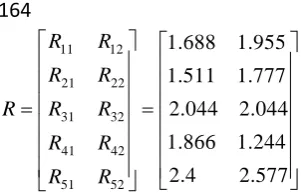
11 12 21 22 31 32 41 42 51 52
1.688 1.955 1.511 1.777 2.044 2.044 1.866 1.244 2.4 2.577
R R
R R
R R R
R R
R R
After runing all of mdeld prelimanary results sumerized in Table 1.
Table 1:
priliminary result
In evaluation sE In evaluation sC In evaluation sA
1
2
3
E C A
s
s
s
1
2
3
E A C
s
s
s
1
2
3
E C A
s
s
s
And in finaly isSE winner candidate.
4. Conclusion
This paper introduce A two phases approach for discriminating efficient candidate by using DEA inspired procedure and do it by using two very important model. The most important part in this paper is second phase in which in order find CSW this paper use MIN-MAX method and provide final ranking by this part.
Acknowledgment
Thanks to Dr. Ghasem Tohidi and Dr. Farahad hossienzadeh due to their useful suggestions in my education time.
Reference
[1] P. Andersen, N.C. Petersen, "A procedure for ranking efficient units in data envelopment analysis", Management Science vol. 39 (10) pp.1261-1294, 1993.
[2] I. Contreras, "A DEA-inspired procedure for the aggregation of preferences," Expert Systems with Applications, vol. 38, pp. 564-570, 2011.
[3] W.D. Cook, M. Kress, "A data envelopment model for aggregating preference rankings”, Management Science vol. 36, pp. 1302-1310, 1990.
[4] A.A. Foroughi, M. Tamiz, "An effective total ranking model for a ranked voting system", Omega vol. 33, pp. 491-496, 2005.
[5] R.H. Green, J.R. Doyle, W.D. Cook, "Preference voting and project ranking using DEA and cross-evaluation". European Journal of Operational Research, vol, 90(3) pp. 461-472, 1996. [6] A.A. Hashimoto, "A ranked voting system using a DEA/AR exclusion model, a note". European
Journal of Operational Research, vol. 97, pp. 600-604, 1997.
161
M. Zangane, et al /IJDEA Vol.1, No. 3 (2013).159- 165
[8] T. Obata, H. Ishii, "A method for discriminating efficient candidates with ranked voting data", European Journal of Operational Research, vol. 151, pp. 233-237, 2003.
[9] Gh.Tohidi, M.Zangane "An application of VBC method in supply chain", 4th national conference on data Envelopment analysis, Iran. 2012
[10] Gh.Tohidi, M.Zangane “Voting and ranking based on criteria (VBC method) ", 4th national conference on data Envelopment analysis, Iran. 2012.
[11] M. Zangane, “A two stage inspired DEA algorithm to select foremost supplier ", 6th international conference on OR, Iran. 2013.