International Journal of Finance and Managerial Accounting, Vol.1, No.4, Winter 2016
55
With Cooperation of Islamic Azad University – UAE Branch
Endowment and Charity Financing Model to
Develop Science and Technology
Mehdi Madanchi
Assistance Professor, Faculty ofe- learning, Islamic Azad University. [email protected]
Shadi Shahverdiani
Assistant Professor, Department of Business Administration, Shahr-e-QodsBranch, Islamic Azad University, Tehran, Iran , (corresponding author)
Fatemeh Hamidifar
Assistance Professor, Faculty ofEducation, Islamic Azad University, Central Tehran
Branch. [email protected]
ABSTRACT
Financing is one of the essential necessitates for science and technology development that many universities have paid attention to it and through establishing financing funds including endowment funds have realized this important issue. So endowment today has played a crucial role in financing and the issue of endowment, benefactors and strategic position of benefactors and donors has been one of the main discourses of Science Ministry in staff and planning area.
Endowment considering religious, cultural and historical characteristics of Iran always has been paid attention from benefactors of this territory. Currently, much of endowments are in the form of constant assets, properties and real estate. Given the changing functions of endowment constant assets and people’s needs over time, in many cases using incomes and benefits of dedicated assets along with benefactor’s initial objectives isn’t possible and it has made them static and blocked. As development of education, particularly in higher education section and performing scientific and applied researches and producing science, in view of increasing development of technology can’t be afforded by government and requires public wide participation. This article investigates necessities of establishing endowment funds, potential limitations of establishing endowment funds and also investigates different grounds for setting up such funds in order to development of education and research and considering different involved issues in this area, pattern of endowment financing as scientific findings have been presented. Research method also is based on library work and mostly study of documents, scientific foundations and analytic background.
Keywords:
1. Introduction
Science and technology requires providing appropriate base for development of education and research to make possible proper expansion of science production process that meanwhile supporting and funding these activities has a particular importance. Funding higher education in order to equip facilities for scientific and applied researches and producing science can’t be afforded totally by government and requires extensive participation of public.
Endowment financing through endowments has been one of the most important and effective ways of participation in this task and other charity and non-profit ones, has long been considered by benefactors of this territory. Much volume of dedicated assets in the form of building education, health and dormitories buildings confirms benefactors’ attention in this regard. And has a long history in our country and by increasing development of technology, change of needs and adding new needs of education and research activities, dedicated assets in the past traditional form aren’t fully responsive of the new demands as traditional way.
An endowment fund is one of the funding procedures through investing dedicated assets. Endowment funds are used regarding education and research affairs extensively throughout the world, particularly in countries that are counted as developed countries and have high ratings for science production among countries of the world. So that in USA funding more than half of public universities budget is made by endowment funds. In our country in the past times financing of development of scientific centers such as Jondi Shapoor university, Rabe Rashidi in Tabriz as knowledge city have been through endowment assets.
In this article irrespective of juridical and legal limitations of endowment funds, merely the positive functions of this financial institution in funding development of science and technology and it is suggested that model of financing through mutual funds charity is among appropriate ways to develop science and technology.
2. Literature Review
Financing is one of the main necessities to develop science and technology and without having adequate resources to investigate, study, and consequently the
production of knowledge and scientific development isn’t possible and has no sense to produce efficient wealth. Along this, the idea of establishing an organization that its asset is devoted to charity purposes there has been long including in Iran and Islamic communities such as Baghdad Nizamiehs and Rabe Rashidi and currently plentiful charity foundations in many countries especially in USA have a great contribution in social and economic tasks. Famous foundations such as Nobel Foundation in Sweden, Ford and Rockefeller in US are among them.
Endowment and endowment foundations of western countries has a fundamental difference with Islamic endowments but in cases that their purpose is resolving public problems, support, encouragement and promotion of knowledge and technique have basic similarities. Hence it is worthy that by recognizing nature and purposes of each others endowments; we utilize mutually each other’s valuable experiences, to the extent that cultural framework allows, in a world that its joint objective is achieving sustainable development.
2.1. Financing
Providing resources to equip and develop and implement universities and research centers objectives is an essential for their survival in order to realize the defined objectives. Financing, is an important issue in financial management that has become on of the most important financial decisions and, in the other words, is treated among key decisions of financial area along investment and profit sharing decisions.
Financing is the process of identification and applying different methods using different tools in various markets and attention to actual capacitates of real and legal persons that result in equipment of financial resources that by optimal and correct expertise the possibility of continuing the institution’s (organization and enterprise) activity is provided.
Endowment financing is among appropriate procedures in the current market which has a distinct complexity because activists of this arena, namely benefactors with a special belief and understanding about endowment intend different objectives that financiers and needy people must consider the issue.
2.2. Endowment
According Persian dictionaries endowment (Vaghf) literally means to stand, hold, stop, lock out and confine a something for someone’s use. In other word, endowment is based on donating a viable and durable property, and alternative use of its benefits and incomes. Waqf developed mainly as an Islamic institution, although Christians and Jew sometimes had a similar type of community/religious endowment (Bonine, 2009).
Articles 55 of civil law define endowment legally and term as: “endowment is confining and original
property and donating its benefits”: Confining must be permanent so that what has been established by benefactor wouldn’t be destructed over time. In the similar way that ownership is a permanent concept unless a legal cause makes its transition to other one, endowment also must has such a sense, whether according new regulations, itself find originality and character (article 3 of organizations and authorities of Endowments and Charity Affairs Organizations, approved in 1984) or according some jurists’ idea is transferred to those for whom it has been donated (Mohaghegh in Sharey and Allameh in Rules and Mohaghegh Sani in Jameo almaghased and Sheykh Mohammad Hasan Najafi in Javaherol Kalam).
2.3. Classification of endowment
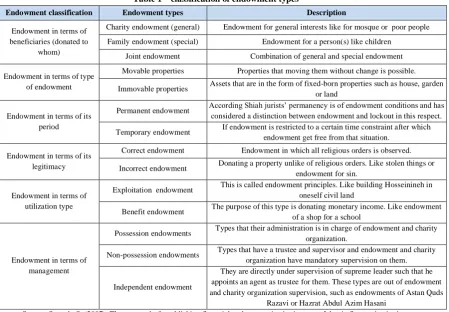
Endowment can be classified from different perspective that has been summarized in table 1:
Table 1 – classification of endowment types
Endowment classification Endowment types Description
Endowment in terms of beneficiaries (donated to
whom)
Charity endowment (general) Endowment for general interests like for mosque or poor people
Family endowment (special) Endowment for a person(s) like children
Joint endowment Combination of general and special endowment
Endowment in terms of type of endowment
Movable properties Properties that moving them without change is possible.
Immovable properties Assets that are in the form of fixed-born properties such as house, garden or land
Endowment in terms of its period
Permanent endowment According Shiah jurists’ permanency is of endowment conditions and has considered a distinction between endowment and lockout in this respect.
Temporary endowment If endowment is restricted to a certain time constraint after which endowment get free from that situation.
Endowment in terms of its legitimacy
Correct endowment Endowment in which all religious orders is observed.
Incorrect endowment Donating a property unlike of religious orders. Like stolen things or endowment for sin.
Endowment in terms of utilization type
Exploitation endowment This is called endowment principles. Like building Hosseinineh in oneself civil land
Benefit endowment The purpose of this type is donating monetary income. Like endowment of a shop for a school
Endowment in terms of management
Possession endowments Types that their administration is in charge of endowment and charity organization.
Non-possession endowments Types that have a trustee and supervisor and endowment and charity organization have mandatory supervision on them.
Independent endowment
They are directly under supervision of supreme leader such that he appoints an agent as trustee for them. These types are out of endowment and charity organization supervision, such as endowments of Astan Quds
Razavi or Hazrat Abdul Azim Hasani Source: Sayyah, S. (2007). The proposal of establishing financial endowment institution as an Islamic finance institution.
2.4. Types of endowment funds
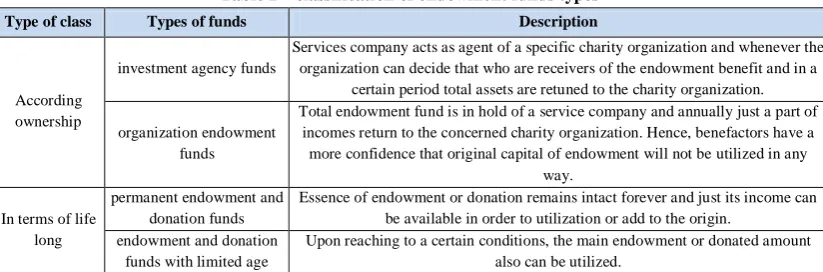
Endowment funds have different types according ownership and life length that has been summarized in table 2:
Table 2 – classification of endowment funds types
Type of class Types of funds Description
According ownership
investment agency funds
Services company acts as agent of a specific charity organization and whenever the organization can decide that who are receivers of the endowment benefit and in a
certain period total assets are retuned to the charity organization.
organization endowment funds
Total endowment fund is in hold of a service company and annually just a part of incomes return to the concerned charity organization. Hence, benefactors have a
more confidence that original capital of endowment will not be utilized in any way.
In terms of life long
permanent endowment and donation funds
Essence of endowment or donation remains intact forever and just its income can be available in order to utilization or add to the origin.
endowment and donation funds with limited age
Upon reaching to a certain conditions, the main endowment or donated amount also can be utilized.
2.5. Background of endowment in Iran
Endowment is among interdisciplinary subject that despite of its extensive capacity, less has been investigated by researchers. In fact it must be said that except for a few research in its juridical dimension, no comprehensive research has been performed on the other dimensions such as economic, social, cultural, sociologic, psychological …. Certainly, if a comprehensive attitude about endowment is created and this prophetic tradition is utilized along with modern world developments can play a wonderful role in a society. As in the other countries, similar institutions of endowment have numerous functions in areas such as higher education, health and charity.
In Iran three distinct institutions are in charge of Waqf properties. The first is the Auqaf and Charity Organization (ACO) which has been established by law (Auqaf, 2002). Its legal status has changed several times, and after the Revolution it was put under the supervision of the culture ministry. The head of the organization will represent the supreme leader, since all the endowments without a trustee should be run under his custody. If the categories of expenditures are not specified in the deed or are for general public benefit, the income generated by the endowed properties shall be used for research, propagation and publication of Islamic teachings.
The second Waqf administration is that of holy shrines of the Prophet’s progeny members. They are autonomous and their mission is to advance Islamic Shari’ah and provide service to pilgrims. The most prominent among them is the Astan Quds Razavi (AQR) of Imam Reza (AS), the eighth grandson of the Prophet (SAAS). The corpus value is estimated to be worth more than$ 15 billion (Astan Quds, 2013). The endowment deeds were made after the revolution to disclose clearly and concisely the wills of the founders. Based on these deeds, the activities in AQR are identified and described in three categories: cultural and educational activities, health and medical services and economic and business complex (Astan Quds, 2013).
The third type of administration is that of private trustees or joint private –public custodians. Two eminent examples are Namazi Hospital and Afshar Cultural Foundations (Afshar, 2004).
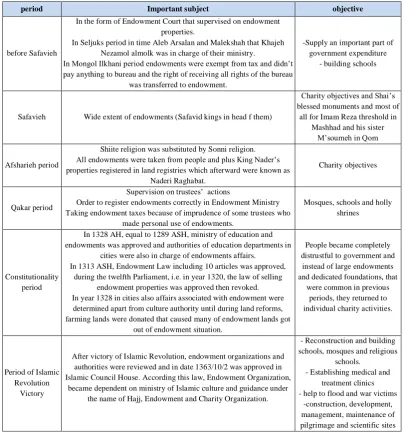
Table 3. Classification of endowment background in Iran
period Important subject objective
before Safavieh
In the form of Endowment Court that supervised on endowment properties.
In Seljuks period in time Aleb Arsalan and Malekshah that Khajeh Nezamol almolk was in charge of their ministry.
In Mongol Ilkhani period endowments were exempt from tax and didn’t pay anything to bureau and the right of receiving all rights of the bureau
was transferred to endowment.
-Supply an important part of government expenditure
- building schools
Safavieh Wide extent of endowments (Safavid kings in head f them)
Charity objectives and Shai’s blessed monuments and most of
all for Imam Reza threshold in Mashhad and his sister
M’soumeh in Qom
Afsharieh period
Shiite religion was substituted by Sonni religion. All endowments were taken from people and plus King Nader’s properties registered in land registries which afterward were known as
Naderi Raghabat.
Charity objectives
Qakar period
Supervision on trustees’ actions
Order to register endowments correctly in Endowment Ministry Taking endowment taxes because of imprudence of some trustees who
made personal use of endowments.
Mosques, schools and holly shrines
Constitutionality period
In 1328 AH, equal to 1289 ASH, ministry of education and endowments was approved and authorities of education departments in
cities were also in charge of endowments affairs. In 1313 ASH, Endowment Law including 10 articles was approved,
during the twelfth Parliament, i.e. in year 1320, the law of selling endowment properties was approved then revoked. In year 1328 in cities also affairs associated with endowment were determined apart from culture authority until during land reforms, farming lands were donated that caused many of endowment lands got
out of endowment situation.
People became completely distrustful to government and
instead of large endowments and dedicated foundations, that
were common in previous periods, they returned to individual charity activities.
Period of Islamic Revolution
Victory
After victory of Islamic Revolution, endowment organizations and authorities were reviewed and in date 1363/10/2 was approved in Islamic Council House. According this law, Endowment Organization,
became dependent on ministry of Islamic culture and guidance under the name of Hajj, Endowment and Charity Organization.
- Reconstruction and building schools, mosques and religious
schools. - Establishing medical and
treatment clinics - help to flood and war victims
-construction, development, management, maintenance of pilgrimage and scientific sites
2.6. Higher education a necessity of
science and technology development
Higher education is a strong driver to create social transformation, growth and development in a country. In fact university is one of the most valuable institutions a society has for development and progress. Therefore, one strategy for comprehensive development of a country is paying attention to higher education development in macro-level planning and
policy-making. And consequently one of the influential institutions for science and technology development is universities and higher education institutions that long with globalization phenomenon and becoming a knowledge-based community has been considered as its major priority plans (Jamshidi et. al, 2013).
learning (OECD, 2000), knowledge-based development (Knight, 1995), public education, learning for everyone and lifetime learning, governments attempt to encourage their nation for more participation and investment in higher education. Thus, one of the political objectives of governments is increasing access to higher education (Long, 2008). Moreover, according side benefits theory (Moretti, 2005) in a society everyone’s access to higher education is desirable in addition to himself for other people through providing a complement in production process. Also, higher education by help of long-term economic growth (Creedy & Francois, 1990) enhances social desirability.
In today world, role of investment for learning as a key factor in the process of cultural, economic and social development has been made clear. Universities in communities in one hand serve as protector and transferor of cultural heritage and values governing on a society and in the other hand are responsive of social needs of people to acquire, distribute and development of knowledge and technology. Their institutional task is to recognize social problems and provide answer for them.
Recently a research has been performed in order to study, pathology and design a desirable model to implement article 44 of Constitution for development of higher education in Iran. In this research, while review of diversification models of financial resources in the selected countries’ higher education, they believe that an appropriate model to increase access to higher education in Iran is a hybrid model of public-private in macro-level system of higher education that using dedicated resources with diversification of financial resources, such as incomes of endowment properties, the independence of university and scientific freedom is institutionalized (Tofighi et. al., 2014).
Various evidence imply that higher education while considering the crisis of quantity increase and financial bottlenecks has to pay attention to science and technology development as well (Hansmann, 1990). Universities and higher education centers have three major tasks: knowledge production, knowledge transfer (training specialized human power) and providing services to community. Optimal performing each of the mentioned three tasks require doing scientific research; because science is a fruit of investigation, success in knowledge transfer and in the
other word, success of professional and efficient human power who equip with up-to-date knowledge requires sufficient proficiency in modern knowledge through scientific research or study of other scholars’ discoveries; offering professional services to a society also through knowledge-based recognition of community problems and presenting scientific answers will be successful. Considering important tasks of universities, necessity of investment in this section becomes clear ( Jongbloed, 2004; Liefner, 2003). One mission of higher education is support of knowledge-based companies in order to develop and distribute technology, financial support of demand-based research jointly with universities and higher education, research and technology institutions in cases concerning to solve the existing problems of the country, financial support and facilitating formation and development of Private and cooperative small and medium businesses that operate in the field of commercialization of science and technology, particularly production of products based on advanced technologies and export of technical and engineering services and also support for start-up incubators and science and technology parks by private sector, financial support for creation and development of idea exchange and IT market in order to using scientific capacities to meet the needs of industry, agriculture and services as well as the expansion of higher education according priority areas of science and technology, kind of institutions, climate situations and community needs and employment of graduates based on comprehensive scientific plan of the country( Long Bridget, 2008; Johnstone, 2006). And according the general policies of science and technology that have been communicated from supreme leader of Islamic Revolution, the necessity of diversification in supply of financial resources of higher education has been emphasized that endowment can be one of the appropriate strategies to realize this issue.
aim of strengthening mission orientation in higher education and pushing academic activities in support of scientific and technological innovators as well as promotion of efficiency and effectiveness of higher education in the science and technology system of the country has been emphasized greatly. To achieve foundational innovations to strengthen national sovereignty and to develop capabilities and technological capacity throughout the industry has been encouraged. Development of science and technology is an inclusive concept for the realization of values and objectives of the country’s holistic scientific map.
2.7. History of education and research
endowment in the world
Higher education and research has a high position in the endowment foundations and currently many charity foundations have a great part in social, economic and also education affairs in many countries. In USA alone there are 2400 scientific endowment that each in somehow support sciences, technology and talents. European countries also have been active in
this issue, particularly Germany that is pioneer among these countries. One of the most important endowment independent foundations of Germany, due to the importance of this foundation in terms of pure investigations, is Volkswagen Foundation established in 1961. The budget of this foundation just is for purpose of support and promotion of science and technique and assist to research and higher education.
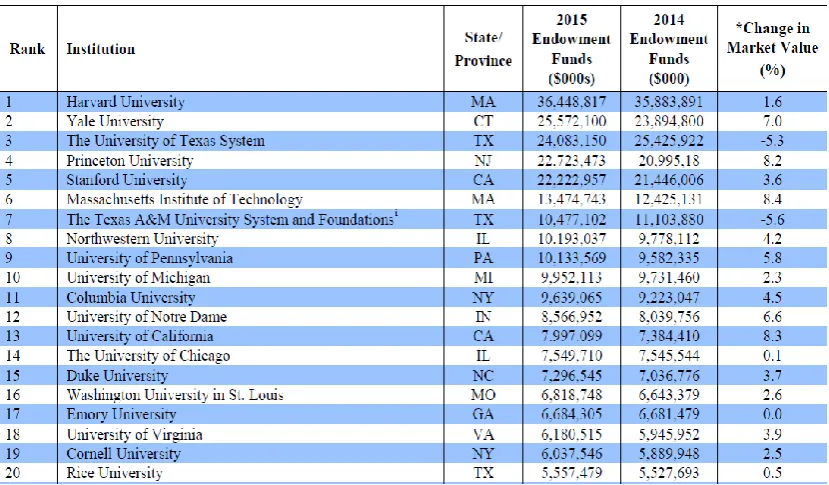
In table 4, market value of endowment funds assets of the world top universities that are administrated through these funds has been determined:
Universities don’t consume their dedicated assets just in one take in order to protect university capital, intellectual independence of university and immunization of university against financial fluctuations and reserve them in the form of endowment funds. In fact, universities for three reasons are very vulnerable to financial fluctuations: 1. their assets are specialized and have not much collateral value, 2. in financial crises times, universities can’t issue bonds, and 3. their expenses like rent cost is inflexible. Hence, universities establish endowment funds.
Table 4: Value of endowment funds assets of the world top universities in 2014 - 2015
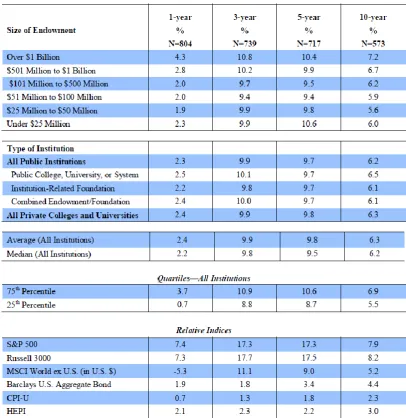
National Association of College and University Business Officers and Common-fund Institute in a report on study of its endowment funds, has presented average compounded nominal returns of endowment funds investment for year ended to June 30, 2015, using data of 832 education and academic institutions (with market value of over 1 billion dollars for dedicated assets of funds) as table 5.
Allocation percent of total assets of funds in various groups of assets for 832 education and university institutions of US have been presented in table 6.
Also average annual distribution rate calculated for 832 investment funds of education and university institutions of US during 2006-2015 have been gathered in table 7.
Table 5: Average compounded nominal return rates of endowment funds investment of US for year ended to June 30, 2015
Table 6: Average percentage of the allocation of different assets categories in investment funds of educational and academic of U.S.A
Source: NACUBO-COMMONFUND ENDOWMENT STUDY FOLLOW-UP SURVEY 2015 http://endowments.com/funds/
Table 7: the average annual distribution rate of investment funds of education and university institutions of US
3. Methodology
Current research method is heuristic, descriptive and comparative, with adding knowledge objective and gradual approach that scientific bases and background were gathered by library and document method and analyzed and pattern of financing based on endowment and charity doctrines.
The idea of establishing an organization that its assets is devoted to charity objectives have long existed including in Iran and Muslim societies, such as Nizamiehs of Baghdad and Rashidi quarter and now numerous charity foundations in many countries particularly U.S.A have a grate role in social and economic activities. Famous institutions such as Noble Foundation in Sweden, Ford and Rockefeller in U.S.A are among these.
Endowments foundations in western countries have essential difference with Islamic endowments but in the cases that their objective is to solve public problems, support, encourage and promote knowledge and technique has essential common aspects. Hence it is appropriate that by identification of nature and objectives of each others’ endowments enjoy from these valuable experiences, as far as cultural frameworks allow, in the world that its common aim is to reach sustainable development
4. Results
The structure of endowment funds has been presented, by study of the scientific bases and investigation background and to assess research objectives, in the following three separate sections:
a) Overall structure of endowment funds in the world
Charity institution or benefactors administer assets under endowment or donations through company of management services of endowment and donation or what is called “Foundation”. They establish endowment fund by help of these foundations and thereby administer assets under endowment in an effective, simple and flexible way.
Charity foundations operate various funds professionally. In developed countries, foundations can be identified that manage up to 100 funds. To modern endowment funds of the world, cash, securities accepted in exchange, securities of public non-stock companies, estates and properties, insurance
policies and mass of physical and other real properties are donated and gifted. The aim of these foundations is to help an endowment fund establishment until benefactors that haven’t sufficient time and expertise or even haven’t all financial sources, can make necessary organizing. To administer endowment and donation funds through establishment of investment funds, two procedures are common:
1)The first procedure is that benefactor him/herself with establishing organization that is called dedicated foundation. Such as Rockefeller Foundation
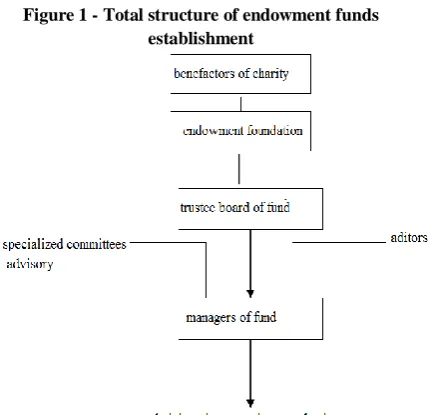
2)Second procedure is that several benefactors close to foundation establish their funds. These foundations operate different funds for different benefactors and are composed of professional managers of investment. Also institutions of “endowment management services” exercise professional management on endowment funds. It is required to mention that organizing endowment differ in different countries, but mainly, dedicated assets are under supervision of board of trustees and administrated by managers. Some endowment funds are limited to source received from initial benefactor, and in some countries these funds are permitted to grow larger through receiving funds from people. Total structure of endowment funds, charity … in everywhere is partly like figure 1:
In managing endowment organizations always it has been attempted that protection of autonomy and independent character is considered in order to these organizations can be autonomous at the same time of transparency and wouldn’t incline to use of government helps.
b) Structure of endowment funds in universities
There are two legal structures for endowment funds in universities:
1 – as a part of a university
2 – as a separate legal entity like an institution Main objective of these funds according Honsman’s study (1990) is a tool to support university against financial adversities and according Tobin’s study (1974) providing a secure and stable income flow for university and in terms of Black (1976) has been determined as an income source for university.
c) Structure of endowment funds in Iran
In Iran because of social, cultural and religious features, endowment funds haven’t established in today and developed form and most of the benefactors’ assets in direct form is donated to charity affairs and particularly for education, cultural and health. But in 2011 the directors’ board of Securities and Exchange has announced statute and prospectus of charity
investment funds. In this notification the objective of the charity investment funds, has been mentioned collecting funds from charitable individuals and allocating them for purchase of various assets according the relevant prospectus, in order to reduce investment risk, using the savings gained from scale and ensuring interests and then according investor’s decisions, allocating all profits to charity activities or a portion of the obtained profits to investor and the remainder to the charity affairs set forth in the prospectus of the fund (Dimmock, 2010) . The structure of charity investment funds is similar to the mutual investment funds. The structure of this fund and summary its principals tasks are shown in figure (2). Participation ways of charitable individuals in charity affairs are as following:
a) The original and all benefits obtained from investing are allocated to charity affairs for this purpose investment certificates are issued in the name of the administrator.
b) The original belongs to benefactor and s/he allocates all obtained benefits for charity affairs and investment certificates are issued in the name of the administrator.
c) Benefactor takes least amount for himself and allocates its excess to charity affairs and investment certificates are issued in the name of the administrator.
d) Situation of charity funds in Iran
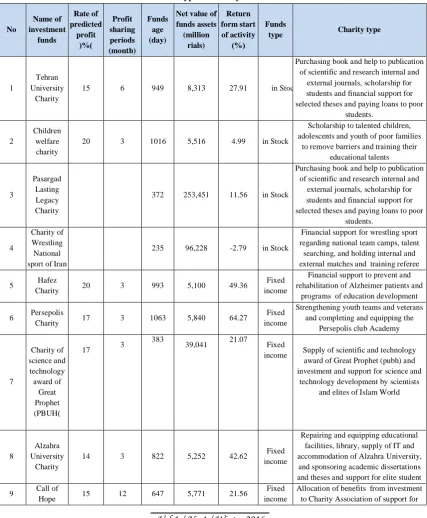
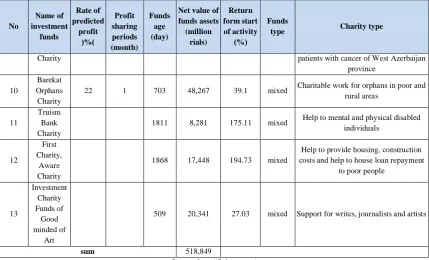
Situation of charity funds in terms of assets value, type of funds and charity objectives have been summarized in table 8. A total of 13 charity funds have been established in the country and the total value of
their assets amounts to 519 billion Rials. This amount is very insignificant compared to the whole value of endowment assets in the country. Because of cultural capacity and historical background of the country there is a ground of growth and spread of charity funds.
Table 8: The types of charity funds in Iran
No Name of investment funds Rate of predicted profit (%) Profit sharing periods (month) Funds age (day)
Net value of funds assets (million rials) Return form start of activity )%( Funds
type Charity type
1
Tehran University
Charity
15 6 949 8,313 27.91 in Stock
Purchasing book and help to publication of scientific and research internal and
external journals, scholarship for students and financial support for selected theses and paying loans to poor
students.
2
Children welfare charity
20 3 1016 5,516 4.99 in Stock
Scholarship to talented children, adolescents and youth of poor families
to remove barriers and training their educational talents 3 Pasargad Lasting Legacy Charity
372 253,451 11.56 in Stock
Purchasing book and help to publication of scientific and research internal and
external journals, scholarship for students and financial support for selected theses and paying loans to poor
students.
4
Charity of Wrestling National sport of Iran
235 96,228 -2.79 in Stock
Financial support for wrestling sport regarding national team camps, talent searching, and holding internal and external matches and training referee
5 Hafez
Charity 20 3 993 5,100 49.36
Fixed income
Financial support to prevent and rehabilitation of Alzheimer patients and
programs of education development
6 Persepolis
Charity 17 3 1063 5,840 64.27
Fixed income
Strengthening youth teams and veterans and completing and equipping the
Persepolis club Academy
7 Charity of science and technology award of Great Prophet (PBUH)
17 3
383
39,041 21.07 Fixed
income Supply of scientific and technology award of Great Prophet (pubh) and investment and support for science and
technology development by scientists and elites of Islam World
8
Alzahra University
Charity
14 3 822 5,252 42.62 Fixed
income
Repairing and equipping educational facilities, library, supply of IT and accommodation of Alzahra University,
and sponsoring academic dissertations and theses and support for elite student
9 Call of
Hope 15 12 647 5,771 21.56
Fixed income
No Name of investment funds Rate of predicted profit (%) Profit sharing periods (month) Funds age (day)
Net value of funds assets (million rials) Return form start of activity )%( Funds
type Charity type
Charity patients with cancer of West Azerbaijan
province
10
Barekat Orphans Charity
22 1 703 48,267 39.1 mixed Charitable work for orphans in poor and
rural areas
11
Truism Bank Charity
1811 8,281 175.11 mixed Help to mental and physical disabled
individuals 12 First Charity, Aware Charity
1868 17,448 194.73 mixed
Help to provide housing, construction costs and help to house loan repayment
to poor people
13 Investment Charity Funds of Good minded of Art
509 20,341 27.03 mixed Support for writes, journalists and artists
sum 518,849
Source: http://fipiran.com/
5. Discussion and Conclusion
Endowment and charity funds is one of the newfound issues in funding particularly in education and research area that in this article has been investigated scientifically and from its history, and understanding its difference in western communities,
islamic and Iran a structure has been identified and suggested.
Initially, differences of administering endowment properties in Iran with endowment funds have been identified and summarized in the following table.
Table 9: Difference of administering endowment in Iran with charity (endowment) funds Characteristic type Features of endowment management in Iran Endowment funds features
Maintaining value Emphasis on physical maintain of origin property
Emphasis on maintaining real and economic value not physical essence of property
Converting assets Difficulty of converting endowment property Ease in converting property and its management in order to maintain economic value
Combining assets Most of donated properties are physical and immovable.
Most of endowment funds assets are monetary. Endowment institutions are active in capital markets of countries.
Endowment character
Lack of independent character and mainly
concentrated management and under
supervision of Endowments Organization
formal legal non-public character of endowment funds and their financial autonomy
Assets managers
Management of endowment properties by trustee, committed, literate, able to do the task (not necessarily specialized)
Management of funds by financial experts like other financial institutions
Financial reporting
Lack of reporting capability regarding: Value of assets and endowment debts in
every moment
Periodic reports on management
performance regarding maintaining properties, earning income and its distribution, future plans…
Considering the importance of establishing endowment and charity funds in higher education, the most important reasons for its formation in this regard are:
Change of needs and adding new needs in higher education (from hardware possibilities perspective)
More need to funding education and research activities of elite and talented people
Need to more attention to research activities in science production
Need to updating researchers and graduates knowledge
Support for knowledge-based plans and ideas of researchers and elites
Need to updating researchers’ and graduates’ knowledge
Capability of using endowment properties for satisfying new needs of society (dependent on time requirements and in framework of benefactors’ objectives and desires).
Figure 3: Suggested model for establishing endowment funds
The overall conclusion of the current research is that endowment is one of the most important and effective ways of participation in this task and other charity and non-profit ones, has long been considered by benefactors of this country. Much volume of
aren’t fully responsive of the new demands as traditional way. Some of them are as following:
Change of needs and adding new needs in higher education (setting up digital libraries and scientific portals)
More need to funding education and research activities of elite and talented people
Need to more attention to research activities in science production
Support for knowledge-based plans and ideas of researchers and elites trough establishing charity funds with the function of Venture Capital Fund (venture funds)
Need to updating researchers and graduates knowledge
Furthermore, endowment fund is one of the funding procedures through investing dedicated assets. Endowment funds are used regarding education and research affairs extensively throughout the world, particularly in countries that are counted as developed countries and have high ratings for science production among countries of the world. Most important benefits and effects of endowment funds are:
Professional administration of endowments Higher effectiveness and efficiency of
dedicated assets compared to traditional ways and maximization of benefits of those who have been donated.
Conserving endowments value over time and increasing their value
Separating investment decisions from decisions for allocating benefits to those who have been donated.
Capability of using endowment properties to satisfy new needs of society (dependent on time requirements and in framework of benefactors’ objectives and desires).
In this article irrespective of juridical and legal limitations, merely the positive functions of charity funds institution for effective and efficient administration of dedicated assets, particularly its role in funding development of education, research and science production have been explained, and it is suggested that endowment funds are established in the country and its administrative model and stages as shown in figures (1) to (3) is suggested.
The organization of endowment and charity and organization of securities and stock exchange with
awareness of social and economic functions of such institutions can by promoting and culture-building provide development context of this institution in different sections of society and assist government in the path of sustainable economic and social development. Also it is suggested to future researchers that utilize financial engineering for tool-making and covering endowment funds risk and target a comprehensive research.
Reference
1) Afshar, Mahmud, (2004), Panj Waqfnameh; Foundation of Dr. Mahmud Afshar Endowments, 2nd Edition. Tehran.
2) Auqaf and Charity Organization, (2002). Report on developments in Waqf and charity affairs during the last 20 years, Auqaf & Charity Organization, Public Relation Office, http//www.razemandegari.com.
3) Astan Quds Razavi, (2013). “A 33 Years Performance Report”. Vol. 1, The Central Official Complex, Mashhad, Iran.
4) Black, F. (1976). The investment policy spectrum: Individuals, endowment funds and pension funds. Financial Analysts Journal 32(January-February):23-3
5) Bonine. Michael E: (2009), “Waqf and its Influence on the Built Environment in the Medina of the Islamic Middle Eastern City,” Berlin, New York.
6) Creedy, J., & Francois, P. (1990). Financing higher education and majority voting. Journal of Public Economics, 21, 111–211.
7) Dimmock, S. (2010). Background Risk and University Endowment Funds. SSRN. Endowment and Charity Organization, endowment affairs assistance, activities report, website of Endowment and Charity Organization.
8) Hansmann, Henry. (1990). Why do universities have endowments? Journal of Legal Studies 19(January): 3-42.
9) Islamic Azad University, research assistance (2009). Feasibility of establishing endowment fund for higher education in Iran and the role of endowment funds in financing Islamic Azad University.
experiences), first edition, Jahad Daneshgahi publication, Kharazmi unit.
11)Johnstone, D. B. (2006). Higher education accessibility and financial viability: The role of student loans. In Global University Network for Innovation (GUNI) (Ed.), Higher education in the world: The financing of universities. Basingstoke and New York: Palgrave Macmillan.
12)Jongbloed, B. (2004). Funding higher education: Options, trade-offs and dilemmas. Working Paper of CHEPS, University of Twente, the Netherlands Paper for Fulbright Brainstorms- New Trends in Higher Education.
13)Knight R., V. (1995). Knowledge-based development: Policy and planning implications for cities. Urban Studies, 92(2), 225-231. 23.
14)Liefner, I. (2003). Funding, resource allocation, and performance in higher education systems. Higher Education, 13, 133–113. 27.
15)Lundvall, B.-A. and Johnson, B. (1994), ‘The learning economy’, Journal of Industry Studies, Vol. 1, No. 2, pp. 23-42.
16)Moretti, E. (2005). Estimating the social return to higher education: Evidence from longitudinal and repeated cross-sectional data. Journal of Econometrics, 121, 175–212.
17)National Association of College and University Business Officers and Common fund Institute.
(2015). NACUBO-COMMONFUND
ENDOWMENT STUDY FOLLOW-UP
SURVEY. http://endowments.com/funds/
18)Nikoomaram, H.; Rahnamay roodposhti, F.; Rohbati, F. (2011), Foundations of financial management, volume 1,2, Termeh publication. 19)OECD (2000). Knowledge management in the
learning society. Paris.
20)Organization of endowments and charity affairs, deputy of endowment affairs, activities report, website: www.oghaf.ir
21)Financial Information Processing of IRAN
http://fipiran.com/
22)Sayyah, S. (2007). The proposal of establishing financial endowment institution as an Islamic finance institution, (articles collection of the international conference on Islamic financing), collected by: Technology Research Center of Sharif Industrial University, October 20, 2007, pp 204-205.
23)Securities and Exchange Organization. “A sample
of Statute and prospectus of charity funds.
approved by Directors Board of Securities and
Exchange Organization” www.seo.ir
24)Tobin, James. (1974). What is permanent endowment income? American Economic Review 64(May): 427-32.
25)Tofighi, J.; Ferasatkhah, M. (2014). Review, pathology and designing an optimal model for implementation of Article 44 of Iran's Constitution for Iran higher education development. Tehran: Presidential Deputy for Science and Technology, Technological Development Deputy