Croat. j. for. eng. 37(2016)2 251
Analysis of Accuracy of Evaluating
the Structure of a Harvester Operator’s
Workday by Work Sampling
Grzegorz Szewczyk, Janusz M. Sowa, Jiri Dvořák, Krzysztof Kamiński, Dariusz Kulak,
Arkadiusz Stańczykiewicz
Abstract
The study covered an analysis of the accuracy level of measuring time within a working shift using the method of regular snapshot observation at a harvester operator’s worksite in Scots pine stands. A conformance level of the analyzed methods was evaluated through assessing the accuracy of rectilinear fitting of time structures, established using the photography of work day method and snapshot observations. The accuracy of snapshot measurements performed in 3-minute intervals was determined as high, exceeding 95%. Increasing the time interval between observations to 10 or 15 minutes resulted in higher estimation error in snapshot observation time, ranging between 5 and 10% for late thinned and clear-cut stands. The ac -curacy of evaluating proportions of specific work times within a working shift, in regular snapshot observations, was correlated with work cyclicality. The strongest work cycle in thinned stands consisted of 43 activities, with total duration of 13 minutes, whereas in clear-cut stands it comprised 45 activities, with total duration of 15 minutes. One of the advan -tages of the described method, apart from its lower labour intensity as compared to working day photography, was the possibility to assess labour time and breaks as well as estimate the share of downtime.
Keywords: work measurement, time series, snapshot observation, timber harvesting
1. Introduction
Work measurement is a two-stage examination, including measuring time during work and
determin-ing a number of work products after completdetermin-ing the production process. Most methodological errors are made in the first stage, i.e. at determining the time of work. Field research of technology of timber harvest
-ing and skidd-ing are normally conducted within the operational work time, i.e. for activities directly re
-lated to the work being done, and then an assumption of their proportions in the entire working shift is made (Backhaus 1990, Sowa et al. 2006, Zečić et al. 2005, Nur
-minen et al. 2006, Spinelli and Visser 2008). The share of main work time within a working shift is usually estimated based on a labour-intensive time study, i.e. measurement of recurrent work sequences (Szewczyk et al. 2014).
Evaluating the proportions of preparatory and com
-plementary work times is even more troublesome, due to their irregular occurrence. Therefore, they are esti
-mated based on observations of the entire working shift. This method is known as photography of work day (Monkielewicz and Czereyski 1971, Samset 1990, Häberle 1992, Kärhä et al. 2004, Moskalik 2004, Ovas
-kainen et al. 2004, Picchio et al. 2012, Sowa et. al. 2007, Szewczyk 2010, 2011a). Changeable and complex pro
-duction processes, typical of forest works, require a suitable measuring method. In this respect, methodolo
-gies involving an estimation of frequency of certain activities may appear extremely interesting when many worksites are subjected to investigation, in particular, at early stages of labour research (Szewczyk 2014b).
The method of snapshot observations was intro
1930s. The grounds for this methodology, called »snap-reading«, were established in 1927 by the British stat
-istician, Tippett (1935). Work analyses performed on similar basis were described as »ratio-delay« (Morrow 1957) or »work sampling« (Brisley 2001), while in Po
-land they were popularised as »snapshot observa
-tions«, at the end of 1950s (Wołk 1960). Work measure
-ment by means of snapshot observations consists in recording events taking place in a constant or varying time interval. The frequency of particular activities encountered at a given worksite translates into a pro
-portion (share) of their durations within the entire time of observation (Wołk and Strzelecki 1993, Szew
-czyk 2014a). An essential problem recognised for the method in question is determining the time interval, within which the measurements should be taken. This paper presents an analysis of the possibility to extend the time interval between snapshot observations in work sampling at timber harvesting. Such methods have already been applied in forestry sciences, though they still require thorough testing under varied condi
-tions of logging opera-tions (Miyata et al. 1981). The research aimed to assess the possibility of in
-creasing the time interval between snapshot observa
-tions recorded at a harvester operator’s worksite and determining their accuracy in various time intervals. The reference point was the time structure of a work
-ing shift, obtained us-ing the photography of work day method. In the initial stage of the research, it was as
-sumed that differences would occur in the accuracy of evaluating time consumption for various time inter
-vals in snapshot observations, and that a factor would be indentified related to the cyclicality of work activi
-ties and determining the measurement accuracy.
2. Material and Methods
Trial plots were located within the Regional Direc
-torate of the State Forests in Radom, Staszów Forest District (21˚10’E, 50˚33’N), and the Regional Director
-ate of the St-ate Forests in Łódź, Kolumna Forest Dis
-trict (19˚12’E, 51˚36’N). At these plots, studies of effi
-ciency of mechanised timber harvesting were carried out in 2009–2011, and based on them primary assump
-tions for methodology of work sampling with the use of snapshot observations were developed (Szewczyk 2014b). The research presented in this paper covered additional, supplementary work measurements. The selected taxation features of the investigated stands were gathered in Table 1.
Wood extraction was mechanised, employing mid-class harvesters Ponsse Ergo (Jiroušek et al. 2007, Dvořák et al. 2011). There were three operators aged 30 to 40, with more than one-year experience. In the course of works performed in the CTL system, the following assortments were bucked: longwood with a length ranging from 8 to 12 m, logged timber
Table 1 Selected taxation features of the investigated stands
Forest district Cutting category* Species composition yearsAge Stocking index DBH cm Large timber in total m3/ha Total removal of large timber m3/ha
Staszów
CC Pine 10 87 0.8 27 300 300
CC
Pine 10 112
0.9 35 336 336
Oak locally 80
Birch locally 80
LT Pine 10 63 1 25 361 75
LT Pine 8 63 1 25 280 75
Oak 2 63 26 56
Kolumna
LT Pine 9 62 1 24 323 75
Birch 1
ET Pine 10 44 1 24 355 46
ET Pine 10 54 0.9 22 318 46
ET Pine 10 51 0.9 24 300 46
Croat. j. for. eng. 37(2016)2 253
with a length of 4 m and middle-sized wood in a form of 2.5 meter rollers.
In fragments of the stands, uniform in terms of their taxation features (DBH, height, species compo
-sition), work time study was conducted using the photography of workday method (Szewczyk 2011b, 2012, Nurminen et al. 2006, Dvořák and Walczyk 2013). Time measurement was taken automatically by means of PSION Workabout device with »Tim
-ing« software, developed especially for chronometric analyses (Sowa et al. 2007, Sowa and Szewczyk 2013). The duration of specific work activities were record
-ed (accurate to 1 second) and then classifi-ed accord
-ing to the IUFRO standards (Björheden 1991, Dvořák et al. 2011, Szewczyk et al. 2014) (Table 2).
For selecting a homogenous trial sample, the sig
-nificance of differences in mean time of relocation around the workplace area was tested. From the chronometric sequences, chosen in the above-de
-scribed manner and obtained by means of the pho
-tography of work day method, time categories, theo
-retically observed in snapshot observations, were sampled. Testing was performed for 3-, 5-, 10-, 15-, 20- and 25-minute intervals between subsequent ob
-servations. A simple correlation between percentages of specific time categories from the above-mentioned database was computed and used as the measure of conformance of time structures, determined with the use of both methods, photography of work day and snapshot observations. Since the research covered an analysis of a linear model without an absolute term, a directly proportional relationship between both of the variables was put to the test. Two measures of
fitting accuracy were assumed: a coefficient of regres
-sion and a coefficient of determination, with error rate at 5%.
The accuracy of work time measurement, as
-sessed with the use of snapshot observations in the given time interval, was correlated with the cyclical
-ity of work activities. This cyclical-ity was determined through displaying the measurement data as time series, i.e. a sequence of observations for a certain variable in a constant time interval (Box and Jenkins 1976). For converting the chronometric sequences recorded at the investigated worksites into time se
-ries, particular observations were encoded using the notation presented in Table 2. Such constructed time series contained the names of respective activities expressed as numerals and playing the role of an ob
-served variable, while the succession of activities (work sequencing), typical of a certain worksite, be
-came an ordering variable (Szewczyk 2011a, Szewc
-zyk et al. 2014, Szewc-zyk 2014a).
The difficulty in adjusting the method of time se
-ries analysis to the investigated phenomenon consist
-ed in the fact that particular cases (observ-ed work activities) did not occur in a stable time interval. For displaying the results of time study, conducted at the selected work sites, in a form of time series, successive observations were encoded according to the scheme presented in Table 2. Thus, the occurrence of sequenc
-es of work activiti-es was considered as time seri-es, where individual activities, with their names encoded as numbers, were an observable variable, while the succession of activities typical of the analyzed work sites (work sequencing) constituted an ordering vari
-Table 2 Flow chart presenting classification of harvester work times. Numerical codes referring to the applied classification were used for constructing time series
WP Workplace time
Main work time MW
Ac
tiv
ity
c
od
e
1 Pulling out a crane arm, positioning, cutting, felling Pulling a tree onto a machine, delimbing, bucking
Complementary
work time CW 2
Time of relocation around the workplace
Time of preparing a worksite – removing branches and fragments of logs hindering access to the tree being cut
Time of arranging logs, sorting bucked assortments
Maintenance
time MT 3
Time of changing a cutting chain, refuelling, technological adjustments Time of unblocking a harvester head, removing branches
Repair time RT 4 Times of deleting faults in hydraulic system
Non-working
time NT 5
Rest time
able (Szewczyk 2011a, Szewczyk et al. 2014, Szewczyk 2014a).
Since the examined time series revealed random fluctuations, their moving average (of equal weights) was smoothed. Time series, in contrast to random samples, are characterised by a non-accidental order of observations. This attribute was used in the present study. The simplest examination of sequencing of cer
-tain observations is based on identifying regular fluc
-tuations, i.e. with fixed lengths (expressed by a num
-ber of observations), determined as seasonal fluctuations. This simplified approach was assumed by Szewczyk in his studies on establishing the length of work cycles of forest machines. With regard to work sites characterised by a great variability of work (e.g. at timber harvesting or skidding), the length of stable and recurrent fragments of a workday was difficult to determine. In fact, the structure of work time succes
-sion at work sites related to timber harvesting and skidding indicated an occurrence of two overlapping work cycles with various lengths. For detecting a vari
-able of this cyclical structure of the investigated time series, methodology of the single-band Fourier analy
-sis was employed (Kot et al. 2007, StatSoft Inc. 2009). Lengths of recurrent work cycles were estimated based on the entire measurement database. The op
-eration of cutting a tree was assumed as the beginning of each cycle, whereas its total duration was a sum of durations of successive activities, the number of which determined the total cycle length. The beginning of next cycle was marked with another cutting operation.
During the field research, nine working shifts were measured, three per each category of operation. The measurement database contained 10,193 records doc
-umenting durations of the distinguished activity cat
-egories, while the measurements were taken continu
-ously within more than 86 hours. An analysis of homogeneity of the research sample was performed based on the variance analysis of the time of relocation between successive worksites. The obtained chrono
-metric sequences did not reveal statistically significant differences in respect of the mean value of relocation time; therefore further study was carried out using the entire measurement sample.
The tested database for snapshot observations en
-closed 731 records for early thinned stands, 589 for late thinned ones and 652 for clear-cut stands.
3. Results
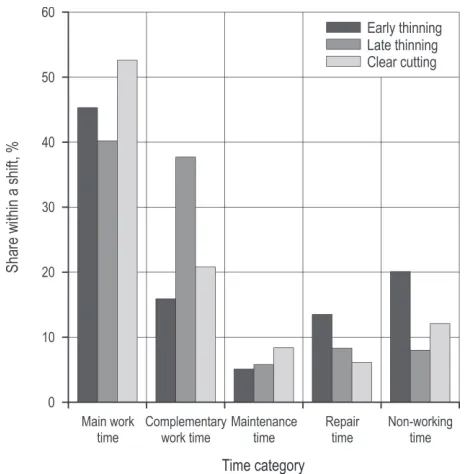
The lowest share of operational work times was recorded in early thinned stands (0.63), where work
conditions were far more difficult when compared with those of late thinnings. The graph in Fig. 1 presents the time structure of a harvester working shift.
With regard to stands of all categories, work times within the operational work time, i.e. main work times (40.2–52.6%) and ancillary work times (15.9–37.7%), had the highest share. The fact that over 40% of all activities were those directly related to work proved that the manipulation areas were very well prepared and the training level of operators was suitable. The highest share of ancillary work times was recorded in late thinned stands (37.7%), which was justified by
longer time of relocation between subsequent work
sites. The share of times of repairs and technical main
-tenance, in the technological variants under scrutiny, accounted for ca. 10%, while the share of times for rest and physiological needs amounted to 13%. A slightly higher share of complementary work times was re
-corded in early thinned stands, which may be ex
-plained by harder work conditions.
Activity categories in the analyzed time intervals were sampled, with the use of EXCEL spreadsheets, from the entire database obtained by means of the snapshot observation method. Sampling was conduct
-ed using the LOOKUP logical function (vector form), which searches for given data in a row or one-column range (vector), and returns the value in the same position in another one-line or one-column range.
Croat. j. for. eng. 37(2016)2 255
Table 3 presents a comparison between databases created using the photography of work day method and those based on the selected variants of snapshot observations.
Table 4 contains the accuracy parameters of the time structure assessment obtained using the snapshot observation method.
The performed analyses demonstrated that the time structures, determined upon application of both of the investigated methods in 3-, 5-, 10- and 15-minute intervals, were very strongly correlated (R2ε≤0.70;
0.99≥) (Stanisz 2007). Moreover, the relationship be
-tween the time structures for these time intervals was nearly directly proportional (Rε≤0.86; 1.00≥). Thus, the accuracy of the snapshot observation method for the above-mentioned time intervals was proved to be con
-siderable. In respect of other investigated time inter
-vals, the estimation error was higher.
Fourier spectral analysis revealed an occurrence of overlapping cycles of work activities within the investigated working shifts, differing in terms of their
Table 3 Number of observations in the tested variants
Early thinned
stands
Late thinned
stands
Clear cutting stands
Photography of work day, pc. 4229 3129 2703
Observation time interval, min 5 10 15
Snapshot observations, min 399 200 132
Share of snapshot observations,% 9 5 3
Table 4 Accuracy parameters of the time structure assessment obtained using the snapshot observation method for the selected observa-tion time intervals
Cutting category, working shift (R2/R)
Observation time
interval, min ET1 ET2 ET3 LT1 LT2 LT3 CC1 CC2 CC3
3 0.99/0.99 0.99/1.00 0.99/1.00 0.94/0.87 0.99/0.98 0.96/0.93 0.99/0.97 0.98/0.96 0.99/0.98
10 0.96/0.97 0.98/1.03 0.98/0.98 0.83/0.86 0.97/0.96 0.96/0.94 0.74/0.97 0.99/0.95 0.96/0.91 15 0.93/0.92 0.95/0.98 0.70/1.00 0.93/0.90 0.96/0.94 0.95/0.92 0.73/0.96 0.96/0.90 0.98/1.00 Fig. 2 Fragment of a periodgram of harvester work in early thinning.
The highest peak of the periodgram indicates the strongest work cycles
lengths. The highest peaks of periodograms, present
-ed in Figures 2–4, were typical of cycles having the strongest impact on the observed general variability (Table 5).
Lengths of work cycles and their durations within the analyzed groups of stands were presented in Table 5. Due to the skewness of distribution of work activity durations, a median value was given as a cycle dura
-tion.
With regard to all the investigated stands, the lengths of work cycles were similar, enclosing 43–45 successive activities. Duration of one cycle in thinned stands counted 13 minutes. Whereas, in clear-cut stands, due to longer times of relocation and wood processing, the work cycles were by ca. 15% longer (15 minutes). High accuracy of snapshot observations, presented in Table 4, recorded in longer, 15-minute intervals may be explained by similar sequencing of work.
4. Discussion
Assessing the labour consumption of production processes is based on the proportions of operational times (main work time, ancillary work time), as well as complementary and preparatory times (mainte
-nance time, repair time, non-working time) (Jabłoński 2006, Dvořák et al. 2011). In forestry, due to the great variability of work environment, such studies are usu
-ally conducted using the photography of work day method, consisting in measuring duration of all ac
-tivities encountered during a working shift. This method, though it provides an abundant research ma
-terial, has many drawbacks. Among others, it requires the observers to be perfectly acquainted with the em
-ployed logging technology. Moreover, the measure
-ments involved are extremely time-consuming, which makes the entire investigation very costly. These are the factors due to which the databases obtained in the above-mentioned manner are usually unsatisfactory and insufficient to draw any undisputable conclusions in terms of the general variability of the analyzed phe
-nomena. With regard to harvesters, it would be pos
-sible to perform the work time analyses based on the data recorded by their computer systems (Dvořák et al. 2011), though a decrease in precision of such ob
-tained data is likely to occur (Purfürst and Erler 2011). The method of snapshot observations is an impor
-tant research tool for analyzing the duration of work activities, in particular, while determining the propor
-tions of non-operational times (SW – supportive work time, NT – non-working time, NW – non-workplace time) within a working shift. Miyata et al. (1981) no
-ticed that the method in question is much more useful than the photography of work day since it enables to observe a few worksites at the same time, which con
-siderably shortens the time of taking measurements. Moreover, it is less tiresome, thus the obtained results are believed to be less burdened with measurement errors. One of the greatest advantages of snapshot ob
-servations is the possibility to reduce the size of data
-bases (Miyata et al. 1981, Szewczyk 2014b).
Table 5 Characteristics of a number of activities constituting a work cycle and total duration of the cycle in the investigated stands
Cutting method
Cycle length
Number of observations Cycle length (number of observations) determined in Fourier analysis Number of cycles, based on which a cycle duration was determined Cycle duration (median) min
Early thinning 4229 43 96 13
Late thinning 3129 43 118 13
Clear-cutting 2703 45 76 15
Croat. j. for. eng. 37(2016)2 257
An essential problem arising upon applying the snapshot observation method in work measurement is choosing an appropriate time interval, in which the observations are recorded. This is extremely signifi
-cant while investigating a highly changeable work environment, which is usually encountered at opera
-tions of timber harvesting and skidding. The measure
-ment frequency determines the size of the research sample directly. Therefore the simplest solution would be to establish the minimum number of observations, and based on this, to assess the constant or variable time interval of the measurement. This approach was adopted by Miyata et al. (1981) in their studies on har
-vester operation, making the minimum number of snapshot observations dependent on the standard de
-viation and the assumed confidence level, both calcu
-lated for the primarily taken research sample. The above-mentioned researchers assessed the accuracy of their measurements based on the confidence interval of binominal distribution. A serious drawback in the presented approach was the necessity of assuming one feature arbitrarily (e.g. non-working times) as a refer
-ence point for the entire variability, determined by the characteristic structure of all productive and non-pro
-ductive times.
The snapshot observations, even those recorded at low frequencies and under conditions of great vari
-ability of work, typical of logging operations, allow determining the time structure of a working shift very precisely. The results obtained in the course of the studies presented here, at frequency of measurements up to 10 or 15 minutes, correspond to the data record
-ed for forest machines publish-ed by Miyata et al. (1981).
One of the most essential factors that lowers the accuracy of snapshot observations is the conformance of time interval, in which an observation is recorded, and the length of work cycle, in particular, at high re
-currence of work operations, which is often encoun
-tered, e.g. in industry, on production lines (Wołk 1960, Wołk and Strzelecki 1993, Szewczyk 2014b). The con
-ducted studies proved that the time interval of slight
-ly shorter or longer duration than the one of a work cycle reflects the shares of all activities within a work
-ing shift very accurately. Theoretically, one may expect that in such a case sampling would always indicate the very same work activity, making the measurements completely unreliable. However, since work cycles have varied lengths and sequences of various work activity structures overlap one another, the synchro
-nisation between cycle lengths and snapshot observa
-tions is practically impossible.
5. Conclusions
Accuracy of evaluating the time structure of a work day employing the method of regular snapshot obser
-vations was assessed with the use of coefficients of
determination and regression, calculated for a linear
dependence between the time structures, determined upon application of the photography of work day method and snapshot observations.
The research covered testing an accuracy of the data obtained in snapshot observations recorded in 3-, 5-, 10-, 15-, 20- and 25-minute intervals. In early thinned stands, high accuracy (max. 5% margin error) of regular snapshot observations was proved for time intervals up to 10 minutes. Assuming the lower limit for values of coefficients of determination and regres
-sion at the level of 0.90 (max. 10% margin error) allows to apply 10- or 15-minute intervals also in late thinned and clear-cut stands.
The accuracy of evaluating the proportions of work times within a working shift using the regular snap
-shot observation method depends, among others, on the ratio of the work cycle length to the time interval between subsequent observations. High accuracy of estimation can be reached providing that the length of work cycle and the duration of time interval are simi
-lar, and the measurements are taken at a worksite characterised by great variability of work and overlap
-ping cycles with varied lengths.
Among the advantages of snapshot observations, except for the lower labour intensity of the research than the one required by the photography of work day method, a possibility to assess the shares of comple
-mentary and preparatory work times should be named. Furthermore, quick sampling of time within a working shift allows to evaluate a few worksites at the same time.
Acknowledgement
This work was supported by the Ministry of Sci
-ence and Higher Education of Poland under Grant No DS ZULiD/3412/2014
6. References
Backhaus, G., 1990: Die Allgemeinen Zeiten im forstlichen Arbeitsstudium (Time classification in the work study of forestry). Forsttechnische Informationen 1: 1–5.
Björheden, R., 1991: Basic time concepts for international comparison of time study reports. Journal of Forest Engi
-neering 2(2): 33–39.
Box, G.E.P., Jenkins, G.M., 1976: Time series analysis: fore
Brisley, C.L., 2001: Work sampling and group timing tech
-nique. In: Zandin, K.B., (ed.) Maynard ́s Industrial Engineer
-ing Handbook, 5th edition. New York, McGraw-Hill.
Dvořák, J., Bystrický, R., Hošková, P., Hrib, M., Jarkovská, M., Kováč, J., Krilek, J., Natov, P., Natovová, L., 2011: The use of harvester technology in production forests. Folia Foresta
-lia Bohemica, Kostelec nad Černými lesy, 156 p.
Dvořák, J., Walczyk, J., 2013: Wydajność pozyskania drewna przy pomocy harwesterów i pilarki spalinowej (Productiv
-ity of timber harvest with the use of a harvester and a chain
-saw). Sylwan 157(3): 171–176.
Häberle, S., 1992: IUFRO Symposium ‘Time Study – Meas
-urement and Terminology’. Forst und Holz 47(15): 471. Jabłoński, K., 2006: Optymalizacja sposobów realizacji procesu technologicznego pozyskiwania i zrywki drewna na określonym obszarze (Optimization models for the tech
-nological proces of wood harvesting and extraction in a given forest area). Wydawnictwo Akademii Rolniczej im. Augusta Cieszkowskiego w Poznaniu, 126 p.
Jiroušek, R., Klvač, R., Skoupý, A., 2007: Productivity and costs of the mechanised cut-to-length wood harvesting sys
-tem in clear-felling operations. Journal of Forest Science 53(10): 476–482.
Kärhä, K., Rönkkö, E., Gumse, S., 2004: Productivity and cutting costs of thinning harvesters. International Journal of Forest Engineering 15(2): 43–56.
Kot, M.S., Jakubowski, J., Sokołowski, A., 2007: Statystyka. Statistic. Statsoft Polska Sp. z o.o. Warszawa, 520 p.
Miyata, E.S., Steinhilb, H.M., Winsauer, S.A., 1981: Using work sampling to analyze logging operations. USDA Forest Service. North Central Forest Experiment Station. Research paper NC–213, 8 p.
Monkielewicz, L., Czereyski, K., 1971: Analiza metod usta
-lania technicznych norm pracy przy pozyskaniu i transpor
-cie drewna (An analysis of methods for establishing techni
-cal standards of work at wood extraction and transportation). Prace Instytutu Badawczego Leśnictwa, Warszawa, 77 p. Morrow, R.L., 1957: Motion economy and work measure
-ment. The Ronald Press Company, New York, 265–319. Moskalik, T., 2004: Model maszynowego pozyskiwania drewna w zrównoważonym leśnictwie polskim (Model of fully mechanized timber harvesting in sustainable Polish forestry). Wydawnictwo SGGW, Warszawa, 120 p.
Nurminen, T., Korpunen, H., Uusitalo, J., 2006: Time con
-sumption analysis of the mechanized cut-to-length harvest
-ing system. Silva Fennica 40(2): 335–363.
Ovaskainen, H., Uusitalo, J., Väätäinen, K., 2004: Character
-istics and significance of a harvester operator’s working technique in thinnings. International Journal of Forest Engi
-neering 15(2): 67–77.
Picchio, R., Sirna, A., Sperandio, G., Spina, R., Verani, S., 2012: Mechanized harvesting of eucalypt coppice for bio
-mass production using high mechanization level. Croatian Journal of Forest Engineering 33(1): 15–24.
Purfürst, F.T., Erler, J., 2011: The human influence on pro
-ductivity in harvester operations. International Journal of Forest Engineering 22(2): 15–22.
Samset, I., 1990: Some observations on time and performance studies in forestry. Meddeleser fra Norsk Institut for Skog
-forskning, 80 p.
Sowa, J.M., Leszczyński, K., Szewczyk, G., 2006: Human en
-ergy expenditure in late thinning performed in mountain spruce stands. Acta Scientiarium Polonorum. Silvarum Colendarum Lignaria 5(1): 73–80.
Sowa, J.M., Szewczyk, G., 2013: Time consumption of skid
-ding in mature stands performed by winches powered by farm tractor. Croatian Journal of Forest Engineering 34(2): 255–265.
Sowa, J.M., Kulak, D., Szewczyk, G., 2007: Costs and effi
-ciency of timber harvesting by NIAB 5-15 processor mount
-ed on a farm tractor. Croatian Journal of Forest Engineering 28(2): 177–184.
Spinelli, R., Visser, R., 2008: Analyzing and estimating delays in harvester operations. International Journal of Forest En
-gineering 19(1): 36–41.
Stanisz, A., 2007: Przystępny kurs statystyki. Tom 2, Modele liniowe i nieliniowe. A comprehensible course on statistics. Volume 2, Linear and non-linear models. StatSoft Polska Sp. z o.o., Kraków, 868 p.
StatSoft Inc., 2009: STATISTICA (data analysis software sys
-tem), version 9.0, https://www.statsoft.com/. [Cited 10 Sep
-tember 2015].
Szewczyk, G., 2010: Czasochłonność zrywki konnej w drze
-wostanach trzebieżowych (Time consumption of horse skid
-ding operation). Sylwan 154(1): 52–63.
Szewczyk, G., 2011a: Variability of the harvester operation time in thinning and windblow areas. Proceedings of confer
-ence Technology and ergonomics in the service of modern forestry. Publishing House of the University of Agriculture in Krakow, 183–196.
Szewczyk, G., 2011b: Czasochłonność zrywki drewna wyciągarkami zagregowanymi z pilarkami spalinowymi w drzewostanach trzebieżowych (Time consumption of skid
-ding operations using winches aggregated with chainsaws in thinned stands). Sylwan 155(6): 401–412.
Szewczyk, G., 2012: Sekwencyjność operacji zrywki w drze
-wostanach trzebieżowych i poklęskowych (Sequence of skidding operations in thinnings and snowblow areas). Nauka Przyroda Technologie 6(3): 1–10.
Szewczyk, G., 2014a: Model strukturalny dynamiki zmienności pracy na wybranych stanowiskach roboczych w pozyskiwaniu i zrywce drewna (Structural model of work variability dynamics at selected work sites in timber harvest
-ing and skidd-ing). Zeszyty Naukowe Uniwersytetu Rolnic
Croat. j. for. eng. 37(2016)2 259 Szewczyk, G., 2014b: Obserwacje migawkowe w pomiarach
pracy przy pozyskiwaniu i zrywce drewna (Snapshot obser
-vations in work measurement during timber harvesting and skidding). Sylwan 158(11): 803–810.
Szewczyk, G., Sowa, J.M., Grzebieniowski, W., Kormanek, M., Kulak, D., Stańczykiewicz, A., 2014: Sequencing of har
-vester work during standard cuttings and in areas with windbreaks. Silva Fennica 48(4): 1–16. doi: 10.14214/sf.1159. Tippett, L.H.C., 1935: A snap-reading method of making time-studies of machines and operatives in factory surveys. The Journal of the Textile Institute Transactions 26(2): 51–70.
Wołk, R., 1960: Techniczne normowanie czasów obróbki. Cz. 1. Podstawowe zasady normowania (Technical standardiza
-tion of work times at wood processing. Part 1. Basic rules of work time standardization). Państwowe Wydawnictwo Techniczne, Warszawa, 364 p.
Wołk, R., Strzelecki, J.S., 1993: Badanie metod i normowanie pracy (Studies on methods and work time standardization). Wydawnictwa Politechniki Warszawskiej, Warszawa. Zečić, Ž., Krpan, A.P.B., Vukušić, S., 2005: Productivity of C Holder 870 F tractor with double drum winch Igland 4002 in thinning beech stands. Croatian Journal of Forest Engi
-neering 26(2): 49–57.
Received: September 10, 2015 Accepted: January 11, 2016
Authors’ address:
Assist. prof. Grzegorz Szewczyk, PhD.* e-mail: [email protected]
Prof. Janusz M. Sowa, PhD. e-mail: [email protected] Agricultural University of Cracow Faculty of Forestry
Al. 29 Listopada 46 31-425 Kraków POLAND
Assist. prof. Jiri Dvořák, PhD. e-mail: [email protected]
Czech University of Life Sciences Prague Faculty of Forestry and Wood Sciences Kamycka 1176
165 21 Prague 6 – Suchdol CZECH REPUBLIC Krzysztof Kamiński, MSc.
e-mail: [email protected] Dariusz Kulak, PhD.
e-mail: [email protected] Arkadiusz Stańczykiewicz, PhD. e-mail: [email protected] Agricultural University of Cracow Faculty of Forestry
Al. 29 Listopada 46 31-425 Kraków POLAND