Modern Journal of Language Teaching Methods ISSN: 2251-6204
Vol. 7, Issue 11, November
2017
Page 1
Modern Journal of Language Teaching Methods ISSN: 2251-6204
Vol. 7, Issue 11, November
2017
Page 2
Modern Journal of Language Teaching Methods (MJLTM)
ISSN: 2251 - 6204
www.mjltm.com
Editor – in – Chief
Cristina UNGUREANU,Associate Professor in University of Pitesti
Editorial Board:
1.
Hamed Ghaemi,Assistant Professor in TEFL,Islamic Azad University (IAU),Iran
2.
Domingo Docampo Amoedo,Full Professor,Department: Signal Theory and
Communications, Vigo University,spain
3.
Barbara Sicherl Kafol,Full Professor of Music Education University of
Ljubljana,slovenia
4.
Agüero-Calvo Evelyn,Professor of Mathematics,Technological Institute of Costa
Rica
5.
Tito Anamuro John Albert,Assistant professor Universidad del Norte,Colombia
6.
Dlayedwa Ntombizodwa,Lecturer,University of the Western Cape,South Africa
7.
Doro Katalin,PhD in Applied Linguistics,Department of English Language
Teacher Education and Applied Linguistics,University of Szeged,Hungary
8.
Dutta Hemanga,Assistant Professor of Linguistics,The English and Foreign
Languages University (EFLU),India
9.
Fernández Miguel,PhD,Chicago State University,USA
10.
Grim Frédérique M. A.,Associate Professor of French,Colorado State
University,USA
Modern Journal of Language Teaching Methods ISSN: 2251-6204
Vol. 7, Issue 11, November
2017
Page 3
11.
Izadi Dariush,PhD in Applied Linguistics,Macquarie
University,Sydney,Australia
12.
Kaviani Amir,Assistant Professor at Zayed University,UAE
13.
Kirkpatrick Robert,Assistant Professor of Applied Linguistics,Shinawatra
International University,Thailand
14.
Mouton Nelda,PhD in Education Management,North-West University
(NWU),South Africa
15.
Naicker Suren,Department of Linguistics and Translation,University of South
Africa
16.
Ndhlovu Finex,PhD,Linguistics Programme,University of New
England,Australia
17.
Raddaoui Ali Hechemi,PhD,Associate Professor of Applied
Linguistics,University of Wyoming in Laramie,USA
18.
Rolstad Kellie,PhD,Associate Professor of Education,University of
Maryland,USA
19.
Shahbazirad Mohammad,PhD candidate in English language and
Literature,Yerevan State University,Armenia
20.
Stobart Simon,PhD,Dean of Computing,Teesside University,UK
21.
Suszczynska Malgorzata,Senior Assistant Professor,University of
Szeged,Hungary
22.
Weir George R. S.,PhD in Philosophy of Psychology,University of
Strathclyde,Glasgow,UK
23.
Zegarac Vladimir,PhD,University of Bedfordshire,UK
Modern Journal of Language Teaching Methods ISSN: 2251-6204
Vol. 7, Issue 11, November
2017
Page 4
Abstracting/Indexing
Index
Copernicus 2011
Modern Journal of Language Teaching Methods ISSN: 2251-6204
Vol. 7, Issue 11, November
2017
Page 5
Linguistics Abstract
EBSCO Publication
Lulu Publication
Modern Journal of Language Teaching Methods ISSN: 2251-6204
Vol. 7, Issue 11, November
2017
Page 6
Directory of Open Access Journals
ProQuest
Modern Language Association
Modern Journal of Language Teaching Methods ISSN: 2251-6204
Vol. 7, Issue 11, November
2017
Page 7
Cabell's Directories
COPE
Directory of Research Journal Indexing (DRJI)
Indian Citation Index
Modern Journal of Language Teaching Methods ISSN: 2251-6204
Vol. 7, Issue 11, November
2017
Page 8
International Society of Universal Research in Sciences
Ulrich's
Modern Journal of Language Teaching Methods ISSN: 2251-6204
Vol. 7, Issue 11, November
2017
Page 9
Table of Contents
Psychological characteristics of students' self-organization: Personal and group levels
Natalia G. Bazhenova1, Ruslan I. Bazhenov2
Negrophobia in Faulkner’s Light in August: A Reading through Fanon
Mojgan Abshavi (corresponding author) ,Tayyebeh Gitiforouz
The Role of Multicultural Education in Shaping a Democratic-pluralistic Society
Rashid Ahmadrasha, Saeid Raoofib, Esmaeil Mostafazadehc
Students’ Perceptions of the Foundation Program English Language at an Arab University: Implications for Bridging the Policy-Practice Gap
Dr. Ali Said Mohamed Al-Issa, Rahma Al-Mahrooqi (Ph.D.)
Ubiquitous learning to enhance lab practice
Cárdenas–Robledo, Leonor Adrianaa, Peña–Ayala, Alejandrob
The interconnection between future engineers’ professional mobility in higher school social and cultural environment
Balikaeva Marina Bembaevna
The Higher Achiever Students’ Strategies in English Learning
Hairus Salikina, Saidna Zulfiqar Bin-Tahirb, Christine Emeliaa.b
Discursive acts embedded in English RPs’ introductions of a non-Anglophone academic discourse
Merve Geçiklia , Savaş Yeşilyurtb
Impacts of anxiety, risk-taking, self-confidence, and motivation on Learners’ oral achievement:Case of Bilinguals Learning a Third Language
Hossein Ali Manzouri , Roya Movahed
The Perception of the English Teachers and Students on Fulbright English Teaching Assistant Program (ETA) and the Implementation of the ETA Program in Malaysian Secondary Schools
Mazura Mastura Muhammada, Chan Siang Jackb, Mohd Sahandri Gani Hamzahc, Saifuddin Kumard
Book Review: Language And Power: An Introduction To Institutional Discourse
Mehdi Dastpak , Mahboobeh Azadikhah,Roya Azadikhah, Ali Taghinezhad
Value Formation Process Of Language Learners Through Lingvo-Cultural Dictionaries
Albina Ravilevna Zabolotskaya 1, Olga Aleksandrovna Danilova 1
Analysis Of Postmodern Text When Teaching Russian As A Second Native Language
Ruzalina I. Shaikhutdinova, Yulia K. Lukoyanova, Natallia Savitskaya
Teaching Productive Philological Reading On The Basis Of Problem Search Tasks
Shkilev Roman E.
Modern Journal of Language Teaching Methods ISSN: 2251-6204
Vol. 7, Issue 11, November
2017
Page 10
Emotional And Expressive Sentences In Tatar And French: Representation As A Semantic Component Of Expressivity
Alisa O. Tarasova,Albina K. Gizatullina ,Raushania R. Mingazova,Gerard Brussoix
Ways Of Transer Of American-English Paremiological Units Into The Russian Langauge
Maryam A. Bashirova, Natalya V.Konopleva,Irina F.Berezhnaya
Cultural and historical features of kazakh anthroponyms
Zhanna Orynbasarkyzy Tektigul1, Kulzat Kanievna Sadirova1, Bibigul Hakimovna Kussanova1, Aizhanna
Bulekbayevna Zhuminova1, Assel Tlevleеvna Shetiyeva1 and Munir Idelovich Karabaev2
Using modern cartoons in Russian language classes as foreign one
Aliya Nailevna Miftakhova , Zhang Huiqin
Regional studies text in the system of professional training of a future teacher
Ivygina Alyona Alexandrovna ,Pupysheva Evgeniya Leonidovna
Universal Simulation Of A Class In Biology With The Use Of The Critical Thinking Development Techniques
Rina Samatovna Kamahina1,Ehlmira Shamilevna Shamsuvaleeva2,Raniya Khalilovna Abdullina1
The Work Organization In Elementary Schools Of Kazan In Days Of The Great Patriotic War
RimmaGabdarxakovnaShamsutdinova1,ElenaMikhailovnaShuvalova1,AlbinaMarselevnaImamutdinova1
University Pedagogical System And Its Focus On Destructive Student Behavior Overcoming
Aida V. Kiryakova1*, Alla V. Samigulina2, Elmira R. Khairullina3, Alevtina Ya. Melnikova4, Ruteniya R.
Denisova5, Alfiya M. Ishmuradova6
Didactic Model For Information Cycle's Disciplines (For Bachelors Of Economic)
Ruslan A. Kutuev1, Olga V. Popova2, Izida I. Ishmuradova3, Asiya M. Belyalova4, Rashad A. Kurbanov5,
Alla N. Stolyarova6
Methodological Grounds Of Network Interaction In Training Pedagogues And Managers For Application Of Ict In Professional Activities
Victoria A. Polyakova1, Oleg A. Kozlov2
The Image of a Russian Person in the Northern Worldview: Based on a Study of Russian Dialects Used by The Old Timers of Yakutia
Berdnikova, Tatyana Alexandrovna*, Gorbunova, Yana Yakovlevna, Zhondorova, Galina Egorovna, Pavlova, Irina Petrovna
Kuterma Ot Kondratiev (Kondratiis’ Mess) By G. R. Derzhavin As The First Example Of Lesson Comedy In The Russian Literature
N. E. Erofeeva
Common fixed point theorems for mappings in Hilbert Spacec
Feisal Hassani, Ali Jabbari , Mohammad Shirazipour
Modern Journal of Language Teaching Methods ISSN: 2251-6204
Vol. 7, Issue 11, November
2017
Page 11
Psychological characteristics of students' self-organization: Personal and group levels
Natalia G. Bazhenova1, Ruslan I. Bazhenov2
1Rector of Sholom-Aleichem Priamursky State University, Birobidzhan,Russia
2 Head of Computer Science Department, Sholom-Aleichem Priamursky State University, Birobidzhan ,Russia
Abstract
The goal of the research was to study the psychological characteristics of students' self-organization at personal and group levels. Our hypothesis was that students involved in socially useful organizations possess the psychological qualities promoting their self-organization at personal and group levels to a greater extent. The following techniques were used: E.Yu. Mandrikova's activity self-organization questionnaire, E.Yu. Korzhova's life orientations questionnaire, M.Ya. Dvoretskaya's "Life activity standard", the questionnaire of S. Schwartz, the group cohesion identification technique of C. E. Seashore, and A.V. Petrovskiy's technique of measuring cohesion as a value and orientation unity. The empirical study involved 904 students (316 male and 558 female ones) of the Far Eastern higher education institutions in various years of study and specialities, aged 16 to 31 (the average age was 19-20 years). The valid significant parameter distinctions studied using these techniques were given for two samples of students: those who take part in public organizations and those who do not. The conclusion was made that the students participating in public organizations are more successful, purposeful, persistent; they manage their time better and think more about their plans for the future; they plan their life better, change themselves more intensively, and possess a higher moral and ethic responsibility and sense of community.
Keywords: self-organization, self-governance, subject-object orientations, values, hierarchy of values
Introduction
Student self-governance as an independent and initiative activity is a major constituent of a more generic process of self-organization of young students. Active involvement of students into socially useful organizations is an indicator of the young people's successful socialization and an important goal of upbringing programs in higher education institution.
One of the conditions for full-fledged social development of a future professional's personality is creation of various forms of collective self-organization that are embodied in student associations (Porta & Diani, 2006). In practice, student self-organization has not always been expressed in a relevant manner, while uniting initiated from the top has not always reflected the interests of the young people (Fuchs, 2006). For youth, founding student associations by self-organization is an opportunity for correcting and developing not only personal capacity (value and motivation base, sufficient level of development of personal qualities) but also for channeling the potential of the associations into solving the problems of public character (Hanson, 2014).
Currently, universities have numerous student associations of various forms beginning with officially registered student union organizations and finishing with small youth groups which are informal and created at a department or among the students of the same studies year. The increasing number of the associations points at the fact that students are ready for organized interaction in order to pursue their interests and needs. For more fruitful and efficient interaction with youth, there arises a need to further re-evaluate the mission, methodological bases and subject matter of student organizations (Roueche & Roueche, 1999).
However, the controversial character of young people’s activity in their choice of an organization to join and of motives for joining is pointed out in literature. In their choice, the young people often follow their individual preferences not always orienting to socially useful goals of public activity. Seeking to create asocial isolationist groups and even to unite on a criminal basis is pronounced in some young students in the urban environment. This gives evidence about the improper formation of civic awareness, hierarchy
Modern Journal of Language Teaching Methods ISSN: 2251-6204
Vol. 7, Issue 11, November
2017
Page 12
of values and motives of life and activity essential for a mature socially useful personality. Thus, higher education institution pedagogics and psychology face important objectives in developing the required programs for cultivating social and professional responsibility.
In the actual pedagogical practice of educational institutions, the most topical questions are ones on the necessity for administration to make efforts for creating student self-governed organizations and on the factors which influence the initiation of these processes and the successful course thereof (Bazhenova, 2011). It is studying such factors that this paper is focused on.
Self-organization of young students as a complex systemic phenomenon is a process of students' active participation in socially useful organizations and a spontaneous process of creation, development and functioning of new social student organizations of various natures. Four levels at which the complex process takes place can be outlined: (1) an individual student personal level; (2) an academic student group level; (3) the level of student organizations in a higher education institution; (4) the level of regional and nationsl organizations of young students.
Goal, objectives and methods of the research
The goal of this research is studying the psychological characteristics of individual students' personal self-organization that encompass the first and second levels of consideration of the phenomenon. The methodological prerequisite of such consideration is the subject-based approach, according to which we have to study an individual personality as the main construction brick of the society and to create such s development models as to embody the particularities of a given community within a given time span (Abulkhanova, 2009). This approach stresses the necessity of a personality's inner self-modification in the changing social conditions, which requires the de
velopment of the personality's activity and ability to adapt to complicated life circumstances.
If considered as a special form of public activity, self-organization of students participating in organization of studies, useful forms of social activity, leisure and daily life implies their possessing certain psychological qualities which promote manifesting the initiative and independence. In connection to this, our hypothesis consists in the following: students involved in socially useful organizations possess psychological qualities promoting self-organization and self-governance at the personal level to a greater extent; they are more purposeful, responsible, persistent; they manage their time and activity better; they are more successful and active, and they tend to value the community spirit more as compared to the students who do not take part in any organizations.
The following psychodiagnostic techniques for studying the characteristics of students' self-organization at the first (personal) level were used: E.Yu. Mandrikova's activity self-organization questionnaire (Mandrikova, 2010) which represents the M. J. Bond and N. T. Feather technique (Bond and Feather, 1988) adapted for Russian speakers, E. Yu. Korzhova's subject and object orientations questionnaire (Korzhova and Dvoretskaya, 2005), M. Ya. Dvoretskaya's "Life activity standard" (Korzhova and Dvoretskaya, 2005), and the values questionnaire of S. Schwartz (Schwartz, 1992).
E.Yu. Mandrikova's activity self-organization questionnaire is designed for diagnosing the particularities of tactical planning and strategic goal setting. The questionnaire has six scales: conformity to plan (the extent of involvement of the subject into tactical daily planning according to certain principles); purposefulness (the subject's ability to focus on a goal); persistence (the subject's inclination to making volitional efforts for completing a commenced affair and for sorting out his activity); fixation (the subject's inclination to focus on a preplanned structure of organizing the events in time, his attachment to a clear schedule, his rigidity towards planning); self-organization (the subject's inclination to using external means for organizing his activity), and orientation to the present. A high total score characterizes a person who tends to see and set goals, plan his activity using external means, thus displaying his volitional personal qualities.
The subject and object orientations questionnaire of E. Yu. Korzhova allows revealing the components of basic life orientations manifesting themselves in life situations and their generalized index. The main
Modern Journal of Language Teaching Methods ISSN: 2251-6204
Vol. 7, Issue 11, November
2017
Page 13
indices are situational creativity" – the activity which transforms life situations – and "situational locus of control" – the locus of subjective control over life situations. In its turn, the trans-situational creativity parameter consists of the interrelated indices – "trans-trans-situational changeability" (drive for self-modifications), "trans-situational focus of learning the world", both inner and outer (drive for self-improvement or interaction with the outer world), and "trans-situational mobility" (drive for change in outer life).
M. Ya. Dvoretskaya's "life activity standard" technique (LAS) reveals the generalized integral focus of a personality on certain life ideals and values; it is built along the lines of semantic differential and it represents a set of opposite polarity statements. The testee is offered to estimate the significance of statements according to a 7-point scale. The technique consists of two parts: the first one includes statements characterizing the actual life activity standard, and the second one – an ideal life activity standard. Each statement belongs to one of the three scales: (1) vital LAS includes statements characterizing the focus on vital and hedonistic values; (2) social LAS includes those characterizing the focus on social values; (3) existential LAS contains existential orientation statements.
The values questionnaire by S. Schwartz allows revealing terminal and instrumental values. The terminal values reflect pursuance of certain life goals. The instrumental values characterize a certain way of attaining a goal. The questionnaire consists of two parts that differ in procedure. The first part of the technique (normative values level) allows studying the normative ideals, value orientations that are not always manifested in actual social behavior. The second part of the questionnaire (individual priorities level) deals with value orientations manifesting themselves in the social behavior.
In order to explore the second level of self-organization aimed at studying the social and psychological constituents of students' self-governance, the following techniques that allow characterizing the level of group cohesion of academic student groups and value and orientation unity thereof were selected: the group cohesion questionnaire of C. E. Seashore (Aiken, 1997) and A. V. Petrovskiy's technique of studying the value and orientation unity (Petrovskiy, 1987).
C. E. Seashore's group cohesion index allows revealing the extent of group integration, its cohesion up to an entity from the viewpoint of the group members and the extent of acting as a part of the group being attractive for them. The technique involves five questions with several answer options to each of them. A. V. Petrovskiy's theory of activity-based mediation of interpersonal relations of an individual in a group (or the stratometric concept) views cohesion as a value and orientation unity, i.e. agreement of estimations and attitudes of the group towards objects that are significant for the group as a whole and related to essential facets of its joint dedicated activity and understanding of this agreement. Thus, it is a measure of solidarity of views, standpoints, and value orientation of the joint activity participants.
In the empirical research conducted from January to April 2015, we studied the psychological characteristics of 492 students participating in student self-governance (161 male and 331 female ones) and 412 students not taking part in this form of activity (155 males and 257 females). The sampling covered students of various specialities, in their first through fifth years of study, aged 16 to 31 (the average age was 19-20) enrolled in state higher education institutions of the Far East. In particular, the sampling included the students of North-Eastern Federal University (Yakutsk), Blagoveshchensk branch of the Financial University of the RF Government; Nakhodka branch of Vladivostok State University of Economics and Service, Sholom-Aleichem Amur State University (Birobidzhan), Sakhalin State University; Pacific National University (Khabarovsk), Khabarovsk State Academy of Economics and Law. The students who participated in the research are active members of various socially useful organizations: student union organization, volunteer movements of various focus, student volunteer teams, student research societies, creative and sports clubs.
When analyzing the validity of distinctions between the average values of measured indices in the two groups, Mann-Whitney U-criterion was used.
Results and discussion
Modern Journal of Language Teaching Methods ISSN: 2251-6204
Vol. 7, Issue 11, November
2017
Page 14
Let us consider the results of comparison of the studied samples according to the psychological characteristics of activity self-organization (Table 1) that are most directly relevant to the phenomenon of self-governance.
Table 1here
It should be pointed out that in all indices of E. Yu. Mandrikova's technique, including the total index, valid distinctions between groups were found at a very high significance level (p<0.001 for all indices). Alongside with orientation to the present, the students participating in self-governance score higher than those not involved in self-governance on indices of conformity to plan, purposefulness, persistence, fixation, self-organization, as well as on activity self-organization on the whole. The indices reflect various aspects of personal psychological time both as life time and as particularities of its structuring. According to the findings of our research, the students participating in self-governance are more successful in structuring their time, more purposeful, persistent in attaining their goals; they manage their time better, they are less oriented to the present and, apparently, think more about their plans for the future. Thus, the students involved in social organizations are more active and successful in organizing their own activity.
The following group of indices under consideration belongs to the subject sphere of life orientations. As for these indices, a number of valid distinctions were also detected, yet the results are not so straightforward (see Table 2).
Table 2 Here
First of all, let us highlight the indices that are validly higher in the students participating in self-governance – we range them according to the order of decreasing distinctions strength. They are trans-situational locus of control (p<0.001), trans-trans-situational changeability (p<0.01), trans-trans-situational focus of learning the world (p<0.05). This means that the students participating in self-governance are distinguished by a higher level of subjective control over life situations, they feel responsibility for their life events more profoundly and they are aimed at controlling them. Accordingly, they plan their life noticing the interrelation of their actions and subsequent events (a higher trans-situational locus of control); they change themselves more intensively (trans-situational changeability) and they improve their inner world making self-cognition more profound (trans-situational focus of learning the world). Meanwhile, trans-situational mobility is more characteristic for the students not involved in self-governance (p<0.001), and so is a higher summed score of subject-object orientations – apparently, it is especially influenced by the latter index. Trans-situational mobility characterizes a person's desire to interact with new life situations (professional, academic etc.), to change life, which to some extent conflicts with the above values of other indices of subject-object orientations. It can be supposed that this characteristic reflects an outward activity more, while trans-situational focus and trans-situational changeability characterize the activity toward one's inner world. This gives ground for saying that people involved in self-governance most likely do this not in a formal manner but in line with profound inner change and attention to their inner world. A higher trans-situational mobility index in the students not participating in socially useful organizations may give evidence of a probability of their joining isolationist youth organizations.
Subject-object orientations in life situations are a person's basic life orientations that set the direction for the subjectness potential fulfilling in life activity and determine the extent of one's activity in building their life. With the data being even slightly controversial and not straightforward, they can point at different content of inner activity – it is it’s the formal side of the subject and object orientations' prevalent determination. Due to this, the sphere of values has to be considered in more detail (Table 3).
Table 3 Here
Modern Journal of Language Teaching Methods ISSN: 2251-6204
Vol. 7, Issue 11, November
2017
Page 15
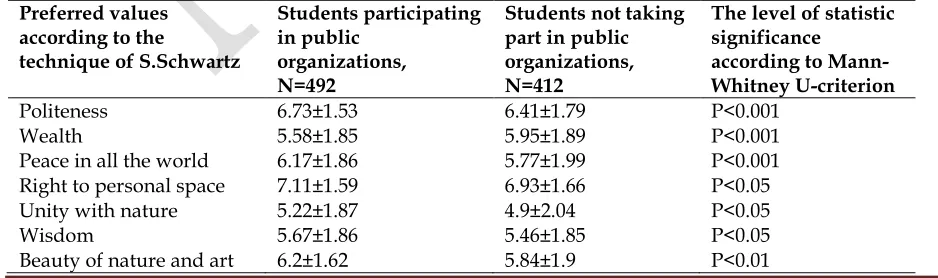
According to the data obtained, the students participating in self-governance feature validly higher scores in the extent of such terminal values as world peace (p<0.001), beauty of nature and art (p<0.01), wisdom (p<0.05), unity with nature (p<0.05), which characterizes the breadth of links with the world, going out beyond the limited "ego" world. They also show higher indices of politeness (p<0.001) and right to personal space (p<0.05), which reflect the intention of socially correct behavior. With regard to this, the value of wealth is validly higher in the students not involved in self-governance, which highlights their orientation to receiving income, yet in not always socially useful spheres of activity. Among the instrumental values, the students participating in self-governance have higher indices of purposefulness (p<0.001), intention to preserve the environment (p<0.001), respect for the elderly (p<0.01), actions for the benefit of others (p<0.01), and significance of faith and religion (p<0.01) – this is quite in line with their terminal value indices given above. Meanwhile, the figure of such value as hedonism is also higher in them (p<0.01), and so is that of acceptance of life (p<0.05). On the one hand, it may give evidence of the involved in self-governance students' having a more pronounced feeling of living a full life. On the other hand, this may mean that they have (just like the students not taking part in organizations) an inherent in today's youth conflict between personal pursuit of pleasures and the necessity of being responsible in social relationships. It characterizes a certain superficial and controversial aspect in relationships with the world, however, with them keeping a positive vector of social and personal development and activity reference point.
The controversial character of relationships with oneself and the world also manifests itself brightly in analyzing the "life activity standard" of students as an integral parameter of their personal orientation (Table 4).
Table 4 Here
It follows from the analysis of the table that the hierarchy of spheres of life activity orientation is clearly the same in the students of the first and the second groups. In both cases, the first place is occupied by the existential ideal, the second – by the vital ideal, and the social ideal ranks so far as third. This means that all students – both the ones involved in self-governance and non-participant ones – are concerned with the meaning of life and death, problems of moral responsibility, loneliness and love to a greatest extent. They view problems of getting pleasure from life, freedom of sexual relations as secondary, and social relationships with other people remain in the background for them.
All three types of "life activity standard" were given validly higher scores by the students participating in self-governance rather than by those not involved in it – both at the real level and at the ideal one, against the high validity of distinctions (p<0,001 in all cases). This means that students participating in self-governance realize their values and ideals more clearly, yet lack a correct hierarchy thereof, even though the general personal orientation is positive. Just like the "not involved ones", the students taking part in self-governance lack a formed attitude to social and public values – it still is in the background with them, though being more pronounced than in the "non-participants".
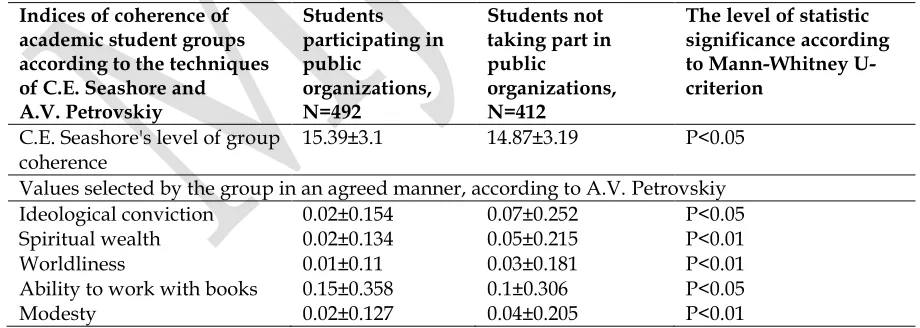
The findings of studying the second level of students organization process represent the estimates of group functioning for academic groups of all respondents and are given in Table 5. The shared positive personal and social orientation of the students participating in public organizations is reflected in a validly higher group coherence index according to C. E. Seashore's technique (Table 5).
The results of estimating the value and orientation unity in A. V. Petrovskiy's technique are not so straightforward, though. The value and orientation unity indices turned out to be higher on a number of values in the students not involved in self-governance, except the ability to work with books (p<0.05).
Table 5 Here
Undoubtedly, the integral index of group coherence confirms higher communicative skills and community spirit in the students participating in organizations, while the content of values, based on which the academic group members' minds meet, does not show such unity. This can be associated with
Modern Journal of Language Teaching Methods ISSN: 2251-6204
Vol. 7, Issue 11, November
2017
Page 16
acquiring the skills of communication with people of different world outlook attitudes by the students involved into public organizations, who have more developed communicative skills, yet feature underformed own world outlook and value and meaning sphere of personality.
Conclusion
Thus, it can be stated that our initial hypothesis was confirmed. The students participating in organizations and in self-governance are more successful in structuring their time, more purposeful, persistent in attaining their goals; they manage their time better; they are less oriented to the present and think more about their plans for the future in comparison with the students not taking part in organizations and self-governance. The former plan their life better, noticing the interconnection between their actions and subsequent events, they change themselves more intensively and they improve their inner world making self-cognition more profound. They have the moral sphere formed to a greater extent, as well as moral and ethic responsibility and the sense of community.
Summing up the research findings, we come to the following conclusion. On the one hand, participation in socially useful organizations is undoubtedly an important factor of students' socialization and acquiring important social and personal qualities. On the other hand, the targeted development of self-organization skills, which is feasible if special upbringing programs are created in higher education institutions, is to enhance the students' motivation for joining socially useful organizations and their creative activity in coming up with new associations useful for the society. This is a systemic process of interaction between the two levels of self-organization: developing personal qualities via upbringing programs is to form motivation for joining organizations, and the experience of participation in the organizations is to form the social skills required. Accordingly, we can conclude that it is essential for higher education institution administrations to create special upbringing programs at the personal level and to render all possible organizational and material assistance for supporting the young students' socially useful initiatives.
References
Abulkhanova, K.A. (2009). Filosofskoye i psikhologicheskoye naslediye S.L. Rubinshteina. [Philosophical and psychological heritage of S.L.Rubinstein.] Psikhologicheskii Zhurnal [The Journal of Psychology], 30(5), 26-45.
Aiken, L.R. (1997). Psychological testing and assessment. Boston: Allyn&Bacon.
Bazhenova, N.G. (2011). Organ studencheskogo samoupravleniya: Organizatsiya ili samoorganizatsiya? [Students self-management union: Organization or self-organization?] Pedagogicheskoe obrazovanie i nauka [Pedagogical Education and Research], 4, 67-72.
Bond, M.J., & Feather, N.T. (1988). Some correlates of structure and purpose in the use of time. Journal of Personality and Social Psychology, 55(2), 321-329.
Fuchs, C. (2006). The self-organization of social movements. Systemic Practice and Action Research, 19(1), 101-137.
Hanson, C. (2014). In search of self: Exploring student identity development. New Directions for Higher Education, no.166. San Francisco: Jossey-Bass.
Korzhova, E.Yu., & Dvoretskaya, M.Ya. (2005). Psikhologicheskaya diagnostika zdorov'ya lichnosti: sub"ektnye i dukhovnye aspekty [Psychological diagnostics of a person’s health: Subjective and spiritual aspects]. Zhurnal Prikladnoy Psikhologii [Journal of Applied Psychology], (6), 11-27.
Mandrikova, E.Yu. (2010). Razrabotka oprosnika samoorganizatsii deyatel'nosti (OSD). [The development of self-organization activity questionnaire (SAQ).] Psikhologicheskaya Diagnostika [Psychological Diagnostics], 2, 59-83.
Petrovskiy, A.V. (1987). Razvitie lichnosti v sisteme mezhlichnostnykh otnosheniy. [The development of the personality in the system of interpersonal relationships.] Sotsial'naya Psikhologiya [Social Psychology]. Moscow: Prosveshchenie.
Modern Journal of Language Teaching Methods ISSN: 2251-6204
Vol. 7, Issue 11, November
2017
Page 17
Porta, D., & Diani, M. (2006). Social movements: An introduction. 2nd edn. Malden: Blackwell.
Roueche, J., & Roueche, S. (1999). High stakes, high performance: Making remedial education work. Washington: Community College Press.
Schwartz, S. H. (1992). Universals in the content and structure of values: Theoretical advances and empirical tests in 20 countries. Advances in Experimental Social Psychology, 25(1), 1-65.
Table 1. Psychological characteristics of activity self-organization in two samples of students
Psychological characteristics of personal self-organization – E.Yu. Mandrikova's techniques Students participating in social organizations, N=492
Students not taking part in social organizations, N=412
The level of statistic significance of
distinctions according to Mann-Whitney U-criterion
Conformity to plan 18.66 ±5.92 17.5±5.69 P<0.001
Purposefulness 35.13±7.85 33.29±7.82 P<0.001
Persistence 23.38±5.28 22.24±5.39 P<0.001
Fixation 20.97±5.12 20.3±5.29 P<0.001
Self-organization 9.86±4.75 8.67±7.0 P<0.001
Total score 116.76±18.79 110.2±19.15 P<0.001
Source: authors' data.
Table 2. Average indices of subject-object orientations in two groups of students
Psychological characteristics of subject and object
orientations according to E.Yu. Korzhova technique
Students participating in social organizations, N=492 Students not taking part in social
organizations, N=412
The level of statistic significance according to Mann-Whitney U-criterion
Total score of subject-object orientations
5.95±2.28 6.21±2.34 P<0.05
Trans-situational changeability 5.47±2.07 5.04±2.09 P<0.01
Trans-situational locus of
control 5.3±2.24 4.73±2.26 P<0.001
Trans-situational focus 5.55±2.32 5.13±2.45 P<0.05
Trans-situational mobility 5.18±2.6 5.41±2.16 P<0.001
Source: authors' data.
Table 3. Comparison of preferred instrumental values in two groups of students (the average score for the group when choosing values)
Preferred values according to the
technique of S.Schwartz
Students participating in public
organizations, N=492
Students not taking part in public organizations, N=412
The level of statistic significance
according to Mann-Whitney U-criterion
Politeness 6.73±1.53 6.41±1.79 P<0.001
Wealth 5.58±1.85 5.95±1.89 P<0.001
Peace in all the world 6.17±1.86 5.77±1.99 P<0.001
Right to personal space 7.11±1.59 6.93±1.66 P<0.05
Unity with nature 5.22±1.87 4.9±2.04 P<0.05
Wisdom 5.67±1.86 5.46±1.85 P<0.05
Beauty of nature and art 6.2±1.62 5.84±1.9 P<0.01
Modern Journal of Language Teaching Methods ISSN: 2251-6204
Vol. 7, Issue 11, November
2017
Page 18
Purposeful, hardworking 6.65±1.72 6.33±1.72 P<0.001
Preserving the nature 5.93±1.82 2.29±3.16 P<0.001
Paying respect to the older people
7.03±1.51 6.88±1.56 P<0.01
Accepting the life 5.25±2.11 5.54±2.02 P<0.05
Useful, working for others' benefit
5.95±1.79 5.56±1.72 P<0.01
Adhering to faith and religious beliefs
4.89±2.22 4.57±2.23 P<0.01
Hedonism 6.00±1.48 5.73±1.53 P<0.01
Source: authors' data.
Table 4. Average values of indices of orientation to different types of life activity ideal in two groups of students
Indices of orientation to a certain type of life activity ideal in M.Ya. Dvoretskaya's technique Students participating in public organizations, N=492
Students not taking part in public organizations, N=412
The level of statistic significance according to Mann-Whitney U-criterion
Vital ideal 23.71 ± 5.177 22.62 ± 5.833 P<0.001
Social ideal 22.17 ± 4.242 20.91 ± 5.102 P<0.001
Existential ideal 24.82 ± 4.591 23.74 ± 5.797 P<0.001
Real vital one 22.23 ± 4.953 20.69 ± 5.265 P<0.001
Real social one 22.13 ± 3.7293 21.24 ± 4.672 P<0.001
Real existential one 23.06 ± 4.488 21.12 ± 5.619 P<0.001
Source: authors' data.
Table 5. Average scores of coherence of academic groups in two samples of the respondents
Indices of coherence of academic student groups according to the techniques of C.E. Seashore and A.V. Petrovskiy Students participating in public organizations, N=492 Students not taking part in public organizations, N=412
The level of statistic significance according to Mann-Whitney U-criterion
C.E. Seashore's level of group
coherence 15.39±3.1 14.87±3.19 P<0.05
Values selected by the group in an agreed manner, according to A.V. Petrovskiy
Ideological conviction 0.02±0.154 0.07±0.252 P<0.05
Spiritual wealth 0.02±0.134 0.05±0.215 P<0.01
Worldliness 0.01±0.11 0.03±0.181 P<0.01
Ability to work with books 0.15±0.358 0.1±0.306 P<0.05
Modesty 0.02±0.127 0.04±0.205 P<0.01
Source: authors' data.
Modern Journal of Language Teaching Methods ISSN: 2251-6204
Vol. 7, Issue 11, November
2017
Page 19
Negrophobia in Faulkner’s Light in August: A Reading through Fanon
Mojgan Abshavi (corresponding author) Assistant Professor
Department of English, Payame Noor University, POBox. 193595-3697, Tehran, Iran
Tayyebeh Gitiforouz MA in English
Department of English, Payame Noor University,Tehran, Iran
Abstract
Faulkner’s Light in August portrays the destroying effects of “negrophobia” on black people. The agony of Faulkner’s protagonist, Joe Christmas, over his racial identity deprives him of his individuality in confrontation with the white race within a society under white domination. Psychic as Joe’s problem is, the questions are where does his problem arise from? Is it a consequence of the un-acknowledgement of his hybridity and his exposure to negrophobia internally and externally? And what is the nature of his relationship with the white woman, as the weakest target of the white society under likely harms by racially mixed men, in this regard? Accordingly, Joe’s identity crisis, regarding what “negrophobia” does to him, will be psychoanalytically highlighted through Fanon’s writings, especially Black Skin, White Masks, a book about the psychic problems of the black in white societies. As such, Joe’s life proves one example among many of the effects of “negrophobia” in Faulkner’s contemporary America. Therefore, Joe’s identity crisis and his developing neurosis about his race lead to his ambiguous love-hate affair with the white woman, finally ending in her murder with his own hands, while his own death by the white man symbolizes the process through which the white gaze turns an originally innocent non-white individual into an evil.
Key Words: Negrophobia, identity crisis, Faulkner, Light in August
Introduction
Frantz Fanon in his outstanding book against racism, Black Skin, White Masks, studies the psychology of racism and dehumanization inherent in situations of colonial domination, especially the colonial domination of black people. According to Fanon, “The Negro enslaved by his inferiority, the white man enslaved by his superiority alike behave in accordance with a neurotic orientation” (2008, 42). By presenting us with a deep psychoanalysis of colonized black people and their inability to fit into the social, cultural, and racial norms of the white society, Fanon believes that “It is the racist who creates his inferior” (2008, 69). “Negrophobia” is the term that Fanon attributes to such condition in a white society, that is, the fear of black people wherever there is a confrontation between the races. Fanon also observes that the European practice of attributing negative characteristics to black people has a negative effect on them, so that their exposure to both colonialism and negative traits causes them to internalize negative ideas about themselves.
“Negrophobia”, if thus implanted within the black psyche, becomes a sort of internalized racism, causing the black individual to think evil of him/herself. Fanon considers the effects of “negrophobia” not only on the individual level, but also on the social level. He holds that “the black man’s alienation is not an individual question. Besides phylogeny and ontogeny stands sociogeny”, or the “question of sociodiagnostics” (2008, 4). In other words, “the juxtaposition of the white and black races has created a massive psychoexistential complex”, in a way that neurotic human beings, of either race, produce nothing more than a neurotic society (2008, 5).
“Negrophobia” leads to black identity crisis. Black people’s identity crisis in a white society has always been an important issue because of racial segregation. The black individual has always had to struggle with the white dominancy and the inferiority complex caused accordingly. As Fanon holds, “We must see
Modern Journal of Language Teaching Methods ISSN: 2251-6204
Vol. 7, Issue 11, November
2017
Page 20
whether it is possible for the black” to overpower their “feeling of insignificance, to rid life of the compulsive quality that makes it so like the behavior of the phobic.” Black people suffer “from an inadequacy in all human communication” which entangles them in “an unbearable insularity” (2008,35), the only escape from which being seemingly to find a way “into the white world” (2008, 36). “Negritude”, or defending black identity, thus remains sterile and “negrophobia” emerges as an escape from blackness even on the part of the black individual. As Fanon remarks,
When the Negro makes contact with the white world, a certain sensitizing action takes place. If his psychic structure is weak, one observes a collapse of the ego. The black man stops behaving as an actional person. The goal of his behavior will be The Other (in the guise of the white man), for The Other alone can give him worth. (2008,119)
As the black sense of “inferiority” is “conscious” (2008, 116), black people live in “an ambiguity that is extraordinarily neurotic” (2008, 148). Therefore, the black individual who is exposed to the white society is either to adapt whiteness and lose his/her identity or claims his/her original identity and fights for “negritude”. If neither happens, the black individual is entangled in an oscillating situation between dreams of whiteness and black codes of honor.
The literary representation of such issues is not infrequent in literature worldwide. One of the most popular novels accordingly is Faulkner’s Light in August (1932), set in the United States and mostly tracing Joe Christmas’ experiences in struggling with his belief that he is part black. As Faulkner weaves together Joe’s story with those of others, he explores the harmful effects of racism on the development of the minds of non-white citizens. Faulkner’s outlook is not alien to the racial problems of the twentieth-century America. “The problem of the twentieth twentieth-century [in America] is the problem of the colorline,” Du Bois wrote in 1903 (1967, 23). The history of racism in America has shown a lifelong “negrophobia” in its society. Racism in America has been a major issue since the colonial era, starting with the exploitation of Indians and still continuing with prejudices against the black. The common thing from the beginning has been the common ignorance of the rights of the non-white, especially African-Americans, although organized efforts by African-Americans to achieve their civil rights developed in the twentieth century. Faulkner was among those writers who elaborated on racism and “negrophobia” throughout his fiction and posed many challenging questions about the covert exploitation of non-white races, especially in Faulkner’s Mississippi. According to Bleikasten, it is undeniable that throughout Faulkner’s life, “Mississippi remained both the poorest and the most backward state in the United States and carried out the most lynchings of all the Southern states” (2017, Chapter 1). As such, blacks were under the subjugation of whites and lynching was still on the run in many places; “a black man named Nelse Patton was hanged in Oxford on September 8, 1908”, an event reflected by Faulkner Light in August (Bleikasten 2017, Chapter 1). Light in August accordingly portrays a range of problems that were typical of mixed races in contemporary America. A re-reading of the novel through Fanon’s opinions can thus be helpful to interpret it to highlight the psychic effect of racial discrimination on the mental state and the life of Faulkner’s Joe Christmas, as he tries to live within a society under racism.
2. Discussion
2.1.1. Fanon and “Negrophobia”
For Fanon, “negrophobia” is a form of “trauma for white people of the Negro” (Kaplan 1999, 153). Fanon created the term “negrophobia” to serve his purpose in analyzing the condition of black people in societies where originally African people are “economically, socially, and politically marginalized”. He believed that “the European practice of attributing negative characteristics to black people and things” had a negative effect on black people’s psyche, and that their exposure both to racism and colonialism caused them “to internalize negative ideas about blacks and objectify themselves” (Brooks 2012, 1). According to Brooks, “negrophobia” in Fanon’s view is “a neurosis typified by the anxious fear and contempt of black people and black culture.” As such, symptoms of “negrophobia” consist of but are not limited to “the attribution of negative characteristics to black people and black things, the fear and hatred
Modern Journal of Language Teaching Methods ISSN: 2251-6204
Vol. 7, Issue 11, November
2017
Page 21
of black men, and the objectification of black women” (2012, 2). “Negrophobia” also implies “the hatred of black people and black culture by black people” themselves, which is in fact “internalized racism” generated by “the trauma of living in a culture that defines blacks as inherently evil” (2012, 2).
Fanon considers “negrophobia” as “a question of a sociodiagnostic” (2008, 4). He describes it as characterizing whole societies, not just individuals. Accordingly, “the black man’s alienation is not an individual question. Besides phylogeny and ontogeny stands sociogeny” which is “a question of sociodiagnostics” (2008, 4), that is, “the juxtaposition of the black and white races has resulted in a massive psychoexistential complex” (2008, 5). In other words, “neurotic humans produce neurotic societies” (Brooks 2012, p. 2).
“Negrophobia” is mostly manifested through the black individual’s encounter with the white society. In Fanon’s view, the black man in a white society would like to be a man like the rest of the white people, “but he knows that this position is a false one”; he has to ask for “permission in the white man’s eyes”, since he is “The Other” (2008, 55). That is why the black man develops “abandonment-neurosis” or the neurosis generated by feeling abandoned by those whom you supposed were your role models (2008, 129). That is when the Negro begins to internalize “negrophobia”, so that he feels dejected at his own existence as a black man. Since the black man wants to resemble the white man, the black man becomes frustrated when he cannot equal the white man at least in appearance, and his “attempts at a hallucinatory whitening” fail (2008, 74). The black man’s “quest for white flesh” (2008, 59), as it is already challenging, puts the black man on fire and “thenceforward he will try to elevate himself to the white man’s level” (Nordey 1939, 32; qtd. in Fanon 2008, 60). In fact, “It is the racist who creates his inferior”, and, therefore, the black man “pays for his own rejection of dependence with an inferiority complex” (Fanon 2008, 69). The black man is covertly forced to form such relations with his superiors in order to escape his inferiority. In Fanon’s words, the white man calls the black man “a parasite on the world” unless he brings himself “as quickly as possible into step with the white world” (2008, 73).
The black man’s “first encounter with a white man” threatens the black man with the “weight of his blackness” (Fanon 2008, 116). On the other hand, the white man has his own fears from the black man. “Negrophobia” in the white man partly originates from a sense of sexual inferiority; the white negrophobic’s hatred of the black man derives from a sense of lacking the black man’s strong sexual powers (McCulloch 2002, 74). This “imago” of the black man in the racist white mind was proved by Fanon’s own clinical experiences, which showed that sexual fantasies developed by the White people have been associated with the figure of the black man (Fanon 2008, 130), and the majority of white men see the black man as the representation of “the sexual instinct” while white women consider the black man “as the keeper of the impalpable gate” to “the realm of orgies” and “delirious sexual sensations” (2008, 136). Fanon holds that the negrophobic white woman is neurotically attracted to the black man as a sexual partner, while the black man dreams of “whiteness” through the white woman:
Out of the blackest part of my soul […] surges this desire to be suddenly white. I wish to be acknowledged not as black but as white.
Now […] who but a white woman can do this for me? By loving me she proves that I am worthy of white love. I am loved like a white man.
I am a white man.
Her love takes me onto the noble road that leads to total realization. . . . I marry white culture, white beauty, white whiteness. (2008, 45)
2.1.2. Fanon and “Negritude”
The first and the most convincing attempt to come to terms with “negritude” was made by Sartre in his essay “Orphée noir”. Sartre’s interpretation of “negritude” influenced all the subsequent interpretations of it, including that of Fanon. Sartre tried to explain the occurrence of black poetry as “the source of Poetry” in the modern era, as “the great black flood, in spite of everything, [that] color[s] the sea into which it pours itself” (Sartre 1948, xi; qtd. in Fanon 2008, 102). Sartre’s approach was an answer to the
Modern Journal of Language Teaching Methods ISSN: 2251-6204
Vol. 7, Issue 11, November
2017
Page 22
question why the European working class cannot produce such artistic work as black poetry. Sartre thus made a clear distinction between the condition of black people and that of the white working class. Although both of these groups are objectively under economical oppressions, black people are more creative because of their internalized racial identities. Sartre also believes that “negritude”, in the subjective sphere, is insufficient in exclusively asserting a future without racial discrimination; it is therefore necessary for negritude to pass into the objective sphere. In his view, the black man “creates an anti-racist racism for himself. In no sense does he wish to rule the world: He seeks the abolition of all ethnic privileges, wherever they come from; he asserts his solidarity with the oppressed of all colors.” So it is necessary that “at once the subjective, existential, ethnic idea of negritude”passes into “the objective, positive, exact idea of proletariat.” He then continues that “it is no coincidence that the most ardent poets of negritude” are simultaneously “militant Marxists.” In other words, Sartre calls the black man to take action instead of craving for a lost world in the past. And he concludes that “negritude is the root of its own destruction, it is a transition and not a conclusion, a means and not an ultimate end” (2008, 102). Fanon strongly objects to Sartre’s view. After reading Sartre’s passage, Fanon asserts that “I felt that I had been robbed of my last chance” (Fanon 2008, 102). And then he continues that
In terms of consciousness, the black consciousness is held out as an absolute density, as filled with itself, a stage preceding any invasion, any abolition of the ego by desire. Jean-Paul Sartre […] has destroyed black zeal. In opposition to historical becoming, there had always been the unforeseeable. I needed to lose myself completely in negritude. (2008, 103)
“Negritude” was of interest to Fanon because it was about the question of personal identity for the black people. However, while in his first and last books Fanon elaborately critiques the “negritude” movement, there is in fact a basic turn in his approach toward the movement “between the years 1952 and 1961” (McCulloch 2002, 36). In fact, Fanon became moresympathetic to “negritude” each time.
In Black Skin, White Masks, A Dying Colonialism,and The Wretched of the Earth Fanon is concerned with the problems of identity and personality of the black people. In Masks, Fanon’s attitude toward “negritude” is paradoxical. He is initially against “negritude” and doubts its ability to defend black identity. He believes that “negritude” cannot counteract colonial racism, that is, black identity cannot be established because of three reasons: (1) claiming “the existence of a black soul” is already rejected in the European mentality; (2) there are no “black values” just as there is no black condition or problem; and (3) there can be “no return to the past” because any development for the black people is merely possible by collaborating with the white people (McCulloch 2002, 37). Yet Fanon holds that “negritude” may be a precondition for black liberation. The belief that black people experience a unique understanding of the world is one of the most basic principles of “negritude”, as Fanon holds:
I am black: I am the incarnation of a complete fusion with the world, an intuitive understanding of the earth, an abandonment of my ego in the heart of the cosmos, and no white man, no matter how intelligent he may be, can ever understand [it]. (2008, 31)
A second principle of “negritude” is the belief in “the Negro values” (2008, 179). Because of the belittlement of the black man’s culture, the black man is driven to promote a set of specific values which are related to racism. These values deviate from the values befitting the black man. Fanon attacks this belief, stating that “My black skin is not the wrapping of specific values” (2008,177). He argues that race and values do not necessarily coincide, and when they coincide the reason is in the social and historical milieu in which the black individual lives. The idea of a common group of “Negro values” in fact originates from white ideology. Thus, rejuvenating a set of “Negro values” may just highlight a racist ideology and thus may not totally work to dismantle the white dominance. Fanon criticizes the effect of this new myth when he says, “I secreted a race. And that race staggered under the burden of a basic element. What was it? Rhythm” (2008, 93), which stands for “an essence shared by peoples of African descent” (Noland 2015, 163). Directly rejecting “negritude”, Fanon thus argues that the element of race is not really relevant to the black man’s sufferings. If there is a common historical experience shared among all blacks, it does not mean that there is just one “Negro” value-system. Fanon holds that “Negro
Modern Journal of Language Teaching Methods ISSN: 2251-6204
Vol. 7, Issue 11, November
2017
Page 23
experience is not a whole, for there is not merely one Negro, there are Negroes” (2008, 104). Moreover, since “negritude” proposes a beneficial return to the past as a prerequisite for freedom from white domination, Fanon holds that the “backward gaze of negritude” leads to “a concern with re-descent into a black soul” and “a preoccupation with the historical achievements of the Negro race”. Fanon is ambivalent about a re-descent; he argues that it represents an embrace of “humanity at its lowest” (2008, 96), which is easily rejected by white racists as it is irrational. As such, the black are looking for something which has no value in the white eye.
Fanon believes that the black can destroy the European image of them through self-purgation. The black can accordingly be free to pursue the path that Fanon favored – a progressive assimilation into the European culture. Wearing a white mask would then be pointless with the disappearance of the “dirty nigger” (Fanon 2008, 21). But Fanon does not attempt to connect this strategy with “negritude”. At the centre of Masks is the belief that the black so far had no choice but trying to adopt the European culture. Any idea about returning to the past is pointless because it has no historical reality and importance for the modern age. Fanon’s most important attack on “negritude” is that it changes nothing in the daily life of the black man. Moreover, “negritude” supporters look for an isolating path which is not really beneficial for black people. Fanon believes that the Negro problem is social and historical, not racial. He writes of the search for the “universal” which inspired so much of the literature of the “negritude” movement (2008,143).
Fanon’s basic criticism of “negritude”, in other words, is that it is abstract. This abstraction appears in gathering all black people under a single group, denying their heterogeneity as individuals. Reiterating the criticisms voiced in Masks and “West Indians”, Fanon in The Wretched of the Earth holds that there is no natural solidarity among black peoples due to race. Movements that promote a cultural renaissance have a tendency to place all blacks into a single category, if only because “the efforts of the native to rehabilitate himself and to escape from the claws of colonialism are logically inscribed from the same point of view as that of colonialism” (Fanon 1967, 170). Fanon thus insists that “There will never be such a thing as black culture because there is not a single politician who feels he has a vocation to bring black republics into being” (1967,188-9). Fanon here reiterates his points in Masks and highlights the fact that “Men of African cultures who are still fighting in the name of African-Negro culture […] should today realize that all their efforts” are “comparisons between coins and sarcophagi” (1967, 188). Furthermore, Fanon keeps a covert distinction between “the objective failings of the negritude movement and its subjective necessity” (McCulloch 2002, 47). Fanon is ambivalent about the necessity of the relationship between “subjective relevance and political progressiveness” (1967, 176). The de-culturing effect of colonialism can lead native intellectuals from hopelessness to assimilate to white society to the adoption of “negritude” and finally to a political commitment. On the other hand, native intellectuals may develop their agony of twin nationalities into the adoption of a universal mentality (1967, 176-177). Accordingly, reviving the native culture can be a good counteraction through which black intellectuals find “some very beautiful and splendid era whose existence rehabilitates us [black people] both in regard to ourselves and in regard to others” (1967, 169). Such renewed encounter between black intellectuals and black folk makes possible an “alliance” between the elite and the peasantry. The return to the source causes important changes in the “psycho-affective” balance of the black intellectual (1967, 168). Freeing him/herself from the pull of the colonialist rule is necessary for the black intellectual. “If it is not accomplished,” Fanon says, “there will be serious psycho-affective injuries and the result will be individuals without an anchor, without a horizon, colourless, stateless, rootless” (1967, 175).
2.2.1. Faulkner and Negrophobia in Light in August
Faulkner grew up in “a nation deeply rooted in ideologies of racial difference” where the “color line” was sharply drawn between the races (Ladd 2007, 133). Ralph Ellison included Faulkner in what he called the “great 19th century moral tradition” which tried to understand the black man as “a rounded human being” and a “symbol of man” (Ellison 1972, 33). Faulkner radicalized “a character’s identity in ways that
Modern Journal of Language Teaching Methods ISSN: 2251-6204
Vol. 7, Issue 11, November
2017
Page 24
call attention to the culturally constructed nature of race and of language’s role in its construction” and knew that “racial epithets” deprive one of its identity and replace it with “a categorizing insult” (Towner 1999, 54).
Light in August (1932) explores “the devastating effects of racism” on people of color (Gale Editors 2007, 124), as depicted by Faulkner. In this study, Faulkner’s arguments in Light in August have been narrowed down to his portrayal of Joe Christmas, who was left to himself because he was recognized to have black blood. Entangled in his racial ambiguity, Joe is consumed with a life-long search for identity and is never able to overcome his loneliness and self-hatred. As he grows up, Joe develops a harsh attitude towards other people as he becomes conscious over his ambiguous racial identity. He tries to live among both white and black communities, but he cannot and thus begins a series of wandering throughout cities. By the end of the novel, completely tired of wandering, Joe takes refuge in Hightower’s house which becomes his death-bed. Psychic as Joe’s problem is, the questions are thus where does his problem arise from? Is it a consequence of the un-acknowledgement of his hybridity and his exposure to negrophobia internally and externally? And what is the nature of his relationship with the white woman, as the weakest target of the white society under likely harms by racially mixed men, in this regard? The conflicts that happen to Joe during the course of his life as a racially mixed man in a white society can thus be categorized into three main parts, having Fanon in mind: the black man in the white society, the black man and the white man, as well as the black man and the white woman.
2.2.2. The Black Man in the White Society
“In America,” Fanon says, “Negroes are segregated. In South America, Negroes are whipped in the streets, and Negro strikers are cut down by machine-guns” (2008, 85). And for the white racist, dealing with the black man is a problem with “Negro-phobogenesis”, meaning that “the Negro is a phobogenic object, a stimulus to anxiety” (2008, 117). In Light in August, “the characters’ failure to recognize the humanity and rights of blacks, coupled with their sense of righteousness” leads to Joe’s persecution and death (Gale Editors 2007, 134).
The people of Jefferson have ignored the blacks who are living on the margins of their town as long as they keep their distance from the white community. Joe thus becomes a threat and subject to punishment when he trespasses their territory. Joe’s story is centered on “the problem of the Negro in Southern society” (Holman 2007, 141). During his life, Joe’s “alienation” is intensified “on the gathering threat” that his presence poses to the white community, a threat finally culminated in Joanna Burden’s death (Porter 2007, 93). Racial identity stands at the core of this threat. Called “nigger” as a child at the orphanage (Faulkner 1990, 122), Joe does not understand that word until the dietitian uses it in upbraiding him when she finds him hiding in her closet and witnessing her affair. If she reveals to the matron of the orphanage that Joe is black, he will have to be sent away to the “nigger” orphanage and her secret will be safe. Thus for Joe, “the ‘woman-smelling’ closet is tied to the word ‘nigger,’ an identification of race and sex” (Porter 2007, 94). Joe thus becomes “racialized as black because this racialization will obfuscate the dietitian’s own guilt” (Dondlinger 1999, 102).
Kidnapped suddenly from the orphanage by the janitor who is in fact his own grandfather, Doc Hines, Joe is eventually adopted by the McEacherns who know nothing of his past. But by that time, at age five, Joe already knows his secret – that he has “some nigger blood” in him (Faulkner 1990, 196). Despite his white skin, Joe is said to be black, not because he is black either in appearance or by heritage, but simply because his grandfather says he is.
Joe literally gets around America on a road that runs “for fifteen years” (Faulkner 1990, 223), which has “much to do with the shaping of his identity” (Dondlinger 1999, 99). When Joe appears in Jefferson at age 33, he has already internalized the opposition between black and white, “so that his identity is secured precisely by that opposition” (Porter 2007, 95). Unable to cooperate with either race, Joe has developed a hostile attitude to both blacks and peoples. If Joe chooses one, as Porter says, “he cannot survive the threat to his singular identity, founded as it is on defiance of both black and white” (2007, 95). For the
Modern Journal of Language Teaching Methods ISSN: 2251-6204
Vol. 7, Issue 11, November
2017
Page 25
racist society, as Faulkner shows in this novel, blacks and whites are not merely two kinds of people; they make a binary pair, each term negating the other. Regarding Joe’s appearance, black and white do not refer to the color of his skin; this opposition is best manifested in the opposition of the white man and the black man. Hearing Lucas Burch call Joe a “nigger,”