Effect of an educational program on nurses' knowledge and
practices toward Hepatitis B virus in emergency hospitals in Erbil
City
Received: 28/3/2013 Accepted: 12/6/2013
Salih A. Abdulla * Zhian Abdulla**
Background and objective: Nurses have major role in prevention and management of hepatitis B. Aim of the study was to find out the effect of an educational program on nurse' knowledge and practices concerning hepatitis B virus.
Methods: A quasi-experimental study was conducted in emergency hospitals, Erbil city, Iraq from 15th of January to 15th of June 2012 involving 50 nurses. Assessment of the knowledge and practices of nurses was carried out by using a questionnaire developed by the researchers. An educational program was designed, constructed and oriented in order to improve the nurses' knowledge and practices towards hepatitis B virus. Post-test was carried out after the educational program using the same (pre program) questionnaire.
Results: The mean (±SD) score of pre test knowledge was 6.96±1.6, while the mean (±SD) score of post test knowledge was 8.4±1.5 (P<0.001). The educational program has significant effects on nurses' knowledge about main function of liver (P<0.001), complica-tions of renal failure (P=0.002), and avoiding sharing needles and syringes (P=0.013). The post test means (±SD) scores for practices (47±2.46) were significantly higher than the pre-test mean score (43.7±5.16). The educational program had effects on advising practice of hand washing before and after using gloves (P=0.01), using solution for hand washing (P=0.003), risk of contamination with patients' bloods and fluids (P=0.04), removing of gown and washing hands (P=0.012).
Conclusion: The educational program played a significant role in some items which could raise the level of knowledge and practices toward prevention of hepatitis B virus.
Keywords: Hepatitis B, Knowledge, Practices, Educational program.
Abstract
*Department of Community Nursing , College of Nursing , Hawler Medical University, Erbil, Iraq. **Department of Community Nursing College of Nursing , Hawler Medical University, Erbil, Iraq.
Introduction
Hepatitis B is a disease caused by the hepatitis B virus (HBV), which is transmit-ted through per-cutaneous or mucosal ex-posure to infectious blood or body fluids1. It is a major problem because it can cause chronic infection, resulting in cirrhosis of the liver, liver cancer, liver failure, and death. In addition, several extra-hepatic lesions occur because of HBV infection, with this, there is deposition of immune complexes in different organs of the body especially, the kidney2. According to the
most recent World Health Organization es-timate, two billion people worldwide have serologic evidence of past or present HBV infection, and 360 million are chronically
prevention of HBV infection: behavior modi-fication to prevent disease transmission, passive immunoprophylaxis, and active im-munization. Changes in sexual practices and improved screening measures of blood products have reduced the risk of transfu-sion-associated hepatitis. Hepatitis B Im-mune Globulin (HBIG) is a sterile solution of ready-made antibodies against hepatitis B. HBIG is prepared from human blood from selected donors who already have a high level of antibodies to hepatitis B and used in passive immunoprophylaxis. Pre-vention of primary infection by vaccination is an important strategy to decrease the risk of chronic HBV infection and its subse-quent complications6. It is important for HCWs to know their HBV status by being screened for the HBV surface antigen (HBsAg) and antibody (anti-HBs), and to be vaccinated against hepatitis B if found to be unprotected. This will protect them from being infected, and prevent them from spreading the virus which can infect pa-tients. The vaccine has been found to be safe and effective, and can protect one for lifetime7. Needle sticks and sharps injuries
represent a significant hazard in profes-sional nursing. Researches also have shown that, between all HCWs, nurses are the ones who sustain a high needle sticks injuries burden8. Up to researchers’
knowl-edge, no previous study was carried out in Erbil to assess the effect of an educational program on nurses’ knowledge and prac-tices regarding hepatitis B. Healthcare pro-fessionals have always been encouraged to update their knowledge and maintain clinical competence. The objective of the study was to find out the effect of educa-tional program on nurses' knowledge and practices concerning hepatitis B virus.
A quasi-experimental study was conducted on 50 nurses out of 300 nurses in emer-gency hospitals which consisted of Central Emergency Hospital (CEH), Eastern gency Hospital (EEH), and Western Emer-gency Hospital (WEH) in Erbil city. The
study started from 15th of January 2012 to
15th of June 2012. Permission for data
col-lection was obtained from Erbil Directorate of Health for conducting the study. Con-venience method of sampling was used to collect the study subjects. The inclusion criteria for nurses were: age between 20 to 50 years, and nurses who didn't receive any related educational program. Verbal consent was taken from all nurses before the start of the study. Assessment of knowledge and practices of nurses was carried out by using a questionnaire de-signed by the researchers. Data were col-lected through direct interview with the nurses through the use of the mentioned questionnaire which consisted of three parts: Part I was related to socio-demographic characteristics of nurses such as age, gender, years of experience, place of work, and educational level. Part II was related to nurses' knowledge towards HBV; this HBV knowledge questionnaire was used to assess nurses' knowledge and practice about hepatitis B virus. It was developed by the researcher based on re-view of literature; it involved 10 items which were concerned with issues of the nurses' knowledge towards hepatitis B virus. These issues included definition of hepati-tis B, liver functions, hepatihepati-tis B symptoms, transmissions of disease; risk factors help to develop disease, complications and uni-versal precautions, prevention, and treat-ment. The researchers used “Yes” or “No” (Score one was given for correct an-swer, score zero for incorrect answer) as a measurement score through interview. Part III was about nurses' practices towards HBV, it consisted of 10 items which were concerned with issues of the nurses' prac-tices towards HBV such as the routine use of appropriate barrier and techniques to reduce the likelihood of exposure to blood, other body fluids and tissues that may con-tain blood borne pathogens in the studied hospitals. The checklist was filled by the researchers during their observation of nurses' practices. An education program was designed, constructed and oriented
with respect to the nurses' knowledge and practices towards hepatitis B virus. The at-tendants were involved 15-20 nurses dur-ing at rest period from 11:00 a.m. to 01:00 p.m. in hall of each hospital. The program was presented through two sessions that lasts for each two hours. The period be-tween implementation of the program and post test was one week. The content of the program was including the following: hepa-titis B overview, hepahepa-titis B transmission and cause, hepatitis B symptoms, hepatitis B, hepatitis B diagnosis, hepatitis B treat-ment, hepatitis B medications and hepatitis B vaccination. Post-test was carried out after the educational program using the same (pre program) questionnaire Statisti-cal analysis: Data were analyzed using the Statistical Package for Social Sciences (SPSS version 15). McNemar test was used to show effects of an educational pro-gram to improve knowledge and practice of nurse toward hepatitis (the test compares proportions before and after the program). Paired t test was used to compare mean scores before and after the application of the educational program. A “P” value of ≤ 0.05 was considered as statistically signifi-cant.
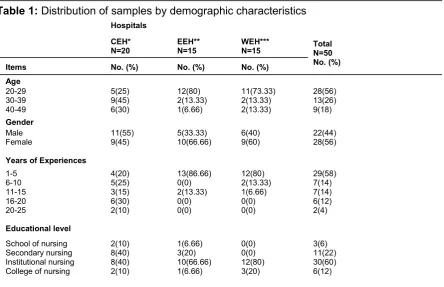
Mean (±SD) score of pre test knowledge was 6.96±1.6, while the mean (±SD) score of post test knowledge was 8.4±1.5 (P<0.001). The post test mean scores for practice (47±2.46) was significantly higher than the pre-test mean score (43.7±5.16) (P<0.001). Table 1 shows that more than half (56%) of the sample aged 20-29 years. Females constituted 56% of the studied sample. The table shows that high propor-tion (58%) of nurses had experience of 1-5 years, and only 4% of the sample had ex-perience of 20-25 years. It is evident in the same table that 60% of the sample was graduates of institutes. Table 2 presents comparisons between the proportions of knowledge about HBV before and after ap-plication of the educational program. There were differences between pre and post test
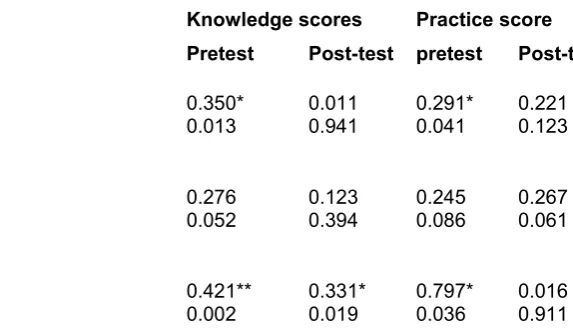
percentages of knowledge regarding func-tion of the liver, definifunc-tion of hepatitis, and complications of the disease (42%, 62%, and 44% on pre test compared to 98%, 86%, and 76% respectively in post test, i.e. after intervention) (P value <0.001, 0.008, and 0.002 respectively). There were also significant improvement in the knowledge about the universal precautions (p = 0.013). Table 3 shows that there were sig-nificant differences between pre and post test percentages of practice regarding hand washing before and after using gloves, and solution used in hand washing (62% and 54% respectively on pre test compared to 94% and 80% respectively in the post test, i.e. after intervention) (P value = 0.02 and 0.002 respectively). Table 4 shows the correlation between total knowledge and practice with some vari-ables in the study group pre and post im-plementation of program. Result present positive statistically significant correlation between pre test of knowledge and prac-tice with age (r=0.350, r=0.291, P value 0.013 and 0.041 respectively). This table also show positive statistically significant correlation between pre test of knowledge and practice with years of experience (r=0.276, r=0.245, P value 0.052 and 0.086 respectively). Same table show positive highly statistically correlation between level of education with knowledge (r=0.421, P value 0.002), while in post test the correla-tion was not highly significant (r=0.33, P=0.019). The table shows that there was significant positive correlation between level of practice with educational level (r=0.797, P value 0.036) while in post test there was no significant correlation be-tween educational level and practices (r=0.016, P value=0.911).
Table 1: Distribution of samples by demographic characteristics
*CEH: Central Emergency Hospital **EEH: Eastern Emergency Hospital ***WEH: Western Emergency Hospital
Table 2: Proportions of nurses’ knowledge about hepatitis B, before and after the educa-tional program
Mean (±SD) score of pre test knowledge 6.96±1.6 Mean (±SD) score of posttest knowledge 8.4±1.5
Items
Pretest N=50
Posttest N=50 P F (%) F (%)
Hepatitis B is a viral infection 39(78) 50(100) NA
Liver secretes bile, stores and filters blood 21(42) 49(98) <0.001
Hepatitis B symptoms include yellowing discoloration of skin and sclera 31(62) 43(86) <0.008
Hepatitis B virus is transmitted by contact with the blood or other body
fluids 35(70) 43(86) <0.07
Sharing needles during intravenous drug use is a risk factor 37(76) 38 (76) 1.0
Chronic hepatitis B can be treated with interferon and anti-viral agents 39(78) 42(84) 0.54
Vaccination is very effective against type B hepatitis 38(76) 41(82) 0.607
Hepatitis B infection can cause kidney failure 22(44) 38(76) 0.002
Hepatitis B can be prevented by avoiding sharing needles and syringes with others
39(78) 41(82) 0.8
Universal precautions refer to the practice of avoiding contact with patients' bodily fluids, by gloves, goggles, and face shields
35(70) 46(92) 0.013
Hospitals
Total N=50 No. (%) CEH*
N=20
EEH** N=15
WEH*** N=15
Items No. (%) No. (%) No. (%)
Age
20-29 30-39 40-49
5(25) 9(45) 6(30)
12(80) 2(13.33) 1(6.66)
11(73.33) 2(13.33) 2(13.33)
28(56) 13(26) 9(18)
Gender
Male Female
11(55) 9(45)
5(33.33) 10(66.66)
6(40) 9(60)
22(44) 28(56)
Years of Experiences
1-5 6-10 11-15 16-20 20-25
4(20) 5(25) 3(15) 6(30) 2(10)
13(86.66) 0(0) 2(13.33) 0(0) 0(0)
12(80) 2(13.33) 1(6.66) 0(0) 0(0)
29(58) 7(14) 7(14) 6(12) 2(4)
Educational level
School of nursing Secondary nursing Institutional nursing College of nursing
2(10) 8(40) 8(40) 2(10)
1(6.66) 3(20) 10(66.66) 1(6.66)
0(0) 0(0) 12(80) 3(20)
Table 3: Proportions of nurses correct practices about general precautions regarding hepatitis B virus, before and after the educational program
Table 4: Correlations of nurses' knowledge score and practice with age, years of experi-ence and educational level
** Correlation is significant at the 0.01 level. Mean (±SD) score of pre test of practice 47±2.46
* Correlation is significant at the 0.05 level. Mean (±SD) score of posttest of practice 43.7±5.16
No Items Pretest Post-test
p
F % F %
1. Hands should be washed before and after patient care. 40 80 41 82 0.08
2. Hands should be washed before and after using gloves. 31 62 47 94 0.02
3. Hands should be washed after contact with blood and
body fluid 36 72 41 82 0.1
4. Gloves should be worn before venipuncture 29 58 44 88 0.10
2
5. Solution should be used for hand washing 27 54 40 80 0.00
2
6. Mask should be worn to protect the nose and mouth. 31 62 41 82 0.07
7. Needles should not be bent before disposal. 31 62 42 84 0.09
8. Immediate actions required for sharp injuries. 30 60 41 82 0.07
9. When there is a risk of being contaminated with a patient’s
blood or body fluids, a gown should be worn. 36 72 36 72 0.06
10 Take off gown and washing hands before leaving patient's environment.
33 66 33 66 0.06
No Items Knowledge scores Practice score
Pretest Post-test pretest Post-test 1. Age
r-value
p-value 0.350* 0.013 0.011 0.941 0.291* 0.041 0.221 0.123
2. Years of Experience r-value
p-value
0.276 0.052
0.123 0.394
0.245 0.086
0.267 0.061
3. Educational Level r-value
The present study shows that the largest proportion of the study samples were among age group 20-29, and the highest proportion (around 60%) has job experi-ence between one to five years, and only 12% of sample has bachelor degree of nursing. Results of current study were agreement with the result of study done by Satekge show that majority of respondents (59.6%) were below 31 years of age9. Knowledge regarding preventive measures plays an important role in hepatitis control, as nurse staff knowledgeable about pre-ventive measures can convey their knowl-edge to the rest of the population which come into contact with them in their day-to-day activities10. The present study showed that knowledge of nurses about HBV and uses of preventive measures was inade-quate before the educational program, and improved after participation in the program especially in items related to functions of liver, definition of hepatitis, and complica-tions of HBV. Similarly a quasi-experimental study conducted by Abou Shady in Mansoura, Egypt involved 50 nurses, found that an increase in staff's knowledge about viral hepatitis and their complication with preventive precautions from pretest to post11. Regarding hand
washing, the present study revealed that nurses practice inadequate frequency of hand washing. Anderson et al. emphasized that hand washing is the most effective way of preventing the spread of infectious dis-eases12. A study done by Knight and
Bods-worth shows that the good practices were also found among nurses in Australia as they put on gloves when handling blood/ blood equipment, urine and feces 13. Re-sults of current study were disagreement with the result of study done by Stein et al. that shows the Australian nurses also wash hands before and after putting on the gloves14. This study indicated that there was a positive significant statistical correla-tion between age and knowledge and prac-tices of nurses' staff pre test (increase
Discussion knowledge and practice with increase age
of nurses). While post test there was no differences statistical correlation between age and both knowledge and practices of nurses this result indicate that the effects of educational program make adjust between nurse knowledge and practice among dif-ference age categories. The Present study also indicated that there was high statistical positive correlation between level of educa-tion and knowledge of nurse pre test. While post test there was no positive correlation in the significant level of 0.01%. This study also shows that there was highly positive statistical correlation between educational backgrounds with level of nurse knowledge regarding HBV (increase knowledge with increase educational background). While post test the correlation was not highly sig-nificant. Regarding practices result of pre-test indicates that the level of practices sig-nificantly increase with the level of educa-tion but effects of an educaeduca-tional program make the correlation not significant in post-test. Similar findings have been reported from Ghahramani et al. showed that there was a significant relationship between knowledge of hepatitis and age, educa-tional level15.
The study concludes that if a need based health education program is developed for different levels of nurses, it definitely leads to improvement in the knowledge and prac-tices of nurses regarding hepatitis B virus. The results of this study showed that edu-cational intervention had a positive impact on knowledge and practice of nurses tow-ered hepatitis B virus. To reduce the occu-pational risk, effort should be focused to establish effective infection control program and training of staff. It is recommended that further research upon hepatitis B virus is needed.
2003; 54(1):68-73.
15. Ghahramani F, Mohammadbergi A, Mohammad-Salehi N. Survey of the Students' Knowledge about Hepatitis in Shiraz University of Medical Sciences. Hepatitis Monthly 2006; 6(2):59-62. References
1. Center for Disease Control: A Comprehensive Immunization Strategy to Eliminate Transmission of Hepatitis B Virus Infection in the United States. Morbidity and Mortality Weekly Report; 2006. 55(RR16):1-25.
2. Koff R. Immunologically mediated extra hepatic manifestations of viral hepatitis. In: Krawitt EL, Wiesner RH, editors. Autoimmune Liver Disease, New York: Raven press; 1991.
3. Shepard CW, Simard EP, Finelli L. Hepatitis B Virus Infection: Epidemiology and Vaccination, Epidemiologic Reviews 2006; 28:112-25.
4. WHO. Hepatitis B, WHO, (Factsheet No. 204), Geneva, (http://www.who.int/mediacentre/ fact-sheets/fs204/en/, 2008 (accessed 9 May 2013). 5. Kermode M, Jolley D, Langkham B, Thomas MS,
Crofts N. Occupational exposure to blood and risk of blood borne virus infection among health care workers in rural north Indian health care settings. Am J Infect Control 2005; 33:34-41.
6. Hou J, Liu Z, Gu F. Epidemiology and Prevention of Review Hepatitis B Virus Infection. Int J Med Sci 2005; 2(1):50-7.
7. South African Vaccination and Immunisation Cen-tre, Clinical Disease hepatitisB. Accessed May 9, 2013. Available from (http://www.savic.ac.za/ dis-ease.php? sub3=88). 2008.
8. Smith DR, Ac Choe M, Jeong J, Jeon MY, Chae YR, An GJ. An epidemiology of needle stick and sharps injuries among professional Korean nurses. J PROF NURS 2006; 22(6):359-66. 9. Satekge MM. Knowledge, attitudes and practices
regarding the prevention of hepatitis B virus infec-tions, in final year college student nurses in gau-teng province. M.Sc. Thesis. University of Lim-popo Medunsa Campus, School of Public Health; 2010.
10. Mohamed SA, Wafa AM. The effective of an edu-cational program on nurse's knowledge and prac-tice related to Hepatitis C Virus: A Pretest and posttest quasi-experimental design. Aust J Basic Appl Sci 2011; 5(11):564-70.
11. Abou Shady, Ibrahim Y, Salem Y. Implementa-tion and evaluaImplementa-tion of educaImplementa-tional program for nurses regarding nosocomial infection control at Mansoura University Hospital. New Egypt J Med 2001; 24(5):226-33.
12. Anderson JL, Warren CA, Perez. Gender and ethnic differences in hand hygiene practices among college students. Am.J Infect Control 2008; 36(5):361-8.
13. Knight VM, Bodsworth NJ. Perceptions and prac-tices of universal blood and body fluid precautions by registered nurses at a major Sydney teaching hospital. J Adv Nurs 1998; 27(4):746-51.