Can Learning Styles, Teaching Styles, and
Teachers' Self-Efficacy Predict Iranian EFL
Students' Language Learning Achievements? A
Structural Equation Modeling Analysis
Reza Khany
1Associate Professor, Ilam University
Hasan Tarlani Aliabadi
PhD candidate in TEFL, Ilam University
Abstract
This paper investigates whether the combined effects of teachers' teaching styles, the teachers' self-efficacy and the learners' learning styles impact on the learners' final achievement. 800 intermediate Iranian English learners filled out the Grasha Learning Styles Inventory (1990) and 144 Iranian English teachers completed the Grasha-Riechmann Teaching Style Inventory (1996) and Tschannen-Moran and Woolfolk Hoy's (2001) Teacher Sense of Efficacy Scale (2001). Structural equation modeling analysis revealed that the variables under study significantly contributed both directly and indirectly to the learners' final achievement. The "efficacy in classroom management" was the most powerful predictor of the learners' achievement reflecting one of the most common learning patterns in Iranian EFL classroom contexts and supporting the path model proposed in the study.
Keywords: Learning Styles, Teaching Styles, Teachers' Self-efficacy,
Learning Achievements, Structural Equation Modeling Received on May 21, 2016
Accepted on December 2, 2016
1. Introduction
Teachers are no longer looked at as solely in terms of transferor of knowledge to learners. Instead, they are considered to be bringing with themselves a wealth of different teaching styles to the classroom which can assist learners in learning language effectively. In other words, no two teachers draw on the same teaching styles. Some give their top priority to
linguistic rules whereas others explain through examples. Some prefer lecturing while others prefer acting out. Still some other teachers place importance to memory while others to understanding. Successful teachers always think of employing innovative teaching techniques which are likely to bring about positive changes in students' behavior. Williams and Burden (2000) argue that teachers boost their students' confidence, motivate them, enhance their self-esteem, and organize an appropriate learning environment. There is enough evidence (Tschannen-Moran, Woolfolk Hoy, & Hoy, 1998; Pajares and Schunk, 2001; Mortiboys, 2005; Atay, 2007) that the teacher's success (which, inter alia, requires the use of appropriate teaching styles) is affected by their perception of self-efficacy. When a teacher has a strong sense of his efficacy and capabilities they can 'work their guts out' for good teaching and burgeon better and better teaching ideas or in the terms of Frederickson (2001) employ 'broad-minded coping skills' (p. 223).
A teacher's efficacy belief is "a judgment of his or her capabilities to bring about desired outcomes of student engagement and learning, even among those students who may be difficult or unmotivated" (Bandura, 1977, as cited in Tschannen-Moran & Woolfolk Hoy, 2001, p. 783). For example, Allinder (1994) argues that teachers with a strong sense of efficacy tend to exhibit greater levels of planning and organization.
660). Or in the words of Brown (2000) learning styles are "consistent rather enduring tendencies or preferences within an individual. Styles are those general characteristics of intellectual functioning (a personality type as well) that pertain to you as an individual and that differentiate you from somebody else" (p. 119). Given the fact that students come to class with diverse abilities and differ in their learning styles and strategies, teachers' awareness of students preferred learning styles can assist them in adjusting their teaching styles aligned with those of the students. This, therefore, enhances students’ chances of engagement, motivation, and collaboration. A plethora of research (Oxford 1990; Oxford & Ehrman, 1993; Sternberg & Zhang, 2001; Wallace & Oxford 1992; Zhang, 2003) shows learners make use of different learning styles when addressing a learning problem, and this can predict students' performance (Ehrman & Oxford, 1995; Reiff, 1992). Teachers need to identify students' preferred learning styles to create better educational situations for them by aligning our teaching styles with those of our students to ensure adequate performance and invent innovative teaching practices. Thus, the conventional notion that 'one size (method) fits all' has begun to fall out of favor with the enlightenment that each individual with their preferred learning styles benefits more from one particular set of teaching styles than from other teaching approaches.
type of experimental finding with several necessary criteria" (Pashler et al., 2008, p. 105) which is judged as a precondition for the validity of matching teaching styles to students' learning styles. Despite a great wealth of research which has investigated the relationships of different individual attributes, the combined effects the variables discussed above in accounting for the learners' final achievement have received little (if any) attention.
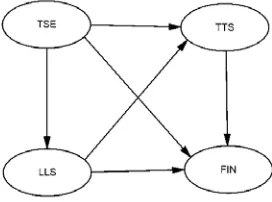
In Iran, a number of studies have reported to investigate correlations among either student variable (e.g., Akbari & Hosseini, 2008) or teacher variables (Moafian & Ghanizadeh, 2009; Rastegar & Memarpour, 2009). For instance, Moafian and Ghanizadeh's study (2009) revealed that three subscales of teachers' emotional intelligence–emotional self-awareness, interpersonal-relationship, and problem solving–were correlated and were good predictors of the teacher's self-efficacy. However, the correlations between teacher and student variables and their joint influences on the students' final achievements in Iranian EFL contexts have received little (if any) attention. Thus, as touched upon earlier, appropriate use of the teaching styles might be influenced by the teachers' perceptions of their self-efficacy and given the fact that teachers' awareness of their efficacy significantly assist them to align their teaching approaches with their learners' learning styles, it provided a sufficient impetus for the present study to investigate whether there are relationships among teachers' teaching styles (TTS), teachers' perceptions of their self-efficacy (TSE) and learners' learning styles (LLS hereafter) and if so, whether they predict as well as impact on the learners' final achievement (FIN).
2. The Initial Proposed Model
Therefore, SEM makes it possible to test cause-effect relationships based on correlational data. In order for the Amos to investigate the correlations among the observed and latent variables, the following hypothetical model is presented based on substantive theories in second and foreign language learning. As discussed above, prior research (e.g., Wallace & Oxford, 1992) indicates a positive correlation between matching TTS with LLS which can significantly enhance the learner's final achievement. With reference to the relationship between the TTS and their TSE, Tschannen-Moran and Woolfolk Hoy (2001) point out that the teacher's efficacy beliefs relate to their behavior in the classroom among which is the kind of teaching styles they employ when they teach. Thus, it is hypothesized that the kinds of teaching styles a teacher chooses to teach is to be influenced positively by their capability to exhibit greater levels of planning and organization. We, therefore, use a one-dimensional arrow to indicate this influence. With regard to the TSE, those teachers who feel capable of engaging their students actively offer innovative ways which encourage the students to exert their maximum effort to capitalize on their in-built syllabuses (Corder, 1967), learning styles and strategies in order to enhance their performances in the class. We, therefore, hypothesize that there be a positive correspondence between the TSE and their students' preferences for particular learning styles. Given this, we use a one-way arrow to show this impact (Fig. 1).
3. Method
3.1 Participants
The first group of the participants was 800 Iranian intermediate English language learners including 456 males (57%) and 344 females (43%) from language institutes in Ilam, a city in the west part of Iran and Tabriz, a city in the northwest of Iran. The language institutes were chosen on the basis of credibility and feasibility. The participants were adult learners ranging in age from 25 to 51 with a mean age of 34.
Also, 144 language teachers including 94 males (65.27%) and 50 females (34.73%) and each majoring in English language teaching with varying years of experiences ranging from 5 (24%), 6 (21%), 7, (11%), 8 (21%) to 9 (23%) years were the second group of the participants who were the teachers of those learner participants included in the study.
3.2 Instruments
Three instruments were used in this study. The Grasha-Riechmann Teaching Style Inventory (1996) describes five teaching styles: (a) expert (EX: one who transmits information), (b) formal authority (FA: one who structures instruction), (c) personal model (PM: one who teaches by examples), (d) facilitator (FC: one who acts as consultant, guides students), and (e) delegator (DE: one who assigns task, teacher as a resource). In this study, the Cronbach alpha values for each subscale's internal consistency were as follows: .86 (EX), .78 (FC), .79 (PM), .67 (FA), and .64 (DE).
for each subscale's internal consistency were as follows: .81 (IND), .77 (DEP), .72 (COM), .69 (COL), .84 (PAR), and .73 (AVO).
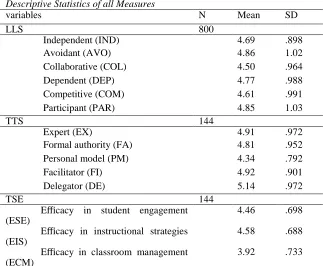
And finally, Tschannen-Moran and Woolfolk Hoy's (2001) 24-item Teacher Sense of Efficacy was employed to gain a fine-tuned understanding of how the teachers in our study are self-efficient in the following categories: efficacy in student engagement (ESE); efficacy in instructional strategies (EIS); and efficacy in classroom management (ECM). In this study, the Cronbach alpha values for each subscale's internal consistency were as follows: .82 (ESE), .79 (EIS), and .84 (ECM). Table 1 indicates the mean and standard deviation of the components based on the data collected from the participants.
Table 1
Descriptive Statistics of all Measures
variables N Mean SD
LLS 800
Independent (IND) 4.69 .898
Avoidant (AVO) 4.86 1.02
Collaborative (COL) 4.50 .964
Dependent (DEP) 4.77 .988
Competitive (COM) 4.61 .991
Participant (PAR) 4.85 1.03
TTS 144
Expert (EX) 4.91 .972
Formal authority (FA) 4.81 .952 Personal model (PM) 4.34 .792
Facilitator (FI) 4.92 .901
Delegator (DE) 5.14 .972
TSE 144
Efficacy in student engagement (ESE)
4.46 .698 Efficacy in instructional strategies
(EIS)
4.58 .688 Efficacy in classroom management
(ECM)
3.92 .733
3.3 Procedures
The teachers were asked to fill in both the Grasha-Riechmann Teaching Style Inventory (1996) and Teacher Sense of Efficacy Scale (Tschannen-Moran & Woolfolk Hoy, 2001). 64 items comprised the two questionnaires (40 items for Grasha-Riechmann Teaching Style Inventory and 24 items for Teacher Sense of Efficacy Scale). They were allowed to take the questionnaires home and submitted them after a week. But the learner participants filled in the Grasha-Riechmann Learning styles in the classroom. The researchers were present in the classroom to respond to the participants' possible questions about the questionnaire. At the end of the semester, they were given an achievement test and their final scores were obtained.
3.4 Data Analysis
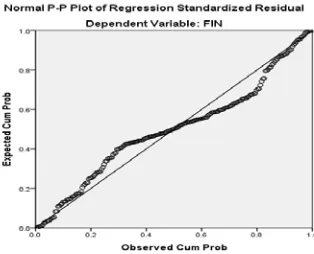
To run the SEM analysis, AMOS 20.0 was used. However, the assumptions of normal distribution and linearity should also be met for the SEM to analyze the proposed model. The results the P-P plot regression standardized residuals indicated our data were normally distributed and the correlation among the variables was linear (Fig. 2). Thus, a Pearson product-moment correlation was applied to explore the relationship among the teachers' teaching styles, their self-efficacy and learning styles. However, to find out which component might have more predictive power in predicting the learners' achievement, a regression analysis was also run.
Several criteria were employed to evaluate the validity of the structural model. Among those were the following: normal fit index (NFI), incremental fit index (IFI), comparative fit index (CFI), and root mean square error of approximation (RMSEA), Root Mean Square Residual (RMR), NonNormed Fit Index (NNFI), Relative Fit Index (RFI). The usually accepted value >.90 on a scale of 0-1.0 for all is generally indicative of good fitness. However, a value of < .05 is considered to be good for RMSE (Table 2).
Table 2
Selected Fit Measures for the Final Model
Index Evaluation Current Level Accepted Level
X2 very good P < .32 P > .05
X2/df very good 1.699 < 3
RMR very good 0.022 > .90
NFI very good 0.94 > .90
TLI very good 0.97 > .90
CFI very good 0.97 > .90
RFI very good 0.93 > .90
IFI very good 0.97 > .90
RMSEA good 0.05 < 0.05
Note. learner participants: 800; teacher participants: 144
3. Results
3.1 Correlation Analyses
Table 3 indicates a number of significant relationships. All the three components of TSE, all the five components of TTS and all the six components of LLS are positively correlated with FIN.
Table 3
Correlations Between the Observed Components of LLS, TTS, TSE and FIN
**p < .01
Learning styles subscales Teacher's self-efficacy and Teaching styles
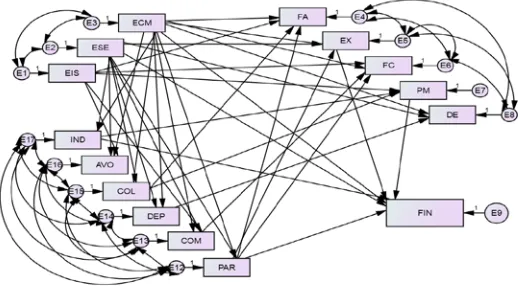
The schematic representation of the final model with standardized path coefficients is presented in Fig. 3. Table 2 shows the overall model fit indices meet the assumptions of the acceptable levels. To begin with, the ratio of the chi-square to degrees of freedom (X2/df) in the present study is 1.699 which is desirable value. Moreover; all the selected model fit indices display very good levels.
Figure 3.The schematic representation of the final model with standardized path coefficients
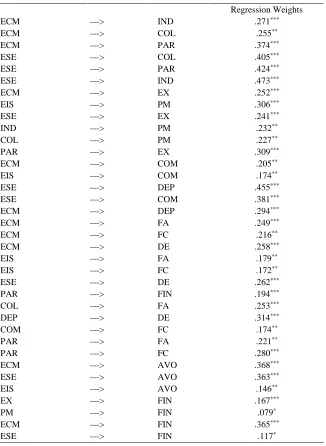
A closer look at the obtained SEM results reveals significant coefficient paths between the components of the latent variables. The model indicated a number of significant impacts. Most specifically, ECM exerted the most significant direct impact on the FIN with PAR, ESE, IND, EX and PM possessing other significant direct effects, respectively (Table 4).
3.2 Mediation Analyses
Table 4
Standardized Regression Weights
Regression Weights
ECM ---> IND .271***
ECM ---> COL .255**
ECM ---> PAR .374***
ESE ---> COL .405***
ESE ---> PAR .424***
ESE ---> IND .473***
ECM ---> EX .252***
EIS ---> PM .306***
ESE ---> EX .241***
IND ---> PM .232**
COL ---> PM .227**
PAR ---> EX .309***
ECM ---> COM .205**
EIS ---> COM .174**
ESE ---> DEP .455***
ESE ---> COM .381***
ECM ---> DEP .294***
ECM ---> FA .249***
ECM ---> FC .216**
ECM ---> DE .258***
EIS ---> FA .179**
EIS ---> FC .172**
ESE ---> DE .262***
PAR ---> FIN .194***
COL ---> FA .253***
DEP ---> DE .314***
COM ---> FC .174**
PAR ---> FA .221**
PAR ---> FC .280***
ECM ---> AVO .368***
ESE ---> AVO .363***
EIS ---> AVO .146**
EX ---> FIN .167***
PM ---> FIN .079*
ECM ---> FIN .365***
3.3 Regression Analyses
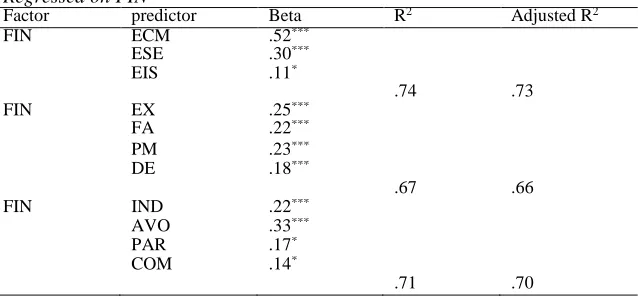
We examined which specific sub-scales of the TSE, TTS, and LLS predicted FIN (Table 5). The results showed that TSE explained 74% of the variance in FIN with ECM, ESE and EIS emerging as significant predictors, respectively. TTS accounted for 67% of the variation in FIN with Ex, PM, FA, and DE emerging as significant predictors. And finally, we found that LLS explained 71% of the variation in FIN.
Table 5
Three Separate Multiple Regression Analyses with TSE, TTS, and LLS Regressed on FIN
Notes. *p < .05. ***p < .001. Learner participants: 800; teacher participants: 144
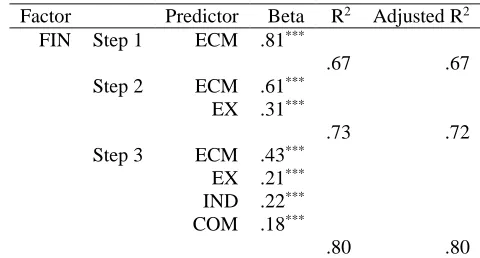
To find out which of the scales accounted for significant variation in FIN over the other, we ran hierarchal multiple regressions (Table 6). In the first step, we entered the three TSE sub-scales that emerged as significant predictors. Then, in the second step, the four significant sub-scales of the TTS were entered. And finally, we entered the four sub-scales of LLS. The results indicated that TSE explained 67% of the variance in FIN (with ECM appearing as significant predictor), TTS explained an additional 6% (with Ex as significant predictor) and finally LLS explained still an additional 7% of the variation in FIN (with IND and COM as significant predictor).
Factor predictor Beta R2 Adjusted R2
FIN ECM .52***
ESE .30***
EIS .11*
.74 .73
FIN EX .25***
FA .22***
PM .23***
DE .18***
.67 .66
FIN IND .22***
AVO .33***
PAR .17*
COM .14*
Table 6
Hierarchical Multiple Regression Analyses with The Significant TSE, TTS, and LLS Regressed on FIN
Factor Predictor Beta R2 Adjusted R2 FIN Step 1 ECM .81***
.67 .67
Step 2 ECM .61*** EX .31***
.73 .72
Step 3 ECM .43*** EX .21*** IND .22*** COM .18***
.80 .80
Notes. ***p < .001. Learner participants: 800; teacher participants: 144
4. Discussion
Second, results from our mediation analyses revealed that instructors who were efficient, more particularly, in student engagement (ESE) and classroom management (ECM) encouraged their learners to develop participant and independent learning styles to process information thoughtfully.
Third, teachers who were efficient in ECM adopted EX teaching style which subsequently affected positively the participants’ FIN. In fact, this supported Tschannen-Moran and Woolfolk Hoy's (2001) assertion that the teacher’s efficacy beliefs relate to their behavior in the classroom in that they impact on the effort the learners might invest in learning, and their degree of engagement.
Forth, as shown in Table 3, all the observed components of TTS, TSE and LLS were positively correlated with FIN though the strength of the correlations differed. This is consistent with both the premise that all these styles (both of teachers and learners), though to varying degrees, have some value on students' final achievement and also support Ehrman and Oxford's (1990) considerations that learners learn effectively when they are allowed to learn by way of inherent preferences for how they engage themselves in the learning process.
establish discipline to keep the students engaged in the class. There is no reservation that when the learners feel that their teachers are not capable enough to establish discipline in the class and they keep being interrupted by other students, they have their attention diverted away from what is taught in the class. This finds importance when it comes to the Iranian EFL contexts where most of the learning takes place in the class. The reason is that one preferred learning practice is that Iranian students indicate little predilection to refer to any other resources than their teachers. Therefore, when the learners are deprived of this opportunity (the opportunity to learn in the class), they find themselves performing poorly.
5. Conclusion
Overall, the results revealed that the inter-correlation between LLS, TTS, and TSE could explain 80% of the variance in the FIN of the participants. Of these, the TSE was the most powerful predictor of the FIN implying that teachers should never be looked at functioning as solely displaying authority and transferring knowledge. Rather, the present study highlighted the importance of the teacher and what other teaching styles and strategies transferring knowledge they actually bring with themselves to the class. Research shows that the more the TSE is higher and the more TTS and LLS are in alignment with one another, the more likely they motivate the learners and enhance their final success. Thus, taking Pashler et al.'s caveat into account, we suggest that syllabus designers, language programmers as well as instructors need to identify the students' preferred learning styles, teachers' teaching styles and then align teachers' teaching styles with those of students. This will, in turn, create better educational situations and ensure adequate performance.
FIN. Future research could further our comprehension of the complex nature of academic achievement by examining other variables such as motivation and personality types. Thus, it warrants separate studies to examine other individual teacher and learner as well as environmental factors such as socioeconomic statuses of participants as predictors of academic achievement.
Because this is the first study in an Iranian EFL context examining the combined correlations among TTS, TSE, LLS and effects of their interrelations on FIN, the results should be treated with caution. The reason is that more studies are needed to replicate the study with other learners and teachers both in Iran and with learners and teachers from other L1 backgrounds to see whether similar results are obtained.
References
Akbari, R. & Hosseini, K. (2009). Multiple intelligences and language learning strategies: Investigating possible relations. System, 36, 141-155. Allinder, R. M. (1994). The relationship between efficacy and the
instructional practices of special education teachers and consultants. Teacher Education and Special Education, 17, 86–95.
Ashton, P. T., & Webb, R. B. (1986). Making a difference: Teachers' sense of efficacy and student achievement. New York: Longman.
Atay, D., (2007). Beginning teacher efficacy and the practicum in an EFL context. Teacher Development 11(2), 203–219.
Bandura, A. (1977). Self-efficacy: Toward a unifying theory of behavioral change. Psychological Review, 84, 191–215.
Bandura, A. (1997). Self-efficacy: The exercise of control. New York, NY: W. H. Freeman.
Brown, H. D. (2000). Principles of language learning and teaching. Longman University Press.
Corder, S. (1967). The significance of learners' errors. National Review of Applied Linguistics, 5, 161-167.
Dornyei, Z. (2007). Research methods in applied linguistics. Oxford: Oxford university Press.
Ehrman, M. E., & Oxford, R. L., (1995). Cognition plus: Correlates of language learning success. Modern Language Journal 79(1), 67–89. Ellis, R. (2009). The study of second language acquisition. Oxford: Oxford
University Press.
Felder, R. M. (1995). Learning and teaching styles in foreign and second language education. Foreign language annuals, 28(1), 21-31.
Frederickson, B. L. (2001). The role of positive emotion in positive psychology: the broadening and-build theory of positive emotion. American Psychology 56, 218–226.
Grasha-Riechmann, A. F. (1996). Teaching with style: A practical guide to enhancing learning by understanding teaching and learning styles. San Bernadino: Alliance Publishers.
Grasha, A. F. (1990). Using traditional versus naturalistic approaches to assessing learning styles in college teaching. Journal on Excellence in College Teaching, 1, 23-38.
Grasha, A. F. (2002). Teaching with style. Pittsburgh. PA: Alliance Publishers.
Klassen, R. M., Bong, M., Usher, E. L., Chong, W. H., Huan, V. S., Wong, I. Y. F., & Georgiou, T. (2009). Exploring the validity of a teachers' self-efficacy scale in five countries. Contemporary Educational Psychology, 34, 67–76.
James, W. B. & Blank, W. E. (1993). Review and critique of available learning-style instruments for adults. New directions for adult and continuing education, 59, 47-57.
Lockhart, D., & Schmeck, R. R. (1984). Learning styles and classroom evaluation methods: different strokes for different folks. College Student Journal, 17, 94–100.
Moafian, F., & Ghanizadeh. A. (2009). The relationship between Iranian EFL teachers’ emotional intelligence and their self-efficacy in language institutes. System, 37, 708 718.
Moore, W., & Esselman, M. (1992, April). Teacher efficacy, power, school climate and achievement: A desegregating districts experience. Paper presented at the annual meeting of the American Educational Research Association, San Francisco.
Mortiboys, A., (2005). Teaching with emotional intelligence: A step-by-step guide for higher and further education professionals. Routledge: London. Oxford, R. L. (1990). Missing link: Evidence from research on language
Oxford, R. L., & M. E. Ehrman. (1993). Second language research on individual differences. Annual Review of Applied Linguistics 13, 188-205. Pajares, F., & Schunk, D. (2001). Self-beliefs and school success: self-efficacy, self-concept, and school achievement. In R., Riding, & S. Rayner (Eds.), Perception (pp. 239–266). London: Ablex Publishing. Pashler, H., McDaniel, M., Rohrer, D., & Bjork, R. (2008). Learning styles:
Concepts and evidence. Journal of the Association for the Psychological Science, 9(3), 105–119.
Reiff, J., (1992). Learning styles (what research says to the teacher). Washington, DC.: National Education Assn.
Ross, J. A. (1992). Teacher efficacy and the effect of coaching on student achievement. Canadian Journal of Education, 17(1), 51–65.
Smith, L. H., & J. S. Renzulli. (1984). Learning style preferences: a practical approach for classroom teachers. Theory into Practice 23, 44-50.
Sternberg, R. J., & Zhang, L.-F. (Eds.). (2001). Perspectives in thinking, learning, and cognitive styles. Mahwah, NJ: Erlbaum.
Tschannen-Moran, M., Woolfolk Hoy, A., & Hoy, W. K., (1998). Teacher efficacy: Its meaning and measure. Review of Educational Research 68, 202–248.
Tschannen-Moran, M., Woolfolk Hoy, A., (2001). Teacher efficacy: capturing and elusive construct. Teaching and Teacher Education, 17, 783–805.
Tschannen-Moran, M., & Barr, M. (2004). Fostering student achievement: The relationship between collective teacher efficacy and student achievement. Leadership and Policy in Schools,3, 187–207.
Wallace, B., and R.L. Oxford. (1992). Disparity in learning styles and teaching styles in the ESL classroom: Does this mean war? AMTESOL Journal 1, 45-68.
Williams, M., & Burden, R., (2000). Psychology for language teachers: A social constructivist approach. Cambridge: Cambridge University Press Zhang, L. (2003). Does the big five predict learning approaches? Personality