
Comparative Life Table Parameters of the Beet Armyworm, Spodoptera exigua (Hübner) (Lepidoptera, Noctuidae) on Five Host Plants
12
0
0
Full text
(2) 92. FARAHANI, S., NASERI, B., TALEBI, A. A.. limitation of food ingested is important in regulating insect populations (Umbanhowar & Hastings, 2002) as the performance of insects may be affected by variation in host plant (Awmack & Leather, 2002). Larval survival and development can be reduced on poor-quality hosts due to nutritional composition and/or secondary plant metabolites (Herms & Mattson, 1992; Slansky, 1992). Nutritional composition and secondary plant metabolites vary among different plants, plant parts and developmental stages (Nelson et al., 1981; Brower et al., 1982). Different host plants can also play an important role in population increase and outbreaks of polyphagous insect pests (Singh & Parihar, 1988). The outbreak of S. exigua is not regular but develops quickly and since older larval instars are difficult to control with insecticides, early cautioning of population build up is necessary to effective intervention (Tisdale & Sappington, 2001; Idris & Emelia, 2001). It was reported that S. exigua larvae have developed resistant to nearly all pesticides used to its control (Ray et al., 1996). Population parameters are important in the measurement of population growth capacity of species under specified conditions. These parameters are also used as indices of population growth rates responding to selected conditions and as bioclimatic indices in assessing the potential of a pest population growth in a new area (Southwood & Henderson, 2000). The intrinsic rate of increase (rm) is a functional ecological parameter and to predict the potential of population growth of an animal under a given environmental condition (Andrewartha & Birch, 1954; Ricklefs & Miller, 2000;). The rm can be estimated from life table data under standardized laboratory conditions (Southwood & Henderson, 2000). A number of extrinsic and intrinsic factors have been shown to influence the rm value and related demographic parameters. These include temperature, geographical origin of insect and host plant species/cultivars (Gilbert & Raworth, 1996; Syed & Abro, 2003). Several researches have evaluated host plant influences on life history traits of S. exigua (Greenberg et al., 2001; Azidah & Sofian-Azirun, 2006; Saeed et al., 2009) or studied the effect of the insect feeding on population growth potential (Afify et al., 1970; East et al., 1989; Meade & Hare, 1991; Tisdale & Sappington, 2001). However, published information by above-mentioned researchers has been variable. Therefore, the objectives of the present study were to investigate the life table parameters of S. exigua reared on different host plants to determine whether various host plants have similar effects on these population parameters of S. exigua.. MATERIALS AND METHODS Host plants Seeds of the four host plants including Zea mays (L.) var. 704 (Poaceae); Gossypium hirsutum L. var. Varamin (Malvaceae); Brassica napus L. var. RGS (Brassicaceae) and Glycine max (L.) Merr. var. Sahar (Fabaceae) were acquired from the Plant and Seed Modification Research Institute of Karaj, Iran and were grown in the research field of Tarbiat Modares University in suburbs of Tehran, Iran. The weed species, Chenopodium album L. (Chenopodiaceae), which is commonly found.
(3) Comparative Life Table Parameters of the Beet Armyworm. 93. in the fields was selected and used in the experiment. For this study, the leaves of five host plants were transferred to a growth chamber at 26 ± 1°C, 60 ± 5% RH and a photoperiod of 16:8 (L:D) h and used for feeding of different larval stages. Insect colony Originally, S. exigua specimens were collected from the beet fields located in the northwestern of Iran. Cultures were reared on each host plant for a whole generation (from eggs to adult emergence) in a growth chamber under given conditions to allow them to adapt to the new host plants, as the population was collected from the beet fields, and to remove maternal effects (Lacey, 1998). They were maintained inside a growth chamber at 26 ± 1°C, 60 ± 5% RH and a photoperiod of 16:8 (L:D) h. Experiments The same aged eggs (within 12 h) of S. exigua were taken from the adult moths, which had already been reared for a whole generation on each host plant using a small brush and placed in Petri dishes (8.5 cm. diameter and 3 cm. height) on a leaf of each host plant. The number of eggs used to start the experiment on host plants was 90, 100, 70, 100, and 70 eggs, respectively. The petioles of detached leaves were inserted in water-soaked cotton to maintain freshness. To facilitate aeration, lids of Petri dishes were covered with fine nylon mesh. After emergence of neonate larvae, they were transferred individually into plastic Petri dishes (8.5 cm. diameter and 3 cm. height) with a hole covered by a fine mesh net for aeration, containing the fresh leaves of different examined plants. Head capsules or exuviae from moulting larvae were used for discrimination of larval instars. The regular checking of Petri dishes were continued until all adults emerged or pupae died. The daily survival/mortality was recorded for all immature stages and ultimate instar larvae were kept in plastic containers (3 cm. diameter and 5 cm. height) for pupation. Larval and pupal periods were also recorded on different host plants. The newly emerged adult females were transferred to separate cages (11 cm. diameter and 12 cm height) and one male added to each cage for mating. The host plant leaves were replaced with new ones every day and the number of eggs laid by individual females was recorded daily. For this purpose, the male and female moths were placed in a new cage, then all deposited eggs on a host plant leaf and inner walls of cage (as oviposition substrates) were counted daily. A small cotton wick soaked in 10% honey solution was placed in the cages to provide a source of carbohydrate for adult feeding. Daily monitoring continued until death of females. To obtain sex ratio on each host plant, deposited eggs that produced on the related host plants foliage were maintained until adult moths’ emergence. Data analysis The data resulted from the effects of different host plants on development time, oviposition period, fecundity and adult longevity of S. exigua were subjected to the one-way analysis of variance (ANOVA) using the statistical software Minitab 15. The population growth parameters were calculated using formulae suggested by Carey (1993): intrinsic rate of increase (rm), mean generation time (Tc), finite rate of.
(4) FARAHANI, S., NASERI, B., TALEBI, A. A.. 94. increase (λ), net reproductive rate (R0) and doubling time (DT). All terminology and formulae for computing demographic parameters are consistent with Carey (1993). For example, the intrinsic rate of increase (rm) of S. exigua on different host plants was estimated using the following equation (Birch, 1948): β. ∑α e. − rm x. x=. l x mx = 1. The jackknife procedure was used to estimate the variance for rm and the other population parameters (Meye et al. 1986). It is based on repeated recalculation of the required estimator, missing out each sample in turn (Maia et al. 2000). Effect of host plant species on different parameters was analyzed using one-way ANOVA. If significant differences were detected, multiple comparisons were made using the Student-Newman-Keuls (SNK) (P < 0.05). Statistical analysis was carried out using Minitab 15.. RESULTS Development time, adult longevity and life span The data of the development time of immature stages, adult longevity and life span of S. exigua reared on different host plants are given (Table 1). There was no variation in the incubation period of S. exigua on different host plants. Larval and pupal periods, development time of immature stages, and life span of S. exigua indicated significant differences among the host plants tested. The larval period, pupal period, development time and life span were longest on G. hirsutum (P < 0.01). However, the shortest larval period, development time of the immature stages and life span of this insect was on B. napus (P < 0.01). Furthermore, the shortest pupal period was on B. napus and G. max for males and females (P < 0.01). Oviposition period and fecundity Oviposition period and fecundity of S. exigua adults developed from the larvae fed on different host plants are shown in Table 2. The pre-oviposition period of S. exigua was significantly different among host plants tested (P < 0.01), but oviposition period and post-oviposition period were not significantly affected by different host plants. The longest pre-oviposition period was on G. hirsutum (4.15 days), whereas the shortest one was on B. napus (2.65 days). The fecundity of S. exigua female (total number of eggs laid per female) is given in Table 2. Different host plants as larval food significantly influenced the total number of eggs produced per female (P < 0.01). The highest number of eggs laid was 948.0 eggs on B. napus and the lowest number of eggs was 426.3 eggs on G. hirsutum. Population growth parameters The population growth parameters of S. exigua on five host plants are given in Table 3. There were significant differences in the net reproductive rates (R0) of S. exigua on different host plants (P < 0.01). The highest R0 value was on C. album.
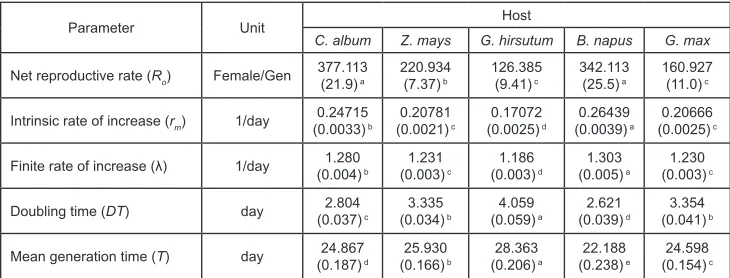
(5) Comparative Life Table Parameters of the Beet Armyworm. 95. Table 1. The mean (±SE) duration of development stages and adult longevity of Spodoptera exigua on different host plants under laboratory. Stage. Host C. album. Z. mays. G. hirsutum. B. napus. G. max. Incubation period (d). 3.00±0.00a. 3.00±0.00a. 3.00±0.00a. 3.00±0.00a. 3.00±0.00a. Larval period (d). 12.53±0.13d. 14.91±0.17b. 15.50±0.15a. 11.98±0.14e. 13.10±0.17c. 12.45±0.15. 15.00±0.25. 15.58±0.24. 11.87±0.22. c. 12.74±0.25b. Male Female Pupal period (d) Male. bc. a. a. 12.76±0.25b. 14.83±0.24b. 15.43±0.19a. 12.08±0.18b. 13.41±0.22b. 7.00±0.62. b. 7.02±0.13. b. 8.70±0.11. a. 6.69±0.09. c. 6.66±0.08c. bc. 7.54±0.18. b. 9.11±0.13. a. 7.00±0.13. c. 7.00±0.11c. 7.40±0.09. Female. 6.70±0.10b. 6.59±0.13b. 8.32±0.15a. 6.42±0.11b. 6.37±0.10b. Development time (d). 22.64±0.17. c. 24.93±0.22. b. 27.22±0.20. a. 21.63±0.16. d. 22.76±0.18c. Male. 22.83±0.19. c. 25.54±0.30. b. 27.69±0.30. a. 21.83±0.25. d. 22.74±0.29c. Female. 22.45±0.28c. 24.41±0.29b. 26.79±0.25a. 21.46±0.20d. 22.78±0.24c. 13.47±0.42. 13.69±0.52. a. 11.72±0.47. b. 12.49±0.57. 12.37±0.42ab. 12.25±0.08. a. 10.58±0.59. a. 12.04±1.04. Adult longevity (d). ab. ab. Male. 12.83±0.65. Female. 14.10±0.52a. 14.93±0.65 a. 12.79±0.66 a. 12.88±0.58 a. 13.03±0.61a. 36.33±0.44. b. 38.42±0.53. a. 38.94±0.45. a. 34.12±0.56. c. 35.15±0.41bc. bc. 37.79±0.74. ab. 38.31±0.65. a. 33.87±0.95. c. 34.33±0.55c. 34.35±0.65c. 35.84±0.57bc. Life span (d) Male Female. 35.87±0.67. a. 36.80±0.58b. 38.93±0.75a. 39.54±0.62a. a. 11.59±0.52a. The means followed by different letters in the same rows are significantly different (P < 0.01, SNK) Table 2. The mean (±SE) pre- and post-oviposition and oviposition periods and fecundity of Spodoptera exigua on different host plants Parameter. Host C. album. Z. mays 3.80±0.19. a. 8.00±0.47. a. G. hirsutum. B. napus. 4.15±0.18. a. 6.55±0.53. a. G. max. 2.65±0.21. b. 3.55±0.15a. 8.50±0.53. a. 7.40±0.53a. Pre-oviposition period (d). 2.95±0.20. b. Oviposition period (d). 7.80±0.34. a. Post-oviposition period (d). 2.35±0.49a. 2.50±0.49a. 1.45±0.38a. 1.85±0.41a. 1.25±0.29a. Fecundity (egg/female). 865.9±50.4. 620.6±21.6. 426.3±31.7. 948.0±71.3. 503.1±34.3bc. a. b. c. a. The means followed by different letters in the same rows are significantly different (P < 0.01, SNK). (377.11 female/female/generation), whereas the lowest value was on G. hirsutum (126.39 female/female/generation). The intrinsic rate of increase (rm) was also found to be significantly different on various host species (P < 0.01). The rm value ranged from 0.1707 to 0.2644, which was the highest on B. napus and lowest on G. hirsutum. The highest value of finite rate of increase (λ) was on B. napus (1.303 day -1). However, the lowest value was on G. hirsutum (1.186 day -1). The doubling time (DT) was also found to be significantly different on various host plants, which was the longest on G. hirsutum (4.059 days) and shortest on B. napus (2.621 days). The mean generation time (Tc) was significantly (P < 0.01) different on host plant species, which showed longest generation time on G. hirsutum (28.363 days) and shortest on B. napus (22.188 days) (Table 3)..
(6) FARAHANI, S., NASERI, B., TALEBI, A. A.. 96. Table 3. The mean population growth parameters (SE) of Spodoptera exigua on different host plants under laboratory. Parameter. Unit. Host C. album. Z. mays. G. hirsutum. B. napus. G. max. Female/Gen. 377.113 (21.9) a. 220.934 (7.37) b. 126.385 (9.41) c. 342.113 (25.5) a. 160.927 (11.0) c. Intrinsic rate of increase (rm). 1/day. 0.24715 (0.0033) b. 0.20781 (0.0021) c. 0.17072 (0.0025) d. 0.26439 (0.0039) a. 0.20666 (0.0025) c. Finite rate of increase (λ). 1/day. 1.280 (0.004) b. 1.231 (0.003) c. 1.186 (0.003) d. 1.303 (0.005) a. 1.230 (0.003) c. Doubling time (DT). day. 2.804 (0.037) c. 3.335 (0.034) b. 4.059 (0.059) a. 2.621 (0.039) d. 3.354 (0.041) b. Mean generation time (T). day. 24.867 (0.187) d. 25.930 (0.166) b. 28.363 (0.206) a. 22.188 (0.238) e. 24.598 (0.154) c. Net reproductive rate (Ro). The means followed by different letters in the same rows are significantly different (P < 0.01, SNK). Data in the parenthesis are standard error of the means.. DISCUSSION The role of host plants, especially food limitation, is an important factor in regulating insect populations (Umbanhowar & Hastings, 2002) as the life cycle characteristics of herbivores may be affected by variation in host plant traits (Awmack & Leather, 2002). For example, the life history parameters such as fecundity, longevity and survival may be influenced by the variation in host plant quality (Awmack &d Leather, 2002). The present study demonstrated that the life table parameters of S. exigua were significantly differed on the five host plants tested. In regard to insect-plant interactions, it is useful to determine the effect of the different host plants/cultivars on the performance of herbivorous (Azidah & Sofian-Azirun, 2006; Saeed et al., 2009). Since there was no variation in egg incubation period (3.00 days) of S. exigua on five host plants tested, this indicated that host plant type did not affect normal egg hatch. Azidah and Sofian-Azirun (2006) & Sivapragasam and Syed (2001) also found the incubation period of S. exigua to be 3 days, but Afify et al. (1970) and Ahmed et al. (1997) stated that this parameter was between 2 to 3 days and 2.8 to 3.1 days, respectively. The current research showed that the development time of S. exigua, which had been fed during the larval stage on different hosts was affected by the host plant species. This result is supported by Azidah & Sofian-Azirun (2006). The larval period (for male and female) was longest on G. hirsutum (15.50 days) and shortest on B. napus (11.29 days). According to the reports by East et al. (1989), Meade & Hare (1991) and Berdegue et al. (1998) the larval period of S. exigua was 39.3 days on cabbage at 25 °C, 13.7 to 18.5 days on celery depending upon cultivar at 26 °C, and 21.3 days on common weed (Chenopodium murale L.) at 28 °C, respectively. These variations might be due to either the variability of nutritional quality and quantity of the host plant species (Bernays & Chapman, 1994), differences in experimental conditions especially temperature or age differences within a plant (Wada, 1979), which increase the incidence of additional moults (Azidah & Sofian-Azirun, 2006)..
(7) Comparative Life Table Parameters of the Beet Armyworm. 97. There were five larval stages of S. exigua on all host plants tested. This situation has been previously reported by several researchers (Afify et al., 1970; Anwar et al., 1996; Sivapragasam & Syed, 2001). However, Afify et al. (1970) and Anwar et al. (1996) stated that occasionally there were six larval instars, and Ali & Gaylor (1992) reported that there were seven larval instars. The pupal period was also affected by the larval host plant that it has been observed by Azidah & Sofian-Azirun (2006). However, it is not in consistency with the results of Berdegue et al. (1998) and Idris & Emelia (2001). These differences might be because of different host plants or different plant parts consumed by the larvae, which may be very different in primary and secondary biochemicals. The pupal period of S. exigua varied from 6.66 days on G. max to 8.70 days on G. hirsutum. According to the literature, pupal period of S. exigua was 7.5 days on celery (Berdegue et al., 1998) and 9.02 to 10.21 days on shallot and lady’s finger, respectively (Azidah & Sofian-Azirun, 2006). The development time of immature stages reared on each host plant species ranged from 21.63 days on B. napus to 27.22 days on G. hirsutum. Ali & Gaylor (1992) reported that S. exigua larvae had longer development time and required a greater number of stadia when reared on cotton, G. hirsutum compared with artificial diet or pigweed, Amaranthus hybridus L. (Amaranthaceae), a preferred wild host (Taylor, 1931). Longer development time of S. exigua on G. hirsutum may allow longer windows of expedient for using natural enemies in biological control programs (Saeed et al., 2009). Based upon Greenberg et al. (2001), development time of S. exigua varied from 20.2 days on A. retroflexus to 26.6 days on pepper Capsicum annuum L. (Solanaceae). These findings are almost in agreement with our results on the development time of S. exigua reared on different host plants. Adult male and female longevities of S. exigua fed on five host plants were not significantly different, which is not in agreement with the findings of some researchers (Azidah & Sofian-Azirun, 2006; Saeed et al., 2009). Azidah & Sofian-Azirun (2006) noted that there was no difference in adult longevity reared on different host plants. However, there was a difference in the female and male longevity, where both adult females and males reared on lady’s finger, and females on long beans lived longer than males reared on cabbage (Azidah & Sofian-Azirun, 2006). Females reared as larvae on B. napus produced the highest number of eggs (948.0 eggs per female) as compared to the other hosts. The lowest number of oviposited eggs was recorded from females reared as larvae on G. hirsutum (426.3 eggs per female). The variation in S. exigua response has previously been shown to be attributed to the host plants and the conditions under which the plants were grown (Greenberg et al., 2001). Abdullah et al. (2000) reported that S. exigua produced 472.5 eggs on soybean leaf. Sethi et al. (2006) reported that fecundity of S. exigua on Valmaine and Tall Guzmaine cultivars of lettuce was 123.2 and 383.6 eggs, respectively. Differences between our study and the results of above-mentioned researchers might be as a resulted of host plant differences. The population growth parameters of S. exigua vary considerably depending on various factors such as host plants and environmental conditions (Greenberg et al.,.
(8) 98. FARAHANI, S., NASERI, B., TALEBI, A. A.. 2001; Tisdale & Sappington, 2001). In the present study, the values of the intrinsic rate of increase (rm) of S. exigua varied from 0.1707 on G. hirsutum to 0.2644 on B. napus, suggesting the least suitability of the cotton as a host plant for population increase. It is known that cotton leaves contain chemicals, including volatile terpenoids that attract and/or deter herbivorous arthropods (Harborne, 1988). Gossypol has been shown to reduce S. exigua larval weights, increase the development time, and cause mortality (Bottger & Patana, 1966). Cotton plants with gossypol were less preferred as hosts to many herbivorous arthropods (Maxwell et al., 1965; Lukefahr & Martin, 1966). It is suggested that S. exigua larvae obtain a less diverse source of readily available (unbound) essential amino acids on cotton (because cotton leaves lack free leucine and sometimes free histidine and free phenylalanine) than pigweed, A. hybridus (Showler, 2001). The higher intrinsic rate of increase on B. napus was due to the faster development of immature stages (shorter generation time), higher survivorship and higher fecundity rates. High value of rm indicates the susceptibility of a host plant to insect feeding, while a low value indicates that the host plant species is resistant to the pest. The increase in growth rate, shorter development time, and higher fecundity point out that increased feeding and/or higher assimilation rate, both of which may be the result of an increased titer of digestive enzymes (Woods, 1999). Our results revealed that the highest value of net reproductive rate of S. exigua was on C. album (377.11) and lowest one was on G. hirsutum (126.39). However, this value on C. album had not significant difference with the values obtained on B. napus (342.11). Greenberg et al. (2001) reported that net reproductive rate of S. exigua ranged from 139.3 to 596.0 on cabbage Brassica oleracea capitata L. (Brassicaceae) and A. retroflexus, respectively. Therefore, according to our results the net reproductive rate of S. exigua on G. hirsutum was almost similar to that reported by Greenberg et al. (2001) on cabbage. The greatest mean generation time (T) was on G. hirsutum (28.36 days) and the shortest was on B. napus (22.19 days). Greenberg et al. (2001) have reported the shortest mean generation time of S. exigua on A. retroflexus (24.2 days) and longest on cabbage (31.6 days). However, our data for mean generation time of S. exigua on C. album (24.87 days) and G. max (24.60 days) was nearly similar to the estimates reported by Greenberg et al. (2001) on A. retroflexus (24.2 days). The longer mean generation time of S. exigua on G. hirsutum revealed that the mean time required for a newborn female to replace herself by R0-fold was longer on this host species as compared to the other host plant species. Because of the highest intrinsic rate of increase of S. exigua on B. napus, the shortest time period required for doubling the initial population was observed on this host plant. Doubling time ranged from 2.62 days on B. napus to 4.06 days on G. hirsutum. Greenberg et al. (2001) have noted that the doubling time of S. exigua varied from 2.62 days on A. retroflexus to 4.44 days on cabbage. However, our data for doubling time of S. exigua on B. napus (2.62 days) and G. hirsutum (4.06 days) were similar to their estimates on A. retroflexus (2.62 days) and pepper, C. annuum (4.00 days), respectively. Possible reasons for some inconsistency of our data with the results of above-mentioned researchers are likely caused by variations in experimental conditions, physiological.
(9) Comparative Life Table Parameters of the Beet Armyworm. 99. differences depending on the type of the host plant species, genetic differences as a result of laboratory rearing or variation in strains of S. exigua . Understanding the variations in host plants and food quality among different host plants could have useful implications for the management of insect pests including S. exigua (Greenberg et al., 2001; Saeed et al., 2009). In conclusion, our findings will help to perceive the performance of S. exigua and could help in its management and control. Perhaps of the most practical significance is the fact that S. exigua larval development times differ depending on host plant, an occurrence also demonstrated by Palumbo et al. (1999) in their study on the influence of host plant on the development of S. exigua. Therefore, future studies should focus on testing a wider range of host plant species for the development of S. exigua and, also, assessing of the chemical components of the host plant species would help to better understand the mechanism of host suitability. Additional study will be required to determine the biochemical basis of multiple-insect resistance in the host plants tested especially in cotton cultivars. Knowledge of the mechanism of resistance will doubtlessly help in the development of cotton cultivars with improved pest resistance and may result in reduced insecticide use.. ACKNOWLEDGEMENTS This research was partly supported by a grant from the Center of Excellence for Integrated Pests and Diseases Management of Oil Crops of Iran, which is greatly appreciated.. REFERENCES Aarvik, L., 1981, The migrant moth Spodoptera exigua (Hübner) (Lepidoptera, Noctuidae) recorded in Norway. Fauna Norveg, 28: 90-92. Abdullah, M. D., Sarnthoy, O., Chaeychomsri, S., 2000, Comparative study of artificial diet and soybean leaves on growth, development and fecundity of beet armyworm, Spodoptera exigua (Hübner) (Lepidoptera: Noctuidae). National Science, 34: 339-344. Afify, A. M., El-Kady, M. H., Zaki, F. N., 1970, Biological studies on Spodoptera (Laphygma) exigua Hbn. in Egypt, with record of five larval parasites. Journal of Applied Entomology, 66: 362-368. Ali, A., Gaylor, M. J., 1992, Effects of temperature and larval diet on development of the beet armyworm (Lepidoptera: Noctuidae). Environmental Entomology, 21: 780-786. Andrewartha, H. G., Birch, L. C., 1954, The Distribution and Abundance of Animals, University of Chicago Press. 782. Anwar, M., Shafique, M., Taufique, M., 1996, Biology and mass rearing of Lucerne caterpillar, Spodoptera exigua (Hbn.) on artificial diet. Proceedings of the Pakistan Congress of Zoology, 16: 207-212. Awmack, C. S., Leather, S. R., 2002, Host plant quality and fecundity in herbivorous insects. Annual Review of Entomology, 47: 817-844. Azidah, A. A., Sofian-Azirun, M., 2006, Life history of Spodoptera exigua (Lepidoptera: Noctuidae) on various host plants. Bulletin of Entomological Research, 96: 613-618. Berdegue, M., Reitz, S. R., Trumble, J. T., 1998, Host plant selection and development in Spodoptera exigua: do mother and offspring know best? Entomologia Experimentalis et Applicata, 89: 57-64. Bernays, E. A., Chapman, R. F., 1994, Host-Plant Selection By Phytophagous Insects, Chapman and Hall, New York, 312. Birch, L. C., 1948, The intrinsic rate of natural increase of an insect population. Journal of Animal Ecology, 17: 15-26..
(10) 100. FARAHANI, S., NASERI, B., TALEBI, A. A.. Bottger, G. T., Patana, R., 1966, Growth, development, and survival of certain Lepidoptera fed gossypol in the diet. Journal of Economic Entomology, 59: 1166-1168. Brower, L. P., Seiber, J. N., Nelson, C. J., Tuskes, P., Lynch, S. P., 1982, Plant determined variation in the cardenolide content, thin layer chromatography profiles, and emetic potency of monarch butterflies, Danaus plexippus reared on milkweed, Asclepias eriocarpa in California. Journal of Chemical Ecology, 8: 579-633. Carey, J. R., 1993, Applied Demography For Biologists With Special Emphasis on Insec, Oxford University Press, UK, 211. East, D. A., Edelson, J. V., Cartwright, B., 1989, Relative cabbage consumption by the cabbage looper (Lepidoptera: Noctuidae), beet armyworm (Lepidoptera: Noctuidae), and diamondback moth (Lepidoptera: Plutellidae). Journal of Economic Entomology, 82: 1367-1369. Gilbert, N., Raworth, D. A., 1996, Insect and temperature, a general theory. Canadian Entomologist, 128: 1-13. Greenberg, S. M., Sappington, T. W., Legaspi, B. C., Liu, T. X., Setamou, M., 2001, Feeding and life history of Spodoptera exigua (Lepidoptera: Noctuidae) on different host plants. Annals of the Entomological Society of America, 94: 566-575. Harborne, J. B., 1988, Introduction to Ecological Biochemistry, 3rd ed. Academic Press, New York. Herms, D. A., Mattson, W. J., 1992, The dilemma of plants: to grow or to defend. Quarterly Review of Biology, 67: 283-335. Idris, A. B., Emelia, O., 2001, Development and feeding behaviour of Spodoptera exigua (Lepidoptera: Noctuidae) on different food plants. Journal of Biological Science, 1: 1161-1164. Khalid Ahmed, M., Mohammed, G., Venkataiah, M., Rao, N. H. P., 1997, Biologty and bionomics of cutworm Spodoptera exigua (Hübner) (Lepidoptera: Noctuidae) on chillies. Vegetables Science, 24: 61-63. Lacey, E. P. 1998, What Is An Adaptive Environmentally Induced Parental Effect?. In: Mousseau, T. A., Fox, C. W. (Eds.). Maternal Effects as Adaptations. Oxford University Press, New York, USA. 54-66. Lukefahr, M. J., Martin, D. F,. 1966, Cotton-plant pigments as a source of resistance in the bollworm and tobacco budworm. Journal of Economic Entomology, 59: 176-179. Maia, A. H. N., Luiz, A. J. B., Campanhola, C., 2000, Statistical influence on associated fertility life table parameters using jackknife technique, computational aspects. Journal of Economic Entomology, 93: 511-518. Maxwell, F. G., Lafever, H. N., Jenkins, J. N., 1965, Blister beetles on glandless cotton. Journal of Economic Entomology, 58: 792-793. Meade, T., Hare, J. D., 1991., Differential performance of beet armyworm and cabbage looper (Lepidoptera: Noctuidae) larvae on selected Apium graveolens cultivars. Environmental Entomology, 20: 1636-1644. Meyer, J. S., Ingersoll, C. G., McDonald, L. L., Boyce, M. S., 1986, Estimating uncertainly in population growth rates: jackknife vs. bootstrap techniques. Ecology, 67: 1156-1166. Nelson, C. J., Seiber, J. N., Brower, L. P., 1981, Seasonal and intraplant variation of cardenolide content in California milkweed, Asclepias eriocarpa, and implications for plant defense. Journal of Chemical Ecology, 7: 981-1010. Palumbo, J. C., Reyes, F., Amaya, A., Ledesma, L., Cary, L., 1999, Development and consumption rates for lepidopterous larvae as influenced by host-plant and temperature. 10 pp. University of Arizona College of Agriculture 1999 Vegetable Report. http://ag.arizona.edu/pubs/crops/ az, 1143. Portillo, H. E., Pitre, H. N., Meckenstock, D. H., Andrews, K. L., 1998, Performance of a lepidopteran pest complex (Langosta) (Lepidoptera: Noctuidae) on sorghum, maize, and noncrop vegetation in Honduras. Environmental Entomology, 27: 70-79. Ray, H., Fichs, T., Benedict, J., Parker, R., Sparks, S., Norman, J., Leser, J., Knutson, A., Minzenmayer, R., Frisbie, R., 1996, Management Guidelines For the Beet Armyworm on Cotton, Texas Agricultural Experiment Station. Ricklefs, R. E., Miller, G. L., 2000, Ecology, 3rd ed. Freeman and Company, New York..
(11) Comparative Life Table Parameters of the Beet Armyworm. 101. Saeed, S., Sayyed, A. H., Ahmad, I., 2009, Effect of host plants on life-history traits of Spodoptera exigua (Lepidoptera: Noctuidae). Journal of Pest Science, 83: 165-172. Sethi, A., Mcauslane, H. J., Nagata, R. T., Nuessl, G. S., 2006, Host plant resistance in Romaine lettuce affects feeding behavior and biology of Trichoplusia ni and Spodoptera exigua (Lepidoptera: Noctuidae). Journal of Economic Entomology, 99: 2156-2163 Showler, A. T., 2001, Spodoptera exigua oviposition and larval feeding preferences for pigweed, Amaranthus hybridus, over squaring cotton, Gossypium hirsutum, and comparison of free amino acids in each host plant. Journal of Chemical Ecology, 27: 2013-2028. Singh, O. P., Parihar, S. B. B., 1988, Effect of different hosts on the development of Heliothis armigera. Bulletin of Entomological Research, 29: 2168-2172. Sivapragasam, A., Syed, A. R., 2001, The genus Spodoptera with emphasis on the ecology and natural enemies of the beet armyworm, Spodoptera exigua Hübner in Malaysia. Malaysian Plant Protection Society Newsletter. October, 6-7. Slansky, F. Jr., 1992, Allelochemical-nutrient Interactions In Herbivore Nutritional Ecology. In: Rosenthal, G. A., Berenbaum, M. R., (Eds.). Herbivores: Their Interaction with Secondary Plant Metabolites. Academic, New York. 135-174. Southwood, T. R. E., Henderson, P. A., 2000, Ecological Methods, 3rd ed. Blackwell Science, Oxford. Syed, T. S., Abro, G. H., 2003, Effect of brassica vegetable hosts on biology and life table parameters of Plutella xylostella under laboratory conditions. Pakistan Journal of Biological Science, 6: 1891-1896. Taylor, J. S., 1931, Notes on the biology and Laphygma exempta Walk., and L. exigua Hübn. (Lepidoptera: Noctuidae). Bulletin of Entomological Research, 22: 209-210. Tisdale, R. A., Sappington, T. W., 2001, Realized and potential fecundity, egg fertility, and longevity of laboratory-reared female beet armyworm (Lepidoptera: Noctuidae) under different adult diet regimes. Annals of the Entomological Society of America, 94: 415-419. Umbanhowar, J., Hastings, A., 2002, The impact of resource limitation and the phenology of parasitoid attack on the duration of insect herbivore outbreaks. Theoretical Population Biology, 62: 259-269. Vanderzant, E. S., 1958, The amino acid requirements of the pink bollworm. Journal of Economic Entomology, 51: 309-311. Wada, T., 1979, Influence of the temperature and the growing stages of the rice plant on the number of larval instars in the rice leaf roller, Cnaphalocrocis medinalis Guenee. Japanese Journal of Applied Entomology and Zoology, 23: 178-182. Woods, H. A., 1999, Patterns and mechanisms of growth of fifth instar Manduca sexta caterpillars following exposure to low- or high-protein food during early instars. Physiological and Biochemical Zoology, 72: 445-454.. Received: December 12, 2010. Accepted: January 28, 2011.
(12) Copyright of Journal of the Entomological Research Society is the property of Journal of the Entomological Research Society and its content may not be copied or emailed to multiple sites or posted to a listserv without the copyright holder’s express written permission. However, users may print, download, or email articles for individual use..
(13)
Figure

Related documents
A complete description of the mechanisms for a particular injury type in a given sport needs to account for the events leading to the injury situation (playing situation, player
WAM P.. Color in life. 9 & 10) Body of adult overall gray to bluish gray with thick black or dark-brown scale margins producing a network pattern; head gray to brownish,
859, 869 (1991) (“Substantive due process thus continues alive and well, although its application to punitive damages appears to have much more in.. Moreover, the Court has signaled
Logical data independence--Application programs and ad hoc programs are logically unaffected, to the extent possible, when changes are made to the table structures... 10g
Whether health costs and changing health conditions can explain the decline in housing at older ages in the United States and the United Kingdom is a possibility the authors plan
Vanderzee attended the SUCH (Skidmore, Union, Colgate & Hamilton) Counselor Tour. Skidmore College is located in Saratoga Springs, NY, participates with Common
If multiple (or multiport) Broadcom NetXtreme Gigabit Ethernet adapters are installed in a system, the NDIS2 driver software loads by default on the adapter/port that has a good
Q: 110 You ~ Bharat Sir’s Student Block transfer also called Burst Mode: DMAC performs full data transfer and only then return the bus back to 8086. Cycle Stealing also called
