SELF-STERILITY ALLELOMORPHS.* E. M. EAST AND S. H. YARNELL
Harvard University, Bussey Institzllion,
Forest Hills, Boston, Massachusetts
Received November 1, 1928
INTRODUCTION
In a previous paper of this series (EAST AND MANGELSDORR 1926), the behavior of self-sterile plants of Nicotiana Sander@ Hort. was interpreted by the reactions of 3 allelomorphs S1, S2, and Sa. The action of these alle- lomorphs was such that a plant of constitution SI S 2 , when pollinated by pollen from a plant of constitution S2 Sa, produced two types
of
progeny,S1
S s and SzSQ,
due to the slow growth of the pollen tubes behring the factor Sz (which was contained in the mother plant) as compared with the growth of the pollen tubes bearing the factor S 3 . That these 3 factors were allelomorphic forms was shown by their ordinary behavior in 'crosses, and also (BRIEGER AND MANGELSDORF 1926) by the similar crossover val- ues exhibited when a corolla-color factor C of the same linkage group was involved. Only the three allelomorphic factors were found in the material on hand,-material which had been inbred for several generations; but the results reported in an earlier paper (EAST AND PARK 1917) indicated that additional factors controlling self-sterility are present in Nicotiana alata grandiflora, in Nicotiana Forgetiana, and in the hybrids known as Nicotiana Sandera, which involve these two species.Material was obtained from various seedsmen, therefore, for the purpose of isolating new factors, if such could be found. There were two objectives in view: first, to gather information as to the number of mutations that have taken place in the S locus; second, to find out whether mutations of a second locus are involved in controlling the behavior of self-sterility in these species. The second point has considerable theoretical importance. If mutations in a single locus will account for the genetic behavior of these self-sterile plants, obviously one may assume either that like factors inhi- bit pollen-tube growth or that unlike factors stimulate it. If two or more loci are involved, one must use the second postulate, since the plants used previously in studying the factors SI, S p , and Sa, must have been homozy- gous for self-sterility factors located in other loci.
456 E. M. EAST AND S. H. YARNELL
EXPERIMENTAL WORK
The first lot of new material was grown from seed purchased at the firm of R. and J. Farquhar and Company of Boston. One packet of seed was marked Sandere hybrids, the other was marked Nicotiana afinis ( = Nico-
tiana d a t a grandijora). From among the plants obtained from the seed of the first packet, 4 individuals were investigated. One plant had a pre- viously known genetic formula
Sa3,
as shown by sterility to pollen of S&, S 3 S 3 , and S2S3. The other 3 plants each contained the factor S,; and, in addition, 2 of them contained a new factor S4, while the third contained another new factor S5. That is to say, by critical crossing tests, 1 plant was shown to be &S3, 2 plants were shown to be S S I , and 1 plant was shown to bess5.
From the plants derived from the other packet, 2 were investigated. They proved to have the genetic formulas S a e andS2S7,
respectively.
Thus there were 7 allelomorphs of the S factor which could be used in further tests. To make the proposed tests most effectively, plants were produced having the genetic fo rmuk SS2, S S 3
. . . .
S S , . Seed was then obtained of Sandere hybrids and of Afinis hybrids from various sources, and 11 plants were selected for investigation. These 11 plants were crossed with the pollen from a plant having the genetic formulaS$l,-plants there- fore which did not contain this particular factor. Each plant of the new material, since it was produced by natural pollination, could be assumed to be heterozygous for sterility factors. Any given population resulting from crossing a plant with S1 pollen, therefore, should consist of equal numbers of plants S S , and SS,.The sources of the 11 families thus produced were as follows:-
Family BA BB " BC
" BD " BE
BF BG BH
B1
" BK " BL
Affinis hybrid
l1 U l1 l1
Sanderae "
f i n i s "
Sanderae
u u
U 'l
U l1 l1 l1
Affinis "
From Dreer Mitchel! Dreer
" Vaughan
Dreer
u u
U U
From Vaughan
u u
Ferry Dreer
plants of the family. For example, all of the plants of Family BB were pollinated with pollen from BB2. The plants sterile with this pollen were assumed to have the genetic formula S S z . But BB 1 was fertile to the pol- len from BB2. BB1, and allof the plants sterile to its pollen, were assumed, therefore, to have the genetic formula SIS,.
The results of the work in classifying the 11 families are shown in the tables 1 to 11. Fertility is designated
+
; sterility is designated -.
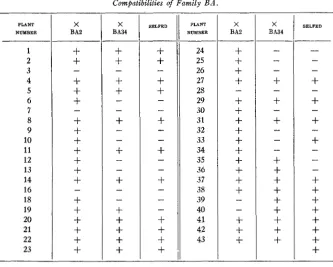
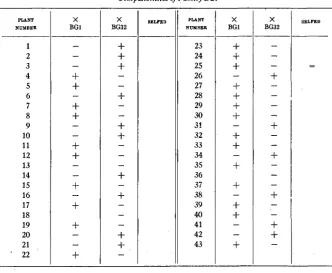
The behavior of Family BA, shown in table 1, is seen to be somewhat exceptional. The mother plant used in the production of the family was
TABLE 1.
Compatibilities of Family BB.
PLANT X X SELFED X
NUMBER BA2 BA34 NUMBER BA2 BA34
SELFED
_ _ _ _ _ _ _ _ _ _ _ _ _ _ ~ " "
1
+
+
+
+
23
+
+
+
43
+
+
+
22
+
+
+
42
+
+
+
21
+
+
+
41
+
+
+
20
+
+
-
40
-
+
+
19
39
+
+
-
+
18
+
+
+
38
16
+
+
+
37
+
+
+
14
+
+
36
-
+
13-
+
+
35
+
12
- -
+
34+
+
+
11
+
-
+
33+
10
+
32
-
-
+
9
+
+
+
31
+
+
+
8
+
30
7
+
+
+
29
+
6
- -
28
+
+
+
5
+
+
+
27
+
+
+
4
3
+
25
+
+
+
2
+
24
+
+
+
- -- -
- - - 26
+
- --
- -
- - - - -
- -
- -
- -
- -
- - -
- -
I
45 8 E. M. EAST AND S . H. YARNELL
to inhibit pollen-tube growth, even in combination with environmental conditions that are disadvantageous, are sufficient to prevent full com- plements of seed. being formed after selfing. Factor S,, therefore, may be termed a true factor for self-fertility. On the other hand, there are among the S factors several which produce such slow-growing pollen tubes that no combination of stimulating subsidiary heritable factors and optimum environmental conditions is sdlicient to cause selfed seed to be produced. But between these two categories a r e s factors which are on the border line. When inhibiting subsidiary factors and poor environmental conditions (as
TABLE.2.
Compatibilities ~j Family BB.
P U N T X X SELFED PLANT X BB1 BELIED
NUMBER I BB2 BB1 NUMBER BB2
_ _ _ _ _ _ _ _ _ _ ~ ~ _ _ _ _ _ _ _ _ _ _ _ _
1
+
- 27+
35
+
9
+
34
+
8
+
- -
33
-
+
7
-
+
32
+
6
-
+
31
+
5
+
30
+
4
-
+
29
+
3
+
28
-
+
2
+
10
+
- - 36 -+
11
+
37+
12
+
38+
-13
+
39+
14
+
- - 40+
15
+
- 41+
18
+
42+
19
+
- 43+
20
+
44+
21 -
+
45 '+
22
+
4623
+
47+
24
+
4825
50
- -
+
26
49
-
+
- -
- - -
-
- - -
- - -
- -
-
- - -
- -
- - - -
- -
-
- -
- -
-
- -
-
- - -
+
+
+
+
- -
- -
- -
-
plants. The self-fertile plants were fertile to the pollen of both BA2 and BA34, as would be expected,-with two exceptions. Plants 39 and 40 were sterile to BA2 pollen. Evidently there was just enough difference between plants 39 and 40 and the remainingplants of the group to inhibit the pollen- tube growth of pollen from BA2 sufficiently to prevent fertilization. The behavior of the 18 plants belonging to Type I1 was also slightly anomalous. It was to have been expected th,at all of these self-sterile plants would be
TABLE 3
Compatibilities of Family BC.
Pseudo-fertility small capsules.
fertile to the pollen of BA2 and sterile to the pollen of BA34. Actually, 13 plants behaved in this manner. In addition, plants 3 , 7 , 1 8 , and 28 were sterile to both testers, while plant 19 was fertile to both testers. Plant 19 may belong to Type I, since it gave a small capsule on one self-pol- lination. The behavior of the other 4 plants is exceptional. Each was tested more that ance with pollen of BA2 and the results were always negative. Possibly we have here a case in which plants of a given constitution are sterile to more than one S factor under the proper environmental condi-
460 E. M. EAST AND S. H. YAKNELL
tions and with the proper subsidiary factors; if so, it is something not found heretofore.
Family BB, (table 2), also an Afinis hybrid, had 48 plants which fell without exception into two groups. There were 23 plants fertile to BB2 and sterile to BB1. There were 25 plants sterile to BB2 and fertile to BB1. A random sample of 18 plants was selfed. Each proved to be self-sterile. Family BC (table 3 ) , an Afinis hybrid from Dreer, contained 43 plants. All of them appeared to be self-sterile, to judge from the small number of capsules that set naturally, with the exception of plants 4 and 8. These 2 plants produced the small capsules usually characteristic of pseudo-
TABLE 4
Compatibilities of Family BD.
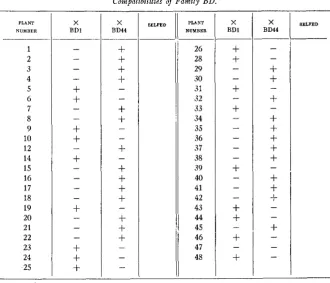
Family BD (table 4) was produced by a Sandera hybrid from Dreer. It consisted of 45 plants. None were selfed, since-from the paucity of capsules set naturally-they all appeared to be self-sterile. One exception- al plant (No. 47) was repeatedly sterile to both testers, though the pollen appeared to be viable. We have no further information as to why i t be- haved in this manner. The cause may be connected with the self-sterility phenomena in some way not at present understood. But we are not limited
NUMBER PLANT
-
1
2
3 4 5
6
7
8 9 10 11
12 13
14 15
16
17 19
20 21 22
TABLE 5
Compatibilities of Family BE.
X BE28
-
BELFED
to such an interpretation. Occasional plants from material such as this show true male sterility. That is to say, they have defective pollen. And there is indication, though no critical proof, that somewhat more rarely female sterility is found. The remaining 44 plants fell into the usual 2 groups. There were 26 plants sterile to BD1 and fertile to BD44; there were 18 plants fertile to BD1 and sterile to BD44;
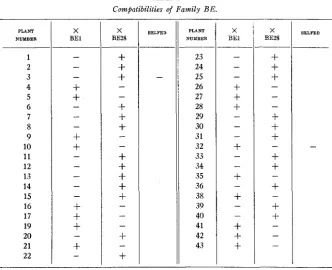
Family BE (Table 5) came from a Sandera hybrid from Vaughan. I t consisted of 41 plants. The general appearance of the plants led us to believe that all were self-sterile, except possibly,plants 3 and 32. These proved to be self-sterile. All of the plants fell into 2 groups: 24 were ste-
462 E. M. EAST AND S. H. YARNELL
rile to BE1 and fertile to BE28; 17 were fertile to BE1 and sterile to BE28.
It should be noted, however, that there was a little difficulty in classifying plants 21, 32,34, and 38. Plants 21 and 38 produced seed in crosses with
BE1, but the capsules were not as full of seed as would normally be ex- pected. They were completely sterile with BE28. Plant 32 produced nor- mal capsules with BE1. With BE28 a failure was recorded with one pol- lination and a small capsule with a second pollination. Plant 34 produced good capsules with BE28 and a small capsule with a few seeds with BE1.
TABLE 6
Compatibilities of Family BF.
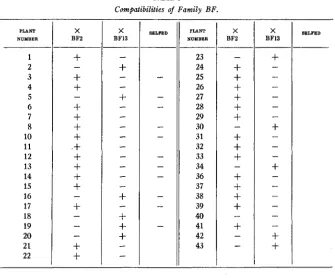
29 and 37 produced full capsules with BF2, and was sometimes sterile and sometimes partly fertile (few seeds) with BF13.
Family BG (table 7) consisting of 43 plants, was derived from seed of
Salzderce hybrids obtained from Dreer. Plant 13 was sterile twice with both testers. Plants 18 and 36, through some oversight were not tested with
BG1. If one assumes that the sterility of these plants with pollen of BG32
is sufficient to classify them, then there are 16 plants sterile to BG1 and TABLE 7
Compatibilities of Family BG.
SELFED
"
fertile to BG32, and 26 plants fertile to BG1 and sterile to BG32. Though the plants of this family all appeared to be self-sterile when judged by their ability to.set capsules under natural conditions, undoubtedly there were some border line cases. For example, plant 25 gave full capsules with BG1
and proved to be self-sterile under test, ,but it also gave four partially filled capsules with BG32. Plant 38, which should have been fertile to BG32,
having been sterile to BG1, gave one full capsule in one trial and failed to set in one trial. In addition, it should be noted that plants 3, 9, 14, and
464 E. M. EAST AND S. H. YARNELL
was tested twice with BG32; and while all of the eight pollinations were positive, the capsules were never full of seed.
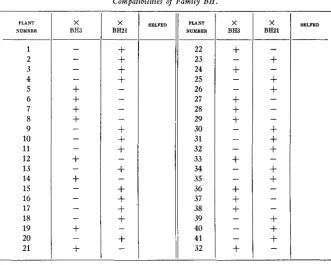
Family BH (table S) was derived from the Sandera hybrids of Vaughan. It consisted of 42 plants, of which 24 were sterile to BH3 and fertile to BH21, and 18 were fertile to BH3 and sterile to BH21. All appeared to be
TABLE 8
Compatibilities of F a m i l y B H .
self-sterile. I n fact, plant 33 was the only plant that showed a slight evi- dence of pseudo-fertility. The or#y difficulties encountered in trying to classify the plants of this family were with plants 19,24,30, and 33, which had to be tested twice in order to establish their compatibilities in an unmistakable manner.
Family B1 (table 9) from Vaughan’s stock of S a n d e r a hybrids, consisted of 50 plants, all of which appeared to be self-sterile. A sample of 9 plants proved to be self-sterile. The plants could be divided into 2 groups with- out difficulty. There were 30 plants sterile to B11 and fertile to BI32, and 20 plants fertile to B11 and sterile to BI32.
pseudo-fertility. It gave a small capsule when selfed. Plants 30,32, and 33
also showed some pseudo-fertility,-the first and the third yielding small capsules when selfed. These three were the only plants besides BK1 which showed noticeable self-fertility. All three were fertile with both BK3 and
BK1; but, judging both from the size of capsules produced after pollina- tion with BK1 as compared with those produced after pollination with
BK3, and from the behavior of the four plants (including BK1) when selfed they should be classified as belonging to the type represented by BK1.
TABLE 9
Compatibilities of Family B I .
NUMBER PLANT
1 2 3 4 5 6
7
8
9
10 l1 12 13 14 15 16
17
18 19 20 21 22 23 24 25
B11
X
-
+
Omitting these three plants, however, there are two groups, one of 20 plants fertile to BK3 and sterile to BK1, and one of 18 plants sterile to
BK3 and fertile to BK1. In addition, i t may be noted that plants 39 and
40 showed a slight pseudo-fertility in one pollination with BK1 and com- plete sterility in a second pollination. Likewise, plants 6 , 13, 14 and 20
exhibited a slight degree of pseudo-fertility with BK3.
466 E. M. EAST AND S. H. YARNELL
TABLE 10
Comnpatibilities of Family B.K.
m m X X
BK3 8ELFED X
X
NUMBER BKl NUMBER BK3 BKl
BlCLFED
~~~~-~
1
+
-31
-
+
9
+
+
+
30
-
+
8
+
-
29
-
+
7
+
6
-
+
27
+
5
+
26
-
+
4
+
3
-
+
24
-
+
2
-
+
23
-
+
+
10
+
32+
+
-12
+
- 33+
+
+
13
+
3414
+
+
43
+
22
+
42
-
+
21
41
+
20
+
40
-
+
19
+
39
+
18
+
38
+
17
+
-
37
+
-
16
+
36
+
l5
+
35
+
-
+
25 -- -
-
+
28 --
- -
- -
- -
- -
- -
-
- -
+
-
- -
TABLE 11
Family BL (table l l ) , was derived from the Afinis hybrids of Dreer. From their behavior all of the 38 plants constituting the population were self-sterile although only 4 were tested. No anomalous behavior and no pseudo-fertility was recorded. There were 18 plants sterile to BL1 and fertile to BL31 and 20 plants fertile to BL1 and sterile to BL31.
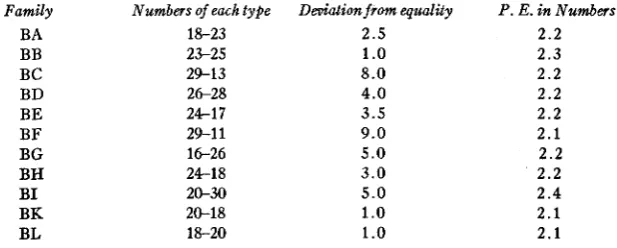
The data on the B families show that the 11 individuals chosen for cross- ing with S& were heterozygous for definite S factors,-that is that their genetic formulae as regards self-sterility were S S , , S,S,, and so forth. Each family consisted of two groups containing approximately equal numbers of individuals. This is seen to be the case when one compares the family groups with the probable errors expressed in numbers of individuals, as follows:-
Family
BA BB BC BD BE BF BG BH B1 BR BL
Numbers of each type
18-23 23-25 29-13 26-28 24-17 29-1 1 16-26 24-18 20-30 20-18 18-20
Deeriation from equality
2 . 5 1
.o
8 . 0 4.0 3 . 5 9.0 5 . 0 3 . 0 5 . 0 1 . 0 1.o
P . E . in Numbm
2 . 2 2 . 3 2 . 2 2 . 2 2 . 2 2 . 1 2 . 2 2 . 2 2 . 4 2 . 1 2 . 1
Of the 11 families, the deviations of the two groups from equality is less than
.S
P. E. in 3 families, slightly over 1.0 P. E. in 1 family, less than 2.0 P. E. in 3 families, slightly over 2.0 P. E. in 2 families, over 3.0 P. E. in 1 family, and over 4.0 P. E. in the family showing the greatest discrepancy. The next point in the investigation was to try to distinguish the differ- ent S factors in the various groups. BA Type I, afterwards called BA-I,was tested with BA-11, with the two types of the other 10 families, and with the seven other testers, SISz
. . . .
S S , . It showed fertility in every test. Since the plants of BA-I were self-fertile it may seem queer to call its S factor SI5; but there seems to be no good reason for not so doing. The behavior ofSu
is merely an extreme case of rapid pollen-tube growth which is uninhibited in styles of plants bearing the same factor. From the different source of the material, we believe that the S, factor borne byN . Langsdorfii is probably different from S15;but there is no way of prov-
ing the matter.
Table 12 shows the tests made with the plants of Family BA, Type 11.
It will be noted that there were two cases of incompatibility. Plant BA-II-
468 E. M. EAST AND S. H. YARNELL
12 was sterile to the pollen of plant BE-11-28; and plant BA-11-6 was sterile to the pollen of BG-11-32. Two additional pollinations for each of these combinations confirmed the result. We may take it, then, that
TABLE 12
Tests of Family B A .
MOTEER PLANT -.
BA-11-34 BA-11-12 BA-11-12 BA-11-12 BA-11-12 BA-11-12 BA-11-12 BA-11-12 BA-114 BA-11-6 BA-11-12 BA-11-12 BA-11-12 BA-11-12 BA-11-6 BA-11-6 BA-11-9 BA-11-9 BA-11-9 BA-11-9 BA-11-9 BA-11-34 BA-I141 BA-11-34 BA-11-41 BA-11-41 BA-11-34 BA-11-34
BA-I141 BA-11-34 BA-11-41 BA-11-34 BA-11-41
TYPE 11
POLLEN PLANT
BA-11-32 BB-1-2 BB-11-1 BC-1-1 BC-11-21 BD-1-1 BD-11-44 BE-1-1 BE-11-28 BF-1-2 BF-11-13 BG-1-1 BG-11-32 BH-1-3 BH-11-21 BI-1-1 BI-11-32 BK-1-3 BK-11-1 BL-1-1 BL-11-31 s1s2 s1s2 S1S3 S1S3 S1S4 s1s4 s1s5 SlS.5 S1S6 S1S6 S1S7 S1S7
RESULT
-
+
+
+
+
+
+
+
+
+
+
+
+
+
+
+
+
+
+
+
+
+
+
+
+
+
+
+
+
+
+
--
combinations BE-11-28 BA-11-32 and BE-11-42 BG-11-32 while in table 18 are found combinations BG-11-43 BA-11-32 and BG-11-43 BE-11-28 all show incompatibility as expected.
In table 13 are the tests on Family BB. Among the combinations made with Type I are 2 tests with plants having the genetic formula SSS. One was fertile, one was sterile. Other tests, however, show that the single failure with SIS5 was accidental. For example, combinations made with
TABLE 13
Tests of Family BB.
MOTHER PLANT
BB-1-2 BB-1-2 BB-1-2 BB-1-2 BB-1-2 BB-1-2 BB-1-2 BB-1-2 BB-1-2 BB-1-2 BB-I4 BB-1-2 BB-1-2
B B - I 4 BB-1-4 BB-I4 BB-1-4 BB-1-4 BB-1-4 B B - I 4
BB-1-4 BB-1-4 BB-1-7 BB-1-4 BB-1-7 BB-1-4 BB-1-7 BB-1-4 BB-1-7 BB-1-4 BB-1-7 BB-1-4 BB-1-7 BB-I4 TYF'E I POLLEN PLANT BA-1-2 BA-11-32 BB-1-2 BB-11-1 BC-1-1 BC-11-21 BD-1-1 BD-11-44 BE-1-1 BE-11-28 BF-1-2 BF-11-13 B G-I- 1
BG-11-32 B H - I 3 BH-11-21 BI-1-1 BI-11-32 BK-1-3 BK-11-1 BL-1-1 BL-11-31 s1s2 s1s2 S1S3 S1S3 S1S4 S1S4 S E 5 s1s5 S1S6 S1S6 S1S7 S1S7 -
-l-
II
TYPE I1
RESULT
(1
MOTHER PLANT+
+
+
+
+
+
+
+
+
+
+
+
+
+
+
+
+
+
+
+
+
+
+
+
+
+
+
- --
-
-
+
BB-11-1 BB-11-1 BB-11-1 BB-11-1 BB-11-1 BB-11-1 BB-11-1 BB-11-1 BB-11-1 BB-11-3 BB-11-3 BB-11-3 BB-11-3 BB-11-6 BB-11-6 BB-11-6 BB-11-6 BB-11-6 BB-11-6 BB-11-6 BB-11-6 BB-11-6 BB-11-1 BB-11-10 BB-11-1 BB-11-10 BB-11-1 BB-11-10 BB-11-1 BB-11-10 BB-11-1 BB-11-10 BB-11-1 BB-11-10POLLEN P L A m
BA-1-2 BA-11-32 BB-1-2 BB-11-1 BC-11-21 BC-1-1 BD-1-1 BD-11-44 BE-1-1 BE-11-28 BF-1-2 BF-11-13 BG-1-1 BH-1-3 BH-11-21 BG-11-32 BI-1-1 BI-11-32 BK-1-3 BK-11-1 BL-1-1 BL-11-31 s1s2 s1s2 S1S3 S1S3 S1S4 S1S4 s1s5 S1S5 S1S6 S1S6 S1S7 S1S7 RESULT
+
+
+
+
+
+
+
+
+
+
+
+
+
+
+
+
+
+
+
+
+
+
+
+
+
+
+
+
+
+
+
--
-470 E. M. EAST AND S. H. YARNELL
plants from BB-I1 and from BI-11, which are later shown to be SIS5, are fertile. The only true incompatibility of BB-I is with SlS6 and with BL- 11-31. And BL-I1 is also shown to be &S6 by the tests of table 22. BB-I1 plants have the formula S1S5. Plant BB-11-6 is sterile to pollen of BI-11-32. The reciprocal is also sterile as is seen in table 20. It is true that one test with S,S, showed fertility and one test showed sterility. But additional tests not shown in the table confirmed the fact that BB-I1 is in truth S$5 and is incompatible with S 8 5 plants. There were 3 more
TABLE 14
Tests of Family BC.
MOTHER P U N T
BC-1-3 BC-1-1 BC-1-1 BC-1-1 BC-1-1 BC-1-1 BC-1-1 BC-1-1 BC-1-22 BC-1-22 BC-1-22 BC-1-22 BC-1-22 BC-1-22 BC-1-22 BC-1-22 BC-1-22 BC-1-22 BC-1-22 BC-1-22 BC-1-22 BC-1-3 BC-1-42 BC-1-3 BC-1-42 BC-1-3 BC-1-42 BC-1-3 BC-1-42 BC-1-3 BC-1-42 BC-1-3 BC-1142
TYPE I
I1
POLLEN PLANT
BA-11-32 BB-1-2 BB-11-1 BC-1-1 BC-11-21 BD-1-1 BD-I144 BE-1-1 BE-11-28 BF-1-2 BF-11-13 BG-1-1 BG-11-32 BH-1-3 BH-11-21 BI-1-1 BI-11-32 B R - I 3 BR-11-1 BL-1-1 BL-11-31 s1s2 s1s2 S1S3 S1S3 S1S4 S1S4 SlS5 SlS.5 S1S6 S1S6 S1S7 S1S7
+
' ++
+
+
+
+
+
t+
+
% +
; +
+
' +
. $+
' ++
+
'.+
- - -+
+
+
+
! ++
'+
+
+
i !+
B C-11-2 1
BC-11-2 BC-11-2 BC-11-2 BC-11-2 BC-11-2 BC-11-2 BC-11-2 BC-11-23 BC-11-23 BC-11-23 BC-11-23 BC-11-23 BC-11-23 BC-11-23 BC-11-23 BC-11-23 BC-11-23 BC-11-23 BC-11-23 BC-11-23 BC-11-21 BC-I141 BC-11-21 BC-11-41 BC-11-41 BC-11-21 BC-11-41 BC-11-21 BC-11-21 BC-11-41 BC-11-1 BC-11-41
TYPE I1
tests with the pollen bf SSs and 2 reciprocal tests in which S S 5 was used as the.mother. All failed.
The tests of Family.BC are shown in table 14. Incompatibility of Type BC-I was shown only with&S,. Two additional tests not shown in the table were made with the pollen of SS,. Two reciprocal tests were also made. In each test failure was recorded. The plants of BC-I, therefore, havethe genetic constitution S S 2 . The only incompatibility exhibited by plants of BC-I1 is with BD-1-1. The reciprocal combination also failed
TABLE 15
Tests of Family BD.
M( THEB PLANT
BD-1-1 BD-1-1 BD-1-1 BD-1-1 BD-1-1 BD-1-1 :
BD-1-1 BD-1-1 BD-1-1 BD-1-1 BD-1-1 BD-1-1 BD-1-1 BD-1-1 BD-1-1 BD-1-1 BD-1-1 BD-1-1 BD-1-1 BD-1-1 BD-1-1 BD-1-1 BD-1-45 BD-1-1 BD-1-45 BD-1-1 BD-1-45 BD-1-1 BD-1-45 BD-1-1 BD-1-45 BD-1-1 BD-1-45 TYPE I
POLLEN PLANT
BA-11-32 BB-1-2 BB-11-1 BC-1-1 BD-1-1 BC-11-21 BD-11-44 BE-1-1 BE-11-28 BF-11-13 BG-1-1 BG-11-32 BF-1-2 BH-1-3 BH-11-21 BI-1-1 BK-1-3 BL-1-1 BL-11-81 s1s2
s1s2
S1S3 S1S3 S1S4 S1S4 S1S5 S1S5 S1S6 S1S6 S1S7 S1S7 BI-11-32 BR-11-1REEULT
11
Y O T W B PLANT+
+
+
+
- -+
+
+
+
+
+
+
+
+
+
+
+
+
+
+
+
+
+
+
+
+
+
+
BD-11-26 BD-11-26 BD-11-26 BD-11-26 BD-11-26 BD-11-26 BD-11-26 BD-11-26 BD-11-26 BD-11-26 BD-11-26 BD-11-26 BD-11-26 BD-11-26 BD-11-26 BD-11-26 BD-11-26 BD-11-26 BD-11-26 BD-11-26 BD-11-26 BD-11-26 BD-11-44 BD-11-26 BD-11-44 BD-11-26 BD-11-44 BD-11-26 BD-11-44 BD-11-26 BD-11-44 BD-11-26 BD-11-44TYPE I1
POLLEN PLANT
BA-11-32 BB-1-2 BB-11-1 BC-1-1 BC-11-21 BD-1-1 BE-1-1 BE-11-28 BF-1-2 BD-11-44 BF-11-13 BG-1-1 BG-11-32 B H -I 3 BH-11-21 BI-1-1 BK-1-3 BL-1-1 BL-11-31 s1s2 s1s2 S1S3 , S1S3 S1S4 S1S4 SlS.5
s1s.5
S1S6 S1 S6 S1S7 S1S7 BI-11-32 BK-11-1 RESULT+
+
+
+
+
+
+
+
+
+
+
+
+
+
+
+
+
+
+
+
+
+
+
+
+
+
+
+
+
+
- - - ~472 E. M. EAST AND S. H. YARNELL
(table 15). The plants of this group, then, can be given the formula SS9.
I n table 15 are the tests of Family BD. As is to be expected from the results of table 14, BD-I plants show incompatibility only with BC-11. Since the test plants BD-1-1 and BD-1-45 died before they could be tested with S&', and S S , , i t is a fair question to ask how we know that they do not belong to either of these groups. The reason is that BD-I plants were tested reciprocally with plants of BB-I and BL-11,. two groups having the constitution S J s ; and were further tested with plants of BG-I and BK-I,
TABLE 16
Tests of Family BE.
MOTHER PLANT
BE-1-30 BE-1-1 BE-1-1 BE-1-1 BE-1-1 BE-1-1 BE-1-1 BE-1-1 BE-1-1 BE-1-1 BE-1-1 BE-1-1 BE-1-1 BE-1-1 BE-1-1 BE-1-1 BE-1-2 BE-1-2 BE-1-2 BE-1-1 BE-1-2 BE-1-30 BE-1-31 BE-1-30 BE-1-31 BE-1-30 BE-1-31 BE-1-30 BE-1-31 BE-1-30 BE-1-31 BE-1-30 BE-1-31
TYPE I
POLLEN PLANT
BA-11-32 BB-1-2 BB-11-1 BC-1-1 BC-11-21 BD-1-1 BD-I144 BE-11-28 BF-1-2 BF-11-13 BG-11-32 BH-11-21 BI-1-1 BK-1-3 BK-11-1 BL-1-1 BL-11-31 s1s2 s1s2 S1S3 S1S3 S1S4 S1S4 s1s5 s1s5 S1S6 S1S6 S1S7 S1S7 BE-1-1 BG-1-1 BH-1-3 BI-11-32
+
+
+
+
+
+
+
+
+
+
+
+
+
+
+
+
+
+
+
+
+
+
+
+
+
+
+
+
+
+
- - BE-11-28 BE-11-43 BE-I143 BE-11-43 BE-11-43 BE-11-43 BE-11-43 BE-11-43 BE-I143 BE-11-42 BE-11-43 BE-I143 BE-11-43 BE-I142 BE-11-42 BE-I142 BE-11-43 BE-11-43 BE-11-43 BE-11-43 BE-11-43 BE-11-27 BE-11-28 BE-11-27 BE-11-28 BE-11-27 BE-11-28 BE-11-27 BE-11-28 BE-11-27 BE-11-28 BE-11-27 BE-11-28TYPE I1
POLLEN PLANT
two groups having the constitution S$,. All of these combinations were fertile. BD-I1 plants are shown to have the constitution SSlo. They are persistently sterile only with plants from the group BK-11, other pollina- tions not shown in the table having been made as a check. It is true that BD-11-26 was sterile to the pollen of BL-11-31 (2 pollinations); but there is reason to believe that this single outstanding exception in the extensive crosses among the plants of the B families was due to particulate tru sterility of flowers of a certain branch of plant BL-11-31. In the first place,
TABLE 17
Tests of Family BF.
YOTEER PLANT
BF-1-23 BF-1-2 BF-1-2 BF-1-2 BF-1-2 BF-1-2 BF-1-2 BF-1-2 BF-1-2 BF-1-2 BF-1-2 BF-1-2 BF-1-2 BF-1-2 BF-1-2 BF-1-2 BF-1-2 BF-1-2 BF-1-2 BF-1-2 BF-1-2 BF-1-23 BF-1-43 BF-1-23 BF-1-43 BF-1-23 BF-1-43 BF-1-23 BF-1-43 BF-1-23 BF-1-43 BF-1-23 BF-1-43
TYPE I
II
POLLEN PLANT BA-11-32 BB-1-2 BB-11-1 BC-1-1 BC-11-21 BD-1-1 BD-11-44 BE-1-1 BE-11-28 BF-1-2 BF-11-13 BG-11-32 BH-11-21 BG-1-1 BH-1-3 BI-1-1 BI-11-32 BK-1-3 BK-11-1 BL-1-1 BL-11-81 s1s2 s1s2 $1S3 S1S3 S1S4 S1S4 s1s5 s1s5 S1S6 S1S6 S1S7 S1S7
RESULT
11
MOTHER PLANT+
+
+
+
+
+
+
+
+
+
+
+
+
+
+
+
+
+
+
+
+
+
+
+
+
+
+
+
+
+
+
- - BF-11-22 BF-11-13 BF-11-13 BF-11-13 BF-11-13 BF-11-13 BF-11-13 BF-11-13 BF-11-13 BF-11-13 BF-€1-13 BF-11-13 BF-11-15 BF-11-15 BF-11-15 BF-11-15 BF-11-15 BF-11-15 BF-11-15 BF-11-15 BF-11-15 BF-11-22 BF-I141 BF-11-22 BF-11-41 BF-11-22 BF-11-41 BF-11-22 BF-11-41 BF-11-22 BF-11-41 BF-11-22 BF-11-41 TYPE 11POLLEN PLANT
BA-11-32 BB-1-2 BB-11-1 BC-1-1 BC-11-21 BD-1-1 BD-11-44 BE-1-1 BE-11-28 BF-1-2 BF-11-13 B G-I- 1 BG-11-32 B H - I 3 BH-11-21 BI-1-1 BI-11-32 B K - I 3 BK-11-1 BL-1-1 BL-11-31 s1s2 s1s2 S1S3 S1S3 S1S4 S1S4 s1s5 s1s5 S1S6 S1S6 S1S7 S1S7 REBULT
+
+
+
+
+
+
+
+
+
+
+
+
+
+
+
+
+
+
+
+
+
+
+
+
+
+
+
+
+
+
+
+
-474 E. M. EAST AND S. H. YARNELL
the reciprocal of this type of mating,. BL-11-4XBD-11-44, was fertile. Moreover, several critical tests show that BL-I1 plants have the formula
Ss6, as do the plants of BB-I; yet no other plants of the group s I s 6 , are sterile to plants of BD-11.
Table 16 shows the tests of Family BE. BE-1,plants can be given the formula SS,,. They are sterile only to the pollen
af
BF-I. The reci- procal isalso sterile(tab1e 17). Plant BE-1-30 died before it could be tested against S,S3; but BE-1-31 was fertile with S,S3 and BE-1-1 was fertileTABLE 18
Teslsef Family BG.
M T E E R PLANT
BG-1-31 BG-1-1 BG-1-1 BG-1-1 BG-1-1 BG-1-2 BG-1-2 BG-1-1 BG-1-1 BG-1-1 BG-1-1 BG-1-1 BG-1-42 BG-1-42 BG-1-42 BG-1-42 BG-1-42 BG-I42 BGrI42 BG-1-42 BG-1-41 BG-1-31 BG-1-42 BG-1-31 BG-1-42 BG-1-31 BG-1-42 BG-1-31 BG-1-42 BG-I31 BG-1-42 BG-1-31 BG-1-42
TYPE I
POLLEN PLANT BA-11-32 BB-1-2 BB-11-1 BC-1-1 BC-11-21 BD-1-1 BD-11-44 BE-1-1 BE-11-28 BF-1-2 BF-11-13 BG-1-1 BG-11-32 B H - I 3
BI-1-1 BI-11-32 BR-11-1 BL-1-1 BL-11-31 s1s2 s1s2 S1S3 S1S3 S1S4 S1S4 s1s5 s1s5 S1S6 S1S6 S1S7 S1S7 BH-11-21
B K - I 3
”
+
+
+
+
+
+
+
+
+
+
+
+
+
+
+
+
+
+
+
+
+
+
+
+
+
+
+
+
+
- - - - BG-11-43 BG-11-43 BG-11-43 BG-11-43 BG-11-43 BG-11-43 BG-11-43 BG-11-43 BG-11-43 BG-11-43 BG-11-43 BG-11-43 BG-11-4 BG-11-4 BG-I14 BG-11-4 BG-11-43 BG-11-43 BG-11-43 BG-11-43 BG-11-40 BG-11-32 BG-11-43 BG-11-32 BG-11-43 BG-11-32 BG-11-43 BG-11-32 BG-11-43 BG-I143 BG-11-32 BG-11-32 BG-11-43TYPE I1
POLLEN PLANT BA-11-32 BB-1-2 BC-1-1 BC-11-21 BD-1-1 BB-11-1 BD-11-44 BE~I-1 BE-11-28 BF-1-2 BF-11-13 BG-1-1
B H - I 3
BI-1-1 BG-11-32 BH-11-21 BI-11-32 BK-1-3 BK-11-1 BL-111 BL-11-31
s1s2
s1s2 S 1 3 S1S3 S1S4 S1S4 s 1 s 5with BL-1-1, (also SS,). BE-I1 plants proved to be S,S,. They were sterile reciprocally with BA-1.1 plants and with BG-I1 plants,-these last two groups being incompatible with each other, as expected.
In table 17 the results of the tests with Family BF are recorded. BF-I plants, as already noted, have the constitution SSll. They belong to the same group as the plants of BE-I. All other combinations are fertile. The plants of BF-I1 are fertile to the plants of all other groups. They are de- signated SSl2.
TABLE 19
Tests of Family B R .
YOTEER PLANT
BH-1-2 BH-1-1 BH-1-1 BH-1-1 BH-1-1 BH-1-1 BH-I3 BH-1-1 BH-1-1 BH-1-3 BH-I3 BH-1-3 BH-I41 BH-1-41 BH-1-41 BH-I41 BH-1-40 BH-1-40 BH-1-40 BH-1-40 BH-1-41 BH-1-1 BH-IS BH-1-1 BH-1-1 BH-1-2 BH-1-2 BH-1-1 BH-1-2 BH-1-1 BH-1-2 BH-1-1 BH-1-2 TYPE I
POLLEN PLANT
-
BA-11-32 BB-1-2 BB-11-1 B C-I- 1BD-1-1 BC-11-21 BD-11-44 BE-1-1 BE-11-28 BF-1-2 BG-1-1 BH-1-3 BH-11-21 BI-1-1 BI-11-32 BK-I3 BF-11-13 BG-11-32 BK-11-1 BL-1-1 BL-11-31
s1s2
s1s2
S1S3 S1S3 S1S4 S1S4 s1s5 SlS5 S1S6 S1S6 S1S7 S1S7RESULT
/I
YOTEER PLANT-
+
+
+
+
+
+
+
+
+
+
+
+
+
+
+
+
+
+
+
+
+
+
+
+
'+
+
+
+
+
+
+
+
- BH-11-29 BH-11-42 BH-1142 BH-11-42 BH-11-42 BH-11-42 BH-11-42 BH-11-42 BH-11-42 BH-11-42 BH-11-42 BH-11-42 BH-11-38 BH-11-38 BH-11-38 BH-11-28 BH-11-42 BH-11-42 BH-11-42 BH-11-42 BH-11-38 BH-11-38 BH-11-29 BH-11-28 BH-11-29 BH-11-28 BH-11-29 BH-11-28 BH-11-29 BH-11-28 BH-11-29 BH-11-29 BH-11-28 TYPE 11POLLEN PLANT
BA-11-32 BB-1-2 BB-11-1 BC-1-1 BC-11-21 BD-1-1 BD-11-44 BE-1-1 BE-11-28 BF-1-2 BF-11-13 BG-1-1 BG-1-32 BH-1-3 BH-11-21 BI-I81 BI-11-32 BK-I3 BK-11-11 BL-1-1 BL-11-31 s1s2
s1s2
S1S3 S1S3 S1S4 S1S4 SlS5 s1s5 S1S6 S1S6 S1S7 S1S7 RESULT+
+
+
+
+
+
+
+
+
+
+
+
+
+
+
+
+
+
+
+
+
+
+
+
-
-+
f+
+
+
+
-476 E. M EAST AND S. H. YARNELL
Table 18 shows the results of the tests with Family BG. BG-I plants are
ss,,
as shown by their incompatibility with the pollen of SI.$?. S S , plantswere also found to be sterile to the pollen of BG-I plants in 4 tests. BG-1-42 was also sterile to BK-1-3, another
ss7
group. This last combination was made with negative results in 3 other cases not recorded in the table. All other combinations were fertile. BG-I1 plants were fertile in all combina- tions except those with BA-I1 and BE-11. This group, therefore, is SS,. Table 19 shows the results of the tests with Family BH. The plants ofTABLE 20
Tests of Family BI.
YOTEER P U N T
BI-1-1 BI-1-1 BI-1-1 BI-1-1 BI-1-1 BI-1-1 BI-1-1 BI-1-51 BI-1-51 BI-1-51 BI-1-51 BI-1-51 BI-1-51 BI-1-51 BI-1-51 BI-1-51 BI:l-51 BI-1-1 BI-1-1 BI-1-12 BI-1-1 BI-1-12 BI-1-1 BI-1-12 BI-1-1 BI-1-1 BI-1-51 BI-1-51 BI-1-51 BI-1-12 BI-1-12 BI-1-1 BI-1-12
TYPE 1
/I
POLLEN PLANT BA-11-32 BB-1-2 BC-1-1 BC-11-21 BD-1-1 BB-11-1 BD-11-44 BE-1-1 BE-11-28 BF-1-2 BF-11-13 BG-1-1 ,BG-II-32
B H - I 3 BH-11-21 BI-1-1 BI-11-32 B K - I 3 BK-11-1 BL-1-1 BL-11-31 s1s2 s1s2 S1S3 S1S3 S1S4 S154 s1s5 s1s5 S1S6 S1S6 S1S7 S1S7
RESULT
I I
MOTHER P U N T+
+
+
+
+
+
+
+
+
+
+
+
+
+
+
+
+
+
+
+
+
+
+
+
+
+
+
+
+
+
+
- BI-11-13 BI-11-2 BI-11-2 BI-11-2 BI-11-2 BI-11-2 BI-11-2 BI-11-2 BI-11-50 BI-11-50 BI-11-50 BI-11-50 BI-11-50 BI-11-50 BI-11-50 BI-11-50 BI-11-50 BI-11-50 BI-11-50 BI-11-50 BI-11-13 BI-11-13 BI-11-25 BI-11-13 BI-11-25 BI-11-15 BI-11-25 BI-11-13 BI-11-25 BI-11-50 BI-11-25 BI-11-13 BI-11-25-1
TYPE I1POLLEN P U N T
BH-I are SS,. They are fertile in all combinations with the other groups. The plants of BH-I1 are SS,. They show sterility with the pollen of SISI as recorded. An S S 4 plant was also used as the mother against pollen from BH-I1 plants in 3 tests not shown in the table, with negative results. In table 20 are the results of the tests with Family BI. The plants of
BI-I are fertile in all combinations, and can be given the formula S1S14.
The plants of BI-I1 belong to the group S S 5 . Besides the tests shown in the table, 3 other tests were made with pollen of SIS5, while 2 tests were
TABLE 21
Tests of Family BK.
MOTHER PLANT
”
BK-1-10 B K - I 3 BR-1-3 BR-1-3 BR-1-3 BK-1-3 B K - I 3 BK-1-3 BR-1-3 B R - I 3 B R - I 3 BK-1-3 BK-1-3 BR-1-3 BR-1-3 BK-1-3 BK-1-3 B R - I 3 BR-1-3 B R - I 3 BK-1-3 BR-1-10 BK-1-41 BK-1-10 BK-1-41 BK-1-10 BK-1-41 BK-1-10 BK-I41 BK-1-10 BK-1-41 BK-1-10 BK-1-41 TYPE I
POLLEN PLATN
BA-11-32 BB-1-2 BB-11-1 BC-1-1 BC-11-21 BD-1-1 BD-1144 BE-1-1 BE-11-28 BF-1-2 BG-1-1 BF-11-13 BG-11-32 BR-1-3 BH-11-21 BI-1-1 BI-11-32 B R - I 3 BL-1-1 BL-11-31
s1s2
s1s2
S1S3 S1S3 S1S4 S1S4 s1s5 SlS5 S1S6 S1S6 S1S7 S1S7 BK-11-1RESULT
11
MOTHER PLANT+
+
+
+
+
+
+
+
+
+
+
+
+
+
+
+
+
+
+
+
+
+
+
+
+
+
+
+
+
- - - - BK-11-1 BK-11-2 BR-11-2 BR-11-2 BK-11-2 BK-11-2 BK-11-2 BR-11-2 BR-11-42 BK-11-42 BK-11-42 BK-11-42 BK-11-42 BK-11-42 BK-11-42 BK-11-42 BK-11-42 BR-11-42 BR-11-42 BK-11-42 BK-11-42 BK-11-1 BR-11-43 BR-11-1 BK-11-13 BK-11-1 BK-11-1 BR-1143 BR-11-43 BK-11-1 BK-11-43 BR-11-1 BK-11-43 POLLEN PLANT BA-11-32 BB-1-2 BB-11-1 BC-1-1 BC-11-21 BD-1-1 B E-I- 1 BD-11-44 BE-11-28 BF-1-2 BF-11-13 BG-1-1 BH-1-3 BI-1-1 BK-1-3 BG-11-32 BH-11-21 BI-11-32 BK-11-1 BL-1-1 BL-11-31s1s2
s1s2
S1S3 S1S3 S1S4 S1S4 SlS.5 s1s5 S1S6 S1S6 S1S7 S1S7 RESULT+
+
+
+
+
+
+
+
+
+
+
+
+
+
+
+
+
+
+
+
+
+
+
+
+
+
+
+
+
+
+
- -47 8 E. M. EAST AND S. H. YARNELL
made of the reciprocal combination. All of these tests showed the matings to be incompatible. Plants of BI-I1 were also sterile in reciprocal combi- nations with the other SISs group BB-11. The other combinations were fertile.
Table 21 shows the tests made with Family BK. The plants of BK-I have the formula SS,. Besides the tests shown, 3 other matings with S S , plants failed and 2 matings SSTXBK-I failed. BK-I plants were also sterile to the plants of BG-I, as was to be expected. The other combina-
TABLE 22
Tests of Family BL.
II
TYPE 1
II
TYPE I1YOTAER PLANT
BL-1-2 BL-1-2 BL-1-2 BL-1-2 BL-1-2 BL-1-2 BL-1-2 BL-1-2 BL-1-2 BL-1-2 BL-1-2 BL-1-2 BL-1-2 BL-1-2 BL-1-2 BL-1-2 BL-1-1 BL-1-1 BL-1-1 BL-1-2 BL-1-2 BL-1-25 BL-1-2 BL-1-2 BL-1-25 BL-1-2 BL-1-25 BL-1-2 BL-1-25 BL-1-1 BL-1-1 BL-1-25 BL-1-25 POLLEN PLANT BA-11-32 BB-1-2 BB-11-1 BC-1-1 BC-11-21 BD-11-44 BE-1-1 BE-11-28 BF-1-2 BG-1-1 BG-11-32 BH-1-3 BH-11-21 BD-1-1 BF-11-13 BI-1-1 BI-11-32 BK-1-3 BK-11-1 BL-1-1 BL-11-31 s1s2 s1s2 S1S3 S1S3 S1S4 S1S4 s1s5 s1s5 S1S6 S1S6 S1S7 S1S7
RESULT
11
MOTEER PLANT+
+
+
+
+
+
+
+
+
+
+
+
+
+
+
+
+
+
+
+
+
+
- - -+
+
+
+
+
+
+
+
BL-11-27 BL-11-4 BL-I14 BL-11-4 BL-11-4 BL-I14 BL-11-4 BL-11-4 BL-11-4 BL-11-4 BL-11-4 BL-11-4 BL-I14 BL-I14 BL-I14 BL-11-4 BL-I14 BL-11-4 BL-I14 BL-I14 BL-11-4 BL-11-26 BL-11-27 BL-11-26 BL-11-27 BL-11-26 BL-11-27 BL-11-26 BL-11-27 BL-11-26 BL-11-27 BL-11-26 BL-11-27POLLEN PLANT RESULT
tions were fertile. BK-I1 plants were found to be fertile in all combina- tions except those involving BD-11. Thus, they belong to the S S , , group.
The tests of Family BL are shown in table 22. The BL-I plants were fertile in all combinations except with Ss3. The reciprocal combination,
S S 3 X BL-I also failed twice. The plants are therefore S,S3. The plants of the BL-I1 group have the formula
ss,,
as shown by their incompatibili- ty to S S , pollen. Reciprocals were also sterile. They were also sterile in reciprocal combinations to plants of BB-I (sIs6). All other combina-tions were fertile.
DISCUSSION
The original material with which the senior author began his studies on self-sterile plants some 18 years ago consisted of Nicotiana alata grandi-
Rora from 4 sources (3 from seedsmen in the United States and 1 from Italy,
through the UNITED STATES DEPARTMENT OF AGRICULTURE) and seed
from a plant which was determined as Nicotiana Forgetiana. The plants of the second type grew from seed obtained from a Gray Herbarium sheet erroneously labeled Nicotiana Clevelandii. This plant had been sent in by a Californian botanist. It had been grown from seed obtained from Sander and Sons and had been called Nicotiana Sandera.. Now, Nicotiana Sandera. had been produced by crossing N . Forgetiana with Nicotiana alatagrandijiora, which had produced thewell-known large-flowered, many- colored hybrids. And Sander and Sons have repeatedly claimed that they did not distribute seed from the pure species Nicotiana Forgetiana,-
a South American species which has apparently been collected but once. But since the seeds from the Gray Herbarium sheet produced a uniform
population of plants having small,redjiowers, corresponding perfectlywith the plate (8006) for the species published in the BOTANICAL MAGAZINE, it is possible that they did indeed belong to N . Forgetiana. It is also possible that they were segregates from Sandera. hybrids. Be that as it may, the studies on self-sterility made in this laboratory up to 1924 were made upon this so-called Nicotiana, Forgetiana, upon Nicotiana alata grandijiora, and upon hybrids between the two types. Nearly all of the work was done upon the hybrids. The indications are that the original material contained sev- eral S factors. This conclusion may be deduced from the fact that in the earlier years cross-fertility was very high. The later experiments were upon inbred lines of this material; and therefore presumably not over 2 of the
480 E. M. EAST AND S. H. YARNELL
The new material described earlier in this paper came from Sanderae hybrids and from Nicotiana alata grandijlora. It was obtained from 5 different seedsmen. But although Nicotiana alata grandijlora was grown in this country long before the Sandem hybrids were produced, there is no guarantee that the material that we obtained contains a random sample of the S factors carried by either Nicotiana Forgetiana or by Nicotiana alata grartdijlora. All that can be claimed is that the 16 plants (besides a second
ss4
plant) of new material investigated from a random sample of the Sandere hybrids and the alata hybrids now being grown in this country,-in so far as 16 plants can be a random sample of anything. These 16 plants proved to have the following genetic formulae:- Farquhar’s alata, &SS,s2s7;
Farquhar’s Sandere, &S3, SS4,Sls5;
Dreer’s alata, S8sl5,Szsg,
s3s6; Dreer’s Sandere S9sl0, s7S8; Mitchell’s alata, S&S;Vaughan’s alata, SllSlz; Vaughan’s Sandere, S8Sll,
SS13,
s5s14; and Ferry’sSandere, S7Sl0.
It may be seen, then, that factors
S1,
S2,
and St, which had been isolated from our original material, were again recovered. S1was found only in Farquhar’s Sandera; but S2 and Sa were found both in Sandera and in alata, and in plants obtained both from Farquhar and from Dreer. Of the other factors found more than once, S4 and Slo were found only in Sandere, from Farquhar and Vaughan, and from Dreer and Ferry, respectively;Ss
was found only in alata, but from the 3 souTces Farquhar, Dreer, and Mitchell. The remaining 4 factors that were found more than once were common to both alata and Sanderae. Farquhar’s Sandere, Mitchell’s alata, and Vaughan’s Sandere contained S,; Farquhar’s alata, Dreer’s Sandera, and Ferry’s Sandere contained S,; Dreer’s alata and Sandere and Vaughan’s Sandera contained Ss; Dreer’s alata and Sandera contained S s ; while Vaughan’s alata and Sandera containedSI1. Thusit is evident that the alata hybrids and the Sandera hybrids are as similar to each other as are different samples of each type. One suspects that the alata plants now being grown by horticulturists are merely white-flowered segregates of the Sandera hybrids, and that all of the stocks sold by the various seedsmen are closely related; but this matter cannot be settled unless a study is made of material known to be unrelated to that in current circulation here in this country.Factors
I
FrequencyI
2S2
4 2 2 3 3 3 3 2 2 2 1 1 1 1
s1, S14 S13 Sl? S I 1 SI”
S9
s s
S7
S6
S5
S4
S3
-”” __-__
It is possible to treat this distribution as a normal frequency distribution centering on S*, which was met 4 times. The standard deviation of this distribution is 3.5 & .3; and the probable number of classes into which the variates should fall is expressed by the formula 4a2+1, or 50. But un- fortunately, there is no common-sense justification for such a calculation. Another set-up of the problem shows how far the above assumption may lead us astray. Let us assume that the number of factors in our material is exactly 15, or exactly 16, or 20, and that each factor is to be found with the same frequency. If there are exactly 15 factors, the most probable appearance of any particular factor is 2, the next most probable appearance of particular factor is 1 or 3. Actually, 2 appeared 6 times; 1 and 3 ap- peared 4 times each. Calculation is unnecessary. It is obvious that, with the assumption of equal frequency for all factors,it is quite probable that there are only 15 factors and highly improbable that there are more than 20 fac- tors. But there is no good rezson for making the above assumption. Indeed it is thecommonexperience ingenetics that factorsare not foundwith equal frequency. Some are plentiful, some are rare. There is even evidence in this case that plants containing certain S factors are less viable than plants containing other S factors. And the more unequal the distribution is as- sumed to be, the greater the probable number of factors. The reasonable conclusion for us to draw, therefore, should run somewhat like this: other S factors may exist; but the number must be decidedlylimited and the frequency so low that a further investigation of a scope humanly possible’ could hardly be expected to add more than 4 or 5 factors to the present number.
The division of the progeny of all crosses of the type S,S,XSISl into two approximately equal groups of plants SS,XSS, shows that we are dealing with mutations of a single locus. There is no evidence that factors a t a second locus have a direct effect on the behavior of these self-sterile plants. It is probable, however, that, given the presence of a particular
S factor, such as SSI, subsidiary factors accelerate or retard pollen-tube growth in a limited fashion. That is to say, our experience leads us to be- lieve that in a plant SS2WW the pollen tube may grow faster after an
One would now have to test unknown factors against 15 testers, and this work would increase with every additional factor discovered.
482 E. M. EAST AND S. H. YARNELL
incompatible mating than it will in a plant S1S2ww. Moreover, BRIEGER~
(1927) has reported the isolation of one such factor
“P”,
apparently belonging to the same linkage group as the “S” factors, which acceler- ates the rate of pollen-tube growth where S3 is involved.Environmental conditions also have an effect upon pollen-tube growth. Direct evidence that such is the case has been obtained by making pollina- tions of a given type on certain plants kept under different conditions and studying the stained pollen tubes a t various times after pollination. When plants are kept at a temperature around
lO”C,
the pollen tubes grow some- what more slowly than they do a t 18°C. Similarly, plants in a healthy condition or a t t h e height of their flowering period exhibit slower pollen- tube growth after a given pollination than if they are in a poor physiologi- cal condition or are at the end of their flowering period. We believe that this conclusion holds for all types of matings, but it is easier to demonstrate when dealing with incompatible unions where pollen-tube growth is slow. Slight acceleration or retardation of the pollen tubes after a compatible mating has but little effect on time of fertilization. Fertilization occurs after a compatible mating in from 80 to 130 hours, and during the last 5hours the tube may grow 10 mm. Since 130 hours is long before the flower would fall off if unpollinated, the slowest tubes reach the micropyle and effect fertilization; hence, indirect evidence of differentia€ pollen-tube growth is impossible, and direct evidence is difficult to gain.
Direct evidence of differential pollen-tube growth is also di5cult to obtain when two types of pollen tubes are competing and both are compati- ble unions,-for example, when an SISl plant is pollinated with SUS3pollen. But the existing indirect genetic evidence-equality of the two classes of progeny-indicates that in all types of compatible mating, the pollen tubes grow at about the same rate. Furthermore, in a union such as SlSl XSIS2, where “incompatible” pollen tubes are competing with “com- patible” pollen tubes, there is no evidence that the growth of “incompati- ble” pollen tubes is accelerated beyond their normal rate by the presence of the “compatible” pollen tubes.
Yet the above remarks are not thewhole story,as the followingargument shows. There seems to be a compensation for different style lengths of
such a nature that in families segregating for style length’it’is not easier to obtain a given union in plants with styles 20 mm. Iong than it is in plants with styles 60 mm. long. I n fact, the families which have shown the high- est degree of self-sterility have been-although this is possibly accidental-
families with short styled flowers. Again, unpollinated flowers usually fall off after 3 or 4 days. Flowers pollinated with incompatible pollen often remain on the plant for 10 or 12 days, although no fertilization occurs; which indicates that in incompatible matings the final stage of pollen-tube growth is not linear, as the studies of EAST and PARK (1917) indicated, but shows some retardation. And finally, by bud-pollinations, we have been able to self plants with genetic formulae SS2, SS3, S a d , Sd5, and
S2Ss,
and have obtained populations of progeny indicating that the two types of pollen tubes grew at about the same rate. But bud-pollinations of S1S4 and SiSs have never yielded seed. Thus it seems to follow that SI in combination with Sz and S3 produces pollen tubes which grow faster than when in combination with S4 and Ss.Thus, although in compatible unions all pollen tubes appear to grow at practically the same rate, there may be slight differences that would be detectable if accurate determinations could be made. And in incompati- ble unions, the pollen tubes do grow a t different rates. For example, plants bearing certain S factors never produce seeds even after bud-polli- nations or under other conditions that favor self-fertility. Plants bearing other S factors produce full capsules of seed after selfing in the bud. Plants bearing still other S factors show different degrees of pseudo-fertility under conditions favorable to fertility. If, therefore, the environmental factors affecting rate of pollen-tube growth affect all S factors in approximately the same degree, then plants bearing certain factors produce tubes which normally grow faster than those bearing other factors. For example, the pollen tubes bearing the factor S4 only with the greatest difficulty can be made to grow fast enough to enable seed to be produced after a self- pdllination; but pollen tubes bearing the factor S,, which grow normally a t a faster rate than those of S4, can be shifted over into apparent fertility (our pseudo-fertility) both by favorable external conditions and by the presence of the proper heritable subsidiary factors. It is not improbable, moreover, that various other factors exist which, though they are all S allelomorphs, are characterized by dijerent pollen-tube growth-rates that are too rapid to be shifted to a similitude with the self-sterility factors by unfavorable conditions; yet, because seed is always produced, growth- rate differences’ can be determined only by direct study of the pollen tube velocities. This conclusion seems probable because our factor SI6 is a factor having a border-line pollen tube velocity. Ordinarily, full capsules of seed are produced after self-fertilization ; but under conditions inhibiting pollen tube growth, ,the plants exhibit some self-sterility. Factor S f , an S alle- lomorph coming from Nicotiana Langsdorfli, on the other hand, produces
484 E. M. EAST AND S. H. YARNELL
pollen tubes which grow so rapidly that no combination of inhibiting fac-. tors will‘cause self-sterility.
I t is natural to speculate as to the bearing of these facts, if any, on the nature of the gene, and in particular on GOLDSCHMIDT’S quantita- tive theory of heredity. We have isolated 16 allelomorphs of the S factor (including S,). They are all point .mutations, since they all behave as alle- lomorphs to each other and since the crossover values of 3 of them with the corolla-color factorcare approximately the same. It has been demon- strated that certain of these allelomorphs are characterized by pollen-tube growth-rates (after selfing) of different velocities. For instance, S,, SI5,
Ss, Ss, S,, and
S4
have different normal growth rates, from high to low in that order. Now, it may be that each of these 16 allelomorphs is charact- ized by a pollen-tube growth-rate of velocity different from all others. It might even be possible, if these growth-rates could be determined with a high degree of accuracy and classified in descending order, to find t h a t each differed from the other by a definite mutation-quantum expressed in velocity, as a strict interpretation of GOLDSCHMIDT’S theory would demand. Unfortunately, we cannot say that no two of these allelomorphs have identical pollen-tube growth-rates. Still more unfortunately, our experience leads us to believe that disturbing variables, both environ- mental and heritable, definitely prevent growth-rate determinations being made with the accuracy necessary to give us this knowledge.On the other hand, one may assume that each S allelomorph differs from the next in order by a definite quantum expressed in reaction velocity and may speculate as to what conclusions follow, if any, in connection with our conception of the gene. To put the matter most simply: Does a postulate of the above type lead to the conclusion that the different velocities of the reactions directed by the various allelomorphs of a single gene are due to the presence of different quantities of the gene? Arguments in favor of such a conclusion have been presented with much vigor and clarity in the various writings of GOLDSCHMIDT. The writers have only admiration for the brilliant work of the Berlin geneticist and certainly do not wish to be
numbered among those who say that his position is“neither sound genetics nor sound physiology,” (GOLDSCHMIDT 1928); yet they are of the opinion that a sympathetic and receptive agnosticism in regard to his quantitative theory of gene action is at present the wisest course to take. The reasons for adopting this attitude cannot be set forth adequately in this paper; but the argument, skeletonized, runs somewhat as follows.
within the chromosomes. From calculated crossover values, we diagram their positions in the chromosomes; and we assume, from minimum known crossover values and because multiple allelomorphs show similar crossover values with specific genes in the same linkage group, that the .gene phy- sically is small. Calculations based upon minimum crossover values and chromosome size in Drosophila melanogaster put the bulk of the gene in the same order as that of a relatively small number of protein molecules. But it should not be forgotten that the lastfewpoints in this complex hypo- thesis rest upon a slender basis. Let us assume, for example, that minimal crossover values do, in fact, determine gene size, and that the minimum unit physically determinable in the fruit fly is one-fifth of one percent, or one five hundredth of the size of the chromosome. Let us assume further that there are portions of the chromosome in which five percent is the lowest crossover value. The following questions then arise: Are there no genes in this second chromosome block, which is twenty-five times the size of the other piece? Is the trouble merely that the genes in this larger piece have not been discovered? Or, more important theoretically, is the actual unit of heredity twenty-five times as large in the second case as it is in the first? We have no information on these points, but they are im- portant to bear in mind when considering the more general aspects of the gene theory.
GOLDSCHMIDT was led to speculate on the nature of the gene from the results of his brilliant experiments on intersexes in the Gypsy moth. And he believes that in these investigations definite quantities of a gene were studied. He admits that no experimental proof h a s been offered to show that the sex determiners F and M are single genes; but he says that they behave like single genes, or a group of inseparable genes, and therefore the quantitative effects shown by the experiments should be interpreted as the effects of the behavior of different quantities of genes. “A quantita- tive relation or balance,” he says, “has no meaning except in connection with the absolute q u a n t i t h back of the proportion.” But is this conclusion unavoidable? Our physical conception of the gene has been built up on crossover values. And on the question of sex there is no information of this precise kind. It seems valuable, therefore, to preserve the distinction; and, so long as no definite gene loci are found, to interpret sex by “gene] balance.”
Moreover, there is a second consideration. The gene is a biological unit, presumably different from the chemical unit, the molecule. I n l a s t analysis, however, its behavior is chemical, even though more like the working of a chemical laboratory than the reaction of a pure compound;