ISSN (Online) : 2319 - 8753
ISSN (Print) : 2347 - 6710
International Journal of Innovative Research in Science, Engineering and Technology An ISO 3297: 2007 Certified Organization Volume 6, Special Issue 14, August 2017
Two Days National Conference on Modernization in Engineering Science (NCMES 2K17) 23rd-24th March 2017
Organized by
Dept. of EEE, Sri Krishna College of Engineering & Technology, Coimbatore 641 008, Tamil Nadu, India
Simulation of Robotic Car Controlled using
Wi-Fi Module ESP8266
Karthikeyan K
1, Mutthu K
2, Nanthish N
3, Rahesh R
4, Vineeth V V
5U.G. Student, Department of Electrical and Electronics Engineering, Sri Krishna College of Engineering and
Technology, Coimbatore, Tamil Nadu, India1,2,3,4
Assistant Professor, Department of Electrical and Electronics Engineering, Sri Krishna College of Engineering and
Technology, Coimbatore, Tamil Nadu, India 5
ABSTRACT: Robot controlling through Wi-Fi is an interesting tool to perform laboratory experiments within
Electronics and Telecommunication Engineering. Designing of the system requires the knowledge of physical components, sensors, embedded system and decision algorithm. As we know humans cannot perform many task which a Robot can do. Robots are required where human interventions are nearly impossible. Due to this, a concept of designing a robot which can be controlled through Wi-Fi emerged in our minds. Here controls of the robot are integrated on a webpage. This project comprises of basically the following modules Wi-Fi Module, Router, Microcontroller and Smartphone and laptop with which handles all basic functionalities of a Robot.
KEYWORDS:Simulation, Wi-Fi, Module, Microcontroller, Arduino UNO, Driver, Motor.
I. INTRODUCTION
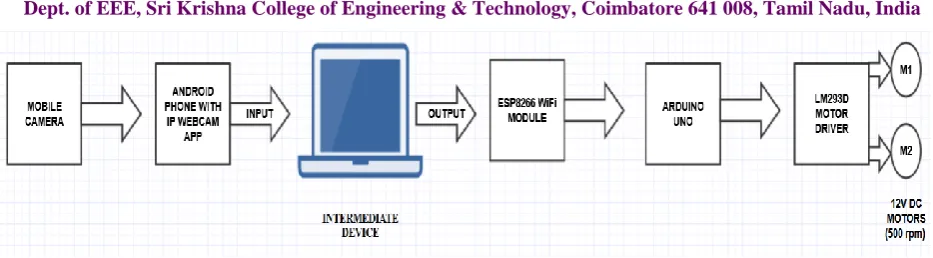
Fig 1: Block diagram of Robotic car controlled using Wi-Fi Module ESP8266
II. RELATEDWORK
ISSN (Online) : 2319 - 8753
ISSN (Print) : 2347 - 6710
International Journal of Innovative Research in Science, Engineering and Technology An ISO 3297: 2007 Certified Organization Volume 6, Special Issue 14, August 2017
Two Days National Conference on Modernization in Engineering Science (NCMES 2K17) 23rd-24th March 2017
Organized by
Dept. of EEE, Sri Krishna College of Engineering & Technology, Coimbatore 641 008, Tamil Nadu, India
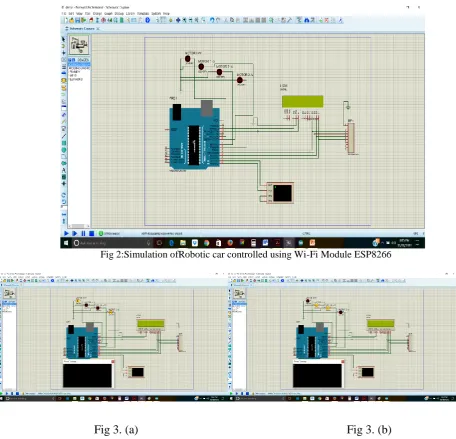
Figure 2 represents the entire simulation of the system using Proteus 8 Professional software that consist of the virtual components and instruments of the real world electronic components.
Fig 2:Simulation ofRobotic car controlled using Wi-Fi Module ESP8266
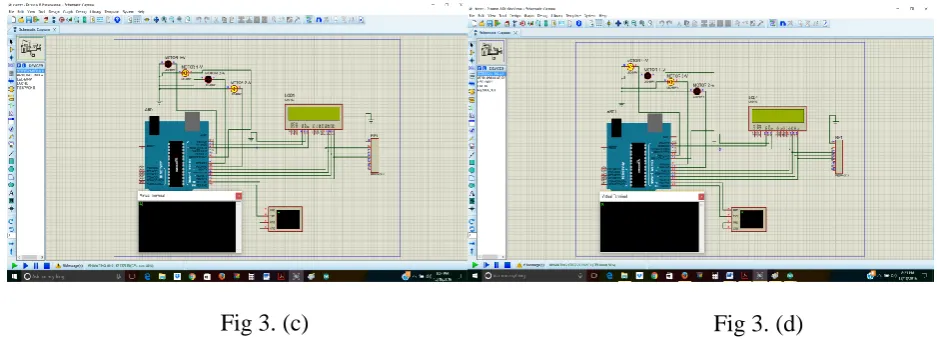
Fig 3: LED representation of the direction of motion of robotic car.(a) Forward, (b) Reverse, (c) Left ,(d) Right.
For each instruction through the virtual terminal of the simulator software, keyboard instructions like F or f, R or r, L or l, R or r & S or s are given. It controls the LEDs (M1, M2, M3& M4) in the simulators which represent the operation of motors as follows.
Fig 3.a: F or f instruction turns M1 and M4 ON which means Forward motion of motors in real time.
Fig 3.b:B or b instruction turns M2 and M3 ON which means Reverse motion of motors in real time.
Fig 3.c:L or l instruction turns M2 and M4 ON which means Leftmotion of motors in real time.
Fig 3.d:R or r instruction turns M1 and M3 ON which means Right motion of motors in real time.
IV.RESULT
Thus the given simulation illustrates that the robotic car follows the following instructions that are given through the
virtual terminal in the simulation window.
Commands Real-time instruction keys Operations
ISSN (Online) : 2319 - 8753
ISSN (Print) : 2347 - 6710
International Journal of Innovative Research in Science, Engineering and Technology An ISO 3297: 2007 Certified Organization Volume 6, Special Issue 14, August 2017
Two Days National Conference on Modernization in Engineering Science (NCMES 2K17) 23rd-24th March 2017
Organized by
Dept. of EEE, Sri Krishna College of Engineering & Technology, Coimbatore 641 008, Tamil Nadu, India
V. CONCLUSION
It was possible to control the robot over the internet in a very cost efficient and user friendly way. This method can be used for any robot with Bluetooth communication system. The robot can be used in any disaster case for scouting of distressed areas. It can supply live video feed going to places inaccessible for larger mechanical devices or human. The robot can be used for spying and surveying reported places especially in Warfield. This can be used for live feed from any region needed to be looked out for.
REFERENCES
[1] Song, M., Kim, B., Ryu, Y., Kim, Y., and Kim, S., “Control Robot System Using Android Smartphone”, The 7th International Conference on Ubiquitous Robots and Ambient Intelligence (URAI), Busan-Korea, 2010
[2] Krofitsch C., Grabler R., “Android-Based LowCost Robot Controller”, Practical Robotics Institute Austria (PRIA)
[3] Namratha S.N, Anjanaparua, Kumuda. S, Self-Balancing Robot Using Android Phone, BMS college of Engineering, IT Department, Bangalore [4] Pradeep N., ShariefM., Siddappa M., Building Vision And Voice Based Robots Using Android, 1st Annual International Interdisciplinary
Conference, 2013
[5] M. Klingmann, “Accelerometer-Based Gesture Recognition with the iPhone”, Goldsmiths University, MSc in Cognitive Computing, London, September 2009
[6] T.A. Baede., Motion Control of an Mobile Robot, National University of Singapore, Faculty of Engineering, Departement of Mechanical Engineering, 2006.
L or l Left
R or r Right