| INVESTIGATION
Evolutionary Rescue Through Partly Heritable
Phenotypic Variability
Oana Carja*,1and Joshua B. Plotkin†
*School of Computer Science, Carnegie Mellon University, Pittsburgh, PA 15213 and†Department of Biology, University of Pennsylvania, Philadelphia, Pennsylvania 19304 ORCID ID: 0000-0002-4296-2326 (O.C.)
ABSTRACTEnvironmental variation is commonplace, but unpredictable. Populations that encounter a deleterious environment can sometimes avoid extinction by rapid evolutionary adaptation. Phenotypic variability, whereby a single genotype can express multiple different phenotypes, might play an important role in rescuing such populations from extinction. This type of evolutionary bet-hedging need not confer a direct benefit to a single individual, but it may increase the chance of long-term survival of a lineage. Here, we develop a population genetic model to explore how partly heritable phenotypic variability influences the probability of evolutionary rescue and the mean duration of population persistence in changing environments. We find that the probability of population persistence depends nonmonotonically on the degree of phenotypic heritability between generations: some heritability can help avert extinction, but too much heritability removes any benefit of phenotypic variability. Partly heritable phenotypic variation is particularly advantageous when it extends the persistence time of a declining population and thereby increases the chance of rescue via beneficial mutations at linked loci. We discuss the implications of these results in the context of therapies designed to eradicate populations of pathogens or aberrant cellular lineages.
KEYWORDSevolutionary rescue; time to extinction; bacterial persistence; stochastic switching; evolutionary bet-hedging;fluctuating environments; adaptation to environmental change
T
HE veryfirst study in experimental evolution, led by W. D. Dallinger in the 1880s, attempted to demonstrate that populations can rapidly adapt to environmental change and that evolutionary rescue of a population from extinction de-pends on the rate of change (Dallinger 1887). Evolutionary rescue is the process by which a population is able to recover from environmental changes that would otherwise lead to a demographic decline and eventual extinction (Gomulkiewicz and Holt 1995; Bell and Gonzalez 2009; Gonzalezet al.2013; Lindsey et al. 2013; Alexander et al. 2014; Carlson et al. 2014). Evolutionary responses that allow populations toadapt to change on a sufficiently fast timescale to prevent extinction have been the focus of considerable experimen-tal and theoretical interest, across diverse biological sys-tems. In the field of conservation biology, questions of rescue are framed around ensuring the survival of species in deteriorating global habitats (Palumbi 2001; Daviset al. 2005; Gonzalez et al. 2013). In contrast, in clinical con-texts, the goal is the eradication of pathogens or harmful populations of cells (Gonzalezet al.2013; Alexanderet al. 2014). These two bodies of work share a common thread [as Maynard Smith (1989) emphasized, adaptation in threatened populations is not like ordinary adaptation, it is a race against extinction], yet each presents unique difficulties.
Here, we focus on the questions of population eradication that arise in medically relevant settings, where populations are often surprisingly resilient or recalcitrant to treatment due to evolutionary adaptation. In particular, we ask: how does heritable phenotypic variability alter the probability of evo-lutionary rescue? We study the evoevo-lutionary advantage of heritable phenotypic variability in populations of nonconstant
Copyright © 2019 Carja and Plotkin doi:https://doi.org/10.1534/genetics.118.301758
Manuscript received November 1, 2018; accepted for publication January 15, 2019; published Early Online January 29, 2019.
Available freely online through the author-supported open access option.
This is an open-access article distributed under the terms of the Creative Commons Attribution 4.0 International License (http://creativecommons.org/licenses/by/4.0/), which permits unrestricted use, distribution, and reproduction in any medium, provided the original work is properly cited.
Supplemental material available at Figshare: https://doi.org/10.25386/genetics. 7639649.
1Corresponding author: School of Computer Science, Carnegie Mellon University,
size. We determine the probability of rescue and the mean time to extinction in changing environments, through both analytical approximation and Monte Carlo simulations of population genetic models.
We are motivated in asking this question by well-docu-mented examples of phenotypic heterogeneity used as evo-lutionary bet-hedging strategies in volatile environments. Classic examples include: the bifurcation of a genotypically monomorphic population into two phenotypically distinct bistable subpopulations (Dubnau and Losick 2006); bacte-rial persistence (Kussellet al.2005; Lewis 2010; Cohenet al. 2013; Sharmaet al.2015), whereby a genetically identical bacterial population survives periods of antibiotic stress by producing phenotypically heterogeneous subpopulations, some of which are drug-resistant (Lewis 2007); or quiescent phenotypes in cancer cell populations (Aguirre-Ghiso 2007; Sharmaet al.2010; Smithet al.2016), which are transient phenotypic (epi)states protected from the action of drugs. These dormant phenotypic states confer the population with some degree of phenotypic heterogeneity, helping it withstand periods of environmental stress. Phenotypes may be partially heritable upon cellular division, so that the offspring cell can sometimes“remember”and express the phenotypic state of its parent, or sometimes switch be-tween phenotypic states at rates that greatly exceed those of genetic mutations (Balabanet al.2004; Van den Berghet al. 2016). Partial phenotypic inheritance through epigenetic mechanisms can lead to faster rates of adaptation and envi-ronmental tracking than genetic mutations alone. Even though persisters in such populations rely on a nongenetic form of inheritance, the rate of“phenotypic mutation”(also called “epimutation”) is itself likely under genetic control (Levin and Rozen 2006).
Epigenetic bet-hedging strategies that use dynamic regu-lation of phenotypic variability can allow a popuregu-lation to persist and escape extinction, until more permanent genetic strategies arise. Many studies have addressed questions of genetic responses in evolutionary rescue (Orr and Unckless 2008, 2014; Lindsey et al. 2013; Martin et al. 2013; Alexander et al.2014; Ueckeret al.2014; Uecker and Her-misson 2015; Wilson et al. 2017). Less attention has been given to the potential impact of phenotypic variability and of stochastic switching on evolutionary rescue (Chevinet al. 2013; Ashanderet al.2016). A recent study integrated sto-chastic demography with quantitative genetic theory in a model with evolving plasticity to explore the probability of rescue from a single, abrupt change in the environmental conditions (Ashander et al. 2016). Evolving plasticity was shown to facilitate evolutionary rescue unless the new envi-ronment was unpredictable.
Epigenetic plasticity, as studied in Ashanderet al.(2016), can cause phenotypes to differ widely within a lineage, whereas purely genetically encoded phenotypes only allow offspring phenotypically similar to the parents. The type of phenotypic variability we explore here can produce pheno-typic heterogeneity with familial correlations intermediate to
these two extremes, as observed in the contributions of DNA methylation variation to the heritability of phenotypes in Arabidopsis thaliana for example (Johannes et al. 2009; Carja et al. 2014a; Carja and Plotkin 2017). This type of partly heritable phenotype is commonplace across biological systems and its role in evolutionary rescue is yet to be understood.
We explore the evolutionary fate of a population that experiences either one sudden shift in the environmental regime or many periodic changes in the environment. In the case of a single abrupt environmental change, we study the probability of rescue when one mutant allele permits the expression of multiple phenotypic states. We imagine these phenotypic states as partially heritable, so that the phenotype expressed by an individual will be inherited by the offspring with some probability, p. We call this probabilitypthe phenotypic memory (Carja and Plotkin 2017). We are especially interested in the long-term fate of the population as a function of the variance in expressible phenotypes that the mutant allele confers, and also as a function of the amount of phenotypic mem-ory between generations.
Our paper starts by specifying a mathematical model, based on birth–death processes, for populations subject to environmental change and to the introduction of a mutant allele that permits a range of expressible, partly heritable phenotypes. We pose our research question in terms of analyzing the long-term probability of extinction of such a population. We show that after one abrupt environmen-tal change, the probability of evolutionary rescue is signif-icantly increased when a new phenotypically variable allele is introduced in the population, and that this in-crease critically depends on the phenotypic memory of individuals expressing the variable allele. When the pop-ulation experiences multiple environmental changes, the mean time to population extinction also increases for phe-notypically heterogeneous populations (i.e., population persistence increases) and this increase depends nonmo-notonically on the phenotypic memory of the mutant al-lele, p. We also show that partly heritable phenotypic variation can be particularly advantageous for populations under threat of extinction when it extends the persistence time of the declining population and thereby increases the chance of rescue via beneficial, resistance mutations at linked loci. We provide a simple intuition for the complex dependence of evolutionary rescue on the degree of phe-notypic memory, and we discuss the implications of our results for the eradication of evolving populations in med-ical contexts.
Methods
controls its phenotype. TheAallele encodes afixed phe-notypic value, whereas individuals with theaallele may express a wider range of phenotypes, drawn from afixed distribution. Here, we analytically study the case where theaallele has access to two different phenotypic values. By simulation, we also explore cases where the a allele has access to more than two phenotypic states. The phe-notypic values available to the a allele are chosen such that both allelesAandahave the same expectedfitness, so that the only difference between them is the possibility of (partly heritable) phenotypic variability. We analyze the probability of rescue as a function of the phenotypic variance and the phenotypic memory associated with the aallele.
We study two sets of questions related to phenotypic variability and persistence. In thefirst set of questions, the population, assumed to be initiallyfixed for the wild-type allele A, experiences a single abrupt change in the envi-ronmental regime at timet¼0. This environmental shift is expected to lead to a demographic decline in the pop-ulation, meaning that death rates exceed birth rates for allele A. We ask what is the probability of rescue when there is a positive mutation rate to the phenotypically variable allelea, which can provide an adaptive benefit. In this situation, there is a race between extinction of the population, and the establishment of a phenotypically variable a lineage. We also ask, what is the probability of evolutionary rescue from standing genetic variation; that is, whether theaallele is already present in the pop-ulation at some frequency at time t ¼0. We study how the probability of rescue depends upon parameters such as the population size at timet ¼ 0, the phenotypic var-iance of the a allele, the phenotypic memory of the a allele, and either the mutation rate towardaor the initial frequency ofa.
In the second set of studies, we assume a population otherwisefixed on the nonvariableAallele with one phe-notypically variablea allele introduced at time t¼0, but here we assume multiple epochs of environmental changes, occurring periodically. The question of persistence is framed in terms of the mean time to extinction of the pop-ulation, as a function of the environmental period, the phe-notypic variance, and the phephe-notypic memory available to the aallele. In this case, the mapping from phenotype to
fitness depends on the environmental regime, and it is cho-sen so that both alleles have the same expected fitness across environments.
Evolutionary rescue from a single environmental change
The one abrupt environmental change model studies how a novel allele that can express multiple phenotypes might alter the probability of evolutionary rescue of a population other-wise headed toward extinction. We describe the population using a continuous-time birth–death model. We assume the death rates are density-independent, and we study both
den-sity-independent birth rates and density-dependent ones (see the Supplemental Material). For the density-independent model presented here, individuals of the wild-type A and mutant type aeach give birth and die according to the fol-lowingper capitarates:
Here, FAis afixed number andFa is a discrete random
variable that can take two values, Fa2 and Faþ. We also
denote the current population size by N and the carrying capacity by K. The death rates of the two alleles are both assumed to be in unity. The valuesFAandFaare constrained
so that the two alleles have the same mean fitness: FA¼EðFaÞ. We study fitness functions with equal means
so that we can focus our analysis on the effect of variance in phenotypes expressed by allelea, VarðFaÞ, and not on any
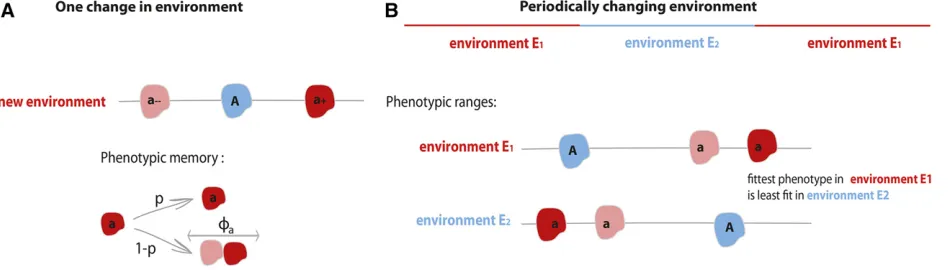
meanfitness effects. An illustration of this model is presented in Figure 1A.
In our analysis of this model, we initiate the population in a regime where the wild-type allele has a higherper capita death rate than its birth rate, so that a wild-type population is expected to become extinct fairly quickly. We analyze the conditions under which the mutant allele a(arising either by mutation or from standing variation at time t¼0) will rescue the populations from extinction. We compare this analysis with Monte Carlo simulations, in which we record the proportion of replicate simulations in which rescue occurs.
Population persistence in periodically changing environments
In our analysis of periodic environmental changes, we as-sume that the population experiences two different environ-ments,E1 and E2, which alternate every ngenerations, so that the environmental period is 2ngenerations. We assume that one environment is more favorable to one allele and the other environment is more favorable to the other allele; that is, we study a model where the phenotypically variable al-leleahas lower expectedfitness than the wild-type allele in one of the environmental regimes (for example the“no an-tibiotic”regime) and it has higher expectedfitness than the wild-type in the other regime (for example with antibiotic pressure) (Carja and Plotkin 2017).
We choose phenotypic ranges so that the mean fitness expressed by each of the two genotypes are equal across the two environmental regimes. This setup allows us to focus on the evolutionary advantage of the phenotypic variance ofa, VarðFaÞ, and to study population persistence without any
Individuals of the wild-typeAand mutant typeaeach give birth and die according to the followingper capitarates:
whereFadenotes a random variable andFAis afixed value.
The functionsfi:ℝ/ℝ(i2 f1;2g) map phenotype to birth
rate in each of the two environments, and f1 is the iden-tity function. We assume that both alleles have the same mean fitness in their optimal environment and the same meanfitness in their unpreferred environment:Eðf1ðF
AÞÞ ¼ Eðf2ðF
aÞÞ and Eðf2ðFAÞÞ ¼Eðf1ðFaÞÞ. This condition also
ensures that the average of two alleles’meanfitnesses, which we denote M¼Eðf1ðFAÞÞþ2Eðf1ðFaÞÞ¼Eðf2ðFAÞÞþ2Eðf2ðFaÞÞ, is the same in both environments. The function f2 is defined as a reflection of f1 around M: f2ðxÞ ¼2M2f1ðxÞ. As a result, the variance in fitness of allele a with a randomly drawn phenotype is the same in both environments: Varðf1ðF
aÞÞ ¼
Varðf2ðF
aÞÞ ¼VarðFaÞ(Carja and Plotkin 2017). For our
an-alytical treatment, we assume that theaallele has access to only two phenotypic values, as depicted in Figure 1B, but Supplemental Material, Figures S8 and S9 show similar results in simulations of a model with more than two phenotypic states associated with allelea.
We study the possible long-term advantage of heritable phenotypic variability by analyzing how the introduction of the a allele into an otherwise nonvariable population (A) changes the population’s probability of evolutionary rescue. We quantify how the probability of rescue depends on envi-ronmental factors, such as the envienvi-ronmental period 2n; on demographic factors, such as the carrying capacityKif there is density dependence; and on molecular factors, such as the variance in phenotypes that can be expressed by allele a,
VarðFaÞ, and the degree of phenotypic memory,p. We derive
analytic approximations in the case of one environmen-tal change and we determine the mean times to extinction in changing environments by Monte Carlo simulations (Gillespie 1976), using an ensemble of at least 10,000 rep-licate populations.
Evolutionary rescue from a resistance mutation at a linked second locus
To explore the possibility that phenotypic variability allows populations to persist longer until more permanent genetic strategies can be found, we also study a model where each individual in the population is also defined by a second, linked locus,R, at which a resistance mutation can appear at a rate smaller than the mutation rate at theA=alocus. We compare the probability of evolutionary rescue due to a resistance mutation in populations fixed for the nonvariable alleleA vs. populations that allow the phenotypically variablea al-lele, and focus on the case in which the aallele by itself is unable to save the population from extinction (the effective birth rate ofais smaller than its death rate, similar to theA allele). The birth rate of an individual carrying the resistance Rallele is assumed to be independent of the genotype present at theA=alocus.
We simulate the birth–death process in continuous time as follows. We sample the waiting time for an event from an exponential distribution with a rate parameter equal to the sum of all possible rates beginning at time zero; we then randomly assign a specific event according to the relative probabilities of occurrence of each event type (birth or death events) and update the population status, time, and all event rates. If the event implemented is a birth, we then determine the phenotypic state of the offspring as follows. If the indi-vidual chosen to reproduce has genotypeA, then the pheno-typic state of the offspring always equals its parent’s (fixed) phenotypic value. However, for a reproducing individual with theaallele there exists a probability of phenotypic memory, denoted by the parameterp, between parent and offspring: with probabilitypthe offspring retains the phenotypic state of
its parent, and with probability 12pthe offspring’s pheno-type is redrawn independently from the random variableFa.
Thus, individuals of typeacan express a range of pheno-typic values and their phenotype is partly heritable between generations (providedp.0). In the case of periodic environ-ments, we implement environmental changes (and recalculate event rates) at deterministic times:n, 2n, and 3n,etc. Time is measured in units of an individual’s expected lifetime; that is, the death rate is set to unity for all individuals in all simulations.
Data availability
The authors state that all data necessary for confirming the conclusions presented in the manuscript are represented fully within the manuscript. Supplemental material available at Figshare:https://doi.org/10.25386/genetics.7639649.
Results
Evolutionary rescue from a novel mutation
We study the probability of evolutionary rescue after a single, abrupt environmental change that would lead to population extinction of the wild-type alleleA. We assume that there is a constant rate of mutation from the A allele toward the a allele,m. We obtain analytic approximations for the density-independent model and also discuss the density-dependent case in the Supplemental Material. Intuitively, the den-sity-independent model applies in biological situations where the population is very far from carrying capacityK (such that the term ð12N
KÞ is1), while the
density-de-pendent case applies for populations large enough at the time of environmental change such thatð12N
KÞcannot be
ignored.
The probability of establishment of the new mutant (and therefore the probability of population rescue) depends crit-ically on the mutation rate to theaallele, and whether thefirst aindividual is initially introduced with its beneficial or dele-terious phenotype: that is, whether its birth rate is initially larger or smaller than its death rate. Wefirst study the case where theAallele can only mutate to produce anaallele with the beneficial phenotype, denoted byFaþ. Biologically, this could be due to the presence or absence of an epigenetic marker that makes the deleterious Fa2 phenotype directly
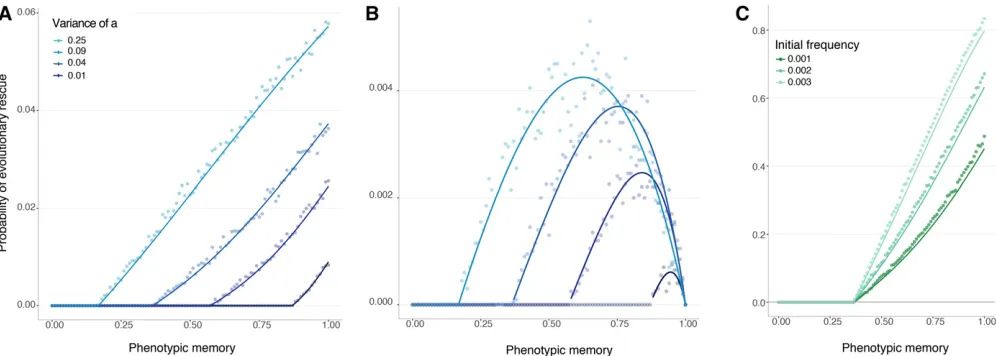
inaccessible from theAallele. The population will be rescued, by definition, if thea lineage manages to become estab-lished (Uecker and Hermisson 2011). As shown in Figure 2A, the chance of evolutionary rescue increases monoton-ically with the strength of phenotypic memory,p. This re-sult makes intuitive sense: high-fitness variants of the a allele are preferentially transmitted to the next genera-tion, and greater phenotypic memorypincreases their pro-pensity to maintain the high-fitness phenotype and become established in the population. Moreover, the probability of rescue is uniformly greater when theaallele can express a greater diversity of phenotypes,i.e., for large VarðFaÞ
(Fig-ure 2A), because the larger variance is associated with greater fitness of the Faþ phenotype. In summary, when the variable allele is introduced with a beneficial pheno-type, rescue is facilitated by increased phenotypic memory and by increased phenotypic variance of the phenotypi-cally variable allele.
When thea allele is introduced with a deleterious phe-notypeFa2, evolutionary rescue can still occur, because the
phenotype ofa-type individuals may change between gen-erations. In this case, Figure 2B shows that the probability of evolutionary rescue depends nonmonotonically on the strength of phenotypic memoryp. There is simple intuition for this result as well, which is informed by our mathemat-ical analysis below. Intuitively, the probability of establish-ment in this case is the product of the probability that some a-type individual produces an offspring with the beneficial phenotype,Faþ, before thealineage is lost, times the prob-ability of establishment associated with such an individual with phenotype Faþ. Therefore, rescue is facilitated as the strength of phenotypic memory increases above zero (this effect is driven by the increase in the probability of rescue once an individual of phenotypeFaþarises); but as the phe-notypic memory increases further, toward one, the proba-bility of rescue is reduced, because the entirealineage will likely become extinct before producing any individual with a beneficial phenotype. Or, put differently, the a lineage needs sufficient variability to produce the correct pheno-type, but not too much to avoid losing it after it has been produced.
To provide a clear analytical analysis of the intuitions described above, wefirst derive the probability of rescue, ℙrðaþÞ, when there is recurrent mutation toward the
ben-eficial phenotype Faþ. We first compute an effective se-lection coefficient of the entire a lineage, by assuming that the two phenotypes within the a lineage quickly reach epimutation–selection balance (Carja and Plotkin 2017). Given epimutation rate u¼122p between the two phenotypes, the standard mutation–selection balance ex-pression (where x refers to the frequency of the Faþ phenotype),
Fa22Faþ
x22Fa22Faþþu
Fa2þFaþ
xþFa2u¼0;
implies that the equilibrium frequency of phenotype Faþ within thealineage is given byfaþ:
faþ¼
Faþ2Fa22uFa22uFaþ 2Faþ2Fa2
þ
ffiffiffiffiffiffiffiffiffiffiffiffiffiffiffiffiffiffiffiffiffiffiffiffiffiffiffiffiffiffiffiffiffiffiffiffiffiffiffiffiffiffiffiffiffiffiffiffiffiffiffiffiffiffiffiffiffiffiffiffiffiffiffiffiffiffiffiffiffiffiffiffiffiffiffiffiffiffiffiffiffiffiffiffiffiffiffiffiffiffiffiffiffiffiffiffiffiffiffiffiffiffi
4Fa2uFaþ2Fa2þFa22FaþþuFaþþuFa22
q
2Faþ2Fa2
(1)
The effective birth rate of thealineage is
sa¼Fa2
12faþ
Taking into account that Fa2¼FA2sFa and Faþ¼FAþ sFa, this birth rate can be rewritten as a function of the mean
EðFaÞand the standard deviationsFaof the two alleles:
faþ ¼
2sFa22EðFaÞu 4sFa
þ
ffiffiffiffiffiffiffiffiffiffiffiffiffiffiffiffiffiffiffiffiffiffiffiffiffiffiffiffiffiffiffiffiffiffiffiffiffiffiffiffiffiffiffiffiffiffiffiffiffiffiffiffiffiffiffiffiffiffiffiffiffiffiffiffiffiffiffiffiffiffiffiffiffiffiffiffiffiffiffiffiffiffiffiffiffiffiffiffiffiffi
2EðFaÞu22sFa228sFasFau2EðFaÞu
q
4sFa
(3)
and
sa¼
EðFaÞ2sFa
12faþ
þEðFaÞ þsFa
faþ; (4)
as in Carja and Plotkin (2017).
When the effective birth ratesaof thealineage exceeds its
death rate (unity), the probability of establishment of this new mutation arising at timetin the population is given by
ℙest;aþðtÞ ¼
2 1þRN0
sa
12NðtþKtÞ
þ1Þexp2Rt
0
sa
12Nðt9KþtÞ
21dt9dt (5)
following Uecker and Hermisson (2011) and Wilson et al. (2017). Assuming that the mutant lineages have indepen-dent probabilities of establishment, and thus neglect-ing the mutant population size, NðtÞ can be approximated by the A allele population size, which, due to the density-independence in birth rate for the wild-typeA(but see the density-dependent case in the Supplemental Material), can be deterministically approximated by NðtÞ ¼N0expð2ð12ð12mÞFAÞtÞ, where N0¼Nðt¼0Þ.
This expression takes into account mutations away fromA at ratem.
We can now derive the probability of evolutionary rescue from at least one adaptive mutant by modeling mutant estab-lishments using a time-inhomogeneous Poisson process with intensity function mNðtÞFAPest;aþ. The probability of evolu-tionary rescue then becomes one minus the probability that no mutants establish:
ℙrescue;aþ¼12exp
2
ZN
0 m
NðtÞFAℙest;aþðtÞdt
; (6)
which simplifies to
ℙrescue;aþ¼12e
2mN0FAðsa21Þ
ð12ð12mÞFAÞsa: (7)
This analytic approximation is shown in Figure 2A alongside the results of Monte Carlo simulations. For comparison to simulation, we defined rescue as the population reaching carrying capacityK.
Conversely, when the a mutation is introduced with its deleterious phenotypic state,Fa2, wefirst derive an
approx-imation for the probability of establishment ℙest;a2ðtÞ as the
probability of at least one epimutation toFaþbefore the loss of the a allele, followed by the establishment of this aþ
mutation:
ℙest;a2¼12e2 RN
0uFa2Na2ðtÞℙest;aþðtÞdt; (8)
according to epimutation viewed as a time-inhomogeneous Poisson process, where
Na2ðtÞ ¼e2ð12ð12uÞFa2Þt (9)
represents the decline in theapopulation from a single indi-vidual with negative expected growth rate and mutation away froma2at rateu[see also Serra and Haccou (2007)]. Then,
the analytic expression for the probability of rescue becomes
Figure 2 Probability of evolutionary rescue from a new mutation, density-independent birth. The lines represent the analytical approximations. The dots represent the ensemble average across 10,000 replicate Monte Carlo simulations. (A) Probability of rescue whenAcan only initially access theaþ
phenotype. (B) Probability of rescue when A can only initially access the a2 phenotype. Here, K¼5000, N0¼1000, N0m¼0:01, and
EðFAÞ ¼EðFaÞ ¼0:95. (C) Probability of evolutionary rescue from standing genetic variation, density-independent birth. Here, N0¼2500,
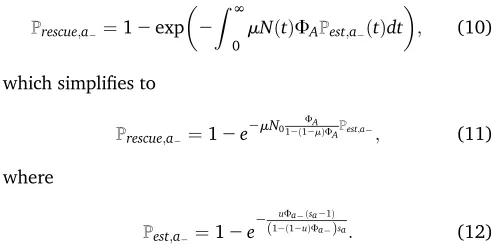
ℙrescue;a2¼12exp
2
Z N
0 m
NðtÞFAℙest;a2ðtÞdt
; (10)
which simplifies to
ℙrescue;a2¼12e2m
N012ð1F2AmÞFAℙest;a2; (11)
where
ℙest;a2¼12e
2 uFa2ðsa21Þ
ð12ð12uÞFa2Þsa: (12)
This analytical approximation is shown in Figure 2B, along-side the results of an ensemble of Monte Carlo simulations.
In the Supplemental Material, and Figures S1 and S2, we discuss and show both analytic and simulation results for the equivalent density-dependent model. Figure S10 ex-tends the parameter regime studied, exploring different mean birth rates for theA=aalleles. As expected, the den-sity-independent approximation for the rescue probability is similar to the full density-dependent treatment for sys-tems starting far from carrying capacity (Figure S3). For the sake of simplicity, the analysis that follows (cases of rescue from standing genetic variation or rescue from a resistance mutation) assumes that birth and death rates are density-independent.
Evolutionary rescue from standing genetic variation
Evolutionary rescue may alternatively occur from an adap-tive variant that exists, at low frequency, at the time of the environmental shift that dooms the wild-type genotype to extinction.
To study this, we assume that at timet¼0, the population already contains a numberqofaalleles, and we study the probability of rescue from this standing genetic variation (Figure 2C). In this case, the alineage is assumed to be at epimutation–selection balance between its two phenotypic forms at the time of the environmental change t¼0. The epimutation–selection balance is computed using Equation 1 and the probability of rescue becomes
ℙrescue¼12exp 2 faþq
ðsa21Þ sa
þ12faþ
q 12exp 2ð uFa2ðsa21Þ 12ð12uÞFa2Þsa
!!!!
:
(13)
The result of this approximation, together with Monte Carlo simulations, is shown in Figure 2C. As the phenotypic memory p increases, the phenotypic epimutation toward a2decreases, and therefore the fraction ofa2phenotypes
initially present in the population decreases. Since the probabilities of establishment for the deleteriousa2 phe-notypes are smaller than the ones for theaþphenotypes,
the initial number of aþphenotypes is the main driver of
the evolutionary dynamics.
Evolutionary rescue from a novel resistance mutation at a secondary locus
We adapted our model to study the possibility that phenotypic variability might allow the population to persist until a more permanent genetic change, such as a resistance mutation, can establish.
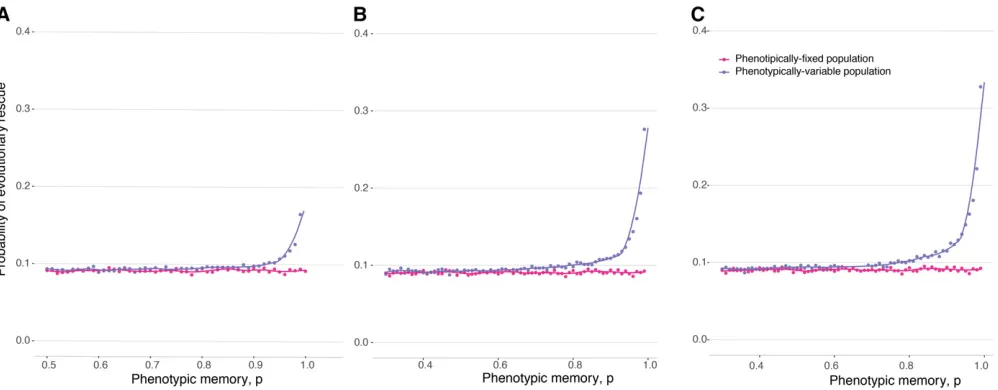
Wefind that phenotypically heterogeneous populations have an advantage over populations composed of individuals offixed phenotype (Figure 3 and Figures S4, S5, and S11). Even in the regime when the a allele cannot itself rescue the population from extinction, the probability of rescue from a resistance locus R can be significantly greater for a population with recurrent mutation toa(purple line) compared to a populationfixed for the phenotypically invariant A allele (pink line). This effect holds only for relatively high mutation rates toa. The higher this mutation rate and the larger thefitness advantage ofR, the wider the range of phenotypic memory for which this result holds. Since the probability of rescue whenaandRare available to the population can be strictly greater than the probability of rescue fromR, keeping in mind that the probability of rescue fromais zero, this result represents a form of epistatic interac-tion between thea=Alocus and theRlocus. The epistatic in-teraction arises because theaallele increases the expected time to extinction, even though it cannot alone rescue the popula-tion, and this additional persistence time increases the chance of acquiring a rescue mutation at the resistance locus.
Population persistence in periodically changing environments
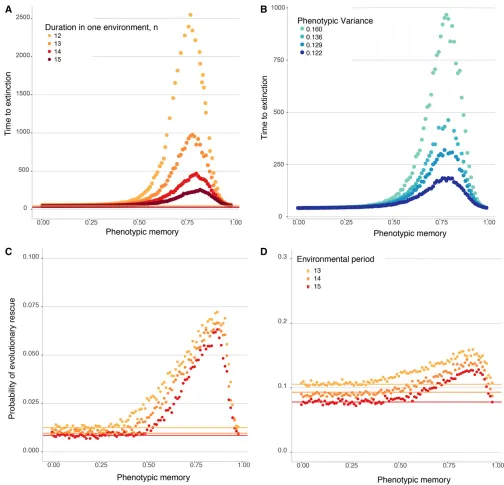
Phenotypic variability and phenotypic memory also influence population persistence in periodically changing environ-ments, in addition to the case of a single environmental change that has been the subject of most work on evolutionary rescue. With a periodically changing environment, the question of persistence is conveniently framed in terms of the mean time before population extinction. Even in this more complicated setting, we once again observe a nonmonotonic effect of phenotypic memory, p, on population persistence: popula-tions go extinct quickly for either smallpor largep, whereas intermediate amounts of phenotypic memory can promote persistence for long periods of time.
Figure 4A shows the mean time to extinction as a function of the phenotypic memory for a range of environmental pe-riodsn. In all these cases, a population comprised of only the nonvariable wild-type alleleAgoes extinct quickly (compare with Figure S6), but populations initiated with a single copy of the phenotypically variable allele ahave the potential to persist for very long times, especially for intermediate values of the phenotypic memory parameterp.
replenish. It is particularly in faster-changing environments that phenotypic memory in a phenotypically variable allelea provides the largest advantage for population persistence, be-cause it helps the high-fitness realizations of theaallele remain high in fitness, which is essential for population persistence through environmental epochs deleterious to the wild-typeA allele. The nonmonotonic dependence of persistence time on phenotypic memory also makes intuitive sense. On the one hand, it is beneficial for theaallele to have some phenotypic memory within each environment (E1 orE2), as this helps the high-fitness realizations of the allele with little effect on its
low-fitness realizations. On the other hand, too much phenotypic memory is detrimental in the long-run, because once the envi-ronment shifts, thealineage will be“stuck”with a deleterious phenotype. Moreover, regardless of the phenotypic memory, the duration of persistence always increases with the variance in phenotypes that a can express, VarðFaÞ (Figure 4B); that is,
the population can persist longer when the phenotypically vari-able allele has access to a larger phenotypic range.
Similarly to the case of a single change in environment, the phenotypically variable allele allows the population to persist for longer and thereby increases the chance that a resistance allele will arise and establish, rescuing the population from extinction (Figures 4C and 4D and Figure S7). The epistatic effect between a phenotypically plastic allele and a resistance allele observed in Figure 3 is also observed in periodically changing environments; while theaallele by itself cannot rescue the population from extinction, the probability of rescue for a population that has access to bothaandRis significantly elevated (with a maximum for intermediate memoryp) compared with a populationfixed onAwith access only to the resistance alleleR.
Multiple phenotypes
We also explore the probability of rescue and time to extinc-tion for populaextinc-tions in which theaallele has access to more
than two different phenotypes. In Figure S8 we show by simulation that, when the aallele has access to four or six different phenotypes, as long as the phenotypic variance of theaallele is kept constant, the rescue probabilities are al-most the same as the case of a phenotypic random variable with two-point masses. The same holds for the time to ex-tinction in periodically changing environments (Figure S8C). We also vary the number of phenotypes available to the a lineage while keeping its phenotypic range constant (increas-ing the number of phenotypes available with a constant phe-notypic range decreases the phephe-notypic variance). The probability of evolutionary rescue decreases with the number of phenotypes in accordance with the accompanying de-crease in the phenotypic variance (Figure S9).
Discussion
Evolutionary adaptation occurring on the same timescale as demographic dynamics can have profound effects on the persistence of a population. The theory of evolutionary rescue provides a conceptual framework that links demog-raphy and evolution infinite populations of variable size (Orr and Unckless 2008, 2014; Lindseyet al. 2013; Alexander et al.2014; Ueckeret al.2014; Uecker and Hermisson 2015; Bertramet al.2016; Wilsonet al.2017). Populations expe-riencing a sudden change in selection pressures, or frequent and unpredictable environmental variation, may either ge-netically adapt or be unable to recover. These populations have a limited window of opportunity for individuals with phenotypic solutions advantageous in the novel environ-ment to appear and establish. Genetic adaptation after abrupt environmental changes can prevent extinction under several different demographic scenarios, but such a mecha-nism of rescue is inherently limited by the genomic mutation rate.
Figure 4 (A and B) Population persistence in periodically changing environments. The dots represent the mean time before population extinction across 10,000 replicate simulations. All populations are initiated atN¼500, with a carrying capacityK¼10000, with a single-mutant genotypea drawn with a random phenotype introduced into one of the two random different environments. The two environments then cycle deterministically with each environmental epoch lastingntime units, where time is measured in units of the expected life span of an individual. (A) Mean time until population extinction for a range of different environmental periods, withf1ðF
AÞ ¼0:5,f2ðFAÞ ¼1:5, and VarðFaÞ ¼0:16. The lines, each
corre-sponding to a different value ofn, show the mean time to extinction of a population comprised of only wild-typeAalleles. (B) Mean time until population extinction for different amounts of phenotypic variability, VarðFaÞ, with afixed environmental duration ofn¼13 units,f1ðFAÞ ¼0:5, and f2ðF
AÞ ¼1:5. (C and D) Probability of evolutionary rescue in periodically changing environments from a resistance mutation. The dots represent the
probability of evolutionary rescue for a phenotypically variable population, while the lines represent this probability for a phenotypicallyfixed population, across 10,000 replicate simulations. All populations are initiated atN¼500, with a carrying capacityK¼5000, with a single-mutant genotypeadrawn with a random phenotype introduced into one of the two random different environments. The two environments then cycle deterministically with each environmental epoch lastingntime units (withnas in the legend), where time is measured in units of the expected life span of an individual. Here, the birth rate of the resistance alleleRis 1.5,f1ðF
AÞ ¼0:5,f2ðFAÞ ¼1:5, and VarðFaÞ ¼0:16. (C) Mutation rate toRis 1026. (D) Mutation rate toRis
It is widely recognized that phenotypic variation can serve as a response to environmental change (Botero et al.2015; Tufto 2015). The goal of this study has been to develop a population genetic model to quantify the probability of evo-lutionary rescue and mean times to extinction for populations that can access an allele with increased, partly heritable phe-notypic variation. We have studied the problem of evolution-ary rescue both from a novel mutation or for preexisting standing variants. Our analytical results are restricted to the case in which the phenotypically variable lineage can access two different phenotypes, but we also show that the results hold in simulation for alleles with more than two phenotypic states. The model with exactly two phenotypic states can be easily reframed as a model of stochastic pheno-typic switching. Here, the switching rate can be written as 12p
2 , where p is the phenotypic memory described in this paper. This reframing helps place some of our results in the context of the larger literature on phenotypic bet-hedging that has been developed both for infinite andfinite popula-tions, and for environments fluctuating through time (Balaban et al. 2004; Kussell et al. 2005; Salathé et al. 2009; Carjaet al.2014a; Carja and Plotkin 2017).
Previous theoretical studies on the adaptive benefit of stochastic phenotypic variability have mostly analyzed the evolution of rates of phenotypic switching by modifier loci, and mostly in infinite populations (Salathéet al.2009; Carja et al. 2014a). These studies have found that phenotypic switching rates should evolve in tune with the correlation between the environments of parent and offspring: when the environmentfluctuates periodically between two states with different optimal phenotypes, the uninvadable switch-ing rate between phenotypic states will evolve to approxi-mately 1/n, wherenis the number of generations between environmental changes (Ishiiet al.1989; Salathéet al.2009). Further studies generalized these results to include both en-vironmental and spatialfluctuations in selection (Carjaet al. 2014a,b). We have previously explored the dynamics of phe-notypic switching rates in finite populations of fixed size, where we found that thefixation probability of phenotypi-cally variable alleles depends nonmonotoniphenotypi-cally on the prob-ability of phenotypic inheritance between parent and offspring: probabilities offixation are maximized at interme-diate rates of phenotypic switching in fluctuating environ-ments (Carja and Plotkin 2017).
Under periodic changes in selective pressures, we show that a phenotypically variable allele increases the time to extinction. Moreover, this increase is nonmonotonic: there exists an intermediate phenotypic switching rate that maxi-mizes population persistence. The optimal rate of epimutation induces proportions of standing phenotypes in sync with the rate of environmental change, similar to thefindings in Carja and Plotkin (2017). Partly heritable phenotypic variation can also rescue populations in decline following a single environ-mental change. We have derived approximations for the probabilities of rescue, both for a model of density-dependent selection as well as a simpler model of density-independent
selection. While the two models lead to qualitatively similar evolutionary dynamics of the phenotypically plastic allele, the optimal memory rates are up to three times larger un-der independent selection compared to density-dependent selection.
The most striking result occurs when the allele providing phenotypic variation cannot rescue the population alone, but it can nevertheless facilitate rescue when linked to targets of beneficial mutations. Transient and variable phenotypes, which can be mediated by rapid transitions in the epigenome, may provide an additional, selectable layer of traits that en-able populations to persist until the appearance of more permanent strategies, such as genetic resistance. In empirical settings, ranging from bacterial infections to latency in viral populations, or cellular neoplastic development, this form of epigenetic, partly heritable phenotypic heterogeneity has been shown to facilitate adaptation and persistence under changing selection pressures (Seger and Brockman 1987; Acaret al.2008; Veeninget al.2008). Responses mediated by partially heritable phenotypic variability can occur on faster timescales than genetic responses, and they may play a critical role in the path toward long-term resistance eventually reinforced by genetic changes. Indeed, here we explored the fate of populations waiting for a resistance mu-tation, and we found that phenotypically variable popula-tions have a higher probability of rescue via resistance than less-variable populations, both for the evolutionary rescue scenario as well as a scenario with periodically changing en-vironments. One caveat is that these results hold only for very large rates of mutation from the wild-type to the persister phenotype a. We believe that future theoretical work of in-terest includes qualitative as well as quantitative explorations of a larger parameter space for this model of evolutionary rescue through initial persistence, followed by genetic resis-tance, as well as a rigorous exploration of the contribution of other evolutionary forces to the epistatic effects observed here.
Although our analysis does not describe the myriad of specific mechanisms that give rise to phenotypic variability, our model nonetheless provides qualitative and quantitative predictions that should hold broadly, and can help inform the design of therapies in clinical contexts where population eradication is desired. Indeed, many clinical examples of therapy failure are now known to be caused by phenotypic heterogeneity, persistence, or quiescent cellular states (Cohen et al.2013; Deriset al.2013).
the population becomes extinct. Of course, further detailed predictive models, specialized to particular populations and drug actions, are needed to formulate optimal therapies across the plethora of diseases where transient phenotypic variability drives treatment failure; but we expect the lessons learned from simple models, concerning the complex effect of phenotypic memory on persistence, to hold generally.
Acknowledgments
This research was conducted using resources provided by the Open Science Grid, which is supported by National Science Foundation award 1148698 and the U.S. Department of Energy’s Office of Science. We gratefully acknowledge sup-port from the David and Lucile Packard Foundation, the U.S. Department of the Interior (D12 AP-00025), and the U.S. Army Research Office (W911NF-12-1-0552).
Literature Cited
Acar, M., J. T. Mettetal, and A. van Oudenaarden, 2008 Stochastic switching as a survival strategy in fluctuating environments. Nat. Genet. 40: 471–475.https://doi.org/10.1038/ng.110 Aguirre-Ghiso, J. A., 2007 Models, mechanisms and clinical
evi-dence for cancer dormancy. Nat. Rev. Cancer 7: 834–846. https://doi.org/10.1038/nrc2256
Alexander, H. K., G. Martin, O. Y. Martin, and S. Bonhoeffer, 2014 Evolutionary rescue: linking theory for conservation and medicine. Evol. Appl. 7: 1161–1179. https://doi.org/ 10.1111/eva.12221
Ashander, J., C. Luis-Miguel, and M. L. Baskett, 2016 Predicting evolutionary rescue via evolving plasticity in stochastic environ-ments. Proc. Biol. Sci. 283: 20161690. https://doi.org/ 10.1098/rspb.2016.1690
Balaban, N. Q., J. Merrin, R. Chait, L. Kowalik, and S. Leibler, 2004 Bacterial persistence as a phenotypic switch. Science 305: 1622–1625.https://doi.org/10.1126/science.1099390 Bell, G., and A. Gonzalez, 2009 Evolutionary rescue can prevent
extinction following environmental change. Ecol. Lett. 12: 942– 948.https://doi.org/10.1111/j.1461-0248.2009.01350.x Bertram, J., K. Gomez, and J. Masel, 2016 Predicting patterns of
long-term adaptation and extinction with population genetics. Evolution 71: 204–214.
Botero, C. A., F. J. Weissing, J. Wright, and D. R. Rubenstein, 2015 Evolutionary tipping points in the capacity to adapt to environmental change. Proc. Natl. Acad. Sci. USA 112: 184– 189.https://doi.org/10.1073/pnas.1408589111
Carja, O., and J. B. Plotkin, 2017 The evolutionary advantage of heritable phenotypic heterogeneity. Sci. Rep. 7: 5090.https:// doi.org/10.1038/s41598-017-05214-2
Carja, O., R. E. Furrow, and M. W. Feldman, 2014a The role of migration in the evolution of phenotypic switching. Proc. Biol. Sci. 281: 20141677.https://doi.org/10.1098/rspb.2014.1677 Carja, O., U. Liberman, and M. W. Feldman, 2014b Evolution in
changing environments: modifiers of mutation, recombination, and migration. Proc. Natl. Acad. Sci. USA 111: 17935–17940. https://doi.org/10.1073/pnas.1417664111
Carlson, S. M., C. J. Cunningham, and P. A. H. Westley, 2014 Evolutionary rescue in a changing world. Trends Ecol. Evol. 29: 521–530.https://doi.org/10.1016/j.tree.2014.06.005 Chevin, L.-M., R. Gallet, R. Gomulkiewicz, R. D. Holt, and S. Fellous, 2013 Phenotypic plasticity in evolutionary rescue experiments.
Philos. Trans. R. Soc. Lond. B Biol. Sci. 368: 20120089.https:// doi.org/10.1098/rstb.2012.0089
Cohen, N., M. Lobritz, and J. Collins, 2013 Microbial persistence and the road to drug resistance. Cell Host Microbe 13: 632–642. https://doi.org/10.1016/j.chom.2013.05.009
Dallinger, W. H., 1887 The president’s address. J. R. Micros. Soc. 7: 185–199.
Davis, M. B., R. G. Shaw, and J. R. Etterson, 2005 Evolutionary responses to changing climate. Ecology 86: 1704–1714.https:// doi.org/10.1890/03-0788
Deris, J. B., M. Kim, Z. Zhang, H. Okano, R. Hermsen et al., 2013 The innate growth bistability andfitness landscapes of antibiotic-resistant bacteria. Science 342: 1237435.https://doi. org/10.1126/science.1237435
Dubnau, D., and R. Losick, 2006 Bistability in bacteria. Mol. Mi-crobiol. 61: 564–572.https://doi.org/10.1111/j.1365-2958. 2006.05249.x
Gillespie, D. T., 1976 A general method for numerically simulat-ing the stochastic time evolution of coupled chemical reactions. Trends Ecol. Evol. 22: 403–434.
Gomulkiewicz, R., and R. D. Holt, 1995 When does evolution by natural selection prevent extinction? Evolution 49: 201–207. https://doi.org/10.1111/j.1558-5646.1995.tb05971.x
Gonzalez, A., O. Ronce, R. Ferriere, and M. E. Hochberg, 2013 Evolutionary rescue: an emerging focus at the intersec-tion between ecology and evoluintersec-tion. Philos. Trans. R. Soc. Lond. B Biol. Sci. 368: 20120404. https://doi.org/10.1098/rstb. 2012.0404
Ishii, K., H. Matsuda, Y. Iwasa, and A. Sasaki, 1989 Evolutionarily stable mutation rate in a periodically changing environment. Genetics 121: 163–174.
Johannes, F., E. Porcher, F. K. Teixeira, V. Saliba-Colombani, M. Simonet al., 2009 Assessing the impact of transgenerational epigenetic variation on complex traits. PLoS Genet. 5: e1000530.https://doi.org/10.1371/journal.pgen.1000530 Kussell, E., R. Kishony, N. Q. Balaban, and S. Leibler,
2005 Bacterial persistence: a model of survival in changing environments. Genetics 169: 1807–1814. https://doi.org/ 10.1534/genetics.104.035352
Levin, B. R., and D. E. Rozen, 2006 Non-inherited antibiotic re-sistance. Nat. Rev. Microbiol. 4: 556–562. https://doi.org/ 10.1038/nrmicro1445
Lewis, K., 2007 Persister cells, dormancy and infectious dis-ease. Nat. Rev. Microbiol. 5: 48–56.https://doi.org/10.1038/ nrmicro1557
Lewis, K., 2010 Persister cells. Annu. Rev. Microbiol. 64: 357– 372.https://doi.org/10.1146/annurev.micro.112408.134306 Lindsey, H. A., J. Gallie, S. Taylor, and B. Kerr, 2013 Evolutionary rescue
from extinction is contingent on a lower rate of environmental change. Nature 494: 463–467.https://doi.org/10.1038/nature11879 Martin, G., R. Aguilée, J. Ramsayer, O. Kaltz, and O. Ronce, 2013 The probability of evolutionary rescue: towards a quan-titative comparison between theory and evolution experiments. Philos. Trans. R. Soc. Lond. B Biol. Sci. 368: 20120088.https:// doi.org/10.1098/rstb.2012.0088
Orr, H. A., and R. L. Unckless, 2008 Population extinction and the genetics of adaptation. Am. Nat. 172: 160–169.https://doi.org/ 10.1086/589460
Orr, H. A., and R. L. Unckless, 2014 The population genetics of evolutionary rescue. PLoS Genet. 10: e1004551. https://doi. org/10.1371/journal.pgen.1004551
Palumbi, S., 2001 Humans as the world’s greatest evolutionary force. Science 293: 1786–1790.https://doi.org/10.1126/science. 293.5536.1786
Genetics 182: 1159–1164. https://doi.org/10.1534/genetics. 109.103333
Seger, J., and H. J. Brockman, 1987 What is bet-hedging?, pp. 182– 211 inOxford Surveys in Evolutionary Biology, Vol. 4, edited by P. H. Harvey and L. Partridge. Oxford University Press, Oxford. Serra, M. C., and P. Haccou, 2007 Dynamics of escape mutants.
Theor. Popul. Biol. 72: 167–178. https://doi.org/10.1016/j. tpb.2007.01.005
Sharma, B., A. V. Brown, N. E. Matluck, L. T. Hu, and K. Lewis, 2015 Borrelia burgdorferi, the causative agent of lyme disease, forms drug-tolerant persister cells. Antimicrob. Agents Chemo-ther. 59: 4616–4624.https://doi.org/10.1128/AAC.00864-15 Sharma, S. V., D. Y. Lee, B. Li, M. P. Quinlan, F. Takahashiet al.,
2010 A chromatin-mediated reversible drug-tolerant state in cancer cell subpopulations. Cell 141: 69–80. https://doi.org/ 10.1016/j.cell.2010.02.027
Smith, J. M., 1989 The causes of extinction. Philos. Trans. R. Soc. Lond. B Biol. Sci. 325: 241–252. https://doi.org/10.1098/ rstb.1989.0086
Smith, M. P., H. Brunton, E. J. Rowling, J. Ferguson, I. Arozarena et al., 2016 Inhibiting drivers of non-mutational drug tolerance is a salvage strategy for targeted melanoma therapy. Cancer Cell 29: 270–284.https://doi.org/10.1016/j.ccell.2016.02.003 Tufto, J., 2015 Genetic evolution, plasticity, and bet-hedging as
adaptive responses to temporally autocorrelated fluctuating
selection: a quantitative genetic model. Evolution 69: 2034– 2049.https://doi.org/10.1111/evo.12716
Uecker, H., and J. Hermisson, 2011 On thefixation process of a beneficial mutation in a variable environment. Genetics 188: 915–930.https://doi.org/10.1534/genetics.110.124297 Uecker, H., and J. Hermisson, 2015 The role of recombination in
evolutionary rescue. Genetics 202: 721–732. https://doi.org/ 10.1534/genetics.115.180299
Uecker, H., S. P. Otto, and J. Hermisson, 2014 Evolutionary res-cue in structured populations. Am. Nat. 183: E17–E35.https:// doi.org/10.1086/673914
Van den Bergh, B., J. E. Michiels, T. Wenseleers, E. M. Windels, P. V. Boeret al., 2016 Frequency of antibiotic application drives rapid evolutionary adaptation of Escherichia coli persistence. Nat. Microbiol. 1: 16020. https://doi.org/10.1038/nmicrobiol. 2016.20
Veening, J.-W., W. K. Smits, and O. P. Kuipers, 2008 Bistability, epigenetics, and bet-hedging in bacteria. Annu. Rev. Micro-biol. 62: 193–210. https://doi.org/10.1146/annurev.micro. 62.081307.163002
Wilson, B., P. S. Pennings, and D. A. Petrov, 2017 Soft selective sweeps in evolutionary rescue. Genetics 205: 1573–1586. https://doi.org/10.1534/genetics.116.191478