Study on Use of Big Data for improving
organizational performance
Manisha Shinde-Pawar
1,Dr. Kamal Alaskar
2Assistant Professor, Dept. of Management, IMRDA, SANGLI, Bharati Vidyapeeth Univerisity, Pune, India
Professor, Dept. of Computer Applications, IM, Kolhapur,Bharati Vidyapeeth Univerisity, Pune, India
ABSTRACT: Technologies, practices for continuous iterative exploration and investigation of past performance helps to gain insights of business and to drive business planning and decisions. By using Big Data emerging technological solutions helps to derive relationships from data.Technological advancement and generation of lots of data are key challenges in modern business processes.Formerly using big data was considered as only digital firms and its executives dream, but big data is enough potential for all different traditional business organizations as well. Organizational changes in Infrastructure, real world development, deployment, and experiences delivering Big Data solutions for such organizations.The researchers would like to study and reveal organizational performance significance in transactions, information management, communicating and in decision making by using big data. Reachable communication process advancement and transactional efficiency and ethics are need of time to improve and to build confidence amongst customers.
KEYWORD: Big Data, decision making, digital firm, communication process, Transactional efficiency, organizational performance.
I. INTRODUCTION
A.BIG DATA
Big data is an all-encompassing term for any collection of data sets so large and complex that it becomes difficult to process them using traditional data processing applications. Scientists regularly encounter limitations due to large data sets in many areas, including meteorology, genomics, connectomics, complex physics simulations, and biological and environmental research. The limitations also affect Internet search, finance and business informatics. The easiest definition of big data as given by Sam Madden in white paper “From databases to Big Data” is stated as “Data that is too big, too fast, or too hard for existing tools to process”.
Big data is data that exceeds the processing capacity of conventional database systems. The data is too big, moves too fast, or doesn‟t fit the strictures of your database architectures. Big data is distributed data. This means the data is so massive it cannot be stored or processed by a single node. It‟s been proven by Google, Amazon, Facebook, and others that the way to scale fast and affordably is to use commodity hardware to distribute the storage and processing of our massive data streams across several nodes, adding and removing nodes as needed.
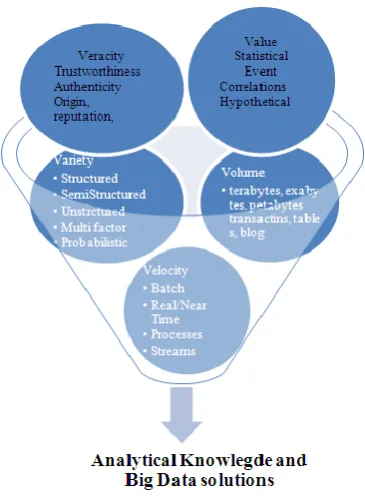
B.FIVE V’S OF BIG DATA:
Figure 1 Big Data Concept
Volume describes the large size of data in Exabyte, Petabyte or Terabyte and relative processing capability. Velocity described at data is generated, captured, shared and stored. A proliferation of data types from social, machine to machine, and mobile sources add new data types to traditional transactional data. Data no longer fits into neat, easy to consume structures.
C.ISSUES & CHALLENGES WITH BIG DATA
According to Bill Frank the data in big data can be categorized as: Automatically generated by a machine, typically an entirely new source of data (e.g. blogs), not designed to be friendly (e.g. Text streams), may not have much values (need to focus on the important part).
From the above categorization author has found the big data as Structured - Most traditional data sources
Semi-structured- Many sources of big data Unstructured- Video data, audio data
Raw data must be converted into knowledge and understanding in order to stimulate scientific discoveries, economic growth and industrial innovation.
II. LITERATURE REVIEW
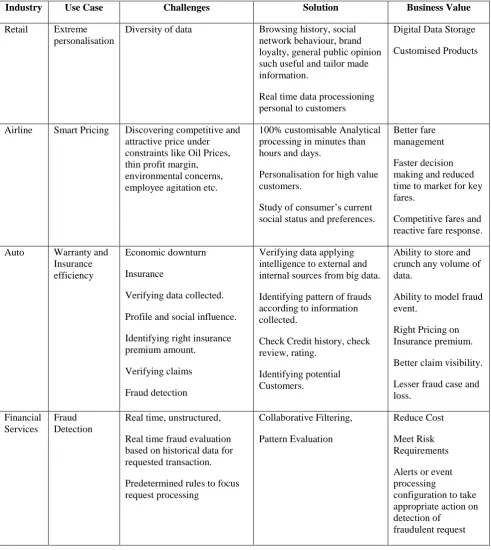
Big data Spectrum by Infosys, explores Big Data Industry use cases as:
Table No.1
Industry Use Case Challenges Solution Business Value
Retail Extreme personalisation
Diversity of data Browsing history, social network behaviour, brand loyalty, general public opinion such useful and tailor made information.
Real time data processioning personal to customers
Digital Data Storage
Customised Products
Airline Smart Pricing Discovering competitive and attractive price under constraints like Oil Prices, thin profit margin, environmental concerns, employee agitation etc.
100% customisable Analytical processing in minutes than hours and days.
Personalisation for high value customers.
Study of consumer‟s current social status and preferences.
Better fare management
Faster decision making and reduced time to market for key fares.
Competitive fares and reactive fare response.
Auto Warranty and Insurance efficiency
Economic downturn
Insurance
Verifying data collected.
Profile and social influence.
Identifying right insurance premium amount.
Verifying claims
Fraud detection
Verifying data applying intelligence to external and internal sources from big data.
Identifying pattern of frauds according to information collected.
Check Credit history, check review, rating.
Identifying potential Customers.
Ability to store and crunch any volume of data.
Ability to model fraud event.
Right Pricing on Insurance premium.
Better claim visibility.
Lesser fraud case and loss.
Financial Services
Fraud Detection
Real time, unstructured,
Real time fraud evaluation based on historical data for requested transaction.
Predetermined rules to focus request processing Collaborative Filtering, Pattern Evaluation Reduce Cost Meet Risk Requirements
Alerts or event processing
configuration to take appropriate action on detection of
Energy Tapping Intelligence in Smart Grid
Inadequacies in generation, transmission and distribution and inefficient use of electricity.
Smart meters
Detect Critical anomalies
Enriched Information
Demand forecasting
Responding to peak load.
Smart metering
Analysing consumer usage and behaviour
Manage load congestion and shortfall
Energy security and climate change data management
As shown in Table No.1, Big data solution for different industries has efficient uses and business value viz. Customer personalisation, smart pricing, identifying and detecting fraud patterns, smart metering in energy industry. This shows that organisations has improved their performance and are providing smarter and efficient services by using big data. Organisational internal and external stakeholders are adopting big data solutions applied in form of activities, tasks, intelligent / expert systems, cloud storages to meet organisational goals and to satisfy their different needs.
Big Data applications run on the SAP HANA platform and helps organisations to share insight and improve results in all areas of your organization – including sales, marketing, finance, supply chain management, and manufacturing.
More and more organizations are stepping out of the traditional boundaries of the enterprise to understand the impact of the environment on their business, big data keeps growing bigger. Social media channels, websites, automatic censors at the workplace and robotics are producing a plethora of structured, unstructured and semi-structured data. Advanced analytics based on big data is the art of putting all these fragmented and often disconnected pieces together and generate actionable insights for the enterprise.
Expert David Loshin examines the different types of big data analytics tools available today, and takes a look at how each can be used in the enterprise in Business Decision published on June 2015Accrording to him, “more complex predictive and prescriptive modelling can help companies anticipate business opportunities and make decisions that affect profits in areas such as targeting marketing campaigns, reducing customer churn and avoiding equipment failures.”
The world's technological per-capita capacity to store information has roughly doubled every 40 months since the 1980s; as of 2012, every day 2.5 Exabyte‟s (2.5×10¹⁸) of data were created. The challenge for large enterprises is determining who should own big data initiatives that straddle the entire organization.
Big data requires exceptional technologies to efficiently process large quantities of data within tolerable elapsed times. A 2011 McKinsey report suggests “suitable technologies include A/B testing, crowdsourcing, data fusion and integration, genetic algorithms, machine learning, natural language processing, signal processing, simulation, time series analysis and visualization”.
According to Stephen Kaisleret. al. the data stored with machine plays very important role in decision making and knowledge discovery. A major challenge for IT researchers and practitioners is that growth rate is fast exceeding our ability to both:
(1) Design appropriate systems to handle the data effectively (2) Analyse it to extract relevant meaning for decision making.
STATEMENT OF THE PROBLEM
Big data is changing scenario for business stakeholders and all different organizations. Big data transformations are cost effective means to improve organizations performance. To accelerate the development and adoption of big data revolutionary changes research and problems in big data needs to be tackled. Researcheraims to focus and study use of big datain organizational performance.
III. OBJECTIVES
To carry out comparative study of different big data feature and improvement of usingbig data in organizations. To study big data components of performance at different organizational levels
To study considering multiple parameters for business solutions, with accuracy, expected to be fast, precise and improved. It will help to design the strategies and reduce the business loss.
IV. RESEARCH METHODOLOGY
Big data enables business organization to uncover and analyze hidden relationship and to utilize this knowledge for performance optimization to improve business outcomes and manage risk, now and in the future. Big data aims to restructure the organization for dynamic and real time, quick business planning and to drive business accordingly to enhance business revenues by providing advancement in communication process and transactional efficiency.Big data solutions are adapted by Amazon, AOL, eBay, Facebook, Foursqaure, Google, IBM, Netflix, Twitter, Yahoo and many more organizations are implementing.
It provides reliable multi dataset storage, easy queries and report filtering for complex data set that is too big, too complex, by adopting complex data structure by using built in, extendable and flexible types and formats using low level processing using built in tools.
A.BIG DATA OUTCOMES AT DIFFERENT LEVELS OF ORGANIZATION
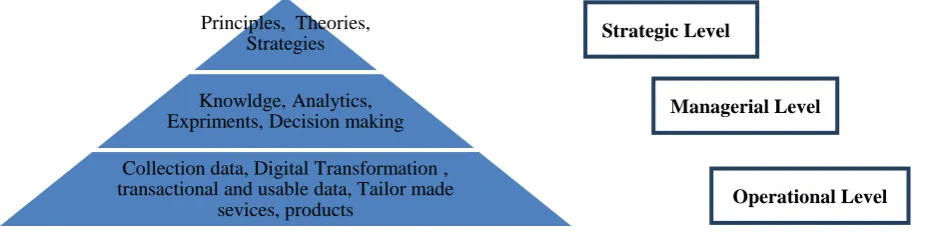
As shown in figure no. 2, using big data solution in organizations help it to achieve its objective by improving performance at different level of organizations.
At bottommost operational level using big data can improve performance and unlock significance of organization by creating transparency through providing real time and near time transactional ways and exchanging digital information, by personalization adding value to customer services, providing precise and tailor made services and also equipping organizational resources with digital information storage capability to give accurate and detailed performance data.
Figure No.2: Big data outcomes at different levels of organization
Principles, Theories, Strategies
Knowldge, Analytics, Expriments, Decision making
Collection data, Digital Transformation , transactional and usable data, Tailor made
sevices, products
Strategic Level
Managerial Level
Managerial level performance is supported, made more sophisticated and improved in decision making by providing data analytics, segmentation of customers, controlled experiments and study due to large and variety of data set availability. Opinion mining helps for quality improvement and to restructure and redesign services and products, targets. Pattern analysis helps in risk and fraud identification and controlling mechanism. Uncovered knowledge from transformed information will guide and support business experts to drive their business activities with efficient plans and proactive maintenance, measures to perform organizational tasks.
Topmost facilitates and supports senior executive information and decision-making needs with relevant organizational goals. At this level of organization,big data is analyzed and used for next generation product and services designs, to design strategies with innovative offers. To retrieve core principle and theories to implement and achieve organizations sound performance.
B.BIG DATA UNDERSTANDING WITH DIFFERENT ASPECTS
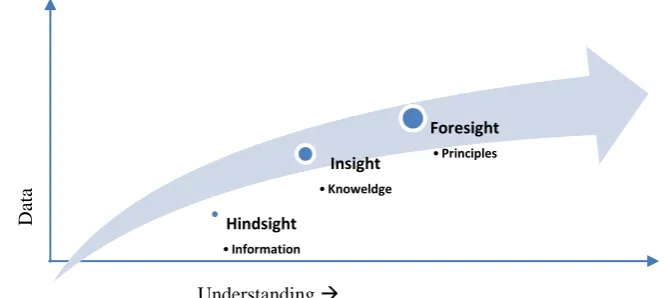
Big data is useful in understanding different aspects and time relevant implementationswith past, present and future estimations.So it helps to analyze retrospection, introspection and to forecasting.
As shown in figure No. 3, detailed real time data and relevant historical practices data and its understanding at specific level involves specific hindsight for transactions and operations. With such different number of events and transactions and related possible sources data collection grows data with its dimensions it becomes complex to understand. Business decisions are based upon accurate data and information. Analysts spend 80% of their time in retrieving and manipulating data and only 20% of their time in using and analysing that information for decision making. Iterative exploration with sophisticated analytics and fact based management is achieved gaining insights and customized performance evaluation with support of dashboards, Key Performance Indicators, benchmarks through expanded data views and planned, organized, structured and primarily automated extraction of data. Knowledge of insight view in right time also helps to track risky events at real time to control them with suggested solutions. It also helps to view data with many angles, drill down and pinpoint particular event, analyze trend analysis and provides appropriate decision making tools.
Understanding
Figure No.3: Big data understanding with different aspects.
Big Data foresight will help to drive and plan activities by using predictive analytics, risk analysis, segmentation analytics. It helps to find out innovative relationship patterns to determine principles and possible strategies extracted from transformed data to maximize business revenue.
Da
ta
Hindsight •Information
Insight •Knoweldge
C.ORGANIZATIONAL PERFORMANCE
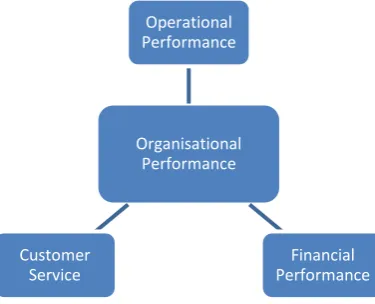
Organizational performance comprises the actual output or results of an organization as measured against its intended outputs. Organizational performance is the ultimate dependent variable of interest for researchers concerned. Systematic analysis of organizations output with its aims and objectives mainly focuses three main levels of performance as
Figure No.4 Organizational Performance
1. Financial Level :
Estimation and analysis of Revenue Growth using Income statement and sales plan variances, operating margin in operational plan variances, Risk Exposure Index for risk management and risk compliance. Using big data organizations can perform tasks like variance analysis, scenario modelling, and simulations. Customer Profitability analysis techniques.
2. Operational Level:
Big data help companies uncover ways to make operations more efficient and effective by improving asset efficiency.
Estimation and analysis of Supply chain cost, Operations cost, Overhead cost, Return on strategic investment, Staff Productivity Index, Expense Retention. Reengineering the operational procedures to overcome variances. It also involves identifying different operational factors like revenue factors like market opportunities, sales
results, and Product and portfolio management, pricing, on time delivery, Demand generation, expense factors like purchasing, distribution, Inventory management, production management, IT Vendor management and risk factors like internal environment, risk assessment, risk response, control activities, information and communication and risk monitoring.
3. Customer Service:
Performance of their organization led directly to better sales and customer service. Big data helps in understanding and analyzing Customer orientation, identifying customer loyalty, customer needs.
Helps to improve responsiveness to customer at point of interaction. It helps to integrate real time data with historical data.
Improve customer satisfaction and customer retention.
Identify and deliver right offer so most likely to be accepted by customer.
Organisational Performance
Operational Performance
Financial Performance Customer
D.BENEFITS OF BIG DATA
To gain business hindsight, insight and foresight to get competitive advantage and identifying association relationship and Cross Selling Opportunities.
Gain insights on demand for Key metric reports.
Altering way of business by providing ecosystem based customer adoptive transactional processes, communicating digital information and large information storage.
Identifying and resolving frauds by uncovering hidden patterns. Better Decision making across organization
Better Management functioning and customer satisfaction.
V. CONCLUSION
Use of Big data will help organisations for its digital transformations and to gain competitive advantage for next generation improvement in decisions, services, and mainly innovative ways transactional data processing.Big data provides visibility, insight and control of organizational performance measure and monitor financial and operational performance, anticipate gap performance, analysing root causes, assessing alternatives and giving quick recommendations. Tracking real time and integrating with historical frequent patterns of fraud can address fraud situation effectively using big data.
Big data management can be used to enhance performance at all levels of organisation, by getting quality rich information and transactional efficiency for operational management, transformed knowledge and improved decision making for middle management and wisdom part to get principles and theories or to set strategies at topmost executive level.However, big data use-case implementation integrating with existing distributed systems applications and mobile applications may be future research trend to cope up with digital infrastructure and resources requirement to improve internal organisational performance.
REFERENCES
1. Edd Dumbill, Big Data 2012 Edition O‟Reilly, Published by O‟Reilly Media, Inc., 1005 Gravenstein Highway North, Sebastopol, CA 2. Soumendra Mohanty, Madhu Jagadeesh, Harsha Srivatsa ,”Big Data Imperatives: Enterprise „Big Data‟ Warehouse, BI Implementations and
Analytics” Apress
3. Demystifying Big Data: A Practical Guide to Transforming the Business of Government, TechAmerica Foundation‟s Federal Big Data Commission, 2012
4. George Gilbert, A guide to big data workload management challenges, May 2012, by Datastax.
5. Manisha Shinde, “Formation of Smart Sentiment Analysis Technique for Big Data”, International Journal of Innovative Research in Computer and Communication Engineering. Vol.2, Issue 12, December 2014.
6. http://www.infosys.com/cloud/resource-center/Documents/big-data-spectrum.pdf 7. http://en.wikipedia.org/wiki/Big_data
8. http://www.bain.com/publications/articles/big_data_the_organizational_challenge.aspx
9. http://www.mckinsey.com/insights/business_technology/big_data_the_next_frontier_for_innovation 10. http://www.sap.com/solution/big-data/software/applications.html
11. http://klouddata.com/big-data