An Approach for Congestion Control in
Wireless Network using Sliding Window
Attiuttama¹, Kanojia Sindhuben Babulal²
M.Tech Scholar, Dept. of CSE, United Institute Of Technology, Allahabad, India¹ Assistant Professor, Dept. of CSE, United Institute Of Technology, Allahabad, India²
ABSTRACT: The transmission Control protocol is one of the pillars of the global internet. One of TCP’s critical functions is congestion control in wireless network communication. Congestion control in wireless networks has been broadly investigated and numerous techniques have been developed, all with the aim of improving performance in wireless network. This paper provides an effective scheme for congestion control error detection and correction in transmission of data packets in wireless communication networks. The goal is to maximize the total utility and achieve low end-to-end delay simultaneously with accuracy. For this objective, sliding window based approach is applied in which Go-Back-N cyclic coding technique is used to prevent congestion control.
KEYWORDS: TCP, ACK, NAK, MATLAB, ARQ, Go-Back-N, FEC, EEC, CRC
I. INTRODUCTION
In data networking and queuing theory, network congestion occurs when a link or node is carrying so much data that its quality of service deteriorates. Typical effects include queuing delay, packet loss or the blocking of new connections. A consequence of the latter two effects is that an incremental increase in offered load leads either only to a small increase in network throughput, or to an actual reduction in network throughput.
Congestive collapse (or congestion collapse) is the condition in which congestion in a packet-switched computer network prevents or limits useful communication. Congestion collapse generally occurs at "choke points" in the network, where the total incoming traffic to a node exceeds the outgoing bandwidth. Connection points between a local area network and a wide area network are the most likely choke points.
Congestion control concerns controlling traffic entry into a telecommunications network, so as to avoid congestive collapse by attempting to avoid oversubscription of any of the processing or link capabilities of the intermediate nodes and networks and taking resource reducing steps, such as reducing the rate of sending packets. It should not be confused with flow control, which prevents the sender from overwhelming the receiver.The TCP congestion avoidance algorithm is the primary basis for congestion control in the Internet. Problems occur when many concurrent TCP flows are experiencing port queue buffer tail-drops. Then TCP's automatic congestion avoidance is not enough. All flows that experience port queue buffer tail-drop will begin a TCP retrain at the same moment – this is called TCP global synchronization.
II. LITERATURE SURVEY
(An ISO 3297: 2007 Certified Organization)
Vol. 3, Issue 10, October 2015
Ahmed Khurshid, Md. Humayun Kabir, and Md. Anindya Tahsin Prodhan: As the basic TCP congestion control algorithm cannot distinguish between congestion event and bit error event, it fails to perform well in wireless networks. In this paper, we propose modifications to the basic TCP congestion control algorithm so that its performance is enhanced in wireless networks. In particular, our algorithm refines the multiplicative decrease algorithm of TCP NewReno. We are using some statistical counters to track the frequencies of the occurrences of timeouts and 3-dupacks. Different ratios of these counter values are then used to differentiate a congestion event from a non-congestion event. We are also tracking the time difference between two consecutive timeouts to figure out whether timeouts are caused by network congestion or random bit errors. We tested our proposed algorithm using the Network Simulator version 2 (ns-2) and found that it shows better performance than any other TCP variants in the wireless networks. Moreover, our algorithm is end-to-end in nature and modifies only TCP sender’s algorithm.
Alessandro Abate, Minghua Chen, Shankar Sastry: This paper proposes two new congestion control schemes for packet switched wireless networks. Starting from the seminal work of Kelly (Kelly et al., Dec 1999), we consider the decentralized flow control model for a TCP-like scheme and extend it to the wireless scenario. Motivated by the presence of channel errors, we introduce updates in the part of the model representing the number of connections the user establishes with the network; this assumption has important physical interpretation. Specifically, we propose two updates: the first is static, while the second evolves dynamically. The global stability of both schemes has been proved; also, a stochastic stability study and the rate of convergence of the two algorithms have been investigated. This paper focuses on the delay sensitivity of both schemes. A stability condition on the parameters of the system is introduced and proved. Moreover, some deeper insight on the structure of the oscillations of the system is attained. To support the theoretical results, simulations are provided.
P.Radha Krishna Reddy, Ashim Roy, G.Sireesha K., Pushpa Rani : In this paper we proposed to improve channels transmission rate but different time-invariant error rates. By assuming the Gilbert–Elliott model (GEM) for each channel and TCP for high speed. The additive increase/multiplicative-decrease (AIMD) algorithm is a feedback control algorithm best known for its use in TCP Congestion Avoidance. AIMD combines linear growth of the congestion window with an exponential reduction when congestion takes place. Multiple flows using AIMD congestion control will eventually converge to use equal amounts of a contended link. The related schemes of multiplicative-increase/multiplicative-decrease (MIMD) and additive-increase/additive-decrease (AIAD) do not converge.
III. THEORETICAL ANALYSIS
The Transmission Control Protocol (TCP) is a core protocol of the Internet protocol suite. It originated in the initial network implementation in which it complemented the Internet Protocol (IP). Therefore, the entire suite is commonly referred to as TCP/IP. TCP provides reliable, ordered, and error-checked delivery of a stream of octets between applications running on hosts communicating over an IP network.
Figure1. Process of ACK & NAK between sending and receiving end
In Go-back-N, if packets are correctly delivered, they are delivered in the correct sequence. Therefore, the receiver does not need to keep track of `holes’ in the sequence of delivered packets.
Figure2. Representation of Go-Back-N ARQ
IV. MATLAB SIMULATION & RESULT
The coding done for sliding window is implemented on MATLAB 7.11 (R2010b) and the system configuration of Intel Core i3- 1.90 GHz with 64 bit operating system. This code asks to enter the number of frames to be sent and asks to enter number of bits in one frame, and then it generates the transmitted bits with the received message with the ACK frame. This is a MATLAB coding that implements Go-Back-N ARQ with Cyclic Coding. Error Correcting FEC used is Cyclic Coding and CRC is used for Error Detection. Retransmission strategy is Go-Back-N. All this based on the principle of sliding window. Simulation result is then obtained.
B
A 2
1
3 2
received 3
ACK2
packet 1 is received, send ACK 2
B
A 3
2
4 3
4
1
1 2
4 3
B
A 4 2
Time out for Packet 2 retransmit frame 2,3,4
(An ISO 3297: 2007 Certified Organization)
Vol. 3, Issue 10, October 2015
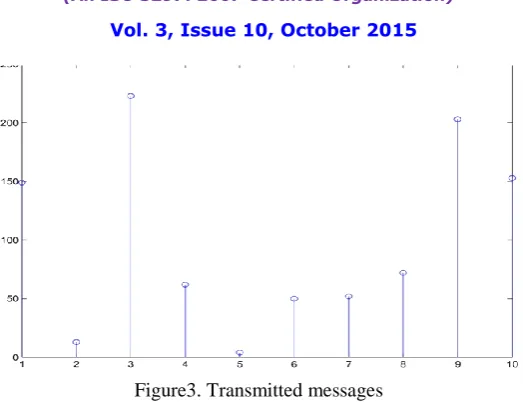
Figure3. Transmitted messages
The coding for sliding window displays this result. When the simulation is done code asks to enter the number of frames user want to send and then how many bits in one frame consist which will then generate the transmitted bits with the received message and also the ACK frame. All this is based on the principle of sliding window which is very essential part in congestion control in wireless communication system. In support of this concept the figure below shows the output of the MATLAB code.
Figure 4. Output graph of MATLAB coding
Go-Back-N ARQ is a specific instance of the automatic repeat request (ARQ) protocol, in which the sending process continues to send a number of frames specified by a window size even without receiving an acknowledgement (ACK) packet from the receiver. It is a special case of the general sliding window protocol with the transmit window size of N and receive window size of 1.
Figure5. Data coded with CRC
The check value or CRC, for each block of data to be sent or stored and appends it to the data, forming a codeword. When a codeword is received or read, the code either compares its check value with one freshly calculated from the data block, or equivalently, performs a CRC on the whole codeword and compares the resulting check value with an expected residue constant. If the check values do not match, then the block contains a data error. The device may take corrective action, such as rereading the block or requesting that it be sent again. Otherwise, the data is assumed to be error-free (though, with some small probability, it may contain undetected errors; this is the fundamental nature of error-checking).
Figure6. Cyclic coded data transmitted
(An ISO 3297: 2007 Certified Organization)
Vol. 3, Issue 10, October 2015
Figure7. Data packet decoded
When the error check and correction are over then the data packets are decoded at the receiver end and the receiving channel receives the data packets which are now in pure form. Hence the figure-7 shows the data after decoding and the corresponding data packets received are shown below in figure-8
Figure8. Received Data packets
V. CONCLUSION
throughput as well as SISD or MISD can be applied for calculating error rate for single and multiplicative channels when selective sequential queues are approached. Enhancing TCP to reliably handle loss, minimize errors, manage congestion and go fast in very high-speed environments are ongoing areas of research and standards development.
REFERENCES
1. Kanojia Sindhuben Babulal, Rajiv Ranjan Tiwari,|” Cross layer Energy Efficient Routing .(XLE2R) for prolonging the lifetime of wireless sensor network,” IEEE 2nd International Conference on Computer and Communication Technology (ICCCT-2010) September 15-17, pp
,70-74, 2010.
2. David Q. LIU, Williana Jean BAPTISTE , “On Approaches to Congestion Control over Wireless Networks”, Int. J. Communications, Network and System Sciences, 2009, 3, 169-247
3. Ahmed Khurshid, Md. Humayun Kabir, and Md. Anindya Tahsin Prodhan, “An Improved TCP Congestion Control Algorithm for Wireless Networks”.
4. Alessandro Abate, Minghua Chen, Shankar Sastry, “New Congestion Control Schemes Over Wireless Network: Delay Sensitivity Analysis and
Simulations”.
5. Ekaterina Dashkova and Andrei Gurtov, “Survey on Congestion Control Mechanisms for Wireless Sensor Networks”.
6. B.Nithya, C.Mala and Vijay Kumar B, “Impact of Contention Window on Congestion Control Algorithms for Wireless adhoc Networks”. 7. M. E. Anagnostou and E. N. Protonotarios, ―Performance analysis of the selective repeat ARQ protocol,‖ IEEE Trans.Commun., vol.
COM-34, pp. 127–135, 1986.
8. Z.Rosberg and N. Shacham, ―Resequencing delay and buffer occupancy under the selective-repeat ARQ,‖ IEEE Trans.Inf. Theory, vol. 35, pp. 166–173, 1989.
9. M. Moeneclaey, H. Nruneel, I. Bruyland, and D. Y. Chung, Throughput optimization for a generalized stop-and-wait ARQ scheme,‖ IEEE Trans. Commun., vol. COM-34, pp. 205–207,1986.
10. J. G. Kim and M. K. Krunz, ―Delay analysis of selective repeat ARQ for a Markovian source over a wireless channel,‖ IEEE Trans. Veh. Technol., vol. 49, pp. 1968–1981, 2000.
11. L. B. Le, E. Hossain, and A. S. Alfa, ―Delay statistics and throughput performance for multi-rate wireless networks under multiuser diversity,‖ IEEE Trans. Wireless Commun., vol. 5, pp. 3234–3243, 2006.
12. M. Rossi, L. Badia, and M. Zorzi, ―SR ARQ delay statistics on N-state Markov channels with non- instantaneous feedback,‖ IEEE Trans.Wireless Commun., vol. 5, pp. 1526–1536, 2006.
13. D. Towsley, ―A statistical analysis of ARQ protocols operating in a non independent error environment,‖ IEEE Trans. Commun., vol. COM-29, pp. 971–981, 1981.
14. Z. Ding and M. Rice, ―Throughput analysis of ARQ protocols for parallel multichannel communications,‖ in Proc.IEEE GLOBECOM, 2005, pp. 1279–1283.