Document Extraction with Content and
Querying Support System using
Attribute Suggestion
Shaikh Ifat1, Prof. Santosh Kumar 2
1M.E. Student, Dept. of Computer Engineering, SITRC College of Engineering, Nasik, India
2Associate Professor, Dept. of Computer Engineering, SITRC College of Engineering, Nasik, India
ABSTRACT: Today is the world of Internet, www .An important data is generated in multiple organization which is
in textual format. In such organization the text structured information is get wrapped in unstructured text. There are collections of several, multiple, large textualdata which contains variable amount of structured format information, which should be hidden in unstructured text. From these collections of inter relevant data/information is always difficult to search desirable documents. Current specified algorithms is working on constructing information from raw material or data , but they are not inexpensive or less cost effective and sometimes shows improper result set especially when they are finding for text with lacking of information about exact arrangement of text files. We are proposing two technique that provides the generation of proper structured metadata by identifying documents which are contain information of user interest and this information is going to be useful for applying query to the database finding exact information/document. Here people will likely to assign attributes for metadata related to documents which they upload which will easily help the users to finding the documents. This main concept is totally depends on the idea that humans can add the more necessary attributes for metadata when they are creating any document, if it prompted by any other interface; so it is much easier for humans (and/or algorithms) to identify the attributes when such kind of information actually presents in such kind of files, instead of different normal users who need to fill in forms with such information which is not available in the document. So the system consist of two main part from which major modules discover set of structured attributes and interesting knowledge or features about the document , with the help of these techniques which can combine utilization of the
a. Content of the document and the
b. Query Value
The proposed algorithms may fetch knowledge from raw data are considering words and their frequency count but not the phrases or any extraordinary sequence of words. As the main thing of our contribution is that we are introducing a technique i.e. phrase extraction. This technique can tag or extract typical collection of words to construct knowledge from raw data.
KEYWORDS: CADS Technique, Information Extraction Algorithm, Attribute Suggestion.
I. INTRODUCTION
Nowadays, the existing output on searching some kind of a special document is a primary requirement. To get multiple searched output, we have to store documents and data in specific way i.e. stored data in either structured format or in unstructured format. Annotation technique is one of the best feasible techniques to manage such kind of documents and get efficient search result. Attribute/ fields pairs are generally strong and give significant data because it contains more information than un typed format approaches. Efforts should be taken for decent maintenance of such extraction of documents by user.
of information is related to data which is present in database and therefore it is useful in organizing the documents. Another sharing tool is Google base [1]. Google base is a database which is used by the Google in that user can able to add any kind of data, such as text, pictures, videos, audio etc. It allows the users to mention or suggest the attributes of data, it also enable the users to select attribute values from predefined templates. But these types of tagging or annotation process requires large amount of knowledge discovery due to the huge database information discovery.
There are many annotation methods/ techniques are present which are based on attribute/ fields value pair. This strategies is based on attribute/field value pair for effective method of document extraction. But there is some restriction such as document must be in specific structured format when using such systems. Also user has good knowledge of generated attributes of document, as there are many attributes can generate because of them it will be more complex and difficult and infeasible to identify such type of attributes and hence It is difficult approach to facilitate document extraction. Along with these restriction it also creates more load on proposed system so that the throughput of system may reduce. Even if attributes are found, but the normal user has less interest for doing such things. All such difficulties will result in poor extraction. Such poor extraction results in cumbersome not only system but also data.
While annotating document special care should be taken and annotation keyword suggested should be semantic. Hence proposed algorithm should be mainly describes on those document which contains words so attributes may create with this words that are used during query. If we ignore contents of document inside then it will be unable to find the specific and required information and hence file feature extraction is done on text documents. Likewise for efficient and exact information retrieval and document extraction ontology are also used.
one of the best feasible techniques to manage such kind of documents and get efficient search result. Attribute/ fields pairs are generally strong and give significant data because it contains more information than un typed format approaches. Efforts should be taken for decent maintenance of such extraction of documents by user.
There are multiple application domains like organizations and IT industries are those can generates and share text information for e.g. newspapers, social networking groups like twitter face book , media channels etc. Microsoft sharing tool is one type of sharing tool that enable the user to share the information and tag or annotate it. Annotation of information is related to data which is present in database and therefore it is useful in organizing the documents. Another sharing tool is Google base [1]. Google base is a database which is used by the Google in that user can able to add any kind of data, such as text, pictures, videos, audio etc. It allows the users to mention or suggest the attributes of data, it also enable the users to select attribute values from predefined templates. But these types of tagging or annotation process requires large amount of knowledge discovery due to the huge database information discovery.
There are many annotation methods/ techniques are present which are based on attribute/ fields value pair. This strategies is based on attribute/field value pair for effective method of document extraction. But there is some restriction such as document must be in specific structured format when using such systems. Also user has good knowledge of generated attributes of document, as there are many attributes can generate because of them it will be more complex and difficult and infeasible to identify such type of attributes and hence It is difficult approach to facilitate document extraction. Along with these restriction it also creates more load on proposed system so that the throughput of system may reduces. Even if attributes are found, but the normal user has less interest for doing such things. All such difficulties will result in poor extraction. Such poor extraction results in cumbersome not only system but also data.
While annotating document special care should be taken and annotation keyword suggested should be semantic. Hence proposed algorithm should be mainly describes on those document which contains words so attributes may create with this words that are used during query. If we ignore contents of document inside then it will be unable to find the specific and required information and hence file feature extraction is done on text documents. Likewise for efficient and exact information retrieval and document extraction ontology are also used.
querying to the data cumbersome. It’s the fact that this effective but ignored attribute/ field value paired annotation scheme can bring smooth searching and maintenance and this motivated us to work on Collaborative Adaptive Data Sharing (CADS) platforms, which is an “extract-as-you create” infrastructure for sorted data extraction. The contribution of this system is to direct use of the query workload to suggest the annotation process, in addition to this check the content of the document. Along with this contribution we are also working on phrase extraction process to build knowledge out of text. CAD provides cost effective and good solution to help efficient search result. The target of CADS form is to support a process that creates extracted documents that can be useful for commonly issued semi-structured queries of end user. The most important contributions is that we are also allowing binary format documents that is pdf because today people are commonly searches the pdf files.
II. RELATED WORK
[1] that is based on CADS , which is an “extract-as-you create” infrastructure, it makes simple way to present query type of data extraction and type of queries entered semi-structured queries. it can provide the annotation of the documents provided or entered at creation time, though the techniques also be used for post generation document annotation while the creator of a particular document is in the phase of “document creation”.
[2] It proposes a work towards more expressive queries that an extraction is the querying strategy in data spaces. In data spaces, Users provide data integration hints at querying time. But this paper is assumed that data collection already contains structured information and the problem is to match the query attributes with the source attribute.
[3] Paper the Crisis Management and Disaster Recovery have got immense importance in the wake of nature inflicted calamities. it proposed a solution or model for disaster preparation and post-disaster business continuity/rapid recovery. In case of disaster need of rapid information retrieval and sharing increases. Paper proposed a disaster management model which works well at some extent but it is not considering the effective retrieval.
[4] it proposes a model for estimating and calculating the quality of the output and retrieved results of an information extraction system when paired with a type of document retrieval strategy.
[5] We identify that the probe predicates are required and it can use defined functions as well as fuzzy joins. Proposed system explains how supporting expensive predicates for ranked queries. Proposed Algorithm MPro which minimizes accesses as possible. The paper work on probabilities of probes for determining if a probe is truly necessary in answering a top-query. Proposed algorithm is very optimal, based onthe important probe principle. Author show that
MPro can scale well results and it can be easily parallelized.
[6]This paper gives solution for prediction of tags for particular object. We can adopt this for out suggesting annotation concept.
[7]This paper exactly works with the same way we want for out document annotations. The proposed system exactly same works as document annotations. it proposes a learning framework for tag recommendation for scientific and web documents. We proposed a Poisson mixture model for efficient document classification. Author proposed an efficient node ranking method as well as several new metrics for evaluating the performance for their framework. The proposed system’s framework executes its potential in evaluations on two real-world tagging data sets, indicating its capability of handling large-scale data sets in real-time. The proposed method can recommend tags in one second on average.
[9] Paper works for Flickr and it suggests the tags for images / snapshots on Flickr. It guides us for web based system structure tag recommendations.
[10].Proposed a solution for Laplace smoothing to avoid zero probabilities for those attributes that do not appear in the workload. Information management challenges in organizations nowadays stem from the organizations’ many diverse but often interrelated data sources. Paper proposed the innovative idea of data spaces and the development of Data Space Support Platforms (DSSP). DSSPs are having the intention to free application developers from to continually again implement basic data management functionality, when dealing with complicated, divisive, interrelated data sources in the same way that traditional DBMSs provide such leverage over structured relational databases. A DSSP does not assume the situation of complete control in the data space. A DSSP allows the data to be managed by the participant systems but provides a new set of collected services over the aggregate of the system.
[11] It suggests social tagging by incremental process. It proposes Probabilistic models. Probabilistic tag recommendation systems are introduced. It uses Bayesian approach. It only focuses on content and not for query workload that reflects the user interest.
[12]A tag prediction for images is proposed in this paper. Itproposes web-based tool for easy image annotation and instant sharing of annotations.
[13] it proposes new algorithm for quality management of labeling process on crowd source environments. The proposed algorithm can be applied when the workers should answer a multiple choice question to complete a task. The novelty of the proposed approach is an ability to assign a single scalar score to each of the worker, which related to the quality of assigned labels. The score does the function separates the intrinsic rate of an error from the bias of the worker, which allowing for more reliable quality estimation. It also leads to more fair treatment of the workers.
[14]USHER focuses on system for form design, data entry and data quality assurance. With an existing data set of form, USHER derives a probabilistic model using the questions of the form. It is closely related to CAD form in our system. Usher can identify dependencies across attributes.
[15] CADS - is an adaptive query form. A technique to extract query insertion forms form existing queries in a dataset that are fires on database using 'querability' of column.
[16] Customization technique is proposed. In this keyword is used to select query form. Proposed System creates schema and contents using data in document as well as query workload.
[17]Proposes an extract algorithm based on Integer programming formulation of the problem. It takes significant amount of time for processing for small workload but provide optimal and nearest solution.
III.PROPOSED ALGORITHM
Figure: 3.1 CADS Workflow
In proposed system, the author generates a new document and uploads it in repository. While uploading documents, CADS analyses each text of document and creates adaptive insertion form as shown in [Figure-3.2]. The CADS form contains an attribute names which are present in the document and information needed for query workload and most probable values of the attributes given in the document. The author has ability to check the form, modify the metadata if it is necessary and finally submit the document for storage.
Figure: 3.2 CADS Insertion Form
While finding attribute names, the attribute insertion form also extracts the attribute values by employing IE (Information Extraction) Algorithm. In order to extract contains of the text file information extraction (IE) algorithm is used.
IV.PSEUDO CODE
C.Flow of the proposed system:
1. User can select the document to upload it on the server. Before uploading the actual document our system analyze the document and get informative data from it.
2. To get data in annotation form in key and value pair. 3. To analyse the data we first use STOP word method. 4. After STOP word we use STEMMER method to filter data 5. After this we calculate the frequency count.
6. Then we apply Bayes algorithm to suggest annotations from filtered data.
8. While searching, Users fire some queries, these search queries are registered by our system and feed to Bernoulli Algorithm to querying value analysis. Later result of Bernoulli’s algorithm is also used to suggest an annotations 9. We contribute pattern mining which helps us to analyse the content of document and search particular pattern from
it and suggest that pattern as an annotation.
V. SIMULATION RESULTS
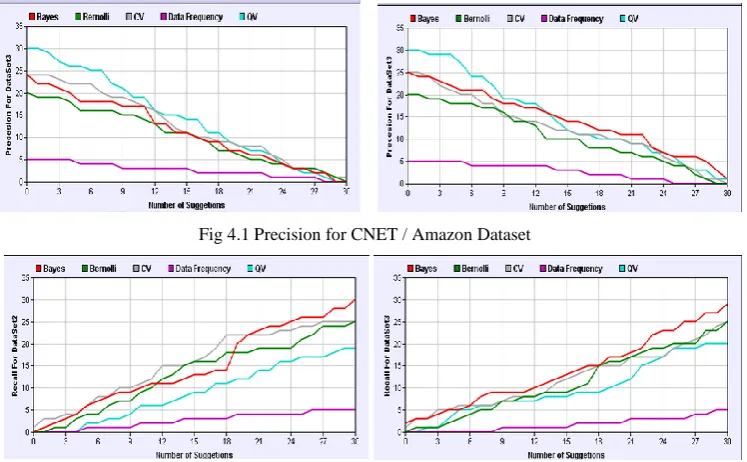
The comparison can be made with dataset 1 and dataset 2 with the precision / Recall value Fig 4.1.a shows a graph for precision value for CNET dataset. And Fig 4.1.b shows precision value ratio for Amazon dataset.
The proposed strategy Bayes and Bernoulli dominates the rest strategies by up to 50%, especially for fewer numbers of suggestions, which are the most practical cases. Interestingly, the QV strategy performs well, even though it ignores the text of the documents. The reason for the frequency of the attributes in the workload decreases very quickly, so covering the top attributes is a successful strategy. QV’s rate of improvement (in number of matches)
increases considerably after 10 suggestions, compared to Data Freq. The reason is that in the query workload, the attributes after the top-10 (in terms of frequency) cover more documents.
The fig 4.2 showing graph for recall value for annotations in which we are implementing all the Bayes, Bernoulli’s method which is used to suggest for annotations. QV value shows a better performance as compared to the other methods. Here Bernoulli value going decrease as compared to the CV value. So the recall value should be high for number of suggestion. Here QV performs well.
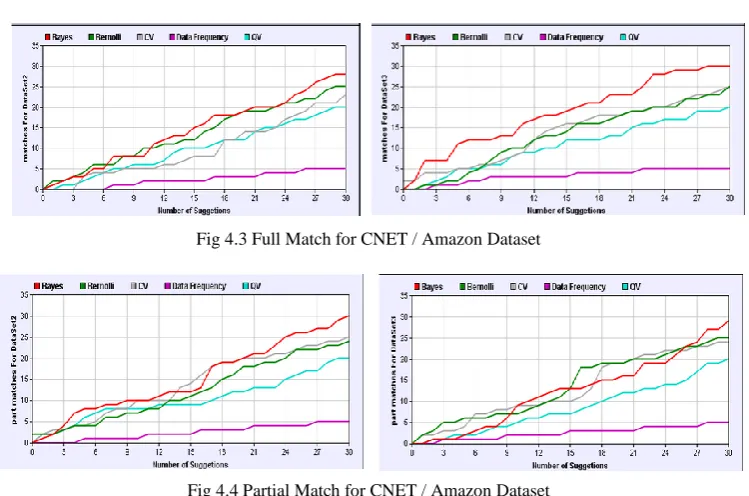
This fig.4.3 graph is representing value for the full matches for the dataset1. It shows the results for various parameters. When query is fired it gives the relevant results. It suggests the subset of the attributes for each document that maximize its query visibility in the query workload; it also satisfies the maximum number of queries. Following a brute-force approach, which took more time but allowed us to measure exactly how close to the optimal each algorithm is.
This fig.4.4 graph is representing value for the Partial matches for the dataset1. It shows the results for various parameters. When query is fired it gives the relevant results. It suggests the subset of the attributes for each document that maximize its query visibility in the query workload. It suggests a subset of attributes that maximize a number of query conditions satisfied. It can be computed making a single pass on the workload
Fig 4.1 Precision for CNET / Amazon Dataset
Fig 4.3 Full Match for CNET / Amazon Dataset
Fig 4.4 Partial Match for CNET / Amazon Dataset
On the contrary, Amazon Dataset are very large in size, the system contains the information about various electronics products, It has very complex data values of attributes in a dataset which needs to be parsed and processed before actually making a decision whether to include the data value as result or not. Also due to the fact, there are some null or invalid entries in case of both the datasets which might stretch the time of algorithm because it has to first remove stop words and then check for match with the search query.
Though all this is true, it can be seen and analysed that a system is not taking more than 20 Seconds for any kind of dataset to search and also a fact that this is the system which can accept many extension document and remove stop words and give the expected results within very small amount of time. Query search is more than the expectation. Following shows the time analysis of existing and proposed system.
VI.CONCLUSION AND FUTURE WORK
Proposed system provides solution to annotate the document at time of uploading and also works on user’s querying needs. The proposed architecture works on a content of document and also analyses the user queries. The most important thing for proposed system is that it is accepting text document which is the main contribution of our system. User queries and document content are two basic sources to generate the annotation. Along with annotation document pattern mining is a technique that helps the user to map document with frequent pattern and use pattern at the time of searching. The annotation and pattern matching technique provides flexible and complete solution for document tagging and searching.
The advantage of proposed system is query based searching. We presented two ways to combine these two pieces of evidence, content value and query value.
REFERENCES
[1] eduardo j. ruiz, vagelishristidis, panagiotis g. ipeirotis ,“facilitating document extraction using content and querying value”, ieee transactions on knowledge and data engineering Vol.Pp No.99 Year 2013.
[2] K.C.-C. Chang and S.-w. Hwang, “Minimal Probing: Supporting Expensive Predicates for Top-K Queries,” Proc. ACM SIGMOD Int’l Conf. Management Data, 2002.
[3] S.R. Jeffery, M.J. Franklin, and A.Y. Halevy : proposed a paper “Pay-as-You-Go User Feedback for Dataspace Systems,”.
[4] K. Saleem, S. Luis, Y. Deng, S.-C. Chen, V. Hristidis, and T. Li : proposed a paper “Towards a Business Continuity Information Network for Rapid Disaster Recovery.
[5] G. Tsoumakas and I. Vlahavas : propose a paper “Random K-Labelsets: An Ensemble Method for Multilabel Classification. [6] P. Heymann, D. Ramage, and H. Garcia-Molina : proposed a paper “Social Tag Prediction” .
[7] Y. Song, Z. Zhuang, H. Li, Q. Zhao, J. Li, W.-C. Lee, and C.L. Giles : proposed a paper “Real-Time Automatic Tag Recommendation”. [8] D. Eck, P. Lamere, T. Bertin-Mahieux, and S. Green : proposed a paper “Automatic Generation of Social Tags for Music Recommendation. [9] B. Sigurbjornsson and R. van Zwol : proposed a paper “Flickr Tag Recommendation Based on Collective Knowledge”.
[10] M. Franklin, A. Halevy, and D. Maier, “From Databases to Dataspaces: A New Abstraction for Information Management,” SIGMOD Record, vol. 34, pp. 27-33, http://doi.acm.org/10.1145/ 1107499.1107502, Dec. 2005.
[11] D. Yin, Z. Xue, L. Hong, and B.D. Davison, “A Probabilistic Model for Personalized Tag Prediction,” Proc. ACM SIGKDD Int’l Conf. Knowledge Discovery Data Mining, 2010.
[12] B. Russell, A. Torralba, K. Murphy, and W. Freeman : propose a paper “LabelMe: A Database and Web-Based Tool for Image Annotation”. [13] P.G. Ipeirotis, F. Provost, and J. Wang, “Quality Management on Amazon Mechanical Turk,” Proc. ACM SIGKDD Workshop Human Computation (HCOMP ’10), pp. 64-67, http://doi.acm.org/ 10.1145/1837885.1837906, 2010.
[14] K. Chen, H. Chen, N. Conway, J.M. Hellerstein, and T.S. Parikh, “Usher: Improving Data Quality with Dynamic Forms,” Proc. IEEE 26th Int’l Conf. Data Eng. (ICDE), 2010.
[15] M. Jayapandian and H.V. Jagadish, “Automated Creation of a Forms-Based Database Query Interface,” Proc.VLDB Endowment, vol. 1, pp. 695-709,Aug 2008.
[16] M. Miah, G. Das, V. Hristidis, and H. Mannila, “Standing out in a Crowd: Selecting Attributes for Maximum Visibility,” Proc. Int’l Conf. Data Eng. (ICDE), 2008.
[17] “Google,” Google Base, http://www.google.com/base, 2011.
[18] Microsoft, Microsoft Sharepoint, http://www.microsoft.com/sharepoint/, 2012. SAP, Sap Content Manager,
https://www.sdn.sap.com/irj/sdn/nw-cm, 2011.
BIOGRAPHY