Automatic Modulation Classification for
Cognitive Radio
Prathamesh Ghanekar
1, Mrs. S. D. Borde
2P.G. Student, Dept. of E&TC Engineering, PES‟s Modern College of Engineering, Pune, India1
Assistant Professor, Dept. of E&TC Engineering, PES‟s Modern College of Engineering, Pune, India2
ABSTRACT: Cognitive Radios have become a key research area in communications over the past few years. They play an important role in dynamic spectrum management and interference identification.Automatic Modulation Classification is the automatic recognition of the modulation format of a sensed signal. Most modulated signals exhibit the property of Cyclostationarity that can be exploited for the purpose of classification. A feature-based method called Cyclostationary Feature Detection is able to classify different modulation schemes. TheSpectral Correlation Function obtained from the sensed signal is used as a cyclic feature. The Cycle frequency Domain Profile derived from Spectral Correlation Function is used as a discriminator in the classification process since several modulation schemes have unique cycle frequency domain profiles. The neural network approach based on the learning mechanism is employed for pattern matching. It is used for classification of data patterns and distinguishing them into predefined set of classes.The two layered neural network is trained using the Back Propagation Algorithm.
KEYWORDS: Cognitive Radio; Cyclostationarity Feature Detection; Spectral Correlation Function; Cyclic Domain Profile; Neural Networks; Back Propagation Algorithm.
I. INTRODUCTION
Modulation is the process of varying a periodic waveform in order to use that signal to convey a message. The purpose of AMC algorithms in a radio receiver is to identify the existence of a signal in a particular frequency band at a given location at a given time and then determine the modulation type being employed in the spectrum. For the receiver, AMC is the intermediate step between signal detection and demodulation. AMC plays an important role in dynamic spectrum management and interference identification for civilian, commercialand military applications. The popularity of Software Defined Radio and Cognitive Radio technologies is increasing over past few decades. AMC is often a critical issue when there is no prior knowledge about signal power, carrier frequency etc. [2].
The main contribution among many automatic modulation classificationalgorithms is based on cyclostationary feature detection method. This feature extracting algorithm can be used with classifier such as Neural Network. Signal detection and signal classification based on pattern matching algorithm becomes robust using cyclostationarity of signals. Neural networks are helpfulfor modulation classification when i) the carrier signal and bandwidth are unknown and ii) the interfering signals and noise are in considerably effective [5].
II. RELATED WORK
recognition.The objective of paper [10] and [11] is to summarize the methods used in various stages of a pattern recognition system andadvantages of Back Propagation Algorithm over other techniques to recognize the complex patterns along with other real-life applications. The authors have given the overview of Artificial Neural Network, its working principle and training in [12] and [13].In [14], the author has provided comprehensive fundamentals in detailed manner with examples and computer-oriented experiments. Moreover, the concepts associated with neural networks are explained. The mathematical treatment of layered neural networks is given in detail.In [15], the author has introduced supervised learning algorithm named Scaled Conjugate Gradient (SCG) andits performanceis compared to that of standard Back-Propagation Algorithm. According to [16], the spectral correlation analysis can be preferably applied for signals that are produced by some periodic modification or modulation of stationary random noise. In [17], the author investigates the spectral features of several basic analog and digital modulated signals from point view of modulation recognition and parameter estimation.In [18] and [19], the spectral correlation function that is a generalization of the power spectral density function is described. Explicit formulae for the spectral correlation function for various types of analog and digital modulated signals are also derived.
III. PROPOSED ALGORITHM A. Design Considerations:
Channel is assumed to be noisy with AWGN with varying values of standard deviation.
Number of data symbols are 2000 and symbol rate is 3 GHz.
Sampling frequency selected satisfied Nyquist criterion.
FFT is used for time smoothing.
Raised Cosine filter is used for frequency smoothing.
400 CDPs of different modulation schemes are input to the neural network.
Number of hidden neurons is 10.
B. Description of the Proposed Algorithm:
Aim of the proposed algorithm is to obtain the SpectralCorrelation Function (SCF) and Spectral Coherence (SC). The transmitter selects one of the four modulation schemes demonstrated here to transmit a stream of data bits. The receiver, upon receiving the signal, extracts its cyclostationary features (spectral coherence function and cyclic domain profile) and uses a trained neural network classifier to classify the modulation scheme. The proposed algorithm consists of following steps.
Step 1:Divide the incoming modulated signal into N frames. Step 2:Take the Fourier transform of each frame.
Step 3:Shift the FFT of each frame by (+α/2) and (-α/2) and multiply them. Step 4:Take the average value of all the N frames.
Step 5:Perform frequency smoothening.
Step 6:Repeat the operation from Step 2 for each value of alpha to obtain SCF.
SxTα f =
1
TXT t, f + α 2 XT
∗ t, f −α
2
- (1) Step 7:Normalize the SCF to obtain SC.
Cxα(f) ≜
Sxα(f)
[S(f + α/2)S(f − α/2)]1/2
- (2) However the use of SC requires large amount of data and hence we use only the peak values in the SC. These peak values are called as cyclic frequency domain profile (CDP) or α-profile.
I α ≜ max
f Cx
α(f)
IV. PSEUDO ALGORITHM
Step 1: Receive the noisy modulated signal. Step 2: Obtain its Cyclic Periodogram. Step 3: Perform Time Smoothing. Step 4: Perform Frequency Smoothing. Step 5: Obtain Spectral Coherence. Step 6: Obtain Cyclic Domain Profile.
Step 7: Train the Neural network with various CDP patterns. Step 8: Obtain Classification Confusion Matrix.
Step 9: Verify the results for different modulation schemes.
V. SIMULATION RESULTS
The proposed algorithm is simulated with combined use ofLabVIEW and MATLAB. If the received signal consists of only noise (assumed AWGN for simulation), then the SCF as well as CDP plots do not show presence of any peak, thereby indicating the absence of signal in the sensed channel i.e. the absence of the primary user.
If the sensed signal is BPSK modulated, then there are three distinct peaks along α axis, as shown in Fig. 1 and Fig. 2. The first peak corresponds to the symbol rate fr, the second one corresponds to the carrier frequency fc and the last one corresponds to fc + fr.
Fig. 1: SCF for BPSK Fig. 2:CDP for BPSK
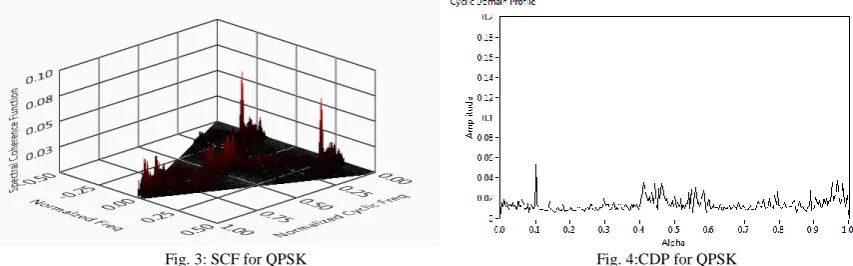
If the sensed signal is QPSK modulated, there is only one peak along α axis, which corresponds to the symbol rate fr as shown in Fig. 3 and Fig. 4. The extra two peaks in BPSK are missing in QPSK, because, QPSK is a balanced modulation (has both in phase and quadrature) and hence peaks corresponding to the carrier frequency get cancelled out.
If the sensed signal is FSK modulated, there are two impulses in the CDP as shown in Fig. 5 andFig. 6, which correspond to two carrier frequencies involved, i.e. „mark‟ frequency and „space‟ frequency. Also, the two peaks that overlap the two impulses are observed. These two peaks along with the third one are analogous to the same observed in CDP of BPSK.
Fig. 5: SCF for FSK Fig. 6:CDP for FSK
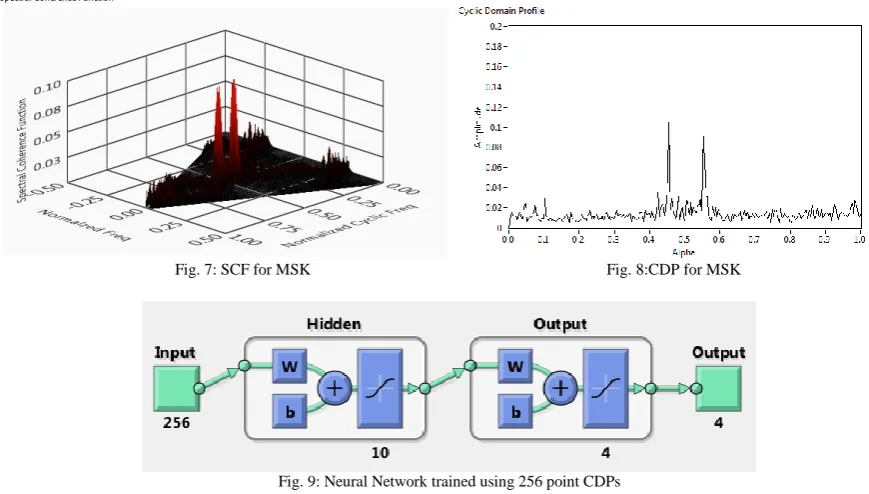
If the sensed signal is MSK modulated, only two peaks are observed in the CDP as shown in Fig. 7 andFig.8, which correspond to the two quadrature carriers sin 2πfct and cos 2πfct.
Fig. 7: SCF for MSK Fig. 8:CDP for MSK
Fig. 9: Neural Network trained using 256 point CDPs
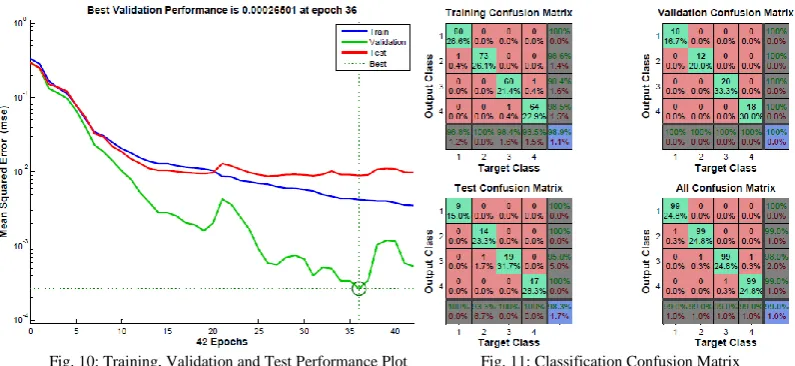
Fig. 10 shows a plot of mean square error versus number of training iterations (epochs) according to which the best validation performance is 0.00026501 at epoch 36. It can be concluded from the plot that the mean square error decreases with increase in number of epochs and attains a stable value at some instant.
testing, it is 98.3% and for validation, it is 100%. The results show very good recognition since overall accuracy of all confusion matrix is 99%.
Thus, the network performs exceptionally well, even at low SNR levels.
Fig. 10: Training, Validation and Test Performance Plot Fig. 11: Classification Confusion Matrix
VI. CONCLUSION AND FUTURE WORK
The simulation results showed that the combination of the SCF algorithm with the trained neural network performs accurately.The CDP can be used as a good discriminator of modulation schemes, because of the uniqueness in their CDP patterns. Using this cyclostationarity based AMC algorithm, signal modulation types can be determined quickly and reliably.The results show very good recognition since overall accuracy of all confusion matrix is 99%.The proposed system performs exceptionally well evenat low SNR levels.Automatic Modulation Classification not only gives the assurance of the presence of signal by detecting its scheme of modulation but also helps to demodulate the signal by knowing its type.As the performance of the proposed algorithm is analyzed with thelimited number of modulation schemes, in future some more modulation schemes can be takeninto consideration. Further, using a neural network for classification constitutes a highly flexible method, since the network can be retrained in order to incorporate new signal modulation types. Performance of this cyclic spectrum based AMC system is tested in a stationary noise environment such as AWGN channel. The AMC should also be tested in a fading channel environment with noise uncertainty and for more sophisticated modulation schemes such as OFDM, DVB and many more.
REFERENCES
[1] W. A. Gardner, “The spectral correlation theory of cyclostationary time-series”, Signal Processing, vol.11, no.1, pp. 13-36, 1986. [2] B. Ramkumar, “Automatic Modulation Classification for Cognitive Radios using Cyclic Feature Detection”, IEEE Circuits and Systems
Magazine, Volume: 9, Issue: 2, Pages: 27-45, 2009.
[3] W. A. Gardner et al., “Cyclostationarity: Half a century of research”, Signal Processing 86, Pg. 639–697, 2006.
[4] K. Kim, I. A. Akbar, K. K. Bae, J.-S. Um, C. M. Spooner, and J. H. Reed, “Cyclostationary approaches to signal detection and classification in cognitive radio,” in Proc. IEEE DySpan, Pg. 212–215, 2007.
[5] A. Fehske, J. Geaddert, and J. H. Reed, “A new approach to signal classification using spectral correlation and neural networks,” in Proc. IEEE Int. Symp. New Frontiers in DySpan, 2005.
[6] Aparna P.S., M. Jayasheela, “Cyclostationary feature detection in cognitive radio using different modulation schemes”, International Journal of Computer Applications, vol. 47, No.21, Pg. 12-16, 2012.
[7] F. Hameed, O. A. Dobre, D. C. Popescu, “On the Likelihood-Based Approach to Modulation Classification”, IEEE transactions on wireless communications, vol. 8, no. 12, Pg. 5884-5892, 2009.
[8] Andrej Krenker et al., “Introduction to the Artificial Neural Networks”, Artificial Neural Networks - Methodological Advances and Biomedical Applications, 2011.
[9] B. Yegnanarayana, “Artificial neural networks for pattern recognition”, 1994.
[10] Dr. Rama Kishore and TaranjitKaur, “Backpropagation Algorithm: An Artificial Neural Network Approach for Pattern Recognition” IJSER, 2012.
[13] Vidushi Sharma et al., “A Comprehensive Study of Artificial Neural Networks”, IJARCSSE, 2012. [14] Simon Haykin, “Neural Networks-A Comprehensive Foundation”, 2nd Edition, 1999.
[15] M. F. Moller, “A Scaled Conjugate Gradient Algorithm for Fast Supervised Learning”, Neural Networks, Vol. 6, 1993, Pg. 525-533, 1991.
[16] J. Goerlich et al., “Signal Analysis Using Spectral Correlation Measurement”, IEEE Instrumentation and Measurement Technology Conference, Pg. 1313-1318, 1998.
[17] Hong Wang, “Spectral Correlation Function of Basic Analog and Digital Modulated Signals”, IEEE, School of Electronic Engineering, University of Electronic Science and Technology of China, 2013.
[18] W.A. Gardner, “Spectral Correlation of Modulated Signals: PART I - Analog Modulation”, IEEE Trans. on Communication, vol. 35, pp. 584-594, 1987.