Toc H Institute of Science & Technology, Arakunnam, Kerala, India during 16th - 18th July -2014
Content Based Image Retrieval Using
Wavelet Transform and Feedback Algorithm
ManjushaS
1, Nelwin Raj N R
2MTech Student (Signal Processing), Dept. of ECE, SCT College of Engineering, Trivandrum, Kerala, India1
Assistant Professor, Dept. of ECE, SCT College of Engineering Trivandrum, Kerala, India 2
ABSTRACT: -As a result of advances in the Internet and new digital image sensor technologies, the volume of digital images produced by scientific, educational, medical, industrial, and other applications available to users increased dramatically. The difficulties faced by text-based retrieval became more and more severe. The efficient management of the rapidly expanding visual information became an urgent problem. So Content based image retrieval is popular nowadays. It is a technique which uses visual contents to search images from large scale image databases according to users’ interests. In this paper, the visual features are extracted using wavelet transform, color, texture and edge descriptors and the user feedback is done by Interactive Genetic algorithm.
KEYWORDS – content based image retrieval, wavelet transform, color descriptor, edge histogram descriptor, indexing.
I. INTRODUCTION
Image retrieval has become one of the important factor in various applications like digital libraries, historic research, finger print identification, medicine etc. Earlier image retrieval was confined to text based image retrieval in which manual annotations or keywords were used for searching images. But it was a cumbersome task which is laborious, time consuming and expensive. Also the more efficient way to represent the visual features should be based on properties that are inherent in the image itself. So most of the retrieval systems has changed from text based to content based image retrieval systems(CBIR). It is a technique in which images are used to retrieve images. It involves visual contents to search images from large scale databases according to users’ interest. Content-based means that the search analyzes the contents of the image rather than the metadata such as keywords, tags, or descriptions associated with the image. The term content refer to colors, shapes, textures, or any other information that can be derived from the image itself. CBIR is desirable because searches that rely purely on metadata are dependent on annotation quality and completeness. Having humans manually annotate images by entering keywords or metadata in a large database can be time consuming and may not capture the keywords desired to describe the image. The evaluation of the effectiveness of keyword image search is subjective and has not been well-defined.
II.
METHODOLOGYToc H Institute of Science & Technology, Arakunnam, Kerala, India during 16th - 18th July -2014
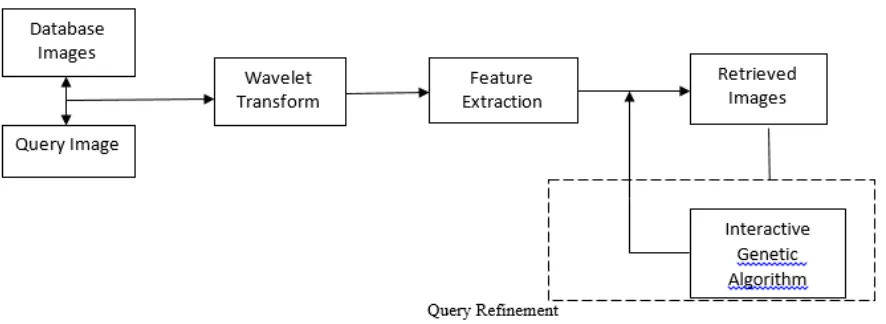
or sketch and those of the images in the database are then calculated and retrieval is performed with the aid of an indexing scheme. Indexing scheme provides an efficient way to search for the image database. Recent retrieval systems have incorporated user’s relevance feedback to modify the retrieval process in order to generate perceptually and semantically more meaningful retrieval result.
A.Steps for Image Retrieval
Step 1: Read the query image
Step 2: Wavelet Decompose the query image
Step 3: Extract the features of query image (i.e. color descriptor, texture descriptor and EHD).
Step 4: Compare the features of the query image with features of database images using the saved feature database.
Step 5: Retrieve the images which are similar to the query image.
Step 6: Ask the user to rate the retrieved images.
Step 7: Based on the user rating (step 5) and similarity (step 3), a fitness function is calculated for all the retrieved images.
Step 8: Features of the retrieved images with the best fitness function values are mixed to form new feature vectors.
Step 9: Compare the new features with that of the database images.
Step 10: Repeat steps 5 to 9 till user is satisfied.
Fig 1. Framework of Analysis
B. Wavelet Transform
Toc H Institute of Science & Technology, Arakunnam, Kerala, India during 16th - 18th July -2014
mirror filters. However in the WPD, both the detail (cDj (in the 1-D case), cHj, cVj, cDj (in the 2-D case)) and approximation coefficients are decomposed to create the full binary tree.
C.Wavelet Decomposition
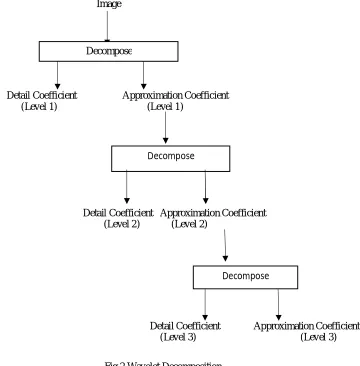
The basic idea is to separate the higher half and the lower half of the spectrum of a signal by using a second order band-pass filter and a low band-pass filter, to subsample the image corresponding to the lower half of the spectrum and to iterate the process. The result of the first band-pass filtering will give us the difference of information between resolution 2j and resolution 2j-1. The result of the next band-pass filtering will give us the difference of information between resolution 2j-1 and resolution 2j-2 and so on. The theory of wavelets shows that we can obtain filters which are very well localized both in the Fourier and spatial domain -thus preserving the locality of information- and that we can achieve a representation which is complete.
Image
Detail Coefficient Approximation Coefficient (Level 1) (Level 1)
Detail Coefficient Approximation Coefficient (Level 2) (Level 2)
Detail Coefficient Approximation Coefficient (Level 3) (Level 3)
Fig 2 Wavelet Decomposition Decompose
Decompose
Toc H Institute of Science & Technology, Arakunnam, Kerala, India during 16th - 18th July -2014
III. FEATURE EXTRACTION
When the input data to an algorithm is too large to be processed and it is redundant (e.g. the same measurement in both feet and meters) then the input data will be transformed into a reduced representation set of features (also named features vector). Transforming the input data into the set of features is called feature extraction. If the features extracted are carefully chosen it is expected that the features set will extract the relevant information from the input data in order to perform the desired task using this reduced representation instead of the full size input. After wavelet decomposition, wavelets are subjected to feature extraction. Feature extraction includes color, shape and texture.
A. Color Descriptor
Color [2] is the visual feature most used in CBIR systems because humans tend to differentiate images mostly by means of color features. The RGB image is converted into HSV plane. Hue is used to distinguish colors whereas saturation gives a measure of the percentage of white light added to a pure color. Value refers to the perceived light intensity. The advantage of HSV is that each of its attributes corresponds directly to the basic color concepts, which makes it conceptually simple.
Here mean and standard deviation are calculated globally and locally. In Global operation, mean and standard deviation of the whole image is calculated. Then the image is divided into blocks of any size. For each block, mean and standard deviation are calculated. The block mean is then compared with the mean of the image obtained. If block mean is greater than mean of the image, then 1 is assigned otherwise zero. Similarly standard deviation of the blocks are also compared with the standard deviation of the global image.
Calculation of mean
A =
11 12 13
21 22 23
31 32 33
Sum(A)= 11 + 21 + 31 12 + 22 + 32 13 + 23 + 33
Sum(sum(A)) = [ 11 + 21 + 31 + 12 + 22 + 32 + 13 + 23 + 33]
h_mean=Sum(sum(A))
∗
Similarly s_mean and v_mean are calculated for all the database images.
B.Texture Extraction
Toc H Institute of Science & Technology, Arakunnam, Kerala, India during 16th - 18th July -2014
Fig 3 Example for a GLCM
C.Edge Descriptor
The image is divided into 16 sub-images (4x4).The edges in each image block are categorized into five types: vertical, horizontal, 45’diagonal, 135’diagonal, and non-directional edges[2].Then the prominent edges in each of the sub-image is found using filtering with corresponding masks. The prominent edges in all the 16 sub-images form the edge histogram descriptor feature.
Normalization Factor = sum of all the edges in the image
Normalized horizontal edge
=
horizontal edge component of the imageNormalization Factor
Similarlarly all the normalized edges are calculated.Find the prominent edge in each image and assign 1 to that edge and
remaining edges with zero.
D.Interactive Genetic Algorithm
Interactive Genetic Algorithm is a branch of evolutionary computation. The fitness is determined by the user’s evaluation and not by any predefined mathematical formula. A user can interactively determine which members of the population will reproduce, and IGA [2] automatically generates the next generation of content based on the user’s input. Through repeated rounds of content generation and fitness assignment, IGA enables unique content to evolve that suits the user’s preference.
Working
A population is created with a group of individuals created randomly. The individuals in the population are then evaluated.The evaluation function is provided by the user and gives the individuals a rating based on the performance.Two individuals are then selected based on their fitness; the higher the fitness, the higher the chance of being selected.These individuals then reproduce to create one or more offspring, after which the offspring are muted randomly.This continues until a suitable solution has been found or a certain number of generations have passed, depending on the needs of the user.
0 0 5 2
0 0 0 4
1 1 2 2 2 1 1 2 2 2 1 3 3 3 3 3 3 4 4 4 3 3 4 4 4
1 2 3 4 1
Toc H Institute of Science & Technology, Arakunnam, Kerala, India during 16th - 18th July -2014
IV. PERFORMANCE MEASUREMENT
To evaluate the performance of retrieval system, measures like precision and recall are calculated. Precision gives the information about the relative effectiveness of the system.
Precis =
Recall gives information about the absolute accuracy of the system.
=
V. EXPERIMENTAL RESULT
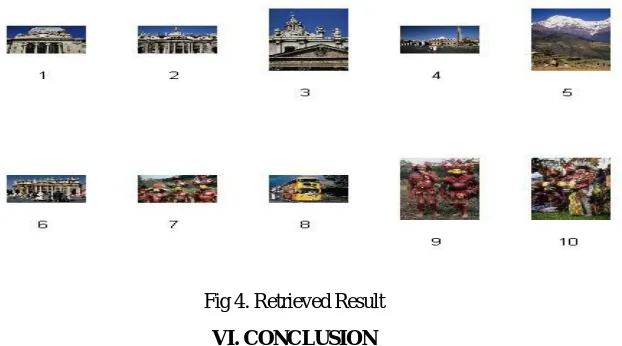
With wavelet decomposition, color descriptor, texture descriptor and edge descriptor, a similarity function is calculated.To make a comparison between the query image with the image in database, Euclidean distance is calculated. Accordingly, the retrieval result is not a single image but a list of images ranked by their similarities with the query image. To improve the result, the user can rate the images which are retrieved with an impact factor which lies in the range of 0-1. It should be multiples of 0.1. then using feedback algorithm, the chromosomes are mated that is the features from the images which are more similar to the query image are combined for the effective retrieval. In this way user can iterate the result till he is satisfied.
Fig 4. Retrieved Result
VI. CONCLUSION
Toc H Institute of Science & Technology, Arakunnam, Kerala, India during 16th - 18th July -2014
REFERENCES
[1] A HarisRangkuti, NashrulHakiem, Rizal BroerBahaweres, Argus Harjoko, AgfiantoEkoPutro,’’ Analysis of Image Similarity with CBIR Concept
Using Wavelet Transform and Threshold Algorithm’’ IEEE Symposium on Computers & Informatics 2013.
[2] Chih-Chin Lai, Ying-Chuan Chen,’’ A User-Oriented Image Retrieval System Based on Interactive Genetic Algorithm’’, IEEE Transactions on Instrumentation and Measurement, Vol. 60, no. 10, October 2012
[3] B. S zanto, P. Pozsegovics, Z. V amossy, SzSergyan’’Sketch4Match – Content-based Image Retrieval System Using Sketches’’, 9th IEEE International
Symposium on Applied Machine Intelligence and Informatics January 27-29, 2011.
[4] Dr. Fuhui Long, Dr. Hongjiang Zhang and Prof. David Dagan Feng,”fundamentals of content-based image retrieval”.
[5] J. Assfalg, A. Del Bimbo, and P. Pala, “Three Dimensional Interfaces for Querying by Example in Content-Based Image Retrieval,” IEEE Trans. Visualization and Computer Graphics, 8(4):305–318, 2002.
[6] M. Kokare, P. K. Biswas, and B. N. Chatterji, "Texture image retrieval using rotated wavelet filters," Pattern Recogn. Lett., vol. 28, pp. 1240-1249, 2007.
[7] K. Sandberg, The Haar wavelet transform: Dept. of Applied Mathematics, University of Colorado at Boulder.
[8] R. Zhang and Z. Zhang, "A robust color object analysis approach to efficient image retrieval," EURASIP J. Appl. Signal Process., vol.2004, pp. 871-885, 2004.