ISSN(Online): 2320-9801 ISSN (Print) : 2320-9798
I
nternational
J
ournal of
I
nnovative
R
esearch in
C
omputer
and
C
ommunication
E
ngineering
(An ISO 3297: 2007 Certified Organization)
Vol. 4, Issue 2, February 2016
Preventing Collaborative Attacks by
Cooperative Bait Detection Approach
Tanmayee Deepakrao Buradkar1, Bharti Patil2
Student, Dept. of ENTC., GHRCEM, Savitribai Phule Pune University, Pune, India1
Assistant Professor, Dept. of ENTC., GHRCEM, Savitribai Phule Pune University, Pune, India2
ABSTRACT: In versatile impromptu systems (MANETs), a key necessity for the establishment of correspondence among hubs is that hubs ought to organize with each other. In the vicinity of pernicious hubs, this necessity might lead genuine security worries; for case, such hub might bother the directing procedure. In this connection, forestalling or distinguishing malevolent hubs dispatching grayhole or community oriented blackhole in test. This task endeavors to decide this issue by planning a Dynamic Source Routing (DSR)- based directing component, which is alluded to as the Cooperative Bait Detection Scheme (CBDS), that facilitates the benefits of both proactive and receptive barrier models. Our CBDS framework actualizes a converse following strategy to help in accomplishing the expressed objective. Reproduction results are given, demonstrating that in the vicinity of noxious hub assaults, the CBDS beats the DSR, 2ACK, and best-effort fault-tolerant routing (BFTR) conventions (picked as benchmarks) as far as parcel conveyance proportion and steering overhead (picked as execution measurements).
KEYWORDS: Cooperative Bait Detection Scheme; MANETS; Dynamic Source Routing; gray- hole attacks.
I. INTRODUCTION
Mobile Ad-Hoc Network (MANET) falls in the classification of remote specially appointed system, and is a self-designing system. Every gadget is allowed to move freely in any heading, and subsequently will change its connection with different gadgets much of the time. Every hub must forward activity which is not identified with its own particular use, and along these lines be both a switch and a recipient. This component likewise accompanies a genuine downside from the security perspective. Positively, the aforementioned applications force some extreme limitations on the security of the system topology, steering, and information movement. For instance, the presence and coordinated effort of vindictive hubs in the system might exasperate the steering process, prompting a flawed of the system operations. The security of MANETs manages avoidance and discovery strategies to battle individual getting rowdy hubs. Regarding the viability of these techniques gets to be feeble when various pernicious hubs scheme together to start a cooperative assault, which can result to all the more stunning harms to the system. These systems are exceptionally powerless to directing assaults, for example, blackhole and grayhole (known as variations of blackhole assaults).
Numerous examination works have concentrated on the security of MANETs. The greater part of them manage aversion and recognition ways to deal with battle individual acting mischievously hubs. In such manner, the viability of these methodologies gets to be powerless when various malevolent hubs intrigue together to start a communitarian assault, which might result to all the more destroying harms to the system.
ISSN(Online): 2320-9801 ISSN (Print) : 2320-9798
I
nternational
J
ournal of
I
nnovative
R
esearch in
C
omputer
and
C
ommunication
E
ngineering
(An ISO 3297: 2007 Certified Organization)
Vol. 4, Issue 2, February 2016
based security arrangement from recognizing its vicinity in the system. It then specifically tosses/advances the information parcels when bundles experience it. Along these lines, our attention is on recognizing grayhole/communitarian blackhole assaults utilizing a dynamic source routing (DSR)- based routing strategy.
II. RELATED WORK
In [1] a convention for routing in specially appointed systems that uses dynamic source routing. The convention adjusts rapidly to routing changes when host development is continuous, yet requires next to zero overhead amid periods in which has move less much of the time. In light of results from a parcel level reenactment of portable hosts working in a specially appointed system, the convention performs well over an assortment of natural conditions, for example, host density and development rates. For everything except the most elevated rates of host development recreated, the overhead of the convention is very low, tumbling to only 1% of aggregate information bundles transmitted for moderate development rates in a system of 24 versatile hosts. In all cases, the distinction long between the courses utilized and the ideal course lengths is irrelevant, and as a rule, course lengths are by and large inside of an element of 1.01 of ideal. This paper has introduced a convention for directing parcels between remote portable hosts in a specially appointed system. Despite the fact that this paper does not address the security concerns intrinsic in remote systems or parcel routing, and analyzing these issues as for assaults on protection and refusal of administration in the directing convention. Likewise it doesn't bolster other steering conventions for use in impromptu systems, including those in view of separation vector or connection state routing, and also the interconnection of a specially appointed system with a wide-zone system, for example, the Internet, reachable by a few however not the greater part of the impromptu system hubs.
In [2], it has proposed that a versatile specially appointed system comprises of a gathering of remote portable hubs that are equipped for corresponding with one another without the utilization of a system framework or any concentrated organization. MANET is a developing examination region with viable applications. Notwithstanding, remote MANET is especially defenseless because of its basic qualities, for example, open medium, dynamic topology, dispersed collaboration, and compelled ability. Routing assumes an imperative part in the security of the whole system. As a rule, routing security in remote MANETs gives off an impression of being an issue that is not insignificant to understand. In this article we think about the steering security issues of MANETs, and dissect in point of interest one kind of assault — the "dark gap" issue — that can without much of a stretch be utilized against the MANETs. We additionally propose an answer for the dark opening issue for specially appointed on-interest separation vector directing protocol. The distinctive steering conventions are likewise presented. We portray the dark gap issue in AODV convention in point of interest. To moderate the assaults, one practical answer for the dark opening issue is exhibited.
One constraint of the proposed strategy is that it works in light of a supposition that vindictive hubs don't function as a gathering, despite the fact that this might happen in a genuine circumstances.
ISSN(Online): 2320-9801 ISSN (Print) : 2320-9798
I
nternational
J
ournal of
I
nnovative
R
esearch in
C
omputer
and
C
ommunication
E
ngineering
(An ISO 3297: 2007 Certified Organization)
Vol. 4, Issue 2, February 2016
In [4] proposed a novel mischief recognizable proof plan called REAct that gives asset proficient record capacity to hub trouble making. Respond recognizes getting out of hand hubs in view of a progression of irregular reviews activated upon an execution drop. We demonstrate that a source-destination pair utilizing REAct can distinguish any number of autonomously getting out of hand hubs in view of behavioral confirmations gave by hubs. Evidences are developed utilizing Bloom channels which are capacity productive enrollment structures, along these lines altogether decreasing the correspondence overhead for trouble making location. Be that as it may, in view of Audit Procedure when destination hub identifies an overwhelming parcel drop, it triggers the source hub to start the review technique. Source hub picks a review hub and it creates behavioral confirmation. Also source hub sets it up behavioral confirmation .On the premise of examination of results malevolent hubs are distinguished. Downside was that it is a receptive methodology .Only if there is a drop in bundle conveyance proportion, the component is activated.
In [5] proposed model incorporates a safe directing component for DSR. We utilize the BDSR (Baited-Black-hole DSR) to recognize and maintain a strategic distance from dark opening assault and extend the idea to the recognition of co-agent dark gap assault. The BDSR consolidates the proactive and responsive safeguard using so as to engineer in MANET the virtual and non-existent destination location to goad the pernicious hub to answer RREP. The execution diagram is reproduced for the bundle conveyance proportion and end to end delay. The BDSR recognizes and stays away from the dark opening assault in MANET. It utilizes the proactive discovery as a part of its starting stage and receptive identification in the later stage. The proactive discovery checks for pernicious hubs vicinity in the beginning stage. The responsive recognition lessens the overhead and asset wastage. Execution of parameters, for example, bundle conveyance proportion and the end to end deferral are noted. Contrasted with DSR, BDSR offers a more noteworthy bundle conveyance proportion and decreased end to end delay. In any case, keeping in mind the end goal to how to distinguish and beat the helpful Black-hole assault was still not explained.
III.PROPOSED ALGORITHM
A. Design Considerations:
Network Model.
Initial Bait.
Initial Reverse Tracing.
Shifted to Reactive Defense Phase.
Security Model.
B. Description of the Proposed Algorithm:
The proposed algorithm is an identification plan called the Cooperative Bait Detection Schemes(CBDS), which goes for distinguishing and counteracting malevolent hubs dispatching grayhole/synergistic blackhole assaults in MANETs. In our methodology, the source hub stochastically chooses a neighbouring hub with which to collaborate, as in the location of this hub is utilized as snare destination location to trap malevolent hubs to send a answer RREP message. Vindictive hubs are in this way distinguished furthermore, kept from taking part in the directing operation, utilizing an opposite following method. In this setting, it is accepted that at the point when a critical drop happens in the parcel conveyance proportion, an alert is sent by the destination hub back to the source hub to trigger the discovery instrument once more. Our CBDS plan blends the benefit of proactive location in the introductory step also, the predominance of receptive reaction at the consequent steps so as to decrease the asset wastage. CBDS is DSR-based. Thusly, it can recognize every one of the locations of hubs in the chose directing way from a source to destination after the source has gotten the RREP message. Be that as it may, the source hub may a bit much have the capacity to recognize which of the middle of the road hubs has the steering data to the destination or which has the answer RREP message or the malignant node answer manufactured RREP. This situation might come about in having the source hub sending its bundles through the fake most limited way picked by the vindictive hub, which might then lead to a blackhole assault. Two recreation situations are considered:
1) Scenario 1: Varying the rate of malevolent hubs with an altered versatility.
ISSN(Online): 2320-9801 ISSN (Print) : 2320-9798
I
nternational
J
ournal of
I
nnovative
R
esearch in
C
omputer
and
C
ommunication
E
ngineering
(An ISO 3297: 2007 Certified Organization)
Vol. 4, Issue 2, February 2016
The source hub first recognizes every one of the hubs which frames its neighbours hub i.e. which are at specific separation from that hub once the neighbor hubs are chosen it then sends the destination location to all the neighbour hubs on the off chance that it is at one jump remove then it has a direct if not then the nearby hub upgrades the source address by redesigning it's area in the source location and after that it does likewise method until a course to the destination is discovered once the way is discovered then a test parcel is sent and the bundles is sent to the destination.
IV.SIMULATION RESULTS
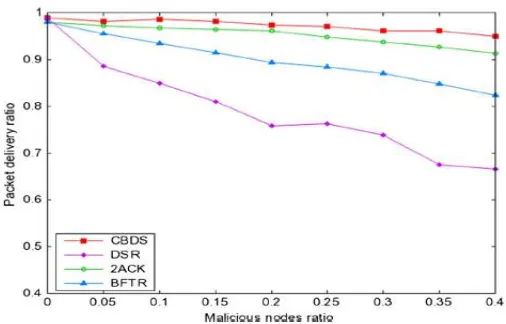
i)Packet Delivery Ratio: It is characterized as the proportion of the quantity of the quantity of parcels sent by the source to the bundles got at the destination.
ii)Routing Overhead: This metric speaks to the proportion of the measure of course finding related control parcel transmissions to the measure of information transmissions.
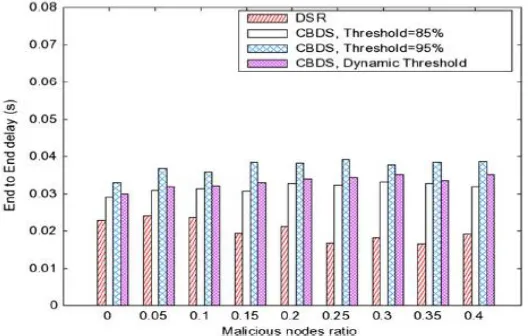
iii)Average End-to-End Delay: It is very much characterized as the normal time taken for a parcel to be transmitted from the source to the destination.
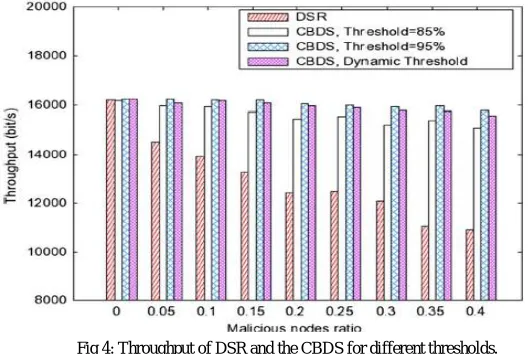
iv)Throughput: It is characterized as the aggregate sum of information, that the destination gets them from the source which is isolated when it takes for the destination to get the last parcel.
ISSN(Online): 2320-9801 ISSN (Print) : 2320-9798
I
nternational
J
ournal of
I
nnovative
R
esearch in
C
omputer
and
C
ommunication
E
ngineering
(An ISO 3297: 2007 Certified Organization)
Vol. 4, Issue 2, February 2016
In Fig. 1, it can likewise be watched that DSR intensely endures from expanding blackhole assaults since it doesn't have any discovery what's more, assurance system to avert blackhole assaults. At the point when the rate of malignant hubs changes in the system from 0% to 40%, BFTR does not distinguish vindictive hubs straightforwardly. It picks another course that might in any case incorporate noxious hubs when the end-to-end execution of a course veers off from the predefined conduct of good courses. Along these lines, the packet delivery ratio of BFTR is lower than that watched for both the 2ACK and CBDS plans. Also, the packet delivery ratio of the CBDS is most astounding contrasted and that of DSR. This is credited to the way that the CBDS sends snare bundles to snare noxious hubs while answering and is able to do following the area of the blackhole hub at the beginning stage.
Fig 2: Effect of malicious nodes on the routing overhead.
In Fig. 2, it can be watched that when the rate of pernicious hubs expands, DSR produces the most reduced routing overhead contrasted and every other plan including the CBDS. This is ascribed to the way that DSR has no natural security or cautious instrument. Besides, the CBDS can accomplish proactive location in the beginning stage and after that change into receptive reaction in the later stage. Through this component, the point of preference of proactive identification and the predominance of responsive reaction can be converged to decrease the misuse of asset. This has prompted a superior routing overhead for the CBDS looked at with that of the 2ACK and BFTR plans.
Fig 3: End-to-end delay of DSR and the CBDS for different thresholds.
ISSN(Online): 2320-9801 ISSN (Print) : 2320-9798
I
nternational
J
ournal of
I
nnovative
R
esearch in
C
omputer
and
C
ommunication
E
ngineering
(An ISO 3297: 2007 Certified Organization)
Vol. 4, Issue 2, February 2016
are more malevolent hubs in the system, the CBDS would even now recognize them all the while when they answer with a RREP. In this way, the end-to-end delay of the CBDS for various limits does not increment when the number of noxious hubs increments. In spite of the fact that a limit of 85% produces the briefest postponement, the subsequent packet delivery ratio has all the earmarks of being lower than that delivered when the limit is set to 95% or is set to the dynamic limit esteem.
Fig 4: Throughput of DSR and the CBDS for different thresholds.
In Fig. 4, it can be watched that DSR experiences the most malicious node assaults contrasted and the CBDS. Likewise, the CBDS with various edges results in higher throughput than DSR. We facilitate study the impact of limits on the throughput.
V. CONCLUSION AND FUTURE WORK
In this methodology, we have proposed another instrument Cooperative Bait Detection Scheme (called the CBDS) for identifying malignant hubs in MANETs under dark/communitarian blackhole assaults. The location of a neighboring hub is utilized as goad destination location to draw malevolent hubs to send an answer RREP message, and noxious hubs are distinguished utilizing an opposite following procedure. Any recognized malignant hub is kept in a blackhole list so that every single other hub that take part to the steering of the message are cautioned to quit speaking with any hub in that rundown. We have watched that the CBDS outflanks the DSR, 2ACK, and BFTR plans, picked as benchmark plans, as far as steering overhead and parcel conveyance proportion. Dissimilar to past works, the value of CBDS lies in the way that it coordinates the proactive and receptive safeguard designs to accomplish the previously stated objective.
1) Inquire about the attainability of modifying our CBDS plan to manage other diverse sorts of communitarian assaults on MANETs and
2) Inquire about the incorporation of the CBDS with other surely understood message security approaches in order to construct a complete secure steering system to ensure MANETs against bastards.
REFERENCES
1. David B. Johnson and David A. Maltz “Dynamic Source Routing in Ad Hoc Wireless Networks”, Mobile computing, Kluwer Academic Publishers, PA 15213-3891, 1996. Pittsburgh.
2. Hongmei Deng, Wei Li, and Dharma P. Agrawal ”Routing Security in Wireless Ad Hoc Networks” IEEE Communications Magazine , pp.0163-6804, October 2002.
3. Sanjay Ramaswamy, Huirong Fu, Manohar Sreekantaradhya, John Dixon and Kendall Nygard “Prevention of Cooperative Black Hole Attack in Wireless Ad Hoc Networks” Department of Computer Science, IACC 258 ,Fargo ND 58105, 2002.
4. William Kozma Jr. and Loukas Lazos“ REAct: Resource-Efficient Accountability for Node Misbehaviour in Ad Hoc Networks based on Random Audits” WiSec’09, pp,16–18, March 2009, Zurich.