Antenna Selection in Massive MIMO System
Nayan A. Patadiya1, Prof. Saurabh M. Patel2PG Student, Department of E & C, Sardar Vallabhbhai Patel Institute of Technology, Vasad, Gujarat, India1 Assistant Professor, Department of E & C, Sardar Vallabhbhai Patel Institute of Technology, Vasad, Gujarat, India2
ABSTRACT: Massive MIMO, also known as very-large MIMO is an emerging technology in wireless communication
that increases capacity largely compared to MIMO systems. With Massive MIMO, multi-user MIMO (MU-MIMO) has been considered where a base station is equipped with a large number (say, tens to hundreds) of antennas and that serves many single-antenna users in the same time-frequency resource. However, multiple antennas require multiple RF chains which consists amplifier, mixer, ADC, filter, etc. So due to multiple RF chains, cost and hardware complexity of the system is increased. Hence in order to reduce cost and hardware complexity, antenna selection techniques is used that minimizes the complexity with nearly same capacity. This paper presents different antenna selection schemes for Massive MIMO system. Simulation result depicts the effect of antenna selection on the performance of Massive MIMO system.
KEYWORDS: Multiple Input Multiple Output (MIMO); Antenna Selection; Analog to Digital converter (ADC);
Radio Frequency (RF); Bit Error Rate (BER)
I. INTRODUCTION
MIMO system has multiple antennas at the transmitter and receiver side to transmit multiple data streams simultaneously in wireless communication systems. In theory, it is shown that with a large number of antennas, system can improve performance significantly in terms of data rate, capacity, link reliability and radiated energy efficiency. In MIMO technology, first conventional point to point MIMO is developed, after that multi-user MIMO is developed. Multi-user MIMO provides many advantages over point to point MIMO, but it has some disadvantages like it roughly requires equal number of Base station antennas and terminals and also it is not a scalable technology[2]. So due to these problems after multi-user MIMO, Massive MIMO (also known as Large Scale MIMO) is developed which gives huge advantages over point to point MIMO and multi-user MIMO.
Massive MIMO have hundreds of Base station antennas. However every antenna element requires RF chain which consist of amplifiers, analog to digital converter/digital to analog converter, mixers, filters, etc., that are very expensive[5]. Large scale base station antenna means large number of RF chains. Hence size, hardware complexity and cost of the system is much increased and also more power consumption occurs, more signal processing required. For this problem, the solution is antenna selection technique. In this technique instead of using all antennas, some optimal set of antennas is selected based on some selection criteria. The selection criteria can be maximization of capacity, minimization of bit error rate, maximization of signal to interference plus noise ratio or maximization of energy efficiency. With a certain number of RF chains and more antennas than that, antenna selection improves the system performance by exploiting the spatial selectivity, as the subset of antennas with the best channel conditions is selected and switched to the RF chains [6]. Hence by using antenna selection technique cost, hardware complexity and size is decreased and at the same time system performance will also be maintained.
This paper is organized as follows. Section II provides the related work completed so far. The next section provides overview of Massive MIMO system. The section IV presents antenna selection in Massive MIMO system. Section V provides the simulation result and the next section presents conclusion of the paper.
II. RELATED WORK
small number of antennas, such as in [1]. The paper [5], shows an adaptive algorithm for antenna selection in MIMO in which the best subset of antenna is selected to maximize the channel capacity. To the best of our knowledge, very few research work has been done for antenna selection in Massive MIMO system. Here different antenna selection methods for Massive MIMO system are presented.
In [2], an energy efficient antenna selection algorithm based on convex optimization for Massive MIMO system has been given. In that selection criteria is to maximize the energy efficiency. For that one condition is given that is, if the channel capacity of the cell is larger than a certain threshold then the number of transmit antennas, the subset of transmit antennas and servable mobile terminals are jointly optimized to maximize energy efficiency. In that, simulation result shows antenna selection using given algorithm shows better performance comparing with no antenna selection and also simulation result shows energy efficiency for different value of pct (power consumption by each
transmit RF chain). In that they concluded that for small values of pct, maximum energy efficiency can be obtained.
In [3], one system model is given for antenna selection in Massive MIMO system. This system model uses channel capacity equation to make a search for only the first optimum antenna and does not need an exhaustive search to find the remaining optimum antennas. It is necessary to send the channel state information (CSI) about the selected column vectors of the channel from the receiver to transmitter as a part of model requirement. This method reduces the complexity of exhaustive search significantly. The given system model shows optimum results for two selected antennas and quite good results if the number of selected antennas is three or more.
In [6], transmit antenna selection is given in the downlink of Massive MIMO system. In this selection criteria is to maximize the capacity. In this transmit antenna selection is applied on two types of large antenna array, one is compact cylindrical array and second is large linear array. In this convex optimization is used for selecting the antenna subset that maximizes the capacity in the downlink. With the antenna selection, the performance of cylindrical array is significantly increased, which without this antenna selection shows lower performance than the linear array.
In [8], a novel antenna selection combining scheme is given for Massive MIMO system. In that the effect of spatial correlation and imperfect channel estimation is considered. The basic purpose is to reduce the effective number of antennas without degrading system performance. In that antenna selection vector is computed by using orthogonal matching pursuit algorithm. In that simulation result shows that given scheme has closely approached the same performance as the well adopted MRC scheme but requiring less number of antennas. So by using this scheme, cost and hardware complexity of the system is reduced. Here one limitation is that the given scheme is for single user system not for multi user system.
III.OVERVIEW OF MASSIVE MIMO SYSTEM
Massive MIMO is an emerging technology that scales up MIMO by possibly orders of magnitude [3]. In MIMO system Base Station (BS) having tens of antennas while in Massive MIMO Base station having hundreds of antennas.
Fig.1. Massive MIMO system [11]
Some benefits of a Massive MIMO system are:
Massive MIMO improves the energy efficiency [4]. Fig.2 shows, with more antennas, the base station can focus its emitted energy into the spatial directions where it knows that the terminals are located.
Fig.2. Single antenna transmission and Multi antenna transmission [12]
Massive MIMO improves system reliability because in Massive MIMO there are multiple antennas, so multiple path is available for radio signal
.
Massive MIMO can be built with inexpensive, low-power components [4]. With massive MIMO, expensive, ultra-linear 50 Watt amplifiers used in conventional systems are replaced by hundreds of low-cost amplifiers with output power in the milli-watt range.
Massive MIMO provides a significant reduction of latency on the air interface. The performance of wireless communication systems is degraded by fading. Fading is caused by interference between multipath waves which arrive at the receiver at slightly different times. Due to fading it is hard to build low-latency wireless links. Massive MIMO depends on the law of large numbers and beam forming to avoid fading, hence fading does not limits latency [4].
Massive MIMO simplifies the multiple-access layer [4]. In Massive MIMO, each terminal can be given the whole bandwidth, which eliminates the need of frequency-scheduling.
Massive MIMO increases the robustness to intentional jamming. Due to the insufficiency of bandwidth, spreading information over frequency is not realizable; the solution of this problem is to use multiple antennas. Massive MIMO provides many excess degrees of freedom that can be used to cancel signals from intentional jammers [4].
Some limiting factors of Massive MIMO are:
Channel reciprocity problem occurs in Massive MIMO. The hardware chains in the base station and terminal transceivers may not be reciprocal between the uplink and the downlink [4].
IV.ANTENNA SELECTION IN MASSIVE MIMO SYSTEM
This figure shows transmit antenna selection in multi-user Massive MIMO system.
Fig. 3. System model of a MU-MIMO system in the downlink [6]
In this, Downlink operation is performed for multi-user Massive MIMO system. Base station contains M transmit antennas and N RF chains. Here Base station is serving K single antenna users simultaneously (K≤N≤M). Here the channel is assumed to be an AWGN channel. Perfect channel state information (CSI) over all the antennas is assumed to be known here. Base on the CSI, the “best” N antennas are selected out of the M antennas according to some criterion [5]. Selection criterion can be maximization of capacity, minimization of BER or maximization of energy efficiency. These N antennas are then connected to the N RF chains through the RF switch.
Received signal is given by following equation(1) [8]:
y = hx + v ...(1)
Here h represents channel vector, x represents transmitted symbols and v is the AWGN (Additive white Gaussian noise) vector.
Channel capacity is computed from the following equation [3]:
c = log2 det (I+ ) ...(2)
Here Es represents total transmitted power, N represents number of selected antennas, V0 represents noise power and
H is the channel matrix.
Bit Error Rate (BER) can be computed from error signal which is given by [8]:
e = x-ℎ ,(hix +v) ...(3)
From error signal, Mean Square Error is computed as,
MSE = E[||e||2] ...(4) After simplified equation (4), we get the expression of MSE as [8],
MSE= − ℎ,ℎ − ℎ ℎ, +ℎ , ℎ ℎ ℎ, + ℎ, ...(5)
Here, ℎ , is the antenna selection vector, hi is the complex channel vector, is the transmitted power and is the
V. SIMULATION RESULT
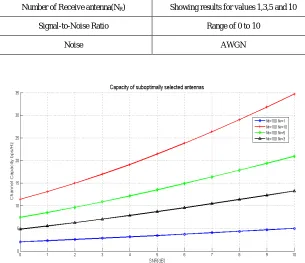
In this we have shown results of capacity and bit error rate using antenna selection. For finding capacity, channel capacity equation is used.
Table 1. Simulation Parameters
Parameter Value
Number of Transmit antenna(NT) 100
Number of Receive antenna(NR) Showing results for values 1,3,5 and 10
Signal-to-Noise Ratio Range of 0 to 10
Noise AWGN
Fig. 4. Capacity of sub optimally selected antennas
Figure 4 shows the channel capacity over the different SNR values. Here we take four different values of NR that is
1,3,5 and 10. From the figure, we can say that as SNR increases then capacity increases and also as value of NR
increases then capacity also increases. For NR=10, we obtain maximum capacity. From these result, we can say that for
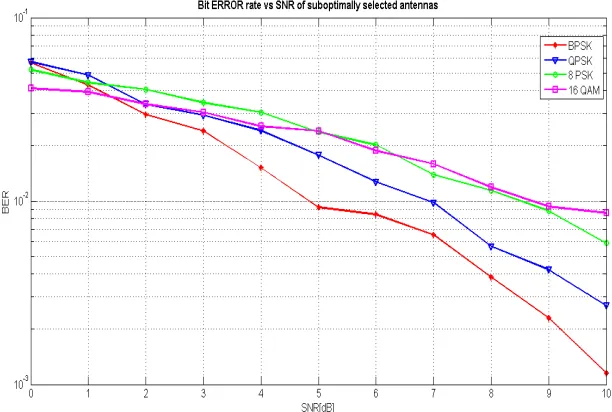
Fig. 5. BER of sub optimally selected antennas
Figure 5 shows the Bit Error Rate performance for different SNR values ranging from 0 to 10. Here we consider BPSK, QPSK, 8 PSK and 16 QAM modulation schemes for digital signals. From the figure we can say that as SNR increases then BER decreases. In these four schemes BPSK gives minimum Bit Error Rate means BPSK gives optimum results compared to other three schemes.
VI.CONCLUSION
In this paper we have presented how antenna selection is performed in Massive MIMO system. Massive MIMO offers all the advantages of MIMO system in larger scale. However, due to multiple antennas at the base station, multiple RF chain is required. So cost, hardware complexity and size of the system is much increased. To solve this problem, antenna selection is required in Massive MIMO system. Here we reviewed different antenna selection technique considering different criterion i.e.,channel capacity and bit error rate. It shows that more number of antennas the receiver is equipped with, better performance is achieved in terms of capacity that can be seen from simulation result. Simulation result also shows bit error rate performance for different modulation scheme. BPSK gives better BER performance than QPSK and QAM Modulation schemes.
REFERENCES
Papers:
1. Andreas F. Molisch and Moe Z. Win, “MIMO Systems with Antenna Selection”, IEEE microwave magazine, March-2004.
2. Hu Bibo, Liu Yuanan, Xie Gang, Liu Fang, Ni Feng, “Antenna Selection for Downlink Transmission in Large Scale Green MIMO System”, Network Infrastructure and Digital Content (IC-NIDC), 4th IEEE International Conference 2014.
3. Mohammed Al-Shuraifi and Hamed Al-Raweshidy, “Optimizing Antenna Selection Using Limited CSI for Massive MIMO Systems”, Innovative Computing Technology (INTECH), 2014 Fourth International Conference.
4. E. Larsson, O. Edfors, F. Tufvesson, and T. Marzetta, “Massive MIMO for next generation wireless systems”, Communications Magazine, IEEE, vol. 52, no. 2, pp. 186-195, February 2014.
5. Inaki Berenguer, Xiaodong Wang and Vikram Krishnamurthy, “Adaptive MIMO Antenna Selection via Discrete Stochastic Optimization”, IEEE Transactions on Signal Processing, Vol. 53, No. 11, November 2005.
9. Fredrik Rusek, Daniel Persson, Buon Kiong Lau and Erik G. Larsson, “Scaling up MIMO: Opportunities and Challenges with Very Large Arrays”, IEEE signal Processing Magazine, January 2013.
10. Shahab Sanayei and Aria Nosratinia, “Antenna Selection in MIMO Systems”, IEEE Communications Magazine, October 2004.
Websites:
11. http://www.commsys.isy.liu.se/en/research/projects/CENIIT-Radio-Resource-Management 12. http://www.slideshare.net/ahmed_nasser_ahmed/introduction-to-massive-mimo-42252235
BIOGRAPHY
Nayan A. Patadiya is a PG student in Department of Electronics & Communication Engineering at Sardar Vallabhbhai Patel Institute of Technology, Vasad, Gujarat, India. He received Bachelor of Engineering in Electronics & Communication Engineering (BE EC) degree in 2013 from GTU, Gujarat, India. His research interests are wireless communication system and signal processing.
![Fig. 3. System model of a MU-MIMO system in the downlink [6]](https://thumb-us.123doks.com/thumbv2/123dok_us/1461753.1179112/4.595.135.471.208.335/fig-system-model-mu-mimo-system-the-downlink.webp)