Optimization of Cutting Parameters for
Surface Roughness and MRR in CNC Turning
of EN 14 Steel
Ravi Kumar1, Dr. G Bala Kumar2, S B Halesh2
Assistant Professor, Department of Mechanical Engineering, Sambhram Institute of Technology, Bangalore,
Karnataka, India1
Associate Professor, Department of Mechanical Engineering, Sir M Visvesvaraya Institute of Technology, Bangalore,
Karnataka, India2
Associate Professor, Department of Mechanical Engineering, Sir M Visvesvaraya Institute of Technology, Bangalore,
Karnataka, India2
ABSTRACT: The introduction of newly developed coated cutting tools has made hard turning more widespread. The
present work deals with the investigation of the performance of CVD coated carbide tool and optimization of cutting parameter when turning with EN14 die steel. In this work, an attempt has been made to analyze the influence of cutting speed, feed, depth of cut on surface roughness and material removal rate by using Taguchi method and Minitab software is used to analyze the predicted values of surface roughness and material removal rate. Turning was done under dry and wet cutting condition by using various cutting speed, feed, depth of cut. The experimental plan was based on Taguchi L9 orthogonal array. The parametric analysis indicates that cutting speed has most significance on surface roughness. The ANOVA is a statistical tool is used to determine the significance of independent parameter on responses; it showed cutting speed has more significance on surface roughness and material removal rate followed by feed and depth of cut. Regression analysis shows that experimental and predicted values are near.
KEYWORDS: Taguchi Method, EN-14 steel, Surface roughness, Material removal rate, ANOVA.
I. INTRODUCTION
II. LITERATURE REVIEW
Suleiman Abdulkareem et al. [1] has studied the influence of the three most important machining parameters of depth
of cut, feed rate and spindle speed on surface roughness during turning of mild steel. In this study, the design of experiment which is a powerful tool for experimental design is used to optimize the machining parameters for effective machining of the work piece. Box Behnken experimental design method as well as analysis of variance (ANOVA) is used to analyze the influence of machining parameters on surface roughness height Ra. The individual parameters effect as well as effect of interactions between the machining parameters on the surface roughness height Ra is analyzed using various graphical representations.
Krishankantet al. [2] have studied on an optimization of turning process by the effects of machining parameters applying Taguchi methods to improve the quality of manufactured goods, and engineering development of designs for studying variation. EN24 steel is used as the work piece material for carrying out the experimentation to optimize the Material Removal Rate. The bars used are of diameter 44mm and length 60mm. There are three machining parameters i.e. Spindle speed, Feed rate, Depth of cut. Different experiments are done by varying one parameter and keeping other two fixed so maximum value of each parameter was obtained. Operating range is found by experimenting with top spindle speed and taking the lower levels of other parameters.
Ali Riza Motorcu[3] has studied the surface roughness in the turning of AISI 8660 hardened alloy steels by ceramic based cutting tools was investigated in terms of main cutting parameters such as cutting speed, feed rate, depth of cut in addition to tool’s nose radius, using a statistical approach. Machining tests were carried out with PVD coated ceramic cutting tools under different conditions. An orthogonal design, signal-to-noise ratio and analysis of variance were employed to find out the effective cutting parameters and nose radius on the surface roughness.
III. MATERIALS AND METHODS
3.1 Work piece material
EN14 steel is the most popular and versatile, hot work tool steel. It is a heat treatable low alloy steel containing Nickel, Chromium and Molybdenum. It is high strength low alloy steel with good toughness, high temperature strength, resistance to abrasion. It is known for its toughness and capability of developing high strength in the heat treated condition while retaining good fatigue strength and moderate wear resistance. It may be used for tool temperature up to about 1000F. Typical applications are for structural use such as Extrusion tools, Die casting Dies, Forging/Heading Dies, mandrels, plastic molds, Ejector pins, hot shear blades. It is also popular for extrusion press tooling because of its ability to withstand drastic cooling from high operating temperatures.
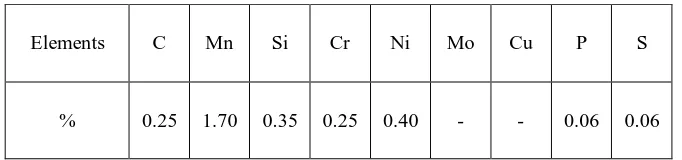
Chemical Composition: The table 1 shows the chemical composition of work-material EN14 steel.
Table 1 Chemical composition of work-material EN14 steel
Elements C Mn Si Cr Ni Mo Cu P S
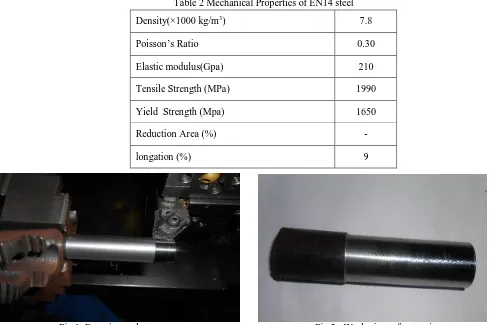
Mechanical Properties: The table 2 shows the Mechanical properties of EN14 steel.
Table 2 Mechanical Properties of EN14 steel
Fig 1: Experimental set up Fig 2: Work piece after turning
3.2. Experimental method
The table 3 shows experimental procedure.
Table 3Experimental Procedure
Density(×1000 kg/m3) 7.8
Poisson’s Ratio 0.30
Elastic modulus(Gpa) 210
Tensile Strength (MPa) 1990
Yield Strength (Mpa) 1650
Reduction Area (%) -
longation (%) 9
Sl. No Description
1 Machine tool CNC Lathe.
2 Material and Size
EN14 die steel : Ø25 x 150 mm Number of steel bars: 18.
3 Insert CVD coated carbide tool
4 Too holder and geometry
MTJNL 2525 M16
Back rake angle: -5o , Clearance angle:5o Include angle: 60o
Nose radius: 0.8 mm
3.3. Design of Experiments using Taguchi Method
Design of Experiments (DOE) is based on the objective of desensitizing a product's performance characteristic(s) to variation in critical product and process design parameters. Through DOE, a series of tests are performed where pre-planned changes are made to the controllable variables so that the reason for changes in the response can be observed and identified. When DOE is performed using Taguchi method, the latter generally relates the variability in the responses of a particular trial condition with the effect of the uncontrollable variables or noise. Taguchi method obtains the optimal condition by observing the reduction in variation of the results within a particular trial condition. Hence, to take into account the variation of results, Taguchi method uses the S/N ratio to identify the quality characteristics applied for engineering design problems. In the S/N ratio, signal is interpreted as mean while noise is interpreted as standard deviation. Thus, Taguchi method tries to reach optimality by maximizing the S/N ratio so that the effect of noise is minimized. The S/N ratio characteristics can again be divided into three categories based on objective of the experiment viz.: lower-the-better (LB), higher-the better (HB) and nominal-the best (NB). For the present case of minimization of wear, LB characteristic needs to be used. Moreover, Taguchi method employs a special design of orthogonal arrays (OA) to learn the whole parameters space with only a small number of experiments. Based on OA, the number of experiments which may increase the time and cost can be reduced. In the present study, an L9 OA is used to study the effect of cutting parameters on cutting force, surface roughness and tool wear. Furthermore, to know which of the testing parameters have a significant influence over the cutting force, surface roughness and wear performance of different tools; analysis of variance (ANOVA) is also performed. Finally, to verification and validation of the optimal condition obtained through OA design.
3.4. Analysis of Variance (ANOVA)
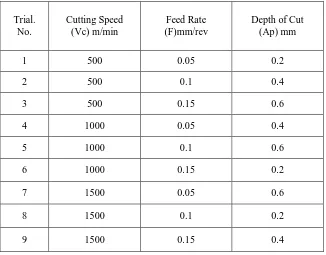
A statistical Analysis of Variance (ANOVA) is performed to see which process parameters are significantly affecting the responses (cutting force, surface roughness and Tool wear (VB)). The goal of this experimental work was to investigate the effects of cutting parameters on cutting force, surface roughness and tool wear to establish a correlation between them. Experiments were planned according to Taguchi’s L9 orthogonal array, which has 9 rows corresponding to the number of test. The factors and the interactions are assigned to the columns. The first column was assigned to the cutting speed (Vc), second feed rate (F) and third one Depth of cut (Ap) and the remaining were assigned to the interactions. It means a total 9 experimental number must be conducted using the combination of levels for each independent factor speed (Vc), feed (F) and depth of cut (Ap). This orthogonal array is chosen due to its capability to check the interactions among factors. ANOVA is used to find which cutting parameters are most significant on cutting force, surface roughness and tools wear. The experimental results are then transformed into a Signal to Noise (S/N) ratio. A total of 9 experiments based on Taguchi’s L9 orthogonal array were carried out with different combinations of the levels of the input parameters. Among them, the settings of cutting speed include 500, 1000 and 1500 m/min those of feed rate include 0.05, 0.1, 0.15 mm/ rev and the depth of cut is set at 0.2, 0.4 and 0.6 mm.
The results were studied using the S/N ratio and ANOVA analysis. Based on the results of the S/N ratio and ANOVA analysis, optimal cutting parameters for surface roughness and MMR were obtained and verified. The percentage of contribution (PC) Calculated as.
% of Contribution (PC) = ((SS) speed – DOF * (SS Mean error)) (SS) total)*100
3.5. Test Parameter
Table 4 Assignment the levels to the factors
3.6. Experimental Plan Test
Table: 5 L9 Orthogonal Arrays for Factorial Experiments
IV. RESULTS AND DISCUSSIONS
In this chapter, the experimentation were carried on a EN14 steel by using CVD coated carbide insert with different parameters, results of surface roughness and material removal rate are determined by the experimental work as depicted below. Taguchi L9 othogonal array is used to find the analysis of variance and major influencing parameters on surface roughness and material removal rate.
4.1. Influence of cutting parameters on surface roughness
Machining process with coolant and without coolant, it has become more popular as a finishing process. Thus it is especially crucial to select the machining parameters to obtain the desired surface finish of machined components.
Parameters Levels 1 Levels 2 Levels 3
Cutting speed (Vc)rpm 500 1000 1500
Feed rate ( F)
mm/rev 0.05 0.1 0.15
Depth of cut (Ap ) mm 0.2 0.4 0.6
Trial. No.
Cutting Speed (Vc) m/min
Feed Rate (F)mm/rev
Depth of Cut (Ap) mm
1 500 0.05 0.2
2 500 0.1 0.4
3 500 0.15 0.6
4 1000 0.05 0.4
5 1000 0.1 0.6
6 1000 0.15 0.2
7 1500 0.05 0.6
8 1500 0.1 0.2
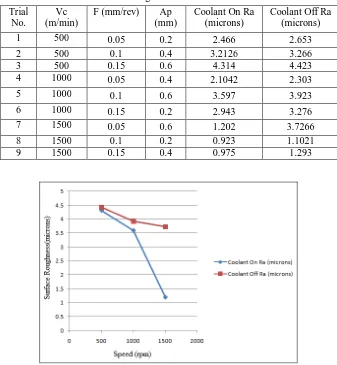
The Table 6 shows the result of surface roughness for coolant on and coolant off at different cutting parameters. The Fig 3 shows the surface roughness significantly decreases with increasing the cutting speed for coolant on and off of same tool. As the cutting speed increases from 500 to 1000 rpm, the surface roughness decreases from higher surface roughness to lower surface roughness at constant depth of cut of 0.6mm. At higher cutting speeds, a good surface finish is obtained. At higher cutting speed less heat is dissipated to the work material as it was swept away in the chips and reduces the adherence of chips to the cutting edge due to this reason good surface finish is achieved.
Table 6 Surface roughness for coolant ON and OFF
Fig 3 Cutting speed versus surface roughness (Depth of cut 0.6mm) Trial
No.
Vc (m/min)
F (mm/rev) Ap
(mm)
Coolant On Ra (microns)
Coolant Off Ra (microns)
1 500 0.05 0.2 2.466 2.653
2 500 0.1 0.4 3.2126 3.266
3 500 0.15 0.6 4.314 4.423
4 1000 0.05 0.4 2.1042 2.303
5 1000 0.1 0.6 3.597 3.923
6 1000 0.15 0.2 2.943 3.276
7 1500 0.05 0.6 1.202 3.7266
8 1500 0.1 0.2 0.923 1.1021
Table 7 ANOVA results of surface roughness for CVD coated carbide tool
Factor SS d.o.f Mean sq PC (%)
F (mm/rev) 6.54 2 3.27 3.21
Vc (m/mm) 178.12 2 89.09 87.63
Ap (mm) 17.186 2 8.93 8.45
Error 1.41 2 0.71 0.06
Total 203.25 8 -- 100
a= 99% confidence level, SS= Sum of square,
d.o.f=degrees of freedom, PC=Percentage contribution
An ANOVA table is commonly used to summarize the tests performed. It was statistically studied the relative effect of each cutting parameters on the surface roughness (Ra) by using ANOVA. Table 5.3 shows the results of the ANOVA (analysis of variance) with the surface roughness for CVD coated carbide tool when coolant on. Here the contribution of speed rate for CVD coated carbide tool on surface roughness is 87.63%, it is more significant and cutting feed factor is 8.45% have statistical and physical significance on the surface roughness obtained for EN14 steel. The feed rate is more significant factor than the other factors. The error associated is 3.21% respectively. From the result, the role of depth of cut is minimum in obtaining good surface finish. It is indicated that in order to achieve good surface finish, always use high cutting speed and low feed rate.
7.2Influence of cutting Parameters on Material Removal Rate
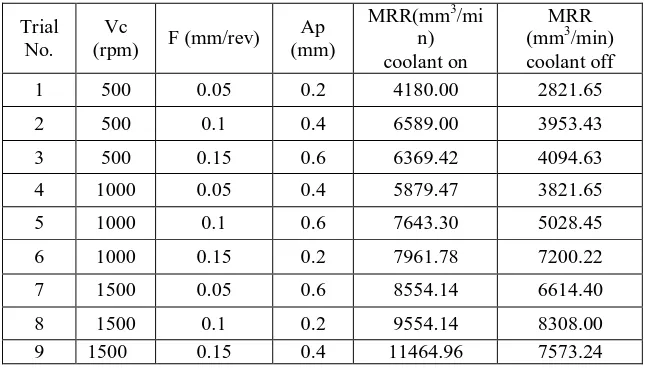
Table 8 shows the MRR for same tool with different cutting parameters when coolant on and off.
Table 8 Material removal rate for coolant on and coolant off for CVD coated carbide tool
Trial No.
Vc
(rpm) F (mm/rev) Ap (mm)
MRR(mm3/mi n) coolant on
MRR (mm3/min) coolant off
1 500 0.05 0.2 4180.00 2821.65
2 500 0.1 0.4 6589.00 3953.43
3 500 0.15 0.6 6369.42 4094.63
4 1000 0.05 0.4 5879.47 3821.65
5 1000 0.1 0.6 7643.30 5028.45
6 1000 0.15 0.2 7961.78 7200.22
7 1500 0.05 0.6 8554.14 6614.40
8 1500 0.1 0.2 9554.14 8308.00
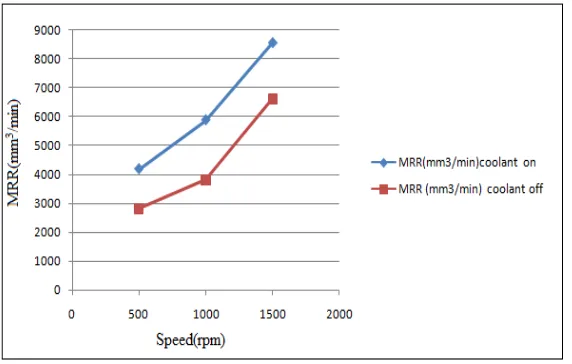
Fig 4 MRR versus cutting speed for CVD coatedCarbide tool.
The Fig 4 shows, material removal rate versus cutting speed for CVD coated carbide tool. Initially the material removal rate lower at cutting speed of 500rpm for both coolants on & off at depth of cut 0.6mm. The cutting speed is increases from 500rpm to 1000rpm and feed rate 0.05mm/rev to 0.1mm/rev, the material removal rate is slightly increases, again the cutting speed increases to 1500 and feed rate to 0.15mm/rev the material removal rate is more. At higher cutting speed and higher feed rate, the material get remove more, material is removed more when coolant on compare to coolant off condition because due coolant carry away the temperature generated so less tool wear and removes the more material.
Table 9 shows the results of the ANOVA (analysis of variance) with the MRR for CVD coated carbide tool. One can observe from ANOVA table that the contribution of cutting speed for CVD coated carbide tool is 72.24%, it is more significant and feed factor is 20.70% have statistical and physical significance on the MRR obtained for AISI 4340 steel. The feed rate and cutting speed are more significant factors. The error associated is 4.81% respectively.
Table 9ANOVA results of MRR for CVD coated carbide tool
a = 99% confidence level, SS = Sum of square
d.o.f = degrees of freedom, PC = Percentage contribution
Factor SS d.o.f Mean sq PC (%)
F (mm/rev) 17.59 2 8.79 20.70
Vc (m/mm) 61.39 2 30.69 72.24
Ap (mm) 1.91 2 0.95 2.25
Error 4.09 2 2.05 4.81
V. CONCLUSION
In the present work, CNC turning was carried out on grade EN14 die steel treated at 42 HRC, with the help of CVD coated carbide cutting tool. This enabled in the development of statistical models of surface roughness and material removal rate components. These models were obtained by Taguchi techniques. From the analysis of results using conceptual S/N ratio approach and ANOVA, the following conclusions can be drawn.
The speed has more influence on, surface roughness, and material removal rate compared to the feed and depth of cut.
Better surface finish is obtained at an optimum cutting speed of 1500rpm, feed rate 0.1mm/rev and depth of cut 0.2mm.
Surface roughness reduces as the speed increases and feed decreases.
Higher material removal rate is obtained at an optimum cutting speed of 1500rpm, feed rate 0.15mm/rev and depth of cut 0.4mm.
Material removal rate is increases with increase in cutting speed and feed rate.
From regression analysis we conclude that experimental values and predicted values are almost near.
Chip morphology study indicates that the formation of continuous chips at lower cutting speed and segmental chips at higher cutting speed.
REFERENCES
[1] Suleiman Abdulkareem, Usman JibrinRuma and Apasi Adaokoma. “Optimizing Machining Parameters during Turning Process”. International Journal of Integrated Engineering, Vol. 3 No. 1 (2011) p. 23-27.
[2] Krishankant, Jatin Taneja, Mohit Bector& Rajesh Kumar. ” Application of Taguchi Method for Optimizing Turning Process by the effects of Machining Parameters”. International Journal of Engineering and Advanced Technology (IJEAT) ISSN: 2249 – 8958, Volume-2, Issue-1, October 2012.
[3] Ali RizaMotorcu. “The Optimization of Machining Parameters Using the Taguchi Method for Surface Roughness of AISI 8660 Hardened Alloy Steel”. Journal of Mechanical Engineering 56(2010)6, 391-401.
[4] Kalpakjian and Schmid, Manufacturing Processes for Engineering Materials, 4th Edition, Prientice Hall, 2003, pp 464, 527.
[5] Poulachon, G., Bandyopadhyay, B.P., Jawahir, I.S., Pheulpin, S. and Seguin, E. (2004).”Wear behavior of CBN tools while turning various hardened steels”. Elsevier Wear. 256: 302-310.