Acetylene as an Alternate Fuel in Modified
4-Stroke Spark Ignition Engine
Nataraja M1, Kiran Kumar M2, Manjunath K3, Madhukumar K4.
Assistant Professor, Department of Mechanical Engineering, Sir M Visvesvaraya Institute of Technology, Bangalore,
Karnataka, India1
Associate Professor, Department of Mechanical Engineering, Sir M Visvesvaraya Institute of Technology, Bangalore,
Karnataka, India2
Assistant Professor, Department of Mechanical Engineering, SEA College of Engg.. & Technology, Bangalore,
Karnataka, India3
Assistant Professor, Department of Mechanical Engineering, Sir M Visvesvaraya Institute of Technology, Bangalore,
Karnataka, India4
ABSTRACT: In the present trend where fossil fuels are in the verge of exhaust, the search for an alternative fuel is one of the needs for sustainable development, energy conservation, efficiency, management and environmental preservation. Therefore, any attempt to reduce the consumption of petrol and diesel possible alternative fuels is mostly preferable, and we have many choices like LPG, CNG with their drawbacks. Due to which it is complicated to use them among various options acetylene gas is a very good fuel for automobiles. This study about the idea of using acetylene gas in the internal combustion engine such that it reduces the demand of the petroleum products that is going to be extinct in near future. It includes about the emissions of harmful gases that can be reduced by the use of acetylene instead of petroleum products. Various fuels have been tested on IC engines for their suitability as alternate fuels. Expect few alcohols, CNG and LPG, not many fuels have been found to be matched with IC Engines requirements. As acetylene is colourless gas and is highly combustible with high flame speed and fast energy release, it can be used as alternative fuel in IC engines. It has a very wide flammability range and minimum ignition energy required for ignition. Furthermore comparing with various other fuel properties, acetylene proved good to be used in internal combustion engines. The main objective of the study is to manufacture the cylinder with all the measures, so that it can be used for chemical reaction of calcium carbide with water and produce the acetylene gas, store the gas and to supply to the engine. And also modify the petrol engine to work on acetylene gas efficiently. The spark timing is changed, so that the spark ignition is little earlier by changing breaker time distance, the timing valve adjustment. Introducing of ethanol in fuel inlet for ignition and reduce adiabatic temperature and acetylene from air inlet along air hose to carburetor. Thus this study is an attempt for the use of an alternative resource such that it can prove to be useful for the peoples in future.
KEYWORDS: Acetylene Gas, Efficiency, Analysis, Comparison, Emission.
I. INTRODUCTION
fuels were tried. But the problems associated with vegetable oil are the high viscosity and low volatility. These properties affect the fuel injection system very badly. Turpentine was used in early engines without any modification. The abundant availability of fossil fuels had stopped the usage of turpentine in I.C. engines. But the increasing cost of petroleum is prevailing today reopens the utility of turpentine in I.C. engine.
Spark Ignition Engine: A spark-ignition engine is an internal combustion engine, generally a petrol engine, where the combustion process of the air-fuel mixture is ignited by a spark from a spark plug. This is in contrast to compression-ignition engines, typically diesel engines, where the heat generated from compression together with the injection of fuel is enough to initiate the combustion process, without needing any external spark. Spark-ignition engines are commonly referred to as "gasoline engines" or "petrol engines. However, these terms are not preferred, since spark-ignition engines can (and increasingly are)run on fuels other than petrol/gasoline, such as auto gas (LPG), methanol, ethanol, bio ethanol, compressed natural gas (CNG), hydrogen, and(in drag racing) nitro methane.
Alternate Fuels: There are three types of fuels viz. solid, liquid and gaseous fuels. Mainly liquid fuels are used in IC engines. Nowadays gaseous fuels such as LPG and CNG are also in use as automobile fuels. In early periods even solid fuels like charcoal, coal and slurry were also tried. Solid fuels: They are not used nowadays, but when Rudolf was designing the engine he used coal dust mixed with water. He used very fine coal particles thoroughly mixed with water and injected in the engine. As coal is abundantly available it becomes an attractive fuel, but there are problems in using it. Major problems are abrasiveness due to solid particles which leads to wear of injectors and the piston rings. Liquid fuels: Liquid fuels are preferred due to their high calorific value and they can be easily stored. Moreover the problem of wear is also overcome by using liquid fuels. The most common liquid alternative is alcohol. And Gaseous fuels: Since physical delay is almost zero for gaseous fuels, they are suited for use in ic engines. Since the gas displaces the equal amount of air, the volumetric efficiency of the engine decreases.
Acetylene: Pure acetylene is a colorless, highly flammable gas with an ether-like odor, but the odor of the commercial purity grade is garlic-like. Acetylene can be safely stored and used in cylinders filled with a porous material and containing acetone into which the acetylene has been dissolved. Acetylene, when not dissolved in a solvent can begin to decompose at pressures above 15 pounds per square inch gauge (psig). The products of dissociation are carbon, in the form of lampblack and hydrogen. Considerable amounts of heat are generated by dissociation, which may produce explosions of great violence. Steel and wrought iron are recommended for use in acetylene piping. Rolled, forged, or cast steel, or malleable iron fittings may be used. Cast iron is not permissible for fittings. Unalloyed copper, silver, or mercury should never be used in direct contact with acetylene since there is the possibility of forming explosive acetylides. Wet acetylene will produce explosive acetylides on copper, 70-30 brass, and aluminum-bronze. Weight (not pressure) is used to determine the amount of acetylene in a cylinder. The tare weight is subtracted from the actual weight, and the difference is multiplied by 14.7 to determine the amount of gas in standard cubic feet. The molecular symbol for acetylene is C2H2.
II. RELATED WORK
An experiment onAcetylene as an Alternative Fuel in IC Engineand found that theacetylene can be a good fuel for the country like Nepal where calcium carbonate are abundant in nature. Despite of being, good fuel for IC engine, there are some of the control measures and safety precautions that are involved in gas phase reactions that can cause serious damages, by Prabin K. Sharma [1]. Experiments involving the use of natural gas in internal combustion engines. Natural gas is a clean burning fuel that is available from large domestic natural reserve. When it is used as a fuel in SI engines, it reduces emissions to meet EURO-III norms with carburettors and EURO-IV norms with manifold injection. Study was conducted on a naturally aspirated, air cooled, small spark ignition engine, to explore the merits of HCNG. The HC emissions were found to decrease with the increase in speed and the maximum heat release rate was found to increase with the increase in speed, by A. Sonthalia[2]
constant power supply. So, FR which worked fine with the setup and even helped to filter the gas which was not done in future which increases chances of rusting inside engine. As there is already a solution for storing acetylene which can be further study and developed for vehicles like a CNG kit, tried a standard acetylene tank which is specially designed so that it can be transported. While storing they add acetone (liquid) to make it safe from transport. By experiments they observe that on wheel production is idea of past and can’t be applied on future vehicles. As mention above a smaller version of acetylene tank can be manufactured just like CNG kit, by Mitul Prajathi. Experiments on the three types of fuels: Alcoholic fuels, gaseous fuels and liquid fuels. And its concluded that the For the same energy input, Methanol produces more brake power than gasoline, Natural gas produces less brake power than gasoline Iso-octane produces more brake power than gasoline, Gasoline-Hydrogen mixture produces brake power more than gasoline, Spark advance from 0-15º BTDC increases the brake power by 5% and the efficiency by 5%, and decreases bsfc by 4%. Spark advance from 15-25º BTDC increases the brake power by Spark advance from 0-15º BTDC increases the brake power by 5% and the efficiency by 5%, and decreases bsfc by 4%. Spark advance from 15-25º BTDC increases the brake power by 2% and the by 1.5%, and decreases bsfc by 1.8%, by Yousef S.H. Najjar [4]. Conducted an trial on the fabrication of “S.I. engine to use acetylene as fuel”, Their study highlights the use of acetylene as a fuel for SI engine, this fuel can be used with conventional S.I. engine with minor fabrication and manipulations. As acetylene has wide range of merits on environmental as well as economic grounds. It produces only carbon dioxide during combustion and is less costly than conventional fuel as acetylene is produced from calcium carbonate which is in abundance. Non-polluting nature and more economic by Suyash Kamal [4]. conducted experiments on a diesel engine aspirated acetylene along with air at different flow rates without dual fuel mode. They carried out the experiment on a single cylinder, air cooled, direct injection (DI), compression ignition engine designed to develop the rated power output of 4.4 kW at 1500 rpm under variable load condition. Acetylene aspiration results came with a lower thermal efficiency reduced Smoke, HC and CO emissions, when compared with baseline diesel operation.
III.METHODOLOGY
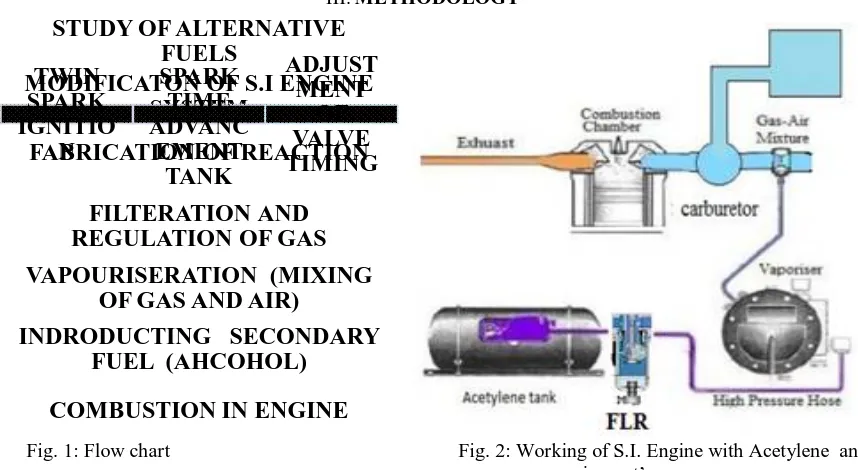
Fig. 1: Flow chart Fig. 2: Working of S.I. Engine with Acetylene and its equipment’s
In the present work, water and calcium carbide are added in the ratio of 2:1 to the reaction tank and, due to reaction the acetylene gas is generated, and it stored. The stored acetylene gas enters the FLR UNIT to filter the gas and regulated and then is vaporized in vaporizer. Tank pressure is reduced to approximately 1.5 psi. As negative pressure is transmitted from the carburetor to the vaporizer, the regulator in vaporizer releases acetylene vapor and acetylene gas was aspirated in the intake manifold. The SI engine will start with petrol or ethanol being the ignition source also use of ethanol will reduce adiabatic temperature, after that the performance and emission characteristics are compared with baseline acetylene gas.
Table 1: Fuel Characteristics Table 2: Properties of Acetylene
COMBUSTION IN ENGINE
INDRODUCTING SECONDARY
FUEL (AHCOHOL)
VAPOURISERATION (MIXING
OF GAS AND AIR)
FILTERATION AND
REGULATION OF GAS
FABRICATION OF REACTION
TANK
MODIFICATON OF S.I ENGINE
SYSTEM
TWIN
SPARK
IGNITIO
N
SPARK
TIME
ADVANC
EMENT
ADJUST
MENT
OF
VALVE
TIMING
STUDY OF ALTERNATIVE
FUELS
Fuel Auto-Ignition Temp. (K) Density (Kg/M3)Flammability limit (%vol. in air)
LPG 678-723 2.26 2.15
CNG 813 0.79 5
Hydr
ogen 858 0.08 4
Biog
as 923 1.2 7.5
Dies
el 523 840 Na
Gaso
line 644 710-750 1.4
Property Value
Appearance: Colorless gas
Odor
Acetylene of 100% purity is odorless, but commercial acetylene has a distinctive, Garlic-like odor.
Physical State: Gas at normal temperature and pressure
Sublimation Point At 1 atm: -118°F (-83.3°C)
Melting Point At 10 Psig (170 Kpa abs): -116°F (-82.2°C
Boiling Point At 10 Psig (170 Kpa abs) Flash Point 103.4°F (-75.2°C) Flammable limits
in air
% By Volume: Lower: 2.5% Upper: 100%
Fig. 3: SI Engine
A spark-ignition engine is an internal combustion engine, generally a petrol engine, where the combustion process of the air-fuel mixture is ignited by a spark from a spark plug. This is in contrast to compression-ignition engines, typically diesel engines, where the heat generated from compression together with the injection of fuel is enough to initiate the combustion process, without needing any external spark. Modification done in engine system: fuel injection with carburetor connected to vaporizer and FLR unit. Spark timing advancement, generally spark is produced within .03 to 0.5seconds before the BDC after compression stroke with crank angle about 10o to 15o, but this is advanced by modifying the CDI.
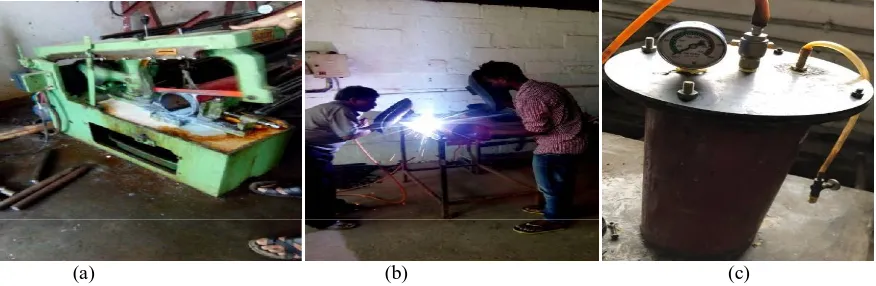
Reaction tank: Reaction tank is made up of mild steel with 6mm thickness, 16cm in diameter, 36cm in length, with the volume of 7238.23mm3. The top flange is removable can fasten with nut and bolt of 8mm for removing the bi product (calcium hydroxide) after reaction, and it consists of three ports: For pressure gauge, Gas outlet with valve and Emergency release for gas with valve.
(a) (b) (c)
Fig. 4: Reaction tank fabrications
Vapor Density (Air = 1) At 32°F (0°C) And 1 Atm: 0.906
Specific Gravity Vol/Vol At 32°F (0°C): 1.7 Solubility In Water Vol/Vol At 32°F (0°C): 1.7 Autoignition
Temperature
581°F (305°C) At 1 Atm
Percent Volatiles By Volume
100
Molecular Weight 26.04
Model Bajaj pulsar 150cc
Bore 57mm
Displacement 149.80cc
Fuel Delivery System Carburetor
Maximum Power 13.80BHP
Maximum Torque 13.40Nm
Stroke Length 56mm
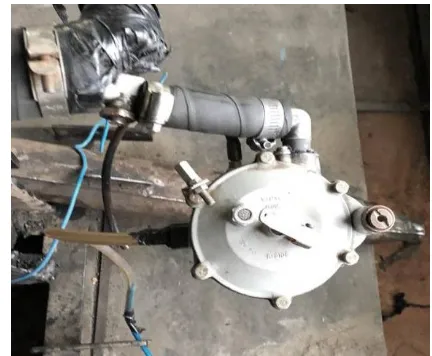
FLR Unit and Vaporizer: Acetylene leaving from reaction chamber which contains contaminants, and calcium hydroxides particles which might cause improper combustion and affect the engine and other components to avoid these problems, the gas is filtered and regulated its pressure when the output pressure is high and removes the moisture in gas so that it avoids the effect of rust on engine and other parts. The maximum pressure is 2Mpa.with input from reaction tank tube and the output after filtering the acetylene, to the vaporizer.
It is very similar to carburetor, as carburetor mixes air and liquid fuel but vaporizer mixes air and gaseous fuel. It consists of TWO valves: Acetylene in, Gaseous fuel out and vacuum pressure in. Quantity of outlet gas is controlled using this diaphragm mechanism. From this outlet fuel gas is moved to the engine for combustion process.
ss
Fig. 5: FLR unit Fig.6: Vaporizer
IV.EXPERIMENTAL RESULTS
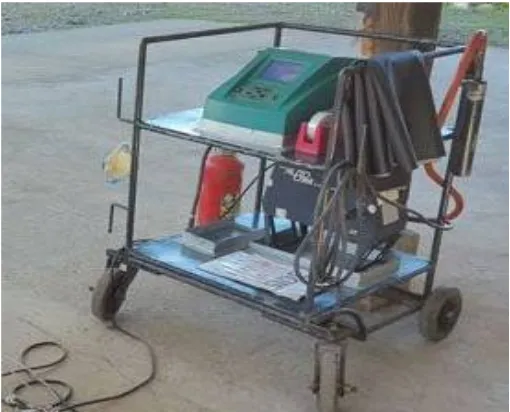
The SI engine is tested with both petrol and acetylene fuels and the data as tabulated for comparing the acetylene with petrol for same engine, and the emission test is done for each load condition and results obtained.
Emission: Table 4: Emission test report
FUEL Carbon Monoxid e in %
Hydroc arbon In PPM
Carbon Dioxide in %
Oxyge n in PPM Acety
lene gas
0.759 272 14.73 2
Fig. 7: Portable Emission Testing Machine
Smoke: The variation of smoke level with brake power is seen. The exact mechanism of smoke formation is still unknown. Generally speaking, smoke is formed by the pyrolysis of HC in the fuel rich zone, mainly under load conditions. In petrol engines operated with heterogeneous mixtures, most of the smoke is formed in the diffusion flame. The amount of smoke present in the exhaust gas depends on the mode of mixture formation. The combustion processes and quantity of fuel injected occur before ignition. The smoke level increases with increase in petrol flow rate, and at full load it is 7 BSU in case of petrol fuel operation. Dual fuel operation with any gaseous fuel proved to be a potential way of reducing the smoke density as compared to petrol operation. A reduction in smoke level is noticed. The smoke level is reduced by 14% in induction technique at full load when compared to baseline petrol operation. This may be attributed to the fact that combustion of acetylene-petrol fuel is faster, contributing to complete combustion, and is also due to triple bond in acetylene which is unstable.
Hydrocarbon Emissions: Depicts the variation of hydrocarbon emissions with load. The HC emissions are 900 ppm in baseline petrol operation and 272 ppm when acetylene is aspirated at full load in induction technique. The reduction in HC emission in the case of dual fuel mode is due to the higher burning velocity of acetylene which enhances the burning rate.
Carbon Monoxide Emissions: The variation of carbon monoxide emissions with load exhibits similar trend of HC. The CO emissions are quit higher than compared to the base line petrol operation. The CO emission is 1.361% by volume followed by base line petrol and 2.759% at full load followed by base line as an acetylene gas. The CO emissions are higher due to the incomplete burning of the fuel.
Carbon Dioxide Emissions: The CO2 emissions are lower compared to the base line petrol, the minimum being 2.18% by volume at full load in acetylene induction technique followed by 3.04% by volume in baseline petrol operation. The CO2 emission of acetylene is lowered because of lower hydrogen to carbon ratio.
Test result by varying the load; taking Petrol as fuel in SI Engine:
Table 5: Tabulation taking Petrol as Fuel
Position of gear
Load (w) kg
Spring load (kg
Rpm (rad/s)
Torque (N-m)
Brake Power (W)
Speed (m/s)
Indicated Power
Mechanical efficiency
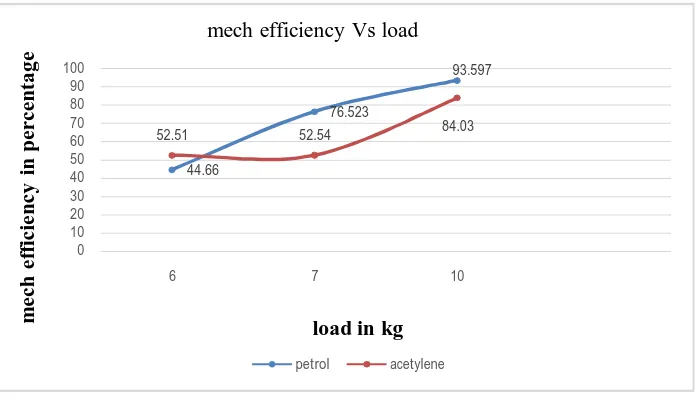
1 10 1 520.11 10.59 432.6 6.3 462.211 93.597
3 7 2 980.36 5.243 680 12.88 1280.12 76.523
4 6 1.5 1200 4.18 690.2 15.21 15450.2 44.66
Test result by varying the load; taking Acetylene as fuel in SI Engine:
Table 6: Tabulation taking Acetylene as Fuel
Position of gear
Load (w) kg
Spring load (kg
Rpm (rad/s)
Torque (N-m)
Brake Power (W)
Speed (m/s)
Indicated Power
Mechanical efficiency
1 10 2 600 9.8066 616.16 7.848 733.26 84.03
3 7 1.5 1050 6.7420 741.32 13.734 1283.31 52.54
4 6 1 1300 6.1291 831.32 17.004 1588.74 52.51
Calculation: Calculation procedure for performance testing:
Braking Torque (N-.m): Braking Torque = (W – S) × Rb:
Where, W = Dead weight in Newton (N); S = spring balance Reading (N); Rb = Radius of brake drum (D/2).
Brake power (w) : Bp = (W- S) ×Rb×2πN/60.
Indicated power (w) : Ip = (IMEP LAnK / 60;
Where, Ip = indicated power (kW); IMEP = Indicated Mean Effective Pressure (kN/m2); L = length of stroke (m); A = cross section area of piston (m2); n = number of power strokes n = N / 2 for four strokes; and N = for two strokes; N = crankshaft speed (revolutions per minute); K = number of cylinders; Mechanical efficiency: ηmech = BP / IP; Speed
(m/s): V= rpm x (2π rad)/ rev x (r/rad);
Theoretical calculation: Sample calculation (using experimental method):
Bore dia. (dc)=57 mm; Stroke (L) = 56.4mm; Compression ratio = 9.5; RPM = 8500; Petrol calorific value = 45.6 MJ/Kg; Acetylene calorific value = 56 MJ/Kg; Cylinder Swept Volume (Vs) : Vs = Cylinder area x Stroke length: = 4 ( ) 2 x L: = 4 (57) 2 x 56.4 = 143.91 cc / cylinder; Compression ratio = 9.5; Air standard efficiency = 1 - 1/rℽ-1: = 1 - 1/(9.5) 0.4: = 0.5936: Eff. = Relative eff. x Air standard eff.: = 0.5 x 0.5936: = 0.2968 Heat supplied: = 9.57 / 0.2968 : = 32.24:
Comparision of Results by Graph and Discussion:
Fig. 8: Graph, Petrol v/s Acetylene
The graph shown in above figure, and from table 6.2.1 and 6.2.2 initially we get better efficiency in low load i,e at 6 kg for acetylene but as we increase the load of to 7 & 10 kg the efficiency of acetylene is decreased abt 36%. The graph shown in above figure, and from table 6.2.1 and 6.2.2 initially we get high bp in same load for acetylene I,e for 6 kg but in mid-range I,e 7 kg we found slight decrease and then higher load 10 kg again BP increase.432w
Fig. 9: Graph, BP v/s Load Fig. 10: Graph, Speed v/s Load
1200 1200 520.11 1300 1050 600 0 200 400 600 800 1000 1200 1400
6 7 10
sp
ee
d
load in kg
speed Vs load
petrol acetylene
44.66
76.523
93.597
52.51 52.54 84.03
0 10 20 30 40 50 60 70 80 90 100
6 7 10
m ech ef fi ci e n cy i n percen ta g e
load in kg mech efficiency Vs load
petrol acetylene 690.2 680 432.6 831.32 741.32 616.16 0 100 200 300 400 500 600 700 800 900
6 7 10
b
rak
e
p
o
w
er
load in kg
BP Vs load
The graph shown in above figure, and from table 5 and 6 from experiment we found that for same load (petrol and acetylene fuel) we get higher speed for acetylene 600+.
V. CONCLUSION
Experiment carried out uses air drier for removing moisture which can be possible solution for 4-wheelers but not for two-wheeler since it requires constant power supply. So, we tried FR which worked fine with our setup and even help us to filter the gas which was not done in future which increases chances of rusting inside engine. As there is already solutions for storing acetylene which can be further study and developed for vehicles like a CNG kit. We tried a standard acetylene tank which is specially designed so that it can be transported. While storing they add acetone (liquid make it safe from transport. By our experiments we observe that on whole production is idea of past and can’t be applied on future vehicles. As mention above a smaller version of acetylene tank can be manufactured just like CNG kit.
The idea of on wheel production is not safe. The study highlights the use of acetylene as a fuel for SI engine; this fuel can be used with conventional S.I. engine with minor fabrication and manipulations. As acetylene has wide range of merits on environmental as well as economic grounds. It produces only carbon dioxide during combustion and is less costly than conventional fuel acetylene is produced from calcium carbonate which is in abundance. Acetylene have proved out to be better fuel due its non – polluting nature and more economic.
REFERENCES
[1] Prabin K. Sharma et al.: “Use of Acetylene as an Alternative Fuel in IC Engine” proceeding of Rentech Symposium Compendium, Volume 1, March 2012.
[2] J. B. Heywood, Internal Combustion Engine Fundamentals, McGraw-Hill, Inc., New York, 1988. [3] Chigier N (1981) "Energy, Combustion and Environment", McGraw Hill.
[3] Yousef S.H. NajjarUse of Acetylene as an Alternative Fuel in IC Engine, vol1 april 2014.
[4] J. Wulff, W.Hulett, L. Sunggyu, “Internal combustion system using acetylene fuel”. United States Patent No 6076487. [5] N. Swami, J.M. Mallikarjuna, A. Ramesh, “HCCI engine operation with acetylene the fuel”. SAE paper no 2008-28-0032.
[6] V.M.S. Ashok, N.I. Khan, “Experimental investigation on use of welding gas (Acetylene) on SI Engine”. Proceedings of AER Conference, IIT, 2006.