ISSN (Online) : 2319 - 8753
ISSN (Print) : 2347 – 6710
International Journal of Innovative Research in Science, Engineering and Technology
An ISO 3297: 2007 Certified Organization Volume 7, Special Issue 5, April 2018
1st International Conference on Recent Innovation in Civil Engineering and Management (ICRICEM '18)
22nd March 2018
Organized by
Department of Civil Engineering & MBA, Loyola Institute of Technology, Chennai, Tamilnadu, India
Modifying the Thermal Effects inside the
Metal Roof Structures for a Workable
Environment
C.K Arunsivabalaji1, V Ajithkumar2, B Maria Benhi Shajee3 , G Iyappan4, M.Kirubakaran5
UG Student, Department of Civil Engineering, Loyola Institute of Technology, Chennai, India123
Assistant Professor, Department of Civil Engineering, Loyola Institute of Technology, Chennai, India 4
Professor, Department of Civil Engineering, Loyola Institute of Technology, Chennai, India5
ABSTRACT: Although building techniques and materials have evolved over thousands of years, construction is still a long, complex, and expensive process. Construction industry boom can be seen in almost all the developing countries. With the increase in material costs in the construction industry, there is a need to find more cost saving alternatives so as to maintain the cost of constructing houses at prices affordable to people. There is need to develop an alternative system of building component which would impart more benefits and are multifunctional with optimum use of labour and material. Autoclaved Aerated light weight block wall in Rat-trap bond is an innovative technique for building masonry unit which reduces the construction cost, time and labor considerably. This may not solve all construction problems but they do resolve many issues associated with traditional materials.
KEYWORDS: Rat-Tarp Bond, Autoclaved Aerated lightweight concrete, alternative building material, Cost Effective.
I. INTRODUCTION
1.1 AEROCON BLOCKS
Aerocon blocks are an innovative product in the green building revolution. Aerocon blocks are the new blocks in walling materials substituting conventional and environmentally unsustainable materials like clay bricks, concrete and hollow blocks.Autoclaved concrete blocks used in the construction of wall materials used in the manufacture of these block are environmentally friendly and are certified green products. Fly ash is also used as an alternative building material which is a waste from thermal power plants.Since these materials are light weight with high thermal insulation, they are highly fire resistant. These blocks save water during construction and ensure long term sustainability of the building. These blocks have been used in wide range of constructions which include residential, commercial, hotels, hospitals, schools etc.
The edges of the blocks are such that they allow easy workability and accurate dimensioning. Aerocon blocks are easier to install as opposed to the installation and usage of conventional building materials where construction deadline is short andlabour scarcity is acute and mortars are to be used.
The time required for the installation of aerocon blocks is about is about 1/3 as compared to the time required for the installation of conventional building materials. Aerocon blocks are available in various sizes and shapes. They are included into the category of green building materials because they don’t emit voc (volatile organic compounds) which cause environmental pollution.
Hence, it is one of the revolutionary materials that can be used to make the work a better, greener and cleaner place to live in.
1.1.1 Aerocon
ISSN (Online) : 2319 - 8753
ISSN (Print) : 2347 – 6710
International Journal of Innovative Research in Science, Engineering and Technology
An ISO 3297: 2007 Certified Organization Volume 7, Special Issue 5, April 2018
1st International Conference on Recent Innovation in Civil Engineering and Management (ICRICEM '18)
22nd March 2018
Organized by
Department of Civil Engineering & MBA, Loyola Institute of Technology, Chennai, Tamilnadu, India
of construction industry about this new innovation, only few are clear about this new innovation, only few are clear about what exactly aerocon is all about.
So in a view to help such folks. Here is our small effort to put forward all the information related to aerocon blocks
1.2 AEROCON INCREDIENTS:
Aerocon blocks are autoclaved aerated concrete (AAC) blocks made with a mixture of
Cement
Fly Ash
Lime
An Aerated Agent foam liquid
Water
1.3 AEROCON BLOCKS PREPARED
During the production, fly ash and water are mixed together to from slurry. This mixture is then heated and transferred to a high speed mixer, to which the rest of the ingredients like lime, cement, and aluminum powder are added. During mixing process, a chemical reaction takes place between the ingredients and as a result small bubbles are formed in the mixture which from the characteristic cellular or aircrete structure.
A little later, when the mixture is partially set, it is wire cut into pre-determined sizes. These cut blocks are then transferred into autoclaves for high pressure seam curing. This autoclaving assisted by aeration process is what gives the unique, light-weight cellular structure as well as dimensional stability to the aerocon block
1.4 TYPES OF AEROCON BLOCK
Infill block
Jumbo block
Thermal block
1.4.1 Infill Block
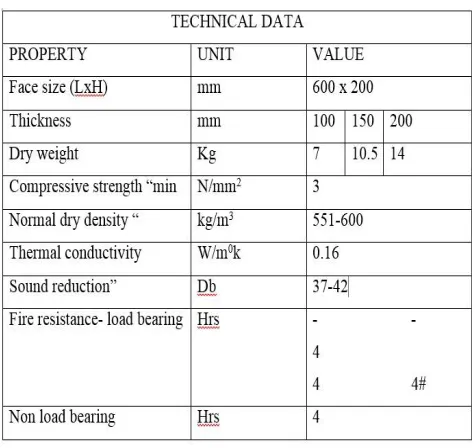
The sizes of the infill aerocon block are 600x200 mm and the thickness varies in the ranges 75, 100, 125, 150, 200 mm. The main advantage of infill blocks is that they can easily replace 60% of the concrete in roof slabs and thus helps in saving significant amounts of concrete, steel, labour, water, plaster etc. these blocks are especially suitable for building roofs in large column-free constructions
1.4.2 Jumbo Blocks
Jumbo blocks are typically in the size of 600x300 mm and thickness ranges from 75, 100, 125, 150, 200 mm. The unique large size of jumbo aerocon blocks results in the usage of much fewer blocks and hence less mortar is required.
These blocks are more suitable for non-load bearing walls, multi-storied buildings etc. 1.4.3 Thermal Blocks
ISSN (Online) : 2319 - 8753
ISSN (Print) : 2347 – 6710
International Journal of Innovative Research in Science, Engineering and Technology
An ISO 3297: 2007 Certified Organization Volume 7, Special Issue 5, April 2018
1st International Conference on Recent Innovation in Civil Engineering and Management (ICRICEM '18)
22nd March 2018
Organized by
Department of Civil Engineering & MBA, Loyola Institute of Technology, Chennai, Tamilnadu, India
II. STANDARD DATA FOR AEROCON BLOCKS
2.1 Jumbo Blocks Data
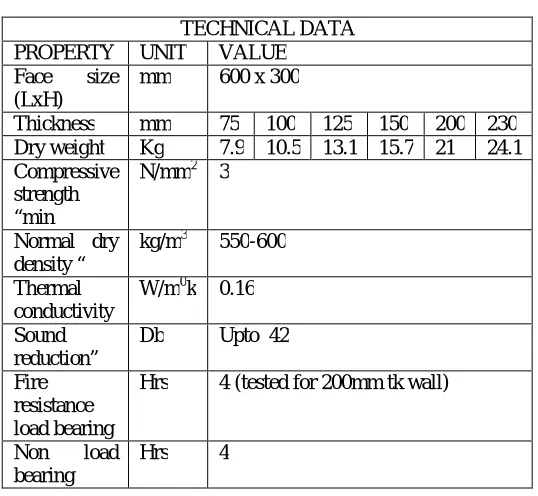
The specification for jumbo block show in table 2.1
TABLE 2.1
TECHNICAL DATA
PROPERTY UNIT VALUE
Face size
(LxH)
mm 600 x 300
Thickness mm 75 100 125 150 200 230
Dry weight Kg 7.9 10.5 13.1 15.7 21 24.1
Compressive strength “min
N/mm2 3
Normal dry density “
kg/m3 550-600
Thermal conductivity
W/m0k 0.16
Sound reduction”
Db Upto 42
Fire resistance load bearing
Hrs 4 (tested for 200mm tk wall)
Non load
bearing
Hrs 4
2.1.1 For Jumbo Blocks Application
Suitable for both load bearing non load bearing wallsIdeal for multi storyed buildings. Most suitable where thermal comforts at home and savings in air conditioning cost are desired.Suitable for all fire rated applications
2.1.2 Flexible Wall Thickness/Wide Range
Wide range of thickness 75mm to 230mm as per customer needs Standard face size 600mm x 300mm
2.1.3 Enhances Carpet Area
An engineered block, it can be offered in any thickness as per the construction design
By using 150mm thick blocks in place of 9 inch brick, the customer gets an additional 2% to 3% carpet area. The savings on account of additional carpet area gained is more than the cost of blocks.
2.1.4 Outstanding Advantages
Savings in mortar
Faster construction
Enhanced thermal and sound performance due to less joints
Economic design savings in cement and steel
Easy handling even jumbo size due to lower density
Light weight 1/3rd the density of clay bricks
2.2 Infill Blocks Data
ISSN (Online) : 2319 - 8753
ISSN (Print) : 2347 – 6710
International Journal of Innovative Research in Science, Engineering and Technology
An ISO 3297: 2007 Certified Organization Volume 7, Special Issue 5, April 2018
1st International Conference on Recent Innovation in Civil Engineering and Management (ICRICEM '18)
22nd March 2018
Organized by
Department of Civil Engineering & MBA, Loyola Institute of Technology, Chennai, Tamilnadu, India
TABLE 2.2
2.2.1 Application Of Aerocon Infill Blocks
Any roof with large column free space construction
Commercial and multistoried buildings
Extension of unplanned floors
Fire rated buildings
Air conditioned buildings
2.2.2 Advantages Of Aerocon Infill Blocks
¼th Density of concrete
Self-weight of roof slab reduces by 20-27%
Economical due to less dead loads
Provides very high insulation to roof
Ribbed slab construction
Gives flat soffits on completion
No edge & inside finishing of ribs required
Enables faster construction
Saving in centering costs
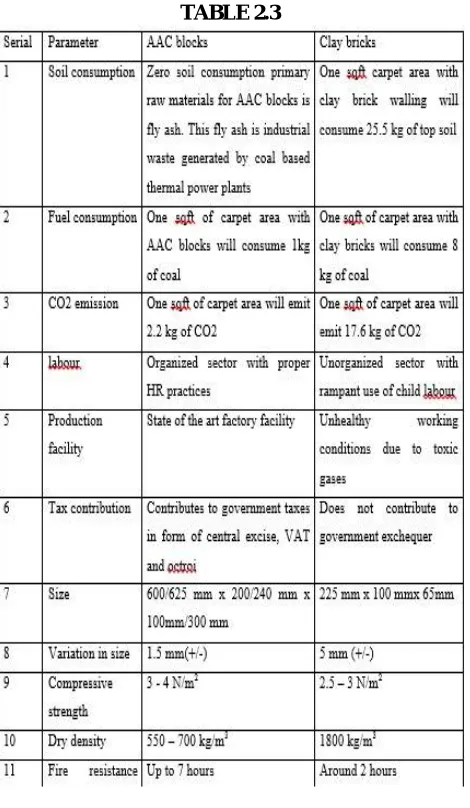
2.3 Comparison Of Parameter Between Aac& Clay
ISSN (Online) : 2319 - 8753
ISSN (Print) : 2347 – 6710
International Journal of Innovative Research in Science, Engineering and Technology
An ISO 3297: 2007 Certified Organization Volume 7, Special Issue 5, April 2018
1st International Conference on Recent Innovation in Civil Engineering and Management (ICRICEM '18)
22nd March 2018
Organized by
Department of Civil Engineering & MBA, Loyola Institute of Technology, Chennai, Tamilnadu, India
TABLE 2.3
III. PRODUCTION PROCEDURE OF AEROCON
3.1 Sand
Optimum properties are achieved when selecting the most suitable raw material. The sand is mostly preferred from river, which is washed and should be with minimum 20% fines. Dust in sand increases the demand for water and cement, without adding to the properties. It also increases shrinkage.
A certain, small amount of fines contributes towards strength. As in conventional concrete (CC), the sand should be free of organic material or other impurities. Crushed sand, due to sharp edges may destroy the foam mechanically.
3.2 Cement
Portland cement is preferred over other cements, such as pozzolan. For early stripping and optimum mechanical properties, high-grade (early strength) cement is recommended. Thick walls and when using battery-moulds, excess heat is developing within and might therefore ask for a lesser grade of cement. The slower, the hardening, the better the final quality of concrete.
ISSN (Online) : 2319 - 8753
ISSN (Print) : 2347 – 6710
International Journal of Innovative Research in Science, Engineering and Technology
An ISO 3297: 2007 Certified Organization Volume 7, Special Issue 5, April 2018
1st International Conference on Recent Innovation in Civil Engineering and Management (ICRICEM '18)
22nd March 2018
Organized by
Department of Civil Engineering & MBA, Loyola Institute of Technology, Chennai, Tamilnadu, India
3.3 Water
When used to produce foam, it has to be potable and for best performance, it should not exceed 25°C. Under no circumstances must the foaming agent be brought in contact with any oil, fat, chemical or other material that might harm its function (Oil has an influence on the surface-tension of water). The oil/wax used in moulds will not harm, since the foam by then will embedded in mortar. Water to prepare the mix has to conform to general requirements for concrete.
3.4 Foaming Agent
The containments holding foaming agent must be kept airtight and under temperatures not exceeding 25°C. This way the shelf life is guaranteed for 24 months.
3.5 Preparation OfMoulds
For smooth surfaces clean moulds completely of remaining concrete, the steel/or wood surface must be oiled, mostly vegetable oil is preferred. Trials with different materials will have to show best results. Oil will not destroy the mix, once the foam has been mixed in the mortar. Steel reinforcement will be placed in the moulds as usual.
No coating of the steel is necessary. In panels of more than 12-15 cm thickness, the use of double mesh is recommended. The steel connected to the lifting anchors should reach more than half of the width of the panel and should possibly not be connected to the mesh. Ordinary steel is used as in CC when casting densities of 1200 or higher. The high ratio of cement to material in aerocon ensures proper protection of the steel against corrosion.
3.6 Charging, Mixing And Pouring
Before charging the mixer with material, it must be rinsed, in particular if the concrete produced before, used any additive, which might have adverse reaction on the foam. Where possible, start the mixer before charging it with material. If the sand contains excessive amount of water, the weight has to be adjusted, adding that much more sand as it contains water by weight, reducing at the same time amount of water to be added to the mix.
To obtain optimum performance, sand is first fed into the mixer, first absorbing water left after rinsing of form the previous AAC mix. Once set correctly, the foam generator will keep the consistency stable, as long as air and water supply remains constant as well. We still recommend to check the weight of the foam once in a week or if the density/consistency of the mix varies.
3.7 Procedure ForAerocon
Gravity mixers (e.g. Ready Mix) take the foam under almost instantly and distribute it homogenously in the mix. It takes more time to achieve a proper distribution when using pan-mixers or similar. In between pours, the mixer should be
Extended time between pours of one building member might result in the creation of dry-joints as happening in the case with regular concrete as well. Although aerocon does not require vibration at least not to density the mix – which is liquid anyhow, vibration of horizontally produced panels will show an even better surface, drawing cement slurry to the mould side. Preference is given to High-Frequency vibrators. Length of vibration 15-20 sec. or until bubbles on the surface appears in large numbers. Use aluminum or other straight and sharp-edged screed slats immediately after pouring the concrete.
Delayed screeding might “smear” the surface. If moulds have to be moved after screeding, this might have to be repeated. Any disturbance of the freshly poured aerocon during the setting process, might be harmful and cause part of it to collapse, in particular when the concrete is not hard enough yet to carry the weight and the foam has been weakened by loss of water, drawn by the cement already for setting.
The poured building member should be covered, if possible, with a canvass or plastic sheet to keep the evaporating water on the surface. As with CC, hardening may be accelerated either by heating the moulds, steam or chemical (ask for details). Using most standard types of cement, panels may be lifted the day after casting. Due to the reduced strength in aerocon, moulds should be tilted before lifting the panels. For the same
ISSN (Online) : 2319 - 8753
ISSN (Print) : 2347 – 6710
International Journal of Innovative Research in Science, Engineering and Technology
An ISO 3297: 2007 Certified Organization Volume 7, Special Issue 5, April 2018
1st International Conference on Recent Innovation in Civil Engineering and Management (ICRICEM '18)
22nd March 2018
Organized by
Department of Civil Engineering & MBA, Loyola Institute of Technology, Chennai, Tamilnadu, India
3.8 Curing / Transport / Assembly
Panels should be positioned upwards on the curing yard, resting on a soft underground - best on a rake or wooden beams. All possible efforts should be taken, in
3.9 Project Profile ForAerocon Blocks
Particular in dry and hot climate or more even when windy, to keep the panels damp for at least three, bettor for more days. A sprinkler will be helpful or canvas that is kept wet. Curing compound would be the costly alternative.
Standards call for a 24 day curing period for cement-based building members. Due to reduced weight, more volume of aerocon building elements can be transported at the same (increased pay-load) then of CC. Panels should be kept upright during transport and also on a soft/wooden underground. Unload only in tilted position.
3.9 Assembly
Assembly of panels in aerocon happens usually the same way as with CC. Special care has tobe taken not to apply any mechanical force to avoid damage.
If necessary, panels of aerocon may be sawn (no gravel), definitely nailed (without the use of dowels as in AAC), drilled or profiled. In densities of 1200 kg/m³ and higher, where reinforcement is used, aerocon requires no special coating/plaster on the outside. Water-repellent paint (dispersion-paint) will be suitable.
IV. DESIGN OF AEROCON BLOCKS
4.1 Dimensions & Ratio Mix Of Blocks
Length: 600 mm Width: 150 mm Height: 200 mm
Ratio Of Mix: 1:5
Material used for producing 1m3Aerocon Cement – 250 kg
Fly ash – 950 – 1000 kg
Chemical (foaming agent) – 1.2 liters Once diluted in 40 parts of potable water. Water – 250 – 300 liters
4.2 Following Tests Were Conducted On Block
Compressive Strength Test Water Absorption Test Dimensions Test
4.3 Calculation
Water Absorption Test
For Aerocon block
ISSN (Online) : 2319 - 8753
ISSN (Print) : 2347 – 6710
International Journal of Innovative Research in Science, Engineering and Technology
An ISO 3297: 2007 Certified Organization Volume 7, Special Issue 5, April 2018
1st International Conference on Recent Innovation in Civil Engineering and Management (ICRICEM '18)
22nd March 2018
Organized by
Department of Civil Engineering & MBA, Loyola Institute of Technology, Chennai, Tamilnadu, India
Weight of oven dried aercon W1 =14.900 kg
Weight of saturated surface of aercon block W2
=16.442 kg
Water absorption = (W2- W1) ∕ W2
= (16.442-14.900)/16.44 = 9.4%
For solid Block
Weight of oven dried solid block W1=13.800 kg
Weight of saturated surface of solid block W2=14.602 kg
Water absorption = (W2- W1) ∕ W2
= (14.602-13.800)/14.602 = 5.5 %
Compression Test
For Aerocon block
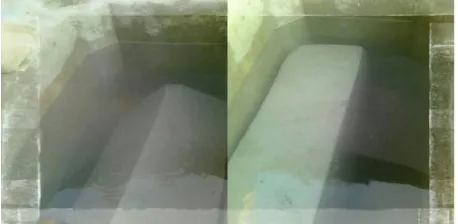
Fig 4.2
Load=2700 KN
Size of block = 600 ×200×150 mm
Compression test = load ∕ area
= (2700×10 3)/ (600×150) = 30 N/ mm 2
For solid Block
Load =1100 KN
Size of block = 400 ×150×150 mm
Compression test= load ∕ area
ISSN (Online) : 2319 - 8753
ISSN (Print) : 2347 – 6710
International Journal of Innovative Research in Science, Engineering and Technology
An ISO 3297: 2007 Certified Organization Volume 7, Special Issue 5, April 2018
1st International Conference on Recent Innovation in Civil Engineering and Management (ICRICEM '18)
22nd March 2018
Organized by
Department of Civil Engineering & MBA, Loyola Institute of Technology, Chennai, Tamilnadu, India
V.RESULT
The result of our project is shown by using the below table 5.1
TABLE 5.1 DESCRIPTION SOLID
BLOCKS
AEROCON BLOCKS
WATER ABSORTION
5.5% 9.4%
COMPRESSION TEST
19KN 30KN
The specification forresult of aerocon blocks show in table 5.1
Fig 5.1
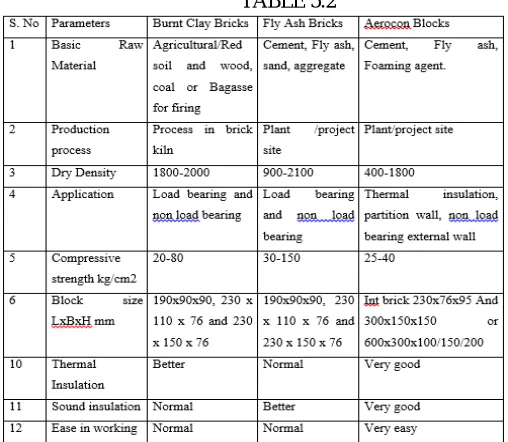
5.2 COMPARISON BETWEEN BURNT CLAY BLOCK, FLY ASH BLOCK AND AEROCON BLOCK The specification forresult of aerocon blocks show in table 5.2
ISSN (Online) : 2319 - 8753
ISSN (Print) : 2347 – 6710
International Journal of Innovative Research in Science, Engineering and Technology
An ISO 3297: 2007 Certified Organization Volume 7, Special Issue 5, April 2018
1st International Conference on Recent Innovation in Civil Engineering and Management (ICRICEM '18)
22nd March 2018
Organized by
Department of Civil Engineering & MBA, Loyola Institute of Technology, Chennai, Tamilnadu, India
VI. CONCLUSION
Aerocon block is an innovative technique for efficient block work system with many advantages over the conventional block work system.
It reduces the use of material (natural river sand and red soil) and uses the waste material (fly-ash), hence it is green construction material. Aerocon block is designed specially to build wall in as efforts have not yet been made to design Aerocon blocks.
The test results on Aerocon block are quite satisfactory and it can be used for non-load bearing exterior and interior wall. Also the light weight of Aerocon block in Rat-trap reduces the dead load on the structure and provides good thermal insulation.
Thus this Aerocon blocks has a very good future scope for its development as a commercial product.
REFERENCES
1.AgusSetyoMuntohar, (2011), Engineering characteristics of the compressed-stabilized earth brick, Construction and Building Materials, Elsevire, vol – 25, pp – 4215-4220.
2. B. V. Venkatarama Reddy, (Feb 2007), Richardson Lal, and K. S. Nanjunda Rao, Enhancing Bond Strength and Characteristics of Soil-Cement Block Masonry, Journal Of Materials In Civil Engineering, ASCE, Vol. – 19, pp – 164- 172..
3.K. B. Anand and K. Ramamurthy, (May-June 2003), Laboratory-Based Productivity Study on Alternative Masonry Systems, Journal Of Construction Engineering And Management ASCE, volume/issue-129, pp – 237-242.
4. Krishna BhavaniSiram, (Dec 2012), Cellular Light-Weight Concrete Blocks as a Replacement of Burnt Clay Bricks, International Journal of Engineering and Advanced Technology (IJEAT) ISSN: 2249 – 89
BOOKS REFERRED
1. Bhatia Gautum, “Laurie Baker – life, work & writings.” Penguin Books India Pvt. Ltd., New Delhi, 1991. 2. “National Building Code of India 1983”Bureau of Indian Standards, New Delhi.
3. IS 1077 – 1992; Common burnt clay building bricks – specification (fifth revision) 4. IS 1805 – 1987; Structural use of unreinforced masonry (third revision)
5. IS 2185 (Part 4): 2005; concrete masonry units– specification, Preformed cellular concrete block.
6. IS 2185 (Part 1&3): 2005; concrete masonry units – specification, part 1 for hollow and solid concrete blocks and Autoclaved cellular (aerated) concrete blocks.