JACKSON, RYAN EVERETT. The Influence of Transgenic Cottons Expressing One or Two Bacillus thuringiensis Proteins Against Helicoverpa zea (Lepidoptera: Noctuidae) and Factors Affecting B. t. Resistance in H. zea. (Under the direction of J. R. Bradley, Jr. and J. W. Van Duyn)
The commercialization of transgenic cottons, Gossypium hirsutum (L.), that contain a gene from the soil bacterium Bacillus thuringiensis var. kurstaki (Berliner) that encodes the Cry1Ac δ-endotoxin has provided a novel control option for certain lepidopteran pests. However, susceptibility of bollworm, Helicoverpa zea (Boddie), to these B. t. cottons has been much lower than that of tobacco budworm, Heliothis virescens (Fab.). Because control of bollworm with B. t. cottons has not been absolute compared to that of tobacco budworm, transgenic cottons expressing two B. t. proteins (Cry1Ac + Cry2Ab) have been developed to provide greater control of bollworm. To substantiate this, various field, greenhouse, and laboratory studies were designed to investigate the influence of single-gene and dual-gene B. t. cottons, Bollgard and Bollgard II, respectively, against bollworm and to
determine the elements affecting resistance evolution to the Cry1Ac and Cry2Ab δ -endotoxins. Three cotton genotypes, Bollgard, Bollgard II, and a conventional sister line, were evaluated for their comparative susceptibility against bollworm in North Carolina field studies from 1999-2001. The impact of supplemental pyrethroid oversprays for bollworm control on yield for each genotype was also evaluated. Comparisons of the three untreated genotypes averaged across three years demonstrated that both B. t. genotypes successfully reduced the percentage of terminals, squares, and bolls infested with live larvae or
revealed that the addition of a pyrethroid to conventional cotton reduced the percentage of terminals with a live larva. However, the pyrethroid-treated B. t. genotypes significantly reduced larval survival in the terminal region below that of the pyrethroid-treated
conventional variety. Averaged across insecticide regimes, the Bollgard genotype had less terminal feeding damage than the conventional variety, but more terminal damage than the Bollgard II line. Both B. t. cottons had reduced larval survival on squares and bolls and sustained less boll damage than the conventional variety; however, the Bollgard II line had significantly lower percentages of bolls infested with live larvae and less boll damage than Bollgard. Square damage was lessened by the addition of a pyrethroid to the conventional variety but square damage in the treated conventional variety remained higher than in the untreated Bollgard variety. In addition, the pyrethroid-treated Bollgard genotype exhibited a reduction in square damage below that of the untreated Bollgard, but was similar to that of pyrethroid-treated and untreated Bollgard II genotype. Pyrethroid-treated subplots of the conventional variety had significantly higher seed cotton yields than the untreated subplots in four of seven trials where bollworm numbers were high enough to cause significant yield reductions. Pyrethroid-treated and untreated subplots of Bollgard and Bollgard II genotypes produced similar yields in each year*location combination.
Results from testing only the feral strain suggested that the Bollgard II genotype was more effective than the Bollgard variety in reducing larval survival, superficial fruit damage, and fruit penetration. Results from the second 1999 greenhouse study that evaluated both a feral and a Cry1Ac-selected bollworm strain demonstrated that when averaged across bollworm strains, the Bollgard II genotype outperformed the Bollgard variety with respect to larval survival and fruit penetration by bollworm. Also, the Cry1Ac-selected bollworm strain displayed increased larval survival, superficial fruit damage, and fruit penetration as compared to the feral strain when averaged across genotypes. Results from the 2000 study confirmed 1999 results as the Bollgard II genotype significantly reduced fruit penetration by bollworm below that of the Bollgard variety when averaged across strains; however, the single Cry2Ab-producing genotype performed similarly to both Bollgard and Bollgard II with respect to fruit penetration. The Cry1Ac-selected bollworm strain displayed
significantly greater larval survival and superficial fruit damage on the Bollgard variety as compared to the feral strain, but no differences among larval strains were evident for other genotypes. Also, when averaged across genotypes, the Cry1Ac-selected bollworm strain penetrated a higher proportion of cotton fruit in comparison to the wild strain.
(L4-L5) produced per hectare below that of the Bollgard and conventional varieties. With regard to the numbers of damaged fruit per hectare, both B. t. genotypes reduced fruit damage below that of the conventional variety, and the Bollgard II line had less damaged fruit than the Bollgard variety. The numbers of adults produced per hectare were
significantly reduced by both B. t. genotypes, with no significant differences between Bollgard and Bollgard II cottons. In 2001, the numbers of larvae produced per hectare and subsequent feeding damage were dramatically reduced by both B. t. cottons, with a further reduction exhibited by the Bollgard II genotype as compared to the commercial Bollgard variety when averaged across insecticide regimes. Both pupal and adult production on a per hectare basis were significantly lowered by the two B. t. genotypes as compared to the conventional variety and averaged across insecticide regimes. No significant differences were apparent between the Bollgard and Bollgard II genotypes with regard to pupal and adult production. Averaged across genotypes, pyrethroid oversprays caused a significant reduction in larval, pupal, and adult production, as well as damaged fruit.
To determine the factors affecting resistance evolution to Cry1Ac and Cry2Ab δ– endotoxins, a laboratory experiment was designed to estimate the frequency of major B. t. resistance genes in the general bollworm population, to determine the presence and contribution of minor B. t. resistance genes, and to determine inheritance of resistance to Cry1Ac and Cry2Ab δ–endotoxins. Female bollworm moths were collected from light traps at various locations near the Tidewater Research Station in Washington Co., NC, in 2001. Progeny from these moths (lines) were screened for growth rate and survival on regular artificial diet and on diets containing 5.0 µg/ml of either Cry1Ac or Cry2Ab Bacillus
a field population of bollworms. Lines that performed within the upper and lower quartiles on each B. t. diet were reared to the adult stage and reciprocal crosses were performed to determine inheritance of resistance and the influence of maternal vigor effects on larval performance. Out of 2,244 genomes tested, none were found to possess major B. t. resistance genes. However, differences in larval growth rates among specific reciprocal crosses
BACILLUS THURINGIENSIS PROTEINS AGAINST HELICOVERPA ZEA
(LEPIDOPTERA: NOCTUIDAE) AND FACTORS AFFECTING B. T. RESISTANCE IN H. ZEA
by
RYAN EVERETT JACKSON
A dissertation submitted to the Graduate Faculty of North Carolina State University
in partial fulfillment of the requirement for the Degree of
Doctor of Philosophy
DEPARTMENT OF ENTOMOLOGY
Raleigh
2002
APPROVED BY:
______________________________ ______________________________
BIOGRAPHY
Ryan Everett Jackson was born on 12 May 1975 in Greenwood, MS. He is the older
of two children of Everett Emmons and Nancy Murphy Jackson. Ryan lived in Greenwood
until he was graduated from Greenwood High School in 1993. He attended Mississippi Delta
Community College for two years and then proceeded to Mississippi State University,
graduating in 1997 with a Bachelor of Science degree in Agricultural Pest Management.
Ryan was accepted to the graduate program in the Department of Entomology at
Mississippi State University under the direction of Dr. Henry N. Pitre. During his stay at
Mississippi State University, Ryan was married to Catherine Rogan Gillespie on 9 May
1998. Upon completion of his Master’s research, “Influence of Roundup Ready Soybean and
Roundup Ultra Herbicide on Pest and Beneficial Insects,” he received his Master of Science
degree in Entomology in 1999.
In June of 1999, Ryan and Rogan moved to North Carolina where Ryan accepted a
graduate position in entomology at North Carolina State University in pursuit of a Ph.D.
degree under the supervision of Dr. J. R. Bradley, Jr. and Dr. J. W. Van Duyn. His research
focused on the effects of Bollgard and Bollgard II cottons against bollworm, Helicoverpa
ACKNOWLEDGMENTS
I would like to express my sincere appreciation to those with whom I worked closely
for completion of my degree at North Carolina State University. First of all, I would like to
offer thanks to my major advisors, Dr. J. R. Bradley, Jr and Dr. John W. Van Duyn, for
giving me the opportunity to participate in their program. I will always have great
appreciation for the learning experience provided by them. I would also like to thank Dr.
Fred Gould and Dr. Clyde Sorenson for their knowledge, assistance and contributions toward
my research. Enough thanks cannot be given to Wayne Modlin, Andrew Summerlin, Tony
Burd, Margery Ambrose, Ryan Kurtz, Rogan Jackson, Phil Threatt, and Carlton Purvis for
technical assistance in the field and laboratory.
Finally, I would like to thank my parents for their support throughout my graduate
career. From emotional support to financial assistance, my parents have always been there
for me, and I cannot thank them enough. Most of all, I would like to thank my wife for her
unbelievable patience and support. She has been by my side for over four years and has
provided words of encouragement all along. I would like to offer her a sincere thank you for
TABLE OF CONTENTS
Page
LIST OF TABLES………...vi
LIST OF FIGURES………....…xi
I. FIELD PERFORMANCE OF BOLLGARD AND BOLLGARD II COTTON GENOTYPES AGAINST BOLLWORM, HELICOVERPA ZEA, (LEPIDOPTERA: NOCTUIDAE)………...…1
Abstract………...2
Introduction………...4
Materials and Methods………...….5
Results………...7
Discussion………...…..11
Literature Cited……….………...……...19
II. PERFORMANCE OF FERAL AND CRY1AC-SELECTED HELICOVERPA ZEA (LEPIDOPTERA: NOCTUIDAE) STRAINS ON TRANSGENIC COTTONS EXPRESSING ONE OR TWO BACILLUS THURINGIENSIS PROTEINS UNDER GREENHOUSE CONDITIONS………...………..32
Abstract………..……...……33
Introduction………..………...…..35
Materials and Methods………..…………...….36
Results………..…………...…..38
Discussion……….………...….41
III. ESTIMATED PRODUCTION OF HELICOVERPA ZEA FROM BOLLGARD AND BOLLGARD II COTTONS AND IMPLICATIONS FOR RESISTANCE
MANAGEMENT………...……….57
Abstract………..………...……58
Introduction………..………...…..59
Materials and Methods………..………...….61
Results………..………...…..63
Discussion……….………...….65
Literature Cited……….………...….71
IV. GENETIC VARIATION FOR RESISTANCE IN HELICOVERPA ZEA TO CRY1AC AND CRY2AB ENDOTOXINS………...……79
Abstract………...…..80
Introduction………...……81
Materials and Methods………...82
Results………...…84
Discussion………...…..87
LIST OF TABLES
Page Chapter I
Table 1 Mean (SE) percentage of terminals containing heliothine eggs, live
larvae, and damage for three cotton genotypes averaged across
locations and years (1999-2001) in North Carolina………...…...23
Table 2 Mean (SE) percentage of squares with live larvae or bollworm
damage averaged across locations and years (1999-2001) in
North Carolina………...…...24
Table 3 Mean (SE) percentage of bolls with live larvae (L4-L5) or
bollworm damage averaged across locations and years (1999-
2001) in North Carolina………...….25
Table 4 Mean (SE) percentage of terminals containing heliothine eggs
and damage for three cotton genotypes averaged across
pyrethroid-treated and untreated subplots and two locations in
North Carolina in 2001………..………...…………26
Table 5 Mean (SE) percentage of terminals containing live bollworm
larvae for pyrethroid-treated and untreated subplots of three
cotton genotypes averaged across two locations in North Carolina
in 2001………...…………...27
Table 6 Mean (SE) percentage of squares with a live bollworm larva for
three cotton genotypes averaged across pyrethroid-treated and
Table 7 Mean (SE) percentage of squares sustaining bollworm damage
for pyrethroid-treated and untreated subplots of three cotton
genotypes averaged across two locations in North Carolina
in 2001………...………...29
Table 8 Mean (SE) percentage of bolls containing a live bollworm larva
(L4-L5) and damage for three cotton genotypes averaged across
pyrethroid-treated and untreated subplots and two locations in
North Carolina in 2001………...…..30
Table 9 Mean yields expressed in kg seed cotton per hectare for
pyrethroid-treated and untreated subplots for each
year*location*genotype combination in North Carolina from
1999-2001………...…..31
Chapter II
Table 1 Mean (SE) percentage of bollworm larval survival, superficially
damaged fruit, and fruit penetration at seven days after infestation
averaged across two runs for three cotton genotypes at ~80 days
after planting in the greenhouse, Wake Co., NC. 1999………...…….50
Table 2 Mean (SE) percentage of bollworm larval survival at seven days
after infestation of a feral and a Cry1Ac-selected bollworm strain
onto three cotton genotypes averaged across two runs at ~100
Table 3 Mean (SE) percentage of superficially damaged fruit at seven
days after infestation of a feral and a Cry1Ac-selected bollworm
strain onto three cotton genotypes averaged across two runs at
~100 days after planting in the greenhouse, Wake Co., NC,
1999………...…………52
Table 4 Mean (SE) percentage of bollworm-penetrated fruit at seven
days after infestation of a feral and a Cry1Ac-selected bollworm
strain onto three cotton genotypes averaged across two runs at
~100 days after planting in the greenhouse, Wake Co., NC,
1999………...……….……...53
Table 5 Mean (SE) percentage of bollworm larval survival of a feral and a
Cry1Ac-selected bollworm strain within each of three cotton
genotypes averaged across two evaluation dates at ~100 days in
the greenhouse, Washington Co., NC, 2000………...…..54
Table 6 Mean (SE) percentage of superficially damaged fruit of a feral
and a Cry1Ac-selected bollworm strain within each of three
cotton genotypes averaged across two evaluation dates at ~100
days in the greenhouse, Washington Co., NC, 2000………...…….55
Table 7 Mean (SE) percentage of fruit penetration by a feral and a
Cry1Ac-selected bollworm strain for three cotton genotypes
averaged across two evaluation dates at ~100 days in the
Chapter III
Table 1 Estimated mean (SE) numbers of live bollworm larvae
(L4-L5), damaged bolls, and successfully-emerged adults
produced on a per hectare basis by untreated conventional, Bollgard, and
Bollgard II cotton genotypes averaged across three locations in
North Carolina from 2000-2001………...………74
Table 2 Estimated mean (SE) numbers of live bollworm larvae
(L4-L5) per hectare produced by conventional, Bollgard, and
Bollgard II cotton genotypes under pyrethroid-treated and untreated
conditions averaged across three sample dates in Edgecombe Co., North
Carolina in 2001………...……….75
Table 3 Estimated mean (SE) numbers of bollworm-damaged bolls per
hectare in conventional, Bollgard, and Bollgard II cotton
genotypes under pyrethroid-treated and untreated conditions
averaged across three sample dates in Edgecombe Co., North
Carolina in 2001………...………….76
Table 4 Estimated mean (SE) numbers of bollworm pupae per hectare
produced by conventional, Bollgard, Bollgard, and Bollgard II cotton
genotypes under pyrethroid-treated and untreated conditions
averaged across three sample dates in Edgecombe Co., North
Table 5 Estimated mean (SE) numbers of bollworm adults per hectare
produced by conventional, Bollgard, and Bollgard II cotton
genotypes under pyrethroid-treated and untreated conditions
averaged across three sample dates in Edgecombe Co., North
Carolina in 2001………...……….78
Chapter IV
Table 1 Ordinal rating scale for Helicoverpa zea larval instar size after
seven days on artificial diet………...………95
Table 2 Correlation coefficients and P-values for various comparisons
among bollworm families selected for larval growth and
LIST OF FIGURES
Page
Chapter IV
Figure 1 Distribution of average ratings for 7-day old larvae of Helicoverpa zea female lines on Cry1Ac, Cry2Ab, and NBT diets. Mean ratings are
approximately 4.4, 4.9, and 9.4, which correspond to a late 2nd instar,
early 3rd instar, and mid 4th instar, respectively…………...……….96
Figure 2 Correlation graphs for all comparisons among Cry1Ac, Cry2Ab, and
NBT families with average corrected ratings plotted for each
family………...…….…98
Figure 3 Correlation graph comparing percent survival for bollworm families
tested on Cry1Ac and Cry2Ab artificial diets………...…99
Figure 4 Correlation graphs for percent survival versus average corrected
ratings for families tested on Cry1Ac and Cry2Ab artificial diets……...100
Figure 5 Mean larval weight in milligrams for Helicoverpa zea resistant lines
(RxR), control lines (SxS), and reciprocal crosses between these
lines (RxS and SxR) taken after ten days on 5.0 µg/ml of Cry1Ac-
containing and Cry2Ab-containing diets, respectively…………...………101
Figure 6 Histogram showing frequency of larval weights (loge) for upper
quartile lines, lower quartile lines, and reciprocal F1 crosses between
these lines taken after ten days on 5.0 µg/ml of Cry1Ac diet. Percent
Figure 7 Histogram showing frequency of larval weights (loge) for upper
quartile lines, lower quartile lines, and reciprocal F1 crosses between
these lines taken after ten days on 5.0 µg/ml of Cry2Ab diet. Percent
survival for each group is shown on each graph………...……..103
Figure 8 Correlation graphs for average ratings for families on Cry1Ac, Cry2Ab,
CHAPTER I
FIELD PERFORMANCE OF BOLLGARD AND BOLLGARD II COTTON
GENOTYPES AGAINST BOLLWORM, HELICOVERPA ZEA,
Abstract
Two transgenic Bacillus thuringiensis var. kurstaki (Berliner) cottons, Bollgard
(Monsanto Agric. Co., St. Louis, MO) and Bollgard II, along with the conventional sister line, were evaluated for their comparative susceptibility against bollworm, Helicoverpa zea
(Boddie), in North Carolina field studies from 1999-2001. Field studies were designed to determine if the Bollgard II genotype exhibited an increased efficacy against bollworm compared to its commercial Bollgard sister line. The impact of supplemental pyrethroid oversprays for bollworm control on yield for each genotype was also evaluated.
Comparisons of the three untreated genotypes averaged across three years demonstrated that both B. t. genotypes successfully reduced the percentage of terminals, squares, and bolls infested with live larvae or subsequent damage as compared to the conventional variety. The Bollgard II line had fewer bolls infested with live larvae and less terminal, square, and boll damage compared to the commercial Bollgard variety. Comparisons of pyrethroid-treated and untreated genotypes revealed that the addition of a pyrethroid to conventional cotton reduced the percentage of terminals with a live larva. However, the pyrethroid-treated B. t.
genotypes significantly reduced larval survival in the terminal region below that of the pyrethroid-treated conventional variety. Averaged across insecticide regimes, the Bollgard genotype had less terminal feeding damage than the conventional variety, but more terminal damage than the Bollgard II line. Both B. t. cottons had reduced larval survival on squares and bolls and sustained less boll damage than the conventional variety; however, the
The availability of transgenic Bollgard cottons that contain a gene from the soil
bacterium Bacillus thuringiensis var. kurstaki that encodes for the Cry1Ac δ-endotoxin has
provided a novel alternative for management of certain lepidopteran pests. Two major lepidopteran pests of cotton in North Carolina that are affected by this technology are the bollworm, Helicoverpa zea (Boddie), and the tobacco budworm, Heliothis virescens (Fab.). Although control of tobacco budworm with transgenic cottons has been absolute, bollworm susceptibility to the Cry1Ac protein has been much lower and considerably more variable. For example, Cry1Ac LC50 values for bollworm populations were 4 to 60 times higher than
those of tobacco budworm populations (Stone and Sims 1993). Field trials conducted in North Carolina confirmed that supplemental insecticide oversprays were frequently required to achieve satisfactory bollworm control and avoid yield reductions in Bollgard cottons (Lambert et al. 1996, 1997; Mahaffey et al. 1994, 1995). Survival of a portion of the bollworm population on Bollgard cottons may also be partially explained by the significant drop in the average levels of Cry1Ac protein in cotton fruit at approximately 80 days after planting (Greenplate 1999; Greenplate et al. 2001), which is coincident with the major bollworm flight into North Carolina cotton. Bollworm survival on Bollgard cottons is not only an economic problem, but also causes concern for resistance evolution; thus, further advances in B. t. cotton technology to decrease bollworm survival are needed to address these problems.
Adamczyk et al. 2001). With the probable increased field control of bollworm due to the additional Cry toxin as compared to Bollgard varieties, Bollgard II cottons may be the new standards with respect to control of heliothines in cotton. Furthermore, they are expected to delay B. t. resistance evolution in bollworm.
Reported herein are the results of field studies designed to evaluate Bollgard and Bollgard II cottons for performance against bollworm and for agronomic productivity as measured by yield under North Carolina conditions.
Materials and Methods
Field studies were conducted at the Upper Coastal Plain Research Station,
Edgecombe Co., NC, in 1999-2001; the Tidewater Research Station, Washington Co., NC, in 1999-2000; the Central Crops Research Station, Johnston Co., NC, in 2000; and at C. A. Martin Farm, Martin Co., NC, in 1999. Each test site represented a randomized complete split-plot design with four replicates. Whole plots consisted of cotton genotypes and subplots were unsprayed or sprayed with a pyrethroid insecticide. Whole plots were 12 rows by 45ft in 1999, but were 16, 20, and 24 rows by 50ft for DP50 (conventional), DP50B (Bollgard), and DP50BX (Bollgard II) genotypes, respectively, in 2000-2001. Area designated to whole plots for each genotype varied in order to increase the probability of collecting large
bollworm larvae from Bollgard and Bollgard II lines. Subplots consisted of various numbers of unsprayed rows and 4 rows that were treated with a pyrethroid as needed for supplemental bollworm control.
2001. Aldicarb (Temik 15 G, Aventis CropScience, Research Triangle Park, NC) was
applied in-furrow at planting at 0.84 kg a. i./hectare for control of early season insect pests in each test. Acephate (Orthene 97 PE, Valent USA Corp., Walnut Creek, CA) was applied at
0.84 kg a. i./hectare as a mid-season overspray for control of tarnished plant bugs and stink bugs and to eliminate arthropod natural enemies. Supplemental bollworm control within appropriate subplots was accomplished by applications of cypermethrin (Ammo 2.5 EC,
FMC Corp., Philadelphia, PA), lambda cyhalothrin (Karate Z 2.08 CS, Syngenta Crop
Protection, Inc., Greensboro, NC), or cyfluthrin (Baythroid 2 2.0 EC, Bayer Corp., Kansas
City, MO). Pyrethroid applications consisting of cypermethrin at 0.112 kg a. i./hectare and lambda cyhalothrin at 0.045 kg a. i./hectare were sprayed at Martin Co. (4 and 16 August, respectively) and at Washington Co. (6 and 19 August, respectively), whereas cyfluthrin at 0.056 kg a. i./hectare was sprayed at Edgecombe Co. (5 August) in 1999. Lambda
cyhalothrin at 0.045 kg a. i./hectare was applied to appropriate subplots for supplemental bollworm control at Johnston and Edgecombe counties (19 July and 7 August) and at Washington Co. (27 July and 9 August) in 2000, as well as at Edgecombe Co. (10 and 16 August) in 2001. Weed control, fertilization, plant growth regulation, and defoliation followed the recommendations of the North Carolina Cooperative Extension Service.
lengths of the two middle rows of each subplot using a mechanical cotton picker. Yields were converted to kg seed cotton/ha prior to analysis.
All egg, live bollworm larvae, and damaged fruit numbers were converted to
percentages and subjected to arcsine square root transformation prior to analysis. These data, along with yield data, were then subjected to ANOVA using PROC GLM (SAS Institute 1990), and means for each treatment were separated (P<0.05) using Fisher’s Protected Least Significant Difference test in SAS.
Results
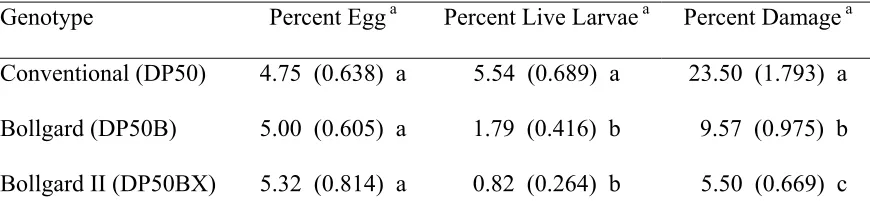
Heliothine egg deposition onto cotton terminals was consistent as no differences were found among the three untreated cotton genotypes averaged across three seasons (F=0.05; df=2, 10; P=0.9498) (Table 1). With respect to the percentage of terminals containing a live bollworm larva, both B. t. genotypes outperformed the conventional variety by significantly reducing larval numbers in the terminal region (F=37.30; df=2, 10; P<0.0001) (Table 1). Bollgard and Bollgard II genotypes reduced the percentage of terminals containing a live larva by 3X and 7X, respectively, as compared to the conventional variety, with no differences evident between B. t. genotypes. The percentage of terminals sustaining
The percentage of squares containing a live bollworm larva was significantly reduced by both Bollgard genotypes as compared with the conventional variety, with no significant differences among B. t. lines (F=121.79; df=2, 10; P<0.0001) (Table 2). Both Bollgard genotypes significantly lowered the percentage of squares sustaining bollworm damage as compared to the conventional variety (F=180.63; df=2, 10; P<0.0001) (Table 2); however, as with terminal ratings, the percentage of squares suffering damage by bollworm was
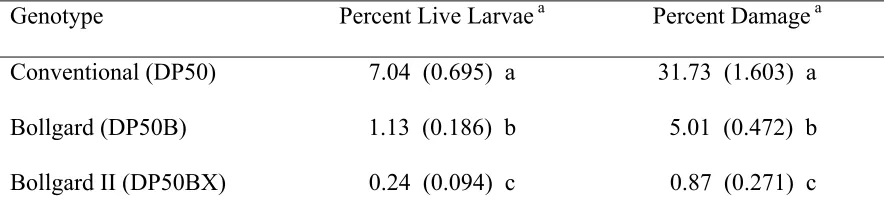
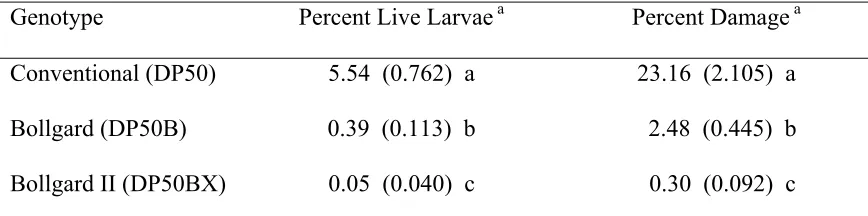
significantly reduced by the Bollgard II genotype as compared to the Bollgard variety. The reduction in the percentage of squares containing a live larva was ~10X for both Bollgard lines, while the percentage of squares sustaining damage was reduced 5X and 10X for Bollgard and Bollgard II genotypes, respectively, as compared to the conventional variety. Both B. t. genotypes significantly reduced the percentage of bolls with a late-instar (L4-L5) larva (F=65.80; df=2, 10; P<0.0001) and bollworm damage (F=113.60; df=2, 10;
P<0.0001) as compared to the conventional variety (Table 3). Bollgard II further reduced the percentage of bolls with a live larva and damage below that of the Bollgard variety. The percentage of bolls containing a live larva was reduced 6X and 29X by Bollgard and Bollgard II genotypes, respectively, as compared to the conventional variety. The Bollgard and Bollgard II genotypes reduced the percentage of bolls with bollworm damage below that of the conventional variety by 6X and 37X, respectively.
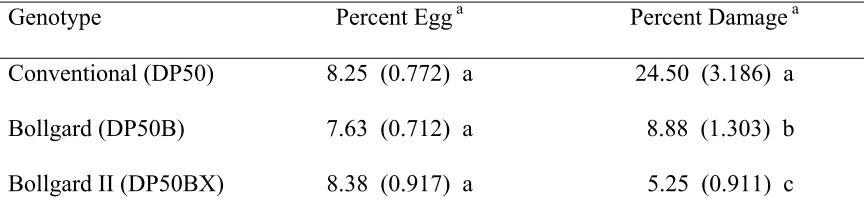
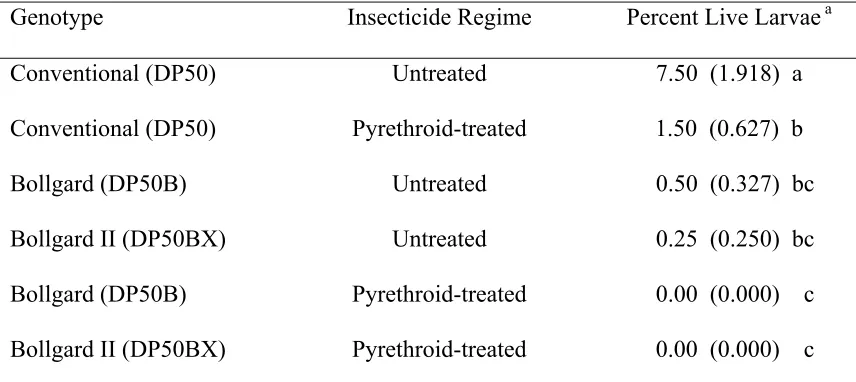
live larva (F=31.35; df=2, 2; P=0.0309). Seven and one-half percent of the terminals in the untreated conventional variety were infested with live bollworm larvae. The percentage of cotton terminals with live larvae was reduced to 1.5% by applying a pyrethroid insecticide to the conventional cotton variety. The pyrethroid-treated conventional variety was similar to the untreated Bollgard and Bollgard II genotypes in the percentage of terminals infested with larvae, but significantly differed from the pyrethroid-treated Bollgard and Bollgard II lines. No significant differences were evident among the pyrethroid-treated and untreated Bollgard genotype with regard to the percentage of terminals with live larvae. Differences in terminal damage among treatment combinations were significantly influenced by the various cotton genotypes averaged across insecticide treatments and locations (F=84.17; df=2, 2; P=0.0117) (Table 4). The conventional variety sustained 24.5% bollworm damage to cotton terminals; however, terminal damage caused by bollworm larvae was significantly reduced to 8.9% and 5.3% by Bollgard and Bollgard II genotypes, respectively. The commercial Bollgard variety lowered terminal damage by 64% compared to the conventional variety; the Bollgard II line reduced terminal damage by 79% versus the conventional variety and 40% versus the Bollgard variety.
The percentage of squares containing a live bollworm larva was significantly reduced by both B. t. genotypes when compared to the conventional variety (F=19.09; df=2, 2;
P=0.0498) (Table 6). No statistical differences were detected between B. t. lines with respect to the percentage of squares infested with a live larva. However, Table 7 illustrates a
overspray. The untreated Bollgard variety sustained approximately half as much damage as the pyrethroid-treated conventional variety. As with the pyrethroid-treated and untreated conventional variety, a pyrethroid overspray to the Bollgard genotype significantly lowered the percentage of squares with bollworm damage when compared to the untreated Bollgard variety. However, no differences were evident between the pyrethroid-treated and untreated Bollgard II lines with respect to the percentage of squares sustaining bollworm damage. Also, no statistical differences were found among the untreated Bollgard II genotype and the pyrethroid-treated Bollgard and Bollgard II lines with regard to the percentage of squares with bollworm feeding damage.
0.3% by Bollgard II lines, a 99% and 88% reduction when averaged across insecticide regimes and compared to the conventional and Bollgard varieties, respectively.
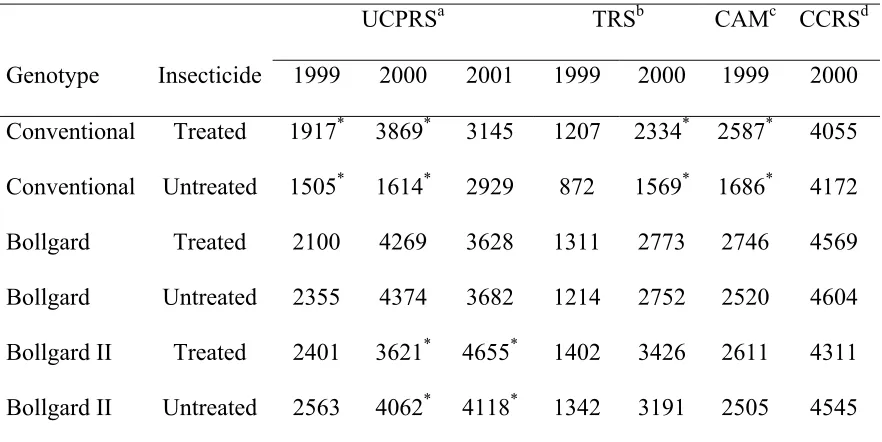
A significant year*location*genotype*insecticide (F=8.30; df=12, 42; P<0.0001) interaction characterized 1999-2001 yield data; therefore, yields expressed in kg
seedcotton/ha for pyrethroid-treated and untreated subplots are shown for each
year*location*genotype combination in Table 9. Yields in pyrethroid-treated subplots of the conventional variety were significantly higher than the untreated subplots in 1999 at C. A. Martin Farms (F=25.78; df=1, 42; P<0.0001) and the Upper Coastal Plain Research Station (F=5.39; df=1, 42; P=0.0237). In 2000, treated subplots produced higher yields than the untreated subplots of the conventional variety at the Tidewater (F=18.61; df=1, 42;
P<0.0001) and Upper Coastal Plain Research Stations (F=161.46; df=1, 42; P<0.0001). Pyrethroid-treated and untreated subplots of Bollgard and Bollgard II genotypes produced similar yields in each year*location combination.
Discussion
Low to moderate bollworm numbers characterized the 1999-2001 field seasons in North Carolina; thus, numbers of eggs, live larvae, and damaged fruit were representative of infestation levels typically encountered in the region. Distribution of heliothine eggs in the terminal region of cotton plants was uniform across test sites averaged across three years, since oviposition has not been affected by B. t. cottons (Lambert et al. 1996, 1997). The percentages of terminals containing a live larva and subsequent damage were significantly reduced by Bollgard and Bollgard II genotypes below that of the conventional variety. Although no differences were detected between B. t. genotypes with respect to larval
variety. Perhaps larval survival was similar between Bollgard genotypes because the Cry endotoxins for each are expressed at a high level in the youngest tissues of the terminals (Greenplate et al. 2000a). Therefore, bollworm larvae feeding on either B. t. genotype would likely ingest a high level of Cry endotoxin(s) leading either to larval death or movement from the terminal region (Gore et al. 2001). On the contrary, a significant decrease in terminal damage was demonstrated by the Bollgard II genotype as compared to the Bollgard variety. These results apparently occurred because less Bollgard II terminal tissue must be consumed compared to the Bollgard variety for larvae to acquire either a repellent or toxic dose of the Cry proteins.
Both B. t. genotypes reduced the percentage of bolls with a live bollworm larva or feeding damage below that of the conventional variety over the three-year period. As with terminal and square damage, both larval survival and damage on bolls were lower in the Bollgard II line than in the Bollgard variety. Reduced larval survival and damage on bolls in Bollgard II cottons may be explained by the overall increase (3.5X) in lepidopteran activity for the dual gene technology as compared to the single toxin varieties as demonstrated by Penn et al. (2001). Farrar and Bradley (1985) demonstrated that the majority of bollworm eggs are deposited within the upper one-third of the plant canopy and larval movement down the plant proceeds with larval age. Gore et al. (2001) reported that larval movement in B. t.
cottons was increased above that of conventional varieties; as young larvae move down the plant, they feed briefly on leaves and squares. With the increased lepidopteran activity demonstrated by Bollgard II lines, a significantly higher proportion of larvae apparently die before reaching the size necessary to feed on bolls. Thus, it was expected that the percentage of bolls infested and boll damage would be less in Bollgard II than in the Bollgard variety.
In 2001, both pyrethroid-treated and untreated subplots within each genotype were sampled to quantify egg and larval populations, as well as terminal and fruit damage. Heliothine egg deposition in the terminal region was consistent across all treatment combinations of genotype and insecticide regime. However, a genotype*insecticide interaction occurred for the percentage of terminals with a live larva. The untreated
pyrethroid-treated B. t. genotypes further reduced the percentage of terminals with a live larva below that of the pyrethroid-treated conventional variety. Since pyrethroid oversprays are very effective against bollworm (Bradley 1996), especially larvae located in the terminal region, it was expected that the pyrethroid-treated conventional variety would exhibit similar levels of larval survival to that of the untreated B. t. genotypes. However, the combination of the B. t.
genotypes and the pyrethroid-oversprays eliminated surviving larvae in the cotton terminals. The percentage of terminals sustaining bollworm damage was characterized by a genotype effect and was significantly reduced by both Bollgard genotypes below that of the
conventional cotton when averaged across insecticide regimes. Bollgard II cottons further diminished the level of terminal damage as compared to the Bollgard variety. The reduction in terminal damage demonstrated by the Bollgard II genotype can be explained by the increased toxin production as compared to the Bollgard variety.
genotype, sustained even lesser amounts of square damage. Unlike larval survival in the terminal region, the untreated Bollgard variety significantly reduced the percentage of squares sustaining bollworm feeding damage below that of the pyrethroid-treated conventional variety. The difference may have been a result of reduced coverage of the pyrethroid overspray on squares compared to that in the exposed terminal region. A reduction in coverage could have resulted in some squares having little to no insecticide, whereas, the Bollgard varieties produced its internal insecticide in every square on the plant. Coverage with the pyrethroid-overspray, however, was sufficient enough to reduce the percentage of squares with damage in the pyrethroid-treated Bollgard variety compared to that of the untreated Bollgard. A portion of the susceptible bollworm larvae, as well as those that may carry B. t. resistance alleles, have demonstrated the ability to complete larval development on Bollgard cottons because Bollgard varieties do not express a “high dose” of Cry1Ac endotoxin with respect to the level necessary to prevent resistance development (Scientific Advisory Panel 1998). Therefore, survivors in the untreated Bollgard cottons could have caused feeding damage to squares, whereas, most larvae surviving the Cry1Ac toxin in the pyrethroid-treated Bollgard variety would have been eliminated by the pyrethroid overspray. Moreover, the addition of a second Cry endotoxin in the Bollgard II genotype appeared to have the same effect in the reduction of square damage as the pyrethroid overspray to the Bollgard genotype.
Both larval survival and subsequent boll damage were significantly reduced by both
B. t. genotypes in 2001; however, the Bollgard II genotype had lower larval survival and
overall increase (3.5X) in lepidopteran activity for the dual gene cottons as compared to the single toxin varieties as demonstrated by Penn et al. (2001).
Pyrethroid-treated subplots of the conventional variety out-yielded the untreated subplots with respect to kg seed cotton/ha in 1999 at C. A. Martin Farms and the Upper Coastal Plain Research Station. In 2000, treated subplots again out-produced the untreated subplots of the conventional variety at the Tidewater and Upper Coastal Plain Research Stations. Year*location combinations where the pyrethroid-treated subplots yielded higher than the untreated subplots were those subjected to moderate or moderately high bollworm numbers. Conversely, year*location combinations with no evident differences between pyrethroid-treated and untreated conventional subplots occurred under conditions of low or moderately low numbers of bollworm.
Pyrethroid-treated and untreated subplots of Bollgard and Bollgard II genotypes produced similar yields in each year*location combination due to the low numbers of survivors within each B. t. genotype*insecticide regime combination. Yield differences between pyrethroid-treated and untreated Bollgard II cottons at the UCPRS in 2000 were due to inefficiencies in harvest methods that were complicated by high seed cotton yields;
agroecosystem are thought to have influenced a reduction in the mean abundance of
bollworm; among these are a decrease in corn acreage, an increase in cotton acreage, and the planting of Bollgard cotton to >50% of the total cotton acreage in the 2000 and 2001 seasons.
Results from these studies cast doubts on the added value of Bollgard II cottons to the farmers since Bollgard provides absolute control of tobacco budworm and adequate
bollworm control, particularly when oversprayed with a pyrethroid. Bacheler (unpublished data) reported that Bollgard fields averaged 0.99 late-season applications with insecticides active against bollworm in 2001. The apparent value of Bollgard II is its potential to delay resistance evolution in heliothines. While we did not measure yield differences between Bollgard and Bollgard II in this three-year study, there were reductions in numbers of
surviving bollworms in Bollgard II. Survival of bollworm larvae in the Bollgard II genotype was negligible, particularly when oversprayed with a pyrethroid.
Acknowledgments
Literature Cited
Adamczyk, J. J., Jr., K. Bew, L. C. Adams, and D. D. Hardee. 2001. Evaluation of
Bollgard (cv. DP50BII) in the Mississippi delta: field efficacy against various Lepidoptera while profiling season-long expression of cry1Ac and cry2Ab. p. 835-836. In Proc.
Beltwide Cotton Conf., Anaheim, CA. 9-13 Jan. 2001. Natl. Cotton Counc. Am., Memphis, TN.
Bradley, J. R., Jr. 1996. Major developments in management of insect and mite pests in cotton. pp. 1-13. In: E. G. King, J. R. Phillips and R. T. Coleman (eds.) The Cotton Foundation. Memphis, TN.
Farrar, R. R., Jr., and J. R. Bradley, Jr. 1985. Within-plant distribution of Heliothis spp. (Lepidoptera: Noctuidae) eggs and larvae on cotton in North Carolina. Env. Entomol. 14: 205-209.
Gore, J., B. R. Leonard, D. R. Cook, and R. H. Jones. 2001. Dispersal of bollworm larvae
on Bollgard and non-Bollgard cotton cultivars. p. 851-854. In Proc. Beltwide Cotton
Conf., Anaheim, CA. 9-13 Jan. 2001. Natl. Cotton Counc. Am., Memphis, TN.
Greenplate, J. T., S. R. Penn, J. W. Mullins, and M. Oppenhuizen. 2000a. Seasonal cry1Ac levels in DP50B; the “Bollgard basis for Bollgard II.” 2000. p. 1039-1040. In Proc. Beltwide Cotton Conf., San Antonio, TX. 4-8 Jan. 2000. Natl. Cotton Counc. Am., Memphis, TN.
Greenplate, J. T., S. R. Penn, Z. Shappley, M. Oppenhuizen, J. Mann, B. Reich, and J. Osborn. 2000b. Bollgard II efficacy: quantification of total lepidopteran activity in a 2-gene product. p. 1041-1043. In Proc. Beltwide Cotton Conf., San Antonio, TX. 4-8 Jan. 2000. Natl. Cotton Counc. Am., Memphis, TN.
Greenplate, J. T., W. Mullins, S. R. Penn, and K. Embry. 2001. Cry1Ac levels in candidate commercial Bollgard varieties as influenced by environment, variety, and plant age: 1999
gene equivalency field studies. p. 790-793. In Proc. Beltwide Cotton Conf., Anaheim, CA. 9-13 Jan. 2001. Natl. Cotton Counc. Am., Memphis, TN.
Lambert, A. L., J. R. Bradley, Jr., and J. W. Van Duyn. 1996. Effects of natural enemy conservation and planting date on the susceptibility of Bt cotton to Helicoverpa zea in North Carolina. p. 931-935. In Proc. Beltwide Cotton Conf., Nashville, TN. 9-12 Jan. 1996. Natl. Cotton Counc. Am., Memphis, TN.
Mahaffey, J. S., J. S. Bacheler, J. R. Bradley, Jr., and J. W. Van Duyn. 1994. Performance of Monsanto’s transgenic B.t. cotton against high populations of lepidopterous pests in North Carolina. p. 1061-1063. In Proc. Beltwide Cotton Conf., San Diego, CA. 5-8 Jan. 1994. Natl. Cotton Counc. Am., Memphis, TN.
Mahaffey, J. S., J. R. Bradley, Jr., and J. W. Van Duyn. 1995. B. t. cotton: field performance in North Carolina under conditions of unusually high bollworm populations. p. 795-798. In
Proc. Beltwide Cotton Conf., San Antonio, TX. 4-7 Jan. 1995. Natl. Cotton Counc. Am., Memphis, TN.
Penn, S. R., B. Reich, J. Osborn, K Embry, and J. T. Greenplate. 2001. Quantification of lepidopteran activity in a 2-gene product: a 2-year summary of Bollgard II. p. 830-832. In
Proc. Beltwide Cotton Conf., Anaheim, CA. 9-13 Jan. 2001. Natl. Cotton Counc. Am., Memphis, TN.
SAS Institute. 1990. SAS/STAT User’s Guide, Vol. 2. SAS Institute, Cary, NC, 795 pp.
Stone, T. B., and S. R. Sims. 1993. Geographic susceptibility of Heliothis virescens and
Helicoverpa zea (Lepidoptera: Noctuidae) to Bacillus thuringiensis. J. Econ. Entomol. 86:
Table 1. Mean (SE) percentage of terminals containing heliothine eggs, live larvae, and damage for three cotton genotypes averaged across locations and years (1999-2001) in North Carolina.
Genotype Percent Egg a Percent Live Larvae a Percent Damage a
Conventional (DP50) 4.75 (0.638) a 5.54 (0.689) a 23.50 (1.793) a Bollgard (DP50B) 5.00 (0.605) a 1.79 (0.416) b 9.57 (0.975) b Bollgard II (DP50BX) 5.32 (0.814) a 0.82 (0.264) b 5.50 (0.669) c
a/ Means within the same column followed by the same letter are not significantly different
Table 2. Mean (SE) percentage of squares with live larvae or bollworm damage averaged across locations and years (1999-2001) in North Carolina.
Genotype Percent Live Larvae a Percent Damage a Conventional (DP50) 5.89 (0.517) a 21.58 (2.318) a Bollgard (DP50B) 0.59 (0.167) b 4.05 (0.576) b Bollgard II (DP50BX) 0.56 (0.262) b 2.28 (0.760) c
a/ Means within the same column followed by the same letter are not significantly different
Table 3. Mean (SE) percentage of bolls with live larvae (L4-L5) or bollworm damage averaged across locations and years (1999-2001) in North Carolina.
Genotype Percent Live Larvae a Percent Damage a Conventional (DP50) 7.04 (0.695) a 31.73 (1.603) a Bollgard (DP50B) 1.13 (0.186) b 5.01 (0.472) b Bollgard II (DP50BX) 0.24 (0.094) c 0.87 (0.271) c
a/ Means within the same column followed by the same letter are not significantly different
Table 4. Mean (SE) percentage of terminals containing heliothine eggs and damage for three cotton genotypes averaged across pyrethroid-treated and untreated subplots and two locations in North Carolina in 2001.
Genotype Percent Egg a Percent Damage a
Conventional (DP50) 8.25 (0.772) a 24.50 (3.186) a Bollgard (DP50B) 7.63 (0.712) a 8.88 (1.303) b Bollgard II (DP50BX) 8.38 (0.917) a 5.25 (0.911) c
a/ Means within the same column followed by the same letter are not significantly different
Table 5. Mean (SE) percentage of terminals containing live bollworm larvae for pyrethroid-treated and unpyrethroid-treated subplots of three cotton genotypes averaged across two locations in North Carolina in 2001.
Genotype Insecticide Regime Percent Live Larvae a
Conventional (DP50) Untreated 7.50 (1.918) a
Conventional (DP50) Pyrethroid-treated 1.50 (0.627) b
Bollgard (DP50B) Untreated 0.50 (0.327) bc
Bollgard II (DP50BX) Untreated 0.25 (0.250) bc Bollgard (DP50B) Pyrethroid-treated 0.00 (0.000) c Bollgard II (DP50BX) Pyrethroid-treated 0.00 (0.000) c
a/ Means within the same column followed by the same letter are not significantly different
Table 6. Mean (SE) percentage of squares with a live bollworm larva for three cotton genotypes averaged across pyrethroid-treated and untreated subplots and two locations in North Carolina in 2001.
Genotype Percent Live Larvae a
Conventional (DP50) 4.50 (1.103) a
Bollgard (DP50B) 0.25 (0.171) b
Bollgard II (DP50BX) 0.00 (0.000) b
a/ Means within the same column followed by the same letter are not significantly different
Table 7. Mean (SE) percentage of squares sustaining bollworm damage for pyrethroid-treated and unpyrethroid-treated subplots of three cotton genotypes averaged across two locations in North Carolina in 2001.
Genotype Insecticide Regime Percent Damage a
Conventional (DP50) Untreated 45.25 (3.272) a Conventional (DP50) Pyrethroid-treated 14.00 (1.363) b
Bollgard (DP50B) Untreated 7.25 (2.505) c
Bollgard (DP50B) Pyrethroid-treated 1.25 (0.648) d Bollgard II (DP50BX) Untreated 0.50 (0.327) d Bollgard II (DP50BX) Pyrethroid-treated 0.25 (0.250) d
a/ Means within the same column followed by the same letter are not significantly different
Table 8. Mean (SE) percentage of bolls containing a live (L4-L5) bollworm larva and
damage for three cotton genotypes averaged across pyrethroid-treated and untreated subplots and two locations in North Carolina in 2001.
Genotype Percent Live Larvae a Percent Damage a
Conventional (DP50) 5.54 (0.762) a 23.16 (2.105) a Bollgard (DP50B) 0.39 (0.113) b 2.48 (0.445) b Bollgard II (DP50BX) 0.05 (0.040) c 0.30 (0.092) c
a/ Means within the same column followed by the same letter are not significantly different
Table 9. Mean yields expressed in kg seed cotton per hectare for pyrethroid-treated and untreated subplots for each year*location*genotype combination in North Carolina from 1999-2001.
UCPRSa TRSb CAMc CCRSd
Genotype Insecticide 1999 2000 2001 1999 2000 1999 2000 Conventional Treated 1917* 3869* 3145 1207 2334* 2587* 4055 Conventional Untreated 1505* 1614* 2929 872 1569* 1686* 4172
Bollgard Treated 2100 4269 3628 1311 2773 2746 4569
Bollgard Untreated 2355 4374 3682 1214 2752 2520 4604 Bollgard II Treated 2401 3621* 4655* 1402 3426 2611 4311 Bollgard II Untreated 2563 4062* 4118* 1342 3191 2505 4545
*/ Indicates a significant difference between treated and untreated subplots for a given
genotype according to the LSMeans procedure (P<0.05).
a/ Upper Coastal Plain Research Station, Edgecombe Co., NC. b/ Tidewater Research Station, Washington Co., NC.
c/ C. A. Martin Farms, Martin Co., NC.
CHAPTER II
PERFORMANCE OF FERAL AND CRY1AC-SELECTED HELICOVERPA ZEA
(LEPIDOPTERA: NOCTUIDAE) STRAINS ON TRANSGENIC COTTONS
EXPRESSING ONE OR TWO BACILLUS THURINGIENSIS
SSP. KURSTAKI PROTEINS UNDER
Abstract
Bollgard(Monsanto Co., St. Louis, MO) and Bollgard II cottons that express either
one or two Bacillus thuringiensis (Berliner) proteins, respectively, were evaluated along with either the conventional sister line or a B. t. line expressing only the Cry2Ab endotoxin in 1999-2000 North Carolina greenhouse experiments for efficacy against either a feral strain of bollworm, Helicoverpa zea (Boddie), or both a feral and a Cry1Ac-selected bollworm strain. Efficacy of Bollgard II and Bollgard cottons was determined for both strains in 1999. In 2000, a greenhouse study was designed to compare the efficacy of three transgenic cottons expressing either the Cry1Ac endotoxin alone, the Cry2Ab endotoxin alone, or both the Cry1Ac and Cry2Ab endotoxins against a feral and a Cry1Ac-selected bollworm strain. Results from testing only the feral strain suggested that the Bollgard II genotype was more effective than the Bollgard variety in reducing larval survival, superficial fruit damage, and fruit penetration. Results from the second 1999 greenhouse study evaluating both a wild and a Cry1Ac-selected bollworm strain demonstrated that when averaged across bollworm strains, the Bollgard II genotype significantly reduced larval survival and fruit penetration by bollworm compared to the Bollgard variety. Also, the Cry1Ac-selected bollworm strain displayed increased larval survival, superficial fruit damage, and fruit penetration compared to the feral strain when averaged across genotypes. Results from the 2000 study confirmed 1999 results as the Bollgard II genotype significantly reduced fruit penetration by bollworm below that of the Bollgard variety when averaged across strains; however, the single
Transgenic cottons that produce the Cry1Ac endotoxin derived from Bacillus
thuringiensis ssp. kurstaki Berliner have been widely planted since the 1996
commercialization of Bollgard (Monsanto Agric. Co., St. Louis, MO) cotton varieties. These cottons have provided producers with an unique, innovative, and environmentally sound method of insect pest management where heliothines such as tobacco budworm,
Heliothis virescens (Fab.), and bollworm, Helicoverpa zea (Boddie), are prevalent pests.
However, recent laboratory and field studies have demonstrated that these Cry1Ac-based transgenic cottons do not provide absolute control of the bollworm and that supplemental insecticide oversprays are often required on these cottons to prevent yield losses (Burd et al. 1999; Lambert et al. 1996, 1997; Mahaffey et al. 1994, 1995). With the knowledge that Bollgard cottons are not “high dose” with respect to bollworm, many scientists have
developed concern for resistance evolution to this technology in bollworm (Tabashnik 1994; Gould 1998).
Obviously, higher efficacy B. t. cottons would better suit resistance management strategies as compared to current, single toxin Bollgard varieties.
The current study evaluates the efficacy of Bollgard II cottons producing two
endotoxins, Cry1Ac and Cry2Ab, and the commercial, single-toxin Bollgard variety against feral and Cry1Ac-selected strains of bollworm.
Materials and Methods
Two greenhouse studies were conducted in greenhouse chambers at North Carolina State University, Wake Co., NC, in 1999, and a single study at the Tidewater Research Station, Washington Co., NC, in 2000. Each experiment was a randomized complete block design with 5 and 7 replicates in 1999 and 2000, respectively. In the first 1999 experiment, replicates consisted of two plants per cotton genotype. For the second 1999 experiment and the 2000 experiment, replicates included two plants per treatment combination of cotton genotype and bollworm strain. Distance between plants within blocks was 0.61 meters, whereas, blocks were separated by a 0.91-m space on tables.
Cotton genotypes consisting of conventional (DP50), Bollgard (DP50B), and Bollgard II (DP50BX) were planted in 1999. In 2000, however, a conventional genotype was not used; instead, a genotype expressing the Cry2Ab endotoxin alone (DP50X) was used in place of the conventional variety in combination with Bollgard and Bollgard II cottons. Cotton genotypes were planted on 29 June in 1999, and 27 June in 2000, into 11.36-liter pots containing BC5s (Bio-Comp, Inc., Edenton, NC) planting medium at one plant per pot.
Aldicarb (Temik 15 G, Aventis CropScience, Research Triangle Park, NC) was applied at
and whiteflies. Fertilization was accomplished through the application of Peters
Professional 20-10-20 water soluble fertilizer at the rate of 200 ppm as needed throughout
plant growth.
Feral female bollworms were collected from light traps at various locations in eastern North Carolina. Females were placed individually into 0.3-ml clear plastic cups covered with cheesecloth as a substrate for oviposition. Moths were held in the laboratory at 27oC and cheesecloths were checked daily for the presence of eggs. Neonate larvae derived from the field-collected bollworm strain were tested alone on the various cotton genotypes in the first study, but served as the control strain in the second study in 1999, as well as in 2000.
A Cry1Ac-selected laboratory strain of bollworm was originally collected from a Cry1Ab-producing sweet corn hybrid at the Tidewater Research Station, Washington Co., NC, and Central Crops Research Station, Johnston Co., NC. Sampling for bollworm larvae consisted of collecting corn ears from randomly selected plants throughout a given field. Ears were then examined for surviving third-stage or larger larvae; this criterion was used to increase the probability of recovering bollworm larvae carrying resistance alleles. Larvae were transported to the laboratory and selected for tolerance to the Cry1Ac protein (MVP,
Mycogen Corp., San Diego, CA) in artificial diet for thirteen generations in 1999, and for 2 generations in 2000 (Burd et al. 2000). The Cry1Ac-selected colonies were maintained at rearing facilities at North Carolina State University at 27-30oC, 55-60% relative humidity, and a photoperiod of 14:10 (L: D) h. Both the 1999 and 2000 Cry1Ac-selected strains exhibited ~100-fold resistance compared to the feral strain. Neonate larvae from the
Five neonate larvae were introduced onto fruiting structures on each cotton plant using a fine-haired artist paint brush when plants reached 80 days in the first 1999 study, and 100 days in the second 1999 study and the 2000 experiment. Assessments of surviving larvae and fruit damage were made by examining whole plants at 7 days after infestation in 1999, and at 14 and 21 days after infestation in 2000. Each fruiting structure on each plant was given a damage rating of no damage, superficial damage (no penetration of carpal wall), or fruit penetration.
Surviving larvae and damage numbers were converted to percentages and transformed using arcsine prior to analysis. Data were then subjected to ANOVA using PROC GLM (SAS Institute 1990), and treatment means were separated (P<0.05) using Fisher’s Least Significant Difference test.
Results
The percentage of surviving larvae from the feral bollworm strain was significantly lowered by both Bollgard genotypes as compared to the conventional variety in 1999 (F=112.55; df=2, 16; P<0.0001) (Table 1). Larval survival at seven days after infestation was high (47.4%) on the conventional cotton variety; however, only 6% of the larval cohort survived on the Bollgard cotton, and no larvae were living on the Bollgard II genotype.
The percentage of fruit sustaining superficial bollworm damage was similar for the conventional and Bollgard varieties, but was significantly reduced by the Bollgard II genotype (F=9.17; df=2, 16; P=0.0008) (Table 6). In contrast, the percentage of fruit penetrated by bollworm was significantly lowered by the Bollgard variety (5.1%) as
Comparison of a feral bollworm strain with a laboratory Cry1Ac-selected strain on various cotton genotypes in 1999 demonstrated that the Cry1Ac-selected bollworm strain exhibited a higher percentage of larval survival (23.7%) as compared to the feral bollworm strain (14.7%) when averaged across genotypes (F=10.09; df=1, 40; P=0.0024) (Table 2). Cotton genotypes also significantly affected larval survival with the commercial Bollgard genotype reducing the percentage of surviving larvae to 11.5% in comparison to 43.5% for the conventional variety (F=67.14; df=2, 40; P<0.0001); furthermore, the Bollgard II genotype significantly lowered the percentage of surviving bollworm larvae to 2.5% as compared to that of the Bollgard variety (Table 2).
The Cry1Ac-selected strain inflicted more superficial fruit damage compared to the feral bollworm strain when averaged across genotypes (F=4.60; df=1, 40; P=0.0361) (Table 3). The percentage of fruit sustaining superficial damage by the Cry1Ac-selected strain was 5.5% compared to 2.7% exhibited by the wild bollworm strain. Cotton genotype had no effect on the percentage of superficially damaged fruit with all genotypes performing similarly when averaged across bollworm strains (F=0.13; df=2, 40; P=0.8774) (Table 3).
As with larval survival and superficial fruit damage, the Cry1Ac-selected bollworm strain exhibited the ability to penetrate a higher percentage of fruit as compared to the feral strain when averaged across genotypes (F=9.84; df=1, 40; P=0.0026) (Table 4). The
percentage of penetrated fruit was 15.3% for the Cry1Ac-selected strain, compared to 11.5% for the wild strain. Cotton genotype also significantly influenced the percentage of fruit penetrated by bollworm when averaged across bollworm strains (F=142.22; df=2, 40;
P<0.0001) (Table 4). The Bollgard genotype significantly reduced the percentage of
Bollgard II genotype further lowered the percentage of penetrated fruit (0.84%) below that of the Bollgard variety.
Comparison of a Cry1Ac-selected bollworm strain to a feral strain with respect to larval performance on selected cotton genotypes in 2000 indicated a genotype*strain interaction (F=3.65; df=2, 60; P=0.0303) for the percentage of surviving bollworm larvae. When comparing larval strains within each genotype, the Cry1Ac-selected strain displayed increased larval survival (5.0%) on the Bollgard variety as compared to that of the feral strain (0.0%) (F=4.81; df=1, 12; P<0.0367) (Table 5). No differences in bollworm strains were evident among the Bollgard II or DP50X genotypes.
As with larval survival, a genotype*strain interaction (F=4.06; df=2, 60; P=0.0208) characterized the percentage of fruit sustaining superficial damage. When comparing larval strains within each genotype, the percentage of superficially damaged fruit was higher for the Cry1Ac-selected strain (4.4%) compared to the feral strain (1.2%) on the Bollgard variety (F=10.25; df=1, 12; P=0.0034) (Table 6). Bollworm strains did not differ with respect to the percentage of superficially damaged fruit within the Bollgard II and DP50X genotypes.
The Cry1Ac-selected strain penetrated a higher percentage of fruit (3.2%) as compared to the feral strain (0.3%) when averaged across genotypes (F=11.55; df=1, 60;
existed among the Bollgard II and DP50X genotypes with respect to percentage of bollworm-penetrated fruit
Discussion
In testing the performance of a wild bollworm strain on various cotton genotypes in 1999, the Bollgard and Bollgard II genotypes provided a high level of control as compared to the conventional variety. The Bollgard II genotype outperformed the Bollgard variety with regard to the percentage of larval survival, superficial fruit damage, and fruit penetration. Greenplate et al. (2000) reported that the level of expression of the Cry1Ac endotoxin is similar among Bollgard and Bollgard II genotypes. Also, the Cry2Ab protein in Bollgard II cottons is expressed at a much higher level than the Cry1Ac protein. Therefore, the
increased performance of the Bollgard II genotype is most likely due to the increased toxicity to bollworm from the addition of the Cry2Ab endotoxin. However, the increased
performance of the Bollgard II genotype could be due to the reported drop in average levels of the Cry1Ac endotoxin in cotton fruit in the Bollgard variety at ~80 days (Greenplate et al. 1998). Since the Cry1Ac endotoxin level in the Bollgard variety was known to decrease significantly at this point, the test of the feral bollworm strain on various cotton genotypes in 1999 was initiated when cotton reached 80 days to determine if the Bollgard II genotype would demonstrate an increased performance against a wild population of bollworm. At that time, the Bollgard II genotype provided excellent control of bollworm at this late stage of growth of the cotton plant.
fruit damage, and fruit penetration when averaged across genotypes. The ~100-fold resistance to Cry1Ac-incorporated artificial diet exhibited by the Cry1Ac-selected strain provided an increased tolerance (ca. 4.8X) to the Bollgard variety as compared to the wild strain with respect to larval survival. The increased percentage of surviving larvae from the Cry1Ac-selected strain when averaged across genotypes was most likely caused by the pronounced increase of larval survival of the Cry1Ac-selected strain on the Bollgard variety, although larval survival was numerically higher for the Cry1Ac-selected strain on all
genotypes.
When averaged across bollworm strains, the percentages of surviving larvae were much lower on the Bollgard and Bollgard II genotypes (11.5% and 2.5%, respectively) as compared to that of the conventional variety (43.5%). Also, larval survival was significantly reduced by the Bollgard II genotype compared to the Bollgard variety. A decline in larval survival in the B. t. genotypes below that of the conventional variety was expected, since numerous field studies have reported significant reductions in bollworm larval numbers in Bollgard cottons (Burd et al. 1999; Lambert et al. 1996, 1997; Mahaffey et al. 1994, 1995). However, the observed decreased larval survival of the Bollgard II genotype compared to the Bollgard variety was partially attributable to the increased survival of the Cry1Ac-selected strain on the Bollgard variety. Nevertheless, the Bollgard II genotype provided increased control of both larval strains over that of the commercially available Bollgard variety.
larval movement on a cotton plant has been demonstrated to increase on Bollgard varieties as compared to conventional cottons (Gore et al. 2001). This is a natural phenomenon exhibited by bollworm larvae when fed an undesirable food source; movement increases as the insects attempt to locate a more suitable food source.
Although the percentage of superficially damaged fruit differed significantly among bollworm strains, cotton genotype had no measurable effect on superficial fruit damage when averaged across bollworm strains. The percentage of superficial fruit damage was 5.3, 3.6, and 3.3% for the conventional, Bollgard, and Bollgard II genotypes, respectively. This would be expected since plants must be fed upon for the B. t. toxin to be ingested; therefore, insects should produce similar amounts of surface damage on B. t. or non-B. t. plants.
As with larval survival and superficial fruit damage, the percentage of fruit penetrated by bollworm was significantly higher for the Cry1Ac-selected strain as compared to the feral strain. The increase in fruit penetration exhibited by the Cry1Ac-selected strain when
averaged across genotypes was apparently caused by the 1.7X increase in fruit penetration displayed by the Cry1Ac-selected strain as compared to the feral strain on the Bollgard variety. The higher level of fruit penetration exhibited by the Cry1Ac-selected strain was directly related to the increased survival of this strain on the B. t. cottons as compared to that of the feral strain.
In the 2000 trial, the Cry1Ac-selected strain exhibited increased larval survival and superficial fruit damage compared to the wild strain on the Bollgard variety; however, no differences among larval strains were evident for the Bollgard II and DP50X genotypes with regard to larval survival and superficially damaged fruit. As with the 1999 study, the
increased survival of the Cry1Ac-selected strain on the Bollgard variety was due to the ~100-fold increase in tolerance to Cry1Ac-incorporated artificial diet compared to the susceptible strain. No differences were expected in larval survival among bollworm strains for either the Bollgard II or DP50X genotypes since these cottons express the Cry2Ab endotoxin;
therefore, both bollworm strains should have been equally susceptible to these genotypes. It would also be expected that the Cry1Ac-selected strain would superficially damage a higher percentage of the available fruit than the feral strain because of the ability of the Cry1Ac-selected strain to ingest a higher level of the Cry1Ac endotoxin.
The percentage of fruit penetrated by the Cry1Ac-selected bollworm strain was significantly higher than that of the feral strain when averaged across genotypes. This
difference existed partially because of the increased survival of the Cry1Ac-selected strain on the Bollgard variety and increased tolerance of the selected strain to the Cry1Ac endotoxin; however, the Cry1Ac-selected strain also penetrated numerically more fruit than the feral strain on the DP50X genotype. This phenomenon may be attributable to infesting the
Averaged across bollworm strains, cotton genotype significantly influenced the percentage of fruit penetration by bollworm larvae. The percentage of penetrated fruit did not differ among the Bollgard and DP50X genotypes, but differed significantly among Bollgard and Bollgard II genotypes. This was expected since larval survival and superficial damage was higher for the Bollgard variety due to the increased survival of the Cry1Ac-selected strain. As mentioned above, the percentage of penetrated fruit for the DP50X genotype did not differ from that of the Bollgard variety because of the apparent drop in average levels of the Cry2Ab endotoxin at ~100 days.
Acknowledgments
Literature Cited
Burd, A. D., J. R. Bradley, Jr., and J. W. Van Duyn. 1999. Performance of selected Bt
cotton genotypes against bollworm in North Carolina. p. 931-934. In Proc. Beltwide Cotton Conf., Orlando, FL. 3-7 Jan. 1999. Natl. Cotton Counc. Am., Memphis, TN.
Burd, A. D., J. R. Bradley, Jr., J. W. Van Duyn, and F. Gould. 2000. Resistance of
bollworm, Helicoverpa zea, to CryIA(c) toxin. p. 923-926. In Proc. Beltwide Cotton Conf., San Antonio, TX. 4-8 Jan. 2000. Natl. Cotton Counc. Am., Memphis, TN.
Gore, J., B. R. Leonard, D. R. Cook, and R. H. Jones. 2001. Dispersal of bollworm larvae
on Bollgard and non-Bollgard cotton cultivars. p. 851-854. In Proc. Beltwide Cotton
Conf., Anaheim, CA. 9-13 Jan. 2001. Natl. Cotton Counc. Am., Memphis, TN.
Gould, F. 1998. Sustainability of transgenic insecticidal cultivars: integrating pest genetics and ecology. Annu. Rev. Entomol. 43: 701-726.
Greenplate, J. T., G. P. Head, S. R. Penn, and V. T. Kabuye. 1998. Factors potentially influencing the survival of Helicoverpa zea on Bollgard cotton. p. 1030-1033. In Proc. Beltwide Cotton Conf., San Diego, CA. 5-9 Jan. 1998. Natl. Cotton Counc. Am., Memphis, TN.