Implementation of Knock Based Security
System
Gunjan Jewani
Student, Department of Computer science & Engineering, Nagpur Institute of Technology, Nagpur, India
ABSTRACT: Security is one of the most critical concerns in daily life. In this paper a novel human–machine interface is being integrated in a security system. The system applies the action of knocking as the input interface to unlock a door without using keys. First, the unlock areas on the door are set. When a user knocks on the door, the system obtains knocking information from vibration sensors in the door. A pattern-recognition algorithm subsequently identifies the knocking pattern of the user, including the knocking areas and the knocking sequence. According to the simulation results, the accuracy of identifying the correct knocking areas is between 85% and 90%. This system is best suitable for
corporate offices, ATMs and home security. A knock based security system (KBSS) system using a Piezo sensor and
ARDUINO . The ARDUINO Leonardo controls the system, the expected outcome includes:
1. Locking and Unlocking of the door through patterns based on knocks.
2. The unlocking of the door through a mobile phone incase if user forgets the pattern using the Bluetooth module.
3. Automatic locking of the door for 30min if intrusion is detected and an alert is sent to the authorized user.
KEYWORDS: Home security system, human–computer interface, knock, lock, pattern recognition
I. INTRODUCTION
Numerous studies have investigated human–computer interactions, based on the design of systems that allow for a more intuitive communication between users and machines or computers. The actions (e.g., touching, clicking, and tapping) generate vibration signals; some researchers have designed novel human–computer interactions by analyzing seismic-vibration information particularly for security systems.
Home or business premises security is undeniably important. Whether you are away or inside your property, the common question is, is your property safe? The security matter is not regulated to homeowners; it is widely emphasis in order to protect your property against potential break-in. The time has been changed drastically in the recent years, home and business security is an important. Those simple locks which have been on the market traditionally are no longer useful as the time pass on, in order to keep you secure you only need a proper system which cannot be tampered easily. A simple ARDUNIO based knock based security system is the solution for twenty four seven monitoring, all needed is a simple technology then the rest you live up to it.
In this study, seismic-vibration information was analyzed to develop a home-security system. Initially, users defined their personal unlock locations on the door and the corresponding knocking sequence. When they knocked on the door to unlock it, the home-security system detected and analyzed the vibration signals, and the pattern-recognition algorithm identified the knocking locations. If the knocking locations and sequence were consistent with the predefined unlock pattern, the door opened.
user friendly. The research of many door in the market that performs different tasks at an affordable cost is to be carried. The delivery of quality at a relatively cheaper cost should be the motivating strength of this design project.
B. Objectives
The key objective of this project is to design an ARDUINO based security system, which restricts intruders. The microcontroller performs as the significant part of the design.
This security systemrepresents a major improvement in protection for home and property.
The system operates under micro-processor control and the software has been preprogrammed to suit the majority of applications.
The system can be operated remotely.
II. RELATED WORK
Indeed, we are not the first to observe the flaws and limitations of the present day security systems. Several researchers have described potential vulnerabilities in door security systems. The traditional security systems as priced low, but they merely act as an alarm system and are no match to the well equipped thief. Many security systems have been proposed over the years. There are some factors must be considered when designing a smart home system. These factors to be used in various applications. Now-a-days smart home system playing a major task with high and low price, less and more security, less and more efficient. This system enters into a smart home technology by using some controlling mechanisms like Bluetooth, Short message Service, Internet, and using some microchips. In [3] the author uses piezo sensor on which user knock and if the intensity is matched to set value the door is opened In [5] the proposed work is to send a signal to door from a Tablet or mobile devices by using wireless system. This allows the user to lock and unlock a door from inside or outside a house with a Wi-Fi range available. In [4] a novel human– machine interface was integrated in a home-security system. The developed system applies the action of knocking as the input interface to unlock a door without using keys.In [1] Microcontroller based Home Security System with Remote Monitoring”, proposes construction of a micro-controller based automated Home Security System. The door lock is password protected with an LED based resistive screen input panel which operates by detecting difference in light intensity captured by the photo diode which is emitted by surrounding red LEDs and reflected by the finger.
III. SCOPE OF RESEARCH
IV. SYSTEM ARCHITECTURE
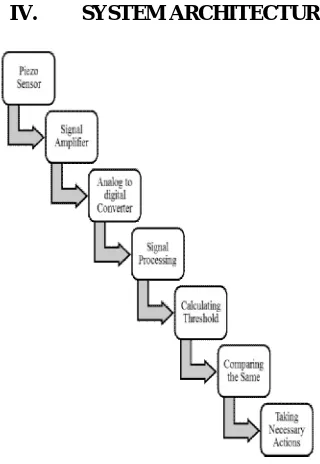
Figure 1.1Flowchart
The above figure is the flowchart of the system will work. It is an overview of the actions that will take when a knock will done on the piezo sensor via door then using ADC how the analog signals are converted to digital to provide the necessary threshold to push the door so that it can be opened.
The Above figure depicts the actual hardware interconnection how the devices are connected and provide a interface for human machine interaction. The hardware interconnection depicts the system architecture.
Actuators
Computer Controller
Transformation Process
Sensors
DAC ADC
Input Devices Output Devices
Continuous and Discrete Variables
Continuous and Discrete Parameters
V. PROPOSED METHODOLOGY
A. Arduino
Arduino is a single-board microcontroller, intended to make the application of interactive objects or environments more
accessible. The hardware consists of an open-source hardware board designed around an
8-bit Atmel AVR microcontroller, or a 32-8-bit Atmel ARM. Current models feature a USB interface, 6 analog input pins, as well as 14 digital I/O pins which allow the user to attach various extension boards.
B. Piezoelectric Sensor
A piezoelectric sensor is a device that uses the piezoelectric effect, to measure changes
in pressure, acceleration, strain or force by converting them to an electrical charge. Piezoelectric sensors have proven to be versatile tools for the measurement of various processes.
Firstly identified the need of a door locking system that reacts to knocking.About how to get sound of knocking. Getting noise free sound, how to recognize patterns using suitable algorithms:
o Interfacing Piezo Sensor with Arduino.
o Getting Piezo Sensors reading in analog Form (Conversion of ADC).
o Checking against stored threshold with Current Reading.
o Acting as per results extracted from above steps.
o Sending SMS to the user using GSM Modem
Arduino programming are the thing in purpose of coming up with a better solution for the problem.
VI. EXPERIMENTAL RESULT
With reference to proposed approach the first module of thehome-security system comprises a setting stage and a usage stage. In the setting stage, the user defines unlock areas on the door (knocking locations).In the usage stage, the user is asked to knock on the unlock areas in sequence.
The setting stage comprises three steps.
Step 1: Defining the unlock areas
In the first step, the user defines the unlock areas on the door. The unlock areas represent one element of the password needed for unlocking the door. After defining the unlock areas, the user defines the order of knocking on the unlock areas. The knocking order is the second element of the password.
Step 2: Collecting knocking information
The home-security system comprises vibration sensors which is piezo that is installed on the door. If the user knocks on the door, the vibration sensors detect the vibration signal.
Step 3: Transferring signal to ARDUINO
VII. CONCLUSION AND FUTURE WORK
Human–machineinteraction was integrated into a home-security system. The system used vibration sensor piezo and an Arduino microcontroller to measure the vibration signals of knocking on a door. The vibration information was then identified thus; the users could unlock the door with a unique knocking pattern. The next module includes GSM which sent alert through text message to authorized user incase of attack
VIII. ACKNOWLEDGEMENT
We acknowledge the efforts and hard work by the experts who have contributed towards development of the different security systems. We also acknowledge the efforts of the reviewers of the journal for the suggestions and modifications to improve the quality of the paper.
REFERENCES
1. “Microcontroller based Home Security System with Remote Monitoring”, Nikhil Agarwal, Department of EC Engineering MIT, Manipal. 2. “A Remote Home Security System Based on Wireless Sensor Network and GSM Technology”, Wuhan, Hubei.
3. “ARDUINO Based industrial security system using piezo electric sensor”, Rupinder Singh Brar.
4. “Using as Input Method for Designing the Home Security System”, Yi-Zeng Hsieh1, Chien-Hsing Chou2*, Huan-Lun Chen2, Yu-Xiang Zhao3 5. “Optimized Locking and Unlocking a System Using Arduino”,Sedhumadhavan. S.
BIOGRAPHY
Gunjan Jewaniis a Research student in M.E. (Embedded System Computing), Nagpur Institute of Technology, RTM Nagpur University. She received B.E. (CSE) degree in 2012 from RTMNU, Nagpur, India. Her research interests are Computer Networks (wireless Networks), HCI, Algorithms, security systems etc.