Abstract
GILBERT, ELANA. Integrating Accelerated Problem Solving into the Six Sigma Process Improvement Methodology (Under the direction of TIMOTHY CLAPP)
Six Sigma has revolutionized the world of business and has presented a new measure of success in customer satisfaction and quality. Six Sigma uses an array of statistical and analytical tools to apply a data-driven, root-cause analysis to existing processes to minimize variation and aim for zero defects. The purpose of this thesis is to study the purposes, tools, goals of Six Sigma’s scientific discovery process and find areas conducive to the integration of accelerated problem-solving techniques, in hopes of deriving a more complete methodology.
A typical Six Sigma project may encounter a variety of issues that either stem from or contribute to the process problem of the project’s focus. The problem solving theory presented in this thesis discusses these issues in terms of the dimensions of problem solving which are orientation level, solving stage, and tool/problem type. Viewing Six Sigma in the light of this theory revealed a need for the addition of tools that addressed issues associated with personnel and belief system limitations, “stuck thinking”, and innovative solution generation.
Kepner-Tregoe’s management model. A hybrid Six Sigma model was developed to address each dimension of problem solving.
INTEGRATING ACCELERATED PROBLEM SOLVING INTO THE SIX SIGMA PROCESS IMPROVEMENT METHODOLOGY
by
ELANA ROYCE GILBERT
A thesis submitted to the Graduate Faculty of North Carolina State University
In partial fulfillment of the Requirements for the Degree of
Master of Science
TEXTILE ENGINEERING
Raleigh 2003
APPROVED BY:
_________________________ _________________________
BIOGRAPHY
Elana Gilbert was born May 22, 1979 in Mt. Holly, NJ. She graduated from the North Carolina School of Science and Mathematics in Durham, North Carolina in May 1997. Afterwards, she attended North Carolina State University, where she received her B.S. in Mechanical Engineering in December of 2001. During her undergraduate career, Elana was teaching assistant, resident advisor and active member of several campus organizations, including the American Society of Mechanical Engineers and the National Society of Black Engineers.
In January of 2002, Elana began her pursuit of a M.S. in Textile Engineering. During that time, Elana conducted interviews with members of industry concerning their experiences with Six Sigma. She also aided in the enhancement and facilitation of short course offerings through N.C. State’s Industrial Extension Service.
ACKNOWLEDGEMENTS
I would like to acknowledge Dr. Timothy Clapp for his supervision during the completion of this thesis and providing the learning environment necessary for me to reach a new level of excellence and to produce my best work.
I would like to thank Jennifer Osborne for being a sounding board and for sharing information on qualitative measures. You are the best friend a thesis writer could ever have.
I would also like to thank the team at Company X for giving me the opportunity to work with them and for their openness to teaching and learning. I truly enjoy working with all of you and for all the advice you shared with me.
I would like to acknowledge my mother for the personal sacrifices she made to push me forward to allow me to reach new levels of excellence. I would like to acknowledge my father his vision, provision, and for teaching me about my heritage. There are not enough words to thank you for all that you given to me.
TABLE OF CONTENTS
Page
LIST OF TABLES………..….….…vi
LIST OF FIGURES………....……....vii
1. INTRODUCTION……….1
2. SIX SIGMA……….………...………..7
2.0 Introduction………..7
2.1 Six Sigma……….7
2.2 Analyzing DMAIC………...23
3. PROBLEM SOLVING THEORY AND ACCELERATED PROBLEM SOLVING 3.0 Introduction………...38
3.1 Problem Solving Theory...………..40
3.2 Accelerated Problem-Solving Tools………..47
3.3 Compatibility with Six Sigma.….………...78
3.4 Summary……….………..79
4. THE INTEGRATED MODEL 4.0 Introduction………...81
4.1 Overall Integration………...82
4.2 Phase Integration……….83
4.3 Summary……….………..98
5. CASE STUDY 5.0 Introduction………..…...101
5.1 Background……..……….…………102
5.2 Define……….106
5.3 Measure……….115
5.4 Analyze………..121
5.5 Improve………..122
5.6 Summary………..……….126
6. RESULTS AND DISCUSSION 6.0 Introduction……….………131
7. FUTURE WORK……….136
8. REFERENCES……….……….138
9. APPENDIX I. ……….…………..………..143
Page
LIST OF TABLES
4.1 APS Tools for DMAIC……….………98
5.1 Project Teams………104
5.2 Performance Measures..………..116
5.3 Specify the Problem………..120
5.4 Fabric Properties and Associated Process Settings………122
Page
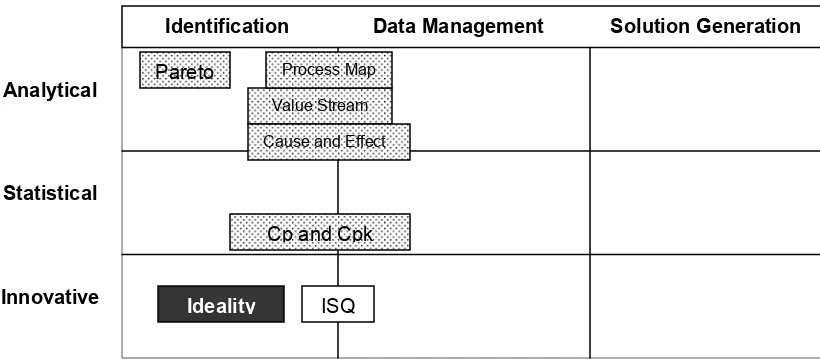
LIST OF FIGURES 2. LITERATURE REVIEW
2.1 The DMAIC Cycle …..………..23
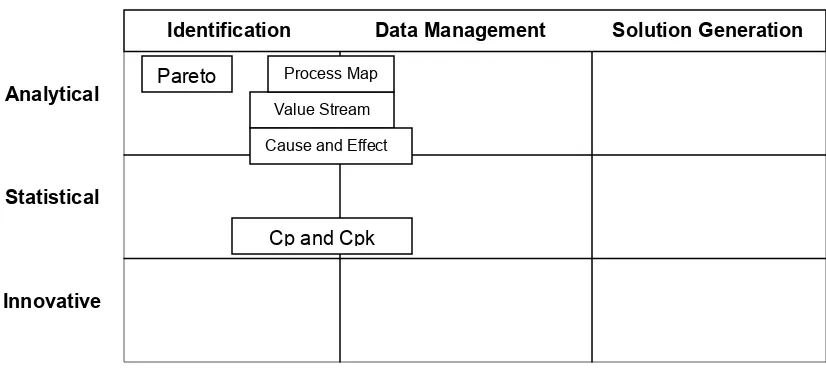
2.2 The Chart of DMAIC Tools………..25
3. ANALYZING SIX SIGMA 3.1 Mind maps of mind mapping………..50
3.2 Mind maps of mind mapping………..50
3.3 TRIZ abstraction model……….………..70
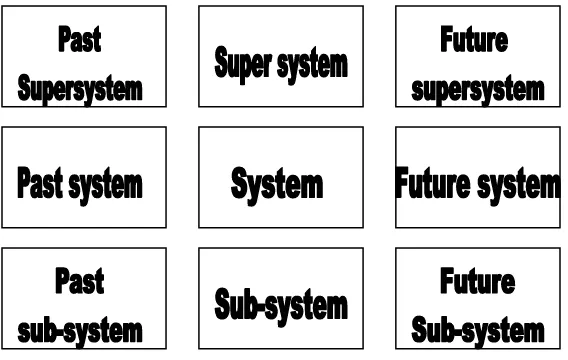
3.4 Systems Approach……….…………..72
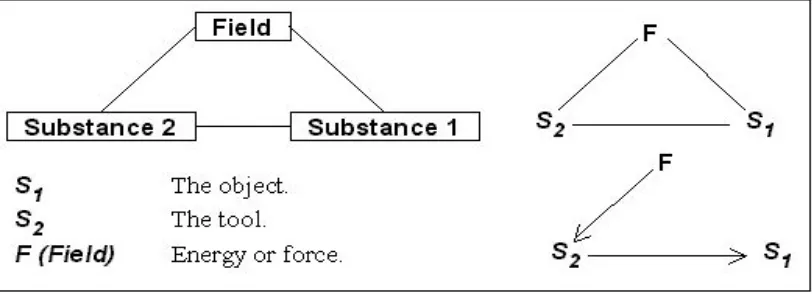
3.5 Typical Su-Field Model……….……...76
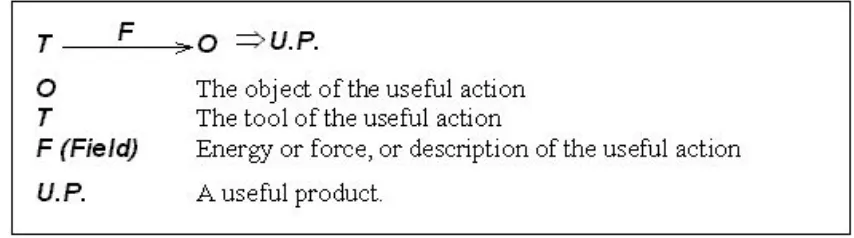
3.6 TOP model and nomenclature………...77
4. THE INTEGRATED MODEL 4.1 Define Before Integration………..………..85
4.2 Define After Integration………86
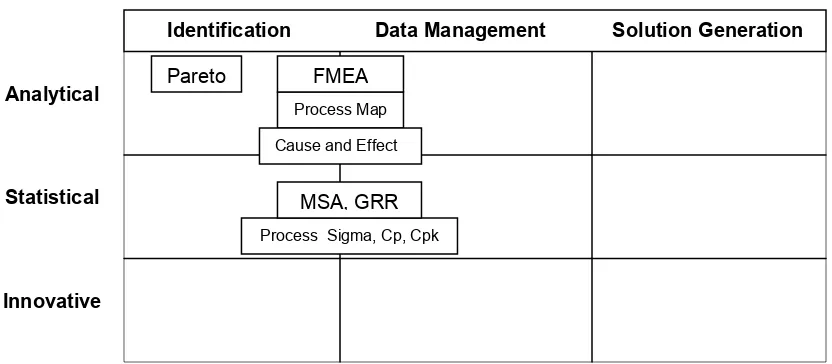
4.3 Measure Before Integration………....88
4.4 Measure After Integration……….………...90
4.5 Analyze Before Integration……….……….91
4.6 Analyze After Integration………...………….……….92
4.7 Improve Before Integration……….….94
4.8 Improve After Integration……….95
4.9 Control Before Integration………...96
4.10 Control After Integration……….…..97
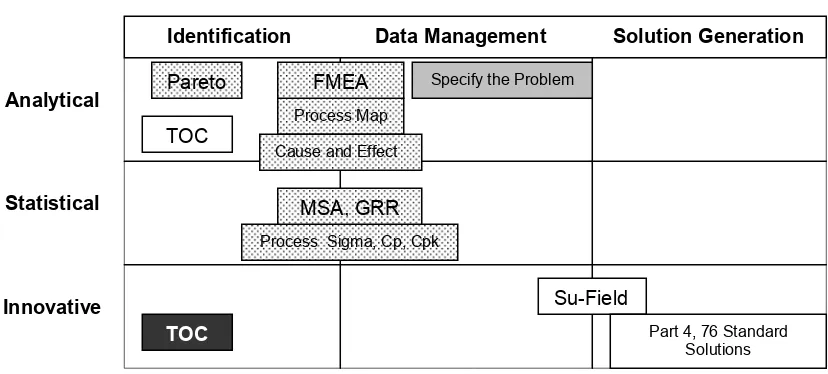
4.11 Integrated Model by Level……….………...……..…….99
4.12 Integrated Model by Stage……….100
5. CASE STUDY 5.1 Schematic of L3………103
5.2 Situation Appraisal for Define……….113
5.3 23 Design for EVOP to Monitor Thickness………126
Chapter One
Introduction
What does it take to survive in business today? How does one stay afloat
in a fluctuating economy flooded with change, a growing demand for low cost,
high quality and minimal time to market? The answer: maintaining a competitive
edge. Any business management professor would agree that in order to stay
appealing to the consumer market, one must anticipate the customer, improve
process efficiency and effectiveness in order to lower cost of production while
achieving high quality standards.
How does a company stay competitive? With buzzwords and phases such
as “innovation”, “total quality” and “thinking outside the box”, the consultant
market has been flooded with those offering to pave the way to managerial and
process improvement breakthroughs. In the last thirty years, ever since the
dynamics in the global market began to shake the American concept of quality
and manufacturing practices, methodologies such as TQM, Global 8D, Lean, and
now Six Sigma have come to the surface to provide structured habits to insure
quality and efficiency, promising gains and results. In the last ten years, Six
Sigma has become the methodology of choice when attempting to achieve
advances in revolutionary quality and streamlined business practices. Its simple,
yet structured approach and its emphasis on using the existing human network
within a company to drive for results that impact the bottom line, make Six Sigma
In 1987, Motorola launched the concept and practice of Six Sigma [26].
Mikel Harry, an engineer and trained statistician, began to study and apply the
concepts of process variation developed by W. Edwards Deming in order to find
ways to reduce variation in order to improve performance. The “sigma approach”,
named for the standard unit of variation around the mean, caught the attention of
Bob Galvin, CEO of Motorola, and soon became the “way of doing business at
Motorola.” With an emphasis on continuous improvement as well as a
continuous aspiration toward perfection, “Motorola adopted a Six Sigma goal in
everything they did, roughly equivalent to a process producing only 3.4 defects
[…] per million opportunities; near perfection”[16].
The practice of Six Sigma addresses and identifies the sources of
“common cause variation” as well as variation due to occasional or special
causes. Employing a long list of preexisting statistical, analytical and quality
techniques, Six Sigma empowers members of an organization to improve
processes and services throughout the organization using a logical, systematic,
problem identification method to meet the organization’s financial objectives and
mission statements. Although the tools and techniques have been around for
quite some time, this method’s layout and infrastructure prescription for the
members of an organization, enable Six Sigma to bring sustainable success
through changing a company’s culture and the way its business is done.
The claims of phenomenal success using this approach have been
Signal, and countless others. During the decade after the birth of the Six Sigma
concept, Motorola saw a “five-fold growth in sales, with profits climbing nearly 20
percent per year; cumulative savings based on Six Sigma efforts pegged at $14
billion…stock price gains compounded to an annual rate of 21.3 percent” [41].
Soon to follow in business breakthrough was the already strong, very profitable
GE, the merged Allied Signal/ Honeywell, which mirrored the turnaround success
of Motorola, as well as a host of other companies varied in background and
industries. Like Motorola and GE, companies that credit Six Sigma with their
major success launched the philosophies, tools, and practices with support,
initiative, and adequate training from top management down to the associates on
the production floor.
Even with Six Sigma’s staggering success and development, process
improvement and management transformation is only the halfway mark for the
goal of staying competitive. What is the next step? The answer lies within a quote
by charismatic CEO of General Electric Company. Jack Welch, CEO of General
Electric, says, “If the rate of change inside the institution is less than the rate of
change outside, the end is in sight. The only question is the timing of the end”
[55]. The next step is innovation.
From his book, Creativity, Innovation, and Quality, Paul E. Plsek cites five
compelling reasons why the members of any organization should interest
themselves with innovation and creativity [43]. The first is associated with the
bottom-line: “Superior long-term financial performance is associated with
demanding innovation.” The third touches on the competition: “Competitors are
getting increasingly better at copying past innovations.” The last two reasons
address the past and the present respectively: “New technologies enable
innovation” and “What used to work, doesn’t anymore” [43]. These reasons
speak to any company’s most significant focal points and what is on the mind of
every CEO: financial performance, the customer, the competition, where they
were and where they are going. Adopting a proven method of innovation will give
an organization a tactical approach to stay ahead of the competition, anticipate
the customer, thrive financially, learn and build off of past success and failures,
and direct a path into the future.
To stay successful and insure future success, Plsek says that companies
must streamline to cut cost, provide quality, and creatively innovate [43]:
“The question of whether an organization should focus on quality
management or creative thinking…is the wrong question. More to the
point, or is the wrong conjunction. Organizations today are challenged to
focus on quality and creativity…all at once…because creativity and
innovation contribute to organizational success. And that is what we
should all be focused on. “
The idea of simultaneously focusing on quality (or process improvement)
and creative innovation via method integration is one of both logical progression
and growing interest. The reasoning for the point that Plsek makes in the above
problems or generating breakthrough ideas. What we need it seems, is the ability
to be analytical when the situation calls for it and creative when the situation calls
for that. Both skills are critical for success”[43]. Without necessarily realizing the
simple, yet profound logic ascribed by Plsek, many have already begun to
contribute toward a movement to systemize and to integrate both process
improvement and innovation to make them more easily and more routinely
implemented. Six Sigma has come forward as the first, clearly systematic
process improvement strategy, leaving verifiable success in its wake. Innovative
techniques such as brainstorming, Mind Mapping, Six Hats and TRIZ are some
of the successful structured results for accelerating and improving problem
solving. The integration of systematic innovation techniques into an effective
process improvement methodology has the potential for a more robust, more
powerful, and a more complete approach, thereby attacking problems from both
an analytical and creative approach. Employment of such a methodology would
lead to faster, exceptional results that would take competition to a whole new
level, putting practitioners on the forefront.
The purpose of this thesis is to find a useful model to integrate some of
the more efficient innovative problem-solving techniques into an effective process
improvement strategy for a more complete methodology that will aid in
maintaining a competitive edge. This thesis will explain how the integrated
problem-solving methodology was developed, weaving elements of TRIZ, Six
Hats Thinking, Kepner-Tregoe, Theory of Constraints, Mind Mapping and
Six Sigma literature, as well as take a closer look at the DMAIC problem-solving
model of Six Sigma. Chapter Three will survey the structure of the selected
innovation tools, respectively, in search of the best areas for a complementary
fusion of techniques. Chapter Three will end with a justification of the selection
of the tools chosen versus the many that are available. Chapter Four will
introduce the integrated method and explain the placement of certain tools based
on the potential impact on the user and the process. The last two chapters will
describe the proceedings and report results of a case study wherein the derived
model was implemented. The report of this case study will include the
impressions and reactions to the effectiveness of both Six Sigma and the
Chapter Two
Six Sigma
2.0 Introduction
Six Sigma’s success has been attributed to embracing it as an
improvement strategy, philosophy and a way of doing business. This chapter will
discuss Six Sigma in terms of definition, history, implementation and experiences
in order to construct a well-rounded profile of the methodology. In doing so, this
chapter will justify the use of Six Sigma as a foundation for integration. This
chapter will then take a closer look at Six Sigma’s process improvement model,
DMAIC, highlighting areas that may have room for innovative tool incorporation.
2.1 Six Sigma
2.1.1 Definition. There are many offerings for the definition of Six Sigma,
each one addressing one of the several aspects of its phenomenon of the pursuit
of “near-perfection in meeting customer requirements” [41]. To be strictly
statistical, it involves “operating with only 3.4 defects for every million activities or
‘opportunities’” [41]. In business terms, “Six Sigma is a smarter way to manage
business or a department. Six Sigma puts the customer first and uses facts and
data to drive better solutions” [40]. Combining the preceding definitions, one
could say that Six Sigma is a data driven, process improvement, problem
identification tool that uses both the scientific method and statistical analysis to
achieve bottom-line results. On the surface, the merging of these two definitions
a more holistic view is important to fully appreciate its potential impact on the
overall profitability of an organization.
For example, to the customer, Six Sigma means higher quality at a better
price. One of the most significant characteristics of Six Sigma is its concept or
“theme” of customer focus. From the very beginning of a typical Six Sigma
project, the practitioner, usually a Black Belt, chooses metrics and deliverables
that drive customer requirements and demands. These goals are known as
CTQs (critical to quality). This approach of “beginning with the end in mind” sets
Six Sigma up to directly benefit customer every time. In his book, The Six Sigma
Revolution, George Eckes relates a “then and now” account of his experience
with the airline industry [16]. By the end of his story, he makes the point that
many companies forget the reason why they are in business: the customer. Six
Sigma helps to bring that point back into focus by not only reintroducing a drive
to please the customer, but also by aligning customer demands with primary
business objectives.
To the employee, Six Sigma is empowerment and a game plan. Often in
manufacturing and service settings, associates and floor managers find
themselves constantly frustrated “putting out fires”, dealing with the constant
onslaught of emergencies, rework and the “gremlins” inherent to the process, all
without attacking the real, recurring root-cause of the problems within the
process. Six Sigma as a methodology provides a logical sequence of steps to
Quality”, who paraphrased some Motorola pundits, “If we can’t quantify it, we
can’t understand it. If we can’t understand it, we can’t control it. If we can’t control
it, it controls us” [46]. Finding the information that leads us to the root causes
puts an end to the blame game, covering mistakes, and ultimately, minimized
variation. Six Sigma provides a systematic method to find, quantify and “translate
that knowledge into opportunities for business growth,” and well as power over
the process [8].
To senior management, and eventually the whole organization, Six Sigma
is a cultural change. Six Sigma is not simply a set of tools or another quality
program; rather, it is “a way of doing business” [55]. Pande, Neuman, and
Cavanaugh, the authors of The Six Sigma Way, put it this way: “Still another way
to define Six Sigma is as a sweeping “culture change” effort to position a
company for greater customer satisfaction, profitability, and competitiveness”
[41]. The above viewpoints echo the six themes of Six Sigma, which are outlined
in The Six Sigma Way. They are:
1. Genuine Focus on the Customer
2. Data- and Fact-Driven Management
3. Process Focus, Management, and Improvement
4. Proactive Management
5. Boundaryless Collaboration
6. Drive for Perfection
These six themes are the heart of the Six Sigma philosophy and shape the
2.1.2 History. Six Sigma is more than a philosophy, a defect rate, or
cultural change; it is also a new way of doing business. In 1985, Motorola
launched the concept and practice of Six Sigma [26]. Mikel Harry, an engineer
and trained statistician began to study the process variation concepts developed
by W. Edwards Deming in order to find ways to reduce variation in order to
improve performance. The “sigma approach”, named for the standard unit of
deviation of variation around the mean, caught the attention of Bob Galvin, CEO
of Motorola, and soon became the widespread business practice at Motorola
[19]. With an emphasis on continuous improvement as well as a continuous
aspiration toward perfection, “Motorola adopted a Six Sigma goal in everything
they did, roughly equivalent to a process producing only 3.4 defects …per million
opportunities; near perfection”[19].
During the decade after the birth of the Six Sigma concept, Motorola saw
a “five-fold growth in sales, with profits climbing nearly 20 percent per year;
cumulative savings based on Six Sigma efforts pegged at $14 billion…stock price
gains compounded to an annual rate of 21.3 percent”[16]. An article entitled, “In
the Beginning”, by Blanton A, Godfrey, reports an interview with Bob Galvin,
detailing his reflection on the start and evolution of Six Sigma [19]. During the
interview, Galvin explains that the key to leading this initiative at Motorola began
with him listening to the customer, despite the fact that at the time, “In this
business we had 85% of the world’s market share and were getting double digit
After Motorola started to share their new practices with others, Larry
Bossidy of Allied Signal begin to experience success with this continuous
improvement practice after launching Six Sigma in 1994. The Six Sigma
program’s success is evident in the $2 billion-plus in savings and 988% growth in
stock price Honeywell has enjoyed [28]. After asking Bossidy, a former
employee of GE, about his successes, Jack Welch, CEO of GE, announced the
beginning of their corporation-wide initiative in 1995. Roger Hoerl of General
Electric Co., explains the launch and evolution of Six Sigma at GE in his article,
“An Inside Look at Six Sigma at GE”[27]. This article reveals that much of the
structure, best practices, certification titles and requirements commonly outlined
in the training arena today occurred at GE during its Six Sigma deployment.
Because of their effort, GE experienced an improvement in operating margins
from 13.6% to 18.9%; a move in inventory turns from 5.8 to 8.5, and a doubling in
earnings per share over the five years of implementing Six Sigma. GE also
experienced “an asset efficiency (ratio of plant and equipment expenditures to
depreciation) moving down toward 1.0 (with future movement projected to 0.8—
which indicates finding free production capacity concealed among current
corporate assets by removing the “hidden factories” caused by waste and
rework)” [55].
2.1.3 Implementation. Most of the literature concerning Six Sigma focuses
on successfully implementing Six Sigma practices into one’s organization.
Implementation comes in one of two models: tool-based and projected-based [6].
opposed to when and how a tool should be implemented and integrated with
other tools.” Project-based implementation involves tools being “taught and then
applied to projects that are defined before [training] sessions begins.” Aspects of
project-based implementation will be the focus of this section since it is the most
widely used by Six Sigma trainers and thought to be the most effective [21].
Many organizations “can achieve more significant bottom-line benefits with this
approach,” as it reflects more use of the themes of Six Sigma, as mentioned
earlier [6].
Most of the texts that touch on training echo the description outlined by
Mikel Harry. He describes a training that is project-based, in that it follows the
Plan-Train-Apply-Review (P-T-A-R) model, where trainees learn the Six Sigma
philosophy, theory, tactics and tools and immediately apply them in a project that
was selected for them prior to the start of training [26]:
“Black Belts spend one week learning each phase of the
Breakthrough Strategy with three weeks between each of the four
weeklong sessions to apply their knowledge of the phase they have
just learned to their assigned projects. Training extends over a
four-month period, with project reviews in Week Two, Week Three and
Week Four.”
Because of the learn-while-doing approach, Black Belts and Green Belts are able
to make a significant impact on current business issues and practices during their
environment. The practical teaching and simultaneously application allows for a
quicker return on investment in training and personnel.
2.1.3.1 Infrastructure. Infrastructure is one of the most important issues
that need to be addressed when employing a project-based approach. A
supportive infrastructure should be in place prior to the deployment of a Six
Sigma initiative. Although there are several parts of the infrastructure, the most
important is the executive leadership [6]. What is often misunderstood about
starting a Six Sigma initiative is that it is another quality program that has to be
executed by a separate management team or quality department. However, a
successful organizational initiative begins with the “commitment and leadership
of their management” as evidenced by GE, Honeywell, and a host of other
companies [6]. The authors of Managing Six Sigma identify twelve components
of the “successful Six Sigma infrastructure”, the first of which (executive
leadership) has already been discussed. The eleven others can be addressed by
following the eight essential steps of Business Process Management, as outlined
in the book, The Six Sigma Revolution by George Eckes. These steps make up
the strategic business component of Six Sigma and are designed to enable
executive leadership to “create the infrastructure for Six Sigma to be successful
in an organization” by translating the function or departments of the organization
into key processes or services through an intense customer focus [16]. These
eight steps are:
1. Creation and agreement of strategic business objectives
3. Identification of process owners
4. Creation and validation of the key measures of effectiveness
and efficiency for each process (as known as “dashboards”)
5. Collection of data on agreed dashboard
6. Creation of project selection criteria
7. Using the project selection criteria for project selection
8. Continual management of processes to achieve strategic
objectives of the organization.
The execution of these eight steps will authenticate management’s commitment
to the initiative as well as provide the planning, communications, and the cultural
change needed to have sustained success with Six Sigma.
2.1.3.2 Deployment. Nearly all of the texts discuss in some regard the
issues surrounding deployment. The most direct discussions can be found in a
book written by Mikel Harry, Richard Schroeder and Don Linsenmann titled, Six
Sigma: the Breakthrough Management Strategy Revolutionizing the World's Top
Corporations. In the chapter, “Implementation and Deployment” they discuss
how to develop a “proper” deployment plan, criteria to select an effective training
provider and several suggestions for trainee to personnel ratios. Proper
deployment, as described by Harry et al., consists of training both Black Belts
(BBs) and Green Belts (GBs) in waves and launching several projects
simultaneously, after designating process owners, champions, and a reward
From Art to Science is a business novel that gives an illustration of such a roll
out, from beginning to end.
Repeatedly stressed throughout Six Sigma texts is the need for “top
management involvement and visible support” as well as the need to think of Six
Sigma as an investment [47]. The idea of deployment suggests that the
organization as a whole, be it an entire corporation, a division or a department, is
in the process of becoming a “Six Sigma organization”, intending to change the
way they do business. Yet, many organizations are prone to launch their Six
Sigma efforts without making a serious commitment [40]. Making the investment
in Six Sigma involves committing full-time Black Belts and/or Master Black Belts
to Six Sigma activities and selecting projects that are important, visible and tied
to the corporate (or organizational) objectives [21].
There are also several misunderstandings of how to practice Six Sigma,
as well as what to expect from that practice. Most of the texts that look at the
whole Six Sigma experience address mistakes made when deploying an initiative
and how to avoid making a launch ineffective. For example, the authors of The
Six Sigma Way offer “Twelve Keys to Success”. Among those are [47]:
• Tie Six Sigma efforts to business strategy and priorities
• Make an investment to make it happen, and
• Make top leaders responsible and accountable
In his article, “Six Sigma Program Success Factors”, Mark Goldstein of
1. Deployment plan. “The lack of understanding of this
fundamental point (or lack of experience in developing a
deployment plan) is a primary factor that contributed to the
failure of some of the earlier quality improvement programs.”
2. Active participation of the senior executives. Goldstein
describes what is meant by active participation by upper
management why it is so critical to the longevity of an initiative.
3. Project reviews. “If reviews are conducted on a regularly
scheduled basis, the process maintains constant, steady
pressure on the BBs and Green Belts (GBs) to drive their
projects to a successful completion and closure. Reviews
provide oversight to make sure that the BBs and GBs are
correctly following the Six Sigma strategy and methodology.
They ensure proper use of the Six Sigma tools.”
4. Technical support (Master Black Belts).
5. Full-time vs. part-time resources.
6. Provide adequate training.
7. Communications.
8. Effective project selection.
9. Project tracking.
10. Institute an incentive program.
13. Customer “WOWS”
Goldstein and others suggest that using the tips and techniques that they outline
will help companies avoid the pitfalls that are associated with managing change
and getting an organization on board with effective program implementation.
As previously mentioned, Mikel Harry expressed concern about proper
deployment and reiterates that point by writing Six Sigma Knowledge Design. He
asserts that the key to setting up the infrastructure that will lead an organization
to breakthrough success is to have a “six sigma knowledge architecture” in place.
In other words, the organization must make a commitment to truly understand the
“relative context, framework, and mitigating factors that should be fully weighted
and considered when designing and developing six sigma curricula” [25]. He
states, “If six sigma is about quantum change—and it most certainly is—then we
need a carefully designed fabric of interactive ideas that are capable of
structuring, unifying, and inspiring each separate mind in a corporation,
particularly those that are directly involved in and responsible for deploying,
implementing, and achieving ambitious business aims” [25]. This book provides
what the author denotes as ten “filters” for assessing of how well an organization
embraced the philosophies of Six Sigma when constructing its infrastructure.
2.1.4 Scientific Discovery Process. Six Sigma’s keystone methodology, a
derivative of Deming’s PDS(C)A cycle, is made up five phases: Define, Measure,
Analyze, Improve and Control. These phases and their distinct characteristics
give Six Sigma its structure and clarity. As practitioners step through each phase,
either special or common cause variation. They systematically examine a
process problem by first clearly defining the problem, deliverables, measures,
and measurement system, and then, verify the measurement system in place.
Next, that practitioner continues by finding the root cause of the problem,
improving the system and finally, holding gains achieved. The practitioners, who
are usually Black Belts or Green Belts, may utilize a combination of several
different statistical and analytical tools to achieve the goals of each phase.
2.1.5 Experiences. Two articles in Six Sigma Forum magazine relate in
detail the experiences of an organization as it reached its goal of becoming a Six
Sigma organization. That organization is General Electric Company and the
articles are “20 Key Lesson Learned” by Gerald J. Hahn and “An Inside Look at
Six Sigma at GE” by Roger Hoerl.
Hahn begins his article by explaining that his list of lessons learned is a
work in progress as well as a summation of lessons from Motorola and his
experiences at GE. Among the lessons learned he lists [23]:
• Start when the time is right: that time is now
• Develop an infrastructure
• Commit top people
• Select initial projects to build credibility rapidly
• Plan to get the right data, and
• Keep the toolbox vital
excerpt by pointing out the “following erroneous conclusions” that many have
made about GE phenomenal success with Six Sigma [27]:
• GE’s Six Sigma deployment was easy (it wasn’t).
• External consultants showed us how to do everything (they
didn’t).
• Nonmanufacturing and design applications came at the very
beginning (they came later).
• GE didn’t make any mistakes along the way (it did).
Hoerl goes on to share a personal account of how Six Sigma unfolded at GE in
the five years that Jack Welch (CEO) projected. A few weeks after Welch’s
announcement, Hoerl attended Master Black Belt training, during which he noted
the commitment of all of the participants present. He relates [27]:
“No one debated over the merits of Six Sigma or asked if the
reported results from AlliedSignal or Motorola were real. No one
wondered if Six Sigma would apply to GE or if this was just a
repackaging of total quality management. Rather than debating
these questions, virtually all the MBBs asked questions about how
to implement it as quickly and effectively as possible.”
Hoerl goes on to comment that some leaders at GE did retain skepticism
concerning Six Sigma, and subsequently left the company: “While such actions
may seem severe, it goes back to something that Jack said: If executives could
not support Six Sigma 100%, GE was simply not the right company for
Hoerl’s article illustrating some of the lessons listed in Hahn’s article by
relating some of the mistakes and modifications that GE made to the Six Sigma
methodology, as well as tips on how to apply Six Sigma to finance. He concludes
his article by emphasizing that application of Six Sigma was “not easy”, and
therefore required commitment, resources and vision by making the following
assertions [27]:
• “…[GE] was doing quite well financially when it embarked on
Six Sigma…Why wait until you have a crisis before you start
improving?”
• “Senior leadership, especially Jack Welch, provided
unyielding commitment to the initiative going and ensured
continued success. This will not be easy for other companies
to copy.”
• “Some of the best people in the company, in virtually all
business functions, were freed from their normal duties to
focus 100% on Six Sigma.”
• “Lastly, GE used a formal and structured deployment plan
that included the required infrastructure (the Six Sigma
organization, project selection systems and benefit
verification systems).
2.1.6 Six Sigma vs. TQM. Many ask, “How is Six Sigma different from
new expert skill level. In fact, many highly effective Six Sigma practitioners
appear to have repackaged prior offerings under this popular title!” [46]. Andell is
only partially correct. The problem solving tools that are taught across the board
in Six Sigma training programs are familiar to many who have years of industry
and quality control experience. The essential tools that reside in the practice of
the methodology and complement its philosophies are statistical process control
(SPC), design of experiments (DOE), analysis of variance (ANOVA), the Voice of
the Customer, encouragement of creative thinking, and process management. As
the training of Six Sigma evolved, along with the certification titles of “Black Belt,”
“Green Belt,” and “Champion,” other tools have been added to the list, such as
measurement systems analysis (MSA), failure mode and effects analysis
(FMEA), root cause analysis, and have been around well before Six Sigma
became the new trend. Andell also goes on to say that Six Sigma is very similar
to TQM with the only difference really being the major CEO/corporate push and
endorsement of personalities like Jack Welch and Larry Bossidy. However,
Andell is neglecting several items to make his point. For example, the efficiency
of that so-called “repackaging”, which happens to be a variation of the scientific
method, better known as the DMAIC model, makes the tools much more timely
and effective.
In addition, Six Sigma stresses the complete involvement and cooperation
of all levels of management in its effort, via its accompanying infrastructure,
which prevents it from becoming a department or sideline activity. The authors of
question of the difference between Six Sigma and TQM in chapter 3. They
recognize that the population of quality professionals that may have been burned
by “failed” TQM efforts of the past, will probably be the most resistant to embrace
next Six Sigma ventures. They use this chapter to review “some of the major
TQM gaffes, as well as hints on how the Six Sigma system can keep them from
derailing your effort”[41].
This discussion would not be complete without highlighting the powerful
foreword by Neil DeCarlo of Mikel Harry’s poignant book, Six Sigma Knowledge
Design, which further distinguishes the line between Six Sigma and TQM. In his
book Six Sigma, Harry has this to say about the difference between TQM:
“The difference between previous total quality approaches and the
Six Sigma concept was a matter of focus. Total quality
management (TQM) programs focus on improvements in individual
operations with unrelated processes. The consequence is that with
many quality programs, regardless of how comprehensive they are,
it takes many years before all the operations within a given process
(a process is a series of activities or steps that create a product or
service) are improved. The Six Sigma architects at Motorola
focused on making improvements in all operations within a process,
producing results far more rapidly and effectively” [26].
Neil DeCarlo amplifies the point that Harry makes by stating, “While TQM has
“six sigma functions as an integrated system for driving business breakthrough,”
in that organization need to focus on turning the business around, instead of
merely turning a process around. He claims that although management and
quality circles are saturated with knowledge concerning Black Belts, the tools,
DMAIC and projects, “they are much less educated about the requirements,
principles, practices and nuances involved in successfully installing and
deploying six sigma…they focus on the details of project application, they tend to
overlook tenets of six sigma success” [25].
2.1.7 Section Summary. To summarize, Six Sigma is a philosophy, a
methodology, and a process that incorporates change within an organization to
bring about improved business results and customer satisfaction. Six Sigma
places an emphasis on data-driven, root-cause analysis by using a diverse
collection of tools to identify and address the sources of special and common
cause variation within the process. The dynamic sequencing of the toolset,
business focus and the demand for executive support set Six Sigma apart from
the total quality management initiative of the ‘80’s. Because of these and many
of other attributes of Six Sigma, it has been the phenomenon credited for the
breakthrough success of many of today’s top-performing corporations.
2.2 Analyzing DMAIC
As introduced in the previous section, Six Sigma’s scientific method,
DMAIC, is a variation of the Plan-Do-Study (or Check)-Act model developed by
process improvement system that is commonly applied by Six Sigma
practitioners and is currently taught in most Black Belt training modules [45].
DMAIC, or Define-Measure-Analyze-Improve-Control, is sometimes mentioned
with three additional steps known as Recognize, Standardize and Integrate,
which are exclusively designated for Champions and Master Black Belts to
execute. These eight steps are involved in what Mikel Harry and Richard 2.1 The DMAIC Cycle [15]
DEFINE
What problem needs to be solved?
MEASURE
What is the capability of the process?
ANALYZE
When and where do defects occur?
IMPROVE
Now can the process capability be Six Sigma? What are the vital few
factors?
CONTROL
What controls can be put in place to sustain the gain? Characterization
Monitoring Systems
Optimization
phase is designed to ensure (1) that companies apply the Breakthrough Strategy
in a methodical and disciplined way; (2) that Six Sigma projects are correctly
defined and executed; and (3) that the results of the projects are incorporated
into running the day-to-day business”[26]. Each phase has a specific purpose
and set of desired outcomes that signal the completion of one phase and the
beginning of another.
Tools. A few books directly and almost exclusively address tools used to
implement Six Sigma. Among those are The Quality Handbook by Joseph Juran
and A. Blanton Godfrey, Implementing Six Sigma by Forrest W. Breyfogle III, and
The Six Sigma Handbook by Thomas Pyzdek. These books go into each of the
tools that are involved in executing Six Sigma. Implementing Six Sigma also
goes into other helpful details, such as how to choose the effective training,
computer software, Lean Manufacturing, Theory of Constraints, and reliability
testing, while The Quality Handbook tends to be a comprehensive encyclopedia
of the history of quality, methods, and practical teaching.
Figure 2.2 outlines the tools that are used throughout DMAIC within their
associated phases. The tools listed in the chart existed long before Six Sigma
began, and have been used long before it became a popular practice. The
difference between how these tools were employed before Six Sigma versus
after is dynamic sequencing and the integration of these tools in one common
line of attack (DMAIC). As a depicted by the chart, many of the tools can be used
phase where they apply. As Six Sigma training has developed, some tools have
been associated with certain phases to improve the overall effectiveness of the
model.
The tools are a combination of statistically based, graphical, analytical
techniques and simple actions that can be assessed as needed by the members
of a project team.
Trainers may offer different combinations of this these tools depending on
The sections to follow will identify the purpose of each phase of DMAIC
and then discuss how the goals of each phase are met using the current toolset.
As the purpose of each phase is identified, the tools that are commonly
associated with that phase will be briefly described.
2.2.1 Define. A problem solver must consider the area that contains the
problem, determine the appropriate focus, and gather all the pertinent information
related to the scope that will eventually aid in providing a robust solution. The
importance of proper definition is mirrored in the goals of the define phase [33]:
1. Identify and recognize. The first goal of Define is to find
opportunities to improve the process, cut costs and/or recognize areas for
overall financial reconstruction.
2. Find the business case for the project. The goal that sets Six
Sigma apart from other quality programs is the one that mandates
practitioners to find projects that have an impact on the bottom-line. This
goal involves determining the identity of the customer and why the project
is important.
3. Set metrics. In this phase, metrics for project success are set
and agreed on by project team members. The metrics are measurable,
data-based and driven by customer requirements.
4. Find specifics/narrow scope. Before solving the problem, one
must gather facts, initial data, and know the history of the problem. The
project team must answer questions such as, “Is the project manageable
questions allow adequate description of the “solving space” that contains
the problem. Doing so eliminates the wasted time solving the wrong
problem or being derailed later.
5. Prioritize. This goal simply addresses project planning and task
management. To accomplish this goal a team must consider what
milestones are on the horizon and what tasks must be completed in order
to reach each milestone.
2.2.1.1 The Tools of Define. The tools commonly linked with Define are
the Pareto principle, the process and value stream map, process capability, and
the Cause and Effect diagram.
The use of the Pareto principle is exhibited by means of a bar graph chart
that shows what processes or causes fit the “80-20” rule, or what twenty percent
of the process, people, and equipment, etc. causes eighty percent of problems,
waste, or mistakes. This tool quickly narrows the scope of the problem by
focusing on the few areas of the process that need to be immediately addressed.
The Pareto chart is also used for purpose of problem identification and
specification.
Process flowcharting is a graphical method that diagrams the overall
process. Although there are different types of flowcharts, most are used to map
the route by which raw materials become a finished product [29]. Flowcharts (or
process maps) capture the storage, data, decisions and activities that make up
Value stream mapping is a powerful tool that constructs a map of the
value added and non-value added components of a process flow. It outlines the
process from beginning to end, taking into account inventory, paperwork, rework
and shipping. Value stream maps and process flowcharts are used for the
purposes of problem identification and data management, as an effective means
of documentation. After constructing a value stream map, one is able to see
bottlenecks that may be present within the process via cycle times and rolled
throughput yield. A flowchart may reveal inefficient flow and decision-making.
Process Capability is another tool usually executed in the Define phase.
The process capability is determined by calculating the index values for Cp and
Cpk. These metrics provide an efficient, universal way of comparing the process
to customer specifications. Process capability can be used for “before and after”
comparisons so that project teams may have a quantifiable measure of process
improvement.
Cause and Effect diagrams, also called Fishbone diagrams, give the
project team an opportunity to identify potential causes of process variation.
Generally, the possible causes are listed with respect to the six categories of
personnel, machines (or equipment), materials, environment, measurement and
methods. These possible causes can then be used to “determine the factors to
consider within regression analysis or DOE.” [6] This tool helps the users to
identify problem areas and view different aspects of the “problem space” by
2.2.2 Measure. Before useful data can be collected to gain insight into the
process and the problem, the measurement system must be verified. Reasoning
behind this phase lies in the fact that gathering data using an unacceptable
measurement system will yield inaccurate data and ultimately waste time and
resources. Often, simply looking at the process and understanding how
parameters are measured will identify improvement opportunities. In this phase,
practitioners verify the measurement system by assessing the capability of the
system and find the cause(s) for variation of recorded measurements. The goals
are as follows [33]:
1. Document existing process.
2. Establish techniques for collecting data.
3. Ensure the measurement system is adequate.
4. Collect data.
5. Establish baseline, including confirmation of financial
considerations.
6. Focus the improvement effort by gathering information on
the current situation
2.2.2.1 Tools of Measure. The main tools associated with Measure are
Measurement Systems Analysis and Failure Mode and Effects Analysis (FMEA).
Process mapping, flowcharts, and performance metrics (process sigma, Cp and
Cpk) are also used or redrafted during this phase, as appropriate.
determine if the “measurement system possesses the required statistical
properties or not” (AIAG 1995). The second objective is to determine what effect,
if any, do environmental factors have on the system. After determining the
acceptability and stability of the system, practitioners verify that the measurement
system will continue to produce the initial results in Phase 2. A verified
measurement system “is said to be consistent when the results for operators are
repeatable and the results between operators are reproducible”[6]. Conducting a
statistical study called “Gage R&R” completes this verification. A Gage R&R
determines if measurement variation comes from part-to-part variation or from
the operator(s).
Failure Mode and Effects Analysis (FMEA) is an analytical technique that
seeks to prevent problems by prioritizing potential problems and predetermining
their resolutions. The FMEA record is called a “living document” because it
requires timely attention and revision in order to maintain its usefulness. There
are two types of FMEA: design (d-FMEA) and process (p-FMEA). The P-FMEA
is used for DMAIC projects to focus on the potential failure modes, causes and
mechanisms that originate from the process. The FMEA is used to direct the
analysis effort and is revised throughout the process as information is gathered
and causes are verified or dismissed.
2.2.3 Analyze. The purpose of Analyze is to identify the most influential
factors within the process and to find the main sources of common cause
variation, thereby gaining knowledge of the overall process. Having better
the process. It is in this phase that enough data are collected to reduce the
variables being considered, find correlation between remaining variables, and
began to identify the major sources of variation. The goals of Analyze are the
following [33]:
1. Narrow the focus by gathering information on the current
situation
2. Uncover potential sources of variation through an
understanding of the relationship between X and Y variables
3. Reduce the number of process variables to be acted on in
the improvement phase
4. Identify and manage high-risk inputs.
2.2.3.1 Tools of Analyze. The tools used to reach the above goals are the
5 Whys, Pareto and Run Charts, Regression Analysis, ANOVA and other
statistical analysis. Again, process mapping, charting and other previously
mentioned techniques can be used in this phase as needed.
The 5 Whys is a simple, yet effective tool that is used to bring clarification
about process method, procedures, and parameters. It involves asking “Why?”
on a particular topic five times in a row while recording answers. By the end of
the inquiry, the answers and/or ideas that are uncovered guide practitioners to a
list of factors that affect the process.
Pareto and Run charts are used to establish which variables or factors
rule out special cause variation and show trends that take place over time.
Pareto charts are used in the same way as they are in the Define phase.
Regression analysis is a general tool that involves finding a mathematical
relationship between two or more continuous input factors and a continuous
output response. Determining such a relationship would enable one to predict
process yield given the values of the factors included in the relationship.
ANOVA, or the analysis of variance, is a statistical method for “separating
the total observed variability in a measured product property into sources of
variation, and for estimating the magnitude of variation that can be attributed to
each source” [29]. For example, using ANOVA, a project team can determine if
the differences between two or more machines, lines, departments, or
procedures is statistically significant. The team can also assess the magnitude of
the differences between machines or lines and adjust the process to reduce or
eliminate the variation or make sure that best practices are standardized.
2.2.4 Improve. The Improve phase is the most pivotal of the DMAIC
model. The purposes of this phase are (1) to develop potential solutions to the
identified problems and (2) to optimize the process for the desired yield or
performance. “Optimization looks at a large number of variables in order to
determine the ‘vital few’ variables that have the greatest impact. Using various
analyses, Black Belts determine which variables have the most leverage or exert
the most influence”[26]. The goals of this phase are outlined below [33]:
2. To identify, test, and implement potential solutions to
address the root cause.
3. To verify the solutions are effective
4. To document the cost benefit
5. To ensure that the solution is robust
2.2.4.1 Tools of Improve. The tools that are used with this phase are
brainstorming, design of experiments (DOE), FMEA, and process mapping.
Brainstorming is typically associated with creative problem solving.
Brainstorming, DMAIC’s tool for solution ideas, can be used informally in project
team meetings, but is a very effective tool for generating solution ideas or
identifying problem areas if used formally. Brainstorming, a term coined by Alex
Osborn, describes a structured process wherein ideas are shared quickly and
randomly (like a storm), and then are recorded and built upon. Brainstorming
allows ideas to be submitted and modified for providing several viable
alternatives to solve a problem or to explore its causes.
Design of experiments is a statistical tool that enables practitioners to gain
process knowledge by systematically changing operating levels within a process
in order to consider several factors and interactions simultaneously. There are
many different kinds of designs depending on the purpose that is intended and
the nature of the process being studied. DOE analyses not only report which few
factors out of several are significant to the process; it also yields prediction
2.2.5 Control. In the Control phase, Black Belts have gained enough
information from the previous phases to improve the overall process to hold the
gains. This is the part of the process that determines the quality and longevity of
the solution: finding ways to live in the solution that has been built. In this phase,
practitioners work to [33]:
1. Create and validate monitoring system for the process
2. Develop new standards or revise existing ones
3. Finalize documentation of procedures.
2.2.5.1 Tools of Control. The main tools used in the Control phase are
statistical process control (SPC), a technique that utilizes control charts, and
poka-yoke (or mistake proofing).
“The most effective statistical process control (SPC) program utilizes the
minimum number of charts that at the same time maximizes the usefulness of the
charts”[6]. Control charts track processes by plotting variable or attribute process
data over time. Poka-yoke, or mistake proofing, is a technique that may use a
creative approach to either prevent a mistake or make “a mistake obvious at a
glance”[6]. Poka-yoke practitioners may apply a combination of “solution
directions” (such as color, physical properties, sound, texture) and random words
to a brainstorming session in order to come up with creative ways to prevent
mistakes.
2.2.6 Section Summary
Overall, DMAIC makes excellent use and availability of many different
the problem, collect, and analyze data. However, the DMAIC toolset is
considerably wanting in several areas. Below is a list of several observations
concerning the content of the Six Sigma toolkit:
• The toolkit is in need when it comes to innovative solution
generation. Although brainstorming is both systematic and useful
for generating solution ideas, the ideas may not be innovative,
robust or easily implemented. Brainstorming has limited capacity if
not used in conjunction with another technique, such as solution
directions as employed in poka-yoke.
• The available tools do not to address problems that surface as a
result of the changes that come about when Six Sigma is being
deployed into an organization, such as with infrastructure and
organizational culture. Such problems may obscure issues
associated with the process or even delay or inhibit solutions to the
process problem. Overwhelming differences in personality types
and ineffective conventions can limit much needed discussions or
discoveries. Although Six Sigma may address these issues in terms
of philosophy, there are no tools or systems in place to deal the
change that an organization encounters when implementing Six
Sigma.
• DMAIC does not have a tool to assist in choosing between
to quickly choose between alternatives and implement chosen
solutions as well, especially in the Improve phase.
• Finally, although DMAIC utilizes many tools to yield useful
information in each phase, the existing identification tools do not
automatically lead the user to a solution. Many of the tools focus
users on problem areas only, rather than solution areas.
The next chapter will introduce theories related to problems solving as well
as several systematic tools used to accelerate problem solving. Survey of these
methods will reveal their ability to complement Six Sigma philosophies and
existing tools. These tools were selected for not only their apparent merits but
their potential to address the above observations and improve the flow and
Chapter Three
Problem Solving Theory and Accelerated Problem Solving
3.0 Introduction
Popular belief holds that creative ability is limited to a select, gifted few
who possess or exhibit this extraordinary, unconventional talent from birth.
Though such speculations persist, research efforts conducted in a variety of
backgrounds over the last eighty years have pointed toward an entirely different
conclusion: creativity can be taught. This idea is often mentioned in the resultant
literature and associated circles as “directed creativity”. Those who studied in this
area eventually proved that by enlisting certain methods that were systematic by
nature and directed the general thinking practice, the process of solving a
problem could be accelerated. Continued work in this arena led to the
development of several practices and tools known as accelerated problem
solving techniques. The techniques are characterized by their promotion of
attention-directed thinking, innovation and creativity, and may possess a
structured approach.
After citing the efforts of Joseph McPherson, a creativity researcher who
collected 28 definitions of creativity, Paul Plsek offered the following in his book
Creativity, Innovation, and Quality, as a conclusive definition for creativity [43]:
“Creativity is the connecting and rearranging of knowledge—in the minds
From this definition, particularly the phrase, “…who will allow themselves to think
flexibly…” Plsek suggests, and later plainly states, that creativity is an attribute
that people are able to and should cultivate by “purposely mov[ing] out of your
comfort zone in many small ways on a regular basis.” By this definition, Plsek
logically leads readers towards a definition for creative problem solving; the new,
surprising ideas that are generated from thinking flexibly about arbitrary
situations are judged to be useful by others. Thus, creativity, for all intents and
purposes for this discussion, is synonymous with the term “creative problem
solving.”
Innovation is a concept often related to and commonly confused for
creativity, or creative problem solving. Innovation is defined by Plsek as “the first,
practical, concrete implementation of an idea done in a way that brings
broad-based, extrinsic recognition to an individual or organization”[15]. This definition
implies that innovation is the direct application of an idea that is not “merely
novel, statistically improbable, or bizarre.” Plsek emphasizes the distinction
between innovation and creativity by expressing that, “real success comes with
innovation.” Thus, it is not enough to be creative; an organization must take the
risk to implement the ideas that are generated within its walls.
Seeing that organizational success genuinely comes from innovation, the
cultivation of innovation skills by all members of the organization becomes
important. However, today’s workforce lacks the skills that would enable them to
quickly and effectively innovate. Creativity and innovation are still commonly
skills can be developed and honed using systematic tools, tools used to
accelerate one’s problem solving ability.
The purpose of this chapter is to present tools designed to accelerate
problem solving. The chapter will begin by taking a look at the theories
concerning the nature of problem solving. Then, it will draw upon the insight
provided by those theories introduced to provide justification for an integrated
model, as a preface for the chapters to follow. It will end with the presentation of
the accelerated problem solving tools that will be integrated into the DMAIC
model, as well as an outline of their compatibility with Six Sigma in philosophy,
execution, and purpose.
3.1 Problem Solving Theory.
Problem solving is thought to be a simple concept. Historical research
would suggest that many individuals have studied the nature of problem solving
and have touched on different aspects in order to facilitate the process. The
sections to follow outline some of these findings and in the final section, combine
these ideas into one problem solving theory for problems that surface within an
organization in pursuit of process improvement.
3.1.1 Problem stages. All problem-solving approaches contain three basic
parts (heretofore known as stages). An article by Paul Palady and Nikki Olyai
titled “The Status Quo’s Failure in Problem Solving,” illustrates this point. The
authors discuss the need for these stages: “Solving chronic problems requires a
and confirmation of the solution” [39]. By choosing to focus on “chronic”
problems, the authors suggest the most successful, lasting solutions come from
completing some form of these three stages of problem solving.
The first stage involves identifying the problem. No matter how useful a
problem solving technique may be, it will be of no use if a project team sets out to
solve the wrong problem. Problem identification sets a focal point for solving
efforts while setting a perimeter for the solving space that includes the boundary
of the problem. Good problem definition will lead to effective research of
background information, efficient use of time spent working on the project, and
strong metrics used to indicate success.
The second stage involves collecting and organizing data related to the
problem’s cause or source. In this stage, collected data are analyzed (organized)
to yield as much useful information as possible. Data collection prevents project
teams from apply solving efforts to the symptoms of the problem only, ignoring
the root cause. Thorough data collection, organization and analysis, or data
management, will enable effective and accurate decision making as well as
confident project development.
The third and final stage of problem solving is the “solving” itself. Solutions
are generated, developed and verified at this point, the best solutions
implemented and standardized. If a solution is innovative or robust enough, it will
be cost effective, durable, and add little to no complexity to the existing system.
3.1.2 Problem Types. The path of problem solving is often clouded by a
revealed that trying to apply the wrong tools to the right problem, i.e. analytical
techniques to a creative problem, could inhibit the discovery of solutions. So,
before tools can be applied, one must first assess what type of problem is being
encountered, be it purely statistical, analytical or innovative. The type of problem
will dictate the type of tools that will best solve the problem. Statistical, analytical
and innovative (creative) problems are not the same. Each type calls for different
kinds of data and asks a different set of questions; which is why they generate
different solutions.
Statistical problems are characterized by special and common cause
variation in a process. These problems are contained in systems or processes
that are given to the collection or interpretation of numerical data, be it discrete or
continuous. The questions fall into two main categories: “Does the target need to
move?” or “Does the spread need to be tightened?” Statistical problems involve
finding the source of inconsistency when the source is not apparent. An example
of a statistical problem is inconsistent measurements of bolts taken by three
different operators from different shifts using the same type of instrument. The
questions of whether or not the operators, shifts, bolts, or instruments are
statistically different fall in the category of “(How) Does the spread need to be
tightened?”
Analytical problems are probably considered the most common. They are
problems that may be complex, begging to be divided into elementary
![Figure 2.2 Chart of DMAIC tools [57]](https://thumb-us.123doks.com/thumbv2/123dok_us/1520878.1186407/35.612.109.542.186.491/figure-chart-of-dmaic-tools.webp)
![Figure 3.1 and 3.2 Mind maps of Mind Mapping [9]](https://thumb-us.123doks.com/thumbv2/123dok_us/1520878.1186407/59.612.120.525.74.323/figure-mind-maps-mind-mapping.webp)
![Figure 3.3 TRIZ abstraction model [44]](https://thumb-us.123doks.com/thumbv2/123dok_us/1520878.1186407/79.612.209.466.264.435/figure-triz-abstraction-model.webp)