ISSN(Online): 2319-8753 ISSN (Print): 2347-6710
I
nternational
J
ournal of
I
nnovative
R
esearch in
S
cience,
E
ngineering and
T
echnology
(A High Impact Factor, Monthly, Peer Reviewed Journal)
Visit: www.ijirset.com
Vol. 8, Issue 3, March 2019
A Knowledge Based Management System for
an It Support Unit in A Banking System
Edebatu Dominic1, Okafor Chigozie Solomon2
Department of Computer Science, Nnamdi Azikiwe University, Awka, Nigeria1
Department of Computer Science, Imo State University, Owerri Nigeria2
ABSTRACT: The motivation of this work stems from the inability of banks in Nigeria to effectively and timely restore or resolve issues within the set time or pass down knowledge from experienced staff or experts to new entrants or even to document issues and resolve them as they arise for reference purposes. The consequences arising from this longer downtime and service failure has resulted in customer dissatisfaction, attrition, bank losses and poor ROI. Thus, the aim of this study is to develop a Knowledge Base Management System (KBMS) that applies Machine Learning based on Data Mining Techniques using significant amount of captured fault logs’ data from a server to predict faults. Therefore, the objective of the work is to create a KBMS software that can be used to resolve Information Technology (IT) challenges/issues in the Banking system as they arise. This will go a long way to solving the problems associated with the present system by reducing downtimes, ensuring availability of service and consequently the satisfaction of customers by the bank. The Methodology used is the Structured Systems Analysis and Design Methodology. The expected result aims at providing a software solution that can predict faults and offer counter measures to resolve them. The research work shall be relevant to those working for a better customer service delivery in the financial sector.
KEYWORDS: Information Technology, Data Mining; Knowledge Base; Management System; Banking System; Eliminate; Downtime, Analysis, Design. Techniques; KBMS.
I. INTRODUCTION
Cambridge Dictionary defines knowledge as an understanding of or information about a subject that one gets by experience or study, either known by one person or people generally. This view was supported by Wikipedia, the [1] when it defines Knowledge as a familiarity, awareness, or understanding of someone or something, such as facts, information, descriptions, or skills, which one acquired through experience or education by perceiving, discovering or learning. Acquisition of knowledge may involve complex cognitive processes in form of perception, communication and reasoning.
From the foregoing, one deciphers that knowledge can refer to a theoretical or practical understanding of a subject, which can be implicit with respect to practical skills or explicit, when a theoretical understanding of a subject is involved.
Before now, some people see knowledge as consisting of contextual information, values, experience, and expert insight that provide a basis for evaluation and incorporation of new information, ideas, and experiences. However, it becomes necessary to know how knowledge starts and how it is applied in the minds of it recipients. Knowledge can also be in form of database, policies, procedures, documents, and uncaptured personal expertise, which could be used to improve efficiency and thus lead to profitability of an organization.
ISSN(Online): 2319-8753 ISSN (Print): 2347-6710
I
nternational
J
ournal of
I
nnovative
R
esearch in
S
cience,
E
ngineering and
T
echnology
(A High Impact Factor, Monthly, Peer Reviewed Journal)
Visit: www.ijirset.com
Vol. 8, Issue 3, March 2019
Today, organizations recognize knowledge as an important strategic resource. With the emergence of knowledge community, information and knowledge are seen as crucial elements of development. As a result, organizations focus on gaining and securing their knowledge to get competitive advantage. With the emergence of Information Technology (IT) as an important tool for enabling business processes and operations, organizations started looking for better ways to integrate IT into their business processes so as to effectively manage their knowledge in order to stand out and create opportunities. This requires an explicit initiative to capture, store, and share and apply existing resources to promote learning and innovation, which was conceptualized as Knowledge Base Management System (KBMS).
KBMS improves overall organizational performance by reducing mistakes, avoiding reinvention, aiding knowledge reuse and promoting learning and innovation. It is widely recognized that good Knowledge Base Management (KBM) leads to higher efficiency and enterprise performance. Thus, knowledge is being considered as a valuable commodity embedded in high-tech products and the expertise of highly experienced employees. However, some school of thought believes that in organizations where KBMS are incorporated into their structure, they demonstrated increased capability to manage and use knowledge in achieving their set goals thereby acting as models to firms that are yet to implement the program.
Generally, no matter how one looks at it, banking is a serious and somehow complex business with a wide range of services to different group of customers (Operations, Marketing, Human Resource, foreign Banking, Domestic banking and FOREX, etc.) and that almost all bank processes are highly dependent on effective use of information and knowledge resources. United Bank for Africa, for example, developed strong practices to promote knowledge sharing among its IT support employees through mentoring, on-the-job training and some coding systems. However, these methods may not be adequate to effectively manage and derive value from existing knowledge resources because
Knowledge is scattered across different sources and individuals, which proved difficult to assemble and integrate. This (spread) has negatively affected the free flow of knowledge and expertise among the IT staff. Again, when a problem is solved in the system, the methods of resolution were not shared and more time is taken to resolve the same problem in other braches – a frustrating situation. There is need for a solution for an observed fault to be logged and kept in the central Server as they reoccur. Thus the need to create a Knowledge base and its management system will go a long way to fix issues in real-time and yield a better banking experience.
II. STATEMENT OF PROBLEM
When faults occur in an organization, consequences are high with respect to cost, staff and customer satisfaction. Users of such facility experience loss of service, loss of valuable data, equipment and lots revenue as a result. So the following problems motivated the quest for this paper:
1. Lack of centralized knowledge repository in the current system; 2. Not being able to timely manage and resolve faults as they arise;
3. Not being able to bring up devices and restore service within the required turn-around time and
4. Poor knowledge and experience transfer mechanisms from experienced professionals to ... the learners newly recruited on troubleshooting issues.
ISSN(Online): 2319-8753 ISSN (Print): 2347-6710
I
nternational
J
ournal of
I
nnovative
R
esearch in
S
cience,
E
ngineering and
T
echnology
(A High Impact Factor, Monthly, Peer Reviewed Journal)
Visit: www.ijirset.com
Vol. 8, Issue 3, March 2019
III.AIM AND OBJECTIVES OF STUDY
The aim of this study is to develop a Knowledge Base Management System that can be used to resolve faults on IT equipment within the Banking system.
The following objectives subsist:
i. To develop a software that can be used to timely resolve faults; ii. To create a centralized knowledge repository or database; and
iii. To effectively share knowledge and experience of experts to learners for prompt resolution of issues.
IV. THEORETICAL FRAMEWORK
The design and implementation of Knowledge base management system for an IT Support unit in a banking system is meant to enhance Knowledge base management processes, which is the main objective of this work. We shall x-ray the concept of knowledge base and knowledge management overview, among others as the discussion continues.
Oxford English Dictionary defines knowledge as facts, information, and skills acquired through experience or education or the theoretical or practical understanding of a subject. It went further to describe it as the sum of what is known.
Today, knowledge regarded as a central focus in the planning and management of organizations because of it nature as an asset. However, [2] describes knowledge as a form of contextual information, values, experience, and expert insight that provide a basis for evaluation and incorporation of new information, ideas, and experiences.
Atlassian.com defines a knowledge base as a self-serve online library of information about a product, service, department, or topic. It posits that the data from a knowledge base can be from anywhere, but usually comes from several contributors who are well versed on the subject - enough to give one all the details. Subjects range from the ins and outs of Human Resource (HR) or Legal department to how a new product, hardware, or software works. The knowledge base can include FAQs, troubleshooting guides, and any other nitty-gritty details one may want or need to know.
Data, information and Knowledge
The above words have been used interchangeably in this work but it is important to explain each of them in their own contexts for the effective understanding of the knowledge concept per se. While Data refers to unorganized, unprocessed facts, figures or observations that communicate something specific and has no meaning until they are analyzed and given a meaning, Information is an organized data for meaningful purposes.
Knowledge as aforesaid consists of practice, strategy, approach, or method, which may be invisible and closely linked to action and decision. Information and knowledge most of the times are used interchangeably but the difference between them is that knowledge is “what an individual possesses after assimilating facts and putting them into context, while information is knowledge that is shared.”
Again, information can be said to be a set of possible messages, where the goal is to send these messages over a noisy channel, and then to have the receiver reconstruct the message with low probability of error despite channel noise. However, [3] believes that Information is converted to knowledge once it is processed in the mind of individuals and knowledge becomes information once it is articulated and presented in the form of text, graphics, words, or other symbolic forms. So, information can said to exist, when it is articulated, verbalized and structured. This critically indicates that knowledge does not exist outside the one that conveys it.
ISSN(Online): 2319-8753 ISSN (Print): 2347-6710
I
nternational
J
ournal of
I
nnovative
R
esearch in
S
cience,
E
ngineering and
T
echnology
(A High Impact Factor, Monthly, Peer Reviewed Journal)
Visit: www.ijirset.com
Vol. 8, Issue 3, March 2019
In today’s connected world, easy access to accurate information is in high demand. Through a built up database, knowledge base raises the questions people want answered. Knowledge base is one of the easiest and cheapest ways to keep customers happy, if well managed. It’s the ideal way to handle high-volume, simple interactions and it’s always available, self-serve round the clock when captured in a database. With a strong knowledge base and knowledge management, organizations would be able to deliver faster service, improve self-service, give greater access to more articles, and offer regular updates through a knowledge management system.
[4] lists other Relevance of a Knowledge Base as follows :
More consistent service: Everybody in the organization speaks from the same playbook. No confusion. No mis-steps. Everyone – customers and sales folk is happy.
Higher resolution rates at first contact: With a good knowledge base, there’s no putting customers on hold, no transfers between agents, no “we’ll call you back in a minute.” Answers are right at customers’ fingertips. And when they have additional questions, others in the community are right there to help. It’s an easy-to-use, self-serve way to resolve issues fast.
Lower training costs: A knowledge base supported by a strong knowledge management program, ensures new hires are trained with the latest information and get consistent guidance, which translates to a better work environment and lower costs.
To co-workers and customers: a knowledge base in place combined with a Knowledge Management system, workers and customers can create, curate, share, utilize and manage knowledge across the whole company and across banking industries.
To a team of employees: Once there is a good knowledge base in place, backed by a plan for knowledge management, customers and employees find answers themselves to questions needing solutions about the business. This would make management focus on really important aspects of its job, rather than answering everyone’s questions.
With Information Technology (IT): It simplifies everything from troubleshooting to training/on-boarding and general how-to and support questions
Under Human Resource (HR): it is good for distributing company policies and pay schedules
Under Legal Policies: it helps with contract and other approval processes, policies, trademarks and registrations
Knowledge Base Management System
According to [5], Knowledge has become one of the strategic resources for the present day organizations due to turbulent and fast changing business environment. It is an organization resource that is used to recognize the value of new information, assimilate it, and apply it to create new knowledge and capabilities.
Knowledge becomes an organization resource when it is systematically managed to be used in the business process. This requires a system that facilitates easy access and integration to existing knowledge resources [3] and a social capital among employees that supports openness and collaboration in joint problem solving [5]. In knowledge base organization, individual expertise is sufficient to be effective in the task. One has to have the skill to collaborate with other colleagues.
Knowledge base management is a multidisciplinary concept which is used in different disciplines with different definitions [6].
ISSN(Online): 2319-8753 ISSN (Print): 2347-6710
I
nternational
J
ournal of
I
nnovative
R
esearch in
S
cience,
E
ngineering and
T
echnology
(A High Impact Factor, Monthly, Peer Reviewed Journal)
Visit: www.ijirset.com
Vol. 8, Issue 3, March 2019
customer. In customer support, one often plays on the reactive end of things. And when you’re swamped in support tickets, it’s hard to be proactive and work on strategic measures to help your customers be successful in the big picture.
Again, KBMS can be defined as a process that deals with knowledge creation, storage, dissemination and application to improve the overall organizational performance [7]. But process models have common implication and shows how knowledge is created, shared and applied in the organization. Whether an organization has an explicit KBMS strategy or not, its usage by employees will enhance organizational output.
Generally speaking, a Knowledge Base Management system is any kind of Information Technology (IT) system that stores and retrieves knowledge to improve understanding, collaboration, and process alignment. It can exist within organizations or teams, but they can also be used to center one’s knowledge database for one’s users or customers. KBMS help people utilize knowledge to better achieve tasks. It is as a more proactive form of customer success. With it, one can answer customers’ questions in real time, as they struggle with their challenges, instead of constantly answering the same questions in one’s support ticketing system, for example.
A Knowledge Base Management system can take many forms, but there are usually of some common characteristics. These include:
FAQ content
Forum or community feature How to articles and tutorials
Education, academies, and training programs Certificates
Case studies Webinars
An example of a Knowledge Base Management system is Tableau Knowledge Base (Tableau is business intelligence software that helps people see and understand their data, which includes a search feature from which users can get answers to specific enquiries as well as top articles and product-specific navigation.
2.3 Types of Knowledge Base Management System [7] explained the following types of KBMS:
Intranet Infrastructures: These provide basic functionality for communication by way of email and teleconferencing and also enable storage, sharing, searching and retrieval of documents and data. Workflow management systems: These systems support organizational processes that are well-structured and can handle the execution of workflows.
Expert systems: These are systems that are used in making choices that are usually performed by a domain expert, for example, the diagnosis of a problem.
Groupware systems: These enable collaboration among staff in an organization and enable sending of messages or sharing of appointment calendars amongst themselves. Groupware systems also enable discussions, time management, meetings, and workshops among teams and work groups.
Document management systems: Enable users to create, store, share and retrieve documents effectively as well as enable easy searching within documents
Decision support systems: Comprises of tools that may be used to support organizational knowledge that exist and is applicable while determining the right approach during decision making. Such technologies may include: simulators, online analytical processing and data mining capabilities. Users are presented with information in a way that can enable them make informed decisions.
ISSN(Online): 2319-8753 ISSN (Print): 2347-6710
I
nternational
J
ournal of
I
nnovative
R
esearch in
S
cience,
E
ngineering and
T
echnology
(A High Impact Factor, Monthly, Peer Reviewed Journal)
Visit: www.ijirset.com
Vol. 8, Issue 3, March 2019
Artificial intelligence technologies: These support activities such as text and web mining, user profiling, search and retrieval of documents.
Database management systems: Enable the use of a collection of data kept in a database more effectively by ensuring easy storage and retrieval.
Knowledge Base Management Life Cycle
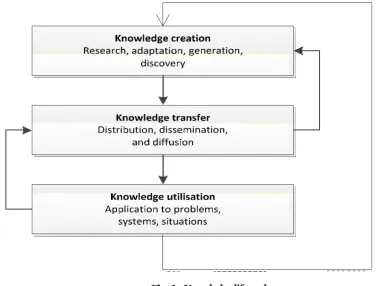
The life cycle consists of four processes known as KBM processes and they include: Knowledge creation, Knowledge storage, Knowledge sharing, and Knowledge utilization. The Knowledge base management
processes can be shown below:
Fig. 1: Knowledge life cycle
Source: [8]
A school of thought defines Knowledge creation as the generation of new knowledge or replacement of content that already exists with new explicit one, it can also be created through exploitation, or exploration of inherent ideas.
ISSN(Online): 2319-8753 ISSN (Print): 2347-6710
I
nternational
J
ournal of
I
nnovative
R
esearch in
S
cience,
E
ngineering and
T
echnology
(A High Impact Factor, Monthly, Peer Reviewed Journal)
Visit: www.ijirset.com
Vol. 8, Issue 3, March 2019
2.4 Knowledge Base Management in the Banking Sector
In banks today, Knowledge base management has been adopted as a business practice. Banks, insurance companies and all other players in the competitive financial service sector have recognized that knowledge is power. But the question is, how do they leverage that knowledge more effectively? The Knowledge, in this sense, covers the range from the bank’s own internal intellectual capital, to the wealth of data held on any customer’s transaction.
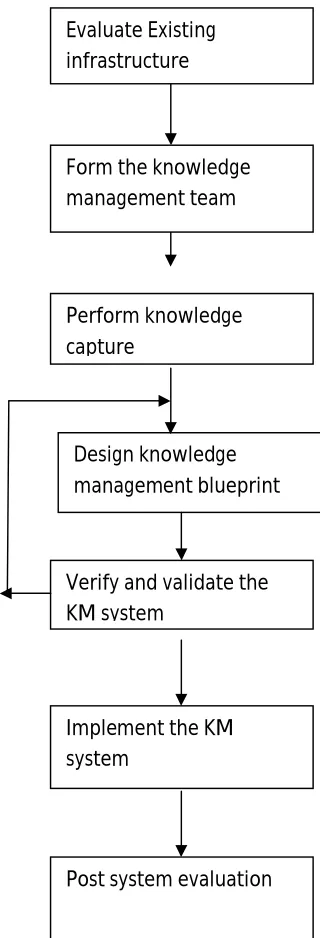
Stages of management is as shown in the figure show below
Fig 2: Knowledge Base Management Life Cycle Evaluate Existing
infrastructure
Design knowledge management blueprint Perform knowledge capture
Form the knowledge management team
Implement the KM system
ISSN(Online): 2319-8753 ISSN (Print): 2347-6710
I
nternational
J
ournal of
I
nnovative
R
esearch in
S
cience,
E
ngineering and
T
echnology
(A High Impact Factor, Monthly, Peer Reviewed Journal)
Visit: www.ijirset.com
Vol. 8, Issue 3, March 2019
Source: [8]
However, the overall aim of the banking sector is to enhance their customer satisfaction and increase revenue as a result. One would have thought that this form of Knowledge base management was something that financial services companies were skilled because of the service-based nature of their business. But this is not the case. Few banks take Knowledge base management seriously, while a greater number of industrial companies do. [9] says that insurers have been more receptive to the benefits of Knowledge base management than the banking sector.
The survey conducted among top two hundred banks and one hundred insurance companies across the world, found that while thirty percent of the overall respondents were not considering implementing a Knowledge base management programme, their number included only one insurer. Despite this, they warned that two thirds of banks in the world are failing to exploit their intellectual capital effectively by not having a Knowledge base management strategy in place. In fact, skill at Knowledge base management has become a critical competency for banking sector survival in the 21st century.
IT Tools Used in Implementing KBMS
In order to effectively implement a KBMS, the tools that can be used are discussed below.
Wikis: A Wiki is a special kind of knowledge base used in an organization for a group of people to collaborate, create, share and have access to knowledge.
Knowledge portals: Knowledge portals are intranet based websites that are used to show the knowledge that an organization has on various topics. Portals can be developed using any hosting solution to the internet and access to the portal can be restricted using access login systems. Individuals can be given different levels of permission to access the portal and the contributions made but different authors.
Virtual Communities of Practice (VCoPs): A community of practice (CoP) is a group of individuals that have specific activity in common, and as a result have some shared knowledge, some overlapping values and a sense of shared identity. In recent times, CoPs have become popular means of knowledge management processes such as creation, sharing and retention of knowledge [10].
Collaborative virtual workspaces: The essence of collaborative virtual workspace is that they allow individuals to participate in activities together irrespective of their geographic location. With collaborative virtual workspaces, people are able to engage in document sharing,
Blogs: A blog is a simple website in form of a journal with a list of dated entries arranged in reverse chronological order starting with the latest on a specific theme. The entries in a blog can contain text, videos, photographs, audio recordings or a combination of different types. Blogs can be used by individuals or a group of people in an organization to create, store, share and apply knowledge.
Social Networking Services (SNS): With the advancement of web 2.0, SNS have become a powerful platform for individuals to communicate, collaborate and share knowledge [11] A social network is a group of people that share a similar area of interest or community of individuals interested in exploring activities and interest of others. Networking services refer to social media services that allow users to create and display their profiles within a bounded system, and clear lists of other individuals with whom they share connections [12].
2KNOWLEDGE BASE MANAGEMENT SYSTEM IMPLEMENTATION
Different approaches to KBMS implementation have been discussed by many authors and they stated three stages for implementing KBMS in an organization to include adoption, acceptance and assimilation.
1) KBMS Acceptance 2) KBMS Assimilation 3) Technological Infrastructure 4) User Satisfaction 5) Policies and Guidelines
ISSN(Online): 2319-8753 ISSN (Print): 2347-6710
I
nternational
J
ournal of
I
nnovative
R
esearch in
S
cience,
E
ngineering and
T
echnology
(A High Impact Factor, Monthly, Peer Reviewed Journal)
Visit: www.ijirset.com
Vol. 8, Issue 3, March 2019
V. METHODOLOGY
This section describes in details the analysis and problem of the existing system, with a view to examining the procedure and method or technique to determine its purpose and how necessary operations can best be achieved. Analysis of a system involves decomposition or stepwise refinement, i.e., breaking down large problems into smaller and specific ones in an attempt to discover its basic problems and the need for the proposed system with an appropriate methodology used to solve the problem.
Analysis of the Present System.
Any downtime experienced in the banking system, results in loss of income and customers dissatisfaction. Hence the need for the systems, applications and network to be functional at all times. The Bank under study has branches in nineteen (19) African countries and a Head office in Nigeria, where the server farm is located. A Wide Area Network linking all the branches to the Head Office (HO) exists. In the bank, the major departments that make up the work force are; Information Technology (IT), Marketing and the Operations departments. All other units apart from the IT unit are referred to as Users’ Unit because they have less experience and privilege to handle the IT infrastructure, they only use the platforms created by the IT unit to serve the Bank’s customers. The IT Unit of the bank is quite large with different units, which are as follows:
i. IT Networks Unit – Handles the network infrastructure of the bank. It resides in the HO where the server farm is located
ii. IT Database Unit – Handles the database servers and querying of the database, and resides in the HO
iii. IT Application Unit – Handles development and management of applications used in the Bank’s network, and resides in the HO
iv. Messaging and Collaboration Unit – handles the mail servers, it creates administration of the mails and mail policies. It resides in the HO.
v. Systems Security Unit – secures the bank’s network and ward off all potential threats in the servers and systems.
vi. IT Support Unit – The regional IT staff stay at the regions to support the branches and perform almost all the functions. They are the ones users see. When issues occur, the users always hold IT support office responsible because it is the one they can see even when the issue might be coming from the Central Server at the Head Office.
Process/Information Flow
ISSN(Online): 2319-8753 ISSN (Print): 2347-6710
I
nternational
J
ournal of
I
nnovative
R
esearch in
S
cience,
E
ngineering and
T
echnology
(A High Impact Factor, Monthly, Peer Reviewed Journal)
Visit: www.ijirset.com
Vol. 8, Issue 3, March 2019
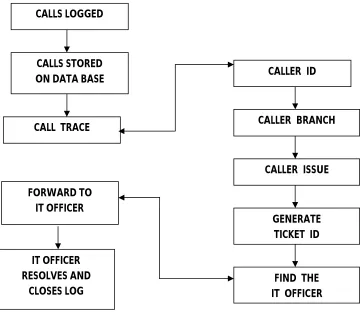
Fig. 3: Behavioural pattern of issue resolution
Figure 3.1 above explains how issues are logged and resolved. When a user experiences an IT challenge, he logs in the issue, the issue is saved in the database and tracked down to the caller. In the process, the caller ID, branch and issue(s) for the call is determined. A ticket ID is generated and assigned to the issue, then IT officer in charge of the branch is located and issue forwarded to him/her. The IT Officer then resolves and closes the Caller log.
Weakness of the Present System
In the current system, when issues occur, the likelihood of getting the it fixed within a required time is very slim. At times, resolution of issues/calls extends over days because the IT officer in charge may not come across such issues and resolves them in time, especially if less experienced IT staff is concerned. In the current system, the knowledge of only one person is involved and applied since there is only one IT staff covering for a branch or branches. He would work only to the best of his knowledge. The breakdown of the weakness of the present system are as follows:
Inability to effectively restore or resolve issues within the set time
Inability to pass down knowledge from experienced staff and experts to new hires. No documentation of issues and resolutions for reference purposes.
In the present system, if any experienced staff resigns, there is always a problem because he takes his entire knowledge and job experience with him and this will pose a difficult challenge to the bank. In this case, when network service goes down, the bank is grounded and loses funds and customers. The bank is dependent on IT in order to render services to
CALLS LOGGED
CALLS STORED ON DATA BASE
CALL TRACE
CALLER ID
CALLER BRANCH
CALLER ISSUE
GENERATE TICKET ID
FIND THE IT OFFICER FORWARD TO
IT OFFICER
IT OFFICER RESOLVES AND
ISSN(Online): 2319-8753 ISSN (Print): 2347-6710
I
nternational
J
ournal of
I
nnovative
R
esearch in
S
cience,
E
ngineering and
T
echnology
(A High Impact Factor, Monthly, Peer Reviewed Journal)
Visit: www.ijirset.com
Vol. 8, Issue 3, March 2019
customers but if there is a failure in the IT backbone as a result of loss of experienced hands, the bank will fail its customers and this is against the oath of continuous excellent service delivery sworn to customers.
Proposed Solutions to the Problems
Based on the above analysis of the present system, with respect to the aforementioned problems and their effects, it becomes necessary that a Knowledge base management system should be designed and implemented. This will go a long way in solving the problems associated with the present system by reducing downtimes, ensuring availability of service and consequently the satisfaction of customers by the bank. In that respect, a Knowledge Base Management System is hereby proposed for IT support departments in Banks.
Maintenance: This involves periodic updating and enhancement of the software and its users. The concept of this project therefore is built around eliminating the weakness area and tidy up the knowledge gap in the IT department within the bank so as to provide a platform for qualitative customer service.
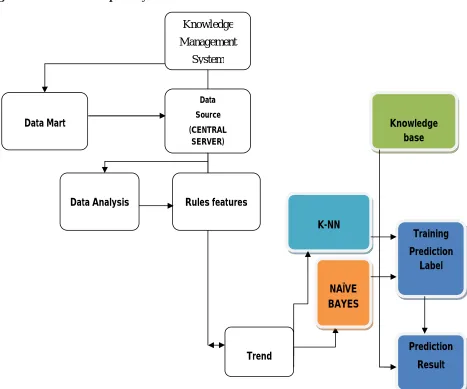
High Level Model of the Proposed System
Fig. 4: Proposed Knowledge base management system Knowledge
Management System
Data Mart
Data
Source (CENTRAL
SERVER)
Knowledge base
Data Analysis
Trend
Training
Prediction Label K-NN
Prediction
Result Rules features
ISSN(Online): 2319-8753 ISSN (Print): 2347-6710
I
nternational
J
ournal of
I
nnovative
R
esearch in
S
cience,
E
ngineering and
T
echnology
(A High Impact Factor, Monthly, Peer Reviewed Journal)
Visit: www.ijirset.com
Vol. 8, Issue 3, March 2019
VI. SYSTEM DESIGN
The system design and implementation techniques will be analyzed in this context. However, the new system, after development will improve learning processes among facilitators and their students.
The definition of the architecture, components, modules, interfaces and data for the new system will be made in this context.
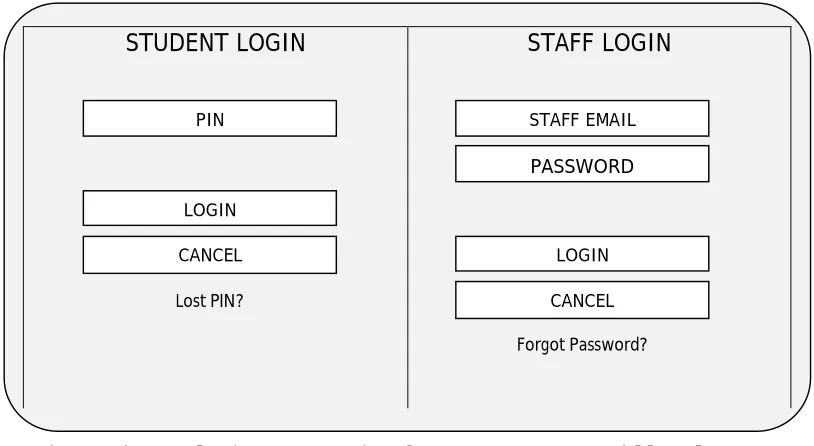
(i) Home Page: this is the first page a user sees when the webpage is launched by the user. It provides login facilities for both learners and facilitators.
Fig 5: Diagram showing System Design of a Home Page (Source: Field Work, 2018)
When the registration number and corresponding PIN are entered, learner’s data are fetched.
Below the Learner’s profile Pane is the Search algorithm. It is designed to enhance search operations.
STUDENT LOGIN
STAFF LOGIN
PIN
LOGIN
CANCEL
Lost PIN?
STAFF EMAIL
LOGIN
CANCEL
PASSWORD
ISSN(Online): 2319-8753 ISSN (Print): 2347-6710
I
nternational
J
ournal of
I
nnovative
R
esearch in
S
cience,
E
ngineering and
T
echnology
(A High Impact Factor, Monthly, Peer Reviewed Journal)
Visit: www.ijirset.com
Vol. 8, Issue 3, March 2019
Fig 6: Diagram showing Learner’s Registration Number (Source: Field Work, 2018)
(iii) My School Page: this page displays various links for the user to perform different operations like: viewing scheme of works, video lessons, assignments, games, results and school calendar.
Algorithms
An algorithm is a detailed series of instructions for carrying out an operation or solving a problem. In a non-technical approach, we use algorithms in everyday tasks, such as a recipe to bake a cake or a do-it-yourself handbook. Technically, computers use algorithms to list the detailed instructions for carrying out an operation. Flowchart was used to show how processes are programmed as shown below:
Search for a Learner’s Registration Number
Search by Surname Surname Search
ISSN(Online): 2319-8753 ISSN (Print): 2347-6710
I
nternational
J
ournal of
I
nnovative
R
esearch in
S
cience,
E
ngineering and
T
echnology
(A High Impact Factor, Monthly, Peer Reviewed Journal)
Visit: www.ijirset.com
Vol. 8, Issue 3, March 2019
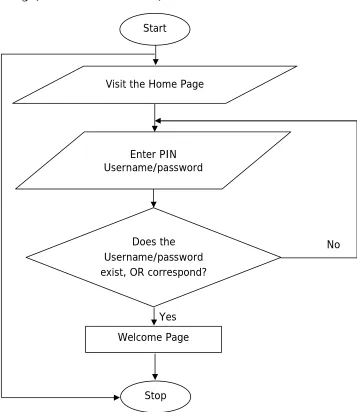
1. Home Page (User Authentication Process)
Fig 7: Diagram showing (Source: Field Work, 2018) Start
Visit the Home Page
Enter PIN Username/password
Yes
No Does the
Username/password exist, OR correspond?
Welcome Page
ISSN(Online): 2319-8753 ISSN (Print): 2347-6710
I
nternational
J
ournal of
I
nnovative
R
esearch in
S
cience,
E
ngineering and
T
echnology
(A High Impact Factor, Monthly, Peer Reviewed Journal)
Visit: www.ijirset.com
Vol. 8, Issue 3, March 2019
2. Application Submission Process
Fig 8: Diagram showing Application Submission Process (Source: Field Work, 2018) Start
Have all entries been made?
Stop
NO
Start a New Application?
YES
NO
YES
NO
Visit the Home Page Click on Admissions Center
Enter your PIN
Start entering all application details
Validate your PIN
Is the PIN valid?
Submit your Application
ISSN(Online): 2319-8753 ISSN (Print): 2347-6710
I
nternational
J
ournal of
I
nnovative
R
esearch in
S
cience,
E
ngineering and
T
echnology
(A High Impact Factor, Monthly, Peer Reviewed Journal)
Visit: www.ijirset.com
Vol. 8, Issue 3, March 2019
System Requirements Hardware Requirements
The following hardware components should be made available for full operation and performance: (i) A hard disk of about 40 (GB) and above. (ii) A Pentium M (1.6 GHz) processor speed. (iii) A flat screen monitor. (iv.) A RAM of at least 512 MB and above.
(v) An enhanced keyboard A printer. (vi) A UPS. Flash drives for backup files.
However, since it is a web application, any standard mobile device, can also access the web application easily. Software Requirements
This refers to all programs, which the computer needs to execute a complete process. For this software to run without any hitch, the following have to be installed;
(i) A web browser
(ii) Reliable antivirus software. Input /Output Design
The aim of design in any system development is to make data entry easy, and logical flow-charts free from errors. There is need for the operator to know the following during the entry:
i) The space allocated to each field.
ii) Field sequence, which must correspond to that in the source document. iii) The format in which the data are entered.
The validity of the input determines the accuracy of the output. The input presented must be as accurate as possible. This should be monitored so that illegal/wrong data would not be entered.
VI. CONCLUSION
In order to start to try and convince the skeptics that Knowledge base management is truly important to organizations’ continued success, it is advisable to try and generate discussion and thinking about the basics of knowledge itself, the different types, tacit, explicit and how it differs from information and data. Once this is achieved, the way through which KBM can fit into the organization can then be thought out. There is no debate about the value of KBM as a business practice in banking industries. However, most banks do not take is seriously, except for the Information Technology while a greater number of other companies do. Banking is an information-centered activity and it is a vital requirement to make information and knowledge available at the right time in the right place without delay. An effective KBM adopted could lead to better Return On Investments (ROI) and finally all sectors of banking industries will gain a lot as a new source of competitive advantage.
VII. RECOMMENDATION
ISSN(Online): 2319-8753 ISSN (Print): 2347-6710
I
nternational
J
ournal of
I
nnovative
R
esearch in
S
cience,
E
ngineering and
T
echnology
(A High Impact Factor, Monthly, Peer Reviewed Journal)
Visit: www.ijirset.com
Vol. 8, Issue 3, March 2019
REFERENCES
[1]Wikipedia, the World Encyclopedia (2009)
[2]Davenport T., Prusak L. (1998). “Working Knowledge, How Organization Manage What They Know”, Boston: Harvard Business School Press. [3]Alavi, M. & Leidnar, D.E 2001. Knowledge management and knowledge management systems: conceptual foundations and research issues. Management Information Systems (MIS) Quarterly, 25(1): 107-136.
[4]www.atlassian.com
[5]Gold, A. H., Malhitra, A. and Segars, A.H. (2001). Knowledge Management: An Organizational
[6]Gupta, J. N. D., Sharma, S. K. and Hsu, J. (2008). An Overview of Knowledge Management. In Knowledge Management: Concepts, Methodologies, Tools, and Applications (Jennex, M. Ed.), p.1, New York: IGI Global.
[7] Gupta, J. N. D., Sharma, S. K. and Hsu, J. (2008). An Overview of Knowledge Management. In Knowledge Management: Concepts, Methodologies, Tools, and Applications (Jennex, M. Ed.), p.1, New York: IGI Global.
[8]http://www.cs.unibo.it/gaspari/www/teaching /slides_KM2.pdf [9]www.slideshare.net/
[10]Ardichvili, A., 2008. Learning and knowledge sharing in virtual communities of practice: Motivators, barriers, and enablers. Advances in developing Human Resources, 20(10): 1-14.
[11]https://doi.org/10.1002/pits.21774