ISSN(Online): 2319-8753 ISSN (Print) : 2347-6710
International Journal of Innovative Research in Science,
Engineering and Technology
(A High Impact Factor, Monthly, Peer Reviewed Journal)
Visit: www.ijirset.com Vol. 8, Issue 3, March 2019
Development of Amphibious Drone for Flood
and Forest Rescue
Seethalakshmi.V 1, Sowndharya.N2, Swathiga.B2, Uma.K 2
Associate Professor, Department of Electronics and Communication Engineering, KPR Institute of Engineering and
Technology, Coimbatore, Tamil Nadu, India1
U.G. Student, Department of Electronics and Communication Engineering, KPR Institute of Engineering and
Technology, Coimbatore, Tamil Nadu, India2
ABSTRACT: Drones have noticeably outperformed humans at finding people in need of assistance. Furthermore, the fact that drones can fly makes it easier to locate at higher altitudes, like those taking shelter on rooftops during flood. In various disasters, both natural and man-made, drones are used to deliver much-needed supplies to areas that would otherwise be inaccessible. This research paper explains the construction and implementation of Amphibious Drone and its application in Flood and Forest Rescue. The Amphibious Drone is an UAV which can land both in ground and water surface. It is made water proof to survive the flood and other disaster condition. The main aim of Amphibious Drone is to drop life saving kits to the sufferer in the flood affected area or forest zone. The dropping mechanism is done by using Servo motor. Voice recognition kit – ‘Helper kit’ is placed in forest based on prediction and human intuition. The kit will sense and detect the voice signals of humans and in turn alert the drone pilot, if there is any emergency occurs. The message is send using GSM module. The Drone pilot will extend the help to the sufferer using the Drone. The Amphibious Drone have more Efficiency than other option.
KEYWORDS: Amphibious Drone, UAV (Unmanned Aerial Vehicle), Voice Recognition, GSM
I. INTRODUCTION
An Amphibious drone is an unmanned aircraft that can fly with a human in control. A drone is formally known as unmanned aerial vehicles (UAVs) or unmanned aircraft systems (UAS). Essentially, a drone is a flying robot. UAVs have most often been used in the field of military but they are also used for search and rescue during natural disasters like flood, earthquake, landslides, tsunami, city surveillance, traffic monitoring, weather monitoring, fire Fighting, research applications in scientific community, fire sensing and some important areas. In addition, the drone carries a life saving materials that can help survivors in initial level rescue and treatment as shown in Fig.1.
Drones have received both pros and cons because of their associations with invasion of privacy and with their armed deployment in war. There is a more positive use that provides protection,safety and relief from disasters. Natural disasters destroy wildlife and other environment, often making conditions so difficult to relief workers and are unable to access areas and provide assistance. Drones have the ability to take on position where relief workers and manned vehicles suffer to reach people.
Fig.1 Drone prototype
II. RELATEDWORK
(1) Samba Siva, B. Prudhviraj kumar, this paper explains the research and development of a Mini Unmanned Aerial vehicle. Unmanned aerial vehicles offer advantages for many advantages when comparing with their manned counter parts such as military and disaster and rescue operations, and survey and for monitoring the weather conditions. They preserve army man of working in unfavourable conditions that can be encountered not limited to military applications but also in other scenarios involving operation in bad weather conditions, trees, near to buildings, infrastructures and other obstacles.
(2) Mr. B. Vinoth Kumar, this paper presents a design for quadcopter that can autonomously detect and take initial steps to stop gas leakage in vulnerable premises by alerting people. The gas sensor has been used which has high sensitivity for methane and LPG. The system consists of leakage of gas detection module which warns by sending information and by an alarm in efficient manner.
(3) Alex G. Kendall, Nishaad N. Salvapantula,this paper presents the development of an object tracking controller for a quad copter using an on-board vision system. A low-frequency monocular computer vision algorithm is applied in closed-loop to track an object of known color. It could be used to locate the target efficiently.
(4)In 1973, Raj Reddy et al. have developed a HEARSAY system for voicechess application. The task of HEARSAY system is to recognize a spoken move in a given board position. The model used hypothesis and test paradigm with a set of cooperating independent parallel processes. The information from all the processes is collabrately used to recognize the spoken utterance.
(5)In 1976, G.M. White.carried out isolated-word recognition using city names and alpha digits. The linear predictive algorithm and analysis for preprocessing and dynamic programming for classification are used. It is observed that the use of data reduction techniques leads to the reduction in the performance of speech recognition systems.
ISSN(Online): 2319-8753 ISSN (Print) : 2347-6710
International Journal of Innovative Research in Science,
Engineering and Technology
(A High Impact Factor, Monthly, Peer Reviewed Journal)
Visit: www.ijirset.com Vol. 8, Issue 3, March 2019
The Amphibious Drone is made to land in ground and to float in water surface. The drone block diagram is shown in the Fig.2 . The transmitter sends signal to the receiver and the Flight controller will operate the motor,ESC and propeller using a 2200 Mah batteryIt will work under any natural disasters like flood and heavy rain, thus it is made waterproof to survive the condition.The drone have an ad-hoc structure connected to it to carry the life saving materials. The ad-hoc structure includes the carrier and door opening system implemented using servo motors.This constitutes the payload of the Amphibious Drone.
Fig.3 Proposed method – Voice Recognition System
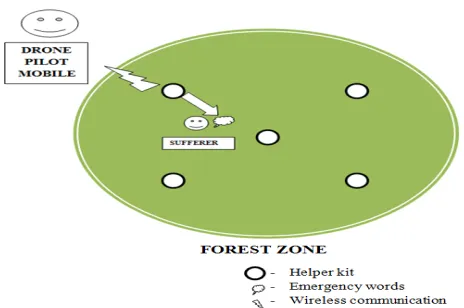
The speech recognition kit is implemented or placed in a forest zone and the block diagram is shown in Fig.3. The location is determined by prediction and human intuition. When a person lost in a dense zone of forest, he/she will be found only by a response to a compliant. But that will create a delay where the person may be dehydrated to death or face an animal attack in that certain delay. The ‘HELPER’ kit will sense the voice of emergency i.e for an example when a person ask for ‘HELP’ or any other word, the kit will sense the voice signal. Then the kit will detect that voice and compare the words with already fed commands using an Arduino board. If the words match, then Arduino will activate the GSM module to send a Short message to the number held by Drone pilot.
IV. METHODOLOGY
Process
The following are the process of the proposed system:
Fig.4 Flow chart
Drone Mechanism:
The Necessary survival materials and emergency kits are dropped by the drone to the person suffering in a flood zone or in a forest- incase of being lost. The Sufferer can be found by camera. The location can be found out by using GPS and it is transferred to Drone pilot using GSM module. After the drone reaches the sufferer location, it will identify the person by manual operation using camera. Then the kit carried by the drone is dropped near the sufferer. The signal is send to the flight controller by the Transmitter. Then the Flight controller will turn on the servo motor. It will rotate from 0 degree to 180 degree and vice versa. So the door open and close accordingly.
Simple prediction:
ISSN(Online): 2319-8753 ISSN (Print) : 2347-6710
International Journal of Innovative Research in Science,
Engineering and Technology
(A High Impact Factor, Monthly, Peer Reviewed Journal)
Visit: www.ijirset.com Vol. 8, Issue 3, March 2019
Fig 5 Simple Prediction
The life saving kit may include: Medical Kit or First Aid Kit
Medicines such as pain relievers , Anti-diarrhea medicines , Antacids or laxatives Sunburn relief ointment, Cotton balls and Cotton swabs
Ropes,Ladders and Lifebuoys or life rings Food stuff and water bottles
Mosquito repellent and Dust mask to help filter contaminated air Flashlight
Future Enhancement:
The future research can be carried out to implement and design the amphibious drone with AI technology to avoid the obstacles automatically while flying.
The future research includes addition of fuel system instead of power supply to fly over long distance via GPS or Google maps.
The artificial intelligence implemented in this project can be efficiently used in navy, commando operations, survey, surveillance, time lapse recording, security purposes, etc,.
The amphibious drone can be used to drop missiles from a certain distance. This will improve the life safety of military soldiers.
Implementing facial expressions and facial identification can provide more improved rescue and surveillance measure to the people.
Implementing electrode carrying system can be useful in medical accidents and abnormal situations. Especially carrying defibrillator unit will make the survival rate to be increase.
V. RESULTANDDISCUSSIONS
The Amphibious drone can fly up to 100 meters height from the ground level. We can use GPS module to follow the location and direction of drone on its flight. We can also help the sufferers from flood and survivors from dense forest using the kit carried by the amphibious drone. The delay of reaching the survivors by the traditional rescuers can be reduced efficiently by using the drone. The Helper kit placed in the forest can sense the voice of the survivors and can alert the people about their critical situation.
module by dumping the code in the arduino these words are processed. The Fig.6 and Fig.7 shows the resultant Drone setup and Helper kit setup.
Fig.6 Drone Setup Fig.7 Helper kit setup
VI. CONCLUSION
This paper presents an approach which could be used for developing a small and compact sized water proof Amphibious Drone which can be used to carry out rescue operations.
There are several problems arise in carrying out rescue operations. It is costly to carry out a rescue mission as it requires many resources and expenditures. Large number of trained and skilled manpower is required for operating rescue operations. Unfavourable conditions such as bad weather, land sliding, earth quakes could appear as a threat during trying to save people.
The Amphibious Drone save lost people in forest zone using voice recognition system and it will provide the first line of warning about the lost person. In some cases, it can help people from animal attacks and other miserable condition. It save people during crisis as it has 70% of success ratio. Thus the Amphibious drone will help efficiently in rescue operations.
REFERENCES
[1]. Dhriti Raj Borah et al., “A review on Quadcopter Surveillance and Control”, ADBU-Journal of Engineering Technology, 4(1), 116-119,2016. [2]. Prof.A.V.Javir, Ketan Pawar, Santosh Dhudum, et al., “Design, Analysis and Fabrication of Quadcopter”, Journal of the International
Association of Advanced Technology and Science, vol. 16, 2015.
[3]. Yiwen Luo, Meng Joo Er, et al., “Intelligent Control and Navigation of an Indoor Quad-copter”, IEEE, 1700-1705.2014.
[4]. Gordon Ononiwu, Arinze Okoye, et al., “Design and Implementation of a Real Time Wireless Quadcopter for Rescue Operations”, American Journal of Engineering Research, 5(9), 130-138.2016.
[5]. Prabhjot Singh Sandhu, “DEVELOPMENT OF ISR FOR QUADCOPTER”, International Journal of Research in Engineering and Technology, 03(4), 181-189, 2014.
[6]. Samba Siva, B. Prudhviraj kumar, et al., “Development of Mini Unmanned Aerial Vehicle”, IOSR Journal of Mechanical and Civil Engineering, 12(2), 16-19, 2015.
[7]. Vimal Raj , Sriram, Ram Mohan , Manoj Austin , “Design and fabrication of inclined arm miniature sized quadcopter UAV”, IOSR Journal of Mechanical and Civil Engineering,13(5), 73-76,2016.