Design, Fabrication and Performance Analysis
of a Versatile Multi Harvesting Tool
Rameez Rasheed Adam1, Rahul S2, Nihal Shanavas3, Nithin Das4, Premkrishnan P5
B.Tech Student, Dept. of ME, KMEA Engineering College, Kerala, India1
B.Tech Student, Dept. of ME, KMEA Engineering College, Kerala, India2
B.Tech Student, Dept. of ME, KMEA Engineering College, Kerala, India3
B.Tech Student, Dept. of ME, KMEA Engineering College, Kerala, India4
Asst. Professor, Dept. of ME, KMEA Engineering College, Kerala, India5
ABSTRACT:There are a number of challenges faced in harvesting different fruit crops that have resulted in their decrease in production levels accompanied with price hikes. Most of these fruits are highly demanded in both domestic as well as foreign markets e.g.: jackfruit. Due to ineffectiveness of traditional harvesting methods such fruits undergo damages making them unfit for use resulting in loss of crop. Here an effort is made to develop a multi-harvesting tool intended to be applied to harvest a wide variety of fruits from tall trees. The main feature of this tool when compared with other newly developed fruit harvesting devices is that it offers versatility as it can be applied for harvesting from peppercorn(lightest) to jackfruit(heaviest).To ensure feasibility of product suggestions from local farmers has been considered.Apart from harvesting, this tool could also be used in spraying pesticides when incorporated with pressure pump and sprayer. The testing showed good results in fruits like mango, tamarind, papaya, custard apple.
KEYWORDS:Multi-harvesting tool, versatility, Jackfruit, peppercorn, pesticide, pressure pump.
I. INTRODUCTION
Manual fruit plucking operations from tall trees involved either usage of tall pole to pull fruit downwards or the operator himself climbing the tree to cut it down. On using a pole, various difficulties arises such as effort in positioning the pole, pulling force to be applied while climbing of tree is a cumbersome and riskier task. In either of methods the fruit is made to fall to ground and the impact so produced may burst the fruit making it non-usable. Throughout the years in consideration to this, many engineering solutions have developed. Main drawback of all such is the complexity of equipment, cost involved, and lack of versatility. As far as jackfruits are concerned, they are highly demanded in both the domestic and foreign markets due to their medicinal advantages and related food products. However manual jackfruit plucking is complicated task mainly due to their weight and nature of jackfruit tree. A few engineering solutions were proposed to it in recent times which however has proven to be too complex for harvesters.
`
ISSN(Online): 2319-8753 ISSN (Print): 2347-6710
I
nternational
J
ournal of
I
nnovative
R
esearch in
S
cience,
E
ngineering and
T
echnology
(A High Impact Factor, Monthly, Peer Reviewed Journal)
Visit: www.ijirset.com
Vol. 7, Issue 4, April 2018
II. LITERATURESURVEY
This section discusses about the informations utilized from reference materials and also explains the point where conceptual designing was started.From reference journal [3] we identified simplicity offered involving tall poles identical to conventional harvesting method. From reference [2] the cutter was decided to be attached to same pipe member rather than providing separate extension which otherwise complicated design. From reference [1] it was identified to involve a member under cutter to receive falling fruit. However rather than a bucket, we have placed a clothed path with zip arrangement at bottom. As far as jackfruit is concerned a need for separate frame is identified. Since the structure is intended to be tall and subjected to varying stimuluses, anticipation for a number of design calculations was realized which all other similar fruit harvesting devices lack. This was refered from [4] and [6].Material selection was aided by reference [5]. Throughout designing suggestions from local harvesters were considered to set design constraints that is dimensions.
III.COMPONENTS INVOLVED AND MODELLING
The proposed multi harvesting tool consist of following parts: 1. Pipes
2. Coupling
3. A-frame with nets attached by means of magnets and ropes 4. Mini frame with a cloth fabric embedded
5. Cutter
6. Hand wheel unit
Below is some detailed description of the parts involved. Modelling is done on Solidworks software.
1. Pipe and coupling:
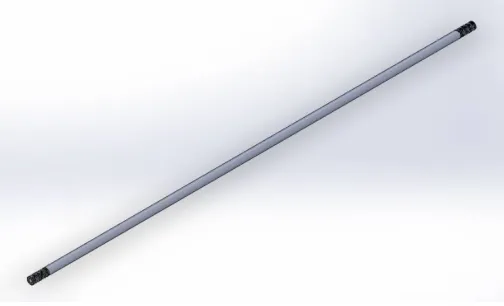
Fig 1: Pipe model
Fig 2: coupling
2. V-Frame with nets attached to it
V-frame is a component only used for heavier fruits like jackfruit. It is used to support nets which will be positioned under jackfruit by the operator. Magnets are attached at the ends of the net that keeps them attracted with the frame. Frame can be positioned anywhere along the pipe and is fixed by clamp in that position.
Fig 3: V-Frame with total length 1000mm
`
ISSN(Online): 2319-8753 ISSN (Print): 2347-6710
I
nternational
J
ournal of
I
nnovative
R
esearch in
S
cience,
E
ngineering and
T
echnology
(A High Impact Factor, Monthly, Peer Reviewed Journal)
Visit: www.ijirset.com
Vol. 7, Issue 4, April 2018
3. MHT Mini frame:
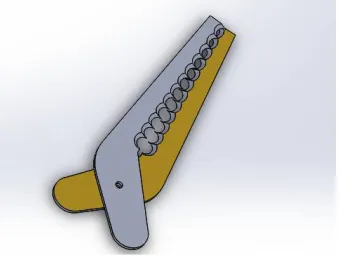
Fig 4: MHT Mini frame model
This structure is only intended for smaller fruits. The legs will have a fabric cloth attached for guiding the falling fruit safely down. Similar to A-frame it can also be positioned at any desired height and is clamped. Total length is 300mm.
4. Cutter:
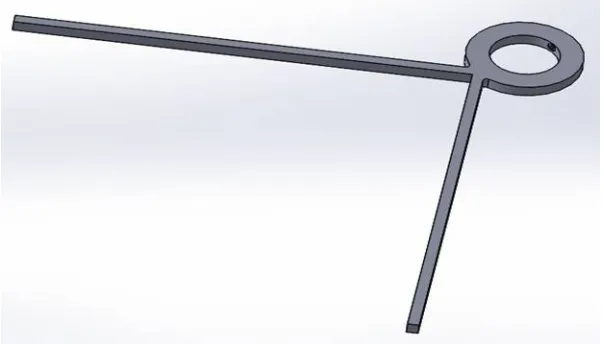
Cutter model is inspired from scissors. It is clamped as per convenience. Made of carbon steel, the cutter is actuated by pulling rope attached to one of its legs. Its model is as shown:
Fig 5: Cutter model with length of 200mm
Since the present model offers a problem to provide leverage for actuating cutting action, thin plates of different lengths are welded on its either legs.
5. Pulley and hand wheel unit:
Both these components are to be used only for harvesting heavier fruits. Pulley is attached at top for hanging the member. Hand wheel unit comprises of handle connected to worm gear. The worm wheel is in turn connected to a rope drum with ropes wound over it. This unit converts rotary motion of handle to motion of rope drum. Hand wheel unit is clamped to pipe member.
Fig 6: Assembled view of MHT
IV.WORKING
During designing considerations were given to ensure simplicity of product. A number of circular pipes held together by couplings is used to raise to the desired height. In order to facilitate the usability it is done manually by the operator. Frame and cutters are clamped to the pole temporarily in order to facilitate height adjustment. The operator holds the setup from bottom. He actuates the cutting action by pulling the cables attached to cutter handle. Following explains the working:
Working of tool is explained for two operating cases: 1. For plucking smaller fruits:
For this MHT mini frame is clamped onto the pipe by the operator. The operator then positions the tool onto the fruit to be cut. He actuates the cutting action by pulling the cable of cutter. Once the fruit is cut, it free falls down through the mini frame. The cloth passage tends to decelerate the falling fruit on its way down. On placing a suitable collector at bottom (optional), the fruit can be collected. Due to this deceleration the effect of impact on ground is negated.
2. For plucking heavier fruits (10Kg-15Kg):
In this case a pulley is to be fastened to top and the mini frame has to be replaced by MHT frame. MHT frame is open frame with members intended to carry nets attached by magnets. The nets has a rope drawn from pulley towards the downside where operator stands. It is connected to a hand wheel unit. The cutter is positioned and cutting action is actuated in similar manner as previous case. As the fruit falls it impacts the nets due to which the nets gets detached from frame and also falls down with fruit. As the net falls it wraps the fruit. The falling is decelerated by manually braking the rotation of hand wheel unit. Hence the fruit can be brought to ground safely.
V. MATERIALSELECTION
In order to select the material required for pipe, coupling, and frame we have performed the weighed point method. Following are our criteria
`
ISSN(Online): 2319-8753 ISSN (Print): 2347-6710
I
nternational
J
ournal of
I
nnovative
R
esearch in
S
cience,
E
ngineering and
T
echnology
(A High Impact Factor, Monthly, Peer Reviewed Journal)
Visit: www.ijirset.com
Vol. 7, Issue 4, April 2018
• Availability • Durability
• Weight
Materials evaluated are Stainless steel, Galvanized iron, and Aluminium.
Table 1: Weighed Point Method for Material selection
Material strength cost weight availability durability
Stainless steel x x x
Galvanized iron x x x x
Aluminum x x x x
Above table 1 shows the weighed point analysis for 3 materials chosen. Stainless steel and Aluminum were more costly than GI. Even though Aluminum has comparatively lowest weight, it can undergo excessive deflections when subjected to stimuluses. Strength of aluminum depends on its thickness which in turn is proportional with its cost. Hence GI is selected.
Mass calculation:
Following is to evaluate the mass of a 2m GI pipe:
m=ρAL
ρ= Density of material= 7100Kg/m3
A= Area of cross-section= (Π/4)*(Do2-Din2) = (Π/4)*(33.22-30.22) =149.6mm2 (selecting 11/4 inch pipe)
L= Length of pipe=2m=2000mm
Therefore mass of 2m GI pipe, m= 2.1Kg.
Hence for 8m height, total weight involved is= 8.6kg=84.36N.Holding onto such weight for longer time induces fatigue in operator. So a pulley may be used for hanging the tool on branch of tree to reduce weight carried.
VI.ANALYSIS
Since MHT is subjected to varying mechanical stimuluses it is to be ensured that the tool safely meets them. Also since the tool has hanging members it is also to be ensured whether stresses acting due to self-weight are within permissible limits and their contribution to the strain energy stored in pipe.Here Von-MISES criterion has been selected as the theory of failure. Analysis is done for an 11/4 inch GI pipe. For SG grade 350
Ultimate strength, σy = 350MPa, Assuming FOS = 2.5
Allowable stress= Design stress (or failure stress)/ FOS
Substituting values, σyd = 350/2.5 = 140Mpa
From Solidworks on subjecting the pipe to self-weight load and an external load of 120N (12 Kg) the principal
stresses are obtained as σ1=98.23Mpa, σ2=23.483MPa, σ3 = -10.652Mpa. From Shear Energy Theory or Hencky-Von-Mises Theory we have:
Von-Mises stress, σe= {[(σ1-σ2)2+ (σ2-σ3)2+ (σ3-σ1)2]/2}0.5
On substituting values, σe= 96.456Mpa, which is less than allowable stress of 140Mpa, Hence the design is safe.
In a similar manner the procedure was repeated and it was found that structure could effectively withstand an external load of 17Kg after which it surpasses the allowable stress and fails. Safety of both the frame and cutter is analysed from strength consideration using ANSYS workbench. Also the stresses induced on MHT mini frame due to impact of falling fruit is analysed. From databook we have impact stress induced on member due to impact of object from height:
σb= (WLc/I)*(1+ (1+ (1+ (6hEI/WL3)0.5)
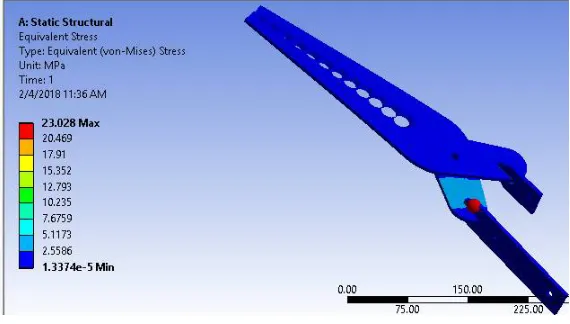
Substituting all the values and computing we obtain σb= 1.512MPa. On analysing the structure subjected to same
stimulus in ANSYS (Fig 7), our results are close to one displayed σb=1.588MPa.
.
Fig 7: Results of bending stress analysis on MHT frame
Cutter is made of plain-carbon steel with a weight of 600gm. The effect of self-weight on cutter is considered to ensure safety since it is a hanging member (as shown on Fig 8). In order to check whether this self-induced stress is safe we analyse the model with carbon steel material on Ansys. Below shows the effect of self-weight on cutter:
Fig 8: Results of stress due to self-weight of cutter in ANSYS
`
ISSN(Online): 2319-8753 ISSN (Print): 2347-6710
I
nternational
J
ournal of
I
nnovative
R
esearch in
S
cience,
E
ngineering and
T
echnology
(A High Impact Factor, Monthly, Peer Reviewed Journal)
Visit: www.ijirset.com
Vol. 7, Issue 4, April 2018
Fig 9: Results of strain energy stored in member from ANSYS
As shown above strain energy is analysed. The results were such that pipe member can effectively withstand stimuluses of up to 15Kg since it is below maximum limit. This is shown in Fig 9.
VII. FABRICATIONANDINFERENCES
The tool was fabricated with GI pipes and was tested. Following are inferences:
1. It was identified that it was difficult to raise the setup from the ground due to moment of inertia so a support frame with GI square pipe was constructed.
2. The cutter was attached at top which could be actuated by pulling rope provided at bottom.
3. Cloth fabric was attached to frame to act as path for falling fruit. For decelerating the fruit a converging-diverging shape is given for path. A zip arrangement is provided at bottom to collect fruit.
4. Current model was not found feasible to apply to jackfruit harvesting due to weight reasons. 5. The tool was integrated with a pressure sprayer, so as to spray pesticides at elevations
Some fabricated component images are shown below:
requires less operator effort to actuate cutting action. Fig 13 shows clothed fabric intended to act as a passage for falling fruit. A zip arrangement (not shown in fig) is provided to collect at bottom.
VIII. CONCLUSION
MHT tool capable of harvesting from peppercorn to jackfruit was effectively designed. The selected material was GI. After fabrication it was identified that weight makes the tool difficult to handle.So it is concluded that the pipe member could have been made either by aluminum alloy or glass reinforced plastic (GFRP) which will reduce overall weight of tool making it fit for jack fruit harvesting. The product showed good capability in fruits like mango, tamarind, papaya, custard apple Also the device may be incorporated with a pressure sprayer to spray pesticides at elevations which we successfully performed. This work may be used as a basis for developing a versatile harvesting tool capable of harvesting wide variety of fruits.
REFERENCES
[1] Nadine Sangster, Terrence Lalla, Satesh sookho, Kristine Baptiste,“The Design of a Fruit Picking device”, IJAIEM, Vol 6, Issue 8,pp.78-84, 2017. [2] Kemparaju C.R, Tareen S.R, Shreedhar M, Mazood Shafeque, “Fabrication of Multi-Purpose Variable length plucking/cutting machine”, IRJET, Vol 4, Issue 6, pp.2637-2641, 2017.
[3] P.K Ratnakumar, “Development of a tool for effective mango harvesting to reduce post-harvest loss”, IJPPHT, Vol 4,Issue 2, pp.135-137, 2013. [4]Dr. Lingaiah, Prof. B.R Narayana Iyenger, “Machine Design Data Handbook”, Suma publishers, Vol 1, Edition 4, 2006.