ISSN(Online): 2320-9801
ISSN (Print): 2320-9798
I
nternational
J
ournal of
I
nnovative
R
esearch in
C
omputer
and
C
ommunication
E
ngineering
(An ISO 3297: 2007 Certified Organization) Vol. 3, Issue 6, June 2015
Adaptive Decision Tree Classifier Enabled
Rain Pixel Recovery in Video Using Motion
Segmentation
Anjaly Reghunath, Bijy Mathew
Pursuing M.Tech, Dept. of CSE, Caarmel Engineering College, MG University, Kerala
Associate Professor and Head, Dept of CSE, Caarmel Engineering College, MG University, Kerala
ABSTRACT: Rain in a video or image degrades the appearance of the system hence it is necessary to remove rain from the videos. This paper proposes a new method for detection and removal of rain. Basically rain in static areas can be easily removed but in case of dynamic scenes it is difficult. Here we use motion segmentation that segments static and dynamic portion of a video. For that optical flow is used. After that as an enhancement adaptive decision tree classifiers are used to classify foreground and background image in a video. After classification chromatic and photometric properties of rain are applied and rain affected area is identified. After that three buffers are created for rain, motion and frame. Rain affected video is passed to high pass filter to remove the rain pixels. After that regaining of corrupted pixels are employed. For that neighbourhood method is employed.
KEYWORDS: Adaptive decision tree classifier, motion segmentation
I. INTRODUCTION
Normally weather conditions are a threat to video or image quality. Hence it is necessary to remove these effects. Basically there are two types of weather static and dynamic. Static weather is easy to handle where as dynamic weather due to its spatial nature is difficult to handle. Rain comes under dynamic weather condition which is difficult to handle.
The existing methods deal only with static scenes. In case of dynamic scenes the results are poorer. To overcome this disadvantage a new method is being proposed ie, motion segmentation. Motion segmentation gives a better result compared to all the existing methods. It handles both static and dynamic scenes in a video effectively. Motion segmentation is a new concept. There are a wide variety of applications for rain removal.
As an enhancement adaptive decision tree classifier is being employed. It is used to classify a video as foreground and background image. It is a method basically used for supervised learning. Clustering is very much effective compared to Gaussian mixture model. Here time consumption for training the data is also very less. After classification chromatic and photometric properties of rain are applied and rain affected area is identified. After that three buffers are created for rain, motion and frame. After that rain affected video is passed through high pass filter. For static and dynamic scenes the value of filter coefficients are different. The pixels that are not affected by rain are returned as it is.
II.LITERATURE SURVEY
ISSN(Online): 2320-9801
ISSN (Print): 2320-9798
I
nternational
J
ournal of
I
nnovative
R
esearch in
C
omputer
and
C
ommunication
E
ngineering
(An ISO 3297: 2007 Certified Organization) Vol. 3, Issue 6, June 2015
All weather conditions are different from one another. One may be static and the other may be dynamic. Based on the difference in the properties, weather conditions can be broadly divided as steady that includes fog, mist and haze or dynamicthat includes rain, snow and hail. In case of weather conditions like fog, mist, individual droplets are small in size (1 − 10 μm) to be detected by a camera. So the models such as volumetric scattering model describing attenuation and air light can be used to essentially describe the effects of weather which is steady [2]. Large number of new algorithms has been developed recently to remove the effectscaused by steady weather fromimages
.
In the works that are existing, focus is on the effects of rain. Rain consists of collection of a large number of various size drops falling down at large velocities. Each drop acts like a sphere which is transparent, refracting and reflecting light from the environment towards the camera[1]. A collection of each drops falling at very high velocities results in time varying intensity fluctuations in images and videos. Due to the finite time the camera is exposing, intensities due to rain are motion blurred and therefore depend on the background. Thus, the representations of rain visually are a combined effect of the dynamics of rain and the photometryof the environment.
The physical properties of rain have been widely analysed in fields such as atmospheric sciences. It briefly analyses the properties of rain and convey observations that are relevant to goal of modelling the appearance of rain. The size of a raindrop normally varies from 0.1mm to 3.5 mm. The representation of drop sizes in rain is represented by the Palmer distribution [2]. Basically the density of rain drops decreases exponentially with the size of the raindrop. The shape of a drop can be expressed in terms of its size. Smaller raindrops are generally spherical in shape while larger drops are similar to oblate spheroids. In a normal rainfall, most of the drops are not more than 1mm in size. Hence, most raindrop ops are spherical.
Detection and recognition of moving objects are main functions in giving assistance. In extending the application area from highway to inner city scenarios, non-rigid objects like pedestrians and bicyclists must be considered. If object detection is based on motion segmentation, the first important step is to track the object parts or object features. In general there are two different problems to be addressed in feature tracking: Which image features can be tracked successfully in the image sequence and how well do these features describe the objects being tracked . The density of the points that are tracked is usually not sufficient for an object description. A natural way is to track edges instead of points. Although it is successful for objects which are artificial, it is very difficult to describe natural objects with a few edges. Colored regions are normally determined by color segmentation.
Probabilistic model based rain removal algorithm is another method that is used. This algorithm is better in finding the rain intensity variations. Probabilistic approach are capable of automatically adjust the threshold and effectively differentiate the rain pixels and non-rain moving object pixels. Differentiation is basically carried out between the objects in both rain and non-rain which are moving by using the time evolution of pixels
in consecutive frames. This algorithm does not assume the
shape, size and velocity of the raindrops as similar and rain intensity, which makes it more robust to different rain conditions. Advantage of this algorithm is that it automates the algorithm and reduces the interaction with user. Here, it is assumed that the camera which captures the scene is stationary. There is a significant difference between the rain and non-rain pixel's time evolution in videos. This difference is captured with the help of the skewness and Pitman test for symmetry. Previous results shows that proposed algorithm gives lower number of miss and false detection in comparison with other algorithms. This algorithm helps in reducing the complexity and execution time of the algorithm because it works only on the intensity plane[4].
ISSN(Online): 2320-9801
ISSN (Print): 2320-9798
I
nternational
J
ournal of
I
nnovative
R
esearch in
C
omputer
and
C
ommunication
E
ngineering
(An ISO 3297: 2007 Certified Organization) Vol. 3, Issue 6, June 2015
can be edited for removing rain, and to regain motion of camera after rain removal. In the algorithm can handle all types of rain. This method is only applicable with static background, and it gives out false results for particular foreground colours.
III. PROPOSED SYSTEM
This paper proposes a method to remove the rain from videos. This is used in applications such as security surveillance. Here a new approach is proposed that is motion segmentation where moving objects are effectively identified. The existing methods are good for static scenes but perform poorly in dynamic scenes. Here photometric, chromatic and locality cues are considered for detection. After that rain removal filters are applied and rain is removed.
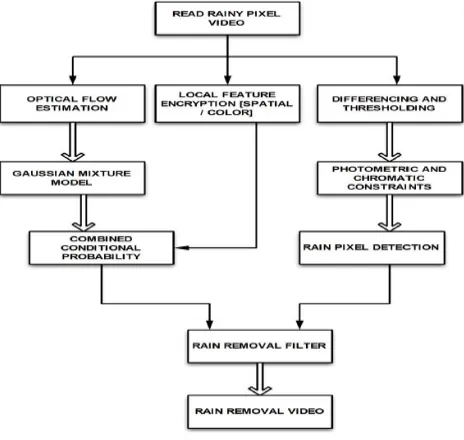
Figure 1: Block diagram of Rain Removal Using Motion Segmentation
Fig.1 shows the block diagram of rain removal pixel using motion segmentation. The steps involved are motion segmentation, rain detection from videos, buffer creation, applying filter to remove rain from videos and recovering the original scene having no rain. Motion field estimation is the first step.
Here user first inputs the video and the system reads it. Then optical flow is estimated using motion segmentation. Optical flow is estimated to find out the moving objects in a video. After that the moving components are given to adaptive decision tree classifier to cluster. Then conditional probabilities are applied and local features of rain are extracted to identify the rain affected pixel in motion area. The same way in static area differencing and thresholding are applied and after those chromatic and photometric properties are applied and both are given to rain
removal filters. For rain affected pixel in motion are filter coefficient as are set as α=1 and β=1/4√2 and for static area
α=2/stk, β=0 where stk is the depth of the buffer. Normally stk is set as 9.
3.1 Pre-processing
ISSN(Online): 2320-9801
ISSN (Print): 2320-9798
I
nternational
J
ournal of
I
nnovative
R
esearch in
C
omputer
and
C
ommunication
E
ngineering
(An ISO 3297: 2007 Certified Organization) Vol. 3, Issue 6, June 2015
3.2 Segmentation of video
Motion segmentation is used to find out the objects that are in motion. In a video there can be static as well as dynamic objects. Static objects mean objects that are not moving where as dynamic objects that are in motion in the video itself. Optical flow is basically employed to perform motion segmentation. After performing optical flow calculation, moving objects are identified and separate treatment is given to moving and static objects.
For classification of static and dynamic objects in this paper adaptive decision tree classifier approach is used. This is a new concept. This method is basically used for supervised learning. In supervised learning examples are fed and from that examples classification is being carried out. It is an efficient method compared to Gaussian mixture model. In adaptive decision tree classifier classification is effective for static and dynamic scenes.
Decision trees are based on certain rules. It can very easily classify objects in a scene or video. This method is basically used in neural networks. It basically uses highly modern techniques for classification.
3.3 Local properties and buffer creation
For detecting rain affected pixels in video local properties are also considered. The local properties include pixel’s location and its chromatic properties. Here a feature vector is being created to represent these spatial details and also colour information. The feature vector consists of intensity values of the R,G,B channel. After creation of feature vector k-means clustering is used. After this we get a count of the pixels that fall into the motion field. This can be grouped as a single cluster. This method effectively determines motion cues in a video.
After performing the above steps rain affected pixels are identified by using physical properties of the rain. After that 3 buffers are created. The rain pixels in the motion area will be in one buffer say Sm. The rain the static scene ie in the background comprises another set say Sb and the final one is Sp that consists of pixels that are not affected by rain ie that are not included in Sm and Sb. Sc is the buffer that consists of all the pixels in a rainy video. These buffers can be represented using (len,wid,stk), where is len*wid is the video frame size and stk is the depth of thebuffer
.
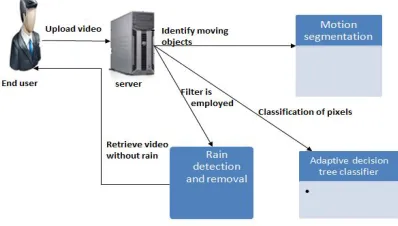
3.4 System Architecture
The system specifies the flow of operations in the proposed system. In this level the end user uploads the video to the database. It is then accessed by the server to perform the necessary operations to remove the rain from video and regain its original pixel values. Here the operations performed are first identify static and dynamic scenes in a video using motion segmentation and cluster them based on adaptive decision tree classifier. Then physical ,chromatic and photometric properties are applied to identify the rain and non rain pixels. After that rain removal filters are applied and rainy effects are removed then its original pixel values are restored with the help of neighbourhood pixel values.
ISSN(Online): 2320-9801
ISSN (Print): 2320-9798
I
nternational
J
ournal of
I
nnovative
R
esearch in
C
omputer
and
C
ommunication
E
ngineering
(An ISO 3297: 2007 Certified Organization) Vol. 3, Issue 6, June 2015
3.5 Property of raindrop
A. A raindrop’s shape
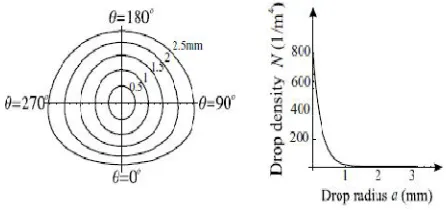
When a rain drop falls on the ground there will be distortion in its shape. The shape of a normal rain drop is spherical in shape. But when it falls on the ground the shape may vary. It may change to spheroid shape. No rain drop is perfectly spherical. Its shape may change as its size gets increased. A smaller rain drop may be spherical in shape. The drops acts like a glass which reflects the light.
a: Shapes of rain drops b: drop size distribution
Fig 3: (a) Shows shapes of raindrops of various sizes (b) Shows number density of a rain drop as a function of drop size
B. Size of A Rain Drop
Rain drop will be different in its size. Basically rain drop size is given by N(a) = 8 × 10⁶e−8200∗h−0.21a [2].
Basically a rain drop will be small in size. As the size increases the rain drop may lose its original shape ie spherical shape. So the size and shape are related. Both may vary linearly.
3.5 Detection And removal of rain Drops
After applying all the above mentioned properties of rain, the pixels that are affected by rain are identified and grouped. The properties may include physical, chromatic properties. After identifying the mentioned properties it is then passed to the filters to remove the rain from the frames.
For the rain covered pixels in static background, filter coefficients will be α = 2 stk, β = 0. Here Gaussian filters are being used. The filters used are high pass filters. The pixels in the motion area the coefficients set will be different from static, filter it is set as α = 1, β =1/4√2. The pixels that are not covered by rain drop, no operations are performed. It is placed as it is.
IV. APPLICATIONS
Rain removal has many applications such as
It can be used in security surveillance
Navigation which employs vision Video/movie editing
ISSN(Online): 2320-9801
ISSN (Print): 2320-9798
I
nternational
J
ournal of
I
nnovative
R
esearch in
C
omputer
and
C
ommunication
E
ngineering
(An ISO 3297: 2007 Certified Organization) Vol. 3, Issue 6, June 2015
V. RESULT
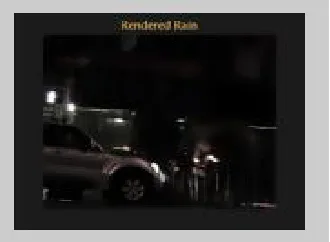
Fig 4(a): Denote video frame having rain
Fig 4(b): Denote the same video frame after removal of rain
The proposed method using motion segmentation very effectively identify the objects in motion in a video and using the enhancement as proposed ie adaptive decision tree classifier very easily identifies the moving objects and cluster them effectively. As an enhancement adaptive decision tree classifier is used which determine the threshold value from the training examples that is fed. In the existing system intensity value is calculated using manually defined threshold but in the proposed system it is determined from training data that is given. Decision tree can be used as an effective method. It effectively clusters data or images in a system. It classifies objects as foreground and background based on different criteria. It performs well compared o all existing methods. It can very easily group a video frame into static and dynamic. Fig 5: (a) Shows rain in dynamic scenes (b) Shows the scene after applying our rain removal. The figure denotes that our proposed method effectively handle rain in dynamic scene compared to the existing methods.
VI. CONCLUSION
ISSN(Online): 2320-9801
ISSN (Print): 2320-9798
I
nternational
J
ournal of
I
nnovative
R
esearch in
C
omputer
and
C
ommunication
E
ngineering
(An ISO 3297: 2007 Certified Organization) Vol. 3, Issue 6, June 2015
methods. The main advantage of the proposed method is that it gives a better result in case of foreground images. Foreground objects are handled effectively
.
REFERENCES
[1] K. Garg and S. K. Nayar, “Detection and removal of rain from videos,” in Proc. IEEE Conf. Comput. Vis. Pattern Recognit., vol. 1, Jul. 2004, pp. 528–535.
[2] K. Garg and S. K. Nayar, “Vision and rain,” Int. J. Comput Vis., vol. 75, no. 1, pp. 3–27, 2007.
[3] X. Zhang, H. Li, Y. Qi, W. K. Leow, and T. K. Ng, “Rain removal in video by combining temporal and chromatic properties,” in Proc. IEEEInt. Conf. Multimedia Expo, Jul. 2006, pp. 461–464.
[4 ] A. K. Tripathi and S. Mukhopadhyay, “A probabilistic approach for detection and removal of rain from videos,” IETE J. Res., vol. 57, no. 1, pp. 82–91, Mar. 2011.
[5] International Journal of Engineering Trends Technol (IJETT) – Volume 10 Number 5 - Apr 2014 ISSN: 2231-5381 A Survey on Rain Pixel Recovery
BIOGRAPHY
Anjaly Reghunath received his Bachelor of Engineering in Computer Science and Engineering from Anna University, Chennai, 2013. At present, she is pursuing M.Tech in Computer Science and Engineering at Caarmel Engineering College, Kerala, and Affiliated to MG University. Her research interests include Data Mining, Image Processing, Cloud Computing.
Bijy Mathew is Associate Professor and Head in the Computer Science and Engineering Department, Believers Church Caarmel Engineering College, Pathanamthitta, Affiliated to MG University. She pursued Master of Engineering degree. Her research interests are Data Mining and image processing.