ISSN(Online): 2320-9801
ISSN (Print): 2320-9798
I
nternational
J
ournal of
I
nnovative
R
esearch in
C
omputer
and
C
ommunication
E
ngineering
(An ISO 3297: 2007 Certified Organization)
Vol. 3, Issue 6, June 2015
Joint Non Linear and Distortion based PAPR
Reduction Technique for Optical OFDM
Systems
Dhanvi Gupta, Divya Dhawan
PG Student, Dept. of ECE, PEC University of Technology, Chandigarh, India Assistant Professor, Dept. of ECE, PEC University of technology, Chandigarh, India
ABSTRACT: Orthogonal Frequency Division Multiplexing (OFDM) has emerged as a promising modulation
technique for high speed optical systems as it reduces intersymbol interference and offers high spectral efficiency. But it has an inherent drawback of high Peak to Average Power Ratio (PAPR) due to multiple subcarriers which makes it sensitive to non linear effects. Different techniques have been proposed for PAPR reduction in literature. This paper presents the joint modified sliding norm transform (SNT) combined with distortion based clipping technique for PAPR reduction in Optical OFDM systems. The CCDF shows improvement in PAPR using proposed methodology over existing modified SNT technique. The BER performance is considered to study the performance of the system.
KEYWORDS: Orthogonal Frequency Division Multiplexing (OFDM), Peak to Average Power Ratio (PAPR),
Complementary Cumulative Distribution Function (CCDF), Clipping, Modified Sliding Norm Transform (SNT). I. INTRODUCTION
OFDM is a spectrally efficient multiple carrier modulation format which converts high data rate channel into multiple lower data rate channels which are spectrally orthogonal to each other . Some of the applications of OFDM include digital subscriber lines, high-definition television broadcasting, long-term evolution based cellular networks and long haul optical communication [1]. OFDM is considered as a suitable technique for high speed optical communication due its due its inborn favorable advantages of lessening in intersymbol interference and high spectral efficiency [2].However, the significant issue with OFDM is high PAPR value which emerges because of large number of subcarriers which increases the non linear effects and also puts a constraint on range of nonlinear network devices such as analog-to-digital converters, amplifiers and modulators. Hence there is a need to lessen the PAPR of OFDM signal in optical OFDM systems.
II. RELATED WORK
In [1], the authors have given a review on the principles, advantages, challenges, and practical requirements of optical orthogonal frequency division multiplexing (OFDM)-based optical access. High PARP has emerged to be the main problem of OFDM system. In [3], authors present a simple and efficient clipping based PAPR reduction technique but it introduces clipping noise. To combat the problems of distortion, techniques like PTS and SLM have been presented in [4],[5] but they require large computations leading to low data rates. A non linear transform based SNT technique has been presented in [6] which does not require large computations.[7] presents modified SNT which uses two samples instead of three samples as used in [6] for PAPR reduction. In this paper modified SNT along with clipping technique has been used to reduce PAPR.
III.OPTICAL OFDMSYSTEM
ISSN(Online): 2320-9801
ISSN (Print): 2320-9798
I
nternational
J
ournal of
I
nnovative
R
esearch in
C
omputer
and
C
ommunication
E
ngineering
(An ISO 3297: 2007 Certified Organization)
Vol. 3, Issue 6, June 2015
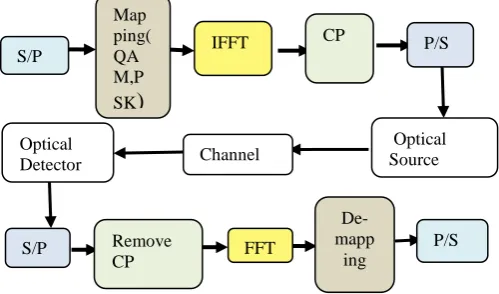
is performed to obtain OFDM signal.. After that, a cyclic prefix is added to the OFDM symbol by adding samples from end of the sequence to the start of the sequence to reduce the effects of inter carrier interference (ICI). The generated OFDM sequence is then modulates the optical carrier which in this case is intensity modulation using Mach Zehnder modulator to which one input is electric OFDM signal and other input is optical carrier generated from laser source. Then the modulated signal is transmitted over an optical fiber. Figure 1 depicts the basic block diagram of an optical OFDM communication system.
Fig. 1. Schematic of optical OFDM system
At the receiver, after detection using photodiodes, the electric domain data is then converted from analog to digital using an analog-to- digital converter (ADC). After removing the cyclic prefix, the Fast Fourier transform (FFT) is performed to demodulate the data which is transformed from time domain to frequency domain . Finally, data is detected by demapping and parallel to serial conversion.
IV.PAPR
A high peak to average power ratio (PAPR) is one of the major shortcomings of the OFDM modulation which occurs due to presence of a large number of subcarriers which when added coherently produces a large PAPR [9]. Mathematically, PAPR of a signal x(t) can be defined as given by (2).
PAPR = max(|x t |)
2
E(|x n |2) (1)
Complementary cumulative distribution function (CCDF) is generally used for illustration of PAPR which is defined as the probability that the PAPR of an OFDM frame exceeds a threshold value and is expressed as given below [4].
(𝑃𝐴𝑃𝑅> PAPRO)= 1− (𝑃𝐴𝑃𝑅≤ PAPRO)
= 1− (1− exp (−PAPRO)) N (2) The value of PAPR of OFDM signal increases with increase in number of subcarriers and high PAPR value enhances the non linear effects of the optical fiber. The effective refractive index of fiber can be expressed as
neff = n1 + n1 P/ A eff (3)
Where P is the input power and Aeff is the effective core area of the fiber. From equation (3), it is clear that, the non
linearities in the fibre place a constraint on the maximum optical power that can be launched into the fibre [9].By reducing the value of the PAPR of an OFDM signal, the power level of the output signal after modulation can be kept low. High PAPR also requires a high dynamic range of linear power amplifier, Digital to Analog/ Analog to Digital converters for operation in linear region. Hence there is need of reduction in PAPR of OFDM signal.
V. PAPRREDUCTION TECHNIQUES
In order to reduce the high PAPR value in optical OFDM systems, various techniques have been proposed in literature [10].Some of the important techniques are signal clipping, companding, SLM, PTS, non linear sliding norm transforms etc.
P/S
De-mapp ing FFT
Remove CP S/P
P/S
Optical Source p Optical
Detector Channel
IFFT CP
S/P
ISSN(Online): 2320-9801
ISSN (Print): 2320-9798
I
nternational
J
ournal of
I
nnovative
R
esearch in
C
omputer
and
C
ommunication
E
ngineering
(An ISO 3297: 2007 Certified Organization)
Vol. 3, Issue 6, June 2015
A. Signal Clipping
Amplitude clipping is a simple technique to reduce the PAPR of OFDM signal. A predefined value of the amplitude is used to limit the peak value of the input signal. Signal having values higher than this threshold value are clipped to the threshold value as follows.
f(x) ={A when x > A,
x when 0 ≤ x < A } (3)
The main problem in this case is that the amplitude clipping introduces undesired clipping noise giving rise to in– band and out of band distortion [3] [11].
B. Companding based signal distortion
The companding technique is a pre-distortion process in which the amplitude of the small signal is enlarged while the large signal remains almost the same [12]. Using this method signal amplitude is re-distributed after transformation which results in reduced PAPR. Also, the gain of PAPR reduction and noise enhancement are increased as μ is increased. Hence there is increase in noise due to companding for a constant value of signal-to-noise ratio. It is important to choose values of companding parameters to avoid significant noise [13].
C. Selected mapping (SLM) for PAPR reduction
In selected mapping method, M independent data blocks 𝑺m=[𝑆𝑚,0,𝑆𝑚,1,…,𝑆𝑚,𝑁−1]T, 𝑚=1,2,…,𝑀 represent the same information are obtained by multiplying the original sequence with M uncorrelated sequence 𝑷m. These are then forwarded into IFFT operation simultaneously. And then the PAPR is calculated for each vector separately. The sequence with the smallest PAPR is selected for final transmission.
The receiver is required to have information about selected phase vector sequence and ensure that the vector sequence is received correctly [5]. This can degrade the spectral efficiency of the system.
D. Partial transmit sequence(PTS)
In this method, the original OFDM sequence is divided into several sub-sequences and each sub-sequence is multiplied by different weights until an optimum value is chosen.
Fig.2. Block diagram of PTS technique for PAPR reduction
As seen from figure 2, data information X is separated into V non-overlapping sub-blocks and each sub-block vectors has the same size N. Thus, for every sub-block, it contains N/V nonzero elements and set the remaining to zero. The sub-block vector is given by
X
= bν v
ν=1
Xν (5)
ISSN(Online): 2320-9801
ISSN (Print): 2320-9798
I
nternational
J
ournal of
I
nnovative
R
esearch in
C
omputer
and
C
ommunication
E
ngineering
(An ISO 3297: 2007 Certified Organization)
Vol. 3, Issue 6, June 2015
E. Sliding Norm Transform(SNT)
Another method to reduce PAPR is SNT. It uses three samples, xn–1, xn, xn+1, and a controlling parameter, α, in each sliding window to calculate the output samples [6][9].
yn =
xn
α + xn−12 + xn2+ xn+12
(6)
At the receiver, Inverse Sliding norm transform is applied as given below.
x𝑛= x3 n3 . 𝑠𝑖𝑔𝑛 𝑦𝑛 (7)
A modified sliding norm transform has been presented in [7] which SNT uses two parameters α and b. and offers less computational complexity. The values of a and b can be adjusted to obtain desired PAPR reduction and power spectral density. The modified sliding norm transform is defined in (9).
𝑦𝑛 =
𝑥𝑜, 𝑛 = 0
𝑥𝑛
𝑎 + 𝑏. 𝑥𝑛 2+ 𝑥𝑛−12
𝑛 = 1,2,3 … . 𝑁 − 1 (8)
For reception, the inverse of the transform is applied as given in (10).
𝑥𝑛 =
𝑦𝑜 , 𝑦𝑛 ≠ 0, 𝑛 = 0
𝑦𝑛.
𝑎 + 𝑥𝑛−12
1 − 𝑏. 𝑦𝑛 2
0 𝑦𝑛 = 0
(9)
The variation in CCDF due to change in parameters a and b is depicted in figure 3. From figure 3(a), it is evident that value of PAPR increases with increase in a. For a >1, the PAPR starts increasing than original OFDM signal, so a is kept between 0 to 1.
a) b) Figure 3. Effect on change in parameter a and b on CCDF of OFDM signal
ISSN(Online): 2320-9801
ISSN (Print): 2320-9798
I
nternational
J
ournal of
I
nnovative
R
esearch in
C
omputer
and
C
ommunication
E
ngineering
(An ISO 3297: 2007 Certified Organization)
Vol. 3, Issue 6, June 2015
The main advantages of SNT are improvement in terms out-of-band distortion in the system and the method does not require any side information to be transmitted and hence there is no loss in data rates [7].The comparison of PAPR reduction capabilities of various PAPR reduction techniques is given in figure 4.
Fig 4. Comparison of PAPR reduction using various techniques (in dB)
As it can be seen from the figure 4, Clipping offers high value of PAPR reduction but high clipping ratio leads to enhancement in noise.SLM and PTS have high computational complexity.
Hence, in this paper, a joint PAPR reduction technique using modified SNT and clipping with a low clipping ratio has been proposed. Figure 6 represents the optical OFDM with PAPR reduction technique
VI.SIMULATION RESULTS
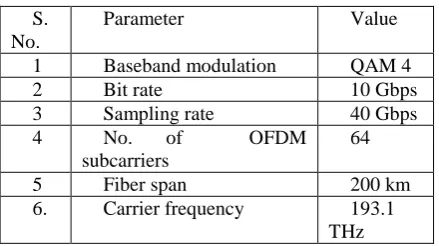
PAPR reduction analysis in Optical OFDM Systems with proposed PAPR reduction technique has been done by comparing the PAPR for OFDM transmitted signal after applying the proposed methodology and simple OFDM transmitted signal using the CCDF. The various parameters used in the system are given in table 1.
Table 1. List of parameters Of Optical OFDM system
S. No.
Parameter Value
1 Baseband modulation QAM 4
2 Bit rate 10 Gbps
3 Sampling rate 40 Gbps 4 No. of OFDM
subcarriers
64
5 Fiber span 200 km
6. Carrier frequency 193.1 THz
In Figure 5(a), CCDF of OFDM signal shows the PAPR reduction performance of the Joint modified SNT and clipping technique. It is evident that PAPR reduction using modified SNT at a=1,b=2 is around 2.5 dB at threshold probability of 1 x10⁻² and is further reduced by 1 dB using the proposed method with clipping threshold of 0.2. The BER of received signal is also studied. Then OFDM signal with reduced PAPR is sent through Optical system Figure 6(b) represents the graph of BER with variation in OSNR of received signal.
0 1 2 3 4 5 6 7
Technique
Clipping
companding
SLM
PTS
ISSN(Online): 2320-9801
ISSN (Print): 2320-9798
I
nternational
J
ournal of
I
nnovative
R
esearch in
C
omputer
and
C
ommunication
E
ngineering
(An ISO 3297: 2007 Certified Organization)
Vol. 3, Issue 6, June 2015
a) b)
Figure 5. a) CCDF showing PAPR reduction using joint technique; b) BER vs OSNR of received signal
As shown in figure 5(b), the BER value reduces considerably with increase in OSNR of received signal. The proposed method provides good range of BER of the received signal where BER of 1.23x10⁻³ for the fiber span of 200km is obtained using the technique.
VII. CONCLUSION AND FUTURE WORK
OFDM is a promising technique for very high speed communication systems as it offers spectral efficiency and reduces intersymbol interference. But OFDM has inherent drawback of high PAPR due to a large number of subcarriers .Various methods have been proposed for reduction of PAPR of OFDM signal. The simplest method is clipping but it introduces noise for large clipping ratio. PTS and SLM give good performance but require extra information for reception. Modified SNT do not need any side information but PAPR reduction needs to be enhanced. This paper presents a joint Modified SNT and clipping as PAPR reduction technique for optical OFDM systems. The results depict the enhancement in PAPR reduction by 1 dB. System exhibits good performance in terms of BER using PAPR reduction technique.
REFERENCES
1. Neda Cvijetic,”OFDM for Next-Generation Optical Access Networks.” Journal of lightwave technology, vol. 30, no. 4, February 15, 2012.
2. Armstrong, J., “OFDM for Optical Communications.” Journal of Lightwave Technology, 27(3), pp.189–204, 2009.
3. Lin CHEN, Yong FANG,” PAPR Reduction in Optical OFDM Systems Using Asymmetrically Clipping and Filtering Technique.”Journal of Computational Information Systems 8: 7 2733–2740,2012.
4. Wang, Jianping, Ying Guo, and Xianwei Zhou, "PTS-clipping method to reduce the PAPR in ROF-OFDM system." Consumer Electronics, IEEE Transactions on 55.2 (2009): 356-359, 2009.
5. Yufeng Shao, Nan Chi, Jingyuan Fan, and Wuliang Fang,”Generation of 16-QAM-OFDM Signals using Selected Mapping Method and Its Application in Optical Millimeter-Wave Access System.” IEEE Photonics Technology Letters, VOL. 24, NO. 15, August 1, 2012.
6. Dursun, S. & Grigoryan, A.M.,” Nonlinear L2-by-3 transform for PAPR reduction in OFDM systems.”Computers & Electrical
Engineering, 36(6), pp.1055–1065, 2010.
7. Salmanzadeh, Rahim, and Behzad Mozaffari Tazehkand. "A Modified Method Based on the Discrete Sliding Norm Transform to Reduce
the PAPR in OFDM Systems." ETRI Journal 36.1 : 42-50.2014.
8. Popoola, Wasiu O., Zabih Ghassemlooy, and Brian G. Stewart. "Pilot-assisted PAPR reduction technique for optical OFDM communication systems." Journal of Lightwave Technology 32.7 (2014): 1374-1382.
9. M.Hariharan, M. Gurunathan, A. Gopi, M. Palanivelan & Sheila Anand,”Non Linear Transform Technique to Optimize PAPR in Optical OFDM (O-OFDM) Systems.” International Conference on Computer Science and Information Technology, 10, March 2013.
10. Lim, Dae-Woon, Seok-Joong Heo, and Jong-Seon No. "An overview of peak-to-average power ratio reduction schemes for OFDM signals." Communications and Networks, Journal of 11.3: 229-239. 2009
ISSN(Online): 2320-9801
ISSN (Print): 2320-9798
I
nternational
J
ournal of
I
nnovative
R
esearch in
C
omputer
and
C
ommunication
E
ngineering
(An ISO 3297: 2007 Certified Organization)
Vol. 3, Issue 6, June 2015
12. Hwan Seok Chung, Sun Hyok Chang, and Kwangjoon Kim,”Companding Transform based SPM Compenstaion in Coherent Optical OFDM transmission.” Optical Society of America,2011.
13. H. Chen et al. ,” Nonlinear effect mitigation based on PAPR reduction using electronic pre-distortion technique in direct-detection optical OFDM system Optical Fiber Technology 19 ,387–391, 2013.
BIOGRAPHY
Dhanvi Gupta is a Post graduation Student in Electronics and Communication Engineering Department, PEC
University of Technology, Chandigarh, India. She received Bachelor degree in Electronics and Communication engineering in 2012 from SMVDU, Jammu, India. Her research interest includes Optical communication systems.
Divya Dhawan is an Assistant Professor in Electronics and Communication Engineering Department, PEC University