ISSN(Online): 2320-9801
ISSN (Print): 2320-9798
International Journal of Innovative Research in Computer
and Communication Engineering
(An ISO 3297: 2007 Certified Organization)
Vol. 3, Issue 7, July 2015
Peer - To - Peer File Sharing: Offline
Approach
Smt. Rachana C R
Associate Professor and Head, DOS in Computer Science, Pooja Bhagavat Memorial Mahajana PG Centre, K.R.S Road, Metagalli, Mysuru, India
ABSTARCT: The traditional method of transferring data within the Internet has followed the client-server paradigm. That means there is a known content provider, the server, to which the clients connect in order to receive the required data directly from the server. Thus, one needs powerful servers, which lead to high costs, to handle all the incoming requests. With home computers getting faster and high-speed Internet connections getting more and more common, relocating the task of content delivery away from the server seemed to be the next logical step.
With the P2P model, however, there is no central server. Every computer connected to the network can act as a server and a client – both sending and receiving data – and the applications running on each PC works to find the most efficient way to share between each other, spreading the load and increasing the strength of the whole network.This paper brings to light the trends and an offline approach to Peer to Peer file sharing on the internet.
KEYWORDS: P2P, File sharing, trends, Structured and unstructured P2P, Offline approach.
I. INTRODUCTION
Peer-to-Peer (P2P) file-sharing networks have become wildly popular. The first major file-sharing network Napster was designed to allow music fans to share MP3 music files. P2P software is becoming increasingly sophisticated with the rise in global internet traffic raise. It may search the entire network of users for the requested content, download from multiple sources simultaneously, and recover from broken connections.
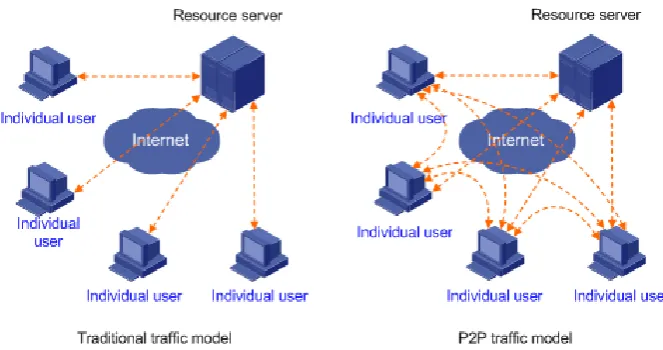
The nature of P2P file-sharing networks is, as the name implies, peer-to-peer and decentralized. There is no central server that uploads stores and downloads content - each user (potentially) acts as a server for each other user. Figure 1 shows the difference between traditional traffic model and P2P traffic model.
ISSN(Online): 2320-9801
ISSN (Print): 2320-9798
International Journal of Innovative Research in Computer
and Communication Engineering
(An ISO 3297: 2007 Certified Organization)
Vol. 3, Issue 7, July 2015
Figure 1: A traditional Traffic model Vs. P2P Traffic model.
A. UNSTRUCTURED PEER-TO-PEER NETWORKS
In unstructured networks, a peer providing content and its corresponding IP address are neither related by any structure nor mapped to each other with an algorithm. This means that the mapping between shared data and its typological location is either stored on a central server or has to be distributed within the network. The first generation of these networks includes centralized and pure peer-to-peer systems, whereas hybrid systems belong to the second generation. Centralized networks- As the term implies, centralized peer-to-peer networks contain a central lookup server, whose main purpose is to store information about the content's location and to hand this information to requesting clients. Only the receiving of files and the storage of content is decentralized. Thus, every client participating in the network communicates with the central element, so that the topology of the overlay network can be described as a star network. Via this direct link the peers inform the server about which files they offer and what content they are looking for. The server stores the provided information and answers search requests with IP addresses and port numbers of the sharing peers given that the content is available. The actual transmission of the data takes place apart from the overlay network, via an end-to-end connection between the peers mostly using the HTTP protocol. The downloading peer establishes this connection with the address data obtained from the lookup server.
Pure peer-to-peer networks- These networks do not rely on a central element for finding content, but instead achieve this via direct communication between the nodes.
Hybrid networks- The notion of peer-to-peer has been extended to cover a range of protocols and solution that does not fully satisfy the pure peer-to-peer definition. Many peer-to-peer protocols have introduced a central element in the peer structure to be able to offer a consistent connection. Hybrid peer-to-peer systems introduce another hierarchical layer with the objective of reducing the high overload of pure peer-to-peer systems which is caused by routing and maintenance messages.
B. STRUCTURED PEER-TO-PEER NETWORKS
ISSN(Online): 2320-9801
ISSN (Print): 2320-9798
International Journal of Innovative Research in Computer
and Communication Engineering
(An ISO 3297: 2007 Certified Organization)
Vol. 3, Issue 7, July 2015
C. CHARACTERISTICS OF PEER-TO-PEER SYSTEMS
The common characteristics of today's typical P2P systems include most of the following: • Peer nodes have awareness of other peer nodes.
• Peers create a virtual network that abstracts the complexity of interconnecting peers despite firewalls, subnets, and lack of specific network services.
• Each node can act as both a client and a server.
The overall performance of the P2P application tends to increase as more nodes are brought online as opposed to typical client-server environments where more clients degrade performance.
Example applications of P2P include the following:
• Consumer file-sharing- Gnutella, FastTrack, and Napster.
• Distributed resources sharing- SETI@Home, Avaki, Entropia, and Grid projects. • Content distribution networks- OpenCola, Blue Falcon Networks, Konitiki.
• P2P communications- AOL Instant Messenger, Yahoo!Messenger, ICQ, Jabber, and others.
• Collaboration applications- Such as Hive, Groove, and myJXTA. File sharing and P2P communications together are often the foundation capabilities used to build a workgroup.
II. RELATED WORK
The rapid technological progress made by computer technology in the past decade has been and continues to be stunning to many. The progression of Internet traffic dominance began in the 80s with ftp (file transfer protocol), and then shifted to http traffic as the World Wide Web became popular in the 1990s. Only recently has the dominance of Internet traffic shifted from centralized services to distributed peer-to-peer traffic. This traffic is however in terms of total bandwidth, which is not surprising given that peer-to-peer objects are often very large-a normal feature-length movie file is typically around 700Mb, depending on content and encoding. This size reflects that maximum capacity of most write-capable compact disc media. MP3 files, another dominant form of peer-to-peer traffic are significantly smaller than movie files, but nonetheless typically range from 3Mb to 10 Mb depending on file length and quality. By comparison, web objects are usually tailored for a variety of users, including low-end users with slow connections, and containmuch simpler text-based and compressed image content. Web objects in general tend to be in the range of 1kb to 50kb, several orders of magnitude smaller than peer-to-peer objects.
Recent studies suggest that file sharing activity accounts for up to 60% of the traffic on any given service provider network. The increase in P2P traffic has dramatically increased network loads and has left service providers scrambling to protect the level of service for their subscribers, particularly for non-P2P users. Moreover, service providers are struggling to avoid, or at least mitigate, the need for unplanned network expenditures. Finally, due to the ad-hoc nature of P2P communication, large amounts of data traffic are indiscriminately pushed onto higher cost network segments (P2P clients don’t care where other P2P clients are located) – driving up network access (NAP) fees.
There are three basic styles of P2P file sharing:
The One-to-One relationship, typically a transfer of files from PC to PC.
The more advanced One-to-Many relationship used by Napster, which enables a single host to communicate and share files with multiple nodes. Examples include mail servers connected to multiple mail clients and HTTP servers communicating with browsers.
The Many-to-Many relationship used by Gnutella protocol, which enables highly, automated resource sharing among multiple nodes.
III. TRENDS
ISSN(Online): 2320-9801
ISSN (Print): 2320-9798
International Journal of Innovative Research in Computer
and Communication Engineering
(An ISO 3297: 2007 Certified Organization)
Vol. 3, Issue 7, July 2015
search, Skype (2003) - VoIP (voice over IP), Chat, Video.The "vast majority" of P2P traffic is of files > 100MB. While most of this is video, there are other things such as CD images for open source software.
The US accounts for 10.57 percent of all global P2P users.As of March 2014, 31.7 million unique IP addresses were engaged in file sharing, up from a monthly average of 28.2 million in 2010.
The extensive use of torrents and P2P file sharing attract much interest from the copyright enforcers and many actions have been taken against the torrent providers in the past as well.However, statistic shows the share of P2P filesharing in peak period internet traffic composition in North America from 2009 to 2016. That year, 5.54 percent of peak period traffic was due to P2P filesharing, down from 12.7 percent in 2012.
Figure 2:Percentage of P2P filesharing of the peak period internet traffic in North America from 2009 to 2015.
Peer-to-peer (P2P) file sharing is now 25 percent of global broadband traffic – last year it was 38 percent of total traffic. It’s important to know that despite this significant drop in percentage, the overall about to traffic generated by P2P in absolute terms is still growing – it’s just growing more slowly than visual networking and other advanced applications such as online video.
BitTorrent’s new photo app, Shoot lets you send and receive photos and videos between iOS, Android, and Windows Phone devices, and what’s spectacular about it is the straightforward approach and very fast transfer speeds.Shoot is based on BitTorrent’s Sync technology, a cross-platform file-sharing tool that works between devices, and bypasses the cloud. BitTorrent says Sync is 16-times faster than uploading to cloud-based services, there’s no file size limit, and, perhaps more importantly, the file-sharing is private because data is never stored on a remote server. The devices also don’t have to be on the same network.
IV. OFFLINE APPROACH
ISSN(Online): 2320-9801
ISSN (Print): 2320-9798
International Journal of Innovative Research in Computer
and Communication Engineering
(An ISO 3297: 2007 Certified Organization)
Vol. 3, Issue 7, July 2015
Figure 3: Architecture of the offline downloader application
Mail senderis designed to perform certain functions for sending the pieces of information that have been cut by the file cutter. This module makes use of the SMTP protocol to send the mail to the Gmail account of the client who has requested for a file for peer download. Copy of the pieces is stored in the e-mail address associated with the client. The user id and the password of the client are authenticated before the file transfer.
POP3 protocol plays a major role in receiving the E-mail into the Gmail account inbox of the peer client who has requested the file. Only if the username and password of the peer client matches with the information on the file sending peer (server), the mail is delivered to the peer client. Otherwise, an error message will be suitably displayed. Specifically, the client peer is responsible for,
Receiving Meta data from the client.
Monitoring the file pieces from sever peer module.
Interacting with other modules via message passing.
Once the receiving of the required pieces of file is complete, the attachment downloader saves the actual file in the client-peer system by reassembling all the pieces of the file.
File cutter contains code to choose a file to send. Once the file is chosen to share, it splits the file into pieces of 1MB each. A metadata data file is created with .txt extension along with the pieces in a directory. Now, the file is ready to be sent.
To establish the connection between the peer client and peer server for data communication, we use the message passing technique which involves the invocation of the pipe listener. An Input pipe is created for chatting services which shows the incoming messages. Peer group services are obtained using pipe service and peer-id. An input
SERVER PEER
FILE/MAIL SENDER
USINGE-MAIL FILE
CUTTER
CLIENT PEER 1
CLIENT PEER 2
CLIENT PEER3
PIPE LISTENER & PEER CONFIGURATOR
ATTACHMENT DOWNLOADER TIME BASED MAIL
ISSN(Online): 2320-9801
ISSN (Print): 2320-9798
International Journal of Innovative Research in Computer
and Communication Engineering
(An ISO 3297: 2007 Certified Organization)
Vol. 3, Issue 7, July 2015
obtain peer group services. The messages to be sent are set. Time stamp, peer details such as peer name, peer ID are also sent.
Peer Configurator: For any communication to occur on the internet between peers, JXTA configuration is absolutely necessary. The peer needs to be initialized and launched into the default JXTA network in order to use its services and also to create its own peer group. A unique ID is obtained for the group from the JXTA services. At first, this module will search for a group, and if a group is found, it will join into it; otherwise, it will create a new group. It then searches for Group Advertisements from the local cache. If not found, it searches from remote peers. In the next step, it specifies advertisement for groups and configures the group, then publishes the required information on it.
Time based mail monitorchecks for new mails in the peer client’s inbox for the arrival of new pieces of the file
every 1 minute.
AES encryption & DES decryption: The most important aspect of Security is maintained as the pieces of the content to be sent to the client peer are encrypted using the AES Encryption algorithm. The pieces are automatically decrypted once the file is downloaded into the client peer system from the E-mail.
V. RESULTS
ISSN(Online): 2320-9801
ISSN (Print): 2320-9798
International Journal of Innovative Research in Computer
and Communication Engineering
(An ISO 3297: 2007 Certified Organization)
Vol. 3, Issue 7, July 2015
Figure 5: the folder which needs to be sent/shared.
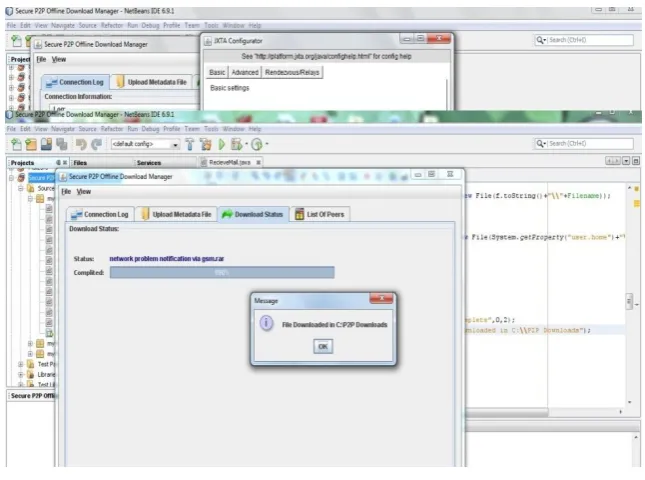
Figure 6: file downloaded successfully
V. CONCLUSION
Offline file download approach is the solution where the upload rate is lesser than the download rate. It is useful since uploading of large files is done only once, even if the pieces are to be sent to multiple clients. The most common disadvantages of Peer-to Peer file sharing on the internet such as Reach ability Problem, Peer-to-Peer blocking, low Upload speed of clients and shortage of IPv4 addresses and IPv6Compatibility problem have been overcome.
ISSN(Online): 2320-9801
ISSN (Print): 2320-9798
International Journal of Innovative Research in Computer
and Communication Engineering
(An ISO 3297: 2007 Certified Organization)
Vol. 3, Issue 7, July 2015
REFERENCES
[1] Peer-to-Peer File Sharing, The impact of file sharing on service provider networks, An Industry White Paper
Copyright © December 2002, Sandvine Incorporated, Copyright © July 2002, Sandvine Incorporated, www.sandvine.com, Ontario, Canada. [2] http://rt.com/news/162744-p2p-file-sharing-increase/
[3] http://www.bestvpnprovider.com/torrent-vpn/
[4] http://www.statista.com/statistics/190826/percentage-of-p2p-filesharing-in-peak-period-traffic-in-north-america/ [5] http://blogs.cisco.com/sp/announcing-the-2010-cisco-vni-usage-study-findings