ISSN(Online): 2319-8753 ISSN (Print): 2347-6710
I
nternational
J
ournal of
I
nnovative
R
esearch in
S
cience,
E
ngineering and
T
echnology
(An ISO 3297: 2007 Certified Organization)
Website: www.ijirset.com
Vol. 6, Issue 6, June 2017
Efficient Data Transfer from Source to
Receiver’s using Ipath Router
Ch.Shekhar1, J.Sireesha2
M. Tech, Dept. of CSE, Mallareddy Engineering College (Autonomous) Hyderabad, Telangana, India1
Associate Professor Dept. of CSE, Mallareddy Engineering College (Autonomous) Hyderabad, Telangana, India 2
ABSTRACT: Late remote sensor systems (WSNs) are ending up plainly progressively mind boggling with the
developing system scale and the dynamic idea of remote interchanges. Numerous evaluation and analytic methodologies rely on upon per-bundle directing ways for exact and fine grained examination of the involute network auras. In this paper, we propose iPath, a novel way induction way to deal with recreating the per-bundle directing ways in powerful and gigantically giant scale systems. The simple origination of ipath is to abuse high way related credit to iteratively in far long ways from short ones. ipath starts with an in it i al kenned set of way sand performs way surmising iteratively. ipath incorporates a novel plan of a light measure whip work for check of the construe red ways. Keeping in mind the end goal to additionally improve the in faience ability and also the execution effectiveness, ipath incorporates a quick bootstrapping calculation to reproduce the in it idlest of ways. We withal execute ipath and assess its execution using follows from cosmically gigantic scale WSN organizations and broad recreations. Results demonstrate that ipath accomplishes substantially higher recreation proportions under various system settings contrasted with other best in class approaches.
KEYWORDS: remote sensor systems, per-bundle steering, bootstrapping calculation, involute network attitudes.
I. INTRODUCTION
ISSN(Online): 2319-8753 ISSN (Print): 2347-6710
I
nternational
J
ournal of
I
nnovative
R
esearch in
S
cience,
E
ngineering and
T
echnology
(An ISO 3297: 2007 Certified Organization)
Website: www.ijirset.com
Vol. 6, Issue 6, June 2017
II.RELEATED WORK
2.1Existing System
The developing system scale and the dynamic idea of remote channel make WSNs turn out to be progressively involute and persistent. The issue of subsisting approach is that its message overhead can be cosmically huge for parcel switch long directing ways.
2.2Proposed System
We propose iPath, a novel way surmising way to deal with reproduce steering ways at the sink side. Predicated on a bona fide world involute urban detecting system with all hub inducing neighborhood bundles, we locate a key perception: It is profoundly likely that a parcel from hub and one of the bundles from's parent will take after a similar way beginning from's parent toward the sink. We allude to this perception as high way related trait. The simple origination of iPath is to abuse high way related credit to iteratively construe long ways from short ones. iPath begins with a kenned set of ways (e.g., the one-jump ways are now kenned) and performs way derivation iteratively. Amid every cycle, it attempts to induce ways on cleave longer until the point that no ways can be construed. So as to determine redress surmising, iPath needs to confirm whether a short way can be utilize d for deducing a long way. For this indicate, iPath incorporates a novel plan of a light weight hash work. Every information parcel appends a hash esteem that is refreshed jump by bounce. This recorded hash esteem is thought about against the figured hash estimation of a surmised way. On the off chance that these two esteems coordinate, the way is effectively construed with a high likelihood. Keeping in mind the end goal to additionally alter the derivation ability and in addition its execution productivity, iPath incorporates a quick bootstrapping calculation to recreate a kenned set of ways.
III. IMPLEMENTATION
3.1 Source:
In this module, settlement supplier peruses the record, enter the document name and sends to the iPath switch. Settlement supplier encodes the information and send to the switch.
3.2 iPath Router:
In this module, switch gets the document parcels from the source, if bundles estimate is more dominant than hub BW then blockage happens and after that way derivation will occur keeping in mind the end goal to locate an option way. It takes another hub and achieves the goal and load adjusting happens. At the point when clog happens hub band width can be increased.
3.3 Receiver:
ISSN(Online): 2319-8753 ISSN (Print): 2347-6710
I
nternational
J
ournal of
I
nnovative
R
esearch in
S
cience,
E
ngineering and
T
echnology
(An ISO 3297: 2007 Certified Organization)
Website: www.ijirset.com
Vol. 6, Issue 6, June 2017
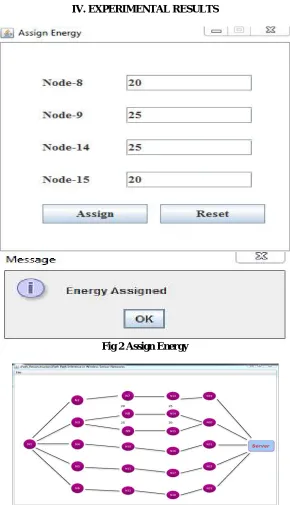
IV. EXPERIMENTAL RESULTS
Fig 2 Assign Energy
ISSN(Online): 2319-8753 ISSN (Print): 2347-6710
I
nternational
J
ournal of
I
nnovative
R
esearch in
S
cience,
E
ngineering and
T
echnology
(An ISO 3297: 2007 Certified Organization)
Website: www.ijirset.com
Vol. 6, Issue 6, June 2017
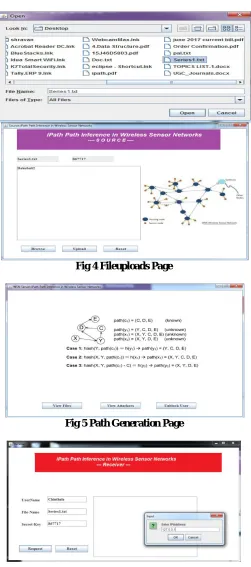
Fig 4 Fileuploads Page
ISSN(Online): 2319-8753 ISSN (Print): 2347-6710
I
nternational
J
ournal of
I
nnovative
R
esearch in
S
cience,
E
ngineering and
T
echnology
(An ISO 3297: 2007 Certified Organization)
Website: www.ijirset.com
Vol. 6, Issue 6, June 2017
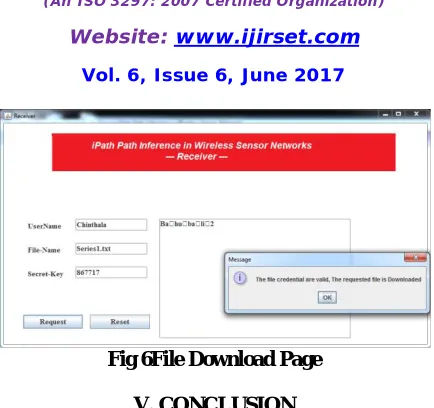
Fig 6File Download Page
V. CONCLUSION
Sensor systems [2] induce numerous early and thrilling application ranges for remote detecting. Nonetheless, entelechy of sensor organizes necessities to slake the limitations presented by variables, for example, adaptation to non-critical failure, cost, equipment, topology change and power utilization. Since these imperatives are very stringent and clear cut for sensor systems, beginning remote specially appointed systems administration conventions are required. In this paper we portray a steering calculation to lengthen the lifetime of the system. Stretching the lifetime is required since all hubs add to gather nature information. The early passing of a hub may prompt a fragmented observing. We incorporated a product module to the guided dissemination convention execution to adjust the vitality utilization of the ways. Our preparatory assessment of the vitality channel demonstrates that it caused an all the more equipollently dissemination of vitality even with moderately unoptimized way winnow. This endorses a more dominant system lifetime, avoiding early human activity and decreasing costs on systems for upkeeps of the convenience.
REFERENCES
[1]DanyanLuo Sch. of Comput. Sci. & Technol., Harbin Inst. of Technol, Harbin, DechengZuoSch. of Comput. Sci. & Technol., Harbin Inst. of Technol., Harbin Xiaozong Yang Sch. of Comput. Sci. & Technol., Harbin Inst. of Technol., Harbin An Energy-Saving Routing Protocol for Wireless Sensor Networks
[2]Wireless Sensor Network: Improving the Network Energy Consumption
Ingrid Teixeira, José Ferreira de Rezende and Aloysio de Castro P. Pedroza,XXI SIMPÓSIO BRASILEIRO DE TELECOMUNICAÇÕES- SBT’04, 06- 09 DE SETEMBRO DE 2004, BELÉM - PA.
[3]X. Mao etal., “CitySee:UrbanCO2 monitoring with sensors,” inProc.IEEEINFOCOM, 2012, pp. 1611–1619. [4]O. Gnawali,R. Fonseca,K. Jamieson, D. Moss, andP. Levis,“Collectiontreeprotocol,” in Proc.SenSys, 2009, pp. 1–14.
[5]D.S.J.D.Couto,D.Aguayo,J.Bicket,andR.Morris,“Ahighthroughputpathmetricformulti-hop wirelessrouting,” inProc.MobiCom, 2003, pp. 134–146. [6]Z.Li,M.Li,J.Wang,asndZ.Cao,“Ubiquitousdatacollectionformobileusersinwirelesssensor networks,”inProc.IEEE INFOCOM, 2011, pp. 2246– 2254.
[7]A.D.Jaggard,S.Kopparty,V.Ramachandran,andR.N.Wright,“Thedesignspaceofprobingalgorithmsfornetwork-performancemeasurement,”inProc.SIGMETRICS,2013, pp. 105–116.
[8]L.Ma,T.He,K.K.Leung,A.Swami,andD.Towsley,“Identifiabilityoflinkmetrics based on end-to-endpathmeasurements,” inProc.IMC,2013, pp. 391–404.
[9]Y.Gaoetal.,“Pathfinder:Robustpathreconstructioninlargescalesensornetworkswithlossylinks,”in Proc. IEEE ICNP, 2013, pp. 1–10.