Seismic Analysis of Multi-Storeyed Building
Having Vertical Irregularities Using Pushover
Analysis
T.M.Prakash 1, B.G. Naresh Kumar 2, Punith N 3, Mallamma 4
Associate Professor, Department of Civil Engineering, P.E.S. College of Engineering Mandya, Karnataka, India.1
Professor, Department of Civil Engineering, Maharaja Institute of Technology Mysore, Karnataka, India.2
Assistant Professor, Department of Civil Engineering, Maharaja Institute of Technology Mysore, Karnataka, India.3
M.Tech. student, Department of Civil Engineering, P.E.S. College of Engineering Mandya, Karnataka, India.4
ABSTRACT: Nowadays, as in the urban areas the space available for the construction of buildings is limited. So in limited space we have to construct such type of buildings which can be used for multiple purposes such as lobbies, car parking etc. To fulfill this demand, buildings with irregularities is the only option available. During an earthquake, failure of structure starts at points of weakness. This weakness arises due to discontinuity in mass, stiffness and geometry of structure. Vertical irregularities are one of the major reasons of failures of structures during earthquakes. A performance based seismic analysis can be used for various purposes such as assessment of large structures, design verification of new construction, evaluation of an existing structure to identify damage states for various amplitudes of ground motions. As the world move to the accomplishment of Performance Based Engineering philosophies in seismic design of civil engineering structures, new seismic design procedures require Structural Engineers to perform both static and dynamic analysis for the design of high rise structures. In this paper the building with vertical irregularities like mass irregularity is considered by modeling the roof diaphragm as rigid and semi rigid. The analysis of the building is done by using ETABS 2015 software by considering the static nonlinear analysis called pushover analysis. So from the results it can be concluded that when building becomes more and more vertically irregular (mass irregular), the storey shear goes on increasing as compared to mass regular building and that structure performs well in mass regular buildings when compared to mass irregular buildings.
KEYWORDS:Mass irregularity, Roof modeling, Rigid, semi rigid, Pushover analysis, ETABS 2015.
I. INTRODUCTION
Earthquakes have the potential for causing the greatest damages, among all the natural hazards. Since earthquake forces are random in nature & unpredictable. During an earthquake, the damage in a structure generally initiates at location of the structural weakness present in the building systems. These weaknesses trigger further structural deterioration which leads to the structural collapse which is due to geometry, mass discontinuity and stiffness of structure. The structures having this discontinuity are known as Irregular structures. These structures constitute a large portion of the modern urban infrastructure. Vertical irregularities are one of the major reasons of failures of structures during earthquakes.
Vertical Irregularity: Vertical irregularity results from the uneven distribution of mass, strength or stiffness along the elevation of a building structure. Mass irregularity results from a sudden change in mass between adjacent floors, such as mechanical plant on the roof of a structure. Stiffness irregularity results from a sudden change in stiffness between adjacent floors, such as setbacks in the elevation of a building.
Stiffness Irregularity- Soft Storey-A soft storey is one in which the lateral stiffness is less than 70percent of the storey above or less than 80 percent of the average lateral stiffness of the three storey’s above.
Stiffness Irregularity-Extreme Soft Storey-An extreme soft storey is one in which the lateral stiffness is less than 60percent of that in the storey above or less than 70 percent of the average stiffness of the three storey’s above. It is as shown in Fig.1.
Fig-1: Stiffness irregularities
Mass Irregularity-Mass irregularity shall be considered to exist where the seismic weight of any storey is more than 200 percent of that of its adjacent storey’s. In case of roofs irregularity need not be considered. It is as shown in Fig.2.
Vertical geometric irregularity: It should be considered to exist where the horizontal dimension of the lateral force resisting system in any storey is more than 150% of that in its adjacent storey.
In-Plane discontinuity in the vertical elements resisting lateral force: A in -plane offset of the lateral force resisting element greater than the length of those elements.
Fig- 2: Mass irregularity
Seismic analysis is a subset of structural analysis and is the calculation of the response of a building structure to earthquakes. It is part of the process of structural design, earthquake engineering and retrofit in regions where earthquakes are prevalent. Structural analysis methods are classified into following five categories:
II. RELATED WORK
Many research papers and code book have discussed the vertical irregularity issue in the building subjected to seismic loading. Some of them are as discussed below.
The FEMA-273, (1997), document provides technically sound and acceptable guidelines for the seismic rehabilitation of buildings. The Guidelines for the Seismic Rehabilitation of Buildings are intended to serve as a ready tool for design professionals, a reference document for building regulatory officials, and a foundation for the future development and implementation of building code provisions and standards. This document provides different Seismic performance levels of buildings for structural and Non-structural components in detail. It also gives different analysis procedures used for Seismic rehabilitation of buildings.
Das and Nau (2003) investigated the definition of irregular structure for different vertical irregularities: stiffness, strength, mass, and that due to the presence of non-structural masonry infill as prescribed in building codes. Linear and nonlinear dynamic time-history (TH) analyses were performed on an ensemble of 78 buildings of 5, 10, and 20 stories and with different story stiffness, strength, and mass ratios. All buildings had three bays in the direction of the ground motion. The lateral force-resisting systems considered were special moment resisting frames (SMRF) designed based on the forces obtained from the ELF procedure according to the strong-column-weak-beam (SCWB) criteria of ACI 318-99 (ACI, 1999) and UBC (1997). They observed that most structures considered in their study performed well when subjected to the design earthquake ground motion. Hence they concluded that the restrictions on the applicability of the ELF procedure given in building codes are unnecessarily conservative for certain types of vertical irregularities considered.
III.METHODOLOGY
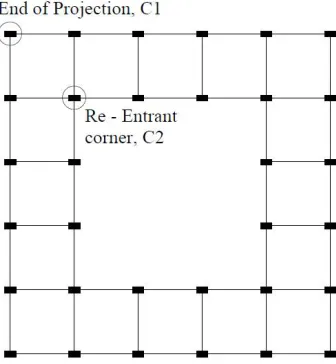
The software used in this research is ETABS-2015 and the method of seismic analysis used is Non-linear Static Analysis also known as Pushover Analysis. The models used for present study include buildings with mass regularity and mass irregularity. The shape of the model considered is a box shaped model (fig.3). Both mass regularity and mass irregularity models consist of 5 floors each (G+4), with the floor heights being 3.5m each. The dimension of the columns being fixed at 230mm x 450mm and that of the beams at 230mm x 450mm for mass regularity and mass irregularity models as shown in table 1. The column positions have so been fixed, that the spans of all the beams in both X and Y directions are kept same and equal to 5m. For mass regular and mass irregular structure the loading conditions are same except an additional mass has been added to the third storey of mass irregular building to maintain the vertical irregularity. Also both the mass regularity and mass irregular models have been analyzed for rigid and semi rigid Diaphragm condition. In this study the results are considered for the column C1 (End of the projection) and Column C2 (Re – entrant corner) as shown in fig. 3.
Fig - 3: Beam and column layout of model.
IV.ANALYSIS
In this project, ETABS-2015 software was used for the design and analysis of building model. The structure was modeled in ETABS by considering the parameters shown in table.1. Then the box shaped model shown in fig.3 was subjected to both dead load and live loads to check the capacity of preliminary dimensions of the structural members of the building model. The seismic analysis is carried out if and only if all the members are safe with design check. If members are not safe, then the dimensions of the members are revised. To carry out the pushover analysis, the static non-linear load patterns and load cases are defined along X and Y directions. Then the columns and beams are assigned with hinges based on the hinge properties taken from ASCE 41-13 table. After assigning hinges the model is checked for errors. Then the model is analyzed which is subjected to lateral pushover loads as per displacement control method. After the pushover analysis is complete, the results like: the push over curve, the formation of hinges, storey shear, force and moment plots, etc. are reviewed. The different parameters considered in the present study are as shown in table.1.
Table-1: Parameters considered in the present study
Structure Type Ordinary moment resisting frame
No. of storey G+4
Typical storey height 3.5m
Type of building use Public cum office building
Foundation type Isolated footing
Seismic zone V
Material properties
Grade of concrete M20
Grade of steel Fe415
Density of concrete 25 kN /m2
Member properties
Slab thickness 0.125m
Beam size 0.23m x 0.45 m
Column size 0.23m 0.45m
Wall size 0.23m
Dead load intensities
Roof finishes 2 kN/m2
Floor finishes 1 kN/m2
Live load intensities
Roof 2.5 kN/m2
Floor 3.5 kN/m2
Earthquake live load on slab as per clause 7.3.1 and 7.3.2 of IS: 1893(Part-1) 2002
Roof 0.25 x 2.5 = 0.625
kN/m2
Floor 0.5 x 3.5kN/m
2
=
But in the present study we are comparing the storey shear distribution along the different storey obtained from pushover analysis
V. RESULTSANDDISCUSSIONS
The following section discusses the results obtained from the analysis with regards to storey shear with respect to the storey number.The fig.4 shows the 3-D view of a box shaped building considered in the present study. The roof modeling is considered as rigid diaphragm and semi rigid diaphragm respectively.
Fig-4: 3-D view of model
The table-2 and table - 3 shows the variation of storey shear with respect to different storey for push x and push y loads.
Table-2: Variation of storey shear of structure
Model Type
Storey No.
PUSH X
Rigid Semi Rigid Along
X Along Y Along X Along Y Mass Regularity
6 0 39.584 0 166.93 3 5 0 79.168 0 233.86
7
4 0 118.75
9
0 350.79 9
3 0 158.33
7
0 467.73 3
2 0 158.40
2
0 467.92 6
1 0 158.46
8
0 468.11 9
Mass Irregularity
6 0 201.23
3
0 201.75 1
5 0 402.46
6
0 403.50 2
4 0 648.34
3
0 650.01 3
3 0 840.57
7
0 851.76 4
2 0 849.90
9
0 852.09 4
1 0 850.24
2
Table-3: Variation of storey shear of structure Model Type Storey No. PUSH Y
Rigid Semi Rigid Along
X Along Y Along X Along Y
Mass Regularity
6 0 1995.
4
0 86.18 2
5 0 3990.
9
0 172.3 60
4 0 5986.
4
0 258.5 4
3 0 7981.
8
0 344.7 2
2 0 7985.
1
0 344.8 7
1 0 7988.
1
0 345.0 1
Mass Irregularity
6 0 1356.
2
0 165.9 2
5 0 2712.
5
0 331.8 4
4 0 4369.
7
0 534.5 7
3 0 5726.
0
0 700.4 9
2 0 5728.
2
0 700.7 7
1 0 5730.
5
0 701.0 4
Chart- 1 shows the variation of storey shear at different storey for a mass regular building due the application of push x force in x – direction for both rigid and semi rigid diaphragm. From the chart it can be seen that the storey shear goes on decreases towards the top from base storey. This clearly suggests that the storey shear will be more near the base and it goes on decreasing towards the top storey.
Chart-1: Variation of storey shear along PUSH X
(Mass Regularity)
In similar way chart-2, chart-3 and chart-4 indicates the variation of storey shear at different storey for a mass irregular building (push x, along x), mass regular (push y, along y) and mass irregular buildings with (push y, along y) respectively.
Chart-2: Variation of storey shear along PUSH X (Mass Irregularity)
For mass irregular structure, both rigid diaphragm model and semi rigid diaphragm are showing the same result due to application of push x load. This may be because of the direction of orientation of longer side of the column towards x direction.
Chart-3: Variation of storey shear along PUSH Y
(Mass regularity)
Chart-4: Variation of storey shear along PUSH Y
VI. CONCLUSION
It has been observed that the vertical irregular buildings have performed very poorly during past earthquakes. Hence performance based analysis like pushover analysis is very essential to understand the behavior of the structures. As building becomes more and more vertical irregular (mass irregular), the storey shear goes on increasing as compared to mass regular building. The orientation of the columns and the roof modeling (Rigid and semi rigid diaphragm) plays a major role. So it can be concluded that structures performs well in mass regular buildings when compared to mass irregular buildings.
REFERENCES
1. Ashish Akhare, Sneha Bhende, “Modal pushover analysis to estimate the seismic demand of vertically irregular structures”, IJPRET, Volume 3 (8): 40-50, 2015.
2. Basavaraju Y. K., Dr. B S Jayashankar Babu, “Seismic Performance of Multi Storey RC Frame Buildings with Soft Storey from Pushover Analysis”, IJESC, Volume 6, Issue No. 7, 2016.
3. Das, S. and Nau, J.M. (2003). “Seismic Design Aspects of Vertically Irregular Reinforced Concrete Das, S. and Nau, J.M, “Seismic Design Aspects of Vertically Irregular Reinforced Concrete Buildings”, Earthquake Spectra, Vol. 19, No. 3, pp. 455-477, 2003.
4. Federal Emergency Management Agency (FEMA- 273), “The Guidelines for the Seismic Rehabilitation of Buildings”, Oct-1997. 5. IS 1893 (Part 1)," Criteria for earthquake resistant design of structures", Bureau of Indian Standards, New Delhi, India, 2002.
6. Kancharla Srimukha, Ramesh Bantupalli, “Pushover Analysis of Multi-Storey RCC Frame with and without Vertical Irregularities”, International Journal of Engineering and Management Research, Volume-6, Issue-4, July-August 2016.
7. Mohommed Anwaruddin Md.Akberuddin, Mohd. Zameeruddin, Mohd. Saleemuddin, “Pushover Analysis of Medium Rise Multi-Story RCC Frame With and Without Vertical Irregularity”, Int. Journal of Engineering Research and Applications, Vol. 3, Issue 5, pp.540-546, Sep-Oct 2013.
8. S K Duggal, “Earthquake Resistant Design of Structures”, Oxford University Press, India, 2009.
BIOGRAPHY
Dr.Prakash T M was born in Thagahalli, Mandya, Karnataka India on 23rd Jan 1964. He has completed his M.Tech in Building Science and Construction Management (IIT-Delhi-1998) and obtained his Ph.D. from VTU-Belgaum (2013). He has more than 28 years of teaching experience. Presently working as associate professor in PESCE – Mandya.
Dr. Naresh Kumar B G was born in Mandya, India on 21st May 1958. He did his M.E. (Structures) from University of Roorkee (1987) and obtained his Ph.D. from IIT - Roorkee(1996). He has more than 36 years of teaching experience and is presently working as professor and principal in MIT-Mysore.
Mr. N Punith was born in Mysore, India, on 21st Oct 1987. He did his B.E. in Civil Engineering from Dr.AIT, Bangalore and M.Tech.(structures) in SJCE, Mysore. Currently he is pursuing his Ph.D. under VTU. He has more than 6 years of teaching experience and is presently working as assistant professor in MIT-Mysore.