ISSN(Online): 2319-8753 ISSN (Print): 2347-6710
I
nternational
J
ournal of
I
nnovative
R
esearch in
S
cience,
E
ngineering and
T
echnology
(An ISO 3297: 2007 Certified Organization)
Website: www.ijirset.com
Vol. 6, Issue 6, June 2017
Comparison of Effectiveness of Music
Therapy and Visual Imaginary Technique on
Anxiety and Depression in Moderate Chronic
Obstructive Pulmonary Disease Patients
Dr.T.Poovishnudevi1, Dr.Noble sunny2, Dr.R.monisha3, S.K.Mohanasundari PhD4,Dr.Mirium john.5
Associate Professor, Faculty of Physiotherapy, KIMSDU, Karad, Maharashtra, India1
Assistant Professor, Medical Trust Institute of Medical Sciences, Cochin, Kerala, India2
Assistant Professor, College of Physiotherapy, Srm Deemed University, Tamil Nadu, India3
Faculty of College of Nursing, AIIMS-Jodhpur, Rajasthan, India4
Superintendent& HOD of Physiotherapy, KIMSDU, Karad, India5
ABSTRACT: Introduction: Anxiety and depression is often a component of dyspnea in advanced chronic obstructive
pulmonary disease (COPD). The aim is to compare the effects of music therapy (MT) and visual imaginary technique (VIT) on anxiety and depression in moderate COPD patients. Method: 70 patients admitted in the hospital for acute exacerbation were screened for inclusion and exclusion criteria and assigned into 2 groups. Group A received music therapy and Group B performed visual imaginary technique. The outcome measures are measured through Spielbergers State Anxiety Inventory (SSAI), State Trait Anxiety Inventory (STAI)and Dyspnea Scale. Result: There were clinically significant reduction in outcome variables (anxiety and depression ) of SSAI, STAI and dyspnoea scale. The P- value of outcome variables of MT (P= 0.0001) and MT were considered statistically significant than VIT . ThereforeMT is effective in reducing anxiety and depression in COPD patients
KEYWORDS: COPD, music therapy, visual imaginary technique, anxiety. dyspnea, relaxation
I. INTRODUCTION
ISSN(Online): 2319-8753 ISSN (Print): 2347-6710
I
nternational
J
ournal of
I
nnovative
R
esearch in
S
cience,
E
ngineering and
T
echnology
(An ISO 3297: 2007 Certified Organization)
Website: www.ijirset.com
Vol. 6, Issue 6, June 2017
NEED OF THE STUDY: Many COPD patients have transistionarymood symptoms during exacerbation which
improve spontaneously as physical status improves. But contrast major mood changes are lacking treatment which is not bothered by physicians, therapist in their protocols. Lack of treatment is also associated with poor quality of life and pre mature death11,12. .Although the primary underlying pathophysiology is pulmonary, associated systemic effects of COPD contribute to disability.Consequently, there is a recognized need for a shift from a focus on assessment and management of COPD, to the comprehensive assessment and rehabilitation of the diverse extra-pulmonary effects of the disease.By keeping this entire scenario in view the present study is conducted to find out effectiveness of music therapy and visual imaginary technique on anxiety and depression in moderate chronic obstructive pulmonary disease.
Aim :To compare the effectiveness of music therapy music therapy and visual imaginary technique on measures of anxiety and depression in patients with moderate COPD patients .
Objectives: 1. To find the effects of music therapy on anxiety and depression in moderate COPD Patients. 2. To find
the effects of visual imaginary technique music therapy on depression and anxiety in moderate COPD Patients. 3. To compare the effects of music therapy and visual imaginary technique on depression and anxiety in moderate COPD Patients
II. METHODOLOGY
Study approach: quantitative approach, Study design - comparative study , setting of the study: Cardio Respiratory Dept, Krishna hospital, Karad,Target population: Moderate COPD patients, Accessible population: COPD patients admitted in Krishna Hospital Karad, Sampling size - 70 Sampling technique - simple random sampling (Lottery method),Study duration - 3 months.
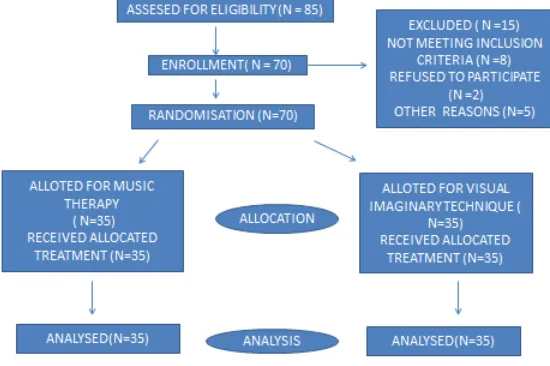
Figure no 2.1.Flow chart of the sample selection
Inclusion criteria:1.Age ≥ 55 yrs, 2.Both sex 3.A diagnosis of moderate COPD on GOLDclassification (FEV1/FVC =70%; 30%≤ FEV1 ˂ 50% predicted) 4.Minimal score of 4 in PRIME-MD screening questionnaire for depression and anxiety 5. Self reported shortness of breath. 6.Ability to provide informed consent.Exclusion criterea1.Patients who have received tricyclic anti depressants or major anti psychotic drugs 2.Inability to communicate because of language skills 3.Hearing or cognitive impairment 4.Aversion of music 5.Individuals with comorbid conditions which affect the safety of the patients and .6.Symptomatic cardiovascular problems.
ISSN(Online): 2319-8753 ISSN (Print): 2347-6710
I
nternational
J
ournal of
I
nnovative
R
esearch in
S
cience,
E
ngineering and
T
echnology
(An ISO 3297: 2007 Certified Organization)
Website: www.ijirset.com
Vol. 6, Issue 6, June 2017
Conventional physiotherapy: Breathing exercises daily- Patients received a daily 30-minute class including stretching of major muscle groups and instruction on diaphragmatic and pursed lip breathing.2.Self management education and psychological and social support were provided through lectures, relaxation classes and recreational activities at least twice a week for 30 minutes.
Music therapy: The music was chosen based on patients personal taste following an interview. Subjects had to select
one record from a collection of five lyric Indian classical music .The collection was of 60-80 beats/minutes is known to have relaxing effect. The music is streamed via headphones in the patient13,14.Position of patient- supine lying or relaxed arm chair sitting. They can be offered with a mask which avoid visual stimuli and concentrate in music.
Visual imaginary technique: Step: 1 Close the eyes and breath slowly and deeply to calm down. Step : 2 Choose Your
Setting ,Feel Relaxed And Picture Yourself In Most Peaceful environment and elaborate it with imagination. Step: 3 Stay in that position for 30 minutes. Keep in mind that imaginary is more effective when all the senses were used. The more the senses used more the relaxation.VIT was well explained to the patients after randomisation.
Development and description of tool/outcome measure: : The following standard scale were used to measure the outcome variables (anxiety and depression).
Spielbergers State Anxiety Inventory (SSAI): The Questionare has 20questions pertaining to how the patient feels
on the day(state) andSpielbergers trait anxiety inventory ( STAI) has 20 questions pertaining to how the patient feels on that day . Dyspnoea scale : Assessed with visual analogue dyspnea scale(VADS). It consists of 100 Mm vertical scale with points as bad breathlessness at top and no breathlessness at bottom15,16Ethical clearance: Ethical clearance was obtained from concerned institutional ethical committee.The studymethodology was accepted by institutional protocol comitee& ethical comitee and informed consent were obtained from patient after explaining the purposes and objectives of the study.
Pilot Study:. The Pilot study was done and based on the difference (D At 5% And Power At 80%). Reference table is
made and required sample size was calculated for each groups17,18. .It is 32- 37 in each Group so the sample size is taken as 35.
Data collection:The treatment protocol is explained to the patients. Demographic and baseline assessments are done to compare group equivalency. Intervention is done on the next day. Group A received music therapy and conventional physiotherapy with medications 30 minutes /session for 3 days. Group B received visual imaginary technique and conventional physiotherapy with medications for 30 minutes /session for 3 days .Pre test values were taken and post test values were measured after the intervention the values of both the groups were analysed and compared for the results.
Analysis and interpretation: Data analysis was blinded.ANOVA with repated measures was used to analyse the changes in outcome variables in pre and post test in both the sessions and in between the groups.
III.RESULT
ISSN(Online): 2319-8753 ISSN (Print): 2347-6710
I
nternational
J
ournal of
I
nnovative
R
esearch in
S
cience,
E
ngineering and
T
echnology
(An ISO 3297: 2007 Certified Organization)
Website: www.ijirset.com
Vol. 6, Issue 6, June 2017
The anxiety and depresion have reduced with MT considerably in the I and II session pre and post values and in VIT the values were reduced but the patients did not perceive much reduction in anxiety and depresion.
Table No.3.2..Changes between session & comparision between groups
The level of significance in MT for SSAI,STAI and dyspnea shows p=0.0001 and in VIT the p value for SSAI is 0.0003 ,STAI is 0.0001 and dyspnea scale is 0.0002.The MT group showed to be statistically significant in reducing anxiety and depression in moderate COPD patients.
Graph No 3.3 Graphical representation of Mean Difference Between MT & VIT
IV. DISCUSSION
The study showed statistically significant improvement in reduction of anxiety and depression in moderate COPD patients following MT at par with VIT. The findings suggest that the symptoms of anxiety and depression started to reduce after the second session in patients with hospitalised moderate COPD who are medically stabilised. The mean change in MT group is more statistically significant compared with VIT .
ISSN(Online): 2319-8753 ISSN (Print): 2347-6710
I
nternational
J
ournal of
I
nnovative
R
esearch in
S
cience,
E
ngineering and
T
echnology
(An ISO 3297: 2007 Certified Organization)
Website: www.ijirset.com
Vol. 6, Issue 6, June 2017
of passive technique and requires no attention and has soothing effect. Music has been effective in relieving is explained at different schools of thought. One mechanism states that there is parallel processing of dyspnea, distress and breathing .The sensory stimuli like dyspneoa are processed at preconscious level, if pre conscious level are flooded with music then dyspnea genic elements can not reach conscious level there by reducing dyspneoa related anxiety.Physiological theory explains the phenomenon of relaxation training is through body s own analgesicsystem – ENDORPHIN.There are evidence that relaxation can increase the blood level of endorphins and increase person s ability to relax muscle tension and arousal.
V. CONCLUSION
Based on the literature and outcome of statistical analysis there is statistically significant improvement on anxiety and depression in hospitalised moderate COPD patients .Recommendations:1.Inclusion of vital signs as outcome measures 2.Effects of those technique evaluated in a long term basis. 3. study to be done on mild and severe COPD patients 4.Future research is warranted to show the effect of these techniques on pulmonary function test. Limitation: Study was conducted in one part of India so generalization of results may be limited.
REFERENCES
1) LopezAD, Shibuya K ,Rao C Et Al. Chronic Obstructive Pulmonary Disease: Current Burden And Future Projections.EurRespire J.vol.12.pp.397-412,2006.
2) Jamal A Ward E, HaoY Et Al .Trends In The Leading Causes Of Death In United States , 1970-2002.JAMA.vol.8,pp,1255-1259.2005. 3) Aydin IO Ulusahina.Depression, Anxiety Comorbidity And Disability In Tuberculosis And COPD Gen Hosp Psychiatry.vol.11,pp.77-83,2001. 4) Lacasse Y, Rousseau L, MaltaisF.Prevalence Of Depressive Symptoms In Patients With Oxygen Dependent COPD.J Cardiopulmonary
Rehabilitation.vol.6.pp.80-86,2001.
5) AustralianBureau Of Statistics .National Survey Of Mental Health And Well Being: Summary Of Results (4326.0) Canberra :ABS pp.134.2013.
6) HynninenKM ,Breitve MH , Wiborg AB Et Al.Psychological Characteristics Of Patients With COPD .J Psychosom Res vol.12,pp.429-443,2012.
7) S.Brooks.Survillence Of Respiratory Hazards ,ATS New.vol.8,pp.12-16,2010
8) .Mineur YS PicciottoMR . Nicotine Receptors And Depression In Copd .Am J Public Health vol.8,pp.225-230,1996. 9) Convey LS Glassman AH ,Stetner F. Cigerrate Smoking And Major Depression ,JAMA vol.3pp.264,1990. 10) Medically Reviewed By Judith MarcinMDvol.9,pp.37,2017.
11) Poppen .R.Behavioural Relaxation Training And Assessment.Heart Lung vol.12,pp.560-566,1998.
12) Yohannesam ,Baldwin RC,Connolly MJ, Prevalence Of Sub Threshold Depressionin Elderly Patients With COPD .Int J Geriatric Psychiatry.vol.12,pp.412-416,2013.
13) Merit S Mind , Music And Imaginary .Boulder: Asian Publishing vol.6,pp.110-112,1990. 14) Bunt L. Music Therapy: An Art Beyond Words.London: Routledge ,vol.20,pp,187-189,1994.
15) Gift AG .Validation Of Visual Analogue Scale As Ameasure Of Clinical Dyspnea .Rehabilitation Nursing Res vol.14,pp.323-325,1989. 16) Gift AG. Visual Analogue Scale :Measurement Of Subjective Phenomena Nursing Res vol.11,pp.286-287,1989.
17) Chaln L. Effectiveness Of Music Therapy intervention On Relaxation On Anxiety And Depression For Patients Receiving Ventilatory Assistance. Heart Lung volume.22.pp.197-199,1998.
18) Zimmerman Lm, Pierson Ma, Marker J Effects Of Patient Anxiety In Coronary Care Units. Heart Lung vol.17,pp.560-566,1988. 19) Merit S Mind , Music And Imaginary .Boulder: Asian Publishing.vol.12,pp.322,1990
20) Campbell,D.Music Physician For Times To Come. Wheaton Il:Quest Books.vol.9,79-82,1991.
21) McCance K, Heather S. pathophysiology : The Biologic Basis For Disease In Adults And Children ,vol.2,pp.23.1999.