KIM, HYON-JUNG. Variance Estimation in Spatial Regression Using a
Nonpara-metric Semivariogram Based on Residuals. (Under the direction of Professor Dennis
D. Boos.)
The empirical semivariogram of residuals from a regression model with stationary
errors may be used to estimate the covariance structure of the underlying process.
For prediction (Kriging) the bias of the semivariogram estimate induced by using
residuals instead of errors has only a minor effect because the bias is small for small
lags. However, for estimating the variance of estimated regression coefficients and
of predictions, the bias due to using residuals can be quite substantial. Thus we
propose a method for reducing the bias in empirical semivariogram estimates based
on residuals. The adjusted empirical semivariogram is then isotonized and made
positive definite and used to estimate the variance of estimated regression coefficients
in a general estimating equations setup. Simulation results for least squares and
robust regression show that the proposed method works well in linear models with
2
Spectral Analysis with Spatial Periodogram and Data Tapers. (Under the
direc-tion of Professor Montserrat Fuentes.)
The spatial periodogram is a nonparametric estimate of the spectral density, which
is the Fourier Transform of the covariance function. The periodogram is a useful tool
to explain the dependence structure of a spatial process. Tapering (data filtering)
is an effective technique to remove the edge effects even in high dimensional
prob-lems and can be applied to the spatial data in order to reduce the bias of the
peri-odogram. However, the variance of the periodogram increases as the bias is reduced.
We present a method to choose an appropriate smoothing parameter for data
ta-pers and obtain better estimates of the spectral density by improving the properties
of the periodogram. The smoothing parameter is selected taking into account the
trade-off between bias and variance of the tapered periodogram. We introduce a new
asymptotic approach for spatial data called ‘shrinking asymptotics’, which combines
the increasing-domain and the fixed-domain asymptotics. With this approach, the
tapered spatial periodogram can be used to determine uniquely the spectral density
AND SPACE DOMAINS
by
HYON-JUNG KIM
A dissertation submitted to the Graduate Faculty of
North Carolina State University
in partial fulfillment of the
requirements for the Degree of
Doctor of Philosophy
DEPARTMENT OF STATISTICS
August 2000
approved by:
Dennis D. Boos Montserrat Fuentes
chair of advisory committee co-chair of advisory committee
Bibhuti B. Bhattacharyya Marcia L. Gumpertz
Dedication
To my father and mother.
Hyon-Jung Kim was born on January 30, 1967, in Seoul, Korea. She received a B.S.
in Mathematics in 1989 at Yonsei University in Seoul. During her junior year she
attended Bowling Green State University as an exchange student. She then attended
Michigan State University and received an M.S. in Mathematical Statistics. While
she went on to study statistics in more depth at Rutgers University, she developed her
interest in applied statistics and worked at Merck & Co. as an assistant statistician
until she began studying for a Ph.D. She completed her M.S. at Rutgers University in
1995. She began her graduate work for a Ph.D. in statistics at North Carolina State
University in 1996 and defended her dissertation in August, 2000.
Acknowledgements
I would like to start by thanking my committee for their time and effort. In particular,
I am so grateful that I have Dr. Dennis Boos as my advisor, and I cannot begin to
thank him enough. He is truly a great mentor not only in statistics but also in
everyday life. I would like to thank him for his direction, guidance, time, and endless
patience. His efforts and help have meant a tremendous amount to me.
Next, I would like to thank Dr. Montserrat Fuentes for introducing me to spectral
analysis and for her creative ideas and support (including financial). She has patiently
helped me become a more independent researcher. I admire her energy and ability
to handle so many things at once.
I would like to thank Dr. Bhattacharyya for teaching me all the
mathemati-cal techniques that I could not learn from anywhere else and checking my lengthy
theoretical results. Without his help, I might have had to delay starting my next
position.
My experience as a research assistant under the guidance of Dr. Gumpertz was
rewarding. I am thankful for her reaching out to students to share her interests
outside statistics. Thanks also to Dr. Davis for his constant encouragement.
but I would like to mention a few. To Dr. Pantula: thank you for your support,
guidance, and the opportunity for me to gain teaching experience. To Jungmin Baik
and Sarah Hardy: thank you for teaching me how to program in Splus. Without your
help, I could not have done much of my research. To Daniel and Carlos: thank you
for your friendship and saving me from complex latex problems. To Mandy, Zeynep,
Ann and Virginia: thank you for being such good friends. You have brightened my
life in North Carolina.
A special thanks to Michael C. Horton, who has helped me with mathematical
insight and taught me about Fortran and Matlab. I am grateful that his research
interest in mathematics has been parallel to my work in statistics.
Finally, I would like to thank my wonderful parents and my dear sister Hyon-Soo,
for always believing in me, even when I did not. I could not have accomplished this
without their love and support, especially during the difficult times. They have kept
me focused on what is important in life, no matter what my plans have been.
Table of Contents
List of Tables viii
List of Figures ix
I
Variance Estimation in Spatial Regression Using a
Non-parametric Semivariogram Based on Residuals
1
1 Introduction 2
2 Variance Estimation of Regression Parameters 6
3 Nonparametric Semivariogram Estimation 9
3.1 Previous Methods . . . 11
3.1.1 Method Proposed by Shapiro and Botha . . . 12
3.1.2 Nonparametric Semivariogram Estimation by Lele . . . 13
3.2 Monotone Semivariogram Estimation . . . 15
3.3 Bias Correction of Residuals-Based Variogram . . . 20
4 Variance Estimation of Regression Parameters Based on Semivari-ograms 29 4.1 Ordinary Least Squares Estimates of β . . . 29
4.2 Robust Regression Estimates ofβ . . . 37
5 Discussion 41
6 Bibliography 42
II
Spectral Analysis with Spatial Periodogram and Data
Tapers
47
7 Introduction 48
8.2 Overview - Periodogram for Time Series Data . . . 54
8.3 Spatial Periodogram . . . 57
9 Data Tapers 59 9.1 Expectation and Covariance of the Tapered Spatial Periodogram . . . 63
10 Shrinking Asymptotics 65 10.1 Overview - Aliasing . . . 65
10.1.1 Aliasing in Time Series . . . 66
10.1.2 Aliasing in Random Fields . . . 68
10.2 Estimation of the Spectral Density . . . 69
10.3 Shrinking Asymptotics . . . 70
10.4 Smoothing Parameter . . . 78
10.5 Estimation of Parametric Spectral Density . . . 82
10.6 Likelihood Function Approximation . . . 84
11 Conclusion 85
12 Bibliography 87
A Proof in Chapter 7 89
B Proofs in Chapter 8 91
List of Tables
3.1 Mean squared errors of the logarithm of empirical and monotone
semi-variogram estimates for constant mean data on a 10 × 10 grid with
exponential semivariogram. Results based on 1000 replications.
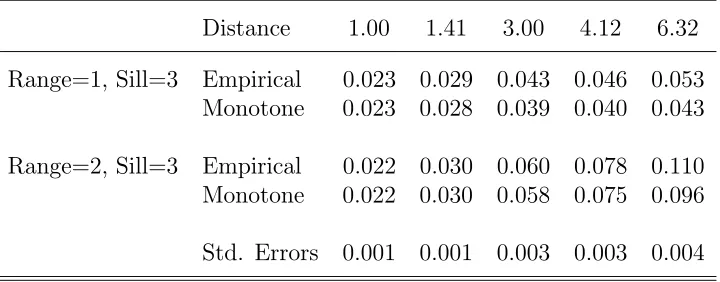
Aver-age standard errors are in the last row. . . 19
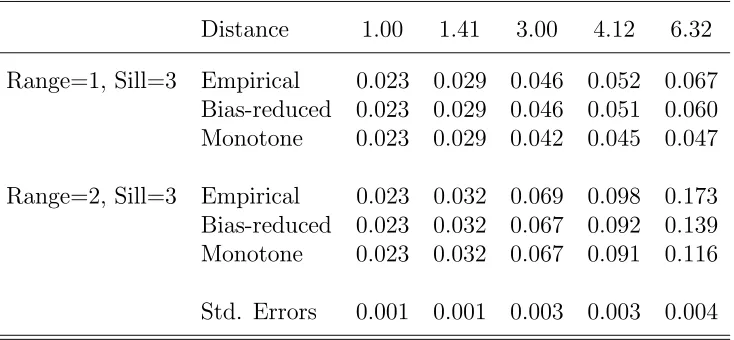
3.2 Mean squared errors of logarithms of semivariogram estimates:empirical,
bias-reduced empirical and monotone. Data are from a 10 × 10 grid
with exponential semivariogram. Results based on 1000 replications.
Average standard errors are in the last row. . . 25
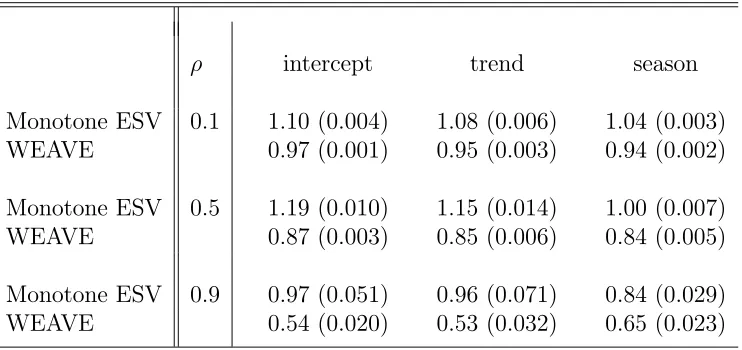
4.1 Average of Standard Deviation Estimates (divided by true standard
deviation) for Regression from Time Series Data of Size 100 with Au-toregressive Errors. Based on 100 replications. Standard errors are in
parentheses. . . 31
4.2 Average of Standard Deviation Estimates (divided by true standard
deviation) for Regression from 10×10 Spatial Data of Size 100 with
Exponential Variogram Errors. Based on 100 replications. Standard
errors are in parentheses. . . 34
4.3 Average of Standard Deviation Estimates (divided by true standard
deviation) for Regression from 16×16 Spatial Data of Size 100 with
Exponential Variogram Errors. Based on 100 replications. Standard
errors are in parentheses. . . 35
4.4 Average of Standard Deviation Estimates (divided by true standard
deviation) for Regression from 16×16 Spatial Data of Size 100 with
Whittle Variogram Errors. Based on 100 replications. Standard errors
are in parentheses. . . 36
4.5 Average of Standard Deviation Estimates (divided by true standard
deviation) for Regression from 10×10 Spatial Data of Size 100 witht
-transformed Exponential Variogram Errors. Based on 100 replications. Standard errors are in parentheses. True standard deviations are based
on 10000 replications and have estimated coefficient of variation .007. 39
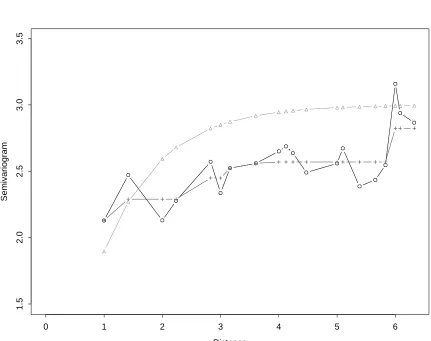
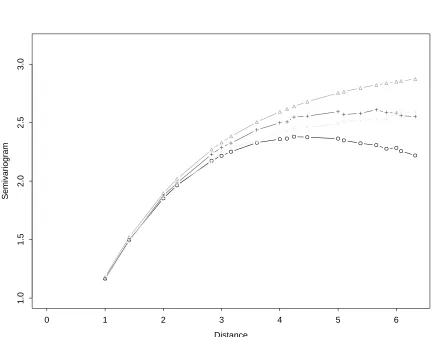
3.1 Empirical semivariograms for data on a 10 x 10 grid generated from a constant mean process with an exponential (sill=1,range=3) semi-variogram (∆): empirical semisemi-variogram (O) and isotonized version
(+). . . 17
3.2 Average of 1000 empirical semivariograms for data on a 10 x 10 grid
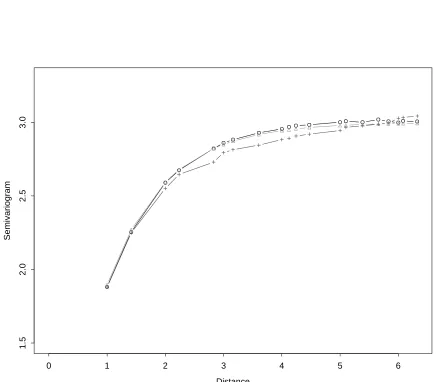
generated from a constant mean process with an exponential (sill=1,range=3) semivariogram (∆): empirical semivariogram (O) and isotonized ver-sion (+). Standard deviations of estimates are approximately bounded
by .02. . . 18
3.3 Exponential(sill=1,range=3) semivariogram (∆) for data on a 10 by
10 grid, average of 1000 empirical semivariograms from residuals with
p= 3 estimated parameters (O) and with p= 6 estimated parameters
(+). Standard deviations of estimates are approximately bounded by
.02. . . 21
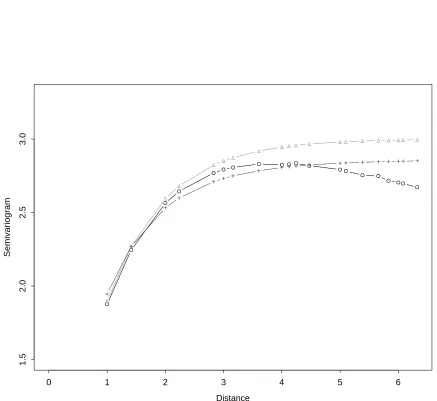
3.4 Exponential(sill=2,range=3) semivariogram (∆) on a 10 x 10 grid and
the average of 1000 replications of semivariogram estimates based on
residuals from p = 3 estimated parameters: empirical semivariogram
from residuals (O), bias-reduced empirical variogram (+), monotonized
bias-reduced empirical variogram (×). Standard deviations of
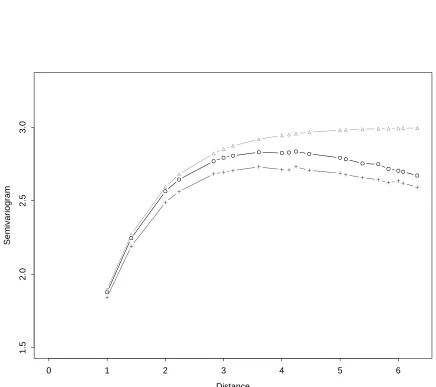
esti-mates are approximately bounded by .02. . . 24
3.5 Exponential(sill=1,range=3) semivariogram (∆), average of 1000
repli-cations of semivariogram estimates based on residuals from p = 3
es-timated parameters: empirical semivariogram from residuals (O) and weighted nonlinear least squares parametric estimate (+). Standard
deviations of estimates are approximately bounded by .02. . . 28
9.1 One dimensional tapering function with different values of a smoothing
parameter ρ. . . 61
9.2 The Multiplicative two dimensional tapering function. . . 62
Part I
Variance Estimation in Spatial
Regression Using a Nonparametric
Semivariogram Based on Residuals
Introduction
Random processes over time or space typically have the property that nearby
obser-vations tend to be more alike than obserobser-vations far apart. Scientific studies of such
processes often involve modeling and estimation of a mean response with random
errors assumed to be from a stationary process. For example, an additive error linear
model is given by
Yi =xTiβ+ei, i= 1, . . . , n, (1.1)
where xi may consist of variables that are a function of location as well as other
co-variates, and theei are errors whose correlation depends only on the distance between
observations.
One standard approach with normally distributed errors is to assume a particular
parametric semivariogram model such as an exponential and use restricted
maxi-mum likelihood (REML) for estimating the parameters of the model and then to
use estimated generalized least squares (EGLS) for estimating β. Alternatively, one
can avoid the normality assumption and use weighted least squares with the
empir-ical semivariogram of the residuals to estimate the parameters of the semivariogram
Chapter 1. Introduction 3
model (see Cressie, 1993, p. 94-99, 165-170). In either case the variance of the EGLS
b
β is estimated using standard formulas for generalized least squares with
semivari-ogram estimates inserted where needed. A correct semivarisemivari-ogram model, however,
is not always easy to choose, and we may be interested in estimation methods other
than least squares.
The purpose of this paper is to give new methods for estimating the variance of
b
β when βb is obtained from a general estimating equations approach, i.e., satisfying
P
Si(Yi,xi,β,b σb) =0, where Si is usually a function of residuals and weights andσb
are additional dispersion parameter estimates. This general class includes ordinary
least squares (OLS, with Si(Yi,xi,β,b σb) = (Yi−xTi βb)xi), EGLS, robust regression
(e.g., Huber, 1980, Ch. 3, with Si(Yi,xi,β,b σb) = (ψ[Yi−xTi βb]/bσ)xi), and
general-ized estimating equations (GEE, Liang and Zeger, 1986). Although these estimation
methods are suitable for a much larger class of models than (1.1), we will focus on
methods for (1.1). However, a parametric semivariogram model will not be chosen;
rather, we will estimate the semivariogram subject only to a monotonicity constraint.
Our approach is similar in spirit to the that of Lumley and Heagerty (1999), who
use a weighted empirical variance estimate for the middle part of the “sandwich”
asymptotic variance formula that arises naturally from the estimating equations
for-mulation. Their approach is more general because it allows nonstationary errors; in
fact Lumley and Heagerty (1999) unify a variety of nonparametric methods including
and Yasui and Lele (1997). Related nonparametric methods are found in Carlstein
(1986), Sherman (1996), Sherman (1997), Garcia-Soidan and Hall (1997), and
Hea-gerty and Lumly (2000).
Our approach differs, though, in two ways from these other methods: we use
non-parametric semivariogram estimation for the middle part of the “sandwich,” and we
explicitly remove bias in the semivariogram estimates that would ordinarily result
from using residuals rather than errors (which are of course unknown). It is this
lat-ter bias issue that we feel is most important. Any nonparametric variance estimation
method based on residuals that does not address the bias issue is doomed to
under-estimate the variance of under-estimated coefficients and of predictions. The problem with
using residuals has long been recognized in the spatial statistics literature (Matheron,
1971, p. 152-155, and Cressie, p. 165-170). However, when fitting parametric
vari-ogram models, the bias is by definition not a problem for REML. It is also claimed
(see Cressie, 1993, p. 167-169) that the bias from residuals is not a major problem
when estimating parametric semivariograms by weighted least squares because the
early lags, where the bias in the empirical semivariogram is small, have the largest
weights (however, see Figure 5 of Section 3.2). In general, though, nonparametric
semivariogram methods will inherit the bias problem of the empirical semivariogram,
especially at moderate to large distances between observations (see Figure 3 in Section
Chapter 1. Introduction 5
3.2, but Matheron (1973) and Cressie (1987) propose a method similar to
differenc-ing in time series for handldifferenc-ing the bias issue. For visual confirmation of parametric
variogram models, Brownie and Gumpertz (1997) suggest adjusting REML estimates
of parametric semivariograms so that graphically they are aligned with a plot of the
empirical semivariogram of residuals.
Our nonparametric semivariogram is based on several simple ideas. First we
construct a semivariogram estimator in the constant mean case by monotonizing
the standard empirical semivariogram (see Section 3.1). We also check for
positive-definiteness and modify our estimate if it is not positive-definite. Next (Section 3.2)
we compute the bias of the residuals-based empirical variogram in model (1.1) when
β is estimated by OLS. Then we correct for this bias by multiplying the empirical
semivariogram by estimated factors computed at each distinct distance between
ob-servations. Finally, we monotonize and make positive-definite the adjusted empirical
semivariogram. This nonparametric semivariogram is then used to estimate the
vari-ance of the estimated regression coefficients. Monte Carlo results for OLS estimates
are given in Section 4.1, and results for robust regression estimates are given in
Sec-tion 4.2. We begin in SecSec-tion 2 with a general explanaSec-tion of how to estimate the
Variance Estimation of Regression
Parameters
The estimating equations approach provides a general framework for deriving the
asymptotic distribution of βb that solves
Gn(β) =
1
n n
X
i=1
Si(Yi,xi,β) =0
(and here for simplicity we have dropped the extra dispersion parametersσmentioned
in the Introduction). That is, by Taylor series approximation,
0=Gn(βb)≈Gn(β) + ˙Gn(β)(βb−β) +Rn,
where
˙
Gn(βb) = ∂
∂βTGn(β) =
1
n n
X
i=1
∂
∂βTSi(Yi,xi,β).
Then, under suitable regularity conditions,βb −→p βandβbis asymptotically normally
distributed with variance
A(β)−1B(β)A(β)−1 T = lim
n→∞[−E ˙Gn(β)]
−1 Var[G
n(β)]
n
[−E ˙Gn(β)]−1
oT
, (2.1)
Chapter 2. Variance Estimation of Regression Parameters 7
where it is assumed that there are matrices A(β) and B(β) such that −E ˙Gn(β) →
A(β) and nVar[Gn(β)] → B(β) as n → ∞. In likelihood models −E ˙Gn(β) =
nVar[Gn(β)] is the average Fisher information. The estimator
˙
Gn(βb) =
1 n n X i=1 ∂
∂βTSi(Yi,xi,
b
β)
will typically satisfy ˙Gn(βb)−E ˙Gn(β)
p
−→β even for correlated data.
Since we have a consistent estimator for E ˙Gn(β), the problem of finding a
con-sistent estimator of the asymptotic variance (2.1) is reduced to finding a concon-sistent
estimator for the middle term (times n),
nVar [Gn(β)] = E
" 1 n n X i=1 n X j=1
Si(Yi,xi,β)Sj(Yj,xj,β)T
#
.
Lumley and Heagerty (1999) point out that the empirical estimator
1 n n X i=1 n X j=1
Si(Yi,xi,βb)Sj(Yj,xj,
b
β)T = 1
n
" n X
i=1
Si(Yi,xi,βb)
# " n X
j=1
Sj(Yj,xj,
b
β)T
#
is identically zero by the definition of βb. This of course contrasts with the common
situation where one can average over independent replications. Thus Lumley and
Heagerty (1999) suggest estimating the middle term by
b
Jn(βb) =
1 n n X i=1 n X j=1
wijnSi(Yi,xi,βb)Sj(Yj,xj,βb)T
where wijn → 1 as n → ∞ but wijn → 0 as the distance between two locations,
d(i, j)→ ∞for fixedn. They also show that the methods proposed earlier by Newey
as weighted empirical estimators with different choices of the weight wijn. Although
these estimators can be used for nonstationary models, one common problem is that
they are not very efficient for highly correlated data (Andrews, 1991).
To implement our approach we first make the simplifying assumption thatSi has
the form Si(Yi,xi,β) =wi(β)S(ei(β))xi, where S is now a real-valued function and
theei(β) are from a stationary process. Thus, theS(ei(β)) are also from a stationary
process, and we will estimate the latter process using semivariogram techniques. We
then employ it to estimate the middle term of (2.1) utilizing the relationship between
semivariogram and covariance functions under second-order stationarity. We present
Chapter 3
Nonparametric Semivariogram Estimation
A process {Z(s),s ∈ D, D ⊂ R
d}
is called intrinsically stationary when it has
con-stant expectation and the variance of the increments depends only on the difference
of locations. For an intrinsically stationary process, the semivariogram is defined as
γ(s1 −s2) = 1
2Var[Z(s1)−Z(s2)].
It is called isotropic ifγ(s1−s2) is only a function of the Euclidean distanceks1−s2k
between locations. We then use the simpler notation γ(h) where h is the distance
between locations. The function 2γ(·) is called the variogram. A valid semivariogram
needs to be conditionally negative-definite; that is, it must satisfy
n
X
i=1
n
X
j=1
λiλjγ(si−sj) ≤0
for each set of locationss1, ...,snand allλ1, . . . , λnsuch that
Pn
i=1λi = 0 (see Cressie,
1993, p. 86). For a sample of given realizations fromZ(·), the empirical variogram is
the unbiased estimator of an isotropic variogram given by
2bγ(h) = 1
|N(h)|
X
N(h)
{Z(si)−Z(sj)}
2
where
N(h) ={(si,sj) :ksi−sjk=h:i, j = 1,2, ..., n}
and|N(h)|is the number of distinct pairs in N(h). Although the empirical variogram
is unbiased for the variogram, it cannot be used directly in procedures such as kriging
(spatial prediction) because it may not be negative-definite.
One standard approach has been to choose a parametric variogram model (which
by definition is negative-definite) and fit it by restricted maximum likelihood (REML),
maximum likelihood (ML), or weighted nonlinear least squares. There are a number
of widely used parametric variogram models based on isotropic processes such as the
exponential, spherical, and Gaussian. The Mat´ern class, originally given by Mat´ern
(1960), allows a wide range of flexibility in that it has a parameter which controls the
smoothness of a random field. The class can be defined by its isotropic autocovariance
function:
C(h) = σ
2ν−1Γ(ν)
2ν1/2h
ρ
ν
Kν
2ν1/2h
ρ
whereσ is the scale parameter,ρthe range parameter, and ν is the shape parameter.
The function Γ(·) is the gamma function and Kν is the modified Bessel function
of the third kind of order ν (Stein 1999). When ν = 12, the model becomes the
Chapter 3. Nonparametric Semivariogram Estimation 11
underlying true variogram is rarely known, and selection of a variogram model is
quite arbitrary in practice. The Mat´ern class appears to be the best choice of the
present parametric models to estimate the dependence structure of a process since it
includes or approximates a number of common models.
3.1
Previous Methods
There have been several attempts to avoid selecting variogram models via
nonpara-metric variogram estimation (Shapiro and Botha, 1991; Cherry et al., 1996; S. Lele,
1995; Hall et al, 1994; Barry and Ver Hoef, 1996; and Gorsich and Genton, 1999).
Shapiro and Botha(1991) appear to be the first to consider a nonparametric
semivar-iogram estimate based on Bochner’s theorem. Cherry et al. (1996) implemented the
Shapiro-Botha estimator using the statistical package S-plus and compared its
perfor-mance to parametric estimation of the semivariogram using non-linear least squares.
They found good performance of their nonparametric estimates and sometimes
bet-ter performance than the traditional parametric approach. One problem with their
method is that the sill estimates tend to be biased and highly variable. Cherry (1996)
suggested a simple remedy for this sill problem, but semivariogram values other than
the sill also seem to have high variability as well. Lele (1995) provided a
nonparamet-ric estimator of the semivariogram using a spline function and included a study of the
performance of his estimator in terms of prediction and prediction error. However,
3.1.1
Method Proposed by Shapiro and Botha
Their method is based on Bochner’s theorem (Schoenberg 1938): A function f is
continuous and nonnegative definite if and only if it is the Fourier transform of a
nonnegative bounded Borel measure µ, i.e.
f(h) =
Z ∞
0
Ωd(ht)dF(t),
where F(t) is a non-decreasing bounded function on t ≥ 0 and Ωd(ht) is a basis for
functions in R
d having the form
Ωd(x) = (2/x)(d−2)/2Γ(d/2)J(d−2)/2(x)
whereJv(d) is a Bessel function of the first kind of orderv. In the one, two and three
dimensional cases Ω1(x) = cos(x), Ω2(x) =J0(x), and Ω3(x) = sin(x)/x.
Using the identity, γ(h) =C(0)−C(h) for a second-order stationary process with
covariance function C(h), c0−f(h) for any constant c0 is continuous, conditionally
negative definite, and a valid semivariogram function. Then, the fitting of such valid
functions to the empirical semivariogram can be accomplished using weighted least
squares.
To solve the estimation problem numerically, let F(t) be a step function with m
finite positive jumps p1, ..., pm at points t1, ..., tm. Then F(t) can be expressed as
Chapter 3. Nonparametric Semivariogram Estimation 13
nonparametric semivariogram estimate can be expressed as:
ˆ
γ(hi) = m
X
j=1
pj(1−Ωd(hitj))
wherei= 1, ..., lis the lag number. The corresponding sill estimate is ˆC(0) =Pmi=1pj.
The weighted least squares estimation problem can be formulated as follows: find a
m×1 vector p= (p1, ..., pm) that minimizes
Q(p) =
l
X
i=1
wi{ˆγ(hi)− m
X
j=1
pj(1−Ωd(hitj))}2.
3.1.2
Nonparametric Semivariogram Estimation by Lele
Lele proposed a method that transforms the problem of estimation of the valid
semivariogram matrix to the problem of estimation of the valid inner product
semi-variogram matrix. Simple smoothed semisemi-variograms (i.e. smoothed scatter plot of
(z(si)−z(sj))
2 using kernel functions or splines) can be considered as nonparametric
semivariogram estimates, but these would violate the conditionally negative definite
property of valid semivariograms. However, it is comparatively easier to approximate
any finite dimensional matrix with a positive definite matrix than using the class
of conditionally negative definite functions (Shapiro and Botha, 1991; Cherry, 1994;
Hall, Fisher, and Hoffman, 1994): Write the spectral decomposition of a matrix Ψ
using the eigenvalues and eigenvectors of Ψ (i.e. Ψ = P DPT where P is the
ma-trix of eigenvectors and D consists of eigenvalues for diagonal elements and of zeros
number and denote this by D∗. ˆΨ = P D∗PT is an approximate positive definite matrix estimate of Ψ. Lele’s estimator is based on a spline smoother evaluated at a
finitely many points and these points are approximated by a collection of
condition-ally negative definite values. The approximated values are then smoothed by a spline
smoother again and these steps are repeated until the spline smoother and the spline
interpolator get nearly identical.
Steps to obtain Lele’s nonparametric semivariogram estimator: 1. Compute the empirical semivariogram estimates.
2. Smooth the empirical semivariogram using a spline function.
3. Obtain the spline-smoothed empirical semivariogram values, ˜γ’s, for all distances
and compute the corresponding inner product semivariogram values, Ψij’s, utilizing
the relationship:
˜
Ψij = ˜γi1+ ˜γj1−˜γij.
Note that the variance-covariance matrix,Ψ, of the vector of contrastsZcis called the
inner product semivariogram matrix.
4. Construct the variance-covariance matrix(Ψ) of the vector of contrasts, Zc =
(Z(s2)−Z(s1), Z(s3)−Z(s2), ..., Z(sn)−Z(s1)),and obtain the approximate positive
definite covariance matrix, ˆΨ.
5. Obtain the spline-interpolated semivariogram estimates, ˆγij’s from ˆΨij using the
relationship:
Chapter 3. Nonparametric Semivariogram Estimation 15
6. Plot the ˆγij’s against all distances ksi−sjk.
7. Repeat steps 2-5 until the resultant plot is visually smooth.
3.2
Monotone Semivariogram Estimation
Most parametric covariance models used in time series and spatial analyses have
cor-relations that are monotone decreasing with distance. Moreover, most physical
pro-cesses exhibit this monotone behavior as well. Thus, the centerpiece of our approach
is to assume that the correlations are momotone decreasing with distance. This is a
much weaker assumption than any of the common parametric semivariogram models.
Our basic approach to produce a nonparametric monotone semivariogram
esti-mator is to apply the pool adjacent violators algorithm (PAVA, Barlow et al. 1972,
p.13) to empirical semivariogram estimates. Although the variance of the empirical
semivariogram at a lag h is not exactly proportional to the inverse of the number of
pairs (e.g., Genton, 1998, p. 328), we will use that weighting in the PAVA routine.
This is similar to Cressie’s (1993, p. 96) weighting in nonlinear least squares fitting of
parametric semivariograms except that for simplicity we ignore the extra weighting
factor due to the value of the semivariogram.
The basic idea of PAVA is the following (using equal weights for simplicity):
start-ing with y1, move to the right and stop if yi > yi+1. In that case replace yi and yi+1
by their weighted average y∗i =yi∗+1 = (yi +yi+1)/2. Then move to the left to make
sure that yi−1 ≤ y∗i. If yi−1 > y∗i, then replace yi−1 with the weighted average of all
proceed again to the right. This process of averaging and back-averaging is continued
until the right end point is reached. In many situations, isotonic estimators have
improved mean squared error properties over the original estimators used in their
construction. We will illustrate that property with Monte Carlo simulation.
Since the variance of the empirical semivariogram is large for large lags, we follow
the common practice of truncating the isotonized semivariogram at half the maximum
distance found in the data set. In order not to induce upward bias at that distance,
we monotonize a larger set of lags before truncating. For example, for a time series
on the equally spaced time points of 1, . . . ,100 we monotonize on the lags 1, . . . ,70
and then truncate at 50.
Figure 1 shows the empirical variogram and the isotonized semivariogram for one
data set on a 10 x 10 grid generated from an exponential semivariogram with range
parameter = 1 and sill = 3, γ(h) = 3[1−exp(−h/3)].
Figure 2 gives averages of 1000 replications of the situation in Figure 1. We can
see that the emprical variogram is unbiased as advertised, and that the monotone
estimate is somewhat biased downward in the middle. Table 1 shows, however, that
the monotone estimate has lower mean squared error for distances beyond 3. Note
that the standard errors of differences of estimates in Table 1 are lower than the
Chapter 3. Nonparametric Semivariogram Estimation 17
Distance
Semivariogram
0 1 2 3 4 5 6
1.5
2.0
2.5
3.0
3.5
Distance
Semivariogram
0 1 2 3 4 5 6
1.5
2.0
2.5
3.0
Chapter 3. Nonparametric Semivariogram Estimation 19
Table 3.1: Mean squared errors of the logarithm of empirical and monotone
semi-variogram estimates for constant mean data on a 10 × 10 grid with exponential
semivariogram. Results based on 1000 replications. Average standard errors are in the last row.
Distance 1.00 1.41 3.00 4.12 6.32
Range=1, Sill=3 Empirical 0.023 0.029 0.043 0.046 0.053
Monotone 0.023 0.028 0.039 0.040 0.043
Range=2, Sill=3 Empirical 0.022 0.030 0.060 0.078 0.110
Monotone 0.022 0.030 0.058 0.075 0.096
Very often, the isotonized semivariogram is already conditionally negative definite.
Sometimes it is not, and then we suggest using the spectral decomposition of the
co-variance matrix followed by replacement of the negative eigenvalues by small positive
ones. For the variance estimation discussed in Sections 4 and 5, this has virtually
no effect. However, for other purposes such as kriging, it may be required. Also,
the isotonic estimators have a “boxy” appearance, and sometimes we find it more
appealing to smooth the isotonized semivariogram using a spline or other smoother.
3.3
Bias Correction of Residuals-Based Variogram
Consider model (1.1) where the errors ei are drawn from a mean zero, second-order
stationary random error process. We shall assume that the unknown regression
co-efficients β are estimated by ordinary least squares. A natural approach is then to
c onstruct the empirical semivariogram from the residuals. Unfortunately, the
distri-bution of the residuals is not the same as the errors, and the empirical semivariogram
is seriously biased downward. Figure 3 shows the average of the empirical
semivar-iogram for 1000 replications of an exponential semivarsemivar-iogram with range parameter
= 1 and sill = 3 for a 10 by 10 grid. The middle line is for residuals based on fitting
an intercept and the location coordinates (x and y). The lower line is for residuals
from a fit with the same three variables and with three more independent variables
Chapter 3. Nonparametric Semivariogram Estimation 21
Distance
Semivariogram
0 1 2 3 4 5 6
1.5
2.0
2.5
3.0
Figure 3.3: Exponential(sill=1,range=3) semivariogram (∆) for data on a 10 by 10
grid, average of 1000 empirical semivariograms from residuals with p = 3 estimated
parameters (O) and with p = 6 estimated parameters (+). Standard deviations of
To understand more clearly the effect of the residuals, let V denote the covariance
matrix of the errors for a sample with ndata points. Then simple calculations show
that the covariance matrix of the residuals bei =Yi−xTi βis given by (I−P)V(I−P),
whereI is thendimensional identity matrix andP =X(XTX)−1XT is the projection
matrix of X, whereX is formed from the row vectors xT
i .
The expected value of the empirical semivariogram of the residuals at lagh is
Eres(h) =
1
2|N(h)|
X
N(h)
E(bei+h−bei)2
= 1
2|N(h)|
X
N(h)
E(be2i+h) + E(be2i)−2E(bei+hbei)
≈ 1
ntrace(I−P)V(I−P)−
1
|N(h)|
X
N(h)
[(I−P)V(I −P)]i,i+h,
where the approximation comes in by taking the average of all of the diagonal elements
of (I−P)V(I−P) instead of the subset of the diagonal elements implied by summing
over elements h distance apart. This approximation is not necessary but makes the
computing considerably easier.
The expected value of the empirical variogram of the errors at lag h is of course
γ(h), but we can write it in a form similar to the above:
Eerr(h) =
1
2|N(h)|
X
N(h)
E(ei+h−ei)2
= σ2− 1
|N(h)|
X
N(h)
Chapter 3. Nonparametric Semivariogram Estimation 23
where σ2 is the variance of the errors. Now the ratio of these quantities, fac(h) =
Eerr(h)/Eres(h), is essentially the ratio of the true semivariogramγ(h) in Figure 3 to
the average of the empirical semivariograms.
We feel that the downward bias in Figure 3 in unacceptable. Moreover,
apply-ing PAVA to the residual-based empirical semivariogram will certainly improve it,
but the scope for improvement is quite limited. Thus we feel it is important to first
adjust the empirical semivariogram before monotonizing. Our approach then is to
es-timate fac(h) by using estimated covariances obtained from the monotonized version
of the residual-based empirical semivariogram. We multiply these estimated factors
times the original residual-based empirical semivariogram resulting in a bias-reduced
empirical semivariogram. Finally we monotonize this bias-reduced empirical
semi-variogram to obtain our estimated semisemi-variogram. It is also possible to iterate the
factor estimation step, but we found that it did not make much difference. Figure
4 shows the average of the residual-based empirical semivariogram, the bias-reduced
empirical semivariogram, and the monotonized version for 1000 samples from a linear
model with intercept and locations fitted (p= 3 case) and errors generated from an
exponential semivariogram with range parameter = 2 and sill = 3. Comparing Figure
4 with Figure 2, one can see that montonizing has a similar effect; that is, it tends to
Distance
Semivariogram
0 1 2 3 4 5 6
1.0
1.5
2.0
2.5
3.0
Figure 3.4: Exponential(sill=2,range=3) semivariogram (∆) on a 10 x 10 grid and the average of 1000 replications of semivariogram estimates based on
residu-als from p = 3 estimated parameters: empirical semivariogram from residuals (O),
bias-reduced empirical variogram (+), monotonized bias-reduced empirical variogram
Chapter 3. Nonparametric Semivariogram Estimation 25
Table 3.2: Mean squared errors of logarithms of semivariogram estimates:empirical,
bias-reduced empirical and monotone. Data are from a 10×10 grid with exponential
semivariogram. Results based on 1000 replications. Average standard errors are in the last row.
Distance 1.00 1.41 3.00 4.12 6.32
Range=1, Sill=3 Empirical 0.023 0.029 0.046 0.052 0.067
Bias-reduced 0.023 0.029 0.046 0.051 0.060
Monotone 0.023 0.029 0.042 0.045 0.047
Range=2, Sill=3 Empirical 0.023 0.032 0.069 0.098 0.173
Bias-reduced 0.023 0.032 0.067 0.092 0.139
Monotone 0.023 0.032 0.067 0.091 0.116
Table 2 shows that the monotonized version has improved mean squared error
properties relative to the original residual-based empirical semivariogram. Note that
the bias-reduced empirical semivariogram has increased mean squared error on the
larger distances. It is often the case that reducing bias is accompanied by increased
mean squared error. Fortunately, monotonizing leads to improved results.
A number of authors (see Cressie, 1993, p. p. 167-169) have shown concern about
the bias problems when the variogram is based on least squares residuals. However,
to our knowledge, no methods have successfully corrected the bias of residuals-based
empirical variograms. In general, the bias of such estimators is small at lags near
the origin but more substantial at distant lags (see Figure 3). Cressie (1993, p.
167-168) concludes that the effect of bias on kriging will be small if a parametric
variogram is fitted with more weight given to the estimates at small lags, such as by
the weighted least squares method. However, he notes that a kriging variance can be
more influenced by the residuals-based variogram estimates. Here our main concern
is with estimation of the variance of estimated regression parameters, not prediction,
and the substantial bias at large lags should not be ignored. Figure 5 shows that
a parametric variogram estimated by WNLS fitted to the residual-based empirical
semivariogram has considerable bias.
The estimation approach least likely to be affected by residual bias is restricted
maximum likelihood (REML). REML maximizes the likelihood of error contrasts
Chapter 3. Nonparametric Semivariogram Estimation 27
REML method provides highly efficient and much less biased estimation compared
to regular maximum likelihood method, especially when the number of parameters
is large relative to the number of observations. The REML method is a useful tool
for analyzing data with spatial variation since it does not suffer from the often severe
underestimation of the parameters that ML does and produces less biased estimates.
One disadvantage of likelihood estimation procedures is that they rely heavily
on the Gaussian assumptions, and such assumptions are often inappropriate; the
underlying distribution of the most processes is not known or contamination of the
distribution can occur by a few errant observations. Nonparametric estimation of
the variogram may provide less sensitive estimates for some non-Gaussian models.
Of course, least squares estimation of regression coefficients is also questionable in
the face of non-Gaussian errors. In Section 5 we consider using robust regression
estimates.
For confirmation of parametric semivariogram models, Brownie and Gumpertz
(1997) suggest adjusting parametric semivariograms fitted by REML so that plots
of the adjusted semivariograms will be consistent with the residual-based empirical
semivariogram. Their approach is similar in spirit to our bias-reduced empirical
semivariogram; the difference is they adjust the fitted semivariogram instead of the
Distance
Semivariogram
0 1 2 3 4 5 6
1.5
2.0
2.5
3.0
Figure 3.5: Exponential(sill=1,range=3) semivariogram (∆), average of 1000
repli-cations of semivariogram estimates based on residuals from p = 3 estimated
Chapter 4
Variance Estimation of Regression
Parameters Based on Semivariograms
4.1
Ordinary Least Squares Estimates of
β
Under the model (1.1) with second order stationary errors and β estimated by
ordi-nary least squares, the variance of βb is given by
Var(βb) = (XTX)−1XTV X(XTX)−1,
whereV is the covariance matrix of the errors. For estimating this variance, we utilize
the relationship between a semivariogram function γ(h) and a covariance function
C(h) under second-order stationarity, γ(h) = C(0) −C(h) and C(h) = γ(∞)−
γ(h), where C(0) =γ(∞) is the variance of the errors. Then we use the monotone
semivariogram estimates proposed in Section 3.2 to estimate V and substitute in the
above expression.
Recall, though, that Figure 4 shows how the correlations tend to be overestimated
by our monotone semivariogram estimate. This happens because on average in the
middle distances the monotone estimate is biased downward. On a sample by sample
case, this can be seen when the middle part of the monotone estimate is flat but rises
near the half maximum distance. In such a case, the correlations are positive for a
large number of distancesh. This results in variance estimates that can be too large.
Thus we use a cutoff rule for correlations: we set any estimated correlation to 0 if
its value is smaller than 0.1/√n. This is a fairly arbitrary rule, but it is similar in
spirit to the WEAVE weight functions of Lumley and Heagerty (1999). Basically,
the number of nonzero correlations cannot be growing too quickly withnif we are to
have good variance estimates.
Table 4.1 shows results for errors from an ar(1) process with ρ =.1, .5., and .9.
The X matrix consists of an intercept term, a linear trend, and a seasonal term and
was taken from the simulation study of Lumley and Heagerty (1999, p. 469). For
comparison, we also report results using the approach of Lumley and Heagerty (1999)
denoted by “WEAVE” in Table 3. We obtained their results using a program from
their website with default values. Perhaps other settings would have performed better
for theρ=.9 case. Our results, denoted by “Monotone ESV” for monotone empirical
semivariogram, are reasonably on target (values close to 1.00), but more variable than
Chapter 4. Variance Estimation of Regression Parameters Based on Semivariograms31
Table 4.1: Average of Standard Deviation Estimates (divided by true standard deviation) for Regression from Time Series Data of Size 100 with Autoregressive Errors. Based on 100 replications. Standard errors are in parentheses.
ρ intercept trend season
Monotone ESV 0.1 1.10 (0.004) 1.08 (0.006) 1.04 (0.003)
WEAVE 0.97 (0.001) 0.95 (0.003) 0.94 (0.002)
Monotone ESV 0.5 1.19 (0.010) 1.15 (0.014) 1.00 (0.007)
WEAVE 0.87 (0.003) 0.85 (0.006) 0.84 (0.005)
Monotone ESV 0.9 0.97 (0.051) 0.96 (0.071) 0.84 (0.029)
our estimates are larger on average than the WEAVE estimates.
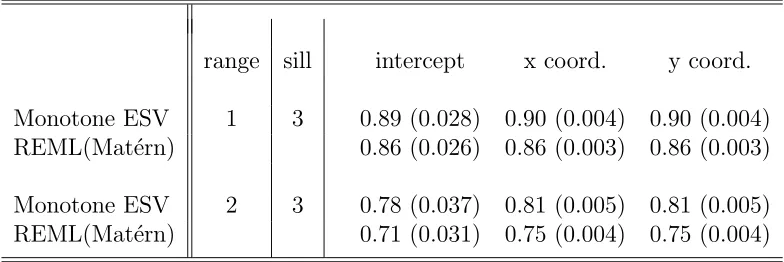
Table 4.2 shows results for Gaussian spatial processes observed on a 10 ×10
grid, that are generated using an exponential variogram model with the sill = 3
and range parameter = 1 and 2, respectively. The average correlation is 0.04 for
the model with the range parameter equal to 1, and is 0.14 for the model with
the range parameter 2. (For comparison with the time series simulation in Table
3, note that the average correlation for ρ = .1, .5, and .9 are .002, .02, and .16,
respectively.) A mean surface was added to these Gaussian processes to describe
a spatial trend: f(µ) = β0 +β1x +β2y, where (x, y) defines a point in R
2 with
β0 = 0.0, β1 = 0.9, β2 = 0.06. Three covariates, a column of ones for the intercept
and x (longitude) and y (latitude), were fitted to the model to estimate the mean
surface. We then compared our methods to REML estimation using an assumed
Mat´ern variogram model (which is correct here). We see in Table 4 that our estimates
are a little closer to the target value and a little more variable than the REML-Mat´ern
estimates. Our estimates have one large advantage not illustrated by these results:
our approach is totally invariant to the presence or absence of a nugget effect. In
contrast, with a nugget effect the Mat´ern model would need to be fit with an added
nugget parameter and results then would be more variable.
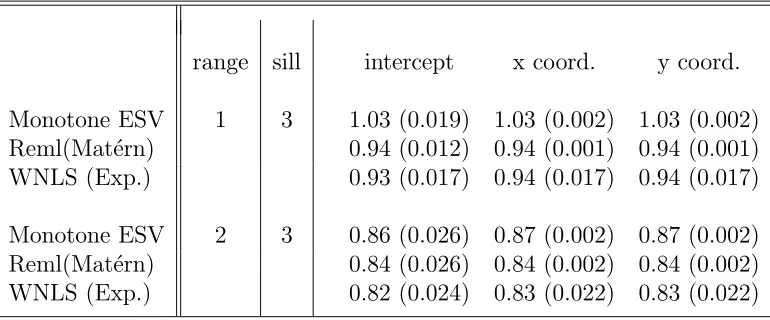
Table 4.3 contains results similar to Table 4.2 but for a 16 by 16 lattice. Comparing
Table 4.2 and Table 4.3 shows that performance is improving with sample size.
Chapter 4. Variance Estimation of Regression Parameters Based on Semivariograms33
with smoothing parameter 1, often called the Whittle model (Whittle, 1954). Whittle
suggests that this model is natural for agricultural field trials. Results here are similar
Table 4.2: Average of Standard Deviation Estimates (divided by true standard
deviation) for Regression from 10×10 Spatial Data of Size 100 with Exponential
Variogram Errors. Based on 100 replications. Standard errors are in parentheses.
range sill intercept x coord. y coord.
Monotone ESV 1 3 0.89 (0.028) 0.90 (0.004) 0.90 (0.004)
REML(Mat´ern) 0.86 (0.026) 0.86 (0.003) 0.86 (0.003)
Monotone ESV 2 3 0.78 (0.037) 0.81 (0.005) 0.81 (0.005)
Chapter 4. Variance Estimation of Regression Parameters Based on Semivariograms35
Table 4.3: Average of Standard Deviation Estimates (divided by true standard
deviation) for Regression from 16×16 Spatial Data of Size 100 with Exponential
Variogram Errors. Based on 100 replications. Standard errors are in parentheses.
range sill intercept x coord. y coord.
Monotone ESV 1 3 1.03 (0.019) 1.03 (0.002) 1.03 (0.002)
Reml(Mat´ern) 0.94 (0.012) 0.94 (0.001) 0.94 (0.001)
WNLS (Exp.) 0.93 (0.017) 0.94 (0.017) 0.94 (0.017)
Monotone ESV 2 3 0.86 (0.026) 0.87 (0.002) 0.87 (0.002)
Reml(Mat´ern) 0.84 (0.026) 0.84 (0.002) 0.84 (0.002)
Table 4.4: Average of Standard Deviation Estimates (divided by true standard
deviation) for Regression from 16×16 Spatial Data of Size 100 with Whittle Variogram
Errors. Based on 100 replications. Standard errors are in parentheses.
range sill intercept x coord. y coord.
Monotone ESV 1 3 1.10 (0.016) 1.08 (0.001) 1.08 (0.001)
Reml(Mat´ern) 0.98 (0.007) 0.96 (0.001) 0.96 (0.001)
WNLS (Exp.) 0.98 (0.013) 0.96 (0.012) 0.96 (0.012)
Monotone ESV 2 3 1.00 (0.023) 0.99 (0.002) 0.99 (0.002)
Reml(Mat´ern) 0.93 (0.015) 0.93 (0.001) 0.93 (0.001)
Chapter 4. Variance Estimation of Regression Parameters Based on Semivariograms37
4.2
Robust Regression Estimates of
β
The OLS estimators minimize the sum of residual squaresPni=1ei(β)2, and effieciency
losses may arise since this sum of squares is sensitive to large values that occur
more frequently with non-Gaussian data. Robust M-estimators minimize an objective
function Pni=1ρ(ei(β)) that is less sensitive to large values. Equivalently by taking
derivatives, one solvesPni=1ψ(ei(β))xi = 0, whereψ =ρ0. In order for the estimators
to be scale invariant, one needs to alter the above equation to
n
X
i=1
ψ
ei(β)
b
σ
xi = 0,
where bσ is a scale estimate. There are different options for selecting ρ and bσ, but a
common approach is to use
ρ(t) =
t2
2 if |t| ≤k,
k|t| −k22 otherwise.
ψ(t) =
−k if t < k, t if −k ≤t ≤k, k if t > k.
where k is a tuning constant, usually selected to give an appropriate asymptotic
b
σ by solving simultaneously
n
X
i=1
ψ2
ei(β)
b
σ
=Ck,
whereCkis a constant chosen so thatσbis consistent for the standard deviation when
the data are from a Gaussian distribution. For example, when k = 1, C1 =.516, and
the asymptotic relative efficiency ofβb to least squares for independent Gaussian data
is close to 90%.
Asymptotic normality of βb was proved by Koul (1977, p. 688). One version of
the asymptotic variance is given by
D(XTX)−1XTVψX(XTX)−1,
where D = σ/Eψ0(e1/σ) and Vψ is the covariance matrix of ψ(e1/σ), . . . , ψ(en/σ).
We should also mention that we have ignored the role of estimating σ in the
asymp-totic distribution of βb because for errors with symmetric marginal distributions, the
asymptotic correlation between βb and σb is zero.
These M-estimators fit into the general scheme outlined in Section 2. That is,
we assume that ψ(e1/σ), . . . , ψ(en/σ) are second-order stationary and estimate their
covariance matrix using our nonparametric semivariogram estimator based on
Chapter 4. Variance Estimation of Regression Parameters Based on Semivariograms39
Table 4.5: Average of Standard Deviation Estimates (divided by true standard
deviation) for Regression from 10×10 Spatial Data of Size 100 with t-transformed
Exponential Variogram Errors. Based on 100 replications. Standard errors are in
parentheses. True standard deviations are based on 10000 replications and have
estimated coefficient of variation .007.
r s intercept x coord. y coord.
True Stand. Dev. (LS) 1 3 0.84 0.118 0.118
True Stand. Dev. (Robust) 0.75 0.106 0.106
Monotone ESV (LS) 1 3 0.91 (0.036) 0.91 (0.034) 0.91 (0.034)
Monotone ESV (Robust) 0.89 (0.035) 0.90 (0.032) 0.90 (0.040)
True Stand. Dev. (LS) 2 3 1.25 0.168 0.168
True Stand. Dev. (Robust) 1.14 0.154 0.154
Monotone ESV (LS) 2 3 0.73 (0.031) 0.75 (0.031) 0.75 (0.031)
least squares residuals. However, one way to motivate their use is by defining
pseudo-observationsYei =xTiβb+dψ(bei/bσ) for any constantd. Then the least squares estimate
based onYei is just βb, and the residuals are dψ(bei/bσ).
Table 4.5 shows results for situations similar to Table 4.2 but with errors from t
-transformed exponential variogram models. That is, we -transformed the exponential
errors used in Table 4.2 using the transformation F5−1(Φ(Yi/
√
3)), where Φ is the
standard normal distribution function andF5−1 is the inverse distribution function of
a t distribution with 5 degrees of freedom. Thus the marginal distribution of Yi is a
t distribution with 5 degrees of freedom.
The entries in rows 1 and 2 and 5 and 6 of Table 4.5 are Monte Carlo estimates of
the variance ofβb based on 10,000 replications. These show that the robust regression
estimates have less variability than the least squares estimates as expected. The other
rows are our standard deviation estimates for the regression parameter estimates
divided by the estimated true standard deviations. The results are fairly similar to
Table 4.2 and show that the estimates are negatively biased but less biased for the
Chapter 5
Discussion
Our main goal has been to estimate the variance of regression coefficients obtained
from a general estimating equations approach without making parametric
semivari-ogram assumptions. Thus we have proposed a new method for nonparametric
semi-variogram estimation based on monotonizing a reduced-bias empirical semisemi-variogram
based on residuals.
The simulations of Section 4 indicate that the resulting variance estimates are
reasonably unbiased and are converging as the sample size grows. Comparison with
REML using the true Mat´ern model shows that the new method is competitive with
parametric methods. It would be useful to make comparisons when the true model is
not from the Mat´ern model.
Bibliography
Andrews, D.W.K. (1991), “Heteroskedasticity and Autocorrelation Consistent
Co-variance Matrix Estimation,” Econometrica, Vol. 59, No.3 817-858.
Barlow, R., Bartholemew, D., Bremner, J., and Brunk, H. (1972)Statistical Inference
Under Order Restrictions, John Wiley, New York.
Barry J.P. and Ver Hoef, J. M. (1996), “ Blackbox Kriging: Spatial Prediction
With-out Specifying Variogram Models,”Journal of Agricultural, Biological, and
Envi-ronmental Statistics, 3, 297-322.
Brownie, C. and Gumpertz, M. (1997), “Validity of spatial analyses for large field
trials,”Journal of Agricultural, Biological, and Environmental Statistics, 2, 1-23.
Carlstein, E. (1986), “The Use of Subseries Values for Estimating the Variance of
Chapter 6. Bibliography 43
a General Statistic from a Stationary Sequence,”The Annals of Statistics, 14,
1171-1179.
Cherry, S., Banfield, J., and Quimby, W.F. (1996), “An Evaluation of a
Nonpara-metric Method of Estimating Semi-variograms of Isotropic Spatial Processes,”
Journal of Applied Statistics, Vol. 23, No. 4, 435-449.
Cherry, S. (1997), “Non-parametric Estimation of the Sill in Geostatistics,”
Environ-metrics, 8, 13-27.
Cressie, N. (1987), “A Nonparametric View of Generalized Covariances for Kriging,”
Mathematical Geology, Vol. 19, 425-449.
Cressie, N. (1993), Statistics for Spatial DataJohn Wiley, New York.
Garcia-Soidan, P. H. and Hall, P. (1997), “On Sample Reuse Methods for Spatial
Data,”Journal of the American Statistical Association,Biometrics, 53, 273-281.
Genton, M. G. (1998) “Variogram Fitting by Generalized Least Squares Using an
Explicit Formula for the Covariance Structure,” Mathematical Geology, Vol. 30,
No. 4, 323-345.
Gorsich, D. J., and Genton, M. G.(2000) “Variogram Model Selection via
Hall, P., Fisher, N. I., and Hoffman, B. (1994), “On the Nonparametric Estimation
of Covariance Functions,” The Annals of Statistics, 22, 2115-2134.
Heagerty, P.J. and Lumley, T. (2000), “Window Subsampling of Estimating Functions
With Application to Regression Models,” Journal of the American Statistical
Association, 95, 197-211.
Huber, P. (1980),Robust Statistics John Wiley, New York.
Koul, H. L. (1977), “Behavior of Robust Estimators in the Regression Model with
Dependent Errors,” Annals of Statistics, 5, 681-699.
Lele, S. (1991), “Jackknifing Linear Estimating Equations: Asymptotic Theory and
Applications in Stochastic Processes,” Journal of the Royal Statistical Society,
Ser. B, 53, 253-267.
Lele, S. (1995), “Inner Product Matrices, Kriging, and Nonparametric Estimation of
the Variogram,” Mathematical Geology, 27, 673-692.
Liang, K.-Y., and Zeger, S.L. (1986), “Longitudinal Data Analysis Using Generalized
Linear Models,” Biometrika, 73, 13-22.
Lumley, T. and Heagerty, P.J. (1999), “Weighted Empirical Adaptive Variance
Esti-mators for Correlated data regression,” Journal of the Royal Statistical Society,
Chapter 6. Bibliography 45
Mat´ern, B. (1960), Spatial Variation. Meddelanden fran Stantens
Skogsforsknin-ingsinstitut, 49, No. 5.
Matheron, G. (1971), The Theory of Regionalized Variables and Its Applications,
Cahiers du Centre de Morphologie Mathematique, No. 5, Fontainebleau, France.
Matheron, G. (1973), “The Intrinsic Random Functions and Their Applications,”
Advances in Applied Probability, 5, 439-468.
Newey, W.K., and West, K.D. (1987), “A Simple Positive Semi-Definite,
Heteroskedas-ticity and Autocorrelation Consistent Covariance Matrix,”Econometrica, 55,
703-708.
Shapiro, A. and Botha, J.D. (1991), “Variogram Fitting with a General Class of
Con-ditionally Nonnegative Definite Functions,” Computational Statistics and Data
Analysis, 11, 87-96.
Sherman, M. (1996), “Variance Estimation for Statistics Computed from Spatial
Lat-tice Data,”Journal of the Royal Statistical Society, Ser. B, 58, 509-523.
Sherman, M. (1997), “Subseries Methods in Regression,” Journal of the American
Statistical Association, 92, 1041-1048.
White, H., and Domowitz, I. (1984), “Nonlinear Regression with Dependent
Obser-vations,” Econometrica, 52, 143-161.
Whittle, P. (1954), “On stationary processes in the plane,” Biometrika, 41, 434-449.
Yasui and Lele, S. (1997), “A Regression Method for Spatial Disease Rates: an
Esti-mating Function Approach,” Journal of the American Statistical Association, 92,
Part II
Spectral Analysis with Spatial
Periodogram and Data Tapers
Introduction
This part of the thesis proposes statistical methods for characterizing stationary
spa-tial processes in the spectral (frequency) domain. The analysis of stationary processes
with their spectral representations in the frequency domain is referred to as spectral
analysis. More familiar approaches to treating the data from spatial processes involve
studying and estimating the covariance function in the time-space domain. Further,
most standard results in spectral analysis have been established for one-dimensional
(time series) data. Our research is devoted to developing alternative approaches to
the conventional space domain methods, extending existing spectral domain results
for time series data to higher dimensional spatial data. Spectral analysis finds broad
applications in many branches of science such as Oceanography, Physics, Electrical
engineering, and Geostatistics. It is useful in a variety of practical problems including
interpretation of energy and frequency distributions of random periodic data,
predic-tion and filtering problems, and statistical model fitting of processes. It is particularly
Chapter 7. Introduction 49
advantageous in analyzing large data sets and in studying properties of multivariate
processes. Geostatistical data are usually collected over a large region, and handling
large data sets is often problematic for the commonly used techniques: for example,
inversion of a large covariance matrix to compute a likelihood function may not be
possible or may demand much effort and time in computation. The use of a Fast
Fourier Transform (FFT) algorithm, which is a key operation in spectral analysis,
can be a good resolution to these computing problems. However, the FFT can be
applied only to regularly spaced data, so data observed on an irregular grid need to
be digitized for FFT.
The spatial periodogram, which can be thought of as a counterpart to the
empiri-cal variogram, is a powerful tool to estimate the correlation structure of a stationary
process. It is a nonparametric estimate of the spectral density, which is the Fourier
transform of the covariance function. The properties of the spatial periodogram have
been investigated by Stein (1995), Guyon (1992, 1982), Ripley (1981), Rosenblatt
(1985) and Whittle (1954). The empirical variogram, which is the most widely used
in the time-space domain for estimating the dependence structure of data, is
usu-ally fitted to parametric variogram models using techniques such as non-linear least
squares (NLS) and restricted maximum likelihood (REML) methods. However, the
same data points are used to obtain the empirical variogram at different lags,
re-sulting in estimates which are more highly correlated than the data observations.
practice and one usually does not account for the correlation between them to fit a
variogram model. Ignoring such correlation can certainly mislead data analyses. On
the other hand, in the spectral domain the periodogram values at any set of Fourier
frequencies are asymptotically uncorrelated. The asymptotic independence of the
periodogram estimates gives one of the big advantages of spectral analysis in that
techniques such as NLS can be naturally applied without incorporating an estimated
correlation. However, the spatial periodogram itself is not a consistent estimator of
the spectral density. In order to achieve consistency, application of smoothing filters
directly to the periodogram estimates has been more considered in the past. The
edge-effect problem does not vanish even asymptotically when we smooth the spatial
periodogram in two or higher dimensions. For one-dimensional data, there is only
one boundary point at each end, but the number of boundary points increases with
the dimension, leading to more serious edge effects. Instead of smoothing biased
pe-riodogram estimates, filtering the raw data with a data taper before computing the
periodogram not only provides a consistent estimate of the spectral density but also
is highly effective in removing edge-effects. The information lost by smoothing the
periodogram because of the presence of powerful frequencies can be better recovered
by data tapers. Prewhitening is another method of filtering data to control the bias
of the periodogram. Moreover, with the fixed-domain asymptotic approach, where
the number of observations increases in a fixed study area, it has been shown that
Chapter 7. Introduction 51
(Stein, 1995).
The effect of tapering higher dimensional data in the space domain was studied by
Dalhaus and K¨unsch (1987), who examined the tapering effect for the usual sample
covariance estimator. In this thesis, we first propose to use the tensor product of two
one-dimensional tapering functions to filter the data before computing the spatial
periodogram. We present a method to choose an appropriate amount of smoothing
for data tapers, taking into consideration the tradeoff between the bias and variance
of the tapered periodogram. We also introduce a new asymptotic approach for spatial
data called ‘shrinking asymptotics’ which extends the idea employed for time series
data by Constantine and Hall (1994). In the shrinking asymptotic approach, we
consider decreasing the space between data observations, allowing the number of
observations to increase at the same time as we expand the studying area. This
approach enables us to avoid aliasing problems and to uniquely estimate the spectral
density.
In Section 2, we introduce the spatial periodogram which is generalized from the
traditional one-dimensional periodogram in time series analysis. In Section 3, the
properties of tapering functions are briefly described. A method of estimating the
spectral density with the tapered spatial periodogram based on shrinking asymptotics
is given in Section 4. Lastly, the practical method to choose an appropriate amount
of smoothing for spatial data is proposed based on the study of the asymptotic mean
Spatial Periodogram
8.1
Spectral Representation of a Stationary
Ran-dom Field
A random field is weakly stationary if its expectation and variance are both translation
invariant over the domain.If a random field Z(x), x∈R
2, is weakly stationary then
it can be represented as
Z(x) =
Z
R
2 exp(iλ
Tx)dφ(λ),
where φ(λ) is an orthogonal-increment process (i.e. the process φ(λ) has the special
property that its increments at different values of λ are uncorrelated). The process
Chapter 8. Spatial Periodogram 53
φ(λ) and a stationary random field Z(x) are related in the following way
E[|φ(λ)|2] =F(λ),
whereF(λ) is a positive finite measure called a spectral distribution function. Priestly
(1996) describes the spectral representation of a stationary process as follows:
“This spectral representation of the process Z(x) essentially tells us that any
stationary process can be represented as the limit of the sum of sine and cosine
functions with random coefficients dφ(λ), or more precisely, with random amplitudes
|dφ(λ)| and random phases arg{dφ(λ)}.”
The covariance function CZ(x) = Cov{Z(x+u), Z(u)}, assuming zero mean for
Z(x), can be expressed in terms of the spectral measure F(·):
CZ(x) =
Z
R
2
exp(iλTx)F(dλ),
where F(·), a finite positive measure.When F(·) is differentiable with respect to
Lebesgue measure, the spectral density at frequencyλis defined as simply the Fourier
transform of the autocovariance function CZ(·):
fZ(λ) =
1
(2π)2
Z
R
2 exp(−iλ T
x)CZ(x)dx.
that obtained from its autocovariance.
8.2
Overview - Periodogram for Time Series Data
The periodogram was first introduced by Schuster (1898) as a tool to identify hidden
periodicities. The periodogram, which is a non-parametric estimate of the spectral
density, reflects periodic behavior of a time series and is a useful tool to analyze
stochastic processes. Smooth series are characterized by periodogram values which
have most of their power at low frequencies, whereas quickly oscillating series are
characterized by periodogram values which have most of their power at high
frequen-cies.
For a real-valued time series process, X(t), t = 0,±1, ... with mean E(X) and
autocovariance function CX(u), the spectral density of period 2π for the series X(t)
is defined as
fX(λ) =
1
2π
∞
X
u=−∞
CX(u)e−iλu, − ∞< λ <∞,
if
∞
X
u=−∞
|CX(u)|<∞,
CX(u) = Cov{X(t +u), X(t)}, t, u = 0,±1, .... To estimate the spectral density
fX(λ), we first compute the finite Fourier transform of the seriesX(t),
PT−1
t=0 X(t)e−
iλt,
at a discrete set of frequencies. This finite Fourier transform is asymptotically