ISSN(Online): 2319-8753 ISSN (Print): 2347-6710
I
nternational
J
ournal of
I
nnovative
R
esearch in
S
cience,
E
ngineering and
T
echnology
(A High Impact Factor, Monthly, Peer Reviewed Journal) Visit: www.ijirset.com
Vol. 6, Issue 12, December 2017
Design of Material Handling System Based On
Anthropometric Data and its Ergonomic
Evaluation
Manjunath Rajesh Wale1, P. V. Salunke2
P.G. Student, Department of Mechanical Engineering, Walchand Institute of Technology, Solapur, Maharashtra,India1
Professor, Department of Mechanical Engineering, Walchand Institute of Technology, Solapur, Maharashtra India2
Abstract: A study for ergonomics was carried out in a stone polishing plant in Solapur, Maharashtra to understand the current material handling methods in the said plant. It was found that the major way of material handling in the plants is manual and is done by bare hands by the workers. Rapid Upper Limb Assessment was used to ascertain the level of comfort and safety of postures of these workers. The assessment gave a result of 7 for every step in the material handling activity. Anthropometric data was collected from various plants and stastical survey was carried out. Later a material handling system was designed using design and modeling softwares. At the end ergonomic analysis was carried out on the newly designed material handling system to assess the improvement in comfort and safety.
KEYWORDS: RULA, Anthropometry, Design
I. INTRODUDCTION
Ergonomics (or its synonym human factors) is “the scientific discipline concerned with the understanding of the interactions among humans and other elements of a system, and the profession that applies theory, principles, data and methods to design in order to optimize human wellbeing and overall system performance”, and it considers both a social goal (human wellbeing) and an economic goal (overall system performance), these two goals are corresponding to dimensions of sustainability.(mmh niosh 2007)
Anthropometry is derived from greek word “anthropos” meaning human and “metron” meaning to measure, refers to measurement of human individual. An early tool of physical anthropology, it has been used for identification, for the purpose of understanding human physical variation. It involves the systematic measurement of the physical properties of the human body, primarily dimensional descriptors of body size and shape.(bridger 1995). The RULA (Rapid Upper Limb Assessment) system was developed at the University of Nottingham's Institute for Occupational Ergonomics (Reference: Lynn McAtamney and E. Nigel Corlett, RULA: A Survey Method for the Investigation of Work-related Upper Limb Disorders). It was developed to investigate the exposure of individual workers to risks associated with work-related upper limb disorders.
II. LITERATURE SURVEY
ISSN(Online): 2319-8753 ISSN (Print): 2347-6710
I
nternational
J
ournal of
I
nnovative
R
esearch in
S
cience,
E
ngineering and
T
echnology
(A High Impact Factor, Monthly, Peer Reviewed Journal) Visit: www.ijirset.com
Vol. 6, Issue 12, December 2017
Tarwinder Singh, (July 2014) et. al. suveyedThree electronic industries in an around Chandigarh. It was observed that the manual lifting tasks were the most critical task, resulted in MSDs amongst workers. These tasks were analyzed by using RULA and REBA techniques. They suggested successful improvements.
Raghunathan Rajesh, et, al (December 2013) identified The causes of ergonomic stressors at a hazardous location in a manufacturing plant. The ergonomic redesign of manual material worksystem was done. The design solution provides a significant reduction in stress on lower back. It was identified that there is scope for further study to explore the impact of ergonomic interventions on productivity.
Dohyung Kee et. al. (2007) Carried out a study aimed to compare 3 observational techniques for assessing postural load, namely, OWAS, RULA, and REBA. The inter-method reliability for postural load category between OWAS and RULA was just 29.2%, and the reliability between RULA and REBA was 48.2%. This was helping in deciding RULA as a method for ergonomic evaluation.
III. METHODOLOGY
First an anthropometric survey was carried out with help of ISO 7250 using an anthropometer and then these values were used to design a material handling system. The material handling system was modeled in CATIA and the 2D drawings were obtained in SolidWorks. CATIA was used to carry out the ergonomic analysis.
IV. SELECTION OF ANTHROPOMETRIC PARAMETERS
Five anthropometric measurements were chosen as the basis to design, they were: Shoulder height is chosen so that the worker will always work staying upright.
Length of elbow is chosen as a parameter so that the handle stays close to the workers body so that he doesn’t have to bend or stoop.
Span is chosen as a parameter so that the pillars are no far placed so that they are within capacity of the worker. Grip reach is chosen so that the worker is not placed too far away from the pillars.
Maximum grip breadth and grip inside diameter are chosen to design the handle and the hand wheel so that these can be handled optimally.
V. SELECTION OF SUBJECTS
The subjects chosen were workers working at various marble industries in solapur. There are 10 workers in siddeshwar marble industries.50 workers were chosen, who came from different backgrounds. They speak languages like Marathi, Kannada, Hindi and Telugu. They are of age groups between 18 to 52.
VI. STATISTICAL ANALYSIS AND PRESENTATION OF DATA
An anthropometer was used to carry out measurements of workers at various stone polishing plants in solapur. Measurement were taken and noted. The workers were made to stand erect on horizontal surface and without any footwear. Series of measurements were then taken. Following are the various measurements that were taken. Following tables hold the data that was gathered by travelling around various stone processing units in and around Solapur. The data was taken from different places so that it is random and to avoid repetition.
Table 1: anthropometric measurements
ISSN(Online): 2319-8753 ISSN (Print): 2347-6710
I
nternational
J
ournal of
I
nnovative
R
esearch in
S
cience,
E
ngineering and
T
echnology
(A High Impact Factor, Monthly, Peer Reviewed Journal) Visit: www.ijirset.com
Vol. 6, Issue 12, December 2017
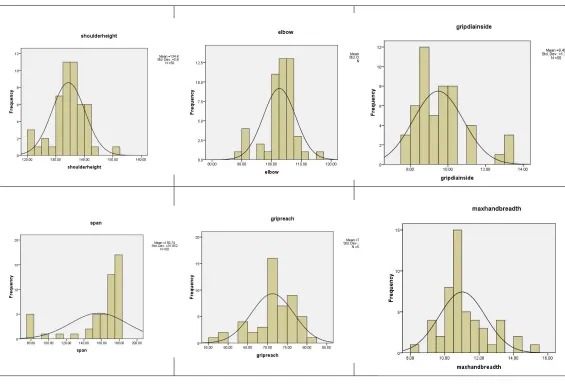
test of normality. The sigma values were found to be within range and hence this data was further utilised to get the maximum and minimum values. The fifth and 95th percentiles were also found out.
The results are as follows
Fig 1:frequency statistics tool in SPSS
ISSN(Online): 2319-8753 ISSN (Print): 2347-6710
I
nternational
J
ournal of
I
nnovative
R
esearch in
S
cience,
E
ngineering and
T
echnology
(A High Impact Factor, Monthly, Peer Reviewed Journal) Visit: www.ijirset.com
Vol. 6, Issue 12, December 2017
Table2: results of stastical analysis
For designing the following values were choden: Shoulder height – 5th percentile 117cm
Elbow length - 5th percentile 94.32cm Span - 5th percentile 88.65cm
Grip reach- 5th percentile 61.2cm
Maximum hand breadth- 95th percentile 13.36cm Grip diameter - 95th percentile 11.879cm
These values were used to decide the basic dimensions of the material handling system. The distance of the worker stands 612mm away from the cart because of his maximum grip reach, the handwheel has to be placed at 943.2mm because of the elbow height. The vertical columns have to be higher than 1170mm because of the shoulder height. The handle of the handwheel has to be larger than 133.6mm because of the maximum hand breadth and its diameter has to be more than 11.879mm
VII. DESIGN
The material handling system works as shown in the figure. A moving platform is placed on two columns that’s moves up and down with the help of a screw jack. The worker slides the slab on to the platform and clamps it. He then lowers the platform by rotating the handwheel and then pushes the trolley to the storage area. He then unclamps the slab and then pushes the slab into the storage area.
The design began with frame on which the other components had to be placed. Tata structura rectangular pipes of various were used for this purpose. A higher factor of safety was assumed while designed. A proper balance was tried to be obtained between safety and economy.
Later the actuator mechanism was chosen for the lifting of slabs. Among various options that included hydraulic jack and rack and pinion mechanism a screw jack was chosen. The load was already
Shoulderheight elbow Span gripreach maxhandbreadth gripdiainside
N Valid 50 50 50 50 50 50
Missing 0 0 0 0 0 0
Mean 134.4220 1.0263E2 1.5674E2 71.2600 11.0220 9.4860 Median 134.5000 1.0400E2 1.7100E2 72.0000 10.7000 9.2000 Mode 134.00 102.00a 178.00 75.00 10.50 10.00 Std. Deviation 5.81537 5.43973 3.18522E1 5.36226 1.34184 1.33172
Variance 33.818 29.591 1.015E3 28.754 1.801 1.773
Skewness -.321 -.821 -1.793 -.939 .893 1.215
Std. Error of Skewness .337 .337 .337 .337 .337 .337
Kurtosis .860 1.376 1.988 .875 .931 1.319
Std. Error of Kurtosis .662 .662 .662 .662 .662 .662
Minimum 121.00 89.00 75.00 56.00 8.40 7.80
Maximum 150.00 116.00 182.00 80.00 15.00 13.00
ISSN(Online): 2319-8753 ISSN (Print): 2347-6710
I
nternational
J
ournal of
I
nnovative
R
esearch in
S
cience,
E
ngineering and
T
echnology
(A High Impact Factor, Monthly, Peer Reviewed Journal) Visit: www.ijirset.com
Vol. 6, Issue 12, December 2017
Fig 4: working of the material handling system
chosen based on the torque a human hand can generate. Appropriate calculations based on the literature available were carried out and it was found that the said screw jack is safe in all respects. Finally for the ease of movement urethane on steel castor wheels with brakes were chosen. Four such wheels were chosen with one at each respective corner. \
The components of the design are: 1. Vertical column 2. Base
3. Handwheel 4. Lifting platform 5. Screw jack 6. Clamp 7. Castor Whee
The material handling equipment is basically a trolley with a lifting platform. This platform is lifted using a screw jack. The screw jack is operated manually with a hand wheel. The trolley is provided with four castor wheels one on each corner.
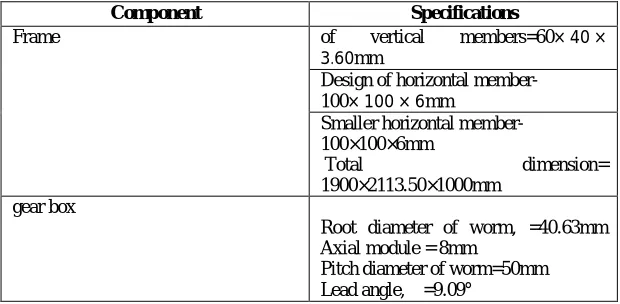
Component Specifications
Frame of vertical members=60× 40 ×
3.60mm
Design of horizontal member- 100× 100 × 6mm
Smaller horizontal member- 100×100×6mm
Total dimension=
1900×2113.50×1000mm gear box
Root diameter of worm, =40.63mm Axial module = 8mm
Pitch diameter of worm=50mm
ISSN(Online): 2319-8753 ISSN (Print): 2347-6710
I
nternational
J
ournal of
I
nnovative
R
esearch in
S
cience,
E
ngineering and
T
echnology
(A High Impact Factor, Monthly, Peer Reviewed Journal) Visit: www.ijirset.com
Vol. 6, Issue 12, December 2017
∝= 20° full depth involute
Face width L =113.6mm Depth of tooth h = 17.24mm Addendum ha1=8mm
Outside diameter of worm =66mm
diametric quotient, q= 6.25mm Axial module, m= 8mm Normal module =7.799mm Dedendum, hf1 =9.37mm
Root diameter of worm
= 40.63mm
PCD of worm wheel, d= 40mm
Face width of worm wheel, b= 37.5
addendum,
ha= 7.799mm
Outside diameter of worm wheel= 55.598mm
bolts:
Material – plain carbon steel 45C8
d=9.67mm,d = 12mm
The standard size of bolt is M12.
Castor wheels Weight on each wheel =
636.89 lbs=288.88kg
Series 30 medium load capacity Dia- 5”=127mm
Width- 2”=50.8mm
Capacity- 900 lbs=408.233kg Bolts 30C8 plane carbon steel
d = 10mm d≈12mm Hence the required bolts are M12.
Screw jack Nominal diameter = 26mm
Pitch = 6.35mm
Mean diameter = 22.825mm Starting torque,
T =27.067 N-mm
d = 19.65mm
material – mild steel 30C8
ISSN(Online): 2319-8753 ISSN (Print): 2347-6710
I
nternational
J
ournal of
I
nnovative
R
esearch in
S
cience,
E
ngineering and
T
echnology
(A High Impact Factor, Monthly, Peer Reviewed Journal) Visit: www.ijirset.com
Vol. 6, Issue 12, December 2017
VIII. ECONOMIC IMPACT
wage of the worker per day = Rs 300 no. of workers required to handle one slab=5 time required to lower one slab= 60 seconds
cost of newly designed material handling system = Rs 29,631
no. of slabs handled by new material handling system at one time = 5 no. of tiles= h h = =177 tiles
total time required to manually unload the truck= 177×60= 10620=3 hours cost of one complete manual unloading of slabs= wage per worker×no. of workers
= 300×5=1500 Rs But, no. of workers required to lower the slab = 3
Cost of one complete unloading of slabs = 3×300 = 900 Rs
Total time required to recover total cost of the new material handling system = = 20 unloading opeartions.
IX. ERGONOMIC ANALYSIS OF THE NEW MATERIAL HANDLING SYSTEM FOR UNLOADING
RAW MATERIALS
The new design was tested to do the operation of handling raw materials and RULA analysis was conducted over it. So that its results could be compared with the results of earlier operations. As done before the manikin was moddelled in catia and the RULA analysis was done. In this operation the slabs need to be lowered from the truck and placed on the trolley. A worker pushes the trolley near the truck and and raises the platform. A worker standing on truck slides the slab on the platform and clamps it. The worker on the ground then lowers the platform. The worker then pushes the trolley towards the storage area. He then applies brakes on the castor wheel. He then removes the clamp and then pushes the slab into a stack.
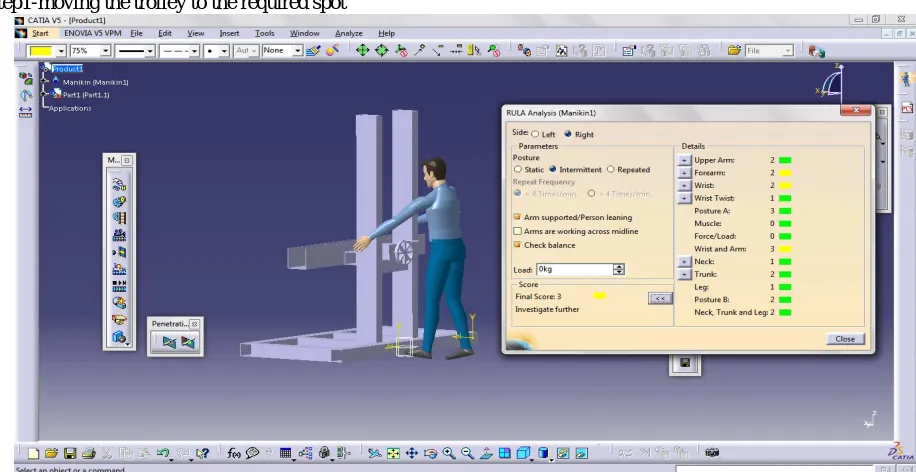
Step1-moving the trolley to the required spot
ISSN(Online): 2319-8753 ISSN (Print): 2347-6710
I
nternational
J
ournal of
I
nnovative
R
esearch in
S
cience,
E
ngineering and
T
echnology
(A High Impact Factor, Monthly, Peer Reviewed Journal) Visit: www.ijirset.com
Vol. 6, Issue 12, December 2017
The worker here first pushes the empty cart towards the truck. He pushes the truck by the two columns. The final RULA score obtained is 3, earlier for the same activity the score was 7 hence we can say the comfort has increased.
Step 2- lifting the rack by rotating the handwheel
The worker is rotating the handwheel here. The worker rotates the handwheel to lift the platform until it reaches the height same as that of the truck. This activity was not present earlier so it cannot be directly compared. But it forms a part of the activity of carrying the slab whose score was earlier 7 but now it has reduced to 4. Hence we can say that the comfort has increased.
Step 3- placing the slab on the rack
The worker is now transferring the slabs on the trolley from the truck. The worker pushes the slab on the platform and clamps it, The RULA score for this was 7 earlier now it has reduced. Hence we can say there is increase in comfort level.
Step 4- lowering the rack by rotating the handwheel
The worker here is lowering the slab. four persons were required earlier for this activity. Now only 2 are required. The RULA score earlier was 7 now it has reduced to 4 hence we can say comfort has increased. Here wrist score is slightly high while turning the handle.
Step 5- pushing the cart to the storage are
The worker now pushes the cart to the storage area . The score of wrist is 2 and posture is 3 which is considerably low than the earlier method and within limit.
Step 6- removing the slab from the trolley
In this activity the worker pushes the slabs from the platform into the stack. Due to the rollers on the platform the force required to push is reduced considerably. The RULA score for this activity is 3 which was earlier 7. Hence we can say that the activity is comfortable. Three people were required to carry out this task now only 1 is required.
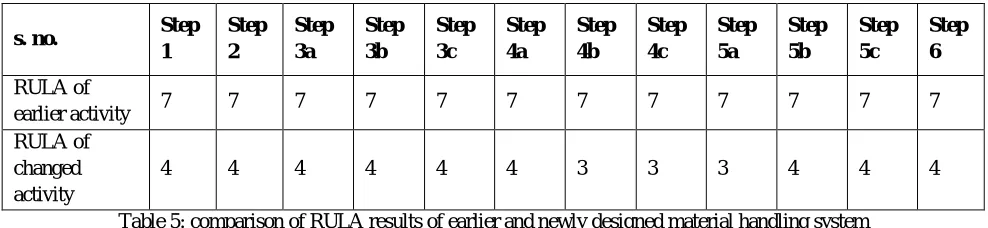
Table of results:
s. no. Step
1 Step 2 Step 3a Step 3b Step 3c Step 4a Step 4b Step 4c Step 5a Step 5b Step 5c Step 6 RULA of
earlier activity 7 7 7 7 7 7 7 7 7 7 7 7
RULA of changed activity
4 4 4 4 4 4 3 3 3 4 4 4
Table 5: comparison of RULA results of earlier and newly designed material handling system
When compared with the results of activity carried out earlier the RULA analysis shows that the activity being carried out now is more comfortable and hence safe.
X. CONCLUSION
ISSN(Online): 2319-8753 ISSN (Print): 2347-6710
I
nternational
J
ournal of
I
nnovative
R
esearch in
S
cience,
E
ngineering and
T
echnology
(A High Impact Factor, Monthly, Peer Reviewed Journal) Visit: www.ijirset.com
Vol. 6, Issue 12, December 2017
of comfort. The cost of device was found to be Rs 29631 and it was found that the total cost of machine can be recovered if the material handling system was used 20 times.
REFERENCES
[1.] Ergonomics Consideration for Hospital Bed Design: A Case Study in Bangladesh ,Md. Ariful Islam, Md. Asadujjaman, Md. Nuruzzaman and Md. Mosharraf Hossain, 2013
[2.] Analytic hierarchy process to support the safety and ergonomic assessment of alternatives in “manuable” material handling, D. Rossi, E. Bertoloni, M. Fenaroli, F. Marciano, M. Alberti Dipartimento di Ingegneria Meccanica e Industriale, Università degli Studi di Brescia 2013 [3.] Ergonomics as element of process and production optimization,Johannes Labuttis, 2015
[4.] Improving The Work Position of Worker’s Based on Quick Exposure Check Method to Reduce the Risk of Work Related Musculoskeletal Disorders, Ayu Bidiawati J.R, Eva Suryani.2015
[5.] Human Factors and Ergonomics in transportation control systems,Kate Dobson, 2015
[6.] Guidelines for a rehabilitation model for banana packing plants from the integration of environmental variables and human factors.Juan C.Paniagua, 2015
[7.] Manual material handling: A classification scheme,Rajesh R.2015
[8.] Improving and modifying the design of workstations within a manufacturing environment [9.] Mustafa Khan, Regina Pope-Ford,2015
[10.] Implementation of ergonomic changes Zbigniew Wisniewski, Aleksandra Polak-Sopinska, Malgorzata Wisniewska, Piotr Sopinski,2015 [11.] Ergonomic Evaluation of Biomechanical Hand Function Kyung-Sun Lee, Myung-Chul Jung,2014