Deadline Constrained Cloud Computing
Resources Scheduling by hybrid of Particle
Swarm Optimization with Ant Colony
Optimization
Nancy Tanwar1, Gautam Kumar2
M.Tech Scholar, Dept. of CS, SDDIET, India1 Asst. Professor, Dept. of CS, SDDIET, India2
ABSTRACT: This paper presents the concepts of three evolutionary algorithms i.e., genetic algorithm, ant colony optimization and particle swarm optimization algorithm. An evolutionary algorithm copies the way how evolution occurs in the nature. There are various types of evolutionary algorithms. This paper focuses on Genetic, ACO and PSO algorithms. Genetic algorithm provides solution to various optimization problems. It follows the principle of “survival of the fittest”. Various problems such as knapsack problem, TSP (travelling salesman problem) can be solved using genetic algorithm. Ant colony optimization is a heuristic algorithm which follows the behaviour of ants i.e., the way ants seek food in their environment by starting from their nest. Particle swarm optimization algorithm(PSO) is also an optimization algorithm which also uses a method of searching using some heuristics.
I. INTRODUCTION
With rapid growth in Information Technology, more and more workflow systems are adopting cloud as their execution environment. It becomes progressively competitive on how to efficiently manage various workflows. Workflow is one of the most challenging problems in cloud to execute it while minimizing time as well as cost incurred by set of heterogeneous resources over the cloud simultaneously.
Nowadays, Cloud computing is a growing area in distributed computing that deliver dynamically adaptable services on demand over the internet through virtualization of hardware and software. The biggest advantage of the cloud is its flexibility to lease and release resources as per the user requirement. Furthermore, the cloud provider offers two types of plans namely short-term plan on demand and long-term reservation plan. It has got intelligent infrastructure i.e. Transparency, Scalability, Monitoring and Security
Scheduling of workflows require huge computation and communication cost. It is the process of mapping inert-dependent tasks on the available resources such that workflow application can complete its execution with user defined quality of service. This work target random workflow requests overtime, so it must schedule workflow execution without any knowledge of future requests.
II. EXISTING WORK
efficiency in terms of makespan and robust nature. A Hybrid Heuristics- Genetic Algorithm for Task Scheduling in Heterogeneous Processor Networks H2GS [7]
Kaur et al. proposed a new Modified Genetic Algorithm for scheduling the tasks in private cloud for minimizing the makespan and cost. In MGA, initial population is generating using SCFP (Smallest cloudlet to Fastest Processor), LCFP (Longest cloudlet to Fastest Processor) and 8 random schedules. Two-point crossover and simple swap are used. This gives the good performance under the heavy loads. A Performance Effective Genetic Algorithm for Task Scheduling in Heterogeneous Systems (PEGA) [17] Ahmad et al. proposed an effective genetic algorithm called PEGA, which is capable of providing the optimal results in large space with less time complexity. The direct chromosome representation is used having two parts. The right half is made by the b-level (upward rank) which give the better results in terms schedule length when compared with randomly generated population. Two-fold cross over is used in which single and two-point crossover are executed one after the other to enhance the quality and the convergence speed of the solution. The author has concluded that the PEGA provides the better schedule with smaller makespan and low time complexity.
Arabnejad et al. proposed a new list-based scheduling technique named PEFT for heterogeneous distributed computing which gives the better results than HEFT in terms of makespan. It has the same time complexity as that of HEFT. It consists of task prioritizing phase and processor selection phase. Most of the list-based scheduling allocates a task to the processor on which it gives the smallest EFT for the current task. They do not consider the impact of children on the current task and hence sometimes lead to the poor decisions.Optimistic EFT is calculated to assign a processor for a task. The aim is to ensure that the children tasks of the current task are finished earlier. The author has shown that PEFT does not give good results if all the tasks lies on critical path. Deadline based Resource Provisioning and Scheduling Algorithm for Scientific Workflows on Clouds [22]
Maria et al. have used PSO metaheuritic technique to optimize the scientific workflow on IaaS cloud. The authors have incorporated the basic features of IaaS cloud such as unlimited heterogeneous resources, flexibility, dynamic provisioning of resources, VMs boot time as well as leased time and performance variation of VMs. The idea is to combine the resource provisioning along with the scheduling strategy with a objective to minimize the execution cost while staying in the defined deadline. Task scheduling using NSGA II with Fuzzy Adaptive Operators for Computational Grids [23]
III. PROPOSED TECHNIQUE PRESENT WORK
4.1 Basic ACO Algorithm
The Ant algorithm was introduced by Dorigo M. in 1996 based on the real ant behavior and it’s a new heuristic algorithm to solve combinational optimization problems. Investigations have shown that ants have the ability to find food in an optimal path between the food and nest. With the ant motion some pheromone is released on ground, previous laid trail is encountered by isolated ant is being detected and follow with a higher probability. The ant’s probability of choosing the way depends upon the pheromone concentration on that way. Higher the pheromone concentration, higher will be the probability of that way adoption. An optimal way can be found by utilizing this positive mechanism of feedback. The steps of ant colony optimization algorithm are given below:
Algorithm 1
Step 1: Parameters is set; pheromone trails are initializing.
Step 2:On path segments, theVirtual trail is accumulated.
Step 3: ACO - Construct Ant Solutions
Pi.j=
( .)( .)
∑( .)( .)
Where,
On edge i, j the amount of pheromone is τi.j
To control the influence of τi,jα is a parameter
In edge i, j (typically 1/di,j) ηi,j is the desirability
To control the influence of ηi,jβ is a parameter
Step 4: ACO - Pheromone Update
According to the equation amount of pheromone is updated
τi,j = (1 − ρ)τi,j + ∆τi,j
Where,
On a given edge i, j the amount of pheromone is τi,j
ρ is the rate of pheromone evaporation is ρ
The amount of pheromone deposited is ∆τi,j, typically given by
∆ . = ,
Where,
The cost of the kth ant’s tour (typically length) is Lk.
4.2 Proposed Workflow Scheduling ACO Algorithm
With the above given ant algorithm characteristic utilization, the task can be scheduled. Similarly, new task can be carried out with the utilization of previous task scheduling result. The basic ideas of ACO algorithm is inherited in Workflow Scheduling-ACO algorithm for the reduction of execution time and cost.
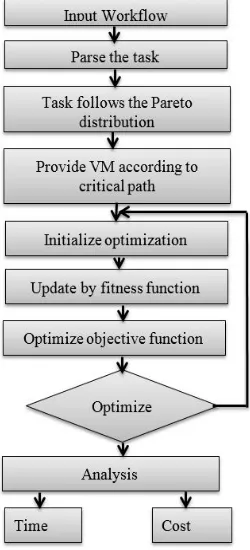
Firstly, input the workflow to the workflow simulator and parse the task from this workflow. Pareto distribution is followed by the task. On VMs, there is a pareto distribution of ants at the beginning and then, VMi pheromone values are
initialized:
( ) = _ × _ + _
Where
_ number of VMi processor
_ million instructions per second of each VMi processor
_ VMi communication bandwidth ability
Choosing VMs rule for next task: For next task, VMi choose by k-ant with probability defined as:
( ) =
[ ( )] [ ] [ ]
∑[ ( )] [ ] [ ] , … … … … .
Where
( )pheromone value of VMi at time T
VMi computing capacity
Ci can be defined as:
= _ × _ + _
lbiVMi load balancing factor for minimizing the degree of imbalance defined as:
= − − _
+ _
Where
is defined as:
= _ + _ _ Where
_ total length of task submitted to VMi
_ task length before execution
, parameters controlling the relative weight of pheromone trail along with VMs computing capacity and load balancing. Once heavily loaded are some VMs becoming bottleneck in cloud influences the given task set makespan. The load balancing factor lbi is defined in the ant algorithm for improving the capacity of lead balancing. Bigger the lbi, higher will be the probability of
choosing means VMi comprehensive ability is greater now.
Updating Pheromone: Ant Let ( ) at any time T be the VMi pheromone intensity. The update of the pheromone is given by:
( + ) = ( − ) × ( ) +∆
Where
[0,1]decay coefficient of pheromone trail
The past solution impact will be less if value of is greater. The ∆ value is defined as:
After the completion of ant tour, updating the local pheromone on VM visited and ∆ value is given as:
∆ = /
Where
K-ant searched shortest path length at ith
iteration
In case, the current optimal solution is found by the ant while completing its tour, larger intensity pheromone is laid on its tour and updating the global pheromone on VM visited and ∆ value is given as:
∆ = /
Where
current optimal solution dencouragement coefficient
If the function is optimized, then we analysis the cost and time of that function.
0 10000 20000 30000 40000
2 6 10 14 18
TE
C
Ensemble size
TEC
ACO
BAT
IV. SIMULATIONS & DISCUSSIONS
Table 4.1: Comparison table of BAT and ACO using SIPHT
Figure 4.2: Comparison graph of TET of BAT and ACO using SIPHT
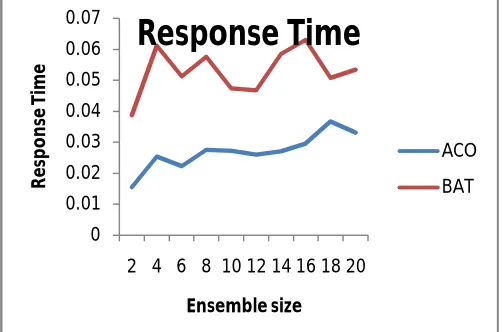
Figure 4.3: Comparison graph of Response time of BAT and ACO using SIPHT
0 0.01 0.02 0.03 0.04 0.05 0.06 0.07
2 4 6 8 10 12 14 16 18 20
R
e
sp
o
n
se
T
im
e
Ensemble size
Response Time
ACO
BAT 0
50 100
2 4 6 8 101214161820
Ensemble size
TET
ACO
0 10 20 30 40
2 4 6 8 10 12 14 16 18 20
TE
T
Ensemble Size
Montage TET
ACO
BAT
0 500 1000 1500 2000
2 4 6 8 10 12 14 16 18 20
M
e
an
T
EC
Ensemble Size
Montage TEC
ACO
BAT
0 0.02 0.04 0.06 0.08 0.1 0.12
2 4 6 8 10 12 14 16 18 20
M
ea
n
R
e
sp
o
n
se
T
im
e
Ensemble Size Montage Response Time
ACO
BAT
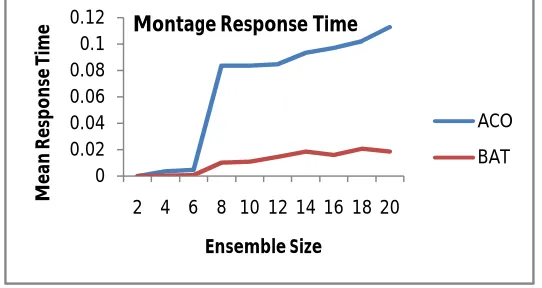
Table 4.2: Comparison table of BAT and ACO using MONTAGE
Figure 4.4: Comparison graph of TET of BAT and ACO using MONTAGE
0 200 400 600 800 1000
2 4 6 8 10 12 14 16 18 20
M
e
an
T
ET
Ensemble Size Genome TET
ACO
BAT
0 50000 100000 150000
2 4 6 8 10 12 14 16 18 20
M
e
an
T
EC
Ensemble Size
Geonome TEC
ACO
BAT
0 0.0005 0.001 0.0015 0.002 0.0025 0.003
2 4 6 8 10 12 14 16 18 20
M
e
a
n
R
e
sp
o
n
se
T
im
e
Ensemble Size Genome Response Time
ACO
BAT
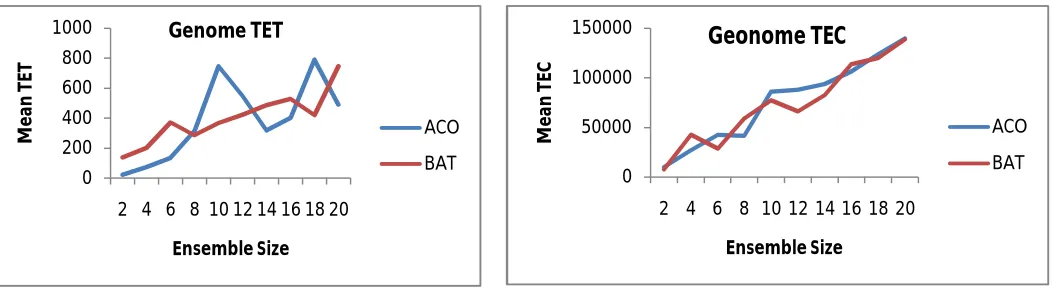
Table 4.3: Comparison table of BAT and ACO using GENOME
Figure 4.6: Comparison graph of TEC of BAT and ACO using GENOME
0 10 20 30 40 50
2 4 6 8 10 12 14 16 18 20
TE
T
Ensemble Size
Cybershake TET
ACO
BAT
0 500 1000 1500 2000 2500 3000
2 4 6 8 10 12 14 16 18 20
TE
C
Ensemble Size Cybershake TEC
ACO
BAT
0 0.02 0.04 0.06 0.08 0.1
2 4 6 8 10 12 14 16 18 20
R
e
sp
o
n
se
T
im
e
Ensemble Size
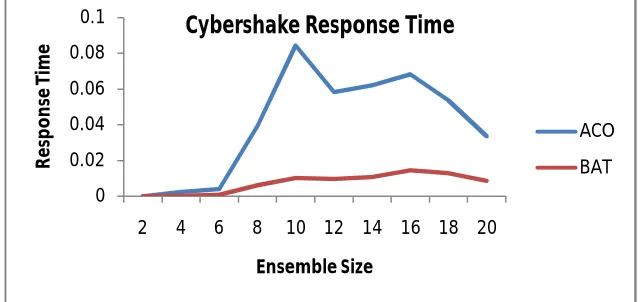
Cybershake Response Time
ACO
BAT
Table 4.4: Comparison table of BAT and ACO using CYBERSHAKE
Figure 4.8: Comparison graph of TET of BAT and ACO using CYBERSHAKE
0 5000 10000 15000
1 2 3 4 5 6 7 8 9 10
M
e
an
T
EC
Ensemble Size
LIGO TEC
ACO
BAT
0 0.005 0.01 0.015 0.02
1 2 3 4 5 6 7 8 9 10
M
e
an
R
e
sp
o
n
se
T
im
e
Ensemble Size
LIGO Response Time
ACO
BAT 0
50 100 150 200
2 4 6 8 10 12 14 16 18 20
M
e
an
T
ET
Ensemble Size
LIGO TET
ACO
BAT
Table 4.5: Comparison table of BAT and ACO using LIGO
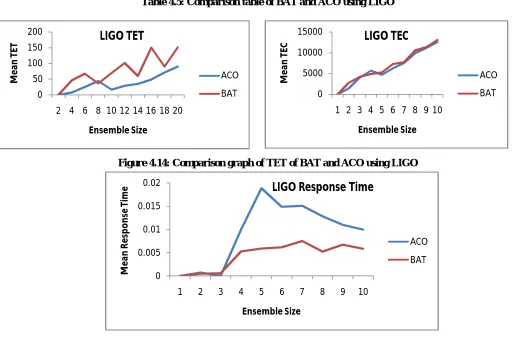
Figure 4.14: Comparison graph of TET of BAT and ACO using LIGO
Figure 4.16: Comparison graph of Response time of BAT and ACO using LIGO
V. CONCLUSION
REFERENCES
[1] Q. Zhang, L Cheng and R. Boutaba, “Cloud computing: state-of-the-art and research challenges”, Journal of internet services and applications, Springer, vol. 1, no.1, pp. 7-18, May 2010.
[2] K. Bessai, S. Youcef, A. Oulamara, C. Godart and S. Nurcan, “Bi-criteria workflow tasks allocation and scheduling in cloud computing environments”, IEEE 5th International Conference on Cloud Computing (CLOUD), pp. 638-645, June 2012.
[3] Mell, Peter, and Tim Grance, "The NIST definition of cloud computing”, Computer Security Division, Information Technology Laboratory, National Institute of Standards and Technology Gaithersburg, pp. 20-23, 2011.
[4] E.N. Alkhanak, S.P. Lee, R. Rezaei and R.M. Parizi, “Cost optimization approaches for scientific workflow scheduling in cloud and grid computing: A review, classifications, and open issues”, Journal of Systems and Software, Elsevier, vol. 113, pp. 1-26, March 2016.
[5] M.I. Daoud and N. Kharma ,“A high performance algorithm for static task scheduling in heterogeneous distributed computing systems”, Journal of Parallel and distributed computing, Elsevier, vol. 68, no. 4, pp. 399-409, April, 2008. [6] G. Wang, Y. Wang, H. Liu and H. Guo, “HSIP: A Novel Task Scheduling Algorithm for Heterogeneous Computing”, Scientific Programming, Hindawi Publishing Corporation, March 2016.
[7] M. I. Daoud and N. N. Kharma, “A hybrid heuristic-genetic algorithm for task scheduling in heterogeneous processor networks”, Journal of Parallel and Distributed Computing, Elsevier, vol. 71, no. 11, pp. 1518–1531, 2011.
[8] Y. Xu, K. Li, J. Hu and K. Li, “A genetic algorithm for task scheduling on heterogeneous computing systems using multiple priority queues”, Information Sciences, Elsevier, vol. 270, pp. 255 – 287, 2014.
[9] H. Topcuoglu, S. Hariri and M.Y. Wu, “Performance-effective and low-complexity task scheduling for heterogeneous computing”, IEEE Transactions on Parallel and Distributed Systems, vol. 13, no. 3, pp. 260-74, March 2002. 24
[10] S. Smanchat and K. Viriyapant, “Taxonomies of workflow scheduling problem and techniques in the cloud”, Future Generation Computer Systems, Elsevier, vol. 52, pp.1-12, November 2015.
[11] X. Liu, D. Yuan, G. Zhang, W. Li, D. Cao, Q. He, J. Chen and Y. Yang, “The design of cloud workflow systems”, Springer Science & Business Media, November 2011.
[12] Talbi and E. Ghazali, “Metaheuristics: from design to implementation”, John Wiley & Sons. , vol. 74, 2009.
[13] J. Yu, R. Buyya and K. Ramamohanarao, “Workflow scheduling algorithms for grid computing”, Metaheuristics for scheduling in distributed computing environments, Springer Berlin Heidelberg, pp. 173-214, 2008.
[14] R.J. Moraga, G.W. DePuy and G.E. Whitehouse,“Metaheuristics: A Solution Methodology for Optimization Problems”, Handbook of Industrial and Systems Engineering, CRC Press, FL. 2006.
[15] K.F. Man, K.S. Tang, and S. Kwong, “Genetic algorithms: concepts and applications”, IEEE transactions on Industrial Electronics, vol. 43, no. 5, pp. 519-34, October 1996.
[16] S. Kaur and A. Verma, “An efficient approach to genetic algorithm for task scheduling in cloud computing environment”, International Journal of Information Technology and Computer Science (IJITCS), vol. 4, no. 10, pp. 74, September 2012.
[17] S. G. Ahmad, E. U. Munir, and M. W. Nisar, “PEGA: A performance effective genetic algorithm for task scheduling in heterogeneous systems”, IEEE 14th International Conference on High Performance Computing, pp. 1082–1087, 2012.
[18] C. Wang, J. Gu, Y. Wang, and T. Zhao, “A hybrid heuristic-genetic algorithm for task scheduling in heterogeneous multi-core system”, in Algorithms and Architectures for Parallel Processing (Y. Xiang, I. Stojmenovic, B. Apduhan, G. Wang, K. Nakano, and A. Zomaya, eds.), Springer Berlin Heidelberg ,vol. 7439 of Lecture Notes in Computer Science, pp. 153–170, 2012.
[19] S. Abrishami, M. Naghibzadeh,and D.H. Epema, “Deadline-constrained workflow scheduling algorithms for Infrastructure as a Service Clouds”, Future Generation Computer Systems, Elsevier, vol. 29, no. 1, pp. 158-69, January, 2013. 25
[20] A Verma and S. Kaushal, “Deadline constraint heuristic-based genetic algorithm for workflow scheduling in cloud”, International Journal of Grid and Utility Computing, Inderscience Publishers Ltd, vol. 5, no. 2, pp. 96-106, January 2014.
[21] Hamid, Arabnejad and JG. Barbosa, “List scheduling algorithm for heterogeneous systems by an optimistic cost table”, IEEE Transactions on Parallel and Distributed Systems, vol. 25, no. 3, pp. 682-94, March 2014.
[22] M.A. Rodriguez and R. Buyya , “Deadline based resource provisioning and scheduling algorithm for scientific workflows on clouds” , IEEE Transactions on Cloud Computing, vol. 2, no. 2, pp. 222-35, April , 2014.
[23] R. Salimi, H. Motameni, and H. Omranpour, “Task scheduling using NSGA II with fuzzy adaptive operators for computational grids”, Journal of Parallel and Distributed Computing, Elsevier, vol. 74, no. 5, pp. 2333–2350, May 2014.
[24] Delavar, A. Ghorbannia and Y. Aryan, "HSGA: a hybrid heuristic algorithm for workflow scheduling in cloud systems", Cluster computing, Springer, vol. 17, no. 1, pp. 129-137, 2014.
[25] M. Kalra and S. Singh, "A review of metaheuristic scheduling techniques in cloud computing", Egyptian Informatics Journal, Elsevier, vol. 16, no. 3, pp. 275-295, 2015.