A Comparative Study of Algorithms for
Measuring HVAC in IoT
Prabhu K1, Dhineshkumar P2, Gobisankar S3, Gowrisankar M 4, Suryapranesh M B5
Asst. Professor, Dept. of CSE, VSBCETC, Tamil Nadu, India1
UG Scholar, Dept. of CSE,VSBCETC, Tamil Nadu, India 2,3,4,5
ABSTRACT: Industrial Internet is the new buzz in the industrial sector, also termed as Industrial Internet of Things (IIoT). It is empowering industrial engineering with sensors, software and big data analytics to create brilliant machines. With the advent of Internet of Things technologies and smart buildings, the need for building automation systems that automatically performs computations without the intervention of humans have also increased. It deals with detection of occupancy in a room from various ambient sources like temperature, humidity MO2, and CO2. With the help of this system, remote monitoring of the building as well as leveraging control on the indoor parameters through HVAC control systems is possible at real-time. It adopts Dempster-Shafer evidence theory for fusing sensory information collected from heterogeneous sensors, assigns probability mass assignments (PMAs) to the raw sensor readings, and finally performs mass combination to derive a conclusion about the occupancy status in a room. In this paper we have compared the different algorithms in IoT.
KEYWORDS: Internet of Things, Sensors, Smart Buildings, Monitoring,Predictive Models, Data Integration.
I. INTRODUCTION
IoT allows objects to be sensed or controlled remotely across existing network infrastructure, creating opportunities for more direct integration of the physical world into computer-based systems, and resulting in improved efficiency, accuracy and economic benefit in addition to reduced human intervention. When IoT is augmented with sensors and actuators, the technology becomes an instance of the more general class of cyber-physical systems, which also encompasses technologies such as smart grids, virtual power plants, smart homes, intelligent transportation and smart cities. The beginning of Internet of Things (IoT) technology and Smart buildings has compelled the need for smart devices that operates without human intervention. One of the basic applications of every home automation system is occupancy detection. In [1] Incorporating IoT technologies in building automation systems enables a user to monitor a building at real-time. This real time access to occupancy status is beneficial in a variety of situations. For example, during emergencies such as natural disaster or fire, real-time occupancy tracking can help rescue personals to evacuate survivors from a building. In addition to this, for many smart homes and building applications, recent studies have discovered that identifying the occupancy patterns results in significantly lower energy consumption compared to approaches assuming fixed occupancy and usage patterns. For several years, researchers used motion detectors around the house to detect the occupancy of a person in a room.
DSET can successfully manage missing information and complimentary hypotheses and thus gives provision for accounting uncertainty and doubt. As a result, it has been considered as a flexible and general strategy compared to the Bayesian approach, and has been efficiently applied to many applications. In addition, complex HVAC control systems can be interfaced with this framework to allow the residents of the Smart building to regulate over the heating or cooling controls. As such, the house owner can monitor and remotely control the system.
II. LITERATURESURVEY
Smart Random Neural Network Controller for HVAC using Cloud Computing Technology
In [1] Abbas javed and et.al proposed Smart homes reduce human intervention in controlling the Heating, Ventilation and Air Conditioning (HVAC) systems for maintaining a comfortable indoor environment. The embedded intelligence in the sensor nodes is limited due to the limited processing power and memory in the sensor node. Cloud computing has become increasingly popular due to its capability of providing computer utilities as internet services. In this work, a model for intelligent controller by integrating Internet of Things (IoT) with cloud computing and web services is proposed. The wireless sensor nodes for monitoring the indoor environment and HVAC inlet air and wireless base station for controlling the actuators of HVAC have been developed. The sensor nodes and base station communicate through RF transceivers at 915 MHz. Random neural network (RNN) models are used for estimating the number of occupants, and for estimating the Predicted mean vote (PMV) based set points for controlling the heating, ventilation and cooling of the building. Three test cases are studied (data storage and implementation of RNN models on the cloud, Case 2- RNN models implementation on base station, Case 3- distributed implementation of RNN models on sensor nodes and base stations) for determining the best architecture in terms of power consumption. The results have shown that by embedding the intelligence in the base station and sensor node, the power consumption of the intelligent controller was 4.4% less than an 19.23 % less than.
Privacy-Preserving Data Analytics in Cloud-Based Smart Home with Community Hierarchy
In [9] Ying- Tsung et.al proposed the emergence of the Internet of Things (IoT) has led to increasing data volumes, which are expected to grow exponentially. The IoT has great potential to positively change society but also presents challenges regarding privacy. In practice, Smart community public housing projects involving tens of thousands of households have recently been implemented. This study proposed a privacy-preserving smart home system, which connects a single home controller with data-hiding capabilities through community networking and integrates the data to a hierarchical architecture on a cloud platform for a data analytical access control mechanism. In addition, this paper outlines a variety of smart home data applications through data collected from a smart community environment with the developed privacy protection mechanism. The monitoring and protecting mechanism combines privacy-enhancing technologies with a privacy-preserving strategy from the initial system-designing stage through to full data lifecycle management. The types of smart home data that can be obtained from a community hierarchy, such as identification values, sensitive data, and non-sensitive data, were collected and classified. Through a combination of empirical application and sophisticated exploration of theoretical knowledge, this paper substantially contributes to the home automation field. The proposed system architecture is expected to enable both easy understanding for users and compliance for analytical service providers regarding the operation, procedure, limitation, and benefits of smart home data analysis, thereby providing a solution that ensures both privacy and data availability.
Research Activities on Sensing, Instrumentation, and Measurement
An Open-Source Wireless Mesh Networking Module for Environmental Monitoring
In [6] H-H. Lin et.al proposed Wireless mesh networking extends the communication range among co-operating multiple low-power wireless radio transceivers and is useful for collecting data from sensors widely distributed over a large area. By integrating an off-the-shelf wireless design, such as the XBee module, development of sensor systems with mesh networking capability can be accelerated. In this study, the design of an open-source wireless network module is introduced, which integrates the functions of network discovery, routing control, and transmission scheduling. In addition, this design is provided in an open-source format in order to promote the use of wireless mesh networking for environmental monitoring applications. Testing of the design and the proposed networking module is reported. For a 10-node implementation an average packet delivery ratio is 95.58%. The proposed system was demonstrated to have the advantages of low-cost combined with high reliability and performance. The proposed design can aid scientists to implement monitoring applications without the complications of complex wireless networking issues.
Environmental Monitoring Systems
In [5] A. Kumar, H. Kim, and G. P. Hancke proposed this review article discusses various techniques of environmental monitoring (EM) systems and what is required for the variations in hardware implementation and/or algorithmic logic. This review presents an overview of the existing state-of-the-art practices of environmental monitoring systems and is mainly focused on energy-efficient and low-cost environment monitoring systems. The following are some of the major factors that usually rule the development of EM systems, namely, energy efficiency, cost of the overall system, response time of the sensor module, good accuracy of the system, adequate signal-to-noise ratio, radio frequency interference/electromagnetic interference (RFI/EMI) rejection during varying atmospheric conditions and in inhomogeneous environments, a user friendly interface with the computer, and complexity of computation. The above concerns are also recognized by reference to research articles on environmental monitoring systems. Emphasis is on the necessity of robust systems that address all or most of the above mentioned criteria.
Performance Study of Multilayer Perceptions in a Low-Cost Electronic Nose
In [4] L. Zhang and F. Tian proposed Non selective gas sensor array has different sensitivities to different chemicals in which each gas sensor will also produce different voltage signals when exposed to an analytic with different concentrations. Therefore, the characteristics of cross sensitivities and broad spectrum of non selective chemical sensors promote the fast development of portable and low-cost electronic nose (E-nose). Simultaneous concentration estimation of multiple kinds of chemicals is always a challengeable task in E-nose. Multilayer perception (MLP) neural network, as one of the most popular pattern recognition algorithms in E-nose, has been studied further in this paper. Two structures of single multiple inputs multiple outputs (SMIMO) and multiple inputs single output (MMISO)-based MLP with parameters optimization in neural network learning processing using eight computational intelligence optimization algorithms are presented in this paper for detection of six kinds of indoor air contaminants. Experiments prove that the performance in accuracy and convergence of MMISO structure-based MLP are much better than SMIMO structure in concentration estimation for more general use of E-nose.
Harvested Power Wireless Sensor Network Solution for Disaggregated Current Estimation in Large Buildings
An Enhanced Geometric Filter Algorithm with Channel Diversity for Device-Free Localization
In [18] M. C. R. Talampas and K. S. Low proposed device-free localization (DFL) techniques estimate a person's location without requiring the person to carry a radio device or tag. In the received signal strength (RSS)-based DFL system, the changes caused by the person's presence in the RSS of links in a wireless network are used to infer his location. A DFL system's accuracy is degraded in cluttered environments due to multipath fading. In this paper, the absolute changes in the RSS of links from different frequency channels are combined into a single measurement vector to mitigate the multipath fading effects. The measurements are then processed by a multichannel geometric filter (MCGF) algorithm that uses link-specific thresholds based on a link's fade level and RSS variance on different frequency channels to detect the target-affected links. In addition, the MCGF algorithm weights probable target locations by the overall fade levels of the target-affected links. Through experiments in both open and cluttered environments, the use of channel diversity and link-specific thresholds is demonstrated to outperform single-channel GF and multichannel methods that are based on radio topographic imaging in terms of tracking accuracy. The proposed algorithm also has a lower computational overhead compared with existing DFL methods, resulting in much faster execution times.
Distributed Sequential Location Estimation of a Gas Source via Convex Combination in WSNs
In [19] M. L. Cao, Q. H. Meng et.al proposed localization of the hazardous gas source plays an important role in the protection of public security, since it can save a lot of time for subsequent rescue works. For gas source localization (GSL), a large number of gas sensor nodes can be rapidly deployed to construct a wireless sensor network (WSN) and cover the whole concerned area. Although least-squares (LS) methods can solve the problem of GSL in WSNs regardless of the distribution of measurement noises, centralized LS methods are not power efficient and robust since they require the gathering and processing of large-scale measurements on a central node. In this paper, we propose a novel distributed method for GSL in WSNs, which is performed on a sequence of sensor nodes successively. Each sensor node in the sequence conducts an individual estimation and a convex combination. The individual estimation is inspired by the LS formulation of the problem of GSL in WSNs. The proposed method is fully distributed and computationally efficient, and it does not rely on the absolute location of the sensor nodes. Extensive simulation results and a set of experimental results demonstrate that the success rate and localization accuracy of the proposed method are generally higher than those of the trust-region-reflective method.
Optimal WSN Deployment Models for Air Pollution Monitoring
III.COMPARATIVEANALYSISOFALGORITHMS
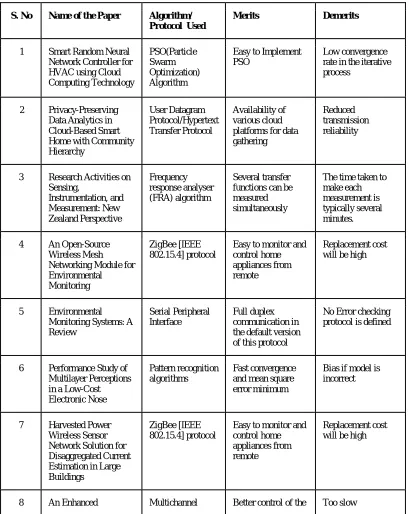
In this part we have analysed the different algorithms used in IoT with its merits and demerits.
Table 1: Comparative Analysis of Algorithms
S. No Name of the Paper Algorithm/
Protocol Used
Merits Demerits
1 Smart Random Neural Network Controller for HVAC using Cloud Computing Technology
PSO(Particle Swarm Optimization) Algorithm
Easy to Implement PSO
Low convergence rate in the iterative process
2 Privacy-Preserving Data Analytics in Cloud-Based Smart Home with Community Hierarchy User Datagram Protocol/Hypertext Transfer Protocol Availability of various cloud platforms for data gathering
Reduced transmission reliability
3 Research Activities on Sensing, Instrumentation, and Measurement: New Zealand Perspective Frequency response analyser (FRA) algorithm Several transfer functions can be measured simultaneously
The time taken to make each measurement is typically several minutes.
4 An Open-Source Wireless Mesh Networking Module for Environmental Monitoring
ZigBee [IEEE 802.15.4] protocol
Easy to monitor and control home appliances from remote
Replacement cost will be high
5 Environmental Monitoring Systems: A Review
Serial Peripheral Interface
Full duplex communication in the default version of this protocol
No Error checking protocol is defined
6 Performance Study of Multilayer Perceptions in a Low-Cost Electronic Nose
Pattern recognition algorithms
Fast convergence and mean square error minimum
Bias if model is incorrect
7 Harvested Power Wireless Sensor Network Solution for Disaggregated Current Estimation in Large Buildings
ZigBee [IEEE 802.15.4] protocol
Easy to monitor and control home appliances from remote
Geometric Filter Algorithm With Channel Diversity Localization
geometric filter(MCGF) Algorithm
Error
S. NO NAME OF THE
PAPER
ALGORITHM/ PROTOCOL USED
MERITS DEMERITS
9 Distributed Sequential Location Estimation of a Gas Source via Convex Combination in WSNs
Localization Algorithm
Range free approaches are its simplicity and low cost
It leads to over congestion
10 Optimal WSN
Deployment Models for Air Pollution
Monitoring
ZigBee [IEEE 802.15.4] protocol
Easy to monitor and control home appliances from remote
Replacement cost will be high
IV.CONCLUSION
The present survey presents various algorithms used in IoT based devices that are capable of detecting occupancy in Smart buildings are in demand today. Numerous attempts in the past have been made for designing such a system through various mathematical and statistical models. It is also seen that the presence of a light sensor remarkably increases the accuracy to a large extent owing to its high accuracy as a single parameter. Furthermore, as future work, we would like to extend this research to provide means to estimate the number of occupants as well.
REFERENCES
[1] Abbas javed, Hadi Larijani, Ali Ahmadinia, “Smart Random Neural Network Controller for HVAC using Cloud Computing Technology”, Vol: 13, Issue: 1, 2017.
[2]. R. K. Pachauri and L. A. Meyer, Eds., Climate Change 2014: Synthesis Report. Contribution of Working Groups I, II and III to the Fifth Assessment Report of the Intergovernmental Panel on Climate Change Core Writing Team, IPCC, Geneva, Switzerland, 2014, p. 151. [3]. M. Harris, “Mules on a mountain,” IEEE Spectr., vol. 53, no. 6, pp. 50–56, Jun. 2016.
[4]. L. Zhang and F. Tian, “Performance study of multilayer perceptrons in a low-cost electronic nose,” IEEE Trans. Instrum. Meas., vol. 63, no. 7, pp. 1670–1679, Jul. 2014.
[5]. A. Kumar, H. Kim, and G. P. Hancke, “Environmental monitoring systems: A review,” IEEE Sensors J., vol. 13, no. 4, pp. 1329–1339, Apr. 2013.
[6]. S. Mukhopadhyay, “Research activities on sensing, instrumentation, and measurement: New zealand perspective,” IEEE Instrum. Meas. Mag.vol. 19, no. 2, pp. 32–38, Apr. 2016.
[7]. J. Gutierrez, J. F. Villa-Medina, A. Nieto-Garibay, and M. A. Porta-Gandara, “Automated irrigation system using a wireless sensor network and GPRS module,” IEEE Trans. Instrum. Meas., vol. 63, no. 1, pp. 166–176, Jan. 2014.
[8] N. Harris, A. Cranny, M. Rivers, K. Smettem, and E. G. Barrett-Lennard, “Application of distributed wireless chloride sensors to environmental monitoring: Initial results,” IEEE Trans. Instrum. Meas., vol. 65, no. 4, pp. 736–743, Apr. 2016.
[9]. Ying-Tsung Lee, Wei-Hsuan Hsaio, Yan-Shao Lin, “Privacy-Preserving Data Analytics in Cloud-Based Smart Home with Community Hierarchy” Vol: 63, No. 2, May 2017.
[10]. H.-H. Lin et al., “An open-source wireless mesh networking module for environmental monitoring,” in Proc. IEEE Int. Instrum. Meas. Technol. Conf. (IMTC), May 2015, pp. 1002–1007.
[11]. M. T. Lazarescu, “Design of a WSN platform for long-term environmental monitoring for IoT applications,” IEEE J. Emerg. Sel. Topics Circuits Syst., vol. 3, no. 1, pp. 45–54, Mar. 2013.
[13]. Y. Liu, Y. He, M. Li, J. Wang, K. Liu, and X. Li, “Does wireless sensor network scale? A measurement study on GreenOrbs,” IEEE Trans. Parallel Distrib. Syst., vol. 24, no. 10, pp. 1983–1993, Oct. 2013.
[`14]. G. Werner-Allen et al., “Deploying a wireless sensor network on an active volcano,” IEEE Internet Comput., vol. 10, no. 2, pp. 18–25, Mar. 2006.
[15]. J. P. Amaro, R. Cortesão, J. Landeck, and F. J. T. E. Ferreira, “Harvested power wireless sensor network solution for disaggregated current estimation in large buildings,” IEEE Trans. Instrum. Meas., vol. 64, no. 7, pp. 1847–1857, Jul. 2015.
[16]. D. Magalotti, P. Placidi, M. Paolucci, A. Scorzoni, and L. Servoli, “Experimental characterization of a wireless personal sensor node for the dosimetry during interventional radiology procedures,” IEEE Trans. Instrum. Meas., vol. 65, no. 5, pp. 1070–1078, May 2016.
[17]. D. Magalotti, P. Placidi, M. Dionigi, A. Scorzoni, and L. Servoli, “Experimental characterization of a personal wireless sensor network for the medical X-ray dosimetry,” IEEE Trans. Instrum. Meas., vol. 65, no. 9, pp. 2002–2011, Sep. 2016.
[18]. M. C. R. Talampas and K. S. Low, “An enhanced geometric filter algorithm with channel diversity for device-free localization,” IEEE Trans. Instrum. Meas., vol. 65, no. 2, pp. 378–387, Feb. 2016.
[19]. M. L. Cao, Q. H. Meng, Y. Q. Jing, J. Y. Wang, and M. Zeng, “Distributed sequential location estimation of a gas source via convex combination in wsns,” IEEE Trans. Instrum. Meas., vol. 65, no. 6, pp. 1484–1494, Jun. 2016.
[20]. M. D. Prieto, D. Z. Millan, W.Wang, A. M. Ortiz, J. A. O. Redondo, and L. R. Martinez, “Self-powered wireless sensor applied to gear diagnosis based on acoustic emission,” IEEE Trans. Instrum. Meas., vol. 65, no. 1, pp. 15–24, Jan. 2016.
[21]. T. D. Chung, R. B. Ibrahim, V. S. Asirvadam, N. B. Saad, and S. M. Hassan, “Adopting EWMA filter on a fast sampling wired link contention in wirelessHART control system,” IEEE Trans. Instrum. Meas., vol. 65, no. 4, pp. 836–845, Apr. 2016.
[22]. G. Mois, T. Sanislav, and S. C. Folea, “A cyber-physical system for environmental monitoring,” IEEE Trans. Instrum. Meas., vol. 65, no. 6, pp. 1463–1471, Jun. 2016.
[23]. K.-H. Chang, “Bluetooth: A viable solution for IoT? [Industry Perspectives], IEEE Wireless Commun., vol. 21, no. 6, pp. 6–7, Dec. 2014. [24]. D. Dujovne, T. Watteyne, X. Vilajosana, and P. Thubert, “6TiSCH: Deterministic IP-enabled industrial Internet (of Things),” IEEE
Commun. Mag., vol. 52, no. 12, pp. 36–41, Dec. 2014.
[25]. P. Guillemin and P. Friess, “Internet of Things strategic Research roadmap,” Eur. Res. Cluster Internet Things, Brussels, Belgium, Tech. Rep., Sep. 2009.
[26]. Ericsson, “Ericsson mobility report,” Ericsson, Stockholm, Sweden, Tech. Rep. 3, Jun. 2016.
[27]. D. de Donno, L. Catarinucci, and L. Tarricone, “RAMSES: RFID augmented module for smart environmental sensing,” IEEE Trans. Instrum. Meas., vol. 63, no. 7, pp. 1701–1708, Jul. 2014.
[28]. H. C. Lee and H. H. Lin, “Design and evaluation of an open-source wireless mesh networking module for environmental monitoring,” IEEE Sensors J., vol. 16, no. 7, pp. 2162–2171, Apr. 2016.
[29]. H.-C. Lee, Y.-C. Chang, and Y.-S. Huang, “A reliable wireless sensor system for monitoring mechanical wear-out of parts,” IEEE Trans. Instrum. Meas., vol. 63, no. 10, pp. 2488–2497, Oct. 2014.