Electric Power Generation by Using Magnetic
Repulsive Force
V.Thirumalairaj1, A.Vembathu Rajesh2, R.Radhakrishnan3,M.Pradeep4 , J.Chakravarthy Samy Durai5
Assistant Professor, Department of Mechanical Engineering, Nadar Saraswathi College of Engineering and
Technology, Theni, Tamilnadu, India1,2,3,4,5
ABSTRACT: This paper proposes a technology to produces electrical energy using repulsion magnet technique. The proposed technology employs the theory of magnetic repulsion. To utilized small amount electrical energy to produce more electrical energy by magnetic repulsion technique. The system uses permanent magnets to produce repulsion and this repulsive force produces a torque which drives a DC generator. The repulsive magnet disc which contains number of permanent magnets are arranged on a circumferential portion of the disc with regular intervals and same magnetic polarity of permanent magnets are located on the shaft of motor. The rotating disc is couple with generator through a set of gears. During driving a load, the motor rotates the disc due to magnetic repulsion which drives a DC generator to produce electrical energy. The power output from the DC generator can be boosted by the voltage booster and to stored in batteries or used to drive any AC loads through an inverter.
KEYWORDS: Permanent Magnet, DC generator, Magnetic repulsion, Voltage booster.
I. INTRODUCTION
In the present scenario power becomes the major need for human life .The availability and its per capital consumptions are regarded as the index of national standard of living in the present day civilization.[1] Energy is an important input in all the sectors of any countries economy.[2] Energy crisis is due to two reasons, firstly the population of the world has been increased rapidly and secondly standard of living of human beings has increased.[3] India is the country, which majorly suffers with lack of sufficient power generation.[4]
The availability of regular conventional fossil fuels will be the main sources for power generation, but there is a fear that they will get exhausted eventually by the next few decades. Therefore, we have to investigate some approximate, alternative, new sources for the power generation, which is not depleted by the very few years.[5] Another major problem, which is becoming the exiting topic for today is the pollution. It suffers all the living organisms of all kinds as on the land, in aqua and in air.[6] Power stations and automobiles are the major pollution producing places. Therefore, we have to investigate other types of renewable sources, which produce electricity without using any commercial fossil fuels, which is not producing any harmful products.[8] There are already existing such systems using renewable energy such as solar wind), OTEC (ocean thermal energy conversions) etc…for power generation. This paper proposes a novel technology to convert the rotational free energy available from rotating machines to electrical energy using repulsion magnet technique. [9]
II. BLOCK DIAGRAM OF PROPOSED SYSTEM
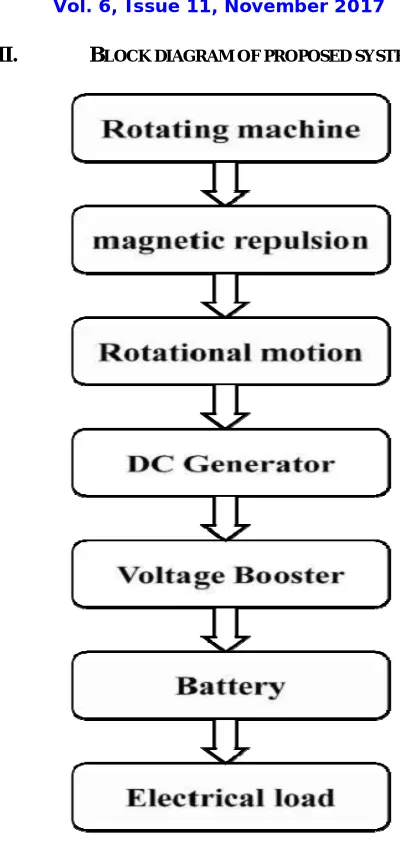
Fig. 1 Block diagram
Rotating apparatus is produce to rotary motion due to magnetic repulsive force. The rotary motion is transmitted to generator through spur gear. Generator is used for convert mechanical energy to electrical energy the converted electrical energy which is booster up by voltage booster and then stored into the battery. The inverter is connected with battery for convert the DC into AC.
III. CONSTRUCTION
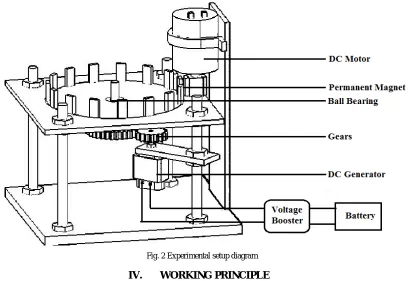
which is meshed with driver gear. The DC generator is fixed in to the stand. The voltage booster is connected in between the DC generator and the battery. When the dynamo rotates the output DC voltage is boosted then stored in the battery and use for their purpose.
Fig. 2 Experimental setup diagram
IV. WORKING PRINCIPLE
V. ANALYSIS OF FORCE CALCULATION
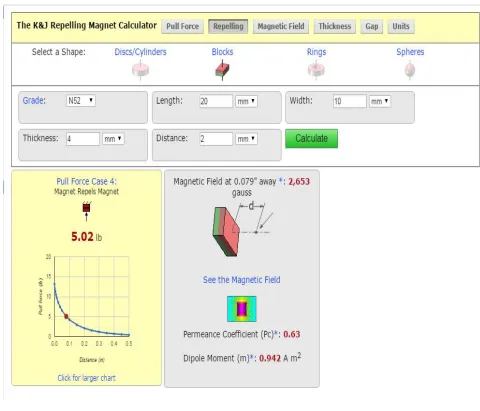
Repulsive force is calculated by using repelling magnet calculator, the results of repelling curve and also size of magnet force is shown in below figure. The distance between the magnets is inversely proportional to the repulsive force.
Fig. 3 Force Analysis of magnet
Power is the rate of work done per unit time. The expression of mechanical work done derived in below,
Power = Work/Time
Torque = Force × distance
Power = Torque × Angular velocity
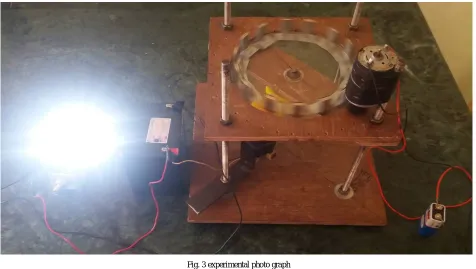
This mechanical power is applied to the generator. The magnetic disc coupled with DC generator its generated electricity. The power output from the DC generator is boosted by the voltage booster and stored in batteries or used to drive any AC loads through an inverter. This modelling repulsive magnetic technique generated 600 watts power. Our experimental photo graph is given below.
Fig. 3 experimental photo graph
VI. CONCLUSION
In this paper we have discussed about technology employs the theory of magnetic repulsion. The system uses permanent magnets to produce repulsion and this repulsive force produces a torque which drives a DC generator to produce electrical energy. It is a nonconventional type of producing the energy. The existing source of energy such as coal, oil etc may not be adequate to meet the ever increasing energy demands. Since the model has only few modifications and more advantages. Future scope of this work is to implement in industry to generated electricity by the rotational free energy available from rotating machines to electrical energy using repulsion magnet technique. The significant conclusions that may be drawn based on the present work may be summarized as follows:
Model study is done and it is found to give a satisfactory results.
The mechanism proposed is much simpler and continuously produces the electrical power.
The produced electrical energy is renewable energy which is pollution free.
Model calculation is done and observed results.
REFERENCES
[1] T.Meenakshi, S.Sujithkumar, S.Suganya, (2014) ‘electricity generation by employing repulsion magnetic technique in rotating machines’, ‘ISRO journal of electrical and electronics engineering’.
[2] Jeong Yong Lee, Gyeonggi-do (KR), (2009) ‘Power Generator using Permanent Magnet’, ‘United States Patent’ [3] Kohei Minato, (1997) ‘Magnetic Rotating Apparatus’, ‘United States Patent’.
[5] ManojGattani, (2012) ‘Design and Development of Linear Magnetic Generator’, International Journal of Advances in Engineering & Technology.
[6] Aradhyula Thirumala Vasu, Murthy Chavali, M. Ramakrishna, B Nageswara Rao, Ram Narayan Chauhan, (2015) ‘Mechanical power generated by developing magnetic flux’, VFSTR Journal of STEM Vol. 1.
[7] Imran khana, Muhammad Amin, Muhammad Imran Masood , Asadullah, (2013) ‘Analysis of Free Energy’ Perpetual Motion Machine System Based on Permanent Magnets’, International Journal of Smart Grid and Clean Energy.
[8] Ciprian Astratini-Enache, Radu Olaru, Camelia Petrescu, (2010) ‘Moving Magnet Type Actuator with Ring Magnets’,journal of electrical engineering, Vol. 61. No 7/s.
[9] Sumit Dhangar, Ajinkya Korane, Durgesh Barve, (2015) ‘Magnetic Piston Operated Engine’, International Journal of Advance Research in Science And EngineeringIJARSE, Vol. No.4, Issue 06.