ABSTRACT
HIDEHIRO SEGAWA. Optimum Flap Angles for Roll Control on Wings with Multiple Trailing-Edge Flaps. (Under the direction of Dr. Ashok Gopalarathnam.)
This research effort explores the use of multiple trailing-edge flaps for efficiently
generating rolling moment on aircraft. Using the concept of basic and additional
lift distributions, the induced drag of the wing is expressed in terms of the flap angles. The theory of relative extrema is then used to determine the optimum
flaps angles for minimum induced drag with a constraint on the rolling moment.
By setting the mean of the flap angle for operation of the wing within the low-drag range, profile low-drag is also minimized. The general methodology can also be
used on tailless aircraft and to study the effect of failure modes such as a stuck
flap. The results show that multiple flaps can be used to generate rolling moments with lower drag than when ailerons are used. They also provide redundancy that
helps efficiently handle control failures such as stuck flaps. The current research
Optimum Flap Angles for Roll Control on Wings with
Multiple Trailing-Edge Flaps
by
Hidehiro Segawa
A thesis submitted to the Graduate Faculty of North Carolina State University
in partial fulfillment of the requirements for the Degree of
Master of Science
Aerospace Engineering
Raleigh, NC 2007
APPROVED BY:
Dr. Ashok Gopalarathnam Advisory Committee Chairman
Dr. Charles E. Hall, Jr. Dr. Agnes Szanto
BIOGRAPHY
Hidehiro Segawa was born to Yorihide and Umeyo Segawa May 27th, 1981 in
Hitachi, Japan. The youngest of three children, Hidehiro lived until his graduation
from Mito-Sakuranomaki High School in the Spring of 2000.
In July of 2000 he moved to the United States for study. He spent two years at
Thiel College in Pennsylvania to study Physics. In the summer of 2002 Hidehiro
transferred to North Carolina State University to major in Aerospace Engineering,
which had been his interest since his childhood. Three years later he graduated
from the university with a Bachelor of Science in Aerospace Engineering.
In the Fall of 2005 Hidehiro decided to remain at the university and enroll as a
Master’s student in Aerospace Engineering. He joined the Applied Aerodynamics
group at NC State in the Spring of 2006 under the advisement of Dr. Ashok
Gopalarathnam, who supported his Master’s work.
After completion of his Master’s degree Hidehiro plans to remain at NC State
to pursue a doctoral degree in Aerospace Engineering focusing on airfoil and wing
ACKNOWLEDGEMENTS
I would like to express my appreciation to Dr. Ashok Gopalarathnam for his
guid-ance in my thesis research. To study Applied Aerodynamics under him was my
dream since I came to the department of Mechanical and Aerospace
Engineer-ing at NC State University. I am really grateful that he gave me a chance to
accomplish this goal.
I would like to express my appreciation to KalScott Engineering for their
fi-nancial support. I also would like to thank Dr. Charles E. Hall, Jr. for being
my thesis committee member. He is one of the most influential professors in the
Aerospace Engineering program, and I appreciate his support. I also would like
to acknowledge Dr. Agnes Szanto from Mathematics department for her kindness
and for being a committee member.
Additionally, I would like to thank my fellow colleagues, Gregory Z McGowan,
Aaron Anthony Cusher, Craig Allen Cox, Stearns Nicholas Heinzen, Blaine A
Levedahl and others for their support, additional assistance and friendship.
Lastly, I really appreciate my family for all their support and prayers for my
success. Completing a degree in a foreign country was very challenging for me,
but because of their understanding and support, it came true. Especially, I would
like to thank my father who passed away over ten years ago. His hard work made
it possible for me to study in a foreign country, and his research interest in fluid
dynamics motivated me to study Aerospace Engineering. I know that he is still
in my heart and very pleased with the completion of my Master’s work. Finally,
I would like to thank my mother and sisters for their prayers. I cannot express
Table of Contents
List of Tables . . . vi
List of Figures . . . vii
Nomenclature . . . x
Chapter 1 Introduction . . . 1
1.1 Background . . . 1
1.2 Outline of Thesis . . . 5
Chapter 2 Methodology . . . 6
2.1 Background . . . 6
2.1.1 Relative Extrema of Multi-Variable Functions with and with-out Constraints . . . 6
2.1.2 Rolling Moment and Optimum Lift Distribution . . . 7
2.1.3 Basic and Additional Lift Distributions . . . 10
2.1.4 Induced Drag of Superposed Lift Distribution . . . 12
2.1.5 Pitching Moment with Multiple TE Flaps . . . 14
2.2 Procedure . . . 17
2.2.1 Minimization of Induced Drag without Constraints . . . . 18
2.2.3 Minimization of Induced Drag with Pitch and Roll Constraints 22
2.2.4 Optimum Loading with a Control Failure . . . 26
Chapter 3 Results . . . 29
3.1 Test Cases . . . 29
3.2 Rolling Moment Constraint . . . 33
3.2.1 Example Case #1−1 . . . 33
3.2.2 Example Case #1−2 . . . 35
3.2.3 Example Case #1−3 . . . 36
3.2.4 Example Case #1−4 . . . 38
3.2.5 Comparison of the Induced Drag . . . 39
3.3 Multiple Constraints of Roll and Pitch . . . 42
3.3.1 Example Case #2−1 . . . 42
3.3.2 Example Case #2−2 . . . 45
3.3.3 Comparison of the Induced Drag . . . 49
3.4 Adapted Distribution Due to a Stuck Flap . . . 52
Chapter 4 Concluding Remarks . . . 60
List of Tables
List of Figures
1.1 Adaptive wing of bird flight.1 . . . . 2
1.2 Schematic representation of the multiple trailing-edge flaps (right side shown). . . 3
1.3 Blended-wing-body (BWB) airplane concept.2 . . . . 4
2.1 Rolling moment due to dL (rear view). . . 8
2.2 Basic and additional lift distributions. . . 11
2.3 Forces applied to the reference section representing the relationship between pitching moments and SM. . . 15
2.4 Adaptive flaps (top view). . . 20
3.1 Example planform for unswept tapered wing with 5 TE flaps per half span. . . 31
3.2 Wing planform for swept tapered wing with 5 TE flaps per half span: (a) Λc/4 of 20 degrees and (b) Λc/4 of 35 degrees. . . 31
3.3 CAM BERED airfoil: (a) Geometry and Cp distribution and (b) drag polar at Re√Cl of three million. . . 32
3.4 REF LEXED airfoil: (a) Geometry and Cp distribution and (b) drag polar at Re√Cl of three million. . . 32
3.5 SpanwiseCldistributions with flap-section drag polars and optimal Cl distributions withCRdesired=0.02 for Example Case #1−1. . . 34
3.6 SpanwiseCldistributions with flap-section drag polars and optimal Cl distributions withCRdesired=0.04 for Example Case #1−1. . . 34
3.7 SpanwiseCldistributions with flap-section drag polars and optimal Cl distributions withCRdesired=0.02 for Example Case #1−2. . . 35
3.8 SpanwiseCldistributions with flap-section drag polars and optimal Cl distributions withCRdesired=0.04 for Example Case #1−2. . . 36
3.9 SpanwiseCldistributions with flap-section drag polars and optimal Cl distributions withCRdesired=0.02 for Example Case #1−3. . . 37
3.10 SpanwiseCldistributions with flap-section drag polars and optimal Cl distributions withCRdesired=0.04 for Example Case #1−3. . . 37
3.11 SpanwiseCldistributions with flap-section drag polars and optimal Cl distributions withCRdesired=0.02 for Example Case #1−4. . . 38
3.13 Planform of a tapered wing with ailerons. . . 40
3.14 Planform of a swept wing with ailerons (Λc/4 = 35). . . 40
3.15 Comparison of induced drag for the unswept tapered wing with
CAM BERED airfoil. . . 40
3.16 Comparison of induced drag for the unswept tapered wing with
REF LEXED airfoil. . . 41
3.17 Comparison of induced drag for the swept wing withCAM BERED
airfoil. . . 41
3.18 Comparison of induced drag for the swept wing withREF LEXED
airfoil. . . 42
3.19 Spanwise Cl distributions with flap-section drag polars and
opti-mal Cl distributions withCRdesired=0.02 for Example Case #2−1,
SchemeA. . . 43
3.20 Spanwise Cl distributions with flap-section drag polars and
opti-mal Cl distributions withCRdesired=0.04 for Example Case #2−1,
SchemeA. . . 43
3.21 Spanwise Cl distributions with flap-section drag polars and
opti-mal Cl distributions withCRdesired=0.02 for Example Case #2−1,
SchemeB. . . 44
3.22 Spanwise Cl distributions with flap-section drag polars and
opti-mal Cl distributions withCRdesired=0.04 for Example Case #2−1,
SchemeB. . . 45
3.23 Comparison of induced drag from SchemeA and SchemeB. . . 46
3.24 Spanwise Cl distributions with flap-section drag polars and
opti-mal Cl distributions withCRdesired=0.02 for Example Case #2−2,
SchemeA. . . 47
3.25 Spanwise Cl distributions with flap-section drag polars and
opti-mal Cl distributions withCRdesired=0.04 for Example Case #2−2,
SchemeA. . . 47
3.26 Spanwise Cl distributions with flap-section drag polars and
opti-mal Cl distributions withCRdesired=0.02 for Example Case #2−2,
SchemeB. . . 48
3.27 Spanwise Cl distributions with flap-section drag polars and
opti-mal Cl distributions withCRdesired=0.04 for Example Case #2−2,
SchemeB. . . 48
3.28 Comparison of induced drag from SchemeA and SchemeB. . . 49
3.29 Comparison of induced drag from SchemeA and SchemeB and a
wing with ailerons. . . 50
3.30 Planform of a swept wing with ailerons (Λc/4 = 20). . . 51
3.31 Comparison of induced drag from SchemeA and SchemeB and a
wing with ailerons. . . 51
3.32 SpanwiseCldistributions with flap-section drag polars and optimal
Cl distributions withCRdesired=0.00 whenF lap1 is stuck with zero
3.33 SpanwiseCldistributions with flap-section drag polars and optimal
Cl distributions withCRdesired=0.02 whenF lap1 is stuck with zero
deflection. . . 53
3.34 SpanwiseCldistributions with flap-section drag polars and optimal
Cl distributions withCRdesired=0.04 whenF lap1 is stuck with zero
deflection. . . 53
3.35 SpanwiseCldistributions with flap-section drag polars and optimal
Cl distributions with CRdesired=0.00 when F lap1 is stuck at δf=10
deg. . . 54
3.36 SpanwiseCldistributions with flap-section drag polars and optimal
Cl distributions with CRdesired=0.02 when F lap1 is stuck at δf=10
deg. . . 55
3.37 SpanwiseCldistributions with flap-section drag polars and optimal
Cl distributions with CRdesired=0.04 when F lap1 is stuck at δf=10
deg. . . 55
3.38 SpanwiseCldistributions with flap-section drag polars and optimal
Cl distributions withCRdesired=0.00 whenF lap6 is stuck with zero
deflection. . . 56
3.39 SpanwiseCldistributions with flap-section drag polars and optimal
Cl distributions withCRdesired=0.02 whenF lap6 is stuck with zero
deflection. . . 56
3.40 SpanwiseCldistributions with flap-section drag polars and optimal
Cl distributions withCRdesired=0.04 whenF lap6 is stuck with zero
deflection. . . 57
3.41 SpanwiseCldistributions with flap-section drag polars and optimal
Cl distributions with CRdesired=0.00 when F lap6 is stuck at δf=10
deg. . . 58
3.42 SpanwiseCldistributions with flap-section drag polars and optimal
Cl distributions with CRdesired=0.02 when F lap6 is stuck at δf=10
deg. . . 58
3.43 SpanwiseCldistributions with flap-section drag polars and optimal
Cl distributions with CRdesired=0.04 when F lap6 is stuck at δf=10
Nomenclature
A1, A2, An coefficients of Fourier series
ac aerodynamic center
AR wing aspect ratio
b wingspan
¯
c mean aerodynamic chord
CDi aircraft total induced drag coefficient
CG center of gravity
CL aircraft lift coefficient
Cl airfoil lift coefficient
CL0 aircraft lift coefficient for zero α
Cla additional lift coefficient
Cla,1 additional lift coefficient defined at CL of one
Clb basic lift coefficient
Clb,camber basic lift coefficient due to airfoil camber
Clb,f lap basic lift coefficient due to flap deflection
Clb,twist basic lift coefficient due to wing twist
Cm0 zero-lift airfoil pitching moment
Cmac airfoil pitching moment coefficient about the aerodynamic center
CMacw
basic aircraft pitching moment coefficient about the aerodynamic center
resulting from the basic lift distribution
CMacw
sections aircraft pitching moment coefficient about the aerodynamic center
resulting from the airfoil sections
CR aircraft rolling moment coefficient
c(y) spanwise chord distribution
dL elemental loading
H objective function
LDR low drag range
LHS left hand side
NLF natural laminar flow
N number of flaps over the span of wing
NP neutral point
Re Reynolds number
RHS right hand side
S wing area
SM static margin
TAT thin airfoil theory
TE trailing edge
V∞ freestream velocity
W aircraft weight
w normalwash/downwash in the Trefftz-plane
Xac longitudinal location of the aerodynamic center
Xcg longitudinal location of the center of gravity
α angle of attack
δf flap angle
¯
δf mean flap angle
ˆ
δf variation flap angle about the mean
λ Lagrange multiplier
Λc/4 quarter-chord sweep angle
θf angular location of flap hinge in radians
Subscripts
desired desired condition
f flap
ideal ideal condition
∞ freestream condition
ref reference
Chapter 1
Introduction
Over the hundred years of aviation history, aircraft performance has improved
dramatically as a result of better understanding of various design issues. These
improvements include airfoil and wing designs, engine performance, flight control
technology, utility of new materials, and so on. This study focuses on one aspect
of improving airfoil and wing aerodynamics, which is an avenue to achieving better
aircraft performance.
1.1
Background
Traditionally, trailing-edge flaps (TE flaps) are used to achieve higher lift for
take-off and landing. In certain applications, however, they are also used for achieving
lower drag. The use of TE flaps for low drag is popular in high-performance
sailplanes. Known as cruise flaps, these devices enable achievement of low drag
over a wide range of flight speeds. Conceived first by Pfenninger3, 4 in 1947, a
cruise flap, when used on a natural laminar flow (NLF) airfoil,5–10 enables
adjust-ment of theClrange of the drag bucket so that laminar flow and the accompanying
low drag can be achieved at off-design Cl values. Since then, many NLF airfoils
have been designed to use cruise flaps.11 The use of multiple TE flaps along the
and wing-weight reduction.
Research projects in the NCSU Applied Aerodynamics Group has recently
fo-cused on the use of TE flaps on aircraft wings. These projects have resulted in
(i) automation of single and multiple TE flaps based on surface pressure
mea-surements,14, 15 (ii) semi-analytical approaches to the determination of ideal flap
angles on a wing with multiple TE flaps,16 (iii) and the use of multiple TE flaps
to achieve low drag on tailless aircraft while satisfying the necessary pitching
mo-ment constraints.17 The results from these studies show that multiple TE flaps are
an efficient way to adapt a wing for different flight conditions. The current effort
builds on these past projects to explore the use of multiple TE flaps in efficiently
generating rolling moment on an adaptive wing.
The original idea of the adaptive wing came from the bird and insect flights.
These creatures are able to adjust not only the wing aspect ratio and wing loading
but also the spanwise twist on the wing to achieve optimal lift distribution. Fig 1.1
is a sketch drawn by Otto Lilienthal, which shows how the spanwise twist is
distributed on a wing for bird flight.
Theoretically, tuning the spanwise twist on a wing is the most accurate way
of generating the optimal lift distribution because each section of the wing can
deflect for desirable twist angle. However, it is still difficult for engineers to create
such a twistable wing mainly due to structural reasons. Instead, it is possible
to manufacture a wing with the multiple TE flaps which serves nearly the same
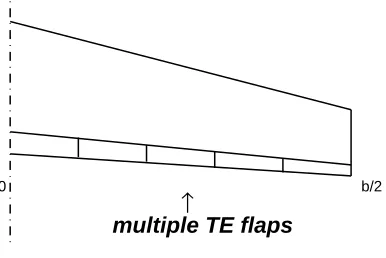
function as the twistable wing. A simple sketch of a wing with the multiple TE
flaps is shown in the Fig 1.2. These TE flaps are controllable individually just like
a bird adjusts the spanwise twist on the wing to generate the ideal distribution.
↑
multiple TE flaps
b/2 0
Figure 1.2: Schematic representation of the multiple trailing-edge flaps (right side shown).
The adaptive wing can be used not only for producing the optimum lift
distri-bution, but also for aircraft control. Azuma18studied the flight dynamics of flying
creatures and described the control with the use of adaptive wing. They trim the
body not by having horizontal and vertical tails, but adjusting the spanwise twist
on the wing. Recent research17 proved that this was possible with the multiple
TE flaps if they were placed on a swept flying wing. However, this research was
only for a longitudinal control. The current research work explores the use of
multiple TE flaps for roll control. Traditionally, the rolling moment is generated
with reduced induced drag. The current work is a first step in exploring the use
of distributed controls (TE flaps) for aircraft control.
In addition, the current work also explores the use of TE flaps for generating
rolling moment on a tailless aircraft, where the TE flaps have to also satisfy a
pitching moment constraint. With continued interest in tailless aircraft such as
the Blended-wing body (BWB) concept (Fig 1.3), it is worthwhile to explore the
efficient use of distributed controls on such configurations. Finally, one of the
benefits of using distributed controls is in the redundancy they provide in case
of failure of one or more components. Towards understanding this capability, the
current study also explores the efficient use of the distributed controls in the event
of a failure of one of the TE flaps.
1.2
Outline of Thesis
This chapter has described a brief history of how the current research topic has
evolved from the previous studies. Also the motivation for conducting the current
research with the multiple TE flaps has been presented.
Moving forward, Chapter 2 describes the background information and
method-ology utilized in this research. First presented is the background information
re-lating to achievement of minimum induced and profile drag, as well as the concept
of additional and basic lift distributions and their superposition. Next section is
a derivation of the rolling moment equation for the multiple TE flaps, followed by
a brief description of the pitching moment constraint.
In the procedure section, minimization of induced drag without constraints is
first described. Then a single constraint of the rolling moment is described. In
the following section, the double constraints of the roll and pitch is presented.
Finally, for a case of the stuck flap, the equation is solved for the deflection angles
of the controllable flaps.
Results using the methodology are presented in Chapter 3 for several example
geometries. The first case is the single constraint of rolling moment. The lift
distributions are obtained for two types of wing and airfoil for different values of
the desired rolling moment. Then the results are shown for the double constraints
of roll and pitch for swept wings. Lastly, the lift distributions for the stuck flap
case on a straight wing are presented and discussed.
Chapter 4 presents brief conclusion of the research as well as some suggested
Chapter 2
Methodology
2.1
Background
In this section, background information is presented on well-known elements of
applied mathematics and aerodynamics that are used in the development of the
current method. Subsection 2.1.1 describes the theory of the relative extrema of
multi-variable functions with and without constraints. Subsection 2.1.2 describes
the derivation of the optimum flap angles for the rolling moment. Subsection 2.1.3
presents a brief review of the concept of basic and additional lift distributions.
Subsection 2.1.4 presents the induced drag of superposed lift distributions based
on Munk’s theorems. Lastly, Subsection 2.1.5 reviews the formulation of pitching
moment due to the multiple TE flaps.
2.1.1
Relative Extrema of Multi-Variable Functions with
and without Constraints
This subsection presents a mathematical technique for solving the minimum value
of a multi-variable function with and without constraints, which is discussed in
more detail in textbooks such as by Bryson and Ho.19 Consider a function,f(xi),
derivative of the function with respect to every variable be zero, as follows:
∂f
∂xi
= 0 (2.1)
In addition, the sufficient condition for a minimum of f is that the Hessian
matrix, formed by elements ∂x∂2f
i∂xj be positive definite.
For a case with equality constraints given by gj(xi) = 0, the problem is solved
by modifying the objective function using unknown Lagrange multipliers, λj, as
follows:
H =f(xi) +
K
X
j=1
λjgj(xi) (2.2)
The relative extremum is found by setting the partial derivatives of H with
respect to xi and λj to be zero, as follows
∂H
∂xi
= 0 (2.3)
∂H
∂λj
= 0 (2.4)
2.1.2
Rolling Moment and Optimum Lift Distribution
The rolling moment is generated due to a different amount of total lift force
pro-duced between right and left sides of the wing. To analyze this moment explicitly,
first of all, the total lift force is derived using an element of the loading, dL.
Then the rolling moment due to the element of lift is calculated. This is shown in
Fig 2.1.
According to the definition in this figure, the rolling moment due to dL is
R (+)
dL
dy y
y
z
Figure 2.1: Rolling moment due todL (rear view).
dR = (−dL)·y (2.5)
The total rolling moment of an aircraft is obtained by integrating this element
of rolling moment for a whole span.
R=−
Z b2 −b
2 1
2ρV
2
∞
cClydy (2.6)
It is then non-dimensionalized and re-written as Eqn 2.7.
CR =−
1
Srefbref
Z b 2 −b
2
cClydy =−
2
Srefbref
Z b 2 −b
2
Γ
V∞
ydy (2.7)
This is the equation of the rolling moment coefficient, which is calculated from
the spanwise lift distribution. The equation is reformed further more to apply for
the multiple TE flaps in the Sec. 2.2.
In the remainder of this subsection, the theoretical optimum for spanwise
constraint is presented. For this derivation of the optimum lift distribution, the
standard solution procedure for lifting line theory is used. As described in several
textbooks such as Anderson,20 a coordinate transformation from y to θ is used:
y=−b
2cosθ (2.8)
The spanwise distribution of bound circulation, Γ(y), is expressed in as a
Fourier series in θ as usingN terms as:
Γ(θ) = 2bV∞
N
X
n=1
Ansin(nθ) (2.9)
For this representation, it can be shown that the lift coefficientCL, the induced
drag coefficientCDi and rolling moment coefficient CR can be written in terms of
the Fourier coefficients as:
CL=A1π
b2
S (2.10)
CDi =π(AR)A
2 1
1 + N
X
2
n
A
n
A1
2
(2.11)
CR =A2
πb2
4S (2.12)
It follows, therefore, that for minimumCDi at a specified CL, all Fourier terms
A2, A3, and higher are zero and the optimum lift distribution is
Γ(θ) = 2bV∞A1sinθ = 2bV∞
C
LS
πb2
sinθ (2.13)
Γ(y) = Γ0
s
1−
2y
b
2
(2.14)
and the corresponding CDi is
CDi =
CL2
πAR (2.15)
When the rolling moment coefficient, CR, is also specified, the solution for
minimum CDi is satisfied by all Fourier terms A3, A4 and higher getting set to
zero. The resulting lift distribution is
Γ(θ) = 2bV∞
A1sinθ+A2sin(2θ)
= 2bV∞
CL
S
πb2sinθ+CR
4S
πb2 sin(2θ)
(2.16)
and the corresponding CDi is
CDi =
1 πAR
CL2+ 32CR2
(2.17)
2.1.3
Basic and Additional Lift Distributions
As it shown in the previous chapter, several ideas were studied to achieve a
desir-able lift distribution along the wing span. Some use geometric and aerodynamic
twist distributions and flap deflections.
The lift distribution is also affected by angle of attack, spanwise chord
distri-bution (taper), and wing sweep. The net distridistri-bution is determined by all of these
factors. Therefore, the distribution needs to be decomposed so that it can be
an-alyzed from different aspects. This is why the concept of basic and additional lift
distributions, discussed in Kuethe and Chow,21is very useful. As per this concept,
and additional distributions as follows:
Cl(y) =Clb(y) +Cla(y) (2.18)
b/2 0
C la Clb
C
l = Cla + Clb
Figure 2.2: Basic and additional lift distributions.
The basic distribution is defined at wing CL=0, and it is determined by the
geometric and aerodynamic twist, the flap deflection, and a change of airfoil or
its camber along span.
Clb =Clb,twist+Clb,camber+Clb,f lap (2.19)
The additional distribution, on the other hand, is the distribution when there
is no twist or flap deflection on the wing. It is also determined by wingCL, which
is a linear function of angle of attack if attached flow on the wing is assumed.
For this case, the wing CL is set to unity to obtain the Cla,1, then a desired CL is
substituted to calculate the additional distribution, as follows:
Cla =CLCla,1 (2.20)
are affected by the wing planform which are taper and sweep of the wing. The
concept of this superposition of these distributions is shown in Fig 2.2.
2.1.4
Induced Drag of Superposed Lift Distribution
It is well-known in wing aerodynamics that induced drag can be calculated through
the superposition of the lift distribution. Eqn 2.21 shows how the induced drag
is determined for a planar wing from the bound vorticity distribution, Γ(y), and
the associated Trefftz-plane downwash, w(y).
Dinduced =
ρ 2
Z b 2 −b
2
Γ(y)w(y)dy (2.21)
Using a small angle assumption, the Trefftz-plane induced angle of attack can
be written as:
αi(y) = w
V∞
(y) (2.22)
From Kutta-Joukowski theorem, the lift force is expressed with the circulation,
which is shown in Eqn 2.23 or non-dimensionalized of Eqn 2.24.
L′
(y0) = ρV∞Γ(y0) (2.23)
Γ
V∞
(y) = cCl(y)
2 (2.24)
The induced drag coefficient is expressed and shown as Eqn. 2.25 based on
Eqn 2.22 and Eqn 2.24.
CDi =
1 S
Z 2b −b
2
The lift coefficient is also derived in the following Eqn 2.26 by the
Kutta-Joukowski theorem.
CL =
1 S
Z 2b −b
2
cCl(y)dy = 2
V∞S
Z b2 −b
2
Γ(y)dy (2.26)
Several theories of the induced drag were derived by Max Munk22 and one of
them states that the induced drag can be determined by adding the contributions
from the interaction of the elementary lift distributions and their corresponding
downwash distributions. Consider a wing with N TE flaps. Let the total lift
distribution be expressed as a superposition of the additional lift andN basic lift
distributions corresponding to the N flaps. With this approach, total induced
drag for that system can be written in terms of the contributions as follows:
Di =Daa +
N
X
i=1
(Dai+Dia) +
N
X
j=1 N
X
i=1
Dij (2.27)
Munk’s mutual drag theorem23 aids to simplify such expression by saying that
the drag induced by element 1 on element 2 is equal to the drag induced by element
2 on element 1. Therefore, D12 =D21 and so on for all other elements. Also each
of these induced drag is non-dimensionalized based on the following equations.
Daa
q∞S
= CL
2
2S
Z b 2 −b
2
cCla(y)αia(y)dy =CL
2C
Daa (2.28)
Dai
q∞S
= CL
2S
Z b 2 −b
2
cCla(y)αii(y)dyδi =CLCDaiδi (2.29)
Dij
q∞S
= 1
2S
Z b2 −b
2
cCli(y)αij(y)dyδiδj =CDijδiδj (2.30)
Finally, the induced drag due to the N multiple TE flaps can be written as
CDi =CL
2C
Daa+CD11δ1
2+
· · ·+CDN NδN
2
+2CLCDa1δ1+· · ·+ 2CLCDaNδN + 2CD12δ1δ2 +· · ·+ 2CD1Nδ1δN
+2CD23δ2δ3+· · ·+ 2CD2Nδ2δN +· · ·+ 2CD(N−1)Nδ(N−1)δN
(2.31)
2.1.5
Pitching Moment with Multiple TE Flaps
Recent work by Cusher and Gopalarathnam17 has explored the use multiple TE
flaps on tailless aircraft; where the pitching moment about the center of gravity
(CG) is constrained to be zero for pitch trim. This section presents some important
methods from that research.
Figure 2.3 shows the forces and moments applied to the reference section of
the wing. The moment at CG is affected by a moment occurs at the aerodynamic
center of a wing (neutral point: NP), and another moment due to an aerodynamic
lift force on the wing. This is shown in Eqn 2.32 where (Xac−Xcg)
¯
c is commonly
known as the static margin. It is noted that the value of the Cmacw will depend
on the wing flap angles.
Cmcg =Cmacw −CL
(Xac−Xcg)
¯
c (2.32)
For the longitudinal trim of an airplane, the moment about the center of
gravity (CG) needs to be zero (Cmcg = 0), so that the equation can be rewritten
as follows:
Cmacw =CL
(Xac−Xcg)
¯
c (2.33)
Therefore, if the static margin and a desiredCLof an aircraft are known, then
the required CMacw can be calculated by this formula.
cen-C
ref
x
ac
x
CG
W L
M
CG Mac
Figure 2.3: Forces applied to the reference section representing the relationship between pitching moments and SM.
ter of an aft-swept wing is shown in Eq. 2.34.
CMacw =
1
Sc¯
( Z b
2
−b
2
Cmac(y)c(y)
2dy+Z
b
2
−b
2
Clb(y)[Xac,wing−Xac(y)]c(y)dy
)
(2.34)
This equation simply explains that the total pitching moment of a wing at
the aerodynamic center is computed by summing two wing spanwise integrals of
(1) sectional pitching moment effect and (2) basic lift distribution multiplied by
its moment arm based on the wing aerodynamic center. For clarity, part (1) of
Eq. 2.34 is referred to as CMacw
sections, and (2) is referred to as
CMacw
basic.
Then the equation is simply rewritten as indicated by Eq. 2.35.
CMac,w =
CMacw
sections+
CMacw
basic =CL
(Xac−Xcg)
¯
c (2.35)
Each term CMacw
sections and
CMacw
effects based on airfoil and wing properties. They are shown in the following
equations.
CMacw
sections =
2
Sc¯
R
b
2
0 Cmac(y)c(y)
2dy+
Ry1
0 Cmδf
1c(y)
2dyδ
f1 +...+
RyN
yN
−1
Cmδf
N
c(y)2dyδ
fN
(2.36)
CMacw
basic=
2
S¯c
R
b
2
0 Clb,twist(Xac,w−Xac(y))c(y)dy
+R
b
2
0 Clb,camber(Xac,w−Xac(y))c(y)dy
+
Rb2
0 Clb,δf1(Xac,w−Xac(y))c(y)dy
δf1 +...
+
R
b
2
0 Clb,δfN(Xac,w−Xac(y))c(y)dy
δfN
(2.37)
Previous adaptive wing studies16 have shown that it is convenient to define
the adaptive flap deflections of {δf} be the sum of two parts: (1) the mean flap
angle, ¯δf, which is constant along span,, and (2) the variation about the mean,
n
ˆ
δf
o
. Therefore, the adaptive flap deflection angle is a summation of these two,
as shown in Eq. 2.38.
{δf}= ¯δf +
n
ˆ
δf
o
(2.38)
Then the mean flap deflection is computed by the following equation for
en-abling operation of the wing in the low-drag range of the airfoil for low profile
drag.
¯
δf =
CL−CLideal
2 sinθf
(2.39)
where θf is the angular coordinate for the hinge location xcf in radians as
θf = cos
−1
1−2xf
c
(2.40)
One of the biggest strength in his research was to decompose these two
equa-tions in terms of the mean flap angle and the variation angle. In order to do that,
the terms due to the variation flap in the CMacw
sections needs to be zero, which
is shown as follows:
2
S¯c
Z y1
0 Cmδfˆ1
c(y)2dy
ˆ
δf1 +...+
2
S¯c
Z yN
yN
−1
Cmˆδf
N
c(y)2dy
!
ˆ
δfN = 0 (2.41)
This is called “weighting factor (WF) equation” which is solved when a
calcu-lation of the TE flap deflection angles is achieved. The details of the WF equation
are provided in the next subsection.
Based on these methods, final forms of the Eqn 2.36 and Eqn 2.37 are shown
as follows.
CMacw
sections=
2
S¯c{
R
b
2
0 Cmac(y)c(y)
2dy+R
b
2
0 Cmδf¯ c(y)2dy
¯
δf } (2.42)
CMacw
basic =
2
S¯c
R
b
2
0 Clb,δˆf1(Xac,w−Xac(y))c(y)dy
ˆ
δf1 +...+
Rb2
0 Clb,δˆfN(Xac,w−Xac(y))c(y)dy
ˆ
δfN
(2.43)
2.2
Procedure
The focus of the current problem is to solve for the optimal flap distribution
according to the constraints setup, and solution procedures for each case are shown
in the following subsections.
In the first subsection, a solution of the multiple TE flap deflection equation
without constraints is described. Second part presents a calculation with a rolling
moment control, which is a single constraint. Then the computation with multiple
constraint is described. The last section describes the stuck-flap analysis and its
calculation, which is the adaptive flap deflection computation when one of the
flaps is stuck at some deflection angle.
2.2.1
Minimization of Induced Drag without Constraints
According to the requirements of the relative extrema in subsection 2.1.1, the first
partial derivatives of the Eqn 2.31 were computed for variation flap angles, and
set to zero as shown in the Eqn 2.44.
∂CDi
∂δˆ1 = 2CLCDa1 + 2CD11
ˆ
δ1+ 2CD12ˆδ2+· · ·+ 2CD1NδˆN = 0
... ∂CDi
∂ˆδN = 2CLCDaN + 2CDN N
ˆ
δN + 2CD1Nδˆ1+· · ·+ 2CD(N−1)N
ˆ
δN−1 = 0
(2.44)
These equations are simplified and rewritten in a matrix form as follows:
2CD11 2CD12 · · · 2CD1N
2CD21 · · · ...
... . .. ...
2CDN1 · · · 2CDN N
ˆ
δ1
ˆ
δ2
... ˆ
δN
=
−2CLCDa1
−2CLCDa2
...
−2CLCDaN
(2.45)
A square matrix with drag coefficients in the left hand side of the equation is
referred to here as the “drag matrix”. It is necessary to mention here that the
with the matrix equation as shown. This is why the weighting factor equation is
applied to this to obtain the unique solution of the flap deflections.
The wingCLin the right hand side of the equation is the desired lift coefficient.
A vector with flap deflections is the output of the system which is the adaptive
flap deflections. Since the drag matrix and the right hand side vector can be
computed, the final goal of the flap deflections is obtained after applying the
weighting factor.
The weighting factor equation for the rolling moment constraint is now
pre-sented. Assuming that the flap to chord ratio being constants, the Eqn. 2.46 can
be derived for non-constant chord distributions and different flap spans.
¯
δf = ˆδ1·
S1
Sref
+ ˆδ2·
S2
Sref
+· · ·+ ˆδN ·
SN
Sref
= CL−CLideal
2sinθf
(2.46)
Now this weighting factor equation is applied to the system.
2CD11 · · · 2CD1N
... . .. ...
2CDN1 · · · 2CDN N
( S1
Sref) · · · (
SN
Sref)
ˆ
δ1
... ˆ
δN
=
−2CLCDa1
...
−2CLCDaN
¯
δf
(2.47)
It is convenient to use a Vortex Lattice Method (VLM) or a panel method
for computing the elements of the drag matrix and the RHS. For this research, a
code called AVL (Athena Vortex Lattice)24 is used. Using the AVL, first of all, the
additional case was run and the lift and downwash distributions were obtained.
Then all basic cases with each flap deflections were computed.
Because of the use of AVL, the drag matrix with the drag coefficients as well
as ones in the right hand side can be computed based on Eqn 2.28, Eqn 2.29,
2.2.2
Minimization of Induced Drag with Rolling
Moment Constraint
In order to utilize Eqn 2.7 for the adaptive wing with the basic and additional
loading theory, the Eqn 2.18 is applied as shown below.
CR=−
1
Srefbref{
Z 2b −b
2
cClbydy+
Z b2 −b
2
cCLCla,1ydy} (2.48)
The additional distribution is a lift distribution with zero flap deflections and
zero spanwise twist on the wing. This means that the distribution is symmetric on
both sides of the wing. Therefore, the additional distribution has no contribution
to a production of the rolling moment. Also, this research focuses on the TE flaps
but not any twist or camber change along the span based on Eqn 2.19. Therefore
the Eqn 2.48 is rewritten as follows.
CR =−
1
Srefbref{
Z b2 −b
2
cClb,f lapydy} (2.49)
1 2 ... ... (N−1) N
Figure 2.4: Adaptive flaps (top view).
Throughout this research the multiple TE flaps are numbered as shown in
Figure 2.4 which is numbered for the whole span. According to this setup, the
CR=− 1
Srefbref{
(
Z b2 −b
2
cClb,δ1ydy)δ1+· · ·+ ( Z 2b
−b 2
cClb,δNydy)δN} (2.50)
According to Eqn 2.38, the flap deflection is decomposed as mean and
vari-ation terms. Also, the mean is constant along span and therefore, it does not
have a contribution in generating the rolling moment. Therefore, the equation is
rewritten as follows.
CR=−
1
Srefbref{
(
Z b 2 −b
2
cClb,ˆδ1ydy)ˆδ1+· · ·+ (
Z b 2 −b
2
cClb,ˆδNydy)ˆδN} (2.51)
The Eqn 2.51 is a final expression of the rolling moment equation due to the
multiple TE flaps. This equation is then used to as a constraint of the system of
the multiple TE flaps. The mean flap angle, which was explained in the previous
section, is a function of the weighting factor which shows the relative effectiveness
of each flaps.
Using the method of Lagrange multipliers (λ), as explained in Bryson and
Ho,19 the constraint equation,g, is the rolling moment equation of Eqn 2.51.
g(xi) = (CR)desired+ 1
Srefbref{
(
Z b 2 −b
2
cClb,ˆδ1ydy)ˆδ1+· · ·+ (
Z b 2 −b
2
cClb,δˆNydy)ˆδN}= 0
(2.52)
Finally, this method of Lagrange multipliers for the constraint is applied to
2CD11 · · · 2CD1N
1 Sb R b 2 −b 2 cCl
b,δˆ1ydy
... . .. ... ...
2CDN1 · · · 2CDN N
1 Sb R b 2 −b 2 cCl
b,δˆNydy
( S1
Sref) · · · (
SN
Sref) 0
−Sb1
R b 2 −b 2 cCl
b,ˆδ1ydy · · · −
1 Sb R b 2 −b 2 cCl
b,ˆδNydy 0
ˆ δ1 ... ˆ δN λ =
−2CLCDa1
...
−2CLCDaN
¯
δf
(CR)desired
(2.53)
This is the final expression of the matrix equation with constraint. Then each
of the system with and without the constraints (Eqn 2.47, Eqn 2.53) are solved
for various wing configurations. Those results are shown in the next chapter.
2.2.3
Minimization of Induced Drag with Pitch and Roll
Constraints
In this section, the equations for dual constraints on rolling and pitching moment
are presented. The weighting factor equation is adapted from the work of Cusher
and Gopalarathnam.17 Just like the rolling moment constraint, the weighting
2CD11 . . . 2CD1N
... . .. ...
2CDN1 . . . 2CDN N
2 S¯c
Ry1
0 Cmˆδf 1
c(y)2dy . . . 2
S¯c
RyN
yN−1Cmδfˆ
N
c(y)2dy
ˆ δ1 ... ˆ δN =
−2CLCDa1
...
−2CLCDaN
0 (2.54)
This is a system without constraints from pitching moment standpoint. This
system will provide a very similar output with the one by Eqn 2.47.
The system with a single constraint of pitching moment is determined based
on Eqn 2.2 and Eqn 2.43.
2CD11 . . . 2CD1N −
2 Sc¯
R
b
2
0 Clb,ˆδf1∆xcdy
... . .. ... ...
2CDN1 . . . 2CDN N −
2 Sc¯
R2b
0 Clb,ˆδfN∆xcdy 2
S¯c
Ry1
0 Cmδfˆ 1
c2dy . . . S2¯cRyN
yN−1Cmδfˆ
N
c2dy 0
2 S¯c
R
b
2
0 Clb,ˆδf1∆xcdy . . .
2 S¯c
R
b
2
0 Clb,δˆfN∆xcdy 0
ˆ δ1 ... ˆ δN λ =
−2CLCDa1
...
−2CLCDaN
0
CMacw
basic (2.55)
In the equation, ∆x represents the term Xac,w−Xac(y). There are two ways
of computing its output based on cases of reducing the induced drag only and the
one with profile drag. Cusher referred to these as Scheme A and Scheme B.
First of all, the static margin of an aircraft is set as well as a desired wing CL.
Then the wing pitching moment is determined by Eqn 2.33.
substituted into the Eqn 2.43 to obtain (CMacw)basic. Then the (CMacw)sections can
be computed by Eqn 2.35. Finally the mean flap angle is found by Eqn 2.42 to
obtain the final flap deflection angles by Eqn 2.38.
For the Scheme B, the CLideal is determined due to the airfoil selection. From
the obtained mean flap angle, the (CMacw)sections is computed by the Eqn 2.42.
This enables to calculate (CMacw)basicby Eqn 2.35. Finally the system of Eqn 2.55
is computed to obtain the total flap deflections of {δf}.
Since the single constraint of rolling moment has been applied to the system
as well as the pitching moment, two constraint of pitch and roll are applied to
the system so that it compute the adaptive flap deflections based on these two
constraints.
The multiple constraints are achieved based on the Eqn 2.2. To able to obtain
output for SchemeAandBof the pitching moment constraint, the rolling moment
2CD11 . . . 2CD1N R1
... . .. ... ...
2CDN1 . . . 2CDN N RN
2 S¯c
Ry1
0 Cmδfˆ 1
c2dy . . . 2
Sc¯
RyN
yN−1Cmˆδf
N
c2dy 0
−R1 · · · −RN 0
· ˆ δ1 ... ˆ δN λ1 =
−2CLCDa1
...
−2CLCDaN
0
(CR)basic
(2.56)
2CD11 . . . 2CD1N R1 −P1
... . .. ... ... ...
2CDN1 . . . 2CDN N RN −PN
2 Sc¯
Ry1
0 Cmˆδf 1
c2dy . . . 2
S¯c
RyN
yN−1Cmδfˆ
N
c2dy 0 0
−R1 · · · −RN 0 0
P1 . . . PN 0 0
· ˆ δ1 ... ˆ δN λ1 λ2 =
−2CLCDa1
...
−2CLCDaN
0
(CR)basic
CMacw
basic (2.57)
In which Rn = Sb1
Rb2 −b
2
cCl
b,δˆnydy, and Pn = −
2 Sc¯
R2b
0 Clb,δˆfn∆xcdy for equation
These two equations are used for each scheme according to the previous
sec-tions of Sec 2.2.2 with the rolling moment requirement from Sec 2.1.2.
2.2.4
Optimum Loading with a Control Failure
The system matrix can also be solved when one of the flaps is stuck at a known
angle due to control failure. For this research only a single constraint of rolling
moment is considered.
First of all, the stuck flap was chosen as the xth which is between 1st andNth
in the total number ofN TE flaps. Noting that ∂CDi
∂δˆx is not set to zero, the system
matrix of Eqn 2.47 is modified as follows.
2CD11(ˆδ1) +· · ·+ 2CD1x(ˆδx) +· · ·+ 2CD1N(ˆδN) = −2CLCDa1
...
2CD(x−1)1(ˆδ1) +· · ·+ 2CD(x−1)x(ˆδx) +· · ·+ 2CD(x−1)N(ˆδN) =−2CLCDa(x−1)
2CD(x+1)1(ˆδ1) +· · ·+ 2CD(x+1)x(ˆδx) +· · ·+ 2CD(x+1)N(ˆδN) = −2CLCDa(x+1)
...
2CDN1(ˆδ1) +· · ·+ 2CDN x(ˆδx) +· · ·+ 2CDN N(ˆδN) = −2CLCDaN
S1
Sref(ˆδ1) +· · ·+
Sx
Sref(ˆδx) +· · ·+
SN
Sref(ˆδN) = ¯δf
(2.58)
Since the ( ˆδx) is known, all the terms including this are moved to the right
2CD11(ˆδ1) +· · ·+ 2CD1N(ˆδN) = −2CLCDa1−2CD1x(ˆδx)
...
2CD(x−1)1(ˆδ1) +· · ·+ 2CD(x−1)N(ˆδN) = −2CLCDa(x−1)−2CD(x−1)x(ˆδx)
2CD(x+1)1(ˆδ1) +· · ·+ 2CD(x+1)N(ˆδN) = −2CLCDa(x+1) −2CD(x+1)x(ˆδx)
...
2CDN1(ˆδ1) +· · ·+ 2CDN N(ˆδN) = −2CLCDaN −2CDN x(ˆδx)
S1
Sref(ˆδ1) +· · ·+
SN
Sref(ˆδN) = ¯δf −
Sx
Sref(ˆδx)
(2.59)
These equations are now reshaped as the matrix form as follows.
2CD11 · · · 2CD1x−1 2CD1x+1 · · · 2CD1N
... · · · ... ... · · · ...
2CD(x−1)1 · · · 2CD(x−1)x−1 2CD(x−1)x+1 · · · 2CD(x−1)N
2CD(x+1)1 · · · 2CD(x+1)x−1 2CD(x+1)x+1 · · · 2CD(x+1)N
... · · · ... ... · · · ...
2CDN1 · · · 2CDN x−1 2CDN x+1 · · · 2CDN N
( S1
Sref) · · · (
Sx−1
Sref) (
Sx+1
Sref) · · · (
SN
Sref)
ˆ δ1 ... ˆ
δx−1
ˆ
δx+1
... ˆ δN =
−2CLCDa1 −2CD1x(ˆδx)
...
−2CLCDa(x−1)−2CD(x−1)x(ˆδx)
−2CLCDa(x+1) −2CD(x+1)x(ˆδx)
...
−2CLCDaN −2CDN x(ˆδx)
¯
δf −SSrefx (ˆδx)
(2.60)
The size of the LHS matrix is (N)×(N−1), the output deflection vector size
solved.
For a case with a rolling moment control, the constraint equation is simply
added to this newly organized matrix as follows. In the equation Rn represents
the term Sb1 R
b
2 −b
2
cClb,δˆnydy.
2CD11 · · · 2CD1x−1 2CD1x+1 · · · 2CD1N R1
... · · · ... ... · · · ... ...
2CD(x−1)1 · · · 2CD(x−1)x−1 2CD(x−1)x+1 · · · 2CD(x−1)N Rx+1
2CD(x+1)1 · · · 2CD(x+1)x−1 2CD(x+1)x+1 · · · 2CD(x+1)N Rx−1
... · · · ... ... · · · ... ...
2CDN1 · · · 2CDN x−1 2CDN x+1 · · · 2CDN N RN
( S1
Sref) · · · (
Sx−1
Sref) (
Sx+1
Sref) · · · (
SN
Sref) 0
−R1 · · · −Rx−1 −Rx+1 · · · −RN 0 ˆ δ1 ... ˆ
δx−1
ˆ
δx+1
... ˆ δN λ =
−2CLCDa1 −2CD1x(ˆδx)
...
−2CLCDa(x−1)−2CD(x−1)x(ˆδx)
−2CLCDa(x+1) −2CD(x+1)x(ˆδx)
...
−2CLCDaN −2CDN x(ˆδx)
¯
δf −SSrefx (ˆδx)
(CR)basic+Rx
(2.61)
Therefore, all the elements of the drag matrix are known as well as the elements
of the right hand side vector. This system can then be solved for the controllable
TE flap deflection angles.
If the number of stuck flaps are more than two, then the system matrix can
also be solved following the same steps with two known TE deflection angles. For
Chapter 3
Results
In this chapter, results for different test cases are presented and discussed. To
obtain the results, a few example wings are used, with dimensions and airfoil
selections shown in the Section 3.1.
Section 3.2 shows the results with a single constraint of rolling moment.
Sec-tion 3.3 shows the results for two constraints of rolling and pitching moments.
Section 3.4 shows some results for a single constraint of the rolling moment with
a stuck flap as an example of control failure.
3.1
Test Cases
Three kinds of wing shapes are used as examples for this research. The first
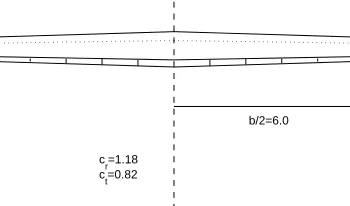
wing is a straight-tapered wing with the taper-ratio (λ) of 0.7, shown in Fig. 3.1.
This wing was used for a case of single constraint of rolling moment. The next
two wings are the swept-tapered-wing with the sweep (Λc/4) of 20 degrees and 35
degrees with the same taper-ratio, shown in Fig. 3.2. These two wings were used
for both single and multiple constraint cases.
Using these two wings, a hypothetical tailless aircraft was used as an sample
platform with characteristics displayed in Table 3.1. These characteristics were
Table 3.1: Assumed parameter values for example tailless aircraft.
Static Parameters Value
Gross weight (W) 14,200 N
(3,200 lbf)
Mean aerodynamic chord (¯c) 1.01 m
(3.31 ft)
Reference area (S) 12.0 m2
(130 ft2)
Wing aspect ratio (AR) 12
Static margin (SM) 10 % ¯c
Number of half-span TE flaps (N) 5
Flap-to-chord ratio (all flaps) 0.2
Variable Parameters Value
1
4 chord sweep angle (Λc/4) 20 deg
35 deg
Airfoil section NLF0824 (CAM BERED)
(Cm0 =−0.0802)
Reflex055 (REF LEXED)
(Cm0 = 0.055)
For each wing shape, two different airfoils were used which were the same
airfoils used in Ref. 17. The first airfoil is a cambered NLF airfoil which has a zero
lift pitching moment coefficient (Cm0) of −0.0802, and is labeled CAM BERED.
This airfoil has a well defined low drag range. The second airfoil is a reflexed
airfoil which was designed to have a positive Cm0 value of 0.055, and is named
REF LEXED. Figures 3.3 and 3.4 display the properties of these airfoils as
analyzed by XFOIL25 calculated at a Re√C
l of three million, as well as their
corresponding geometries.
Based on these wing and airfoil selections, there are four example cases for
a single constraint and four cases for multiple constraints case. Example Case
#1−1 is the CAM BERED airfoil for a straight-tapered wing. Example Case
#1−2 is the CAM BERED airfoil at Λc/4 = 35 deg of wing sweep. Example
b/2=6.0
c
r=1.18
c
t=0.82
Figure 3.1: Example planform for unswept tapered wing with 5 TE flaps per half span.
Λc/4=20°
b/2=6.0 c
r=1.18
c
t=0.82
(a)
Λc/4=35°
b/2=6.0 c
r=1.18
c
t=0.82
(b)
Figure 3.2: Wing planform for swept tapered wing with 5 TE flaps per half span:
(a) Λc/4 of 20 degrees and (b) Λc/4 of 35 degrees.
Case #1−4 is the REF LEXED airfoil with Λc/4 = 35 deg of sweep. For each
of these cases, the desired rolling moment coefficient values were set to CR=0.02
and CR=0.04 respectively. These desired values of CR were determined as the
rolling-moment coefficients for a generic transport aircraft with 5 deg and 10 deg
aileron deflections.
For the multiple constraint case, two examples are studied. Example Case
#2 −1 is the CAM BERED airfoil at Λc/4 = 35 deg. Example Case #2−2
is the REF LEXED airfoil at Λc/4 = 20 deg. Each case were applied for both
SchemeAand SchemeB which is shown in Cusher17with the two rolling moment
coefficient values. For the supplemental analysis of a stuck flap in Sec. 3.4, only
the straight-tapered wing with CAM BERED airfoil is studied. However, two
flaps were chosen as the stuck flaps and each case of data was taken with zero
0 0.2 0.4 0.6 0.8 1 −1.5
−1
−0.5
0
0.5
1
x/c Cp
Cl = 0.5
(a)
0 0.001 0.002 0.003 0.004 0.005 0.006 0.007 0.008 0.009 0.01 0
0.1 0.2 0.3 0.4 0.5 0.6 0.7 0.8 0.9 1
C
d
C
l
(b)
Figure 3.3: CAM BEREDairfoil: (a) Geometry andCpdistribution and (b) drag
polar at Re√Cl of three million.
0 0.2 0.4 0.6 0.8 1 −1.5
−1
−0.5
0
0.5
1
x/c Cp
Cl = 0.5
(a)
0 0.001 0.002 0.003 0.004 0.005 0.006 0.007 0.008 0.009 0.01 0
0.1 0.2 0.3 0.4 0.5 0.6 0.7 0.8 0.9 1
C
d
C
l
(b)
Figure 3.4: REF LEXED airfoil: (a) Geometry andCp distribution and (b) drag
tip, which is called F lap.1, and another located next to the wing root on the
right hand side of the wing, which is namedF lap.6. For each case the two rolling
moment coefficient values were applied.
3.2
Rolling Moment Constraint
3.2.1
Example Case
#1
−
1
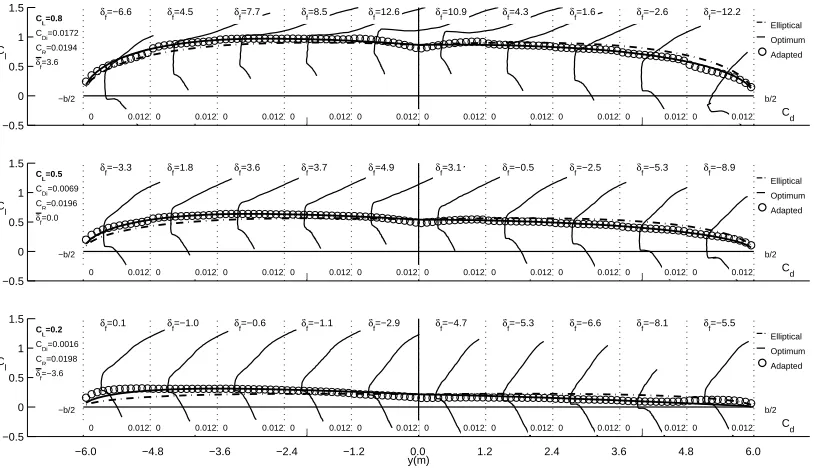
The first case is theCAM BEREDairfoil used on the straight-tapered wing
plan-form with no sweep angle shown in Fig. 3.1. The Cl distribution and drag polar
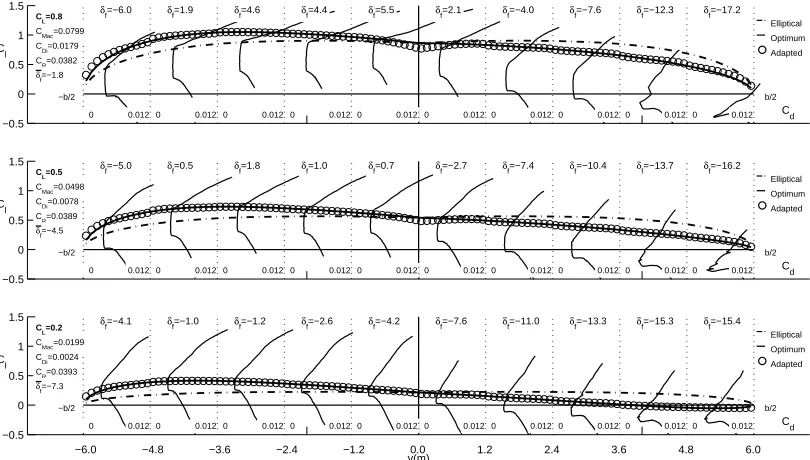
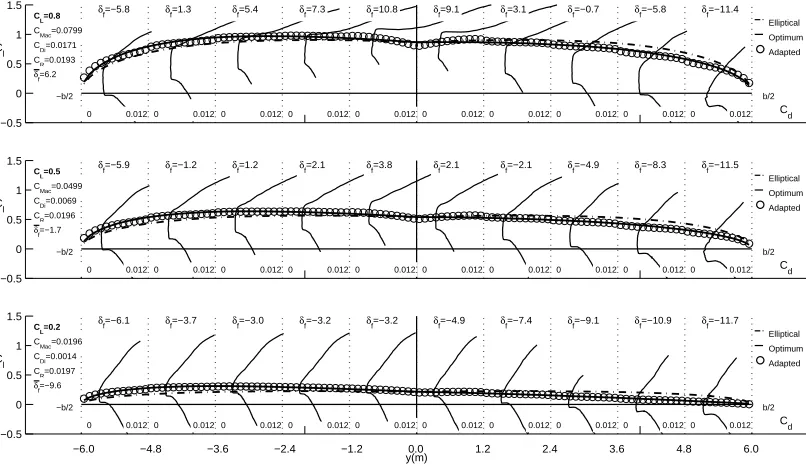
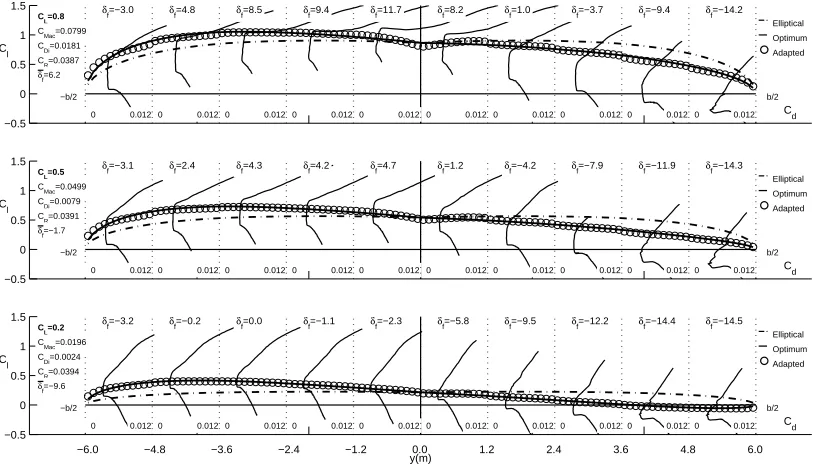
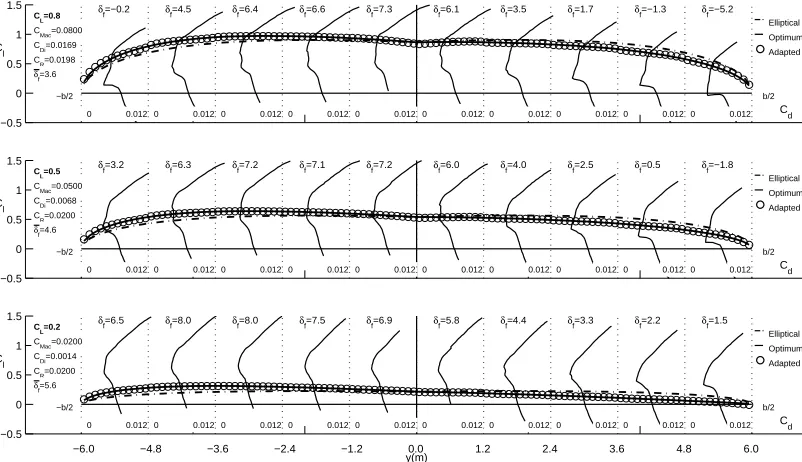
for each flap are shown in the Fig. 3.5. The desired rolling moment coefficient,
CRdesired, is 0.02. Three Cl distributions for the different wing CL values of 0.2,
0.5, 0.8 are shown in the figure. For each distribution the total induced drag,
rolling moment coefficients, and mean flap deflection angles are shown on the left
in the plot. The distribution shown as a dash-dot line is the elliptical
distribu-tion. This distribution has no rolling moment because it is symmetric about the
wing root. TheCldistribution with a solid line is the optimum distribution which
was described in Sec. 2.1.2. The distribution with circle markers is the adapted
distribution achieved by using the multiple TE flap deflections. For each flapped
portion of the wing, the drag polar for that flap angle is plotted, to check if that
portion of the wing is operating within the drag bucket of the airfoil.
It is clear that the adapted distribution is very close to the optimum serves to
verify the theory of induced drag minimization with the rolling moment constraint.
The flap angles are listed in Fig. 3.5 for each CL. It is seen the flap angles are
all moderate and not high enough for flow separation to be a concern. It is also
seen that each portion of the wing is operating within the corresponding low-drag
range, resulting in minimum profile drag in addition to minimum induced drag.
−6 −4 −2 0 2 4 6 −0.5 0 0.5 1 1.5 Elliptical Optimum Adapted b/2 −b/2
δf=0.2
0 0.012
δf=6.2
0 0.012
δf=7.2
0 0.012
δf=6.7
0 0.012
δf=5.3
0 0.012
δf=4.5
0 0.012
δf=4.2
0 0.012
δf=3.1
0 0.012
δf=0.9
0 0.012
δf=−4.9
0 0.012
CL=0.8
CDi=0.0173 CR=0.0197
δf=3.6
Cl
C
d
−6 −4 −2 0 2 4 6
−0.5 0 0.5 1 1.5 Elliptical Optimum Adapted b/2 −b/2
δf=−0.1
0 0.012
δf=2.4
0 0.012
δf=2.7
0 0.012
δf=2.1
0 0.012
δf=1.1
0 0.012
δf=0.3
0 0.012
δf=−0.3
0 0.012
δf=−1.3
0 0.012
δf=−2.9
0 0.012
δf=−5.1
0 0.012
CL=0.5
CDi=0.0069 CR=0.0198
δf=0.0
Cl
Cd
−6 −4 −2 0 2 4 6
−0.5 0 0.5 1 1.5 Elliptical Optimum Adapted b/2 −b/2 −6.0 δf=−0.4
0 0.012
−4.8 δf=−1.5
0 0.012
−3.6 δf=−1.7
0 0.012
−2.4 δf=−2.4
0 0.012
−1.2 δf=−3.1
0 0.012
0.0 δf=−3.9
0 0.012
1.2 δf=−4.9
0 0.012
2.4 δf=−5.8
0 0.012
3.6 δf=−6.7
0 0.012
4.8 δf=−5.4
0 0.012 6.0 C L=0.2 C Di=0.0015 C R=0.0199 δ f=−3.6 C l Cd y(m)
Figure 3.5: Spanwise Cl distributions with flap-section drag polars and optimal
Cl distributions with CRdesired=0.02 for Example Case #1−1.
−6 −4 −2 0 2 4 6
−0.5 0 0.5 1 1.5 Elliptical Optimum Adapted b/2 −b/2
δf=2.7
0 0.012
δf=8.8
0 0.012
δf=9.2
0 0.012
δf=7.9
0 0.012
δf=5.7
0 0.012
δf=4.1
0 0.012
δf=3.0
0 0.012
δf=1.1
0 0.012
δf=−1.7
0 0.012
δf=−7.4
0 0.012
CL=0.8
CDi=0.0182 CR=0.0394
δf=3.6
Cl
C
d
−6 −4 −2 0 2 4 6
−0.5 0 0.5 1 1.5 Elliptical Optimum Adapted b/2 −b/2
δf=2.4
0 0.012
δf=5.0
0 0.012
δf=4.8
0 0.012
δf=3.4
0 0.012
δf=1.5
0 0.012
δf=−0.1
0 0.012
δf=−1.6
0 0.012
δf=−3.4
0 0.012
δf=−5.6
0 0.012
δf=−7.7
0 0.012
CL=0.5
CDi=0.0079 CR=0.0396
δf=0.0
Cl
C
d
−6 −4 −2 0 2 4 6
−0.5 0 0.5 1 1.5 Elliptical Optimum Adapted b/2 −b/2 −6.0 δf=2.2
0 0.012
−4.8 δf=1.2
0 0.012
−3.6 δf=0.3
0 0.012
−2.4 δf=−1.2
0 0.012
−1.2 δf=−2.7
0 0.012
0.0 δf=−4.3
0 0.012
1.2 δf=−6.1
0 0.012
2.4 δf=−7.8
0 0.012
3.6 δf=−9.4
0 0.012
4.8 δf=−7.9
0 0.012 6.0 C L=0.2 C Di=0.0025 C R=0.0397 δ f=−3.6 C l Cd y(m)
Figure 3.6: Spanwise Cl distributions with flap-section drag polars and optimal