DOI: 10.1534/genetics.104.027524
Selective Phenotyping for Increased Efficiency in Genetic Mapping Studies
Chunfang Jin,* Hong Lan,
†Alan D. Attie,
†Gary A. Churchill,
‡Dursun Bulutuglo
‡and Brian S. Yandell*
,§,1*Department of Statistics, University of Wisconsin, Madison, Wisconsin 53706,†Department of Biochemistry, University of Wisconsin, Madison, Wisconsin 53706,‡The Jackson Laboratory, Bar Harbor, Maine 04609 and§Department of Horticulture,
University of Wisconsin, Madison, Wisconsin 53706 Manuscript received February 10, 2004 Accepted for publication August 16, 2004
ABSTRACT
The power of a genetic mapping study depends on the heritability of the trait, the number of individuals included in the analysis, and the genetic dissimilarity among them. In experiments that involve microarrays or other complex physiological assays, phenotyping can be expensive and time-consuming and may impose limits on the sample size. A random selection of individuals may not provide sufficient power to detect linkage until a large sample size is reached. We present an algorithm for selecting a subset of individuals solely on the basis of genotype data that can achieve substantial improvements in sensitivity compared to a random sample of the same size. The selective phenotyping method involves preferentially selecting individuals to maximize their genotypic dissimilarity. Selective phenotyping is most effective when prior knowledge of genetic architecture allows us to focus on specific genetic regions. However, it can also provide modest improvements in efficiency when applied on a whole-genome basis. Importantly, selective phenotyping does not reduce the efficiency of mapping as compared to a random sample in regions that are not considered in the selection process. In contrast to selective genotyping, inferences based solely on a selectively phenotyped population of individuals are representative of the whole population. The substantial improvement introduced by selective phenotyping is particularly useful when phenotyping is difficult or costly and thus limits the sample size in a genetic mapping study.
G
ENETIC mapping involves the ascertainment of a strong incentive to limit the number of animals studied with microarrays. Having a fairly large sample of animals phenotype in a genetically segregating populationfollowed by an analysis of association between the phe- that were genotyped, we asked if a selected subset of this full mapping panel would be more informative than notype and genotypes at marker loci spanning the entire
genome. Due to high-throughput technologies, geno- a randomly selected subsample.
We describe a selective phenotyping strategy that can typing no longer limits the sample size in a genetic
map-ping study. Increasingly, the cost and logistics of pheno- substantially increase detection efficiency whenever phenotyping requires much more effort than genotyp-typing impose limits on sample size. This is especially
true of phenotypes involving complex physiological or ing. We performed simulations to study the behavior of selective phenotyping and then successfully applied the behavioral traits.
Microarray technology has broadened our definition method to our mouse gene expression mapping study. We first consider the performance of selective pheno-of phenotype to include the mRNA abundance data
obtained from microarray experiments. Gene mapping typing for a range of sizes of full mapping panels and for different proportions of individuals selected in sub-using microarray data as phenotypes is now emerging
(Bremet al.2002;Schadtet al.2003;Yvertet al.2003) samples from these mapping panels. We then show how sensitivity improves with increasing score, a measure of and will soon be commonplace (JansenandNap2001;
Doerge 2002; Bochner 2003). The high cost of mi- genetic difference, when some markers used for selec-tive phenotyping are linked to QTL. Next, we investigate croarrays greatly limits the sample size of a gene
map-ping study of mRNA abundance traits. the relative merits of different criteria of selective
phe-notyping. Finally, we examine the performance of selec-We have studied the inheritance of physiological traits
and mRNA abundance traits in an F2sample segregating tive phenotyping on our mouse mapping panel.
for obesity and diabetes (Stoehret al.2000;Lanet al.
2003). Because of the high cost of microarrays, we had
MATERIALS AND METHODS
F2mice selection:Our mapping panel includes 108 (B6⫻
BTBR) F2-ob/obmice used to study QTL associated with obesity 1Corresponding author:Department of Statistics, University of
Wiscon-and diabetes (Stoehret al. 2000). The framework map was sin, 1300 University Ave., MSC-1239, Madison, WI 53706.
E-mail: [email protected] constructed with MapMaker/EXP (Lander et al.1987) and
consists of 188 microsatellite markers spanning the 19 mouse mean,K1, and optimizes selection for nonepistatic effects. The second moment or variance,K2(seeappendix), would further autosomes, composing a framework map with average spacing
of 20 cM augmented by markers in identified regions. The optimize for epistatic QTL.Xu(2003) recommends first select-ing subsamples based on K1 and then selecting the design phenotypes include 11 physiological traits, such as fasting
plasma glucose, fasting plasma insulin, and body weight at 8 with the smallest K2. Alternatively, we could consider some weighted average ofK1andK2. Simulations (not shown) sug-and 10 weeks of age, sug-and the abundance of 12 mRNA species
gest little difference between these approaches in practice. involved in liver metabolic pathways relevant to insulin action
Higher-order moments are probably not effective and are not and glucose homeostasis, such as stearoyl-CoA desaturase 1
considered further. (SCD1), fatty acid synthase (FAS), and acyl-CoA oxidase (ACO).
Two-step implementation:Subset selection is a challenging The liver mRNA abundances in the F2mice were estimated
computational problem due to many possible subsets to evalu-using the quantitative real-time reverse transcriptase-PCR
ate. Therefore, we propose a two-step approach: forward se-(qRT-PCR) as described earlier (Lan et al. 2003). Previous
lection of individuals followed by optimization through pair studies have found that regions on chromosomes 2, 4, 5, 9,
swapping. Initially, the pair of individuals with the minimum 16, and 19 harbor QTL for insulin, glucose, andSCD1mRNA
similarity is selected. Each iteration adds one individual to the traits (Stoehret al.2000;Lanet al.2003). In this study, we
set based on the MMA criterion. It is well known that this ap-selected 60 mice according to their genotypes on these six
proach may not reach the global optimum, since individuals chromosomal regions for subsequent analysis.
chosen earlier may no longer be optimal in light of later
Selection criteria:Assuming only a modest number of
quan-choices. The optimization step swaps individuals out of the titative trait loci, how do we best select a subsample from the
chosen set to be replaced by new individuals. A swap is retained mapping panel for phenotyping? We want to select individuals
if the resulting set has a lower similarity. This swapping proce-that are genotypically dissimilar to maximize the available
dure is repeated until no larger dissimilarity can be found. genetic information. Detection of a major QTL in an F2
map-Genomic information: When we have little information ping panel with an additive genetic effect has the most power
about genetic architecture, we could select individuals on the in a sample that has a 1:1 ratio of individuals homozygous for
basis of a framework map for the entire genome (genome-either parental genotype at the QTL locus (O’BrenandFunk
wide selective phenotyping). However, if previous studies sug-2003). A random sample at this locus would have anⵑ1:2:1
gest that certain genomic regions may be important, we can ratio of A:H:B genotypes and would require up to twice the
employ chromosome-wide selective phenotyping, which uses sample size for comparable power to detect a strictly additive
information only from chromosomes of particular interest, or effect. If we cannot afford to phenotype all individuals, we
marker-based selective phenotyping, concentrating on a few would prefer to selectively phenotype equal numbers of
homo-genetic markers in the genomic regions of interest. zygotes. The selection criterion can also be modified to favor
Performance measures: We used simulations to establish a 1:1:1 ratio to detect general differences among the three
the performance characteristics of different selective pheno-genotypes. Inference obtained through standard interval
map-typing strategies. Selected sets of individuals were compared ping is not affected by selection based on marker genotypes
to random samples of the same size and to the full mapping (see appendix). This is in contrast to selective genotyping
panel to assess the overall efficiency of selection. Detection where it is well known (Lander and Botstein 1989) that
of a QTL is defined as a LOD exceeding the permutation-ignoring unselected progeny leads to bias in QTL effect
esti-based threshold (ChurchillandDoerge1994) within a 40-mation.
cM window surrounding the true locus. The following perfor-We build our algorithm on the experimental design concept
mance measures were used in this study: of minimum moment aberration (MMA), which is equivalent
to other statistically justified criteria (Xu2003). The basic idea Specificity: one minus the false-positive rate is the percentage is to select a subsample of individuals that are as dissimilar as of simulation runs for which no QTL were found over possible. MMA measures similarity for a subsample as an aver- regions of the genome where no QTL were present. age of all pairwise similarities,K1 (see appendix), with the Sensitivity: the percentage of simulation runs in which all QTL similarity for two individuals being the “similarity” between present were detected.
their marker genotypes summed across a subset of markers QTL effect bias: the difference between expected and true from the linkage map. Similarity at a marker could be 1 for value of the QTL effect.
the same genotype and 0 for different genotype to emphasize QTL effect standard error: typical deviation of estimated QTL general QTL effects. For a subsample of 60 individuals, we effect.
prefer to measure similarity as the number of alleles two indi- QTL location estimates:sis the average absolute distance of viduals share (0, 1, or 2) to optimize detection of additive detected LOD peak from the known underlying QTL;cis genetic effects. This measure preferentially selects homozy- the frequency that the true position falls into the interval gotes at the markers of interest. defined by LOD within 1.5 of the peak LOD.
The MMA criterion depends on the size of the mapping
Simulations:We conducted simulations under a variety of panel and the number of markers considered in the similarity
situations that we expect to encounter in a genetic mapping measure. We standardized the similarityK1to allow
compari-experiment. For each situation, we simulated 100 replicate F2 son across experiments of different size. Our score is
normal-mapping panels on the basis of the Haldane normal-mapping function ized between 0 and the square root of sample size,
with evenly spaced (10 cM) markers. Environmental noise was drawn from a standard normal distribution, with heritability score⫽√n(max⫺K1)
encountered in previous studies (Bromanand Speed2002; Yvert et al. 2003). We primarily considered marker-based selective phenotyping, except for the last set of simulations.
We then addressed our specific problem with 110 F2 individ-uals, up to 20 chromosomes of length 70–100 cM, and one to three QTL. Markers were placed every 10 cM along chromo-somes, similar to that inCheunget al.(2003). For each simu-lated mapping panel, a subset of 60 individuals was selected either at random or by using one of the three selective pheno-typing methods. The subsets were compared with each other and with the full mapping panel in terms of sensitivity, speci-ficity, bias, and precision of inferring the correct QTL.
Software:The selective phenotyping algorithm was imple-mented in R (www.r-project.org). Multidimensional scaling was performed using the R/mva package. QTL analysis was performed using standard interval mapping with the R/qtl package (Bromanet al.2003).
RESULTS
How many individuals do we need for selective pheno-typing?We simulated various mapping panel sizes while keeping the selected sample size fixed (n ⫽ 50, h2 ⫽
0.25) and limiting attention to one 100-cM chromosome with one QTL at 35 cM. When progeny are selected randomly, no improvement of sensitivity is observed with increasing mapping panel size (Figure 1a). In sharp contrast, selective phenotyping based on flanking mark-ers (30 and 40 cM) was able to take advantage of the increasing mapping panel. Sensitivity increased with mapping panel size and with the proportion selected. It leveled off when the selected proportion reached 50% (Figure 1a). With higher heritability, the curve levels off below 50% (data not shown). Fixing the selected proportion at 50% (n⫽0.5N,h2⫽0.25), the sensitivity
Figure1.—Effect of mapping panel size on sensitivity and
increased roughly linearly with mapping panel size
(Fig-score with selective phenotyping. F2progeny were selected on
ure 1b). The intercept decreases for selected markers
the basis of markers at 30 and 40 cM, from a mapping panel
further away from the QTL position. of varying size. The true QTL is located at 35 cM on a single-In a situation where the mapping panel is already chromosome genome. The phenotype is simulated with
herita-bility of 0.5. The horizontal axis represents the size of the
established, what proportion of individuals do we need
mapping panel (N). (a) Effect ofNon sensitivity (vertical axis
to selectively phenotype to retain high performance?
on the left) and on score (vertical axis on the right), when
For fixed mapping panel size (N⫽100), as we increased
50 F2 progeny were selected. (b) Effect of N on sensitivity
the proportion selected, the sensitivity rose to a point of (left) and score (right) when 50% of the panel was selected. diminishing returns, depending on heritability (Figure
2a). Selection was more effective for highly heritable traits. Even withh2⫽0.25, there is not much
improve-score appears to increase when sensitivity improves (Fig-ment with ⬎50% selected. This is consistent with the ure 2b) when some markers used for selective phenotyp-findings with fixed selection sample size above. This ing are linked to QTL. Consequently, score is especially indicates that, with high heritability, selectively pheno- useful in “predicting” the performance of different se-typing 50% of the progeny from the full mapping panel lection schemes (not just selective phenotyping) with-can retain most of the information needed for QTL out the need to refer to a particular phenotype or herita-detection. More progeny are needed when the heritabil- bility.
ity is low. What is the most appropriate selective phenotyping
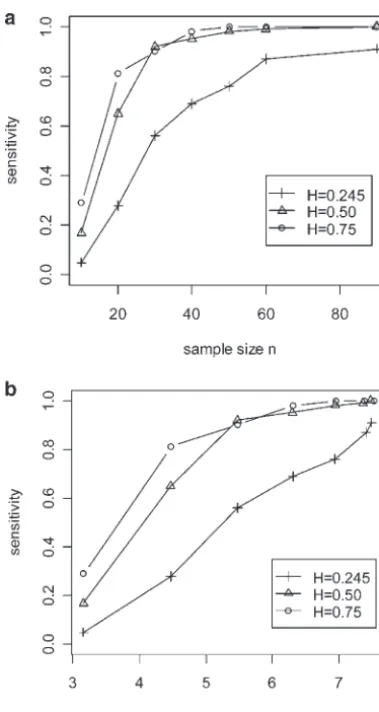
Figure3.—Comparison of selective phenotyping with ran-Figure2.—Effect of heritability and sample size on
sensitiv-dom sampling. (a) The relationship between score (horizontal ity and score with selective phenotyping. Varying numbers of
axis) and sensitivity (vertical axis) for different selective pheno-progeny were selected on the basis of a marker at 30 cM, from
typing methods with one, two, four, or eight chromosomes in a mapping panel of size 100. The true QTL is located at
the genome. “g” stands for genome-based, “c” for chromo-33 cM on a single-chromosome genome. The phenotype is
some-based, and “m” for marker-based selective phenotyping generated with heritability (H) of 0.245, 0.5, or 0.75. (a) The
methods. Sample sizenis 30, mapping panel size is 100, and effect of sample sizen(horizontal axis) on sensitivity (vertical
heritability is 0.5. (b) Sensitivity (vertical axis) comparison axis) under different heritabilities. (b) The relationship
be-of genome-based (g), chromosome 1-based (c), and marker-tween score (horizontal axis) and sensitivity (vertical axis)
based (m) selective phenotyping methods against full map-under different heritabilities.
ping panel analysis (f) and random selection (r). The hori-zontal axis denotes the number of chromosomes in the genome. Sixty F2progeny were selected from a mapping panel of size
had a single marker near the true QTL. A set of
simula-110. The true QTL is located at 33 cM on chromosome 1 of
tions had one QTL with pure additive effect (h2⫽0.245)
a two-chromosome genome. Heritability is 0.245.
on chromosome 1 at 33 cM in a genome with 20 chromo-somes. The mapping panel had 110 individuals, and
60 were selected by one of the criteria or by random Genome-based (40%) and chromosome-based (⬎60%) selection were also considerably better than random sampling.
We found substantial differences in sensitivity to de- selection. A restricted search of a portion of the genome yields smaller differences and higher sensitivity (Figure tect QTL when searching the whole genome (Figure
3). The sensitivity to detect a single QTL decreased as 3b). The dissimilarity scores for either the marker-based or chromosome-based criterion did not change with a the number of chromosomes increased, regardless of
selection criteria. With 20 chromosomes in the genome, restricted search of the genome (Figure 3a), as they depend only on markers used for selection, not on the gene mapping based on random sampling can detect
QTL only 30% of the time, compared with 80% sensitiv- QTL search strategy. However, the dissimilarity score for the genome-based criterion decreased as the region ity of the full mapping panel. This tremendous loss of
sensitivity can be rescued with selective phenotyping. increased. The score is most useful for relative compari-sons of the various selection methods when the search Marker-based selection captured most (⬎70%) of the
sensitivity of the full mapping panel, two- to threefold region is fixed.
Figure4.—LOD map comparison for differ-ent selective phenotyping methods. (a) We simulated 100 F2mapping panels with 110 indi-viduals, 10 chromosomes, and one QTL and performed standard interval mapping. Sixty in-dividuals are selected using the three selective phenotyping methods: genome based (dotted dashed line), chromosome based (dotted line), and marker based (dashed line). Ran-dom method (thin solid line) and full mapping panel analyses (thick solid line) are provided as reference. The vertical axis is the median LOD obtained at each location. The horizontal axis represents the map location. The arrow points at the QTL location, and the solid bar points at the marker used for marker-based selection. (b) Marker-based selective pheno-typing. We simulated 100 F2 mapping panels with 110 individuals, markers every 10 cM, two linked QTL on one chromosome, and a third QTL on a second chromosome. For each simu-lated panel, we performed standard interval mapping. The vertical axis is the median or quartile LOD obtained at each position. The horizontal axis represents the map location for the two chromosomes. Arrows point to the QTL loci, vertical lines indicate markers, and the solid bar indicates the marker used for marker-based selection. Sixty individuals are selected randomly (dashed line) or using the marker-based selection (thick solid line). The 25 and 75% LOD quartile from random method (dotted line) and the median LOD from full mapping panel analyses (thin solid line) are provided as reference.
cates based on one QTL and a genome consisting of 10 lower LODs. Thus, the more specific we can be in selec-tion using previous knowledge, the more sensitive our chromosomes. The median LOD may not correspond to
a result of any single analysis across the genome, but it QTL analysis will be. Even without any prior informa-tion, our analysis still does slightly better than random provides a pointwise summary of LOD analysis for QTL.
The full mapping panel had the highest LODs at the sampling.
Genome-based selective phenotyping improves on true QTL location, followed by the marker-based and
TABLE 1
Comparison of performance measures
Full mapping Random Selective
panel subset phenotyping
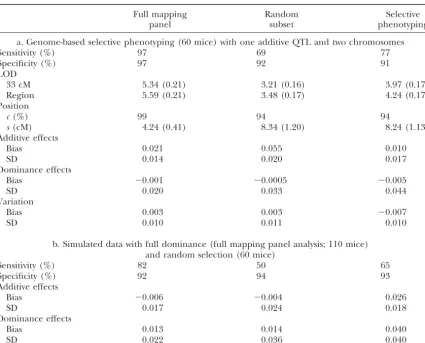
a. Genome-based selective phenotyping (60 mice) with one additive QTL and two chromosomes
Sensitivity (%) 97 69 77
Specificity (%) 97 92 91
LOD
33 cM 5.34 (0.21) 3.21 (0.16) 3.97 (0.17)
Region 5.59 (0.21) 3.48 (0.17) 4.24 (0.17)
Position
c(%) 99 94 94
s(cM) 4.24 (0.41) 8.34 (1.20) 8.24 (1.13)
Additive effects
Bias 0.021 0.055 0.010
SD 0.014 0.020 0.017
Dominance effects
Bias ⫺0.001 ⫺0.0005 ⫺0.005
SD 0.020 0.033 0.044
Variation
Bias 0.003 0.003 ⫺0.007
SD 0.010 0.011 0.010
b. Simulated data with full dominance (full mapping panel analysis; 110 mice) and random selection (60 mice)
Sensitivity (%) 82 50 65
Specificity (%) 92 94 93
Additive effects
Bias ⫺0.006 ⫺0.004 0.026
SD 0.017 0.024 0.018
Dominance effects
Bias 0.013 0.014 0.040
SD 0.022 0.036 0.040
Values in parentheses are standard errors.
with one additive QTL focusing on two chromosomes, the QTL, located on chromosome 1. Chromosome-based selective phenotyping based only on chromosome 1 pro-LOD curve for the genome-based selective phenotyping
came close to the 75th percentile of the random method vides considerably higher sensitivity than random sam-pling and slightly better sensitivity than genome-based (not shown). No QTL signal was found on chromosome
2 for the full mapping panel or any subset; thus the false- selective genotyping (Figure 3). If we know further the approximate region(s) containing QTL of interest, then positive rate is low. Both random selection and
genome-based selective phenotyping maintained a specificity of at marker-based selective phenotyping, relying on one or a few markers, does even better (Figure 3). Thus, we can least 90%, lower than that of the full mapping panel
(97%). Reducing the number of subjects selected seemed improve over random sampling provided the selection region is chosen correctly. However, if we choose re-to affect detection power. Genome-based selective
pheno-typing had smaller bias and standard deviation for additive gions for either criterion that do not contain QTL, such as chromosome 2, then selective phenotyping behaves effect (Table 1). Our selection procedure tends to choose
homozygous progeny more often, as expected, slightly like random selection on average for detection of QTL (not shown).
favoring estimates of additive effects over dominance
ef-fects. A second simulation with one QTL having pure We performed another F2 simulation with two QTL
on chromosome 1 (at 23 and 62 cM) and one QTL on dominance showed that genome-based selective
pheno-typing still generated a higher LOD score than the random chromosome 2 (at 48 cM), all additive of the same magnitude of 0.7, and the residual phenotypic variation method, again tracking the 75th percentile of the random
sampling (not shown). Other measures of performance is assumed to be normally distributed with mean 0 and variance 1. Marker-based selective phenotyping with one did not change much. This supports using selective
phe-notyping even in the presence of full dominance. marker near the first QTL on chromosome 1 had a
higher LOD score and better detection for both QTL Frequently, some chromosomes are of more interest
chromosome 2 is close to that of random sampling on average. Thus, the stronger and more specific the prior knowledge, the more detection power we can gain near these locations.
Mouse experimental design: We have 108 (B6 ⫻ BTBR) F2-ob/obmice, and our goal is to select a subset
of 60 mice for future gene expression studies. We chose them using the marker-based selective phenotyping ap-proach with the following considerations: (1) the sensi-tivity gain with all 19 chromosomes would be minimal with genome-based selection methods; (2) we have pre-viously identified six regions of particular interest, each ⵑ20 cM in length; and (3) there are few missing geno-types for the markers in these regions.
According to the specified criteria, the selected sub-jects should be as dissimilar as possible. To visualize the dissimilarity, we used multidimensional scaling (MDS), which projects individuals onto a two-dimensional map on the basis of their pairwise similarity. Selective pheno-typing should choose individuals that are as dissimilar as possible, and we should not see any evidence of clumping. For the 108 mice, a two-dimensional projec-tion explains⬎30% of the variation and shows no obvi-ous pattern (Figure 5a), except that the progenies not selected tend to have more heterozygous genotypes in these six regions, which is desirable for our purpose.
We examined the performance of our selective phe-notyping method on theSCD1phenotype by comparing its resulting LOD profile to that obtained through re-peatedly drawing random samples of 60 mice (Figure 5b). Our LOD score was generally higher than the
me-dian LOD from random sampling with the exception Figure 5.—Mice selection experiment. (a) Multidimen-of chromosome 5, where there appeared to be evidence sional scaling visualization of the mice selection projected onto the first two principle components, which explain,
re-for dominance and unequal variance re-for SCD1 across
spectively, 23 and 9% of the total variation. The 60
marker-the marker genotypes. Selective phenotyping thus is
selected mice are solid circles; the remaining 50 mice are
superior to a random sample of equal size because it open circles. The size of the circle measures the abundance provides considerably more resolving power. of homozygous genotypes. The smaller the size, the more “H”
it has. (b) Interval mapping ofSCD1trait for chromosomes 2, 4, 5, 9, 16, and 19. The LOD curves are for the full mapping DISCUSSION panel with 110 (B6⫻BTBR) F2-ob/obmice (thick solid line), 60 marker-selected mice (dashed line), and 60 randomly selected
In this study, we present a criterion for selecting a mice (thin solid line). The vertical axis is the LOD obtained subset of individuals for phenotyping based on their at each position. The horizontal axis shows the chromosomes genotypes. We used an F2 mapping panel for all the of interest with markers from the genetic map.
examples, but the method can be easily extended to other experimental designs and combined crosses. The
decision to use genome-based, chromosome-based, or search focus. Assigning the same pairwise similarity be-tween different genotypes results in a balanced design, marker-based selection is made according to prior
knowledge of both the presence and the localization where approximately the same number of progeny is selected for each genotype. This is more desirable if we of putative QTL. Stronger, more specific, and more
accurate prior information leads to better resolution are equally interested in a broad range of hypotheses about gene action. For an F2 single-QTL analysis, this
for those regions of interest. Chromosomes not used in
the selection criterion tend to perform like a randomly includes tests for additivity, dominance, fully dominant and fully recessive. Further selection of individuals with chosen subset. By selecting individuals that are as
geneti-cally dissimilar as possible, the approach proposed here identical K1based on smallest second-moment
similar-ity,K2, results in a more balanced design across pairs
selects subsets of individuals that provide a better
map-ping panel than random sampling. of markers, which can improve detection of epistasis.
re-reach sufficient detection power, one may want to focus genetics, major adjustment is needed. The possible num-on certain tests of interest. Additive effects are usually cnum-on- ber of genotypes at a certain locus may vary greatly, and sidered the most important and most prevailing among the study subjects may come from an unknown number all. The similarity measure we present emphasizes the of hidden populations. The genetic similarity between examination of additivity both within and across loci. each pair of subjects may be obtained through a more There is little evidence from our simulations to suggest sophisticated alternative, relationship estimation (
Gor-an improvement in performGor-ance when the second mo- ingandOtt1997;McPeekandSun2000). However, ment is included with our measure (not shown), but we situations may exist when it is desirable to retain subjects have not carried out an in-depth study of epistatic QTL. with a certain marker genotype pattern. Selective phe-The MMA criterion is conceptually simple and easy notyping can be performed after estimation of hidden to implement, but current theory relies on complete populations (Coranderet al.2003) based on different data and uncorrelated factors. Correlation from genetic genotype patterns. The genetic similarity measure shall linkage can be minimized by selecting widely spaced be defined accordingly to reflect the population struc-markers, in the extreme at most one per region. Since ture. It is worth mentioning that maximizing unrelat-we had few missing genotypes in regions of interest, unrelat-we edness in a general population sample may lead to max-imputed missing values on the basis of flanking markers imizing genetic heterogeneity in the sample, which may using the Haldane map function of no interference. not be desirable in some cases.
Repeated imputation yielded only minor changes in We have demonstrated that selective phenotyping
selection. More imputation error will generally be intro- provides an effective strategy to maximize the efficiency duced into selective phenotyping when using chromo- of genetic mapping studies that require expensive or some-based or genome-based selection. We are investi- time-consuming assays. This can substantially reduce gating the importance of missing values and linkage in research costs while maintaining high power to detect the experimental design criteria. A natural solution is QTL. This methodology could be extended to associa-to define similarity as the expected value of similarity tion studies to select individuals on the basis of haplo-measures based on the flanking marker genotypes when type block information.
the genotype at this locus is missing.
This research was supported in part by National Institutes of
Interval mapping may give biased estimates for QTL Health/National Institute of Diabetes and Digestive and Kidney Dis-effects in the presence of selective genotyping (Lander eases (NIH/NIDDK) grant no. 5803701, NIH/NIDDK no. 66369-01, and American Diabetes Association grant no. 7-03-IG-01 (A.D.A.,
andBotstein1989). We demonstrate that interval
map-B.S.Y., and H.L.); by United States Department of Agriculture
Cooper-ping is robust against selective phenotyCooper-ping. Therefore,
ative State Research, Education and Extension Service grants to the
the inference obtained through analyzing only the
se-University of Wisconsin-Madison (C.J. and B.S.Y.); and by grant no.
lected subjects is representative of the whole population. NIH/HL55001 (G.A.C. and D.B.). However, if segregation distortion is present in markers
that are used (or not used) for selection, then the map-ping panel may be associated with some unobserved
LITERATURE CITED
selection. Selective phenotyping based on these markers
cannot solve this intrinsic problem, but it will also not Bochner, B. R., 2003 New technologies to assess genotype-pheno-type relationships. Nat. Rev. Genet.4:309–314.
introduce another layer of bias.
Brem, R. B., G. Yvert, R. ClintonandL. Kruglyak, 2002 Genetic
We demonstrate in this article that genome-wide se- dissection of transcriptional regulation in budding yeast. Science
lective phenotyping has improved power on average 296:752–755.
Broman, K. W., andT. P. Speed, 2002 A model selection approach
over that of random sampling and can protect against
for the identification of quantitative trait loci in experimental
the occasional (but undetectable) samples that have crosses. J. R. Stat. Soc. Ser. B64:641–656.
very low power. In a large experiment, a two-stage selec- Broman, K. W., H. Wu, S. SenandG. A. Churchill, 2003 R/qtl: QTL mapping in experimental crosses. Bioinformatics19:889–890.
tive phenotyping could dramatically reduce cost and
Cheung, V. G., L. K. Conlin, T. M. Weber, M. Arcaro, K. Y.Jenet increase power. A first stage of genome-wide selection
al., 2003 Natural variation in human gene expression assessed
could identify promising genomic regions, which are in lymphoblastoid cells. Nat. Genet.33:422–425.
then used for marker-based selective phenotyping. This Churchill, G. A., andR. W. Doerge, 1994 Empirical threshold values for quantitative trait mapping. Genetics138:963–971.
is especially useful when more information about
ge-Corander, J., P. WaldmannandM. J. Sillanpaa, 2003 Bayesian
netic architecture is expected to surface at a later stage analysis of genetic differentiation between populations. Genetics of the study. Our focus on additive effects was dictated 163:367–374.
Doerge, R. W., 2002 Mapping and analysis of quantitative trait loci
by being able to phenotype only 60 mice. A larger study
in experimental populations. Nat. Rev. Genet.3:43–52.
with hundreds of individuals selected would naturally Goring, H. H., andJ. Ott, 1997 Relationship estimation in affected want to examine general effects. Results here point to sib pair analysis of late-onset diseases. Eur. J. Hum. Genet.5:
69–77.
the power of such a procedure.
Jansen, R. C., andJ. P. Nap, 2001 Genetical genomics: the added
The proposed selective phenotyping methods can be
value from segregation. Trends Genet.17:388–391.
directly applied to many experimental designs. For Jin, C., J. P. FineandB. S. Yandell, 2003 A unified semiparametric
framework for QTL analyses, with application to “spike”
types. Technical Report, Dept. of Statistics, University of Wis- lected individuals (s
i⫽ 1). Interval mapping (Lander
consin—Madison.
andBotstein 1989) yields parameter estimators that
Lan, H., J. P. Stoehr, S. T. Nadler, K. L. Schueler, B. S. Yandell
et al., 2003 Dimension reduction for mapping mRNA abun- model Pr(Zi|Mi, si ⫽ 1). Note that sampling depends
dance as quantitative traits. Genetics164:1607–1614. only on the marker genotypes: Pr(s
i⫽1|zi,Mi)⫽Pr(si⫽
Lander, E. S., andD. Botstein, 1989 Mapping Mendelian factors
1|Mi). It follows that
underlying quantitative traits using RFLP linkage maps. Genetics
121:185–199.
Lander, E. S., P. Green, J. Abrahamson, A. Barlow, M. J. Daly Pr(zi|Mi,si⫽1)⫽Pr(si⫽1|zi,Mi)⫻Pr(Mi)⫻Pr(zi|Mi)
Pr(Mi,si⫽1)
et al., 1987 MAPMAKER: an interactive computer package for constructing primary genetic linkage maps of experimental and
natural populations. Genomics1:174–181. ⫽Pr(si⫽1|Mi)⫻Pr(Mi)i⫻Pr(zi|Mi)
Pr(si⫽1|Mi)⫻Pr(Mi)
McPeek, M. S., andL. Sun, 2000 Statistical tests for detection of misspecified relationships by use of genome-screen data. Am. J.
Hum. Genet.66:1076–1094. ⫽Pr(z
i|Mi) .
O’Bren, T. E., and G. M. Funk, 2003 A gentle introduction to
optimal design for regression models. Am. Stat.57:265–267. Thus inferences based on a model for Pr(z
i|Mi,si⫽1)
Schadt, E. E., S. A. Monks, T. A. Drake, A. J. Lusis, N. Cheet al.,
are directly interpretable in the model for Pr(zi|Mi).
2003 Genetics of gene expression surveyed in maize, mouse
and man. Nature422:297–302. MMA similarity: The first moment K1 averages the Stoehr, J. P., S. T. Nadler, K. L. Schueler, M. E. Rabaglia, B. S. similarity␦
i j between theith and jth individuals (␦i j⫽
Yandellet al., 2000 Genetic obesity unmasks nonlinear
interac-sum of number of alleles in common over all markers
tions between murine type 2 diabetes susceptibility loci. Diabetes
49:1946–1954. considered) over all pairs of individuals in a selected
Xu, H. Q., 2003 Minimum moment aberration for nonregular de- sample of sizen: signs and supersaturated designs. Stat. Sin.13:691–708.
Yvert, G., R. B. Brem, J. Whittle, J. M. Akey, E. Fosset al., 2003
Trans-acting regulatory variation in Saccharomyces cerevisiae and K1⫽
兺
i j␦i j
n(n⫺1)/2.
the role of transcription factors. Nat. Genet.35:57–64.
Communicating editor: R. W.Doerge For our similarity measure,␦i jis between zero and two
times the number of markers considered.K2 averages
the square of␦i jover all pairs.
APPENDIX
Score:Score is a standardized version of genetic dif-ference. It is defined as
No bias for selective phenotyping:It is well known that interval mapping is affected by selective genotyping based
score ⫽
√
n(max⫺ K1)range ,
on phenotype information (LanderandBotstein1989). However, inference obtained through standard interval
mapping is not affected by selection based only on where max⫽2m(the number of markers) is the maxi-marker genotypes (Jinet al.2003). To demonstrate this, mum possible value ofK1, and the range equals max⫺
we introduce a sampling variable,si, which equals 1 if the min⫽mn/(n⫺1), where the “min” is obtained through
ith progeny is selected, 0 otherwise, withi⫽1, . . . ,N. Let solving the equation by setting the first derivative to 0
Zi andMidenote the phenotype and flanking marker at any given marker. It is assumed that the markers are