MedAgent: Android based Medication
Monitoring using Cloud Computing
Bhamini Suri1, Aishwarya Sundkar1, Abhilash Agarwal1
BE Student, Department of Computer Engineering, S.I.E.S Graduate School of Technology, Navi Mumbai, India1
ABSTRACT: The patient medication administration inIndia has been identified as the error-prone procedure in health-care because of irregular medicine in-takes, consumption of drugs without any proper knowledge, drug-drug reaction and lack of monitoring mechanisms to keep track of medicine in-take. Many systems have been deployed to avoid these issues. However these systems do not provide information about common drugs and expect the patient to fill all details. We attempt to integrate healthcare support with mobile computing: MedAgent. It consists of features which not only record the prescriptions but also formulates a schedule based on the information provided by the doctor. It will push the schedule ahead in case if a dose is missed and power of cloud computing which will be used to store data, calculates the average of a week’s sugar count which helps the doctor to get summarized information.
KEYWORDS:weekly log, blood-sugar check level, dosagereminder, schedule formulation. I. INTRODUCTION
We represent a novel attempt to integrate healthcare support with mobile computing: MedAgent (Medical Agent). In this project, the doctor/receptionist need to feed the prescription details into their databases which can be retrieved by a patient through his mobile application.
The project covers every feature that will be useful for a type1 diabetic patient and all the other diseases that occur due to type1 diabetes. Diabetes mellitus (DM) type 1 is a form of DM that results from the autoimmune destruction of the insulin-producing beta cells in the pancreas. The subsequent lack of insulin leads to increased blood and urine glucose. The classical symptoms are frequent urination, increased thirst, increased hunger and weight loss [1]. Globally, the number of people with DM type 1 is estimated that about 80,000 children develop the disease each year [2].
MedAgent provides an online mechanism for monitoring medication that stores and retrieves information from cloud [3]. Using the foundational elements of cloud computing, all the information about a particular patient can be stored and retrieved from the cloud which is a fast, reliable and easy method of data management as compared to the traditional database management methods. Moreover, our project provides a mechanism that reminds the patient to take his dosage. Basically, it plans an in-take schedule that would help him to keep a track and avoid mistakes. In case if the patient fails to take a particular dose and loses the track, the reminder would reorganize the schedule using artificial intelligence.
Since Mobile telecommunications are now ubiquitous, and vitally important to individuals, to communities, to businesses and to the wider economy [4], project will be convenient for the users as it will provide mobility and flexibility. Furthermore, there are over millions of users who use mobile operating systems. Hence it can be easily accessed by the users.
II. LITERATURE SURVEY
530,000preventable ADEs among Medicare out-patients each year. Although errors can occur in every step of medication process during medicine procurement, prescription, dispensing and administration; they happen most frequently in the prescription and administration stages.
Furthermore, the healthcare practice followed outside India is Electronic Health Records (EHR) [7]. It is a digital version of a patient’s paper chart. EHRs are real-time, patient-centred records that make information available instantly and securely to authorized users. They contain patient’s medical history, medications, etc. The article based on EHR systems was used for understanding the healthcare system [8]. EHRs were used to digitalize all the paperwork involved in healthcare. These included prescription generated, billing and other reports. The EHRs provided a great deal in the health care systems, however they generated huge amount of data which would take a lot of time to read and analyse the patient’s condition. Thus, we referred an article that showed how artificial intelligence has been useful in healthcare [9]. Incorporating AI in health care systems has helped in reducing this effort. This article contains about many systems which include prediction of diseases on the basis of symptoms provided, etc.
III.NEED FOR THE PROJECT
A. SURVEY CONDUCTED
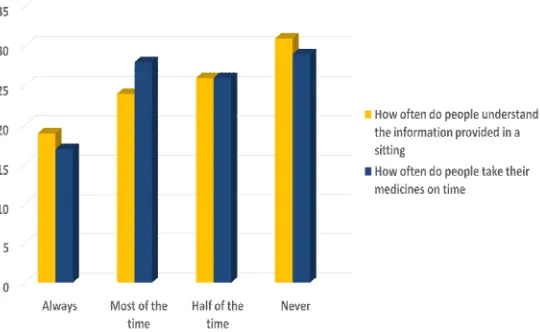
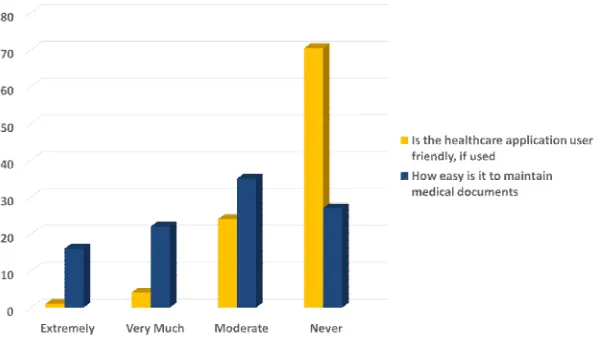
We started with collecting opinions from the patients about the current trends of health care and their way of dealing with it. It was done using an online tool [10]. The following are the results:
Figure 1. Statistics of how often they understand the information provided
Figure 2. Statistics of how useful are the current trends in healthcare for user
It is observed from the figure 2 that more than 25% patients never maintained the documents with ease and 70% patients never found the application to be friendly. Hence, With the help of above survey we came to conclusion that the patients need a system which will not only help them keep a record of what medicines to take and when to take but also help the doctor to get the summarized view of patient’s activities.
B. PROBLEMS WITH EXISTING SYSTEM
The mobile application, Wedjat[11] can alert the patients about potential drug-drug interactions and plan a proper in-take schedule to avoid these interactions. Moreover, it can revise the in-in-take schedule automatically when a dose was missed. However, Wedjat involves the use of EHR system which won’t be feasible in India.
On studying the open source health care application, MedHelper [12] which provides features like reminder about dosages, daily log, storing contact details about pharmacists and doctors, calories burned etc. However, this system completely relies on the patient to fill in the details. Moreover; it does not provide a mechanism to handle the missed dosages.
IV.PROPOSEDSYSTEMOVERVIEW
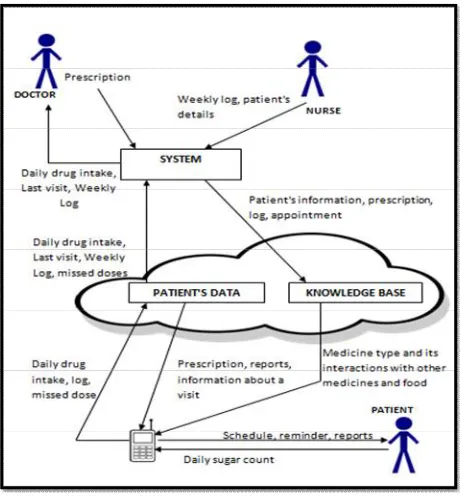
Figure 3 shows system architecture of MedAgent. The system works as follows:
The nurse creates an account for the patient. The patient is provided with a unique patient id.
After diagnosis the doctor feeds the prescription into the system. This prescription is fed into the patient data table as well sent to the patient’s mobile phone.
The knowledge base has details about a particular medicine i.e., its type and its interaction with other medicine. Using this knowledge base and the prescription provided by the doctor a drug intake and insulin intake schedule is automatically generated by the system
This schedule will be transferred to the patient’s phone. Reminders will be set on the basis of this generated schedule
Daily intake schedule will record at what time which drugs are taken so as to help the doctor monitor the patient’s health efficiently. Also the patient has to feed into the system his daily blood sugar count
Figure 3. System Architecture
An average of the blood sugar will be taken on visit/sitting basis and fed into the visit log. The patient will be notified how far he is from his blood sugar goal. Other contents of visit log like blood pressure will be entered by the nurse in every visit which would be on sitting basis. The doctor will thus have a summarized view about a patient’s health on visit basis and what all was discussed in the last visit. Moreover, it will save the effort of storing and carrying prescriptions for every visit as the system will also provide its storage
V. SPECIFICATIONS AND ALGORITHM
A.PARAMETERLIST
Sleeping time – st and current time- ct Medicine time-mt and Waking time – wt Food time – ft and, Buffer time - bt Number of tablets –n
Before food – bf , After food-af
Total no of medicines available with user – tmNext sitting time –nst
Maximum reaction time for a medicine – maxReaction time – rt
Medicine information – mi Slot of the day – m/a/ni
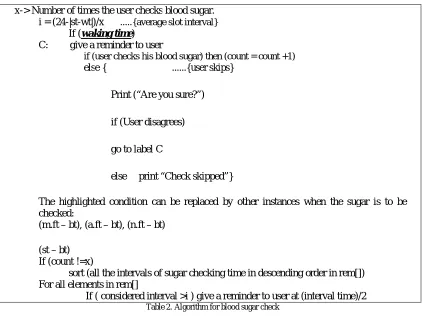
Table 1 shows the medication specifications used in blood sugar check algorithm. These parameters contain essential information of a medicine and also specify the constraints imposed on any particular medicine.
B. BLOOD SUGAR CHECK
x-> Number of times the user checks blood sugar. i = (24-|st-wt|)/x ...{average slot interval}
If (waking time)
C: give a reminder to user
if (user checks his blood sugar) then (count = count +1) else { ...{user skips}
Print (“Are you sure?”)
if (User disagrees)
go to label C
else print “Check skipped”}
The highlighted condition can be replaced by other instances when the sugar is to be checked:
(m.ft – bt), (a.ft – bt), (n.ft – bt)
(st – bt) If (count !=x)
sort (all the intervals of sugar checking time in descending order in rem[]) For all elements in rem[]
If ( considered interval >i ) give a reminder to user at (interval time)/2
Table 2. Algorithm for blood sugar check
Table 2 provides an overview of blood sugar algorithm. Generally blood sugar has to be checked 4-8 times a day viz. Before meals, before and after exercise, before going to bed, while beginning a new medicine, while changing the routine.
VI. RESULTS
(a) (b) (c)
Figure 4.MedAgent (a) GUI Design (b) Schedule Formulation (c) Notification
In figure 5 (a) The prescription contains all the information provided by the doctor during the visit such as name of the medicine, when to be taken (breakfast, lunch, dinner) and the number of dozes to be taken at that time.(b) Nurse/Doctor tend to set the timing of patient’s schedule but if the patient wants to update the changes made in his schedule then he can do that by updating the data in this module
(a) (b)
how far he is from his goal. (b) maintains the Sugar Count of patient with respect to date and how far or near he is from the goal.
(a) (b)
Figure 6.MedAgent (a) Sugar Test (b) Daily Sugar Log
In figure 7 (a) specifies the date of the next visit. (b) Visit Log calculates the average of a week’s sugar count which helps the doctor to get summarized information. Moreover, this module also maintains record of blood pressure during the last visit
(a) (b)
VII. CONCLUSION
Our system provides hassle free job for patients and doctors by automated dosage reminder, maintained visit log book, schedule formulation such that it avoids drug-drug reactions and easy monitoring for the doctor and updated information making the healthcare process easier for everyone. Moreover the system generates ‘Easy to Carry’ e-prescriptions which can be produced to any doctor whenever and wherever needed, thus making things portable. The project can be further expanded in future by generalizing MedAgent by developing similar modules for other ailments like type 2 diabetes.
ACKNOWLEDGMENT
We are thankful to the college SIESGST, Nerul for giving us an opportunity to perform this project for fourth year, in Computer Engineering. We would like to thank our project guide, Mrs PrachiShahane for providing her valuable assistance throughout the project. We would like to express our gratitude towards our H.O.D. Dr.Rizwana Shaikh, our principal Dr.Alka Mahajan for providing the required resources and facilities leading to completion of our project.
REFERENCES
[1] ‘Diabetes mellitus type 1’, [Online] Available: https://en.wikipedia.org/wiki/Diabetes_mellitus_type_1
[2] ‘Personal Assistant for a healthy Lifestyle’, 2016. [Online] Available: http://www.pal4u.eu/index.php/project/background-about-diabetes/ [3] Salesforce.com,'Salesforce.com: The Customer Success Platform To Grow your Business', 2016. [Online]. Available:
http://www.salesforce.com
[4] ‘Benefits of mobile communication’, 2011. [Online] Available: http://www.malvernhills.gov.uk/documents/10558/125552/Benefits+of+Mobile+Communications+Factsheet.pdf/90d9a501-4156-4af0-927b-3f74baa90a76
[5] Kohn LT, Corrigan JM, Donaldson MS (Ed.), To Err IsHuman: Building a Safer Health System. Compiled bythe Committee on Quality of Health Care in America, the Institute of Medicine, US National Academies; published by National Academy Press, 1999.
[6] Aspden P, Wolcott J, Bootman JL, Cronenwett LR (Eds.), Preventing medication errors: quality chasm series, Published by National Academies Press, 2006.
[7] Healthit.gov,'The official site for health IT information', 2016. [Online]. Available: https://www.healthit.gov/providers-professionals/faqs/what-electronic-health-record-ehr
[8] Baron RJ, Fabens EL, Schiffman M, Wolf E, “Electronic Health Records: Just around the corner? Or over the cliff?” Annuals of Internal Medicine143, No. 3, pp.222-226, 2005.
[9] Daniel B. Neill,” Using Artificial Intelligence to Improve Hospital Inpatient Care”,IEEE Intelligent Systems magazine,Vol.28,No.02,pp.92-95,2013
[10] Surveymonkey.com, 'SurveyMonkey: Free online survey software & questionnaire tool', 2015. [Online]. Available: http://www.surveymonkey.com.
[11] Mei-Ying Wang, John K. Zao, P.H. Tsai, J.W.S.Liu,” Wedjat: A Mobile Phone Based Medication Reminder and Monitor”, IEEE Systems Journal 5, No.1, pp.99-110, 2011