DOI: 10.1534/genetics.104.034777
Development of an Expressed Sequence Tag (EST) Resource for Wheat (
Triticum
aestivum
L.): EST Generation, Unigene Analysis, Probe Selection and
Bioinformatics for a 16,000-Locus Bin-Delineated Map
G. R. Lazo,*
,1S. Chao,
†,1,2D. D. Hummel,
†H. Edwards,
†C. C. Crossman,* N. Lui,
†D. E. Matthews,*
,‡V. L. Carollo,* D. L. Hane,
†F. M. You,
§G. E. Butler,
¶R. E. Miller,
†T. J. Close,
&J. H. Peng,**
N. L. V. Lapitan,** J. P. Gustafson,
††L. L. Qi,
‡‡B. Echalier,
‡‡B. S. Gill,
‡‡M. Dilbirligi,
§§H. S. Randhawa,
§§,3K. S. Gill,
§§R. A. Greene,
†M. E. Sorrells,
†E. D. Akhunov,
§J. Dvorˇa´k,
§A. M. Linkiewicz,
§,4J. Dubcovsky,
§K. G. Hossain,
¶¶V. Kalavacharla,
¶¶S. F. Kianian,
¶¶A. A. Mahmoud,
&&Miftahudin,*** X.-F. Ma,*** E. J. Conley,
&&J. A. Anderson,
&&M. S. Pathan,*** H. T. Nguyen,*** P. E. McGuire,
†C. O. Qualset
†and O. D. Anderson*
,5*U.S. Department of Agriculture-Agricultural Research Service (USDA-ARS), Western Regional Research Center, Albany, California 94710-1105,†Genetic Resources Conservation Program, University of California, Davis, California 95616,‡Department of Plant Breeding,
Cornell University, Ithaca, New York 14853,§Department of Agronomy and Range Science, University of California, Davis,
California 95616,¶Arizona Genomics Institute, Department of Plant Sciences, University of Arizona, Tucson, Arizona 85721, &Department of Botany and Plant Sciences, University of California, Riverside, California, 92521,**Department of
Soil and Crop Sciences, Colorado State University, Fort Collins, Colorado 80523-1170,††USDA-ARS Plant Genetics
Research Unit, Department of Agronomy, University of Missouri, Columbia, Missouri 65211,‡‡Department of
Plant Pathology, Wheat Genetics Resource Center, Kansas State University, Manhattan, Kansas 66506-5502,
§§Department of Crop and Soil Sciences, Washington State University, Pullman, Washington 99164-6420, ¶¶Department of Plant Sciences, North Dakota State University, Fargo, North Dakota 58105,
***Department of Agronomy, University of Missouri, Columbia, Missouri 65211 and
&&Department of Agronomy and Plant Genetics, University of Minnesota,
Saint Paul, Minnesota 55108
Manuscript received January 5, 2004 Accepted for publication June 1, 2004
ABSTRACT
This report describes the rationale, approaches, organization, and resource development leading to a large-scale deletion bin map of the hexaploid (2n ⫽ 6x ⫽ 42) wheat genome (Triticum aestivum L.). Accompanying reports in this issue detail results from chromosome bin-mapping of expressed sequence tags (ESTs) representing genes onto the seven homoeologous chromosome groups and a global analysis of the entire mapped wheat EST data set. Among the resources developed were the first extensive public wheat EST collection (113,220 ESTs). Described are protocols for sequencing, sequence processing, EST nomenclature, and the assembly of ESTs into contigs. These contigs plus singletons (unassembled ESTs) were used for selection of distinct sequence motif unigenes. Selected ESTs were rearrayed, validated by 5⬘and 3⬘sequencing, and amplified for probing a series of wheat aneuploid and deletion stocks. Images and data for all Southern hybridizations were deposited in databases and were used by the coordinators for each of the seven homoeologous chromosome groups to validate the mapping results. Results from this project have established the foundation for future developments in wheat genomics.
adapted of the major crops, thus offering potential for
H
EXAPLOID wheat (2n⫽ 6x⫽ 42,Triticumaesti-increased food production. Hexaploid wheat is
com-vumL.) is one of the world’s cornerstone crops,
posed of three genomes (A, B, and D), each of which feeds more people than any other crop (ⵑ600 million
tons is produced annually), and is the most widely contains seven pairs of chromosomes, which have been identified and characterized bySears(1966), who es-tablished that there is a strong homoeologous relation-ship among chromosomes belonging to the three
ge-1These authors contributed equally to this work.
nomes. The wheat genome, while complex, offers a
2Present address:USDA-ARS Biosciences Research Laboratory, Fargo,
ND 58105-5674. unique opportunity for enhancing our understanding
3Present address:Department of Agronomy, Iowa State University, of variation in gene density and evolution between and
Ames, IA 50014-8122. within plant chromosomes.
4Present address:Plant Breeding and Acclimatization Institute,
Radzi-Technical complexities in studying the wheat genome kow 05-870 Blonie, Poland.
include that it is an allohexaploid composed ofⵑ16,000
5Corresponding author:USDA-ARS-WRRC, 800 Buchanan St., Albany,
CA 94710-1105. E-mail: [email protected] Mb of DNA (ArumuganathanandEarle1991),ⵑ40
times the size of the rice (Oryza sativaL.) genome. How- and rice (Sorrells et al. 2003). Results of mapping ever, even with the large size of this hexaploid genome, these ESTs into the seven wheat homoeologous chromo-the genes within chromo-the three component genomes remain some groups are presented in this issue in accompa-largely colinear (Van Deynze et al. 1995). Extensive nying articles by Hossain et al.(2004), Linkiewicz et
aneuploid stocks have been developed, including nulli- al.(2004),Miftahudinet al.(2004),Munkvoldet al.
somic-tetrasomic and ditelosomic lines (Sears1954, 1966; (2004),Penget al.(2004),Randhawaet al.(2004), and
Sears and Sears 1978). The ability of the homoeolo- Conley et al. (2004), with a summary, genome-wide
gous chromosomes of polyploid wheat to buffer losses of analysis byQiet al.(2004). The present report describes chromosome fragments has been shown and developed the generation of project ESTs, the selection and prepa-(Endo1988, 1990) and a collection of overlapping dele- ration of unique EST probes for large-scale mapping of tion lines involving all chromosome arms has been accu- wheat genes, the basic rationales and protocols utilized mulated and characterized (Endoand Gill1996; Qi for mapping with wheat aneuploid and deletion stocks,
et al.2003). The breakpoints of the sequential deletions the bioinformatics tools used and developed to coordi-available for a chromosome arm define physical seg- nate this large multi-institution project, and current ments (bins) for that arm. This deletion series offers a methods to access and query the project EST and bin-unique opportunity to perform bin mapping of all sin- mapping data.
gle-dose restriction fragments by their presence or ab-sence in DNA from members of the deletion population.
Expressed sequence tags (ESTs) are short cDNA se- MATERIALS AND METHODS
quences that serve to “tag” the gene from which the
EST production and probe preparation
messenger RNA (mRNA) originated and that can serve
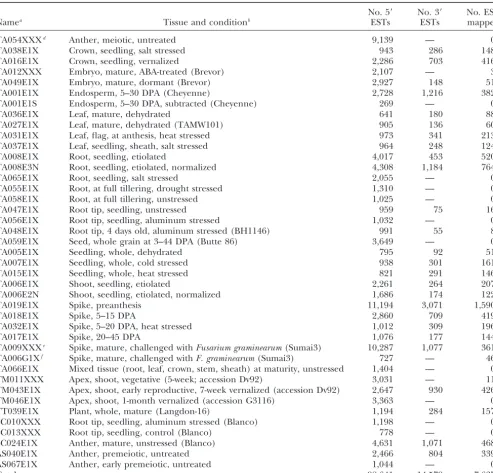
multiple important uses. Typically, anonymous ESTs are cDNA libraries:Fifty-one cDNA libraries were either con-single-pass sequenced to yield a 200–700 bp sequence structed specifically for this project or made available from other sources. Of these, 41 cDNA libraries were used for EST that can be used to search DNA and protein databases
production (Table 1) and for the final contig assembly. The for similar genes (Adamset al. 1991). Information from
libraries were derived from diverse tissues, stages, and treat-the search can be used to determine if a specific gene
ments, including root, root tip, seedling, shoot, leaf, spike, (or sequence motif) has been found in the same or seed, endosperm, anther, embryo, and apical meristem. Chi-other organisms and if its function has been deter- nese Spring wheat, the internationally recognized basic re-search genotype for wheat, was used as the principal mRNA mined. Until recently the lack of ESTs from species of
source. When Chinese Spring was not an appropriate choice the Triticeae tribe [wheat, barley (Hordeum vulgareL.),
for specific research aspects,e.g., for specific stress responses, rye (Secale cereale L.)] had been a serious limitation to
differential development, or ease of tissue isolation, otherT.
gene-sequence-based research for wheat. In May 2000, aestivumcultivars such as BH1146, Brevor, Butte 86, Cheyenne, GenBank contained only 9 ESTs for wheat, 86 for barley, Sumai3, and TAMW101 and related species such asT. monococ-and none for rye. A large EST data set was a high priority cumL.,T. turgidumL.,Aegilops speltoidesTausch, andS. cereale were used. Details of the library preparation and analyses are for large-scale efforts to characterize the wheat genome
presented in the accompanying article byZhanget al. (2004). more fully. An international effort was organized to
Sequence processing:Samples were prepared for DNA isola-develop “deep” wheat and barley EST collections. To
tion and archiving using high-throughput processing methods this end, the International Triticeae EST Cooperative adapted for 96-well microtiter plate formats. Sequencing was (ITEC) established the goal of generating 300,000 pub- done on an ABI Prism 3700 sequencer (Applied Biosystems, Foster City, CA). The flow of sequence production and analysis licly available ESTs each for wheat and barley (see the
is illustrated in Figure 1. Sequence and quality files from trace ITEC website at http://wheat.pw.usda.gov/genome/).
files were read by the phred program (Ewing and Green The present and accompanying reports present
re-1998; Ewinget al. 1998) using a quality score setting of 20. sults of a National Science Foundation-funded project This allowed the definition of a quality read length (QRL) of to generate the main U.S. public contribution to the ⬍0.01 errors/100 bases. In other words, a QRL was a string ITEC wheat EST effort, to assemble these ESTs into of nucleotides read from the sequencing trace file that main-tained an acceptable average quality value. From these QRLs, unique sets as contigs, and to map the EST restriction
high-quality sequence data were extracted after removing vec-fragments by Southern hybridization with a subset of
tor ends and short sequences and then filtered for sequences nullisomic-tetrasomic and ditelosomic lines and 101 of
fromEscherichia coli, plastids, repetitive sequences, and other the deletion lines defining unique deletion bins for each sequence anomalies. Also removed were sequences⬍100 bp, of the 21 wheat chromosomes of the hexaploid wheat sequences of low complexity, or sequences with⬎40% of bases genome (http://wheat.pw.usda.gov/NSF/). The char- with a score below phred 20 within a QRL. A custom web-accessible tracking system, SQPR, was developed and utilized acterization of the deletion stocks used in this project
to follow the quality of sequence generation (Lazoet al.2001). was reported by Qi et al. (2003). Data from the EST
Within SQPR, the phred program was used to read and process chromosome deletion maps have been used to analyze
TABLE 1
Wheat EST project cDNA libraries with data on EST productivity and mapping
No. 5⬘ No. 3⬘ No. ESTs
Namea Tissue and conditionb ESTs ESTs mappedc
TA054XXXd Anther, meiotic, untreated 9,139 — 0
TA038E1X Crown, seedling, salt stressed 943 286 148
TA016E1X Crown, seedling, vernalized 2,286 703 416
TA012XXX Embryo, mature, ABA-treated (Brevor) 2,107 — 3
TA049E1X Embryo, mature, dormant (Brevor) 2,927 148 51
TA001E1X Endosperm, 5–30 DPA (Cheyenne) 2,728 1,216 382
TA001E1S Endosperm, 5–30 DPA, subtracted (Cheyenne) 269 — 0
TA036E1X Leaf, mature, dehydrated 641 180 88
TA027E1X Leaf, mature, dehydrated (TAMW101) 905 136 60
TA031E1X Leaf, flag, at anthesis, heat stressed 973 341 213
TA037E1X Leaf, seedling, sheath, salt stressed 964 248 124
TA008E1X Root, seedling, etiolated 4,017 453 520
TA008E3N Root, seedling, etiolated, normalized 4,308 1,184 764
TA065E1X Root, seedling, salt stressed 2,055 — 0
TA055E1X Root, at full tillering, drought stressed 1,310 — 0
TA058E1X Root, at full tillering, unstressed 1,025 — 0
TA047E1X Root tip, seedling, unstressed 959 75 16
TA056E1X Root tip, seedling, aluminum stressed 1,032 — 0
TA048E1X Root tip, 4 days old, aluminum stressed (BH1146) 991 55 8
TA059E1X Seed, whole grain at 3–44 DPA (Butte 86) 3,649 — 0
TA005E1X Seedling, whole, dehydrated 795 92 51
TA007E1X Seedling, whole, cold stressed 938 301 161
TA015E1X Seedling, whole, heat stressed 821 291 146
TA006E1X Shoot, seedling, etiolated 2,261 264 207
TA006E2N Shoot, seedling, etiolated, normalized 1,686 174 122
TA019E1X Spike, preanthesis 11,194 3,071 1,590
TA018E1X Spike, 5–15 DPA 2,860 709 419
TA032E1X Spike, 5–20 DPA, heat stressed 1,012 309 196
TA017E1X Spike, 20–45 DPA 1,076 177 144
TA009XXXe Spike, mature, challenged withFusarium graminearum(Sumai3) 10,287 1,077 361
TA006G1Xf Spike, mature, challenged withF. graminearum(Sumai3) 727 — 46
TA066E1X Mixed tissue (root, leaf, crown, stem, sheath) at maturity, unstressed 1,404 — 0
TM011XXX Apex, shoot, vegetative (5-week; accession Dv92) 3,031 — 11
TM043E1X Apex, shoot, early reproductive, 7-week vernalized (accession Dv92) 2,647 930 426
TM046E1X Apex, shoot, 1-month vernalized (accession G3116) 3,363 — 0
TT039E1X Plant, whole, mature (Langdon-16) 1,194 284 157
SC010XXX Root tip, seedling, aluminum stressed (Blanco) 1,198 — 0
SC013XXX Root tip, seedling, control (Blanco) 778 — 0
SC024E1X Anther, mature, unstressed (Blanco) 4,631 1,071 468
AS040E1X Anther, premeiotic, untreated 2,466 804 339
AS067E1X Anther, early premeiotic, untreated 1,044 — 0
Total 98,641 14,579 7,637
aThe species source of the library is indicated by the first two letters of the name: TA,T. aestivum; TM,T. monococcum; TT,
T. turgidum; SC,S. cereale; and AS,Ae. speltoides.
bAll of the TA libraries are from the hexaploid wheat Chinese Spring genotype except where indicated otherwise in parentheses;
RNA for bothAe. speltoideslibraries came from F2plants from the cross 2-12-4-8-1-1-1-(1) by PI 36909-12-811-(1).
cCoordinator-confirmed mapping data as of February 2, 2004. dLibrary contributed by P. Langridge, University of Adelaide. eLibrary contributed by G. Muehlbauer, University of Minnesota. fLibrary contributed by J. Fellers, USDA-ARS, Kansas State University.
usda.gov/wEST) and into the NCBI dbEST resource using rameters (penalty, ⫺5; minmatch, 50; minscore, 100) were set to allow like-sequences with 90% identity over a 100-base NCBI sequence-submission protocols to annotate sequences.
Contig assemblies:To determine the unique nature of se- length to form contig clusters. Periodic assemblies were per-formed as sequence pools increased. In addition, assemblies quences within the collections, assembly algorithms were
ap-plied to the sequence pools using the phrap algorithm (http:// were performed on the cDNA libraries individually to assess the level of library redundancy (http://wheat.pw.usda.gov/ www.phrap.org). Assemblies were performed on all sequences
manually or on a BioRobot 8000 (QIAGEN). An aliquot of the purified PCR products was separated by electrophoresis in a 1% agarose gel, stained with ethidium bromide, and photographed. The bands were sized and quantitated using mass and size standards and Quantity One software (Bio-Rad, Hercules, CA). The amplification was considered successful if one prominent DNA band was generated. Aliquots of the purified PCR products were transferred to new plates and shipped to the mapping laboratories to be used as mapping probes. In some cases validated clones were sent and the mapping laboratory performed their own amplifications of inserts as described in the accompanying articles.
Gene ontologies
Each sequence was also searched against the UniProt data-base (Release 1.5, TrEMBL, Swiss-Prot, and PIR at http:// www.ebi.ac.uk/uniprot) resources (Apweileret al. 2004) us-ing blastX, and best matches (E-value⬍10⫺10) were compared
to terms of the Gene Ontology (GO) Consortium. Using GO/ UniProt comparison tables, candidate GO assignments were predicted on the basis of EST matches to the UniProt refer-Figure1.—Overview of sequence processing and database ence sequences. Categories were assigned on the basis of bio-entry. The column on the left shows, from top to bottom, the logical, functional, and molecular annotations available from data processing pipeline for EST sequencing and preparation GO (http://www.geneontology.org/).
of the unigene set for genome mapping. At all steps of the process, data were entered into wheat EST databases
(wEST-Bioinformatics
DB), accessible from http://wheat.pw.usda.gov/wEST. Ar-chives used for blast comparisons included nonredundant
Throughout the process from the generation of ESTs to (NR), dbEST (EST), and local Triticeae (TR) databases.
Se-the mapping of a subset of Se-them, data were transferred sequen-quences deposited into databases were derived from initial 5⬘
tially to several relational databases (http://wheat.pw.usda. sequencing, formed assembly contigs, and 5⬘/3⬘ validation
gov/wEST), culminating with the GrainGenes database (http:// sequencing.
wheat.pw.usda.gov) from which they were further distributed to additional public databases such as NCBI and Gramene (Figure 1). As sequences were processed, background infor-continued with the identification of additional unique se- mation was stored using a MySQL-based relational database quences, the goal being to reduce redundancy. The results as a laboratory information management system, hosting infor-from the global assembly of all project ESTs were used to mation to keep track of clone information, clone production, estimate the extent of ESTs unique to a specific library and DNA isolation, sequencing queues, and storage archives. to estimate the number of unique clusters assembled using the A series of perl script programs, termed sweeping steps, Triticeae sequences. Subassemblies also compared candidate were used to trim down sequence files to limit the final output gene clusters between the species represented in the EST to cleaned sequence data (Table 2). Files were generally han-pool (bread wheat, durum wheat, diploid wheat, rye, andAe. dled on a run-by-run basis to keep track of clone-library
associa-speltoides). tions for each of the sequences. The sequence was marked
Candidate sequences for bin mapping were further up to identify vector-spanning regions of the sequence by screened to eliminate sequences for which matches were cross-match (http://www.genome.washington.edu/UWGC/ found in a series of formatted databases using the blastN protocols) and the identified regions were read by the pro-algorithm (Altschulet al.1997). Databases included UniVec cessing script to further trim down the sequence. The blastN/X (NCBI),E. coli(NCBI, GenBank), plastid and mitochondria reports from the screening steps were parsed using perl scripts (GenBank), rRNA (GenBank), and the Triticeae repetitive to upload information into the online databases. ESTs with (TREP) element collection (Wickeret al.2002); ESTs with no or only poor matches to the nonredundant databases were significant matches (E-value⬍10⫺20) to the previous databases
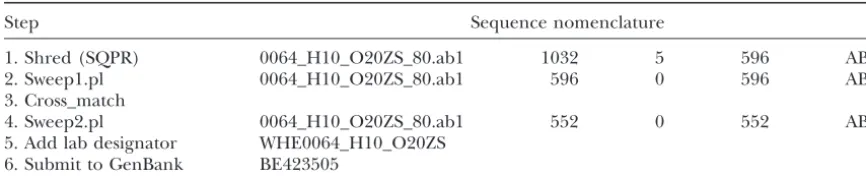
subjected to further comparison using blastN against the NCBI were removed. All processed EST sequences were compared dbEST collection. Information parsed from blast reports in-to the NCBI nonredundant databases by the blastN and blastX cluded all matched sequences, the blast score, and the E-value algorithms using default settings (Altschulet al. 1997). (E-value⬍10⫺4), and sequence alignment values. Additional Probe selection and preparation:Probe selection followed information included tagging the matched database sequence a stringent series of steps to assure minimal problems when to specific plant taxa, concentrating on species of grasses. All performing Southern analysis in the mapping labs. ESTs se- project data are accessible at http://wheat.pw.usda.gov/wEST. lected for validation were rearrayed into 384-well format, 5⬘ Nomenclature was developed to facilitate tracking and data resequenced to confirm clone identity, then 3⬘sequenced to interlinks. Sequence names allowed for tracking plate origin, provide additional validation or to eliminate sequences where well position, and primers used in the sequencing reaction. The original name from the sequencing run was changed to 5⬘sequences did not overlap, but were from the same original
sequence. ESTs with 3⬘sequence similarity⬎90% over at least reflect action at each processing step (Table 2). For example, from line 1 of Table 2, the sequence 0064_H10_O20 is a 100 bases were considered as duplicates and not suitable for
bin mapping. Inserts were amplified by PCR using vector- random cDNA picked into well O20 of a 384-well deep-well microtiter plate for original growth. This 384-well plate was based primers flanking the vector cloning site and purified
96-TABLE 2
Sequence editing steps and nomenclature involved in trimming DNA sequence files
Step Sequence nomenclature
1. Shred (SQPR) 0064_H10_O20ZS_80.ab1 1032 5 596 ABI
2. Sweep1.pl 0064_H10_O20ZS_80.ab1 596 0 596 ABI
3. Cross_match
4. Sweep2.pl 0064_H10_O20ZS_80.ab1 552 0 552 ABI
5. Add lab designator WHE0064_H10_O20ZS 6. Submit to GenBank BE423505
well plates for sequencing, it generated 96-well plates num- corresponding to each EST selected from the unigene set was hybridized to membranes of genomic DNA from each bered 64, 65, 66, and 67. H10 is the well of this clone in plate
64, and O20 the well in the original 384-well plate. The letter aneuploid and stock digested withEcoRI and blotted onto five membranes of 30 lanes each.DNA, digested with HindIII Z indicates the end of clone information, and S indicates the
primer used in sequencing. Subsequent information included andBstEII, was used as a size marker. All five membranes were used in each single hybridization reaction (http://wheat.pw. the original length of read (1032 bp), the start position of
the QRL (fifth nucleotide), the length of the QRL maintaining usda.gov/NSF). Procedures used for genomic DNA isolation, restriction endonuclease digestion, gel electrophoresis, and phred 20 quality (596 bp), and the type of trace file read by
the phred program (from an ABI sequencer). After steps 3 DNA gel blot hybridization were as described inQiet al.(2003) andAkhunovet al. (2003a), unless otherwise noted, and are and 4, removing vector sequences, the QRL was 552 bp in
length. At this point, a laboratory designator was added (WHE, available on line at http://wheat.pw.usda.gov/NSF/project/ mapping_data.html.
in this case). Laboratory designators are an internationally
recognized system to identify clones via three to four letters. To provide uniformity in screening mapping data, a tem-plate for labeling lanes for each of the five membranes was The list of designators can be found at http://wheat.pw.usda.
gov/ggpages/Lab.Designators.html. On submission to Gen- used by all 10 laboratories for the images generated by auto-radiography. A standard template and guidelines for reporting Bank, the sequence received its GenBank accession
designa-tion following NCBI protocol. mapping data and laboratory assessments of the results was also provided. A world-wide-web interface (WWW) was used to facilitate the uploading of mapping data and image files
EST mapping by the mapping labs. Project laboratory designators and
rear-rayed probe plate numbers were added to EST GenBank
acces-Plant materials: The collection of stocks in the Chinese
sion numbers to identify the mapped loci (Table 3). Multiple Spring background used for mapping EST-specific restriction
restriction fragments were resolved by numbering autoradio-fragments consisted of a set of 21 nullisomic-tetrasomic lines
graph bands in order, starting with 1 for the largest detected (Sears1954, 1966), 24 ditelosomic lines (SearsandSears
fragment. 1978), and 101 chromosome deletion lines (EndoandGill
The large scale of this project, wide geographic distribution 1996; Qiet al. 2003), which make possible the mapping of
of laboratories, and critical need for accuracy in scoring auto-fragments to chromosomes, chromosome arms, and subarm
radiographs were addressed by a threefold scoring of each locations (bins), respectively. The bin designations were based
EST. Each hybridization profile was analyzed twice in the map-on the observed fractimap-onal positimap-on of the bounding deletimap-on
ping laboratory where it was produced and uploaded to the breakpoints in the chromosome arm as determined by
cytoge-project website where it was scored again by the coordinators netic observation; this set of deletion stocks delineates 159
assigned to each of the seven homoeologous groups. All scor-distinct chromosome bins (Qi et al. 2003). Deletion stocks
ing and accompanying comments were compiled through the were obtained from the Wheat Genetics Resource Center,
WWW interface. Conflicts were resolved by further communi-Department of Plant Pathology, Kansas State University,
Man-cation and, if necessary, joint examination of original blots. hattan, Kansas. The nullisomic-tetrasomic and ditelosomic
an-Only confirmed data were used for analyses. Data for ESTs euploids (Sears1954;SearsandSears1978) were obtained for which map positions have not been accepted remain as from both the Wheat Genetics Resource Center and the “unconfirmed,” and resolution of these data is ongoing. The USDA-Sears collection of wheat genetic stocks (USDA-ARS/
project’s homoeologous chromosome group coordinators are University of Missouri).
N. L. V. Lapitan, Colorado State University, group 1; J. A. Seeds of the aneuploid and deletion stocks were shipped
Anderson, University of Minnesota, group 2; M. E. Sorrells, to the 10 mapping laboratories (Table 3 and http://wheat.
Cornell University, group 3; J. P. Gustafson, USDA-ARS, Uni-pw.usda.gov/NSF). Plants were grown in greenhouses and
versity of Missouri, group 4; J. Dubcovsky, University of Califor-DNA samples were isolated following protocols established in
nia, Davis, group 5; K. S. Gill, Washington State University, those laboratories.
group 6; and S. F. Kianian, North Dakota State University, Diagrammatic representations of the bins, including the
group 7. position of the breakpoints for homoeologous group
chromo-somes, can be found at http://wheat.pw.usda.gov/wEST/bin maps/. The mapping data and autoradiogram images are
RESULTS AND DISCUSSION accessible on line from http://wheat.pw.usda.gov/westsql.
Deletion mapping:All genomic DNA isolations, restriction
EST generation: Approximately 99,000 5⬘ EST se-endonuclease digestions, gel electrophoresis, DNA gel blot
quences were produced from the 41 different libraries hybridizations, and EST analyses were uniformly carried out
TABLE 3
Identification of the 10 mapping laboratories and their designators and examples of EST locus identifiers derived from the laboratory designator and a GenBank EST accession number
Laboratory
Investigator Institution Designator Example of locus identifiera
J. A. Anderson University of Minnesota UMN UMW134BE604741-4
J. Dubcovsky University of California, Davis UCW UCW169BE483747-1
J. Dvorˇa´k University of California, Davis UCD UCD141BE478737-1
B. S. Gill Kansas State University KSU KSU002BE406357-1
K. S. Gillb University of Nebraska/Washington State University UNL UNL002BF474204-1
J. P. Gustafson USDA-ARS, University of Missouri UMC UMC015BE426301-4
S. F. Kianian North Dakota State University NDS NDS051BE606901-8
N. L. V. Lapitan Colorado State University CSU CSU001BE426257-1
H. T. Nguyenc Texas Tech University/University of Missouri TTU/UMW TTU047BE405648-2
M. E. Sorrells Cornell University CNL CNL014BE591757-2
aThe first three characters are the laboratory designator; the next three characters are the rearrayed plate number; the two
letters and six numbers are the GenBank accession number of the EST used as probe; and the number after the dash is the number of the band detected in the autoradiograph, starting with the largest as number 1.
bNear the end of the project, K. S. Gill relocated from the University of Nebraska to Washington State University; however,
his laboratory designator was not changed.
cApproximately midway through the project, H. T. Nguyen relocated from Texas Tech University to the University of Missouri
and his laboratory designator changed accordingly.
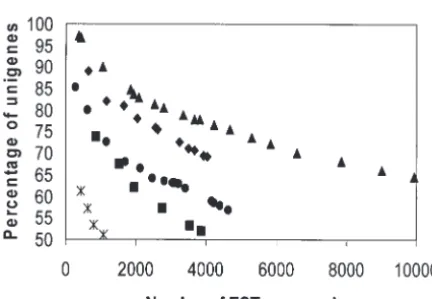
(Table 1). Results of sequencing from each library were library since the endosperm library was a pool of endo-sperm at stages ranging from early endoendo-sperm develop-regularly monitored to assess success at generating novel
sequences. Figure 2 shows examples of such monitoring ment through maturing endosperm. An example of a library that continued to produce a relatively high per-for five libraries. The library from spikes, 20–45 days
past anthesis (DPA; TA017E1X), showed only a small centage of new sequences after deeper sequencing was the preanthesis spike library (TA019E1X).
number of new sequences even by 1000 ESTs, consistent
As part of unigene validation and probe selection, all with the mRNA source from maturing seeds whose main
candidate ESTs were 3⬘sequenced, and a total of 14,579 protein synthetic activity is completion of grain fill. The
3⬘ sequences were generated for a project total of endosperm library (TA00E1X) continued generating
113,220 ESTs deposited in GenBank. The first ESTs new sequences well beyond that of the maturing spike
were deposited in GenBank in July 2001, representing the first large-scale deposition of wheat ESTs to Gen-Bank and the major contribution of the United States to the ITEC wheat EST goal. As of January 2004, there were 577,538 wheat, 377,074 barley, and 9194 rye ESTs in GenBank. Wheat currently ranks first among all plants (and fourth among all organisms), with barley third. Pooling the ESTs of wheat and barley with those of the other species of Triticeae yieldsⵑ977,000 ESTs available to research for candidate gene searches, hy-bridization probes, or other uses, made possible by the close genetic relationships among these species. This is by far the largest such DNA sequence resource for any plant except where the entire genome has been or is being sequenced (e.g., Arabidopsis and rice).
EST classification: All project ESTs, contigs, and Figure2.—Diminishing number of unigene ESTs with
in-mapped probes and their associated blast annotations creasing number of ESTs generated. As libraries were
se-quenced, the total from each library was assessed for the num- are available at http://wheat.pw.usda.gov/wEST. Through ber of new sequences generated. Shown are plots for five such annotation, ESTs can be assigned putative func-libraries as percentages of unigenesvs. total number of ESTs tions on the basis of matches to known sequences. Many generated at each increment of EST generation and analysis:
different presentations of such data are possible, and
䉬, root (TA008E1X);䊉, anther (SC024E1X);䉱, preanthesis
in many cases even a single EST can be assigned multiple spike (TA019E1X);䊏, endosperm (TA001E1X); and *, 20–45
Figure3.—EST annotation by GO and man-ual assignments. ESTs with GO assignments are collated and plotted as a percentage of GO-annotated ESTs plus ESTs manually as-signed to the gliadin and glutenin (prolamine) classes of wheat seed storage proteins. Some classifications were pooled to reduce the num-ber of classes.
functions, be associated with a particular organelle, and March 17, 2003, was selected as a cutoff date for defin-ing a subset of entered and verified mappdefin-ing data for confer disease resistance. Figure 3 shows distribution of
this project’s ESTs on the basis of the Gene Ontology subsequent use in the in-depth analyses presented in the accompanying articles in this issue. At that time, the sorting and includes classifications of those project ESTs
having a significant GO assignment, plus the wheat pro- combined work of the 10 mapping labs had produced and verified 4485 mapped ESTs (http://wheat.pw.usda. lamines not currently covered in GO (gliadin and
glu-tenin classes of wheat seed proteins, polypeptides known gov/NSF/progress_mapping.html). Mapping data sub-for high proline and glutamine content).
Unigene sets and probe selection:The project’s final contig assembly yielded 18,876 contigs and 23,034 sin-gletons from 116,739 ESTs. A total of 25,310 ESTs repre-senting unigenes were advanced for the probe valida-tion process.
At each step of the validation and insert preparation process there was sample attrition due to the failure to grow cultures, obtain DNA, validate 5⬘sequence, obtain 3⬘sequence, obtain nonduplicative 3⬘sequence, or yield an appropriate PCR product. Even with only a small percentage of failures at each step, only 43% of the original ESTs advanced for probe generation passed all stages of validation and preparation. In cases where ESTs that failed to validate were members of a contig, another contig member was chosen for the next round
Figure4.—Mapping loci to chromosome bins using aneu-of probe preparation. Those that passed (13,635) were
ploid stocks. Shown is the mapping of a locus on chromosome distributed to the 10 mapping laboratories for physical 3BS from the data for probe BE406607, band 3 (Figure 1a in mapping into chromosome deletion bins. Qiet al. 2004). The five diagrams represent the chromosome 3B configurations in five stocks represented as C-banded chro-Mapping: EST fragments were allocated to a given
mosomes. Heterochromatic regions are shown as solid and C chromosome bin according to the presence or absence
indicates the centromere. Breakpoint names and positions on of a hybridization fragment in the deletion line. In the
the respective chromosome arms are shown on the left. The example in Figure 4, a probe identified a restriction complete 3B chromosome is on the left. The next three are fragment located on chromosome arm 3BS because the deletion lines named for the deletion breakpoint involved. The last (Dt3BL) is the ditelocentric 3BL line (containing a band is missing in the ditelosomic 3BL lane (Dt3BL,
pair of 3B chromosomes missing the short arm). The presence missing the 3BS arm). The position of the band was
or absence of a hybridizing band from the sample as detected further resolved as being in the deletion bin (indicated
by autoradiography is indicated by⫹or⫺in the “Band pres-by the asterisk in Figure 4), because the band was pres- ent” row. The presence of the band in the first two stocks, ent in the lane for deletion line 3BS-8, but not in the but not in the latter three, indicates that it maps to the bin
mission and verification continued from that time and was distributed into Gramene (Wareet al. 2002), allow-ing comparison of the alignments of wheat sequences as of February 2, 2004, 8318 ESTs had been mapped
and 7757 of them verified. to rice and other grass species. Reciprocal links have
been established where appropriate. Access to project Data access: All submitted data files were uploaded
into databases accessible through Internet connections data has also been developed at the NCBI website (http:// www.ncbi.nlm.nih.gov/). Additional information about using WWW browsers. Two database formats were
uti-lized: ACEDB (DurbinandThierry-Mieg1991), which access to data is available from the supplemental on-line material at http://wheat.pw.usda.gov/pubs/2004/ had many of the display modules already included, and
a MySQL relational database (wEST-SQL), for which Genetics.
Mapped wheat loci:As of February 2, 2004, 8318 ESTs recent tool developments have added flexibility in the
display of data. Data structure facilitated subsequent had been mapped with 7637 of them verified, yielding almost 40,000 scored loci. The subset of mapped and incorporation into the publicly available database
re-sources of GrainGenes (Matthewset al.2003; http:// verified ESTs (4485 as of March 17, 2003) used for the analyses in the accompanying articles, after validation wheat.pw.usda.gov).
Each of the databases provides links among the se- and removal of duplications, yielded 16,093 loci mapped to the Chinese Spring aneuploid and deletion quenced ESTs, assembled contig sets, candidate gene
identities of the ESTs and contigs, and mapped arm and stocks with a distribution by genome of 5173 (A), 5774 (B), and 5146 (D). With analyses on a homoeologous bin locations. Within the wEST-SQL database (http://
wheat.pw.usda.gov/wEST), there are access points for chromosome group basis, the total is 15,843 loci with 2212, 2600, 2266, 2236, 2338, 2043, and 2148 loci ESTs, contigs, and mapping data. The query resources
for the wEST-SQL database provide access from many mapped for chromosome groups 1–7, respectively. The difference in the two totals is due to the fact that analysis entry points, including cDNA libraries, ESTs, contigs,
and mapping data, as well as the opportunity to submit by genome can include ESTs with loci that may have mapped to a chromosome or a chromosome arm only raw SQL queries.
A blast analysis capability was developed for compar- but could not have been mapped to a bin. The number of ESTs for a homoeologous group, totaled from a bin-ing a user-supplied sequence to all project ESTs, ESTs
by library, contigs, and mapped contigs. This capability by-bin analysis, will exclude these, yielding a total less than that obtained when analysis is by genome. More has been expanded to include all GenBank Triticeae
ESTs separately, which can be blast searched by cultivar, detailed presentation of these results is provided inQi et al.(2004).
contig assemblies from international collaborations,
full-length sequence modeled for a barley Affymetrix This material is based upon work supported by the National Science chip, Triticeae genera, rice and Arabidopsis sequences, Foundation Cooperative Agreement no. DBI-9975989, the United States Department of Agriculture, Agricultural Research Service Cur-the GrainGenes TREP data set for Triticeae repetitive
rent Research Information System Project no. 5325-21000-010-00D DNAs, and other custom sets to total ⬎100 sequence
at Albany, California, and the 11 universities participating in this databases (http://wheat.pw.usda.gov/wEST/blast/).
Addi-collaborative effort. tional sets were added as requested by the user
commu-nity.
Project mapping data are primarily available by SQL
LITERATURE CITED query through the public version of the database. A
Adams, M. D., J. M. Kelley, J. D. Gocayne, M. Dubnick, M. H.
query for a specific probe by accession name provides
Polymeropouloset al., 1991 Complementary DNA sequenc-access to mapped locus information by chromosome ing: expressed sequence tags and human genome project. Science
252:1651–1656. and bin location with links to 5⬘and 3⬘ sequences. The
Akhunov, E. D., A. W. Goodyear, S. Geng, L. L. Qi, B. Echalier
adaptable queries can be limited to specific genomes,
et al., 2003a The organization and rate of evolution of wheat
chromosomes, chromosome groups, bins, scored aneu- genomes are correlated with recombination rates along chromo-some arms. Genome Res.13:753–763.
ploid and deletion lines, sequence candidate identities,
Akhunov, E. D., A. R. Akhunova, A. M. Linkiewicz, J. Dubcovsky,
and mapping laboratory searches. Links are provided
D. Hummelet al., 2003b Synteny perturbations between wheat to associated probe data, including links to the wEST- homoeologous chromosomes caused by locus duplications and deletions correlate with recombination rates. Proc. Natl. Acad. ACEDB and Generic Genome Browser displays, which
Sci. USA100:10836–10841. is an experimental application being developed by the
Altschul, S. F., T. L. Madden, A. A. Schaffer, J. Zhang, Z. Zhang
Generic Model Organism Database project (Steinet al. et al., 1997 Gapped BLAST and PSI-BLAST: a new generation of protein database search programs. Nucleic Acids Res.25:3389– 2002; http://www.gmod.org).
3402. Although originally developed for this project, the
Apweiler, R., A. Bairoch, C. H. Wu, W. C. Barker, B. Boeckmann
wEST MySQL site and database have been incorporated et al., 2004 UniProt: the universal protein knowledge base. Nu-cleic Acids Res.32:D115–D119.
into the GrainGenes suite of databases and resources.
Arumuganathan, K., andE. D. Earle, 1991 Estimation of nuclear As shown in Figure 1, the project data have flowed into
DNA content of plants by flow cytometry. Plant Mol. Biol. Rep. GrainGenes and then to additional public databases. 9:208–218.
Conley, E. J., V. Nduati, J. L. Gonzalez-Hernandez, A. Mesfin, M.
Trudeau-Spanjerset al., 2004 A 2600-locus chromosome bin al., 2004 Chromosome bin map of expressed sequence tags in homoeologous group 1 of hexaploid wheat and homoeology with map of wheat homoeologous group 2 reveals interstitial
gene-rice and Arabidopsis. Genetics168:609–623. rich islands and colinearity with rice. Genetics168:625–637.
Qi, L. L., B. Echalier, B. FriebeandB. S. Gill, 2003 Molecular
Durbin, R., andJ. Thierry-Mieg, 1991 AC. elegansdatabase:
docu-characterization of a set of wheat deletion stocks for using in mentation, code and data available from anonymous FTP servers
chromosome bin mapping of ESTs. Funct. Integr. Genomics3:
at ftp.sanger.ac.uk and ncbi.nlm.nih.gov.
39–55.
Endo, T. R., 1988 Induction of chromosomal structural changes by
Qi, L. L., B.Echalier, S.Chao, G. R.Lazo, G. E.Butleret al., 2004 a chromosome ofAegilops cylindricaL. in common wheat. J. Hered.
A chromosome bin map of 16,000 expressed sequence tag loci
79:366–370.
and distribution of genes among the three genomes of polyploid
Endo, T. R., 1990 Gametocidal chromosomes and their induction
wheat. Genetics168:701–712. of chromosome mutations in wheat. Jpn. J. Genet.65:135–152.
Randhawa, H. S., M. Dilbirligi, D. Sidhu, M. Erayman, D. Sandhu Endo, T. R., andB. S. Gill, 1996 The deletion stocks of common
et al., 2004 Deletion mapping of homoeologous group 6-specific
wheat. J. Hered.87:295–307.
wheat expressed sequence tags. Genetics168:677–686.
Ewing, B., andP. Green, 1998 Base-calling of automated sequencer Sears, E. R., 1954 The aneuploids of common wheat. Univ. Mo. traces using phred. II. Error probabilities. Genome Res.8:186– Agric. Exp. Stn. Bull.572:1–58.
194. Sears, E. R., 1966 Nullisomic-tetrasomic combinations in hexaploid
Ewing, B., L. Hillier, M. C. Wendl andP. Green, 1998 Base- wheat, pp. 29–45 inChromosome Manipulations and Plant Genetics, calling of automated sequencer traces using phred. I. Accuracy edited by R.Rileyand K. R.Lewis, Oliver & Boyd, Edinburgh. assessment. Genome Res.8:175–185. Sears, E. R., andL. M. S. Sears, 1978 The telocentric chromosomes
Hossain, K. G., V. Kalavacharla, G. R. Lazo, J. Hegstad, M. J. of common wheat, pp. 389–407 inProceedings of the 5th International Wentzet al., 2004 A chromosome bin map of 2148 expressed Wheat Genetic Symposium, edited by S.Ramanujam. Indian Society sequence tag loci of wheat homoeologous group 7. Genetics168: of Genetics and Plant Breeding, New Dehli.
687–699. Sorrells, M. E., M. La Rota, C. E. Bermudez-Kandianis, R. A. Greene, R. Kantetyet al., 2003 Comparative DNA sequence
Lazo, G. R., J. Tong, R. Miller, C. Hsia, C. Rauschet al., 2001
Soft-analysis of wheat and rice genomes. Genome Res.13:1818–1827. ware scripts for quality checking of high-throughput nucleic acid
Stein, L. D., C. Mungall, S. Shu, M. Caudy, M. Mangoneet al., sequencers. Biotechniques30:1300–1305.
2002 The generic genome browser: a building block for a model
Linkiewicz, A. M., L. L. Qi, B. S. Gill, B. Echalier, S. Chaoet al.,
organism system database. Genome Res.12:1599–1610. 2004 A 2500-locus bin map of wheat homoeologous group 5
Van Deynze, A. E., J. C. Nelson, E. S. Yglesis, S. E. Harrington,
provides new insights on gene distribution and colinearity with
D. P. Bragaet al., 1995 Comparative mapping in grasses. Wheat rice. Genetics168:665–676.
relationships. Mol. Gen. Genet.248:744–754.
Matthews, D., V. Carollo, G. R. LazoandO. D. Anderson, 2003
Ware, D., P. Jaiswal, J. J. Ni, X. Pan, K. Changet al., 2002 Gramene: GrainGenes, the genome database for small-grain crops. Nucleic
a resource for comparative grass genomics. Nucleic Acids Res. Acids Res.31:183–186.
30:103–105.
Miftahudin, K. Ross, X.-F. Ma, A. A. Mahmoud, J. Laytonet al.,
Wicker, T., D. E. MatthewsandB. Keller, 2002 TREP: a database 2004 Analysis of EST loci on wheat chromosome group 4.
Genet-for Triticeae repetitive elements. Trends Plant Sci.7:561–562. ics168:651–663. Zhang, D., D. W. Choi, S. Wanamaker, R. D. Fenton, A. Chinet
Munkvold, J. D., R. A. Greene, C. E. Bermudez-Kandianis, C. M. al., 2004 Construction and evaluation of cDNA libraries for La Rota, H. Edwardset al., 2004 Group 3 chromosome bin large-scale expressed sequence tag sequencing in wheat (Triticum maps of wheat and their relationship to rice chromosome 1. aestivumL.). Genetics168:595–608.
Genetics168:639–650.