DOI: 10.1534/genetics.107.074393
Polymorphism in Multilocus Host–Parasite Coevolutionary Interactions
Aure´lien Tellier
1and James K. M. Brown
Department of Disease and Stress Biology, John Innes Centre, Colney, Norwich, NR4 7UH, United Kingdom Manuscript received April 11, 2007
Accepted for publication September 14, 2007
ABSTRACT
Numerous loci in host organisms are involved in parasite recognition, such as major histocompatibility complex (MHC) genes in vertebrates or genes involved in gene-for-gene (GFG) relationships in plants. Diversity is commonly observed at such loci and at corresponding loci encoding antigenic molecules in parasites. Multilocus theoretical models of host–parasite coevolution predict that polymorphism is more likely than in single-locus interactions because recurrent coevolutionary cycles are sustained by indirect frequency-dependent selection as rare genotypes have a selective advantage. These cycles are stabilized by direct frequency-dependent selection, resulting from repeated reinfection of the same host by a parasite, a feature of most diseases. Here, it is shown that for realistically small costs of resistance and virulence, polycyclic disease and high autoinfection rates, stable polymorphism of all possible genotypes is obtained in parasite populations. Two types of epistatic interactions between loci tend to increase the parameter space in which stable polymorphism can occur with all possible host and parasite genotypes. In the parasite, the marginal cost of each additional virulence allele should increase, while in the host, the marginal cost of each additional resistance allele should decrease. It is therefore predicted that GFG polymorphism will be stable (and hence detectable) when there is partial complementation of avirulence genes in the parasite and of resistance genes in the host.
H
OST–PARASITE interactions are recognized as a major evolutionary force producing biological diversity. Genetic variation for resistance reduces the probability that an individual parasite can infect an individual host (May and Anderson 1990) and con-versely, genetic diversity at parasite recognition loci increases the range of potentially susceptible hosts. Spatial and temporal genetic polymorphism is com-monly found in nature at loci involved in host–parasite recognition such as the major histocompatibility com-plex (MHC) in vertebrates (Apaniuset al. 1997; Hill 2001) or genes involved in gene-for-gene (GFG) rela-tionships, a common feature of plant–parasite inter-actions (Thrallet al. 2001; Laine2004). In both the MHC and the GFG systems, hosts and parasites may have multiple interacting loci (Apanius et al. 1997; Hill2001; Palominoet al.2002). Interactions among several plant resistance (RES) genes and parasite avir-ulence (AVR) genes have been documented for numer-ous diseases, of which the best studied include barley powdery mildew (Jorgensen1994), flax rust (Thrallet al. 2001), and rice blast (Dewit 1992), as well as several diseases of the model plantArabidopsis thaliana
(Holub2001).
In multilocus systems of host–parasite interactions, negative indirect frequency-dependent selection (FDS)
is thought to account for the great polymorphism found in MHC genes (Apaniuset al.1997; Hill2001; Borghanset al.2004) and GFG genes (Frank 1993a; Sasaki2000; Salatheet al.2005; Segarra2005). In this hypothesis, host and parasite genotypes have a selective advantage when they are rare in coevolving populations. This leads to sustained coevolutionary cycles because when a parasite rare allele is selected, its frequency increases, selecting in turn for the corresponding re-sistant host genotype. It is hypothesized that these regular cycles of genotype frequencies prevent invasion by a single genotype, especially when mutations in-troduce new alleles in populations (Sasaki 2000; Borghans et al. 2004). An important question about coevolution is therefore whether or not multilocus interactions are sufficient to maintain polymorphism by themselves or if other ecological and biological factors are required.
In GFG relationships in plants, resistance is induced if the plant has a resistance (RES) gene enabling recogni-tion of a specific parasite avirulence (AVR) protein (Dangland Jones2001). The parasite is not detected by the host and resistance is not induced if the host has a susceptibility allele (res) or the parasite has a virulence allele (avr). The asymmetry of the GFG interaction implies that in the absence of other factors, there will be an ‘‘arms race,’’ as successive pairs ofRESandAVRalleles are driven to fixation in host and parasite populations, respectively (Bergelsonet al.2001; Holub2001). Ac-counting for the diversity observed at host and parasite 1Corresponding author: Section of Evolutionary Biology, Biocenter,
University of Munich, 82152 Planegg-Martinsried, Germany. E-mail: [email protected]
GFG loci (Thrallet al.2001; Laine2004) is a significant challenge because a universally virulent pathogen genotype with an avr allele at each locus might be expected to become fixed as it can infect all plant genotypes (Frank1993a; Segarra2005).
Conditions for the maintenance of polymorphism in GFG interactions have been studied in a single-locus system, with a single matching pair of a hostRESgene and a parasiteAVRgene (Tellierand Brown 2007). Coevolution implies the existence of indirect FDS, because the rate of natural selection onRESdepends on the frequency ofavrand vice versa. Polymorphism can be maintained only if there is also negative, direct FDS, such that the strength of natural selection for the host resistance allele or the parasite virulence allele or both declines with increasing frequency of that allele itself (Tellierand Brown2007). Thus, while costs of
RESandavrare necessary to maintain polymorphism, they are not sufficient to do so in a single-locus system (Tellier and Brown 2007) or in multilocus GFG interactions (Sasaki2000; Segarra2005). In a single-locus GFG interaction, direct FDS is generated if the parasite passes through more than one generation in the same host individual, a feature that is common to most plant diseases. Such polycyclic diseases are char-acterized by an autoinfection rate, the percentage of parasite spores reinfecting the same host from one parasite generation to the next (Barrett 1980). In single-locus GFG interactions, stable long-term poly-morphism can be most readily maintained in host and parasite populations at high autoinfection rates (Tellierand Brown2007).
With respect to the stability of polymorphism, multi-locus systems have behavior similar to that of single-locus GFG systems. For monocyclic diseases on annual plants (one parasite generation per host generation), long-term stable polymorphism with all possible host and parasite genotypes cannot be obtained (Sasaki 2000; Segarra2005). However, multilocus interactions and high mutation rates increase the variance of the lifetime of a mutation (Sasaki 2000; Segarra 2005). Note that the dynamics of genotype frequencies in multilocus models are highly affected by stochastic processes (mutation and drift) when many loci are considered (Frank1993a; Sasaki2000; Salatheet al. 2005). Here, we investigate whether the existence of multiple GFG loci further stabilizes a system in which epidemiological and ecological factors generate direct FDS (Tellierand Brown2007) or further increases the variance of the lifetime of transiently polymorphic alleles (Holub2001; Salatheet al.2005; Segarra2005).
A key issue is to discover the epidemiological and genetic factors that cause polymorphism at host and parasite multiple loci to be transient or stable (arms race or trench warfare models) (Stahlet al. 1999; Holub 2001). We extend the results of Tellierand Brown (2007) to a multilocus GFG system with polycyclic
disease, assuming realistically small costs of RES and
avr. Mutation is included in this model because stochas-tic processes (mutation and drift) have been shown to play an important role in multilocus GFG coevolution (Frank1993a; Sasaki 2000; Salatheet al. 2005). We show that polymorphism can be maintained at several host and parasite loci when the autoinfection rate is high. Moreover, compared to a single-locus GFG re-lationship, multilocus interactions diminish the mini-mum constitutive cost of each RES and avr allele necessary for polymorphism to be maintained.
A complication when moving from a single-locus to a multilocus model is the possible existence of interac-tions between loci. Functional studies of avr or RES
alleles show increasing experimental evidence of epi-static effects between loci in parasites (Baiet al. 2000; Wichmann and Bergelson 2004; Kay et al. 2005; Mudgett2005). In microbial parasites of plants, AVR proteins have a dual role: as well as being triggers for induction of host defenses upon recognition by RES proteins, some of them at least are pathogenicity ef-fectors (Dangland Jones2001; Alfanoand Collmer 2004; Skamniotiand Ridout2005; Ridoutet al.2006). There may be partial complementation between AVR
genes (Baiet al.2000; Wichmannand Bergelson2004; Kayet al.2005; Mudgett2005; Skamniotiand Ridout 2005), so increasing the number of mutations ofAVR
genes toavralleles that have lost pathogenicity effector activity may have a synergistically negative effect on parasite fitness. In plants, on the other hand,RESgenes induce the expression of similar defense processes (Brown 2003). Significant costs might therefore arise when oneRESgene is expressed (Tianet al.2003), but expression of numerous genes would not necessarily increase cost of defense very much (Bergelson and Purrington1996). The models analyzed here incor-porate functions to describe epistasis between the costs of multiple RES and avr alleles, depending on their number. For example, the marginal cost of adding a single new RES allele may decrease as the number of existingRESalleles increases, while the marginal cost of adding anavr allele may increase with the number of existing avr alleles. These epistatic cost functions are shown here to increase the parameter space in which stable polymorphism can be maintained in both host and parasite. This supports the hypothesis that multi-locus GFG systems favor the maintenance of polymor-phism at individual loci with the assumption of realistically small costs ofRESandavralleles.
TWO-LOCUS GFG MODEL WITH MONOCYCLIC DISEASE (MODEL A)
The model:Model A describes a GFG system for two interacting loci in the host and the parasite. Both organisms reproduce clonally. Two alleles, RESandres
at each locus and are coded 1 and 0, respectively (Frank 1993a; Sasaki 2000; Thralland Burdon 2002). For example, a plant genotype with aRESallele at the first locus and aresallele at the second locus is described as
10, as is the parasite genotype withAVRat the first locus andavrat the second locus. An incompatible interac-tion occurs when the host RES allele matches the parasiteAVRallele at least at one of the two interacting loci (1 matching at one or more loci; Frank 1993a). Following a common assumption of GFG relationships, an incompatible interaction results in the parasite being unable to infect the host successfully (Table 1; Dangl and Jones2001). This model is based on Tellierand Brown (2007) and is a GFG system for monocyclic disease slightly simplified from Segarra(2005). Fitnes-ses of host and parasite genotypes are given in Table 1, with the following parameters:sis the cost to a plant of being diseased,u1(u2) is the cost of one (or two)RES alleles, andb1(b2) is the cost of one (or two)avralleles. For instance, in Table 1, the fitness of a10parasite is 0 on plant genotypes 11 and 10 but (1 b1) on plant genotypes 00 and 01. Recurrence equations for the frequencies of the genotypes are given in theappendix. Existence of equilibrium points:Each genotype has an equilibrium frequency; for example, that of host genotype11is defined asRRc ¼RRg ¼RRg11. There are
trivial equilibria defined by fixation of one or two host or parasite genotypes. Host equilibria are thus fixation of double-RESplants (RRc ¼1), fixation of double-suscep-tibility (rrb ¼1), and fixation of both single-resistant genotypes (Rrb 1rRb ¼1). Similar conditions are found for parasite genotypes:AAc ¼1,caa¼1, andAac1aAc¼1. The conditions for stability of these trivial equilibria are given in Sasaki(2000) and Segarra(2005).
The main point of interest here is the existence of multilocus polymorphism, defined as an equilibrium state with three or four host and parasite genotypes, as can be found in natural populations (Thrallet al.2001; Laine2004). This occurs at the nontrivial equilibrium, where host and parasite genotype frequencies are as follows:
c
RR¼b21b1b22b1
1b1
; rRb ¼Rrb ¼b1ð1b2Þ
1b1
; rrb ¼1b2
ð1Þ
c
AA¼ð1sÞð2u1u1u2u2Þ sð1u1Þð1u2Þ
; Aac¼aAc¼ ð1sÞðu2u1Þ sð1u1Þð1u2Þ
;
c
aa¼ su2 sð1u2Þ
ð2Þ
(analysis of recurrence equations is in the appendix with Mathematica 5.0; WolframResearch2003). Note that the equilibrium frequencies of host genotypes depend on costs ofavralleles (b2andb1) while parasite equilibrium frequencies are functions of the costs of
RESalleles (u2andu1) and the cost of disease (s) (Frank 1992).
In Equation 1 the conditions for all host genotypes to exist simultaneously are: 0,rrb ,1 (this is always true because 0,b2,1); 0,rRb;Rrb ,10b2,1 andb1,1/ (2b2), which is reasonable, as costs of virulence tend to be small (Bergelsonand Purrington1996; Brown 2003); and
0,RRc,1;RRc.0Ûb2. 2b1
ðb111Þ
: ð3Þ
Previous GFG models have assumed multiplicative costs of two single avr alleles where b2¼1 ð1b1Þ
2 (S e-garra 2005). Condition (3) is fulfilled if the cost of having twoavralleles (b2) is greater than or equal to the multiplicative cost of two single avr alleles because 1 ð1b1Þ
2.
2b1=ðb111Þ.
In Equation 2 the conditions for all parasite geno-types to exist simultaneously are: 0,aac,10u2,s,
1 (otherwise virulent parasites are eliminated from the population); 0,Aac;aAc,10u2.u1½i.e., the cost of having twoRESalleles must be larger than that of one
RESallele (similarlyaAc.00u2.u1); and
0,AAc,1;AAc.0Ûu2 , 2u1
ðu111Þ
: ð4Þ
In previous GFG models, the costs of having two RES
alleles have been multiplicative: u2¼1 ð1u1Þ 2
. Condition (4) is not satisfied if the cost of having two
RESalleles (u2) is equal to the multiplicative cost of two singleRESalleles because1 ð1u1Þ
2.
2u1=ðu111Þ. Equation 4 shows that when multiplicative costs are assumed (as in Sasaki 2000; Salathe et al. 2005; Segarra2005), double-AVRparasites cannot be main-TABLE 1
Host and parasite fitnesses for monocyclic disease and two loci in each species interacting by gene-for-gene relationships
Parasite fitness Host fitness
AA Aa aA aa AA Aa aA aa
RR 0 0 0 1b2 1u2 1u2 1u2 (1s)(1u2)
Rr 0 0 1b1 1b2 1u1 1u1 (1s)(1u1) (1s)(1u1)
rR 0 1b1 0 1b2 1u1 (1s)(1u1) 1u1 (1s)(1u1)
tained in populations. Epistasis of fitness costs ofRES
andavralleles is thus essential for the existence of an interior equilibrium point with all four host and all four parasite genotypes.
Stability of the equilibrium point:Following analysis in Tellier and Brown (2007), we use a logit trans-formation of genotype frequencies in model A (appendix and supplemental Section 1 at http://www.genetics. org/supplemental/), which simplifies considerably the analysis of the genotype dynamics. At host genera-tiong:
fAa¼log Aag
aAg; faa ¼log aag
AAg; frR ¼log rRg Rrg;
andfrr ¼log rrg
RRg: ð5Þ
The change (D) in the ratio of parasite genotype10and
01frequencies between generationgandg11 is then
DfAa¼logAag11
aAg11
logAag
aAg
: ð6Þ
Thus the system of equations of model A (seeappendix and supplemental Section 1) can be rewritten as
DfAa
Dfaa
DfrR
Dfrr 0 B B @
1 C C A¼JA
fAa faa frR frr 0 B B @
1 C C
A; ð7Þ
where JA is the Jacobian matrix of the system. The dynamics of the system are determined by analysis of the eigenvalues ofJA(seeappendix). For a model with four variables, two pairs of eigenvalues (l1,2 and l3,4) are solutions of the characteristic polynomial equation of
JA. The pairs of eigenvalues can be reall1;2 ¼a16 ffiffiffiffiffib1
p
(and l3;4 ¼a26
ffiffiffiffiffi b2 p
) or complex l1;2¼a16i ffiffiffiffiffib1
p
(andl3;4¼a26i
ffiffiffiffiffi b2 p
), with
a1¼ @DfAa
@fAa 1 @DfrR
@frR and a2¼ @Dfaa
@faa 1 @Dfrr
@frr ð8Þ
(seeappendix). An exact condition for stability of an interior equilibrium of this dynamical system with four variables (Equation 7) is that the four eigenvalues ofJA must lie within a unit circle centered on (1, 0) in the complex plane (Roughgarden1996; Kot2001). The following condition is derived from the Routh–Hurwitz criterion for stability of a dynamical system:
1,a1,0 and 1,b1,1 and 1,a2,0
and 1,b2,1
ð9Þ
(Roughgarden 1996; Kot 2001). For model A, the eigenvalues are
l1;2¼6i ffiffiffiffiffiffiffiffiffib1 p
l3;4¼6
ffiffiffiffiffiffi
b2
p ifb1,0 or
l1;2¼6 ffiffiffiffiffiffib1 p
l3;4¼6
ffiffiffiffiffiffi
b2
p ifb1.0
( (
ð10Þ
with b1¼ ðb22b1ð1b2ÞÞðu2u1ð2u2ÞÞðsu2Þ=
sð1b1Þð1u1Þð1u2Þ and b2 ¼ ð1sÞð1b2Þ
b2
1ðu1u2Þ2=sð1b1Þð1u2Þ. Consequently, there is always at least one eigenvalue that does not verify condition (9), and the interior, nontrivial equilibrium (Equations 1 and 2) is always unstable. The mathemat-ical reason for this is that all diagonal elements ofJAare zero, and thereforea1¼a2¼0 (Equation 8,appendix, and supplemental Section 1 at http://www.genetics. org/supplemental/). The elements ofJAare the rates of natural selection on the ratio of genotype frequencies. For example,@Dfaa=@faa is the rate of selection on the double-avr parasite genotype (00) as a function of its own frequency,i.e., the rate of direct FDS on00parasites (Tellierand Brown2007). Therefore,a1anda2are the sums of the direct FDS coefficients for the four ratios of genotype frequency (Equation 8). Equation 10 demonstrates that for monocyclic diseases, there is no direct negative FDS for host or parasite genotypes, and a polymorphic state with three or four host and parasite genotypes is always unstable.
TWO-LOCUS GFG MODEL WITH POLYCYCLIC DISEASE
Model description: Model B is a multilocus GFG system with polycyclic disease, where polycyclic patho-gens undergo several (G) multiplicative generations during one host generation. Here, the simplest case of
G ¼ 2 parasite generations per host generation is considered. The autoinfection rate (c) is the percent-age of infectious spores that reinfect the same host plant in the second parasite generation (Barrett 1980; Tellierand Brown2007). The cost to a plant of being diseased increases with the number of successive para-site infections, with a maximum fitness loss offafterG
parasite generations (Campbell and Madden 1990; Tellierand Brown2007). The loss of plant reproduc-tive output caused by disease increases disproportionately withp, the number of successful parasite generations on a host plant (p # G) because, as the parasite grows multiplicatively, corresponding damage is done to the host (Campbelland Madden1990). The plant fitness (F) is a decreasing function ofpwherezis a parameter defining the shape of the disease curve (z.1):
F ¼1f p
G z
ð11Þ
(Tellierand Brown2007).eis the decrease of plant fitness afterp¼1 infection (e¼fð1=2Þz
: Equation 11,
As an example, the outcome of infection on plant genotype11is described below (supplemental Table S1 in supplemental Section 2 at http://www.genetics.org/ supplemental/). In the first parasite generation (p¼1), a11plant can encounter parasite genotypes11,01, or11
that cannot infect it successfully. In the second parasite generation (p ¼ 2), that plant can then either (i) encounter spores from the same genotypes (frequen-cies AA1, Aa1, aA1) that cannot infect it (the plant’s fitness is then 1 u2) or (ii) be infected by the supervirulent genotype00(frequencyaa1), so its fitness is (1u2)(1e).
On the other hand, when11plants are infected by a supervirulent (00) parasite atp¼1 (frequencyaagat the start of generationg) the following occurs atp¼2:
i. A proportioncof these plants remain infected by the same parasite genotype (autoinfection). A pro-portioncaagRRgof all the plants in the population has fitness (1 u2)(1 f) after two consecutive successful infections.
ii. A proportion 1 c are allo-infected by virulent parasites (here, only those with the supervirulent genotype00) produced in the first parasite gener-ation with frequency aa1 ½proportion (1 c)aagaa1RRg. These plants are also infected twice and have fitness (1u2)(1f).
iii. A proportion 1cmay encounter spores from the first parasite generation of the genotypes01,01, or
11 (frequencies AA1, Aa1, and aA1) that cannot infect. Their fitness is (1u2)(1e).
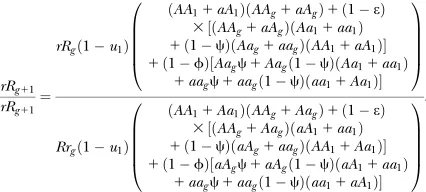
Formulas:The following are deterministic equations for a two-locus GFG system with two parasite generations per host generation with independent fitness costs of host resistance or parasite virulence alleles at different loci and no mutation. Frequencies of parasite genotypes after the first parasite generation are identical to those in model A (see Table 2 and supplemental Section 1 at http://www.genetics.org/supplemental/):
aa1
AA1
¼aagð1b2Þ AAgrrg
Aa1
aA1
¼Aagð1b1Þðrrg1rRgÞ aAgð1b1Þðrrg1RrgÞ :
After the second parasite generation (i.e., at the start of the next host generation, g 1 1), parasite genotype frequencies are as follows:
Ratio of parasite genotype frequencies00to11:
aag11
AAg11 ¼
ð1b2Þ
RRg½aa1ð1aagÞ1aagcð1b2Þ1aagð1cÞaa1 1rrg½aagcð1b2Þ1aa1ð1cÞ 1Rrg½aa1ðAAg1AagÞ1aAgð1cÞaa1
1aagcð1b2Þ1aagð1cÞaa1 1rRg½aa1ðAAg1aAgÞ1Aagð1cÞaa1
1aagcð1b2Þ1aagð1cÞaa1
0 B B B B B B @ 1 C C C C C C A
rrgðcAAg1ð1cÞAA1Þ
:
Ratio of parasite genotype frequencies10to01:
Aag11
aAg11 ¼
ð1b1Þ
rRg½Aa1ðAAg1aAgÞ1Aagðcð1b1Þ 1Aa1ð1cÞÞ1aagðAa1ð1cÞÞ 1rrg½cAagð1b1Þ1Aa1ð1cÞ
0 @
1 A
ð1b1Þ
Rrg½aA1ðAAg1AagÞ1aAgðcð1b1Þ1aA1ð1cÞÞ 1aagðaA1ð1cÞÞ
1rrg½caAgð1b1Þ1aA1ð1cÞ
0 @
1 A
:
The ratios of host genotype frequencies at the end of host generationgand the start of generationg11 are as follows:
Ratio of host genotype frequencies01to10:
rRg11
rRg11 ¼
rRgð1u1Þ
ðAA11aA1ÞðAAg1aAgÞ1ð1eÞ 3½ðAAg1aAgÞðAa11aa1Þ 1ð1cÞðAag1aagÞðAA11aA1Þ 1ð1fÞ½Aagc1Aagð1cÞðAa11aa1Þ
1aagc1aagð1cÞðaa11Aa1Þ
0 B B B B @ 1 C C C C A
Rrgð1u1Þ
ðAA11Aa1ÞðAAg1AagÞ1ð1eÞ 3½ðAAg1AagÞðaA11aa1Þ 1ð1cÞðaAg1aagÞðAA11Aa1Þ 1ð1fÞ½aAgc1aAgð1cÞðaA11aa1Þ
1aagc1aagð1cÞðaa11aA1Þ
0 B B B B @ 1 C C C C A : TABLE 2
Fitness of hosts and parasites in model B for interactions with two parasite generations per host generation (G¼2) and only
autoinfection between parasite generations (c¼1)
Parasite genotypes (frequencies) within host generationg Fitness at beginning of host generation
g11
First generation Second generation Fitness of second parasite
infection Host fitness
Host genotype11(RRg)
11(AAg) 11(AA1) 0 1u2
10(Aag) 10(Aa1) 0 1u2
01(aAg) 01(aA1) 0 1u2
00(aa1) 1b2 (1u2)(1e)
00(aag) 00(aag) 1b2 (1u2)(1f)
Host genotype00(rrg)
00(aag) 00(aag) 1b2 (1f)
01(aAg) 10(aAg) 1b1 (1f)
10(Aag) 10(Aag) 1b1 (1f)
11(AAg) 11(AAg) 1 (1f)
Host genotype01(rRg)
11(AAg) 11(AA1) 0 1u1
01(aAg) 01(aA1) 0 1u1
00(aa1) 1b2 (1u1)(1e)
10(Aa1) 1b1 (1u1)(1e)
00(aag) 00(aag) 1b2 (1u1)(1f)
10(Aag) 10(Aag) 1b1 (1u1)(1f)
Host genotype10(Rrg)
11(AAg) 11(AA1) 0 1u1
10(Aag) 10(Aa1) 0 1u1
00(aa1) 1b2 (1u1)(1e)
01(aA1) 1b1 (1u1)(1e)
00(aag) 00(aag) 1b2 (1u1)(1f)
01(aAg) 10(aAg) 1b1 (1u1)(1f)
Ratio of host genotype frequencies00to11:
rrg11
RRg11
¼ rrgð1fÞ
RRgð1u2Þ
ð1eÞ½aa1ð1aagÞ1aagð1cÞð1aa1Þ
1ð1aagÞð1aa1Þ1ð1fÞ½aagðc1aa1ð1cÞÞ
:
Existence of equilibrium point (c ¼ 1): The same trivial equilibrium points exist as in model A. The complexity of the equations in model B constrains analysis of the nontrivial equilibrium point to the case when there is only autoinfection (c¼ 1). Owing to quadratic terms and the nonlinear behavior of model B, the following assumptions were made: (i)
c
aa1 ¼aacð1b2Þ=ð1b2caaÞand (ii)b1is small so that (1 b1) 1 and (1 b1)(1 b2) (1 b2). The accuracy of these approximations and of the following equilibrium frequencies was tested numerically across a wide range of parameter values. Theoretical values obtained with Mathematica 5.0 (Wolfram Research 2003) were compared to numerically simulated values, calculated as the mean of genotype frequencies over the last 100 generations of 5000 simulated host generations. These approximations (Equations 12 and 14) are accurate for moderate to high values of f, but less accurate for values ofrrb whenf, u1or values of AAc whenu1, f, u2(supplemental Section 3 at http:// www.genetics.org/supplemental/), as
c
aa¼ v
ffiffiffiffiffiffiffiffiffiffiffiffiffiffiffiffiffiffiffiffiffiffiffiffiffiffiffiffiffiffiffiffiffiffi v24eðfu2Þ
p
2ð1u2Þðe1b2ðfeÞÞ
ð12Þ
c
aA¼Aac ¼v
ffiffiffiffiffiffiffiffiffiffiffiffiffiffiffiffiffiffiffiffiffiffiffiffiffiffiffiffiffiffiffiffiffiffiffiffiffiffiffiffiffiffiffiffiffiffiffiffiffiffiffiffiffiffiffiffiffiffiffiffiffiffiffiffiffi v24ðu2u1Þðfu2Þð11fÞ
p
2ð1u1Þð1u2Þðe1b2ðfeÞÞ
c
AA¼v
ffiffiffiffiffiffiffiffiffiffiffiffiffiffiffiffiffiffiffiffiffiffiffiffiffiffiffiffiffiffiffiffiffiffiffiffiffiffiffiffiffiffiffiffiffiffiffiffiffiffiffiffiffiffiffiffiffiffiffiffiffiffiffiffiffiffiffiffi v24eð11fÞð2u11u1u2u2Þ
p
2ð1u1Þð1u2Þðe1b2ðfeÞÞ ;
where v¼ ð1b2Þðf1eÞ1b2ðfeu2ð1eÞÞ. In Equation 12 the conditions for all parasite genotypes to exist simultaneously are caa.0Ûf.u2 and
c
Aa.0Ûu2.u1(similarly foraAc.0):
c
AA.0Ûu2, 2u1
ð1u1Þ
: ð13Þ
In contrast to model A (Equation 4), condition (13) is fulfilled if the cost of having twoRESalleles (u2) is lower than or equal to the multiplicative cost of two singleRES
alleles. The equilibrium frequency of double-AVR para-sites increases when the difference betweenu2andu1 diminishes:
b
rr ¼ð3aac2b2caaÞð1b2Þ
2 3aac2b2
ð14Þ
b
rR ¼Rrb ¼ b1ð3caaÞð1b2Þ
2
ð1b1Þð3aac2b2Þ
c
RR ¼ðb22b11b1b2Þð1b2Þ
2 3aac2b2
:
In Equation 14 the conditions for all host genotypes to exist simultaneously are rrb.0, rRb .0, and Rrb .0 because 3.caa12b2aacand 3.aac12b2by definition:
c
RR.0Ûb2. 2b1
ð11b1Þ
: ð15Þ
Condition (15) is identical to Equation 3 and is fulfilled if the cost of having twoavralleles (b2) is greater than or equal to the multiplicative cost of two singleavralleles. The equilibrium frequency of double-RES plants be-comes higher with a greater difference betweenb2and
b1.
Stability of the equilibrium point: The local stability of the nontrivial equilibrium is analyzed when there is only auto-infection (c¼ 1) because in this situation, stable polymorphism occurs over a wider parameter space (Tellier and Brown 2007). The main differ-ences from model A are that the following coefficients are not zero (supplemental Section 4 at http://www. genetics.org/supplemental/):
@DfAa @fAa ¼
RrgAagaAg
1b2aag1RrgðAAg1AagÞ
¼x5: ð16Þ
This coefficient is always negative as 11RrgðAAg1
AagÞ. b2aag:
@Dfaa
@faa
¼ ð1rrgÞð1b2ÞaagAAg
ð1b2aagÞð22b2aag1ð1rrgÞð1aagÞÞ
¼x6:
ð17Þ
This coefficient is also negative as 21ð1rrgÞ
ð1aagÞ.2b2aag.
The Jacobian matrix for model B, JB, can thus be rewritten:
JB¼
x5 0 x3 0
0 x6 0 x4
x1 0 0 0
0 x2 0 0
0 B B @
1 C C
A: ð18Þ
Approximations for the elements x1, x2,x3,x4 are de-rived in supplemental Section 4 at http://www.genetics. org/supplemental/. JB is diagonalizable and has two pairs of eigenvalues (l1,2andl3,4) that can be real,
l1;2¼ 1 2 x56
ffiffiffiffiffiffiffiffiffiffiffiffiffiffiffiffiffiffiffiffiffi x5214x1x3
q
ifx5214x1x3.0 ð19Þ
l3;4¼ 1 2 x66
ffiffiffiffiffiffiffiffiffiffiffiffiffiffiffiffiffiffiffiffiffi x6214x2x4
q
ifx6214x2x4.0;
or complex,
l1;2 ¼ 1 2 x56i
ffiffiffiffiffiffiffiffiffiffiffiffiffiffiffiffiffiffiffiffiffiffiffiffiffi x524x1x3
q
ifx5214x1x3,0 ð20Þ
and
l3;4 ¼ 1 2 x66i
ffiffiffiffiffiffiffiffiffiffiffiffiffiffiffiffiffiffiffiffiffiffiffiffiffi x624x2x4
q
ifx6214x2x4,0:
A necessary condition for stability (Equation 9) is verified because x5¼@DfAa=@fAa and x6¼@Dfaa=@faa are both negative. However, a second condition for stability is that both absolute values of the discriminants of the characteristic polynomial, jx2
514x1x3j and
jx2
614x2x4j, must be ,1 (Equation 9). Analytical derivation of this second condition is not possible because of the nonlinearity of equations in model B and because only approximations of the equilibrium genotype frequencies can be obtained.
Simulation methods: Host and parasite genotype frequencies were therefore simulated numerically for different values of c and f. Simulations were run in Matlab version 7.0 (Release 14) for 15,000 host gener-ations, by which time stable behavior (or genotype fixation) was achieved, with different sets of initial host and genotype frequencies (all host and parasite geno-types were present at the beginning of each simulation). The system was considered to be stable when the amplitude of the fluctuations of each genotype fre-quency decreased in time and converged toward an equilibrium value for any of the initial allele frequencies tested.
Mutations, especially with high mutation rates, regu-larly introduce new rare genotypes into host and parasite populations (Kirbyand Burdon1997; Sasaki 2000; Salathe et al. 2005). We therefore compared results of simulations with and without mutation. One set of simulations was done with a mutation rate of 105. A second set of simulations assumed two different mutation rates: 105
if a mutation results in a loss of function (fromREStoresand fromAVRtoavr) and 108 for a gain-of-function mutation in the reverse direction (from res to RES or from avr to AVR) (Kirby and Burdon1997). A host or parasite genotype was consid-ered lost from a population when its frequency was
,106, but could be subsequently reintroduced by mutation (if any). On the other hand, a genotype was fixed in a population when its frequency was.1106. For a given set of parameter values, the results of the different types of simulations (with and without muta-tions or with different initial genotype frequencies) were compared. The description of results follows with models B1 and B2.
MULTIPLICATIVE CONSTITUTIVE COSTS (MODEL B1)
Model B1 is a two-locus GFG system with multiplica-tive costs of RES and avr alleles, i.e., no epistatic interactions among loci for fitness values (Frank 1993b; Sasaki 2000; Salathe et al. 2005; Segarra 2005). Recurrence equations for genotype frequencies are those of model B, whereb2andu2are the costs of having twoRESoravralleles:
b2 ¼1 ð1b1Þ2 and u2¼1 ð1u1Þ2: ð21Þ Simulations were run withb1¼u1¼5% andb2¼u2¼ 9.75%, these values being chosen to allow comparison with single-locus results (Tellier and Brown 2007). When there is only auto-infection (c¼1), the double -RES genotype has a very low equilibrium frequency (,104, Equation 14). Model B1 is tested numerically to determine if the equilibrium point with all host and parasite genotypes exists for different values ofcand to discover the range of parameter values of candffor which the equilibrium point is stable.
Results of simulations are summarized in Figure 1 by the state of the system (stable or unstable) and the genotypes maintained in the host (Figure 1a) and parasite (Figure 1b) populations. Figure 2a shows the dynamics of host genotype frequencies in one simula-tion typical of area B of Figure 1a with stable poly-morphism of three host genotypes (00, 10, 01). Similarly, Figure 2b shows the dynamics of parasite gene frequencies in area I of Figure 1b where there is stable polymorphism of all four parasite genotypes, with genotype11at a very low frequency. Typical simulation results for each area of Figure 1 are provided in supplemental Section 4 at http://www.genetics.org/ supplemental/).
If disease severity is smaller than the cost of oneRES
allele, there is fixation of host res alleles (00) because there is no net advantage to resistance (area A in Figure 1a). As a result,AVRalleles (11) are fixed in the parasite population because virulence is costly (area G in Figure 1b). In mathematical terms, areas A and G correspond to the situation with zero (or negative) equilibrium frequencies of parasite genotypes01,10, and11because f,u1,u2(Equations 12). The limit of areas A and G is thus the cost of oneRESallele (f¼u1).
with parasite genotypes11,10, and 01occurs. Mathe-matically, area H corresponds to a situation where the double-avrequilibrium frequency is zero (or negative) asf,u2(Equation 12).
With increasing f and high autoinfection rates, all four parasite genotypes (00,01,10,11) coexist in stable polymorphism (area I, Figure 1b) because there is direct FDS acting on parasite genes (Equations 16 and 17),
and the interior equilibrium for all possible parasite genotypes exists (Equation 12; Figure 2b). The param-eter space in which polymorphism is stable diminishes with increasingf, because resistant genotypes (10and
01) are selected more strongly, in turn selecting for double-avrparasites (00). Therefore, at intermediate to high c, increasing f favors double-avr parasites and counterselects double-AVRgenotypes (11) (area J). In area J, values ofcandfdo not allow the existence of an interior equilibrium frequency for the double-AVR
parasite (Equation 12).
A key result is that the size of areas H, I, and J in Figure 1b matches that of area B in Figure 1a. This is because stability of polymorphic state depends on the strength of direct FDS against strength of indirect FDS, both of
Figure 2.—Dynamics of host and parasite genotype fre-quencies in a two-locus model with independent costs of al-leles at different loci (model B1) defined by two loci as a function of the number of host generations. There is no mu-tation. Autoinfection ratec¼0.9 and maximum cost of dis-easef¼ 0.2. u1, u2, costs of host resistance; b1, b2, costs of
parasite virulence;u1¼b1¼0.05,u2¼b2¼0.097. (a)
Main-tenance of host genotypes with one or both susceptibility al-leles but the double-resistant genotype11is eliminated (area B in Figure 1a). (b) Maintenance of all four parasite geno-types (area I in Figure 1b).
Figure1.—Stability area plots for a two-locus model with independent costs of alleles at different loci (model B1), in relation to values of the autoinfection rate (c) and the cost to a plant of being diseased by two parasite generations (f).u1,u2, costs of host resistance;b1,b2, costs of parasite
vir-ulence;u1¼b1¼0.05,u2¼b2¼0.0975 (subscript 1, cost of
which are determined by c and f. Therefore, condi-tions for stability are identical for host and parasite populations, as shown for single-locus interactions (Tellierand Brown2007), and only the existence of equilibrium frequencies of the various genotypes dis-criminates between the different dynamics in host and parasite populations. Moreover, the equilibrium fre-quency of the double-avrgenotype (00) increases withf (Equation 12) and always has the highest frequency in the parasite population. This is in agreement with ob-servations from surveys in natural populations (Dinoor and Eshed1987; Bevanet al.1993; Thrallet al.2001) (Figure 3b).
When there is a high cost of disease (highf) (Figure 1, a and b), there is first strong selection for resistant host genotypes 01, 10, 11. They select strongly for virulent parasite genotypes and especially for the double-avr genotype (00). Very high frequencies of double-avr parasite (area K, Figure 1b) then lead to a long-term increase of the double-susceptible genotype frequency (00) because RES alleles are costly. At very high f, this results in the fixation of the double-avr
parasite genotype and the double-susceptible host genotype (areas E and L in Figure 1). The dynamical system is unstable when f increases, because the in-direct FDS overrides the in-direct frequency-dependent stabilizing effect (areas D and K).
Realistic mutation rates do not affect the behavior of the model (stability or instability) or frequencies at equilibrium in stable areas (B in Figure 1a and H–J in Figure 1b). Without mutation, when the system is unstable (areas D and E in Figure 1a and K and L in Figure 1b) there is fixation of the double-avr parasite genotype. Mutations can sustain stochastic coevolution-ary cycles by recurrent introduction of new rare geno-types in areas D and K, following an arms race model. However, as the system has unstable behavior (areas D and E in Figure 1a and K and L in Figure 1b) each coevolutionary cycle results in the fixation of the double-avrparasite until a new mutation arises.
EPISTATIC INTERACTIONS AMONG LOCI (MODEL B2)
In model B2 epistatic interactions are assumed between loci both in host and in parasite. General expressions are shown here for the costs of multipleavr
(orRES) alleles in a multilocus GFG system withnloci. The maximum cost of having n avr(orRES) alleles is
bmax(umax).
The costbkof havingk avralleles is thus
bk¼bmax
k n
u
with 0#k#n: ð22Þ
The marginal cost of each additional mutation from
AVRtoavrincreases exponentially with the number of existingavralleles, such that the loss of twoAVR
func-tions is more costly to the pathogen than expected if the costs were independent; therefore, we chooseu.1, and the cost curve has a convex shape. In model B2,
n¼2 sobmax¼b2.
On the other hand, the marginal cost of each additionalRES allele diminishes with increasing num-ber of existingRESalleles, so the cost of twoRESalleles is lower than expected if the costs at different loci were
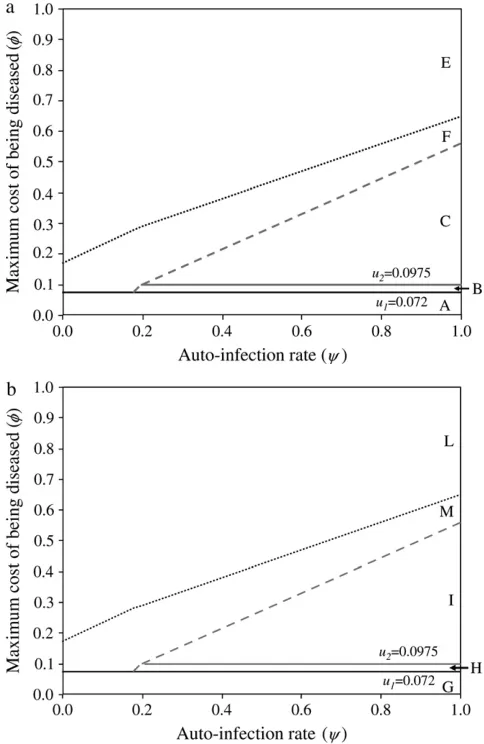
Figure3.—Stability area plots for a two-locus model with epistasis in costs of alleles at different loci (model B2), in re-lation to values of the autoinfection rate (c) and the cost to a plant of being diseased by two parasite generations (f).u1,u2,
costs of host resistance;b1,b2, costs of parasite virulence;u1¼
0.072 andb1¼0.024;u2¼b2¼0.0975. (a) Stability of
independent. The cost curve has a concave shape when j,1. The costukof havingk RESalleles is thus
uk¼umax
k n
j
with 0#k#n: ð23Þ
In model B2,n¼2 soumax¼u2. To compare results from models B1 and B2, the cost of having two alleles is fixed to 0.0975 (u2¼b2¼0.0975, Equation 6). The only difference between models B1 and B2 is then the cost of having one allele withu1 ¼0.072 (j ¼0.4) andb1 ¼ 0.024 (u¼2). Results for each area of Figure 3 can be seen in supplemental Section 6 at http://www.genetics. org/supplemental/.
In model B2, stable polymorphism with all four genotypes is maintained in host (area C in Figures 3a
and 4a) and parasite populations (area I in Figures 3b and 4b) with medium to highc. This occurs because the equilibrium frequency of double-REShosts increases in proportion to the difference betweenb1andb2 (Equa-tion 14). In other words, increasing the cost of having twoavr alleles compared to the cost of oneavr allele favors parasite genotypes 01 and 10, thus enhancing selection for double-REShost genotypes and increasing the value ofRRc (Figure 4a). In simulations conducted with epistasis between parasite loci and multiplicative costs ofRESalleles, there is also stable polymorphism with all four host and parasite genotypes (data not shown). Moreover, epistasis among host loci that de-creases the difference betweenu1andu2has the effect of diminishing the equilibrium frequency of double-avr
parasites and increasing that of double-AVR parasites. The diminution of the cost of having two RES alleles compared to that of oneRESallele decreases selection for host genotypes01and10, thus enhancing selection for double-AVRgenotypes and increasing the value of
c
AA(Figure 4b).
The total stability area for the host in model B2 (C and B in Figure 3a) has a comparable size but is not identical to area B in Figure 1a (model B1). For the parasite, stability areas H and I together in Figure 3b have a comparable size but are not identical to areas H, I, and J together in Figure 1b (model B1). The areas for stable polymorphism are comparable because conditions for stability depend on the strength of direct FDS, which mainly depends oncandf(see Equations 19 and 20). However, stability conditions also depend on costs of
RESandavralleles (Equations 16 and 17), which differ between models B1 and B2, which is why stability areas do not overlap exactly between Figures 1 and 2. Although all four host and parasite genotypes can be maintained, double-res plants and double-avrparasites have higher equilibrium frequencies than the other genotypes, in agreement with results from natural populations (Thrallet al.2001) (Figure 4, a and b).
In model B2, the equilibrium point with the four host and parasite genotypes exists. However, when f in-creases, because indirect FDS overrides the stabilizing effect of direct FDS, this equilibrium state becomes unstable in areas F (Figure 3a) and M (Figure 3b).
Other results from model B2 are similar to those from model B1. Iff,u1, host genotype00(area A in Figure 3a) and parasite genotype 11 (area G in Figure 3b) become fixed. Whenu1,f,u2, andcis intermediate to high, double-RESgenotypes and double-avrparasites are eliminated, respectively, from the host (area B in Figure 3a) and parasite (area H in Figure 3b) popula-tions. In areas B and H, there is stable polymorphism with three host and three parasite genotypes. Finally, at very highf, there is fixation of the00host and parasite genotypes (areas E and L in Figure 3). Simulations for more than two loci generalize our conclusions from models B, showing the generality of the approach (n¼3
Figure 4.—Dynamics of host and parasite genotype fre-quencies in a two-locus model with epistasis in costs of alleles at different loci (model B2) as a function of the number of host generations. There is no mutation. Autoinfection rate
c¼ 0.9 and maximum cost of diseasef¼ 0.2.u1, u2, costs
of host resistance; b1, b2, costs of parasite virulence; u1 ¼
0.072 andb1¼0.024;u2¼b2¼0.0975. (a) Maintenance of
in supplemental Section 7 at http://www.genetics.org/ supplemental/).
DISCUSSION
As in the single-locus model of Tellierand Brown (2007), polycyclic disease gives rise to conditions that stabilize polymorphism at equilibrium (model B, cf. model A). Stable polymorphism with three or four host genotypes and four parasite genotypes occurs at in-termediate to high rates of autoinfection (model B). For monocyclic disease (model A), there is no direct FDS in the host (@DfrR=@frR ¼@Dfrr=@frr ¼0) or parasite (@DfAa=@fAa¼@Dfaa=@faa ¼0) populations (Equation 10). Polymorphism is stabilized in polycyclic diseases, because the stability of GFG systems depends on the outcome of infection in the first parasite generation (g, 1) influencing the second parasite generation (g, 2). Model B extends the principle of single-locus GFG coevolution (Tellier and Brown 2007) to multiple loci. Polycyclic disease generates direct FDS for parasite virulence (@DfAa=@fAa,0 and @Dfaa=@faa,0) but not for host resistance (@DfrR=@frR ¼@Dfrr=@frr ¼0). In-creasing alloinfection (deIn-creasing c) tends to make successive parasite generations on the same plant in-dependent of one another, causing selection against parasite genotypes to tend to become independent of their own frequency (Tellierand Brown 2007) and decreasing the parameter space in which polymorphism is stable. This can be explained as follows.
The coefficient @Dfaa=@faa tends to zero when c is small. When the frequency (AA) of the double-AVR
parasite (genotype11) is high andcis low, most
double-RESplants infected by double-avrparasites in (g, 1) then encounter a double-AVRparasite in (g, 2). Increasingc, however, increases the probability of these double-RES
plants remaining infected with a double-avrparasite in (g, 2). Hence at higher frequencies of double-AVR
parasites and increasing autoinfection, the strength of natural selection for the double-avr genotype and against double-AVRbecomes greater (@Dfaa=@faais more negative). Similarly, the coefficient@DfAa=@fAatends to zero whencis low. When the frequency (Aa) of parasite genotype10andcare both low, most01plants infected by10parasites in (g, 1) then encounter a01parasite in (g, 2). Increasingc, however, increases the probability of these01plants remaining infected with a10parasite in (g, 2). Hence, natural selection for parasite genotype10
and against01is stronger (@DfAa=@fAais more negative) when the frequency of 10 parasites is lower, and this effect is stronger ascincreases.
The absence (model B1, Figures 1 and 2) or presence (model B2, Figures 3 and 4) of epistatic interactions between fitness costs at different GFG loci has a considerable influence on the maintenance of multiple genotypes in host and parasite populations. Epistatic
interactions between virulent loci allow the existence of stable equilibrium frequencies of plant genotypes with multiple RES alleles. In two-locus systems, double-re-sistant plants (11) are maintained ifavralleles have a negative synergistic effect on parasite fitness (model B2), and these results extend to three-locus interactions (model C in supplemental Section 7 at http://www. genetics.org/supplemental/). In biological terms, in-creasing exponentially the cost of each avrallele as a function of the total number of avr alleles counter-selects genotypes with multipleavralleles. The resulting higher parasite genotypic diversity then favors
multiple-RESplant genotypes. Moreover, when the cost of each
RESallele diminishes as a function of the total number of RES alleles, this counterselects host genotypes with intermediate numbers ofRESalleles and favors
double-resplants. Parasites with fewAVRalleles are then favored against super-avrparasites that have high costs ofavr. As a consequence, the equilibrium point with all four parasite genotypes is more likely to exist.
Epistatic interactions between RES and avr loci are interesting in relation to current advances in research on the function ofRESandavrgenes. To date, the great majority of experiments on plant and parasite fitness have been conducted on single genes (RES or avr). Some (Leonard1969; VeraCruzet al.2000; Thrall and Burdon 2003; Tian et al. 2003) but not all (Bergelsonand Purrington 1996; Vera Cruz et al. 2000; Brown 2003) experiments have detected such costs. The structure of fitness costs emerging from current research in molecular biology supports the hypothesis that epistasis is of the type that leads to GFG poly-morphism being stable (and hence detectable).
Avirulence genes in plant parasites have a dual role. The proteins they encode are recognized by the host plant’s defense machinery, and hence their avirulence function, similar to the antigenicity of parasites of vertebrates. However, many AVR proteins also have effector activity, promoting infection, colonization, or pathogenicity (Skamniotiand Ridout2005; Jonesand Dangl 2006; Ridout et al. 2006). Parasites generally have numerous avirulence/effector genes (Kay et al. 2005) and there is evidence for redundancy between AVR proteins (Baiet al.2000; Wichmannand Bergelson 2004; Kay et al. 2005; Mudgett 2005; Skamniotiand Ridout 2005). Increasing the number of mutations of
and Ridout2005; Ridoutet al.2006). Whether such a situation is general is not yet known, but if the cost of having one or very fewavralleles is low (2% in model B2), it might explain the lack of experimental evidence for a high cost of a single virulence allele (VeraCruzet al. 2000; Thralland Burdon2003). It is also predicted that polymorphism would be commonly observed in multi-gene families where there is synergistic epistasis of the costs of differentavralleles, as in models B2 and C. An experiment to test this prediction would estimate the fitness costs of combinations of various numbers ofAVR
genes in a common background (Wichmann and Bergelson2004).
Antagonistic interactions betweenRESalleles in their effect on host fitness are not essential to maintain polymorphism in parasite genotypes, but favor mainte-nance of genotypes with a low to intermediate number ofavralleles. We assume here that the cost of having one
RESallele is high (7% in our simulations compared to 9% found by Tianet al.2003), but that the marginal cost of each newRESallele added at other loci diminishes (here only 2% more cost for the second allele). High costs ofREShave been found experimentally (Tianet al. 2003), but if differentRESgenes each had such a cost, the fitness of a plant with severalRESgenes would be severely depressed (Brown 2003). However, if the marginal cost of adding a new RESgene is small, the fitness load of manyRESgenes may not be much greater than that of one (Bergelson and Purrington1996; Palomino et al. 2002). Functional data on resistance reactions show that many RES genes activate similar defense proteins ( Jonesand Dangl2006). The cost of expressing host defenses may be similar whether they are triggered by a single RES–AVR interaction or by several pairs ofRESandAVRgenes.
Other theoretical models have suggested that multi-locus GFG systems for monocyclic disease enhance poly-morphism maintenance (Frank 1993a, 1997; Sasaki 2000; Thralland Burdon2002; Salatheet al.2005; Segarra 2005). In a multilocus GFG coevolutionary system withninteracting loci, there are2n
genotypes in host and parasite. An increase innalso diminishes the expected frequency of each host and parasite genotype to a mean equilibrium frequency of 1/2n(Frank1993a, 1997). In finite and spatially structured populations, allele frequencies in a high-dimension system (highn) are thus more sensitive to random processes (mutations, genetic drift, and migrations) counteracting the fre-quency-dependent selection process (Frank 1993a, 1997; Thralland Burdon2002). High mutation rates (Sasaki2000; Salatheet al.2005; Segarra2005) intro-duce new genotypes at high frequencies and sustain successive stochastic frequendependent selection cy-cles. As there is no direct frequency-dependent selec-tion in simple models of monocyclic disease, mutaselec-tion lead to arms race coevolutionary dynamics, with re-current fixation of alleles, rather than trench warfare
dynamics, with stable polymorphism. Interestingly, in our models, realistic rates of mutation do not affect the outcome of coevolution in terms of the stability of polymorphism or the number of genotypes maintained but merely increase the time to genotype fixation and the lifetime of a mutation (this was also shown by Segarra2005).
Polycyclic disease and autoinfection are important features of many diseases of plants and animals and have been shown to favor stable long-term maintenance of polymorphism at host and parasite loci (Tellierand Brown2007). Here, a similar outcome is observed in multilocus GFG interactions with realistic costs ofRES
and avralleles (model B1), in contrast to monocyclic disease (model A). Models B2 and C indicate the importance of epistatic interactions between host and parasite loci for costs of multipleRESandavralleles and predict that GFG polymorphism will be stable (and hence detectable) when there is precisely the structure of costs that seems to be emerging from current dis-coveries in molecular biology.
LITERATURE CITED
Alfano, J. R., and A. Collmer, 2004 Type III secretion system
effec-tor proteins: double agents in bacterial disease and plant de-fense. Annu. Rev. Phytopathol.42:385–414.
Apanius, V., D. Penn, P. R. Slev, L. R. Ruff and W. K. Potts,
1997 The nature of selection on the major histocompatibility complex. Crit. Rev. Immunol.17:179–224.
Bai, J. F., S. H. Choi, G. Ponciano, H. Leung and J. E. Leach,
2000 Xanthomonas oryzaepv.oryzaeavirulence genes contribute differently and specifically to pathogen aggressiveness. Mol. Plant-Microbe Interact.13:1322–1329.
Barrett, J. A., 1980 Pathogen evolution in multilines and variety
mixtures. Z. Pflanzenk. Pflanzens.-. J. Plant Dis. Prot.87:383– 396.
Bergelson, J., and C. B. Purrington, 1996 Surveying patterns in
the cost of resistance in plants. Am. Nat.148:536–558. Bergelson, J., G. Dwyerand J. J. Emerson, 2001 Models and data
on plant-enemy co-evolution. Annu. Rev. Genet.35:469–499. Bevan, J. R., I. R. Cruteand D. D. Clarke, 1993 Variation for
vir-ulence inErysiphe FischerifromSenecio vulgaris.Plant Pathol.42:
622–635.
Borghans, J. A. M., J. B. Beltmanand R. J. DeBoer, 2004 MHC
polymorphism under host-pathogen co-evolution. Immunoge-netics55:732–739.
Brown, J. K. M., 2003 A cost of disease resistance: Paradigm or
pe-culiarity? Trends Genet.19:667–671.
Campbell, C. L., and L. V. Madden, 1990 Introduction to Plant Disease Epidemiology.Wiley Interscience, New York.
Dangl, J. L., and J. D. G. Jones, 2001 Plant pathogens and
inte-grated defence responses to infection. Nature411:826–833. Dewit, P., 1992 Molecular characterization of gene-for-gene systems
in plant-fungus interactions and the application of avirulence genes in control of plant-pathogens. Annu. Rev. Phytopathol.
30:391–418.
Dinoor, A., and N. Eshed, 1987 The analysis of host and pathogen
populations in natural ecosystems, pp. 75–88 inPopulations of Plant Pathogens, edited by M. S. Wolfeand C. E. Caten. Blackwell
Scientific Publications, Oxford.
Frank, S. A., 1992 Models of plant pathogen co-evolution. Trends
Genet.8:213–219.
Frank, S. A., 1993a Co-evolutionary genetics of plants and
patho-gens. Evol. Ecol.7:45–75.
Frank, S. A., 1993b Specificity versus detectable polymorphism in
host-parasite genetics. Proc. R. Soc. Lond. Ser. B Biol. Sci.254:
Frank, S. A., 1997 Spatial processes in host-parasite genetics,
pp. 325–352 inMetapopulation Biology: Ecology, Genetics and Evolu-tion, edited by I. Hanskiand M. Gilpin. Academic Press, New York.
Hill, A. V. S., 2001 The genomics and genetics of human infectious
disease susceptibility. Annu. Rev. Genomics Hum. Genet.2:373– 400.
Holub, E. B., 2001 The arms race is ancient history inArabidopsis,
the wildflower. Nat. Rev. Genet.2:516–527.
Jones, J. D. G., and J. L. Dangl, 2006 The plant immune system.
Nature444:323–329.
Jorgensen, J. H., 1994 Genetics of powdery mildew resistance in
barley. Crit. Rev. Plant Sci.13:97–119.
Kay, S., J. Bochand U. Bonas, 2005 Characterization of AvrBs3-like
effectors from aBrassicaceaepathogen reveals virulence and avir-ulence activities and a protein with a novel repeat architecture. Mol. Plant-Microbe Interact.18:838–848.
Kirby, G. C., and J. J. Burdon, 1997 Effects of mutation and
ran-dom drift on Leonard’s gene-for-gene co-evolution model. Phy-topathology87:488–493.
Kot, M., 2001 Elements of Mathematical Ecology.Cambridge University
Press, Cambridge, UK.
Laine, A. L., 2004 Resistance variation within and among host
pop-ulations in a plant-pathogen metapopulation: implications for re-gional pathogen dynamics. J. Ecol.92:990–1000.
Leonard, K. J., 1969 Selection in heterogeneous populations of Puccinia graminisf. sp.avenae.Phytopathology59:1845–1850. May, R. M., and R. M. Anderson, 1990 Parasite host co-evolution.
Parasitology100:S89–S101.
Mudgett, M. B., 2005 New insights to the function of
phytopatho-genic bacterial type III effectors in plants. Annu. Rev. Plant Biol.
56:509–531.
Palomino, M. M., B. C. Meyers, R. W. Michelmoreand B. S. Gaut,
2002 Patterns of positive selection in the complete NBS-LRR gene family ofArabidopsis thaliana.Genome Res.12:1305–1315. Ridout, C. J., P. Skamnioti, O. Porritt, S. Sacristan, J. D. G. Jones et al., 2006 Multiple avirulence paralogues in cereal powdery mildew fungi may contribute to parasite fitness and defeat of plant resistance. Plant Cell18:2402–2414.
Roughgarden, J., 1996 Theory of Population Genetics and Evolutionary Ecology: An Introduction.Prentice Hall, New York.
Salathe, M., A. Schererand S. Bonhoeffer, 2005 Neutral drift
and polymorphism in gene-for-gene systems. Ecol. Lett. 8:
925–932.
Sasaki, A., 2000 Host-parasite co-evolution in a multilocus
gene-for-gene system. Proc. R. Soc. Lond. Ser. B Biol. Sci.267:2183– 2188.
Segarra, J., 2005 Stable polymorphisms in a two-locus
gene-for-gene system. Phytopathology95:728–736.
Skamnioti, P., and C. J. Ridout, 2005 Microbial avirulence
determi-nants: guided missiles or antigenic flak? Mol. Plant Pathol. 6:
551–559.
Stahl, E. A., G. Dwyer, R. Mauricio, M. Kreitmanand J. Bergelson,
1999 Dynamics of disease resistance polymorphism at the Rpm1 locus ofArabidopsis.Nature400:667–671.
Tellier, A., and J. K. M. Brown, 2007 Stability of genetic
polymor-phism in host-parasite interactions. Proc. R. Soc. Lond. Ser. B Biol. Sci.274:809–817.
Thrall, P. H., and J. J. Burdon, 2002 Evolution of gene-for-gene
systems in metapopulations: the effect of spatial scale of host and pathogen dispersal. Plant Pathol.51:169–184.
Thrall, P. H., and J. J. Burdon, 2003 Evolution of virulence in a
plant host-pathogen metapopulation. Science299:1735–1737. Thrall, P. H., J. J. Burdonand A. Young, 2001 Variation in
resis-tance and virulence among demes of a plant host-pathogen meta-population. J. Ecol.89:736–748.
Tian, D., M. B. Traw, J. Q. Chen, M. Kreitmanand J. Bergelson,
2003 Fitness costs of R-gene-mediated resistance inArabidopsis thaliana.Nature423:74–77.
VeraCruz, C. M., J. F. Bai, I. Ona, H. Leung, R. J. Nelsonet al.,
2000 Predicting durability of a disease resistance gene based on an assessment of the fitness loss and epidemiological conse-quences of avirulence gene mutation. Proc. Natl. Acad. Sci. USA97:13500–13505.
Wichmann, G., and J. Bergelson, 2004 Effector genes of Xanthamo-nas axonopodispv.vesicatoriapromote transmission and enhance other fitness traits in the field. Genetics166:693–706. WolframResearch, 2003 Mathematica.Wolfram Research,
Cham-paign, IL.
Communicating editor: M. Veuille
APPENDIX: TWO-LOCUS GFG MODEL WITH MONOCYCLIC DISEASE
The model:The parasite genotype frequencies at host generationgareAAg,Aag,aAg, andaagfor the genotypes11,
10,01, and00, respectively. Similarly,rrg,rRg,Rrg, andRRgstand for the frequencies in generationgof the respective host genotypes 11, 10, 01, and 00. The frequency of parasite genotype 11 in host generation g 1 1 is thus
AAg11¼AAgrrg=wA. Similarly,
aag11¼
aagð1b2Þ wA
;
aAg11¼
aAgð1b1Þðrrg1RrgÞ
wA ;
and
Aag11¼
Aagð1b1Þðrrg1rRgÞ
wA :
WherewAis the overall parasite population fitness,
RRg11 ¼
RRgð1u2Þðaagð1sÞ1aAg1Aag1AAgÞ
wR
and
Rrg11 ¼
Rrgð1u1Þðð1sÞðaag1aAgÞ1Aag1AAgÞ
wR
rRg11 ¼
rRgð1u1Þðð1sÞðaag1AagÞ1aAg1AAgÞ
wR
rrg11 ¼
rrgð1sÞ
wR :
WherewR is the overall host population fitness,
wR ¼ RR1gð1u2Þðaagð1sÞ1aAg1Aag1AAgÞ1Rrgð1u1Þðð1sÞðaag1aAgÞ1Aag1AAgÞ rRgð1u1Þðð1sÞðaag1AagÞ1aAg1AAgÞ1rrgð1sÞ
:
Stability of the equilibrium state: Using logit transformations of the above equations (Equations 5 and 6 in the text), the Jacobian matrixJAcan be rewritten:
JA¼
@DfAa=@fAa @DfAa=@faa @DfAa=@frR @DfAa=@frr @Dfaa=@fAa @Dfaa=@faa @Dfaa=@frR @Dfaa=@frr @DfrR=@fAa @DfrR=@faa @DfrR=@frR @DfrR=@frr @Dfrr=@fAa @Dfrr=@faa @Dfrr=@frR @Dfrr=@frr 0
B B @
1 C C A:
The coefficients ofJAare the rates of natural selection of the ratio of genotype frequencies. For example,@Dfaa=@frris the rate of selection on the double-avrparasite genotype (00) as a function of the frequency of the double-susceptible host genotype (00). Close to the equilibrium point, the Jacobian matrix coefficients are approximately
JA¼
0 0 b
2 1ð1b2Þ2
1b1 0
0 0 0 2b1b22b1b2
1b1
ð1sÞðu2u1Þ2
sð1u2Þ 0 0 0
0 ðsu2Þð2u1u2u1u2Þ
sð1u2Þð1u1Þ 0 0
0 B B B B B @
1 C C C C C A
(supplemental Section 1 at http://www.genetics.org/supplemental/). The Jacobian matrixJAis diagonalizable and thus has four eigenvalues (l1–4):
l1;2 ¼6i ffiffiffiffiffiffiffiffiffib1
p
l3;4 ¼6 ffiffiffiffiffib2
p ifb1,0 or l1;2 ¼6
ffiffiffiffiffi b1 p
l3;4 ¼6 ffiffiffiffiffib2
p ifb1.0
with
b1¼ðb22b1ð1b2ÞÞðu2u1ð2u2ÞÞðsu2Þ sð1b1Þð1u1Þð1u2Þ
and
b2¼ð1sÞð1b2Þb
2
1ðu1u2Þ2
sð1b1Þð1u2Þ :