ISSN(Online): 2319-8753 ISSN (Print): 2347-6710
I
nternational
J
ournal of
I
nnovative
R
esearch in
S
cience,
E
ngineering and
T
echnology
(An ISO 3297: 2007 Certified Organization)
Website: www.ijirset.com
Vol. 6, Issue 7, July 2017
Load Balancing through Multipath Selection
Mechanism for Big Data Centers in Clouds
A. Vijay Kumar1, S. Vasundra2
M.Tech, Department of CSE, JNTUACE, Ananthapuramu, Andhra Pradesh, India1
Professor, Department of CSE, JNTUACE, Ananthapuramu, Andhra Pradesh, India2
ABSTARCT: Cloud Storage has gone to immense usage these days making it more complex for frequent transfer of
large amount of data in data centers. So, load balancing has become a key challenging issue in which large amount of data should be transferred through several thousands of connected servers in big data centers. Open Flow scheduling can balance the data flow through its programmatic traffic controller which makes it more reliable than other mechanism. Existing Open Flow scheduling schemes focus on selecting the transmission route for data before the actual data transfer begins. This results in failure of dynamical data transfer which is major challenging issue in present days. In this paper, multipath selection mechanism for big data centers in clouds is proposed in which when the data transmission route is overflown with large amount of data then the path with lowest data transmission rate is selected. If the incoming data is beyond the bandwidth of route then data is equally distributed among all the available routes making it optimal load balanced route selection.
KEYWORDS: load balancing, Open Flow scheduling, big data centers, dynamic data transfer
I. INTRODUCTION
Big data centers are made up of large number of switches [1] which are used to transfer huge amount of data through servers. Large amount of data is continuously transferred among the data centers which causes lot of resource utilization and load balance problems. Load balanced scheduling is a method through which the data traffic is evenly distributed among all the network links available in data center which reduces the delay in data transfer. Different types of schemes have been proposed to overcome the load balancing problem [2][3], but all these schemes focus only on the initial route selection before the actual data transmission flow begins. However, possibility of network states and work load may change dynamically which results in failure of initial route selection. As a result, the existing schemes does not meet the requirements of dynamical load balancing. By observing all this possible failures and drawbacks, Load Balancing through Multipath Selection Mechanism for Big Data Centers in Clouds is proposed.In this system if a network route is overflown with data transmission and the next data flow is not able to transfer the data at right time then we select the least load having network route for the transfer of that data flow.
II. RELATED WORK
ISSN(Online): 2319-8753 ISSN (Print): 2347-6710
I
nternational
J
ournal of
I
nnovative
R
esearch in
S
cience,
E
ngineering and
T
echnology
(An ISO 3297: 2007 Certified Organization)
Website: www.ijirset.com
Vol. 6, Issue 7, July 2017
In dynamic load balancing [6] data centers use hardware machines to overcome the workload balance. But these machines are very costly and cannot be used for longer periods of time. To reduce such problems load balancing through open flow [7] schemes came into use.
One of the most popular one is NOX [8] which can separate data packet control from data forward and it can be easily shifted to other network paths dynamically making it a load balanced path.
A. Motivational Scenario:
The main motivation for the proposed system is as depicted in the fig.1[9] below where there are 5 data flows (f1,f2,..,f6), and there are 6 switches of the network.Initiallyeach and every network path is assigned with data flows. When you look at the first network path the flow time for f3 will be higher than the remaining data flows. So,in order toreduce the delay in time as well as better usage of bandwidth the f3 is transferred to next network path which has lower load than the other one.
Fig.1 a) regular load balancing b) multipath selection mechanism
By using this scenario as a base for multipath selection mechanism the proposed system is implemented in order to maintain the load balance in network paths in data transfer. Fig. 1 a) represents the regular load balancing mechanism where the data transfer follows first come first serve type. Fig. 1 b) represents the motivational scenario for better load balancing dynamically which is the proposed system.
III. PROPOSED SYSTEM
In the proposed system, multipath selection mechanism is implemented which can select alternate path for data flow if the load is high on current network path. This reduces the network load and maximizes the resource utilization which ultimately reduces the time delay for data transfer.
ISSN(Online): 2319-8753 ISSN (Print): 2347-6710
I
nternational
J
ournal of
I
nnovative
R
esearch in
S
cience,
E
ngineering and
T
echnology
(An ISO 3297: 2007 Certified Organization)
Website: www.ijirset.com
Vol. 6, Issue 7, July 2017
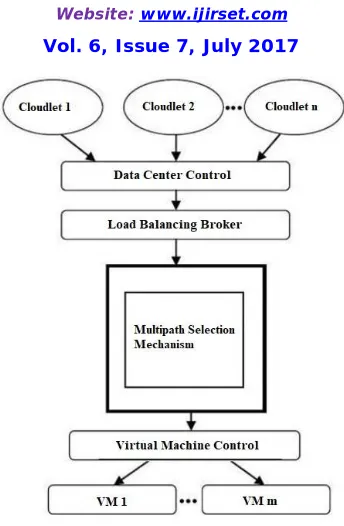
Fig. 2 Implementation modules of proposed work
The implementation modules in Fig. 2 involve mainly of Data center control, Load balancing broker, Multipath selection mechanism(MPM), and Virtual machine control. In this proposed work, the cloudlets are initially allocated to each data center and then they are processed by the broker who executes the load balancing through MPM. After this the data transfer is assigned to virtual machines by virtual machine control.
The modules of architectureare explained as follows
A. Data center control:
Data center control maintains all the detailed list of data centers such as data center name, data center id, host id, its ram and the bandwidth. This takes in the data flow from cloudlets and assigns from which data centers the transfer has to take.
B. Load Balancing Broker:
Load Balancing Broker acts as an intermediator between the Data center and the virtual machines in them. This implements the Multipath Selection Mechanism to assign work load to desired virtual machines.
C. Multipath Selection Mechanism:
ISSN(Online): 2319-8753 ISSN (Print): 2347-6710
I
nternational
J
ournal of
I
nnovative
R
esearch in
S
cience,
E
ngineering and
T
echnology
(An ISO 3297: 2007 Certified Organization)
Website: www.ijirset.com
Vol. 6, Issue 7, July 2017
Algorithm
Multipathselection() {
for each task in task queue
initflowtask = 0;
while (task is assigned to a vm) or (flowtask>threshold){
increment flowtask
if the load > other paths
find the lowest load path and transfer the flow
assign task to vm if indegree >0; decrement indegree
}
remove task from task queque
}
Process completed tasks(){
increment degree of vm assigned to the task
}
D. Virtual Machine Control:
Virtual machine(VM) control controls the assignment of the tasks for each virtual machine present in the network. It shares host list with other vms. It processes cloudlets. This processing happens according to the algorithm, defined by the multipath selection mechanism. Each VM has an owner, which can submit cloudlets to the VM to be executed.
IV. PERFORMANCE RESULTS
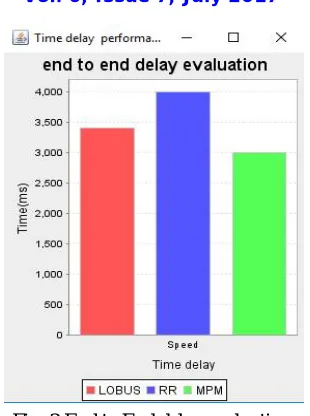
The proposed work is executed and compared with two of the existing load balancing techniques, LOBUS and Round Robin. A generalized checking is done whether the proposed system can reduce the end to end delay in data transmission and it resulted in maintaining low delay than the other two.
ISSN(Online): 2319-8753 ISSN (Print): 2347-6710
I
nternational
J
ournal of
I
nnovative
R
esearch in
S
cience,
E
ngineering and
T
echnology
(An ISO 3297: 2007 Certified Organization)
Website: www.ijirset.com
Vol. 6, Issue 7, July 2017
Fig. 3 End to End delay evaluation
End to End delay is most important factor for faster delivery of data. The MPM shows significant improvement when compared with other load balancing mechanisms. When end to end delay is low then there will be faster data transfer which decreases energy consumption by big data centers and also on time receive of data.
Bandwidth utilization of the proposed systemis evaluated and it outperforms the existing LOBUS and RR.
The following figure Fig.4 represents the graph in which Multipath Selection Mechanism uses the maximum bandwidth and reduces the load on remaining network paths making it a well-balanced flow.
ISSN(Online): 2319-8753 ISSN (Print): 2347-6710
I
nternational
J
ournal of
I
nnovative
R
esearch in
S
cience,
E
ngineering and
T
echnology
(An ISO 3297: 2007 Certified Organization)
Website: www.ijirset.com
Vol. 6, Issue 7, July 2017
V. CONCLUSION AND FUTURE WORK
Load balancing while transferring data in clouds is a complex and time taking so the proposed mechanism is implemented to reduce the load on the network path while transferring the data dynamically. It also maximizes the band width utilization and reduces the end to end delay. This mechanism can be used in large data centers where network links are inter connected and data transfer occurs continuously.
For the future enhancement, we will implement this mechanism in Open Flow networks in three different patterns, uniform, semi uniform and irregular data flows in network paths.
REFRENCES
[1] Z.Z.Cao, M.Kodialam and T.V.Lakshman. Joint Static and DynamicTraffic Scheduling in Data Center Networks. in Proceedingsof IEEE INFOCOM 2014, pp.2445-2553.
[2] N.Handigol, S.Seetharaman, M.Flajslik, N.McKeown, and
R.Johari, Plug-n-Serve: Load-balancing web traffic using Open-Flow, Demo at ACM SIGCOMM, Aug. 2009.
[3] M.Schlansker, Y.Turner, J.Tourrilhes, and A.Karp, Ensemble Routingfor Datacenter Networks, In ACM ANCS, La Jolla, CA, 2010. [4] S. Vasundra, Load Balancing through shortest path in regular mesh topologies, in IJSSAN, pp:149-153, vol.4, issue 1, Jan 11 – June 2011 [5] Z.Z.Cao, M.Kodialam and T.V.Lakshman. Joint Static and Dynamic Traffic Scheduling in Data Center Networks. in Proceedings of IEEE INFOCOM 2014, pp.2445-2553.
[6] T.N.Anitha, R.Balakrishna, An Efficient and Scalable ContentBased Dynamic Load Balancing Using Multiparameters on LoadAware Distributed Multi-Cluster Servers, IJEST, 2008.
[7] R.Wang, D.Butnariu, and J. Rexford, OpenFlow-Based ServerLoad Balancing GoneWild, in: Proceedings ofWorkshop on Hot-ICE, Mar. 2011.[8] N.Gude, T.Koponen, Justin Pettit et al., NOX: Towards an OperatingSystem for Networks, SIGCOMM Comput. Commun. Rev.,Vol.38, July 2008, pp. 105-110.
[9] Feilong Tang, Laurence T. Yang, Can Tang, Jie Li and Minyi Guo. A Dynamical and Load-Balanced Flow Scheduling Approach for Big Data