DOI: 10.1534/genetics.107.082818
Dpb2p, a Noncatalytic Subunit of DNA Polymerase
e
, Contributes to
the Fidelity of DNA Replication in
Saccharomyces cerevisiae
Malgorzata Jaszczur,* Krzysztof Flis,* Justyna Rudzka,* Joanna Kraszewska,*
Martin E. Budd,
†Piotr Polaczek,
†Judith L. Campbell,
†Piotr Jonczyk* and Iwona J. Fijalkowska*
,1*Institute of Biochemistry and Biophysics, Polish Academy of Sciences, 02-106 Warsaw, Poland and †Braun Laboratories, California Institute of Technology, Pasadena, California 91125
Manuscript received October 3, 2007 Accepted for publication November 19, 2007
ABSTRACT
Most replicases are multi-subunit complexes. DNA polymerase epsilon fromSaccharomyces cerevisiaeis composed of four subunits: Pol2p, Dpb2p, Dpb3p, and Dpb4p. Pol2p and Dpb2p are essential. To investigate a possible role for the Dpb2p subunit in maintaining the fidelity of DNA replication, we isolated temperature-sensitive mutants in theDPB2gene. Several of the newly isolateddpb2alleles are strong mutators, exhibiting mutation rates equivalent topol2mutants defective in the 39/59proofreading exonuclease (pol2-4) or to mutants defective in mismatch repair (msh6). Thedpb2 pol2-4 and dpb2 msh6 double mutants show a synergistic increase in mutation rate, indicating that the mutations arising in thedpb2mutants are due to DNA replication errors normally corrected by mismatch repair. Thedpb2mutations decrease the affinity of Dpb2p for the Pol2p subunit as measured by two-hybrid analysis, providing a possible mechanistic explanation for the loss of high-fidelity synthesis. Our results show that DNA polymerase subunits other than those housing the DNA polymerase and 39 / 59 exonuclease are essential in controlling the level of spontaneous mutagenesis and genetic stability in yeast cells.
U
NDERSTANDING of the mechanisms that control the generation of mutations on normal and dam-aged DNA templates is crucial in studies of carcinogen-esis and mutagencarcinogen-esis. The mutator hypothcarcinogen-esis for the origins of cancer suggests that both early and late stages of tumor progression are connected to expression of a mutator phenotype (Loeb2001; Loebet al. 2003; Bielaset al. 2006). One likely source of spontaneous mutations are errors occurring during DNA replication. Thus, un-derstanding of the mechanisms controlling DNA rep-lication fidelity has become a major challenge of current molecular biology.
The accuracy of DNA synthesis is maintained by three highly conserved processes: correct base selection by the DNA polymerases, removal of base insertion errors by 39 / 59 exonucleolytic proofreading activity of DNA polymerases, and postreplication correction of poly-merase errors by the DNA mismatch repair system (MMR). Thus, DNA polymerases are central to replica-tion fidelity. Most of the major replicative DNA poly-merases, often called replicases, are multi-subunit holoenzymes (HE). In eukaryotic cells, DNA replication is executed by at least three DNA polymerases: Pola, Pol d, and Pol e. PoleHE is a four-subunit complex
com-posed of a DNA polymerase/exonuclease subunit, Pol2p, and three auxiliary subunits: Dpb2p, Dpb3p, and Dpb4p (Hamatakeet al. 1990; Duaet al. 2000; Chilkovaet al.
2003; Asturias et al. 2006). This composition of
sub-units is conserved from yeast to humans (Kesti et al.
1993; Liet al. 1997; Jokelaet al. 1998; Liet al. 2000; Feng
et al. 2003; Spiga and D’Urso 2004). Two subunits,
Pol2p and Dpb2p, are essential in yeast (Morrisonet al.
1990; Araki et al. 1991a). Dpb3p and Dpb4p are not
essential (Arakiet al. 1991b; Ohyaet al. 2000). Pol2p is
essential for leading-strand DNA replication and plays a role in linking DNA replication and the S-phase check-point inSaccharomyces cerevisiae(Arakiet al. 1992; Budd
and Campbell1993; Navaset al. 1995, 1996; Duaet al.
1998, 1999; Pursell et al. 2007). Strains carrying a
temperature-sensitive mutation in theDPB2gene (dpb2-1) suggest that Dpb2p is also essential for DNA replication (Arakiet al. 1991a). At the restrictive temperature,dpb2-1
cells are dumbbell shaped, which is characteristic for a DNA replication defect. Dpb2p interacts with Pol2p (Sugino1995; Duaet al. 2000) and is phosphorylated by
Cdc28p, a cyclin-dependent protein kinase, in a cell-cycle-dependent manner (Kestiet al. 2004).
Neverthe-less, the precise cellular function of Dpb2p is unknown. Strains carrying exonuclease-deficient Pold(pol3-01) or Pol e (pol2-4) are mutators. Using URA3 forward mutation or his7-2 reversion assays, Morrison and
Sugino(1994) demonstrated that thepol3-01allele ele-1Corresponding author:Institute of Biochemistry and Biophysics, Polish
Academy of Sciences, Pawinskiego 5A, 02-106 Warsaw, Poland. E-mail: [email protected]
vates spontaneous-mutation rates by100-fold, as com-pared to an only 10-fold increase for thepol2-4allele. However, the fidelity of purified exonuclease-deficient PoldHE is reduced by10-fold compared to wild type, while the fidelity of exonuclease-deficient PoleHE is reduced by100-fold (Shimizuet al. 2002; Hashimoto
et al. 2003). These differences may suggest that the
in vivospontaneous-mutation rates ofpol3-01andpol2-4
strains are modulated by some factor(s). One impor-tant factor is the status of the replication checkpoint, sincepol3-01and pol2-4have similar mutation rates in checkpoint-defectivedun1Dmutants (Dattaet al. 2000).
There are other examples suggesting that noncatalytic DNA polymerase subunits may contribute to polymer-ase fidelity (Arakiet al. 1991b; Huanget al. 2002; Pham
et al. 2006). The absence of Pol32p, a nonessential subunit of Pold HE ofS. cerevisiae, causes increases in genomic deletions of sequences flanked by short direct repeats (Huang et al. 2002). In addition, deletion of
the Dpb3p subunit of Pole HE (dpb3D) elevated the spontaneous-reversion rate by factors 2.2, 2.6, and 20 at
his1-7, ade2-1, and lys1-1, respectively (Araki et al.
1991b). InEscherichia coli, mutations in thednaXgene, encoding thet-subunit of DNA Pol III HE, lead to a mutator phenotype (Phamet al. 2006).
In this work we have investigated whether Dpb2p contributes to the fidelity of Pole. Using random mu-tagenesis, we identified a set of temperature-sensitive
DPB2mutated strains (dpb2ts
). Among them, we
identi-fied several strains that dramatically increase the level of spontaneous mutations. For several tested markers, this mutator effect is even greater than that observed pre-viously for Pol e mutants defective in the 39 / 59
exonuclease proofreading activity (pol2-4) and is com-parable to that observed in certain strains defective in DNA mismatch repair (msh6). We also provide evidence that the observed mutator phenotype is a consequence of an increase in replication errors in thedpb2mutants. Our results indicate that noncatalytic replicase subunits may play an important role in maintaining the fidelity of DNA replication in eukaryotes, as has been shown previously in prokaryotic systems (Phamet al. 2006).
MATERIALS AND METHODS
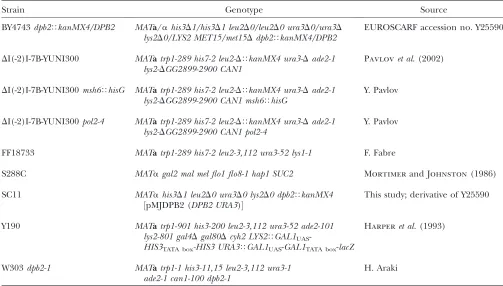
Media and growth conditions:S. cerevisiaestrains are listed in Table 1. Strains were grown in standard media (Adamset al.
1997). Yeast complete medium (YPD), containing 1% yeast extract, 1% peptone, and 2% glucose, was routinely used for culturing yeast strains when nutrition selection was not re-quired. For yeast transformations and mutagenesis assays, yeast strains were grown in SD minimal medium (0.67% yeast nitro-gen base without amino acids, 3% glucose) supplemented with appropriatel-amino acids and nucleotides. To measure
fre-quency of forward mutations at theCAN1locus, SD plates were additionally supplemented withl-canavanine (60 mg/liter),
an analog of arginine. Whereas, SD medium containing, in ad-dition, uracil and 0.1% of 5-fluoroorotic acid (5-FOA) was used for selection ofura3mutants.
TABLE 1
Yeast strains used in this study
Strain Genotype Source
BY4743dpb2TkanMX4/DPB2 MATa/ahis3D1/his3D1 leu2D0/leu2D0 ura3D0/ura3D
lys2D0/LYS2 MET15/met15Ddpb2TkanMX4/DPB2
EUROSCARF accession no. Y25590
DI(-2)I-7B-YUNI300 MATatrp1-289 his7-2 leu2-DTkanMX4 ura3-Dade2-1
lys2-DGG2899-2900 CAN1
Pavlovet al. (2002)
DI(-2)I-7B-YUNI300msh6ThisG MATatrp1-289 his7-2 leu2-DTkanMX4 ura3-Dade2-1
lys2-DGG2899-2900 CAN1 msh6ThisG
Y. Pavlov
DI(-2)I-7B-YUNI300pol2-4 MATatrp1-289 his7-2 leu2-DTkanMX4 ura3-Dade2-1
lys2-DGG2899-2900 CAN1 pol2-4
Y. Pavlov
FF18733 MATatrp1-289 his7-2 leu2-3,112 ura3-52 lys1-1 F. Fabre
S288C MATagal2 mal mel flo1 flo8-1 hap1 SUC2 Mortimerand Johnston(1986)
SC11 MATahis3D1 leu2D0 ura3D0 lys2D0 dpb2TkanMX4 ½pMJDPB2 (DPB2 URA3)
This study; derivative of Y25590
Y190 MATatrp1-901 his3-200 leu2-3,112 ura3-52 ade2-101 lys2-801 gal4Dgal80Dcyh2 LYS2TGAL1UAS
-HIS3TATA box-HIS3 URA3TGAL1UAS-GAL1TATA box-lacZ
Harperet al.(1993)
W303dpb2-1 MATatrp1-1 his3-11,15 leu2-3,112 ura3-1 ade2-1 can1-100 dpb2-1
Construction of plasmids: Generally, plasmids were con-structed according to the standard protocols as described by Sambrooket al. (1989). Propagation of plasmids was performed
in DH5aor XL1-Blue MRF9E. colistrains. All PCR products and fusion junctions were confirmed by DNA sequencing.
Cloning of the DPB2 gene: Genomic DNA from strain FF18733 was used as a template to clone theDPB2 gene by PCR amplification with primers 59-CGTTTGAGGAAGCTTAG GATACTTGGCGTAG-39(theHindIII site is underlined) and 59-GTCCCCATGGATCCCATATATTGTATGCCG-39(BamHI is underlined). The 3.1-kb PCR product was HindIII/Bam HI-cloned into URA3-containing YCplac33 (Gietz and Sugino
1988), resulting in plasmid pMJDPB2. To create a HIS3 -containing plasmid, isogenic with plasmids carrying mutated DPB2alleles (described below), a PCR amplification was per-formed using pMJDPB2 as a template and primers 59-CATC TGCGGTCGACCCCCATACAAAC-39 (SalI underlined) and 59-CAAAAAGTATGGATCCAAATAGATGGCAG-39(BamHI un-derlined). Finally, the 2606-bpSalI–BamHI fragment, contain-ing the DPB2 gene, was cloned into SalI/BamHI-digested pRS313 (Sikorskiand Hieter1989), yielding pGJ2.
Reconstruction of the dpb2-1 allele: We rescued the pre-viously described temperature-sensitivedpb2-1 allele (Araki
et al. 1991a) on a plasmid to test its influence on replication fidelity and to compare withdpb2tsalleles generated ourselves.
The full-length dpb2-1ORF was isolated from W303 dpb2-1 yeast cells (kindly provided by H. Araki) by the gap-repair method using EcoRI/StuI-linearized pKF106 (described be-low). The resulting plasmid was named pKF161 and thedpb2-1 allele obtained was confirmed by sequencing.
Construction of integrating plasmids: Construction of the plasmid for integration into the DPB2 genomic locus was a multi-step procedure. TheClaI-STOP part ofDPB2 and its 901-bp 39flanking region were PCR amplified using genomic DNA of strain S288C as a template and the primer pair 59-CCG CAAGATCCAATTCCTAGTG-39and 59-GTAGTCGACGAGAC GCTTGTGTGTGCTTGATTCTCC-39(SalI underlined). The 1477-bp PCR product wasClaI/SalI-digested and the resulting 1233-bp fragment was ligated into pRS313 atClaI andXhoI sites, yielding pKF100. This destroyed theXhoI site of pRS313, making the XhoI site of DPB2 unique in derivatives of the resulting vector. The pKF100 plasmid was then digested with SmaI and ClaI, and a full-length PDPB2-DPB2-TDPB2 cassette (549-2079-901 bp) was regenerated by inserting the 2303-bp FspI–ClaI fragment of pMJDPB2. The resulting plasmid, pKF107, was subsequently converted to pKF106 by replace-ment of theXhoI–ClaIDPB2fragment with a synthetic double-stranded DNA linker named plomba: 59-CTCGAGCAATTT GCTGCAGTGCCTACACAAGGCATAACTTCGTATAGCATA CATTATACGAAGTTATCCGATATCGAT-39. The 799-bpClaI– HindIII fragment of pKF100, comprising the 39fragment of theDPB2 ORF and the 59-end of theDPB2 terminator (the ‘DPB2-TDPB2’ sequence; apostrophes indicate the sides of truncation), was excised and filled in with Klenow fragment and ligated intoXbaI-linearized and Klenow-treated pKF106. A clone, containing the insert in the same orientation as the full-lengthDPB2gene (theXbaI site recreated), was isolated and named pKF108. The pKF115 vector was created by ligation of the 1470-bpSmaI–Ecl136II part of pAG60 (Goldsteinet al.
1999; EUROSCARF accession no. P30111) into the Nae I-linearized pRS303 (Sikorskiand Hieter1989). This resulted
in insertion of the heterologousCaURA3MX4cassette, con-taining theURA3ORF ofCandida albicansunder the control of both promoter and terminator sequences of theAshbya gossypii TEFgene. A clone bearingCaURA3MX4in inverted orienta-tion with respect to the HIS3gene was chosen as pKF115. Finally, the 2911-bp ‘DPB2-TDPB2’-PDPB2-dpb2Tplomba-TDPB2 se-quence wasApaI/SacI subcloned from pKF108 into pKF115,
yielding an integrative plasmid named pKF117, which served as an acceptor for mutatedDPB2variants. The presence of the short (73 bp) plombasequence instead of a larger fragment (1558 bp) of theDPB2ORF allowed for unambiguous iden-tification of the desired recombinant plasmids by restriction digestion. The map of pKF117 and the use of the vector for integration into the DPB2 locus is shown in supplemental Figure S1 at http://www.genetics.org/supplemental/. A con-trol integrative plasmid, pKF120, was constructed in the same way asdpb2-containing pKF117 derivatives, but the wild-type DPB2sequence was inserted in place of the mutateddpb2gene. Construction of two-hybrid plasmids:Plasmids for the two-hybrid system (Fieldsand Song1989) are based on pGBT9
and pGAD424 multi-copy vectors (Clontech), which encode the Gal4p DNA-binding (BDGAL4) or transcription activation domain (ADGAL4), respectively. pGBT9 and pGAD424 were converted to pKF75 and pKF80, respectively, by EcoRI–PstI digestion and by replacing the 26-bp excised sequence with a new polylinker compatible with a common series of bacterial andE. coli/yeast cloning vectors,i.e., pBluescript (Stratagene, La Jolla, CA) and pRS (Sikorski and Hieter 1989). All
restriction sites introduced were placed in frame with the correspondingGAL4domain. pKF75 and pKF80 were tested for lack of self-activation of expression of the Gal4p-depen-dent genes and were used for construction of fusions of genes of interest with theGAL4domains for the directed two-hybrid assay. The synthetic linker used and the plasmids obtained are listed in Figure 1. For cloning of theDPB2alleles, a sequence encoding ORF of the dpb2Tplombaallele was PCR amplified
from pKF106 with primers 59-CGCGGATCCTTTAAAATGTGT GAAATGTTTGGCTCTG-39 and 59-GATGTCGACGAGACGA TGCATTCATTAGATATATATCTCTTCTTGTA-39 (ORF-coding sequence is double underlined, restriction sites are under-lined, and nucleotides corresponding to the ATG and STOP codons are in boldface). TheBamHI–SalI fragment of the PCR product was cloned into pKF75 and pKF80, giving pKF133 and pKF137 plasmids, respectively. The expected wild-type or mu-tated variants ofDPB2were subsequently created by replacing theplombasequence with subcloned fragments of the respec-tive alleles.
The positive control for two-hybrid assays was the centro-meric pCL1 plasmid (Fieldsand Song1989), which contains
the entire Gal4p-coding region (881 aa). As a negative control, we used pGBT9dnaE1
and pGAD424dnaE1
( Jonczyket al. 1998).
Random mutagenesis of the DPB2 gene and selection of temperature-sensitive dpb2 alleles: A library of mutated variants ofDPB2was created on centromeric plasmids using random mutagenesis procedures based on hydroxylamine treatment or mutagenic PCR. The hydroxylamine mutagene-sis was performed using the pGJ2 plasmid and a standard protocol as described by Sambrooket al. (1989). The Diversify
PCR random mutagenesis kit (Clontech) was used to in-troduce mutations by PCR. The mutagenic PCR amplifications were done under reaction conditions nos. 5–8 of the manu-facturer’s protocol and using the pMJDPB2 plasmid as a template and the same primers as used for construction of pGJ2. The PCR products were SalI/BamHI-digested, cloned intoSalI/BamHI-linearized pRS313, and then used directly for yeast transformation.
To screen for plasmids carrying temperature-sensitivedpb2 alleles, strain SC11 was constructed. A diploid strain, Y25590, carrying wild-type and disrupted chromosomal alleles ofDPB2 (BY4743DPB2/dpb2TkanMX4), was transformed with pMJDPB2
and Ura1
with lysine and leucine, and incubated at 23°for 7–10 days. The His1transformants were isolated and toothpicked twice at 23° onto plates additionally containing uracil and 5-FOA (a selective agent against Ura1
cells; Boeke et al. 1984) to
remove the pMJDPB2 plasmid bearing the wild-typeURA3and DPB2genes. About 15,000 Uracolonies were selected and screened for temperature sensitivity at 37°. Several indepen-dent temperature-sensitive clones were iindepen-dentified. To confirm that temperature sensitivity resulted from the presence of the library clone, the plasmid DNA was isolated from each strain and retransformed into SC11 and the screening procedure was repeated as described above. Temperature-sensitive phe-notype was confirmed for all isolateddpb2strains. DNA se-quence analysis of mutant alleles showed that all contained multiple missense mutations within theDPB2 gene causing amino acid alterations at the protein level. For further studies, two mutated alleles were chosen: one generated by PCR (pMJ25) and another generated by hydroxylamine treatment (pMJ36).
Next, fragments ofdpb2-coding sequence from pMJ25, con-taining identified mutations, were excised and used to replace appropriate fragments of the wild-typeDPB2gene present in the plasmid pGJ2 (pRS313 HIS3 DPB2), generating three plasmids: pMJ100, pMJ101, and pMJ102 (Table 2). Since, in the case of pMJ36, the whole plasmid was treated with hydrox-ylamine, theDPB2 ORF was also subcloned into untreated plasmid, resulting in pMJ103 (Table 2), and the plasmid-dependent temperature-sensitive growth was confirmed again to exclude the possibility that thets phenotype was caused by mutated vector,e.g., by mutations in theHIS3marker gene. Integration into the DPB2 locus: TheDPB2 alleles were introduced into the chromosome by transplacement. The pKF117-derivative vectors were linearized at unique BamHI and XbaI sites positioned between PDPB2 and an additional
fragment of the DPB2 terminator. The linearized plasmids were transformed (as described in Gietzand Woods1998)
into strain DI(-2)I-7B-YUNI300 (Pavlov et al. 2002) and its
two derivatives deficient in mismatch repair (msh6ThisG) or
Poleproofreading exonuclease (pol2-4), respectively (Table 1). Transformants were selected for uracil prototrophy on plates, which were incubated at 23°for up to 10 days. Colonies were replica plated onto new SDUra plates to confirm the Ura1 phenotype. Additionally, these plates were duplicated and incubated at 37° for 3 days to check for temperature-sensitive growth. In the cases of alleles that caused ats phe-notype, only ts Ura1
transformants were further analyzed; otherwise all Ura1colonies were checked for correct integra-tion. The genomic DNA was isolated and used as a template in a PCR reaction with the primers 59-TGTAAAACGACGGCCAGT-39 (-21 M13 universal primer) and 59-GAATACTGGCTTAC CGAG-39, which recognized the vector sequence and the chromosomal sequence downstream of DPB2, respectively, generating a 1361-bp band in case of integration into the aimed locus. The presence of the expected mutation(s) was verified by a second round of PCR withDPB2-specific primers and DNA sequencing of the PCR product. In view of the fact that most of theDPB2alleles used, as well as bothmsh6ThisG
and pol2-4strains, may contribute to a mutator phenotype, the number of passages was minimized and the confirmed integrants were immediately frozen in liquid nitrogen and stored at80°. For that reason, the removing of the residual vector sequence from the chromosome was omitted. TheDPB2 control strains were generated by integration of the pKF120 plasmid. The resultant control strains contained the wild-type DPB2gene and the same residual vector sequence as in the strains constructed with the dpb2-containing derivatives of pKF117. In control studies, where we removed the vector Figure1.—Genetic constructs for two-hybrid system. (A) Scheme of the polylinker that was built in pKF75 and pKF80 vectors.
sequences, we did not observe any difference in the rate of mutagenesis betweenDPB2andDPB2Tvector alleles.
Measurement of spontaneous-mutation frequency and calculation of mutation rates:The assays were performed in different genetic backgrounds. TheDPB2variants were intro-duced on plasmids (SC11 derivatives; BY genetic background) or integrated into the DPB2chromosomal locus ½ DI(-2)I-7B-YUNI300 derivatives. To determine spontaneous-mutation frequencies, 10–15 independent cultures of individual clones were used. Colonies were taken from two to three indepen-dent isolates of each strain and inoculated in 3–15 ml of liquid SD medium supplemented with required amino acids and nu-cleotides. The cultures were grown at 23°to stationary phase; yeast cells were collected by centrifugation, washed, and finally resuspended in water. Aliquots of undiluted cultures and ap-propriate dilutions were plated on selective and nonselective plates and incubated for 7–10 days at 23°, and the appeared colonies were counted. The frequency of forward mutations was measured at theCAN1locus in both genetic backgrounds. Also, the reversion frequencies ofhis7-2, trp1-289, and lys2-DGG2899-2900were measured in theDI(-2)I-7B-YUNI300 de-rivatives. Each experiment was repeated three times. Mutant frequency was determined by dividing the median mutant count by the median total cell count. The mutation rates were calculated using the equationm¼f/ln(Nm) (wheremis the mutation rate per replication,fis the mutant frequency, and Nis the total population size), which was solved by iteration (Drake1991).
Immunoblot analysis of yeast extracts: Yeast strains were grown at 23°in SD minimal medium, supplemented with re-quired amino acids and nucleotides, until OD600nmreached 0.8 unit. Cells from 150-ml cultures were collected by centri-fugation, and pellets were frozen in liquid nitrogen and stored at80°. Cells were thawed and then lysed by addition of 100ml of freshly prepared alkaline lysis buffer (50 mmNaOH, 2%
SDS, 10% glycerol, 5% 2-mercapthoethanol, 2 mm EDTA,
0.04% bromophenol blue), and the samples were boiled for 5 min. Extracts were neutralized with 1nHCl (4.5ml/100ml of
cell extract), and cell extracts were centrifuged for 5 min at 4°. Proteins were separated by 7% SDS–PAGE and transferred to nitrocellulose membrane (Hybond-C Extra, Amersham Bio-sciences). BDGal4-Dpb2 fusion proteins (97 kDa) were detected with rabbit anti-BDGal4pantibodies (Sigma, St. Louis) followed by incubation with the ImmunoPure goat anti-rabbit IgG antibodies conjugated with horseradish peroxidase (HRP; Pierce, Rockford, IL). Bands were visualized using chemilu-minescent substrates for HRP (SuperSignal WestPico, Pierce) and the Fluorchem SP Imager (Alpha Innotech).
Preparation of samples for flow cytometry analysis: Se-lected strains were cultured in 50 ml of liquid YPDA medium (YPD supplemented with adenine) at permissive temperature (23°) until OD600 nmreached 0.4 unit. Samples (1 ml) were
collected for further processing. Cells were treated with a-factor (10mg/ml) and further incubated with shaking at 23° until 95% of the cells were synchronized (3 hr). Synchronized cultures were incubated witha-factor for an additional 1 hr at restrictive temperature (37°). Cells were harvested and re-leased froma-factor by washing twice with prewarmed (37°) YPDA. After washing, cells were resuspended in 75 ml of fresh YPDA at 37°, and 1-ml samples were immediately collected for processing. The remaining cultures were further incubated with shaking at 37° and subsequent samples were collected every 15 min for 2.5 hr. All collected samples were fixed in 70% ethanol and prepared for flow cytometry as described pre-viously (Boronatand Campbell 2007; Reisand Campbell
2007).
Two-hybrid assay:To monitor protein–protein interactions, the yeast two-hybrid system was used (Fieldsand Song1989).
The directed assay was performed in Y190 strain (Harperet al.
1993) transformed with appropriate plasmids, and the lacZ genetic reporter was utilized to indicate the interactions. The interactions were assessed using both a filter assay with 5-bromo-4-chloro-3-indolyl-b-d-galactopyranoside (X-gal) (Vojteket al.
1993) and a quantitative in vitro b-galactosidase assay with O-nitrophenylb-galactoside (ONPG) as a substrate (Roseet al.
1990). For the latter, the yeast strains were grown for 1 day at 23°in SD medium supplemented with required amino acids and nucleotides. The cultures were diluted 10 times with fresh SD medium and incubated for an additional 36 hr. The b-galactosidase activity was determined as described previously (Roseet al. 1990).
RESULTS
Generation of temperature-sensitive alleles ofDPB2: To test the role of the Dpb2p subunit of Pol e HE in maintaining the fidelity of DNA replication, we isolated new dpb2ts mutants. If the Dpb2p subunit is involved
in this process, we would expect to isolate variants of Dpb2p that exhibit a mutator phenotype. As the Dpb2p subunit is essential for yeast growth, the approach was to isolate a set of mutants with a temperature-sensitive phenotype and screen among them for mutators. Plas-mids carrying theDPB2gene were mutagenized by muta-genic PCR or by hydroxylamine treatment as described in materials and methods. Temperature-sensitive
al-leles were obtained by plasmid shuffling between wild-type and mutagenized DPB2genes in thedpb2Dstrain (seematerialsandmethods). After loss of the plasmid
TABLE 2
Amino acid substitutions in the alleles ofdpb2
Original plasmid
Final plasmid
dpb2
allele Amino acid changea
pMJ25 pMJ100 dpb2-100 L284P T345A
pMJ25 pMJ101 dpb2-101 L284P
pMJ25 pMJ102 dpb2-102 T345A
pMJ36 pMJ103 dpb2-103 T342I S343F T345I P347S P348S
pKF161 dpb2-1 D300N K521R V565F G662R
a
Figure 2.—BLAST search for alignment ofS.
carrying wild-typeDPB2, we screened 15,000 clones for temperature sensitivity (loss of growth at 37°). Thirty independent clones were identified and further assayed for growth at 23°, 30°, and 37°. Two clones that exhibited clear temperature sensitivity, that were strong mutators in our preliminary tests, and that had the smallest number of amino acid changes as determined by DNA sequenc-ing, were chosen for further studies. These strains carry plasmids pMJ25 (dpb2-100), derived by PCR mutagenesis, and pMJ36 (dpb2-103), derived by hydroxylamine treat-ment. The nucleotide changes in the DPB2 gene, as identified by DNA sequencing, are shown in Table 2 and Figure 2. Two additional mutants, dpb2-101and dpb2-102, each containing only one of the two amino acid substitutions carried by pMJ25 (dpb2-100), were created by subcloning. Thedpb2-101mutation, L284P, lies in a highly conserved motif within the gene (Figure 2) and confers moderate temperature sensitivity (Table 3). The
dpb2-102mutation, T345A, did not confer temperature sensitivity (nor a mutator phenotype, as shown below) and was therefore not characterized in detail. The temperature-sensitivedpb2-103allele contains five clus-tered changes between amino acid residues 342 and 348 in the proline-rich region separating consensus regions III (OB-fold) and IV (calcineurin motifs) of this family of DNA polymerase-associated B subunits (Figure 2) (Makiniemiet al. 1999). We also determined the DNA
sequence of the previously identifieddpb2-1allele (Araki
et al. 1991a), which had not previously been sequenced, and found four amino acid changes, none of which oc-curred in any of the mutants in our collection (Figure 2, Table 2).
Thedpb2mutants reveal phenotypes typical of DNA replication mutants: Thedpb2-100,dpb2-101, and dpb2-103mutant alleles, as well as wild-typeDPB2, were then integrated into the chromosome of strain DI(-2)I-7B-YUNI300, replacing the endogenousDPB2locus, using
pKF117 derivatives and the pKF120 plasmid, respec-tively. The mutants display varying degrees of tempera-ture sensitivity (Figure 3A). As shown in Figure 3B, the
dpb2-100 and dpb2-103 cells incubated at the nonper-missive temperature arrested with dumbbell morphol-ogy and with the nucleus between mother and daughter cells, the terminal phenotype of mutants with S-phase defects and of dpb2-1 (Pringle and Hartwell 1981;
Arakiet al. 1991a). Thedpb2-101mutant, which displays
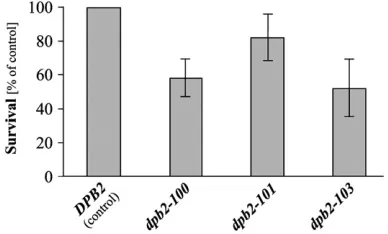
a weak temperature-sensitive phenotype (Figure 3A), exhibits almost wild-type nuclear and cell morphology (Figure 3B). We also analyzed S-phase progression by flow cytometry indpb2-103mutant cells, which had the most severe temperature-sensitive growth defect. Cells were arrested in G1 phase with a-factor and then re-leased into a synchronous cell cycle at 37°. As shown in Figure 3C, the mutant cells appeared to enter S phase, but progressed much more slowly than the wild-type cells through S phase at 37°and arrested with a nearly 2C DNA content or greater. This pattern is typical of temperature-sensitive DNA replication elongation mu-tants and indicates that bulk DNA synthesis can occur slowly but that replication is defective or incomplete. We conclude that thedpb2-103mutant may have a primary defect in chromosomal DNA replication at the restric-tive temperature. The temperature-sensirestric-tive dpb2 mu-tants were examined for viability at 23°. The mumu-tants exhibit decreased viability—between 50 and 80% viabil-ity compared to wild-type cells (Figure 4). These ob-servations confirm that theDPB2gene is important for chromosomal DNA replication.
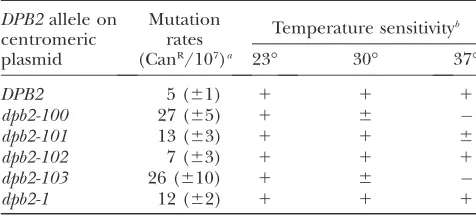
Mutator phenotypes of thedpb2mutants are due to mutations in the DPB2gene:To quantify the mutation rates of thedpb2alleles and to establish that any mutator effects found were due todpb2mutations, we assayed the forward mutation rate at theCAN1locus in strain SC11 carryingHIS3plasmids encodingDPB2,dpb2-100, dpb2-101,dpb2-102, anddpb2-103, as well asdpb2-1. Relevant plasmids were introduced into strain SC11 (which carries a deletion of theDPB2chromosomal locus but contains DPB2 on plasmid pMJDPB2) by transforma-tion, and pMJDPB2 was then eliminated from the transformants by growth on 5-FOA. TheHIS3 plasmid-containing strains were used to determine the level of spontaneous mutagenesis at 23°by measuring canava-nine resistance (CanR) as described inmaterialsand methods. Wild-type cells are sensitive to canavanine, an
analog of arginine. Any mutation that inactivates the arginine permease encoded by CAN1 results in CanR.
The strain carrying the plasmid-encodeddpb2-102allele (T345A), which was not temperature sensitive, did not cause any increase in mutability (Table 3). Strains bearing the remaining four mutated DPB2 alleles, however, elevate the rate of mutations atCAN1two- to approximately fivefold compared to the strain bearing wild-type DPB2. Strains carrying the plasmid-borne mutants display different degrees of temperature sensi-TABLE 3
Mutation rates and temperature sensitivity of the haploid strains carrying the chromosomaldpb2TkanMX4disruption
and respectivedpb2allele on a centromeric plasmid
DPB2allele on centromeric plasmid
Mutation rates (CanR/107)a
Temperature sensitivityb
23° 30° 37°
DPB2 5 (61) 1 1 1
dpb2-100 27 (65) 1 6
dpb2-101 13 (63) 1 1 6
dpb2-102 7 (63) 1 1 1
dpb2-103 26 (610) 1 6
dpb2-1 12 (62) 1 1 1
The strain genotype of the haploid strains isMATahis3D1 leu2D0 ura3D0 lys2D0 dpb2TkanMX4 (BY genetic
back-ground). Mutation rates were measured at 23°.
tivity (Table 3), as do the integrated mutant alleles presented below. The degree of temperature sensitivity correlates well with the frequency of appearance of CanR
mutants except the dpb2-1 mutation, which did not confer temperature sensitivity in the BY genetic back-ground (Table 3). Mutagenesis was also determined at 30°for two mutants,dpb2-101anddpb2-1, which are able to grow at this temperature. However, we did not observe any significant differences in mutation rate compared to results obtained at 23°(data not shown). We confirmed that the mutator phenotypes were Dpb2p dependent by replacing wild-type sequences inDPB2with restriction fragments carrying thedpb2-100anddpb2-103mutations and showing that they conferred the mutator behavior. Mutator effects of dpb2 mutations integrated into the chromosome: To confirm that the effect in dpb2
mutants on mutation rates was not an artifact of ex-pression from the plasmid or the genetic background,
we tested the mutator effect in the strains containing chromosomal copies of thedpb2-100,dpb2-101, and dpb2-103 alleles. We have been unable to obtain viable integrants of thedpb2-1 allele on the chromosome of the strains used here. In theDI(-2)I-7B-YUNI300 strain, mutation frequencies can be measured at four different genetic loci, which allow parallel examination of the specificity of the introduced mutations with respect to base substitution and frameshift mutations (Pavlov
et al. 2002). Forward mutation to canavanine resistance reflects a wide range of mutations, including base substitutions, frameshifts, and more complex mutations (Chenand Kolodner1999). Also,DI(-2)I-7B-YUNI300
harbors thehis7-2mutation-reporter allele, consisting of a single base deletion in a run of eight AT base pairs, which reverts to His1
mainly by addition of 1 bp or loss of 2 bp by insertion or deletion, respectively (Pavlovet al.
2001). The lys2-DGG2899-2900 allele reverts via 1 Figure 3.—Temperature
frameshifts at a run of seven AT base pairs (Pavlovet al.
2002). Finally, DI(-2)I-7B-YUNI300 possesses the trp1-289 nonsense allele, which reverts mainly via a broad range of base-pair substitution mutations converting the premature STOP codon to an amino-acid-coding codon (Pavlovet al. 2001).
All threedpb2mutants tested show an elevated rate of spontaneous mutagenesis for all markers tested (Table 4). The strongest effect, exerted by the dpb2-100mutation, elevates the mutation rate 7-, 19-, 4-, and 6-fold at theCAN1,his7-2,trp1-289, andlys2-D GG2899-2900markers, respectively. The weakest mutator, dpb2-101, elevates mutation rates4-, 6-, 3-, and 3-fold at the same four markers, respectively. These data indicate that the respective dpb2 mutants are spontaneous mutators for both base substitution and frameshift mutations.
Mutator effects of dpb2 mutations in mismatch-repair-defective strains: The mutation rate data pre-sented above suggest that mutant forms of the Dpb2p subunit influence the fidelity of DNA replication. Since mismatches resulting from replication errors are cor-rected by the mismatch repair system (Schaaper1993;
for MMR review, see Jiricny2006), strains deficient in
mismatch repair allow a more direct assay of replication errors. In yeast cells, Msh2p-Msh3p and Msh2p-Msh6p heterodimers form the initiation complexes for two partially redundant repair pathways that act to repair rep-lication errors. The Msh2p-Msh3p heterodimer primarily corrects small loop mismatches while the Msh2p-Msh6p heterodimer primarily corrects nucleotide substitutions and small loop mismatches (for review, see Jiricny2006).
Themsh6strain has a partial defect in mismatch repair that does not affect the survival of the cells and exhibits a moderate increase of spontaneous mutagenesis com-pared to msh2strains that show a very strong mutator phenotype (Flores-Rozasand Kolodner1998). In our
studies, to avoid possible decrease of viability due to error catastrophy (Schaaper and Radman 1989), we used a
strain lacking the Msh6p activity. To assess replication errors in thedpb2mutants, the endogenousDPB2gene in the mismatch-repair-defective strainDI(-2)I-7B-YUNI300
msh6ThisGwas replaced with the wild-type and mutant
dpb2alleles using pKF120 and derivatives of pKF117, re-spectively. We then measured mutation rates at the same four loci as above (Table 4). If mutations in the Dpb2p subunit affect fidelity of replication, we expect a signifi-cant increase in mutability in thedpb2 msh6background. In theDPB2 msh6ThisGcontrol strain, the rate of
spon-taneous mutagenesis at the CAN1,his7-2,trp1-289, and
lys2-DGG2899-2900genes is, as expected, considerably higher than in the mismatch-repair-proficient strain, presumably due to lack of repair of errors generated by
TABLE 4
Mutation rates in strains with different chromosomaldpb2alleles and indpb2 msh6double mutants
Mutation ratesb,c
DPB2allelesa CanR/107 His1/108 Trp1/108 Lys1/108
DPB2 5 (61)½1 5 (65)½1 5 (65)½1 8 (66)½1
dpb2-100 36 (612)½7 97 (638)½19 18 (612)½4 44 (63)½6
dpb2-101 18 (64)½4 30 (67)½6 13 (68)½3 23 (69)½3
dpb2-103 25 (66)½5 53 (621)½11 24 (613)½5 55 (622)½7
msh6 DPB2 47 (612)½9 13 (66)½3 18 (64)½4 12 (67)½1.5
msh6 dpb2-100 222 (653)½44 175 (674)½35 150 (660)½30 254 (644)½32
msh6 dpb2-101 191 (622)½38 78 (69)½16 145 (652)½29 213 (641)½27
msh6 dpb2-103 235 (674)½47 125 (66)½25 139 (669)½28 237 (612)½30 a
dpb2alleles integrated into theDPB2 chromosomal locus ofDI(-2)I-7B-YUNI300 andDI(-2)I-7B-YUNI300 msh6ThisG, respectively.
b
‘‘6’’ indicates standard deviations from three experiments.
c
Within brackets are folds presenting the increase of mutability (the rate of mutagenesis in the respective dpb2 mutant is divided by the rate of mutagenesis in the strain carrying the wild-type DPB2 gene in the MSH6background).
Figure4.—Survival ofS. cerevisiaestrainDI(-2)I-7B-YUNI300
the wild-type replicative polymerases (Table 4). It is inter-esting that thedpb2single mutants (Table 4) are as strong mutators for some alleles as themsh6ThisGsingle mutant.
In addition, the mutability of thedpb2 msh6ThisGdouble
mutants is significantly higher than the mutability of eitherdpb2ormsh6ThisGsingle mutants (Table 4). The
dpb2-100 msh6ThisGdouble mutant was a 6-fold mutator
for CanRand a 2-fold mutator for His1, 8-fold for Trp1, and 6-fold for Lys1
compared todpb2-100. Thedpb2-101 msh6ThisG double mutant had an 11-fold and 3-fold
higher rate of forward CanR mutations and frameshift
reversion to His1
and an 11- and 9-fold higher rate of Trp1
and Lys1
mutations, respectively, thandpb2-101by itself. Thedpb2-103 msh6ThisGhad 9- and 2-fold higher
rate of forward CanRmutations and frameshift reversion
to His1
and a 6- and 4-fold higher rate of Trp1
and Lys1 mutations thandpb2-103by itself. In addition, the values in brackets in Table 4 show that thedpb2andmsh6ThisG
mutator effects were synergistic for all markers tested. These effects in themsh6ThisGstrain suggest that many
of the errors arising in thedpb2mutator strains are cor-rected in mismatch-repair-proficient strains, as expected for DNA replication errors.
Mutator effects of dpb2 mutations in Pol e proof-reading-defective strains: In addition to comparing mutagenicity of thedpb2alleles in wild-type and MMR-defective strains, we also examined mutagenesis under conditions where Poleproofreading is not contributing to error avoidance. Thepol2-4mutation inactivates the intrinsic 39/59exonuclease activity of Pol2p (Morrison
and Sugino1994; Shimizu et al. 2002). If PoleHE,
containing mutant forms of Dpb2p, generates errors, which are subject to 39/59proofreading, thedpb2 pol2-4
double mutants should exhibit a greatly elevated muta-tional rate relative to singledpb2mutants. We introduced the mutateddpb2alleles into strainDI(-2)I-7B-YUNI300
pol2-4. As expected, the haploid strain harboring the
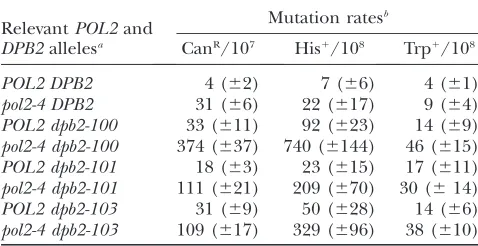
DPB2 and pol2-4 alleles exhibited an elevated level of mutability for three genetic markers tested (Table 5). CanR- and His1
-causing mutations were increased by 8-fold and 3-8-fold, respectively, and Trp1
reversion was increased by 2-fold compared to the wild-type strain. The
dpb2single mutants each showed a level of forward CanR
mutations comparable to thepol2-4single mutant (Table 5). In thepol2-4 dpb2double mutants, the rates of spon-taneous mutagenesis at all three reporter genes were significantly greater than observed with either single mutant alone. The dpb2-100 pol2-4 double mutant in-creases the rate of mutagenesis to CanR, His1, and Trp1 12-, 34-, and 5-fold, respectively, compared to the single
pol2-4mutant (Table 5). Therefore, the presence ofpol2-4
showed significant synergy withdpb2mutants in thehis7-2
and trp1-289 reversion assays or in the CAN1 forward mutation assay. The synergistic effect strengthens the hypothesis that Dpb2p may control fidelity of replication by Poleand provides an additional argument that Pole
participates in yeast chromosomal replication.
Interaction of the C terminus of Pol2p with mutant Dpb2 proteins:By interaction with other subunits of the holoenzyme, Dpb2p may direct assembly of the com-plex and stabilize the function of Pole. It was shown previously that Dpb2p binds to the Pol2p (Dua et al.
2000; Tsubotaet al. 2006). If interaction of Pol2p with
Dpb2p has significance in maintaining the high fidelity of DNA replication, one may expect to find a correlation between mutator phenotype and the ability to interact with Pol2p in certaindpb2mutants. To test this hypoth-esis, we used the yeast two-hybrid system. We cloned wild-type and mutated variants ofDPB2into the pKF133 vector encoding the Gal4p DNA-binding domain as described in materials and methods. The resulting
plasmids contain the complete DNA coding sequence of theDPB2ordpb2alleles, each fused to BDGAL4at the first
ATG codon. It was shown previously that the C-terminal half of Pol2p (aa 1265–2222) interacts strongly with Dpb2p but aa 2163–2222 fails to interact (Dua et al.
1998, 2000). On the basis of this observation we rea-soned that the Pol2p C-terminal fragment (aa 2090– 2222) would be sufficient for Pol2p-Dpb2p interaction. To test this, we cloned this fragment in the Gal4p activation domain-coding vector (pKF80) and carried out a directed two-hybrid assay at 23°, the same tem-perature that we used in mutagenesis experiments. Additionally, we performed a two-hybrid assay (filter assay) at 30°(the optimal temperature for yeast growth) and 33° (the highest permissive temperature for the Y190 strain). As expected, the Pol2p(K2090-I2222) inter-acted strongly with Dpb2p but not with theE. coli dnaE
gene product (Figure 5A). Two mutants,dpb2-103and
dpb2-1, showed weaker Pol2p-Dpb2p interaction at higher temperature. Dpb2p-100, which causes the strongest mu-tator phenotype and is also temperature sensitive for growth, does not interact detectably with Pol2p(K2090-I2222);
TABLE 5
Synergistic mutator effect ofpol2-4anddpb2alleles
RelevantPOL2and DPB2allelesa
Mutation ratesb
CanR/107 His1
/108 Trp1 /108
POL2 DPB2 4 (62) 7 (66) 4 (61) pol2-4 DPB2 31 (66) 22 (617) 9 (64) POL2 dpb2-100 33 (611) 92 (623) 14 (69) pol2-4 dpb2-100 374 (637) 740 (6144) 46 (615) POL2 dpb2-101 18 (63) 23 (615) 17 (611) pol2-4 dpb2-101 111 (621) 209 (670) 30 (614) POL2 dpb2-103 31 (69) 50 (628) 14 (66) pol2-4 dpb2-103 109 (617) 329 (696) 38 (610)
adpb2alleles integrated into theDPB2chromosomal locus
ofDI(-2)I-7B-YUNI300 andDI(-2)I-7B-YUNI300pol2-4, respec-tively.
b
and Dpb2p-103, also a strong mutator and tempera-ture sensitive for growth, shows a 50% reduction in b-galactosidase activity. Dpb2p-101, the weakest muta-tor, shows slightly (20%), but reproducibly, reduced interaction, similar to its partial temperature sensitivity; and Dpb2p-102, which does not show a mutator pheno-type, interacts with Pol2p(K2090-I2222)normally. Control experiments demonstrate that the various BDGal4-Dpb2 fusion proteins are expressed at similar levels in S. cerevisiae cells (Figure 5B), excluding the possibility that the reduced interactions were due to dramatically
reduced protein expression levels. Dpb2p-1 appears to be more severely defective than Dpb2p-101 in interac-tion with the Pol2p C terminus but has about the same level of mutagenesis (Figure 3). The weak interaction of Dpb2p-1 is in keeping with the reported inability to detect Dpb2p-1 in association with Pol2p purified from straindpb2-1(Arakiet al. 1991a). As shown in Table 3, the
dpb2-1 allele present on the plasmid does not show temperature-sensitive colony-forming ability, however. In summary, all of the strongdpb2mutator alleles show reduced interaction with Pol2p.
Figure 5.—Interaction of various
Dpb2p mutants with Pol2p C terminus by two-hybrid assay. (A) Two-hybrid interac-tions. The Y190 strain was transformed with indicated plasmids and the ability of particular Dpb2p variants to interact with the C terminus of Pol2p was tested using thelacZgenetic reporter. Strains carrying empty or bacterial polymerasednaE gene-coding plasmids were used as negative con-trols, whereas the strain bearing the wild-type GAL4gene served as a strong positive con-trol. Theb-galactosidase expression levels were determined as described inmaterials
andmethods. Plate assays were carried out
as described by Vojteket al. (1993), while
thein vitroassay was conducted according to Rose et al. (1990). (B) Expression of
BDGal4p-Dpb2p fusion variants. The Y190 strain bearing the indicated plasmids for the two-hybrid assay was prepared and Western blotting was performed as de-scribed inmaterialsand methods. The
indicated Dpb2p variants are BDGal4p fu-sions and Pol2p(K2090-I2222)is an ADGal4p fu-sion. (Top) Blots probed with anti-BDGal4p antibodies. The 97-kDa band indicates the BDGal4p-Dpb2p fusions. (Bottom) The same blots probed with anti-Hts1p (histidyl-tRNA synthetase, 60 kDa; Chiuet al.1992)
DISCUSSION
We have investigated the role of theDPB2gene product in controlling the fidelity of chromosomal DNA repli-cation inS. cerevisiae. We have isolated new temperature-sensitive dpb2 alleles. Our results show that the dpb2
alleles strongly increase spontaneous mutability (Tables 3–5). Thedpb2 alleles carry mutations in different re-gions of theDPB2gene, and they result in enhancing both base substitutions and frameshift mutations. Because thedpb2-dependent mutations are subject to correction by the mismatch repair system, we conclude that the
dpb2-dependent mutations are replication errors. This conclusion is consistent with our further demonstration that a significant portion of thedpb2-dependent errors appear to be proofread by 39/59exonuclease of Pole. Therefore, Dpb2p is essential not only for cell viability but also for fidelity of DNA replication.
All of thedpb2mutator alleles have reduced viability compared to wild-typeDPB2(Figures 3 and 4 and Table 3) and show a similar nuclear and cellular morphology at the nonpermissive temperature (Figure 3). Interest-ingly, all of the proteins encoded bydpb2mutator alleles interact less strongly with Pol2p than the wild-type Dpb2p. Finally, we have also shown that amino acids 2090–2222 of Pol2p are sufficient for interaction be-tween Pol2p and Dpb2p, although our previous work suggests that additional Pol2p sequences modulate the Pol2p-Dpb2p interaction (Duaet al. 2000).
What is the role of Dpb2p in preventing replication errors? Dpb2p may affect fidelity of replication in several ways. First, by stabilizing the holoenzyme, it may in-directly control the insertion fidelity of Pole. We have shown by two-hybrid assays that there is a defect in interaction, even at 23°, between Pol2p and Dpb2p in the mutants studied here, includingdpb2-1. Proline-rich regions, such as those in which the clustereddpb2 mu-tations fall (dpb2-103), often mediate transient and nonstoichiometric protein–protein interactions that are often important for function rather than for for-mation of a stable complex (Williamson1994). This is
interesting, given the flexibility of the Pol2p-Dpb2p structure indicated by the different conformations of the dimer observed in cryo-electron microscopy recon-structions. Such regions also play structural roles, however. The interaction with the OB-fold domain (Dpb2p-100, Dpb2p-101, Dpb2p-1) may be a stronger structural interaction but not be as relevant to fidelity without the second mutation.
Second, it is possible that Dpb2p influences the switch of the primer terminus between the polymerase and exonuclease site of Pole. However, this is rather unlikely because, on the basis of the results presented in Table 5,
dpb2-100,dpb2-101, anddpb2-103mutations show signif-icant synergy with the pol2-4 proofreading mutation. The synergistic effects betweenpol2-4anddpb2mutator mutations for three genetic markers is more consistent
with the model that mutations in DPB2 increase the number of errors that are subject to proofreading than with a model in which these mutations decrease the efficiency of proofreading. Such errors might arise due to increased incorporation of inappropriate nucleoti-des and/or increased extension of mispairs by the mutated Pol e HE. Interestingly, not all previously described mutator alleles affecting Poleare synergistic withpol2-4(Pavlovet al. 2004). For example, the
pol2-Y831Amutation, falling in conserved polymerase region III of the Pol2p subunit, causes a mutator phenotype that is actually suppressed in thepol2-Y831A, 4 double-mutation-containing strain, suggesting that the double mutation in this case is copying a smaller fraction of the genome than either single mutant alone (Pavlovet al.
2004). While it is difficult to judge from our data alone, the synergy that we observe suggests that in thedpb2 pol2-4double mutant Poleis still participating in replication of a significant fraction of the genome and that the er-rors are due to Poleand are not introduced by a com-pensating DNA polymerase, such as Pold.
A third possibility is that Dpb2p may influence processivity of the holoenzyme and may promote and/ or stabilize optimum interaction of holoenzyme with DNA. The structure of Poleobtained by cryo-electron microscopy by Asturiaset al.(2006) suggests that the
holoenzyme is built of a globular catalytic Pol2p subunit and a more extended region that includes the Dpb2p, Dpb3p, and Dpb4p subunits (Dpb tail). Asturiaset al.
(2006) suggest that this Dpb tail domain contributes directly to Poleprocessivity by mediating engagement of Polewith the DNA template, either instead of or in addition to the polymerase clamp, PCNA. This model is consistent with the observation that the processivity of the intact, four-subunit Poleis higher than processivity of a 140-kDa N-terminal fragment of Pol2p, which lacks the Dpb subunits (Hamatake et al. 1990; Maki et al.
1998). The influence of proteins responsible for DNA polymerase processivity on fidelity of DNA synthesis has been tested (mainly in vitro, using primer extension assays) in several laboratories. Processivity factors such as gp45 of T4 (Kroutil et al. 1998) and RB69 (Bebenek
et al. 2002, 2005), thioredoxin of T7 (Kunkelet al. 1994),
theb-clamp of bacterial polymerases (Bloomet al. 1997;
Kobayashiet al.2002), the 55-kDa accessory subunit of
mitochondrial Pol g ( Johnson and Johnson 2001;
Longley et al. 2001; Fan et al. 2006), and eukaryotic
PCNA (Mozzherin et al. 1996; Chen et al. 2000;
Hashimotoet al. 2003) enhance binding of polymerase
by decreasing the dissociation of the polymerase from DNA. The impact of processivity factors on fidelity, however, presents a complex picture, with processivity having both positive and negative effects on fidelity in
in vitrostudies.
2003). A possible source of errors is that, upon commit-ting a misinsertion error, Pol e may be temporarily stalled. While stalling might be expected to provide an increased chance for proofreading, it would also provide increased probability of enzyme dissociation. If mutant Poledissociates more often from the mispair, it allows participation of low-fidelity polymerases in DNA repli-cation. The mechanisms by which other DNA poly-merases are recruited to the DNA growing point are under investigation (Wagneret al. 2002; Lopez deSaro
et al. 2003) and it should be considered whether Dpb2p plays a role in the processivity of Poleand polymerase switch at the replication fork. The Dpb2p-Dpb3p-Dpb4p tail may prevent dissociation from the mismatched primer terminus, thus decreasing the probability that other, e.g., error-prone, polymerases may extend the mispaired terminus. Mutated Dpb2p may increase dissociation of the holoenzyme by destabilization of the interaction between the catalytic Pol2p domain and the Dpb2p-Dpb3p-Dpb4p tail. Indirect measurements of the binding between Dpb2p and Pol2p by the two-hybrid assay show that the two mutator mutants, Dpb2p-100 and Dpb2p-103, have a significantly impaired Dpb2p-Pol2p interaction while the interaction of the weak mutator Dpb2p-101 is less affected (Figure 5). It is reasonable to assume that the mutator phenotype of
dpb2-100, dpb2-101, and dpb2-103 mutations directly reflects the decreased communication between the Dpb2p and Pol2p subunits. At the same time, reduced interaction may not necessarily lead to a high mutagen-esis rate, as illustrated by the behavior of the dpb2-1
allele, so the alleles that we describe must affect a very specific type of interaction. Thedpb2-1allele may be so defective in interaction that another, error-free poly-merase, such as Pold, substitutes for Pole, as is thought to occur in thepol2-16 mutant (Duaet al.1999; Kesti
et al. 1999). The Dpb2p subunit might modulate the activity of the Pol2p subunit and/or act as a protein that ensures proper communication between other (Dpb3p and Dpb4p) subunits of PoleHE. Additionally, we can-not exclude that Dpb2p facilitates interaction of the Pol
ecomplex with other DNA-replication-associated pro-teins and/or modulates the interaction of the holoen-zyme with DNA.
Summarizing, we hypothesize that the Dpb2p subunit influences the fidelity of replication inS. cerevisiaecells by one or several of the following mechanisms: (i) sta-bilizing the structure of PoleHE; (ii) influencing the ac-tivity of other subunits like Pol2p; (iii) controlling the processivity of PoleHE; (iv) controlling/preventing the involvement of error-prone polymerases in replication; and (v) influencing interactions with other proteins participating in DNA replication.
The results presented in this study may have impor-tant implications for our understanding of the source of genetic instability in all eukaryotes. Interestingly, the human homolog of Dpb2p (POLE2) has 44% overall
amino acid homology to the yeast Dpb2 protein (Liet al.
1997). It was previously shown that MMR defects destabilizing DNA occur in several tumor cell lines, particularly those from colon cancers (Kolodner1996;
Kolodner and Marsischky 1999; Jacob and Praz
2002). Several cancer susceptibility syndromes that are due to inherited mutations in genes whose products function in response to DNA damage and DNA recom-bination/repair have been described. Such a genetic defect could result in higher frequencies of spontane-ous mutagenesis and/or DNA-damage-induced chro-mosome aberrations (Khannaand Jackson2001). Our
demonstration that dpb2 mutants exhibit a mutator phenotype comparable to that of mismatch-repair-defective strains (msh6) suggests that defects in a non-catalytic DNA polymerase subunit may increase genomic instability and the risk of diseases and carcinogenesis.
We thank Katarzyna Bebenek of the National Institute of Environ-mental Health Sciences (Research Triangle Park) and Zygmunt Ciesla of the Institute of Biochemistry and Biophysics Polish Academy of Sciences (Warsaw) for their critical reading of the manuscript; Anna Gajda for her excellent technical assistance; Youri Pavlov of the Eppley Institute for Research in Cancer, University of Nebraska Medical Center (Omaha); and Hiroyuki Araki, Division of Microbial Genetics, National Institute of Genetics, Research Organization of Information and Systems (Shizuoka, Japan) for providingS. cerevisiaestrains. We thank also T. Mason (Department of Biochemistry, University of Massachusetts, Amherst, MA) for anti-Hts1p antibody. This work was supported by grant 2P04A05126 from the Polish Ministry of Science and Higher Education to M.J., K.F., P.J., and I.J.F; and by U. S. Public Health Service grants TW006463 [Fogarty International Collaboration Award (FIRCA)] to I.J.F., P.J., and J.L.C. and GM25508 to J.L.C.
LITERATURE CITED
Adams, A., D. E. Gottschling, C. A. Kaiser and T. Stearns, 1997 Methods in Yeast Genetics: A Cold Spring Harbor Laboratory Course Manual. Cold Spring Harbor Laboratory Press, Cold Spring Harbor, NY.
Araki, H., R. K. Hamatake, L. H. Johnston and A. Sugino, 1991a DPB2, the gene encoding DNA polymerase II subunit B, is required for chromosomal replication inSaccharomyces cere-visiae.Proc. Natl. Acad. Sci. USA88:4601–4605.
Araki, H., R. K. Hamatake, A. Morrison, A. L. Johnson, L. H. Johnston et al., 1991b CloningDPB3, the gene encoding the third subunit of DNA polymerase II ofSaccharomyces cerevisiae.Nucleic Acids Res.
19:4867–4872.
Araki, H. P., P. A. Ropp, A. L. Johnson, L. H. Johnson, A. Morrison et al., 1992 DNA polymerase II, the probable homolog of mam-malian DNA polymerase epsilon, replicates chromosomal DNA in the yeastSaccharomyces cerevisiae.EMBO J.11:733–740. Asturias, F. J., I. K. Cheung, N. Sabouri, O. Chilkova, D. Wepploet al.,
2006 Structure ofSaccharomyces cerevisiaeDNA polymerase epsilon by cryo-electron microscopy. Nat. Struct. Mol. Biol.13:35–43. Beard, W. A., and S. H. Wilson, 2003 Structural insights into the
origins of DNA polymerase fidelity. Structure11:489–496. Bebenek, A., G. T. Carver, H. K. Dressman, F. A. Kadyrov, J. K.
Hasemanet al., 2002 Dissecting the fidelity of bacteriophage RB69 DNA polymerase: site-specific modulation of fidelity by polymerase accessory proteins. Genetics162:1003–1018. Bebenek, A., G. T. Carver, F. A. Kadyrov, G. E. Kisslingand J. W.
Drake, 2005 Processivity clamp gp45 and ssDNA-binding-protein gp32 modulate the fidelity of bacteriophage RB69 DNA polymerase in a sequence-specific manner, sometimes en-hancing and sometimes compromising accuracy. Genetics169:
Bielas, J. H., K. R. Loeb, P. B. Rubin, L. D. Trueand L. A. Loeb, 2006 Human cancers express a mutator phenotype. Proc. Natl. Acad. Sci. USA103:18238–18242.
Bloom, L. B., X. Chen, D. K. Fygenson, J. Turner, M. O’Donnell et al., 1997 Fidelity ofEscherichia coliDNA polymerase III holo-enzyme. The effects of beta, gamma complex processivity pro-teins and epsilon proofreading exonuclease on nucleotide misincorporation efficiencies. J. Biol. Chem.272:27919–27930. Boeke, J. D., F. Lacrouteand G. R. Fink, 1984 A positive selection for mutants lacking orotidine-5-phosphate decarboxylase activity in yeast: 5-fluoro-orotic acid resistance. Mol. Gen. Genet.197:345–346. Boronat, S., and J. L. Campbell, 2007 Mitotic Cdc6 stabilizes APC substrates by a partially Cdc28-independent mechanism and this stabilization is suppressed by deletion of Cdc55. Mol. Cell. Biol.
27:1158–1171.
Budd, M. E., and J. L. Campbell, 1993 DNA polymerases delta and epsilon are required for chromosomal replication in Saccharomy-ces cerevisiae. Mol. Cell. Biol.13:496–505.
Chen, C., and R. D. Kolodner, 1999 Gross chromosomal rearrange-ment inSaccharomyces cerevisiaereplication and recombination de-ficient mutants. Nat. Genet.23:81–85.
Chen, X, S. Zuo, Z. Kelman, M. O’Donnell, J. Hurwitz et al., 2000 Fidelity of eucaryotic DNA polymerase delta holoenzyme fromSchizosaccharomyces pombe.J. Biol. Chem.275:17677–17682. Chilkova, O., B. H. Jonssonand E. Johansson, 2003 The quater-nary structure of DNA polymerase epsilon fromSaccharomyces cer-evisiae.J. Biol. Chem.278:14082–14086.
Chiu, M. J., T. L. Masonand G. H. Fink, 1992 HTS1 encodes both the cytoplasmic and mitochondrial histidyl-tRNA synthetase of Saccharomyces cerevisiae: mutations alter the specificity of compart-mentation. Genetics132:987–1001.
Datta, A, J. L. Schmeits, N. S. Amin, P. J. Lau, K. Myunget al., 2000 Checkpoint-dependent activation of mutagenic repair inSaccharomyces cerevisiae pol3-01mutants. Mol. Cell6:593–603. Drake, J. W., 1991 A constant rate of spontaneous mutation in
DNA-based microbes. Proc. Natl. Acad. Sci. USA88:7160–7164. Dua, R., D. L. Levyand J. L. Campbell, 1998 Role of the putative
zinc finger domain ofSaccharomyces cerevisiaeDNA polymerasee in DNA replication and S/M checkpoint pathway. J. Biol. Chem.
273:30046–30055.
Dua, R., D. L. Levyand J. L. Campbell, 1999 Analysis of the essen-tial functions of the C-terminal protein/protein interaction do-main ofSaccharomyces cerevisiaepoleand its unexpected ability to support growth in the absence of DNA polymerase domain. J. Biol. Chem.274:22283–22288.
Dua, R., S. Edwards, D. L. Levyand J. L. Campbell, 2000 Subunit interactions within theSaccharomyces cerevisiaeDNA polymerasee (pole) complex. J. Biol. Chem.275:28816–28825.
Fan, L., S. Kim, C. L. Farr, K. T. Schaefer, K. M. Randolphet al., 2006 A novel processive mechanism for DNA synthesis revealed by struc-ture, modeling and mutagenesis of the accessory subunit of human mitochondrial DNA polymerase. J. Mol. Biol.358:1229–1243. Feng, W., L. Rodriguez-Menocal, G. Tolun and G. D’Urso,
2003 Schizosaccharomyces pombeDpb2 binds to origin DNA early in S phase and is required for chromosomal DNA replication. Mol. Biol. Cell14:3427–3436.
Fields, S., and O. Song, 1989 A novel genetic system to detect pro-tein-protein interactions. Nature340:245–246.
Flores-Rozas, H., and R. D. Kolodner, 1998 TheSaccharomyces cer-evisiae MLH3gene functions inMSH3-dependent suppression of frameshift mutations. Proc. Natl. Acad. Sci. USA95:12404–12409. Gietz, R. D., and A. Sugino, 1988 New yeast-Escherichia colishuttle vectors constructed within vitromutagenized yeast genes lacking six-base-pair restriction sites. Gene74:527–534.
Gietz, R. D., and R. A. Woods, 1998 Transformation of yeast by the lithium acetate/single-stranded carrier DNA/PEG method. Methods Microbiol.26:53–66.
Goldstein, A. L., X. Panand J. H. McCusker, 1999 Heterologous URA3MXcassettes for gene replacement inSaccharomyces cerevi-siae.Yeast15:507–511.
Hamatake, R. K., H. Hasegawa, A. B. Clark, K. Bebenek, T. A. Kunkelet al., 1990 Purification and characterization of DNA polymerase II from the yeastSaccharomyces cerevisiae.J. Biol. Chem.
265:4072–4083.
Harper, J. W., G. R. Adami, N. Wei, K. Keyomarsiand S. J. Elledge, 1993 The p21 Cdk-interacting protein Cip1 is a potent inhibi-tor of G1 cyclin-dependent kinases. Cell75:805–813.
Hashimoto, K, K. Shimizu, N. Nakashima and A. Sugino, 2003 Fidelity of DNA polymerase delta holoenzyme from Sac-charomyces cerevisiae: the sliding clamp proliferating cell nuclear antigen decreases its fidelity. Biochemistry42:14207–14213. Huang, M. E., A. G. Rio, M. D. Galibert and F. Galibert,
2002 Pol32, a subunit ofSaccharomyces cerevisiaeDNA polymer-ased, suppresses genomic deletions and is involved in the muta-genic bypass pathway. Genetics160:1409–1422.
Jacob, S., and F. Praz, 2002 DNA mismatch repair defects: role in colorectal carcinogenesis. Biochimie84:27–47.
Jiricny, J., 2006 The multifaceted mismatch-repair system. Nat. Rev.
7:335–345.
Johnson, A., and K. A. Johnson, 2001 Exonuclease proofreading by human mitochondrial DNA polymerase. J. Biol. Chem. 276:
38097–38107.
Jokela, M., M. Makiniemi, S. Lehtonen, C. Szpirer, U. Hellman et al., 1998 The small subunits of human and mouse DNA poly-merase epsilon are homologous to the second largest subunit of the yeastSaccharomyces cerevisiaeDNA polymerase epsilon. Nucleic Acids Res.26:730–734.
Jonczyk, P., A. Nowicka, I. J. Fijalkowska, R. M. Schaaperand Z. Ciesla, 1998 In vivoprotein interactions within theEscherichia coliDNA polymerase III core. J. Bacteriol.180:1563–1566. Kesti, T., H. Franttiand J. E. Syvaoja, 1993 Molecular cloning of
the cDNA for the catalytic subunit of human DNA polymerase epsilon. J. Biol. Chem.268:10238–10245.
Kesti, T., K. Flick, S. Kera¨ nen, J. E. Syva¨ ojaand C. Wittenberg, 1999 DNA polymerase epsilon catalytic domains are dispens-able for DNA replication, DNA repair, and cell viability. Mol. Cell
3:679–685.
Kesti, T., W. H. McDonald, J. R. Yates, III and C. Wittenberg, 2004 Cell cycle-dependent phosphorylation of DNA polymer-ase epsilon subunit, Dpb2, by the cdc28 cyclin-dependent pro-tein kinase. J. Biol. Chem.279:14245–14255.
Khanna, K. K., and S. P. Jackson, 2001 DNA double-strand breaks: signaling, repair and the cancer connection. Nat. Genet. 27:
247–254.
Kobayashi, S., M. R. Valentine, P. Pham, M. O’Donnelland M. F. Goodman, 2002 Fidelity ofEscherichia coliDNA polymerase IV. Preferential generation of small deletion mutations by dNTP-sta-bilized misalignment. J. Biol. Chem.277:34198–34207. Kolodner, R., 1996 Biochemistry and genetics of eukaryotic
mis-match repair. Genes Dev.10:1433–1442.
Kolodner, R. D., and G. T. Marsischky, 1999 Eukaryotic DNA mis-match repair. Curr. Opin. Genet. Dev.9:89–96.
Kroutil, L. C., M. W. Frey, B. F. Kaboord, T. A. Kunkeland S. J. Benkovic, 1998 Effect of accessory proteins on T4 DNA poly-merase replication fidelity. J. Mol. Biol.278:135–146.
Kunkel, T. A., S. S. Pateland K. A. Johnson, 1994 Error-prone rep-lication of repeated DNA sequences by T7 DNA polymerase in the absence of its processivity subunit. Proc. Natl. Acad. Sci. USA91:6830–6834.
Li, Y., H. Asahara, V. S. Patel, S. Zhouand S. Linn, 1997 Purification, cDNA cloning, and gene mapping of the small subunit of human DNA polymerase epsilon. J. Biol. Chem.272:32337–32344. Li, Y., Z. F. Purselland S. Linn, 2000 Identification and cloning of
two histone fold motif-containing subunits of HeLa DNA poly-merase epsilon. J. Biol. Chem.275:31554.
Loeb, L. A., 2001 A mutator phenotype in cancer. Cancer Res.61: 3230–3239.
Loeb, L. A., K. Loeband J. P. Anderson, 2003 Multiple mutations and cancer. Proc. Natl. Acad. Sci. USA100:776–781.
Longley, M. J., D. Nguyen, T. A. Kunkel and W. C. Copeland, 2001 The fidelity of human DNA polymerase gamma with and without exonucleolytic proofreading and the p55 accessory subunit. J. Biol. Chem.276:38555–38562.
Lopez deSaro, F. J., R. E. Georgescuand M. O’Donnell, 2003 A peptide switch regulates DNA polymerase processivity. Proc. Natl. Acad. Sci. USA100:14689–14694.
DNA template by sensing single-stranded DNA. J. Biol. Chem.
273:21332–21341.
Makiniemi, M., H. Pospjech, S. Kilpelainenand M. Jokela, 1999 A novel family of DNA-polymerase-associated B subunits. Trends Biochem. Sci.24:14–16.
Morrison, A., and A. Sugino, 1994 The 39-59exonuclease of both DNA polymerasesdandeparticipate in correcting errors of DNA replication inSaccharomyces cerevisiae.Mol. Gen. Genet.242:289– 296.
Morrison, A., H. Araki, A. B. Clark, R. K. Hamatakeand A. Sugino, 1990 A third essential DNA polymerase inS. cerevisiae.Cell62:
1143–1151.
Mortimer, R. K., and J. R. Johnston, 1986 Genealogy of principal strains of the yeast genetic stock center. Genetics113:35–43. Mozzherin, D. J., M. McConnell, M. V. Jasko, A. A. Krayevsky, C.
K. Tanet al., 1996 Proliferating cell nuclear antigen promotes misincorporation catalyzed by calf thymus DNA polymerase delta. J. Biol. Chem.271:31711–31717.
Navas, T. A., Z. Zhouand and S. J. Elledge, 1995 DNA polymerase epsilon links the DNA replication machinery to the S phase checkpoint. Cell13:29–39.
Navas, T. A., Y. Sanchezand S. J. Elledge, 1996 RAD9 and DNA polymerase epsilon form parallel sensory branches for transduc-ing the DNA damage checkpoint signal inSaccharomyces cerevisiae. Genes Dev.10:2632–2643.
Ohya, T. S., S. Maki, Y. Kawasakiand A. Sugino, 2000 Structure and function of fourth subunit (Dpb4p) of DNA polymerasee inSaccharomyces cerevisiae.Nucleic Acids Res.28:3846–3852. Pavlov, Y. I., D. Nguyenand T. A. Kunkel, 2001 Mutator effects of
overproducing DNA polymeraseh(Rad30) and its catalytically inactive variant in yeast. Mutat. Res.8:129–139.
Pavlov, Y. I., C. S. Newlonand T. A. Kunkel, 2002 Yeast origins establish a strand bias for replicational mutagenesis. Mol. Cell
10:207–213.
Pavlov, Y. I., S. Maki, H. Makiand T. A. Kunkel, 2004 Evidence for interplay among yeast replicative DNA polymerases alpha, delta and epsilon from studies of exonuclease and polymerase active site mutations. BMC Biol.2:11.
Pham, P. T., M. W. Olson, C. S. McHenryand R. M. Schaaper, 1998 The base substitution and frameshift fidelity ofEscherichia coliDNA polymerase III holoenzymein vitro.J. Biol. Chem.273:
23575–23584.
Pham, P. T., M. W. Olson, C. S. McHenryand R. M. Schaaper, 1999 Mismatch extension byEscherichia coliDNA polymerase III holoenzyme. J. Biol. Chem.274:3705–3710.
Pham, P. T., W. Zhaoand R. M. Schaaper, 2006 Mutator mutants of Escherichia colicarrying a defect in the DNA polymerase IIIt sub-unit. Mol. Microbiol.59:1149–1161.
Pringle, J. R., and L. H. Hartwell, 1981 TheSaccharomyces cerevisiae cell cycle, pp. 97–144 inThe Molecular Biology of the Yeast
Saccharomy-ces, edited by J. N. Strathern, E. W. Jonesand J. R. Broach. Cold Spring Harbor Laboratory Press, Cold Spring Harbor, NY. Pursell, Z. F., I. Isoz, E.-B. Lundstrom, E. Johanssonand T. A. Kunkel,
2007 Yeast DNA polymerase e participates in leading-strand DNA replication. Science317:127–130.
Reis, C. C., and J. L. Campbell, 2007 Contribution of Trf4/5 and the nuclear exosome to genome stability through regulation of histone mRNA levels in Saccharomyces cerevisiae. Genetics 175:
993–1010.
Rose, M., F. Winstonand P. Hieter, 1990 Methods in Yeast Genetics: A Cold Spring Harbor Laboratory Course.Cold Spring Harbor Labora-tory Press, Cold Spring Harbor, NY.
Sambrook, J., E. F. Fritschand T. Maniatis, 1989 Molecular Clon-ing: A Laboratory Manual.Cold Spring Harbor Laboratory Press, Cold Spring Harbor, NY.
Schaaper, R. M., 1993 Base selection, proofreading, and mismatch repair during DNA replication inEscherichia coli. J. Biol. Chem.
268:23762–23765.
Schaaper, R. M., and M. Radman, 1989 The extreme mutator effect ofEscherichia coli mutD5results from saturation of mismatch repair by excessive DNA replication errors. EMBO J.8:3511–3516. Shimizu, K., K. Hashimoto, J. M. Kirshner, W. Nakai, H. Nashikawa
et al., 2002 Fidelity of DNA polymerase epsilon holoenzyme from budding yeastSaccharomyces cerevisiae.J. Biol. Chem.277:37422– 37429.
Sikorski, R. S., and P. Hieter, 1989 A system of shuttle vectors and yeast host strains designed for efficient manipulation of DNA in Saccharomyces cerevisiae.Genetics122:19–27.
Spiga, M. G., and G. D’Urso, 2004 Identification and cloning of two putative subunits of DNA polymerase epsilon in fission yeast. Nu-cleic Acids Res.32:4945–4953.
Sugino, A., 1995 Yeast DNA polymerases and their role at the rep-lication fork. Trends Biochem. Sci.20:319–323.
Tsubota, T., R. Tajima, K. Ode, H. Kubota, N. Fukuhara et al., 2006 Double-stranded DNA binding, an unusual property of DNA polymerase epsilon, promotes epigenetic silencing in Sac-charomyces cerevisiae.J. Biol. Chem.281:32898–32908.
Vojtek, A. B., M. Hollenbergand J. A. Cooper, 1993 Mammalian Ras interacts directly with the serine/threonine kinase Raf. Cell
74:205–214.
Wagner, J., H. Etienne, R. Janel-Bintzand R. P. Fuchs, 2002 Ge-netics of mutagenesis inE. coli: various combinations of transle-sion polymerases (Pol II, IV and V) deal with letransle-sion/sequence context diversity. DNA Rep.1:159–167.
Williamson, M. P., 1994 The structure and function of proline-rich regions in proteins. Biochem. J.297:249–260.