DOI: 10.1534/genetics.104.039438
The Rate of Compensatory Mutation in the DNA Bacteriophage
φ
X174
Art Poon
1and Lin Chao
Division of Biological Sciences, Section of Ecology, Behavior and Evolution, University of California, San Diego, California 92093-0116
Manuscript received December 7, 2004 Accepted for publication March 28, 2005
ABSTRACT
A compensatory mutation occurs when the fitness loss caused by one mutation is remedied by its epistatic interaction with a second mutation at a different site in the genome. This poorly understood biological phenomenon has important implications, not only for the evolutionary consequences of mutation, but also for the genetic complexity of adaptation. We have carried out the first direct experimental measurement of the average rate of compensatory mutation. An arbitrary selection of 21 missense substitutions with deleterious effects on fitness was introduced by site-directed mutagenesis into the bacteriophageφX174. For each deleterious mutation, we evolved 8–16 replicate populations to determine the frequency at which a compensatory mutation, instead of the back mutation, was acquired to recover fitness. The overall frequency of compensatory mutation was ⵑ70%. Deleterious mutations that were more severe were significantly more likely to be compensated for. Furthermore, experimental reversion of deleterious mutations revealed that compensatory mutations have deleterious effects in a wild-type background. A large diversity of intragenic compensatory mutations was identified from sequencing fitness-recovering genotypes. Subsequent analyses of intragenic mutation diversity revealed a significant degree of clustering around the deleterious mutation in the linear sequence and also within folded protein structures. Moreover, a likelihood analysis of mutation diversity predicts that, on average, a deleterious mutation can be compen-sated by about nine different intragenic compensatory mutations. We estimate that about half of all compensatory mutations are located extragenically in this organism.
C
OMPENSATORY mutation is an important and quires a compensatory mutation and retains resistance, instead of reverting the resistance-conferring mutation, poorly understood evolutionary process. Acom-pensatory mutation occurs when the loss of fitness is dependent on the ratio of mutation rates (Levinet al.
2000). To date, no experimental work directly measures caused by one mutation is remedied by its epistatic
inter-action with a second mutation at another site in the the average rate of compensatory mutation. Although an abundance of studies characterizes suppressor muta-genome (Kimura 1985). Are compensatory mutations
common, or do they represent a genetic oddity? We tions (SujathaandChatterji2000), which prevent the phenotypic expression of some prior mutation, most require some empirical estimate of the average rate or
cases not only lack an unambiguous association with number of compensatory mutations, not only because
fitness evolution, but also are limited to the suppression it would inform us about the evolutionary consequences
of only one or two mutations. However, a recent likeli-of mutation accumulation (WhitlockandOtto1999),
hood analysis of the suppressor mutation literature pre-but also because it would quantify the genetic
complex-dicts that a deleterious mutation is associated on average ity of adaptation (OrrandCoyne1992). Consider, for
with ⬎10 potential sites for compensatory mutation example, the ratio of the rate of compensatory mutation
(Poonet al.2005, this issue), regardless of whether the
and the back mutation rate. This ratio determines the
organism is a virus, a prokaryote, or a eukaryote. This probability that a population that is fixed for a
deleteri-result implies that a meaningful average number of com-ous mutation will recover by acquiring some alternative
pensatory mutations can be isolated from an arbitrary to the ancestral genotype. To illustrate, we refer to the
group of deleterious mutations within any model or-evolution of resistance in microbial pathogens.
Muta-ganism. tions that confer resistance to an antimicrobial agent
To measure the average rate of compensatory muta-are often detrimental to growth in the drug-free
envi-tion, we have generated a large number of deleterious ronment (Maisnier-PatinandAndersson2004). The
mutations derived from a high-fitness ancestral geno-probability that a population in this environment
ac-type of the DNA bacteriophage φX174. This bacterio-phage has a compact circular genome that consists of 5386 nucleotides coding for 11 genes (designated by
1Corresponding author:Division of Biological Sciences, University of
the lettersA–H,J,K, andA* for a gene nested within A;
California, 9500 Gilman Dr., Muir Biology Bldg., Room 3155, San
Diego, CA 92093-0116. E-mail: [email protected] Hayashiet al.1988). A number of suppressor mutations
genome sequence differs from the wild-type strain at seven
affecting several gene products inφX174 have previously
nucleotide sites, causing one silent (T1345C) and six missense
been characterized (e.g.,FaneandHayashi1991),
im-(A1301G, A1428G, C3130G, A3189G, A3121G, and G3339A)
plying that epistatic interactions that can produce com- substitutions.
pensatory mutations are not uncommon in this organ- Our next objective was to generate a large number of
muta-tions in 300aIthat were engineered to be easily detectable.
ism. Moreover, the structure of theφX174 polypeptide
We located all nucleotide substitutions in the 300aIgenome
procapsid assembled from the products of genesF,G,
that would introduce a GATC restriction site, recognized by
andDis well characterized (McKennaet al.1992;
Dok-theDpnII restriction enzyme (New England Biolabs, Beverly,
landet al.1997) and provides a basis for characterizing MA). Because there are no naturally occurring GATC sites in
functional interactions between deleterious and com- theφX174 genome, every such substitution creates a unique
restriction site. We screened these substitutions for a subset
pensatory mutations. In our experiment, we estimated
that would result in a missense substitution in a protein-coding
the ratio of compensatory mutation to back mutation
region of the genome. Additionally, three substitutions (C1137T,
by determining the frequency at which replicate
popula-C1280T, and C2480T) that do not introduce aDpnII
restric-tions recovered fitness while retaining the deleterious tion site were included in this set of targets. For every target mutation. Furthermore, we identified intragenic com- substitution, we designed and ordered a site-specific 18- to
23-mer pri23-mer (Integrated DNA Technologies) with a mismatched
pensatory mutations by sequencing from each replicate
nucleotide corresponding to a target substitution in the
ances-an interval of the genome containing the gene affected
tral 300aI sequence. We used a PCR-based method of
site-by the deleterious mutation.
directed mutagenesis by amplifying a 1- to 2-kbp segment from
Our experiment creates a unique opportunity to esti- a phenol:chloroform extraction of the 300aIgenome using a mate the average rate of compensatory mutation for a mismatched primer complemented by a second primer. The
entire reaction mixture was subsequently transformed by heat
large arbitrary selection of deleterious mutations within
shock into competent C122 cells prepared by a cold CaCl2 a single ancestral genotype. In addition, it has also
treatment (Sambrooket al. 1989). The partial mutant genome
yielded the following novel results: (1) that there is a
is spontaneously completed within theC122cells, possibly by
significant positive association between the severity of cell-mediated extension of the lagging strand over the wild-a deleterious mutwild-ation wild-and the rwild-ate of compenswild-atory type template and ligation to form a double-stranded circular mutation; (2) that compensatory mutations overall are genome that is heterozygous for the target mutation. The transformation mixture was plated with an inoculum ofC122
significantly clustered around deleterious mutations in
and incubated for 4 hr at 33⬚. Emergent plaques were isolated
the linear amino acid sequence and also exhibit
struc-and stored at⫺20⬚in a 1:1 mixture of 80% w/v glycerol and
tural clustering in folded proteins; and (3) that the HFB buffer [0.1
mTris-HCl (pH 7.4), 0.06mNH4Cl, 0.09m average proportion of compensatory mutations that are NaCl, 0.1mKCl, 1 mmMgSO4, 1 mmCaCl2;FaneandHayashi located extragenically isⵑ50%. These results have im- 1991]. Plaque isolate genotypes were identified by a DpnII restriction digest of an amplified segment containing the
tar-portant implications for our understanding of
adapta-get nucleotide (excepting the three taradapta-gets mentioned above,
tion, the evolution of resistance, and the evolutionary
which were confirmed by sequencing). Isolates that, following
consequences of biological complexity in viruses and restriction digest, produced a multiple band phenotype in an
higher organisms. electrophoretic gel were evaluated for a reduction of fitness
by a plaque size assay (described below). If the mutant plaque isolate exhibited a deleterious effect on fitness, then the iso-lated genome was sequenced completely to confirm that the MATERIALS AND METHODS
target nucleotide was the only site in the genome that differed from the ancestral genotype 300aI.
Construction of deleterious mutations:A wild-type strain of
theφX174 bacteriophage and its hostEscherichia coli C(C122) We generated 21 different deleterious mutations by this method. To confirm that each substitution introduced by site-were generously provided by B. A. Fane. This bacteriophage
strain differs from theSangeret al.(1978) genome sequence directed mutagenesis was responsible for the fitness reduction, we reverted that nucleotide by the same procedure unless a (accession no. NC001422) at 11 nucleotide sites, causing one
silent (C2811T), one nonsense (C367T), and nine missense back mutation had been already acquired from serial transfers of the deleterious mutation. In addition to this set of deleteri-(G833A, C1460G, A1650G, C1727T, C2085T, A2731G, C3121A,
G3139A, and G4518A) substitutions. From this wild-type strain, ous mutations, we also studied two mutations (G2979A and A5031G) that occurred spontaneously during site-directed we derived two populations that were evolved by serial transfer
of ⵑ104phage on petri plates supplemented with solid LC mutagenesis. Although these mutations were accompanied by other substitutions in the genome, reversion of the latter had media (modified Luria broth with 1.5% w/v agarose; Chao
et al.1997). All plates were incubated at 33⬚for 4-hr intervals no effect on the fitness reduction in these mutant genotypes. Reversion of the mutations G2979A and A5031G restores fit-(e.g., growth cycle), each having a layer of 3 ml top agar (LC with
0.7% w/v agarose) inoculated with 0.3 ml from an overnight ness. The complete set of deleterious mutations used in this study is listed in Table 1.
culture ofC122and supplemented with 10 mmMgCl2and 5
mmCaCl2to promote infection. After growth, the top agar Measurement of fitness:We used a plaque size assay to estimate the fitness of mutant genotypes. The average plaque area was was harvested into 3 ml BE buffer (50 mmNa2B4O7, 3.0 mm
EDTA; FaneandHayashi1991) and three drops of CHCl3 measured from digital images of replicate plates of a given genotype, each containing a standardized volume of solid LC to terminate bacterial growth and elute phage from cellular
debris. After 300 growth cycles, we isolated a high-fitness clone media (30 ml). Digital images were captured using a Cohu 4900 series high-performance CCD camera and analyzed using (here referred to as 300aI) from one population to serve as a
val was recorded as a putative intragenic compensatory muta-tion. (No more than one new substitution was observed in any sequence from compensated genotypes with deleterious mutations generated by site-directed mutagenesis.) An ab-sence of substitutions in the gene containing the deleterious mutation was interpreted as a case of extragenic compensatory mutation. The positions of deleterious and compensatory mu-tations in the protein structure were visualized using the Uni-versity of California at San Francisco (UCSF) Chimera v1.2 package (Computer Graphics Laboratory, UCSF;Pettersen
et al.2004). We obtained a published structure of theφX174 procapsid subunit (PDB ID: 1AL0;Doklandet al.1997) from the Research Collaboratory for Structural Bioinformatics Pro-tein Data Bank (Bermanet al.2000).
All statistical and randomization analyses were performed in theRstatistical environment for Macintosh (R Development Core Team). The likelihood analysis of intragenic mutation diversity followed the procedure described in previous work (Poonet al.2005, this issue).
Figure1.—Log-log plot of average plaque size against rela-tive fitness. Average plaque size is in square millimeters.
Rela-tive fitness is estimated by the average yield per plaque normal- RESULTS ized by the ancestor 300aI. The top-rightmost data point
The frequency of compensatory mutation:The
num-represents the 300aIhigh-fitness ancestor. A solid line is drawn to illustrate a linear fit to the log-transformed data (R2⫽0.85).
bers of replicate populations that acquire either back
The two fitness measures are strongly correlated (Pearson’sr⫽ mutations or compensatory mutations are listed in Ta-0.92; 95% C.I.⫽0.83–0.96;P⬍10⫺5), which thereby implies
ble 1 for replicate populations descended from each of
that plaque size is a justifiable proximate measure of fitness.
the 23 deleterious mutations in our experiment. The
In generating this plot, we have included fitness measures
overall frequency at which a replicate population
ac-from two additional genotypes not used in this study.
quired a compensatory mutation instead of a back muta-tion was equal to 67.7%, calculated as a weighted
aver-in experimental populations of the RNA bacteriophage φ6 age across all deleterious mutations (Table 1). For two
(BurchandChao2004). To determine the reliability of plaque (A3582G and G4970T) of the 23 deleterious mutations, size as a measure of fitness inφX174, we measured both the
none of the populations recovered fitness after 50
average plaque size and the average yield of phage per plaque
growth cycles by serial transfer. Because A3582G and
for all 23 deleterious mutations and the 300aIancestor and
evaluated the correlation between the two fitness measures. G4970T have weak effects on both the yield of phage
Average yield of phage per plaque was determined by measur- per plaque and the average plaque size (Table 1), any ing the phage density in lysate recovered from replicate plates back or compensatory mutations not only would be very containing a known number of plaques. For both plaque size
slow to increase in frequency, but also would have to
and plaque yield assays, we platedⵑ100 plaques to minimize
reach a substantial frequency to cause a detectable
in-plaque overlap. We found a strong correlation between
log-transformed values of average plaque size and average yield crease in average plaque size. Both mutations were
omit-(Pearson’sr⫽0.92; Figure 1). This correlation justifies the ted from further analyses in our study. Of the 21 re-use of plaque size as a proxy for fitness inφX174. maining deleterious mutations, there are 4 mutations
Screening for compensatory mutations:For each
deleteri-(T489C, T495C, C1280T, and C4552A) for which only
ous mutation, we initiated 8–16 replicate populations that
back mutations were isolated in all replicate populations
were subsequently evolved by the serial transfer of 103–104
phage until an increase in plaque size was detected. A plaque (Table 1), implying that these particular mutations
can-size increase was detected either by visual inspection or by the not be compensated by mutations at any other site in computer-assisted measurement of average plaque size. Upon the genome. Two of these mutations (T489C and T495C) detecting a significant increase, we isolated two plaques from
both occur in geneD, which encodes the external
scaf-that population and verified the divergence of plaque size
folding protein ofφX174 assembly and is the most
con-from the original deleterious mutant. Hence, we did not
re-quire the recovered genotype to fix in the population. All served gene in the family Microviridae (Burch and
plaque isolates were stored individually at⫺20⬚in a 1:1 glyc- Fane 2000). Conversely, no back mutations were ob-erol:HFB mixture. In most cases, we usedDpnII restriction to served in any fitness-recovered populations fixed for one determine whether the deleterious mutation introduced by
of four other deleterious mutations (G232C, C2480T,
site-directed mutagenesis was retained in the plaque isolates
A3054C, and G3524C; Table 1). For these mutations,
that had recovered fitness. Otherwise, an interval containing
the site of deleterious mutation was sequenced. Retention of the lack of back mutations implies that the rate of
com-the deleterious mutation implies that com-the recovery of fitness pensatory mutation greatly exceeds the back mutation was caused by a compensatory mutation at another site in the rate.
genome. For every replicate population potentially containing
It is important at this point to make a distinction
be-a compensbe-atory mutbe-ation, we sequenced be-an intervbe-al of the
tween the actual number of compensatory mutations
genome surrounding the gene in which we had introduced
mu-TABLE 1
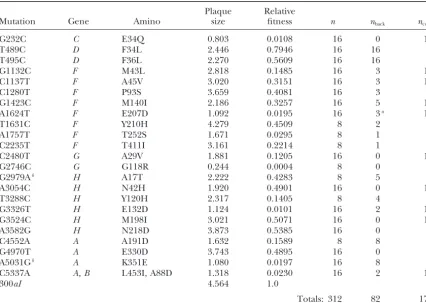
Summary of deleterious mutations
Plaque Relative
Mutation Gene Amino size fitness n nback ncomp
G232C C E34Q 0.803 0.0108 16 0 14
T489C D F34L 2.446 0.7946 16 16 0
T495C D F36L 2.270 0.5609 16 16 0
G1132C F M43L 2.818 0.1485 16 3 13
C1137T F A45V 3.020 0.3151 16 3 13
C1280T F P93S 3.659 0.4081 16 3 0
G1423C F M140I 2.186 0.3257 16 5 11
A1624T F E207D 1.092 0.0195 16 3a 12
T1631C F Y210H 4.279 0.4509 8 2 2
A1757T F T252S 1.671 0.0295 8 1 7
C2235T F T411I 3.161 0.2214 8 1 5
C2480T G A29V 1.881 0.1205 16 0 12
G2746C G G118R 0.244 0.0004 8 0 8
G2979Ab H A17T 2.222 0.4283 8 5 3
A3054C H N42H 1.920 0.4901 16 0 16
T3288C H Y120H 2.317 0.1405 8 4 4
G3326T H E132D 1.124 0.0101 16 2 14
G3524C H M198I 3.021 0.5071 16 0 16
A3582G H N218D 3.873 0.5385 16 0 0
C4552A A A191D 1.632 0.1589 8 8 0
G4970T A E330D 3.743 0.4895 16 0 0
A5031Gb A K351E 1.080 0.0197 16 8 8
C5337A A, B L453I, A88D 1.318 0.0230 16 2 14
300aI 4.564 1.0
Totals: 312 82 172
Each mutation is identified by the initial nucleotide, genome position (numbered from thePstI restriction site in accordance withSangeret al.1978), and final nucleotide. “Amino” refers to amino acid substitutions (initial amino acid, position, and final amino acid). “Plaque size” (i.e., area) is reported in units of millimeters squared. “Relative fitness” is estimated from the average phage yield per plaque of the deleterious mutation, standardized by the yield of ancestral 300aI. The total number of replicate populations founded from each deleterious mutation is listed undern. The numbers of populations acquiring back or compensatory mutations are listed undernbackandncomp, respectively.
aIncludes two independent same-site reversions to nonancestral nucleotide (T1624G). bDoes not introduceDpnII restriction site.
tation. Not every possible compensatory mutation con- rious mutation to identify intragenic compensatory mu-tations. The types and locations of nucleotide substitu-tributes equally to the evolution of fitness. Either a
di-minishingly small effect on fitness or a relatively low tions from this sequencing are summarized in Table 2. We identified a total of 55 unique intragenic compensa-mutation rate can prevent a compensatory compensa-mutation from
becoming established in a modest-sized population. Ide- tory mutations that occurred at least once in our sample of 172 genotypes. No more than one intragenic muta-ally, we want to detect every possible compensatory
mu-tation. However, compensatory mutations that are diffi- tion was observed in any fitness-recovering genotype. An absence of any substitution in the sequenced interval cult to observe because of their mutation rate or fitness
effect require a large population size, in which case the was interpreted as representing an instance of extragenic compensatory mutation. In total, there are 78 putative back mutation is ensured to out-compete them (Burch
andChao1999). Thus, the frequency of compensatory cases of extragenic compensatory mutation (Table 2), which compose an average proportion of 46% for a mutation in our experimental populations is the most
evolutionarily relevant quantity, representing the frac- random sample of compensatory mutants overall. This implies that epistatic interactions occur between muta-tion of mutamuta-tions that can occur and become established
before the back mutation. tions in different genes almost as often as within genes in
this organism. All of the intragenic mutations observed
Sequencing intragenic mutations: From each
repli-cate population that recovered fitness by acquiring a cause a missense amino acid substitution in the gene containing the deleterious mutation, with the exception compensatory mutation, we sequenced an interval of
sub-TABLE 2
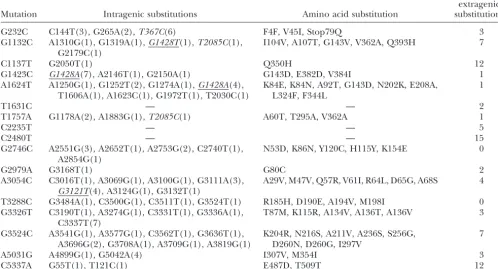
Summary of intragenic sequencing results
No. of putative extragenic
Mutation Intragenic substitutions Amino acid substitution substitutions
G232C C144T(3), G265A(2),T367C(6) F4F, V45I, Stop79Q 3
G1132C A1310G(1), G1319A(1),G1428T(1),T2085C(1), I104V, A107T, G143V, V362A, Q393H 7 G2179C(1)
C1137T G2050T(1) Q350H 12
G1423C G1428A(7), A2146T(1), G2150A(1) G143D, E382D, V384I 1
A1624T A1250G(1), G1252T(2), G1274A(1),G1428A(4), K84E, K84N, A92T, G143D, N202K, E208A, 1 T1606A(1), A1623C(1), G1972T(1), T2030C(1) L324F, F344L
T1631C — — 2
T1757A G1178A(2), A1883G(1),T2085C(1) A60T, T295A, V362A 1
C2235T — — 5
C2480T — — 15
G2746C A2551G(3), A2652T(1), A2753G(2), C2740T(1), N53D, K86N, Y120C, H115Y, K154E 0 A2854G(1)
G2979A G3168T(1) G80C 2
A3054C C3016T(1), A3069G(1), A3100G(1), G3111A(3), A29V, M47V, Q57R, V61I, R64L, D65G, A68S 4 G3121T(4), A3124G(1), G3132T(1)
T3288C G3484A(1), C3500G(1), C3511T(1), G3524T(1) R185H, D190E, A194V, M198I 0
G3326T C3190T(1), A3274G(1), C3331T(1), G3336A(1), T87M, K115R, A134V, A136T, A136V 3 C3337T(7)
G3524C A3541G(1), A3577G(1), C3562T(1), G3636T(1), K204R, N216S, A211V, A236S, S256G, 7 A3696G(2), G3708A(1), A3709G(1), A3819G(1) D260N, D260G, I297V
A5031G A4899G(1), G5042A(4) I307V, M354I 3
C5337A G55T(1), T121C(1) E487D, T509T 12
Substitutions in italics indicate reversions of mutations that had accumulated during adaptation of300aI(indicated by underlin-ing) or divergence of the wild-type ancestor from theSangeret al.(1978) genotype. The number of independent isolates for each substitution is given in parentheses.
stitutions in the corresponding genes that contain the of deleterious mutations occurring in gene F, which encodes the major capsid protein of φX174. Both of deleterious mutation (i.e., genesAandC, respectively).
However, both T121C and C144T occur in a regions of these compensatory mutations reside on the structures that compose the exterior of the viral capsid (affecting genesAandCthat overlap the geneK, causing missense
and nonsense substitutions in the latter (C24R and residues 143 and 362 of the F protein on insertions between-strands E and F and H and I, respectively; R32Stop, respectively), and therefore are not truly silent
substitutions. Indeed, they may represent cases of ex- McKenna et al.1992). Most points of contact between F proteins in the formation of the pentameric structural tragenic compensatory mutation. No function has yet
been attributed to geneK, although it is nonessential component of the viral capsid are located in these exter-nal structures, and likewise most temperature-sensitive for growth (Hayashiet al.1988).
Several of the intragenic compensatory mutations in- mutations that impede procapsid assembly are found here (McKenna et al. 1992). In fact, all but one of volve sites in the genome implicated in the adaptation
of 300aI in the laboratory (G1428A, G1428T, and the compensatory mutations affecting the deleterious mutation A1624T (Table 2), including G1428A, are G3121T) or in the divergence of the wild-type genotype
from the Sanger et al. (1978) sequence (T367C, found on these external structures.
Severe mutations are more compensable:There is an T2085C, and G3121T). The reversion of substitutions
implicated in the adaptation ofφX174 in the laboratory abundance of variation in the relative fitness of the deleterious mutations in our study, ranging from 0.04 as subsequent compensatory mutations is consistent
with our observation that compensatory mutations have to 79% of the average yield of ancestral 300aI phage after one growth cycle (Table 1). This presents a unique deleterious effects when isolated in the ancestral
back-ground (see below). Two of these compensatory muta- opportunity to evaluate the relationship between the severity of a deleterious mutation and its associated rate tions (G1428A and T2085C) were observed in replicate
populations derived from more than one deleterious of compensatory mutation. Figure 2 displays the ob-served proportion of replicate populations that recover mutation. In other words, either of these mutations
address directly the mechanistic relationship between mutation severity and the number of compensatory mu-tations. However, in place of the proportion of replicates with a compensatory mutation, we can instead estimate the total number of different intragenic compensatory mutations on the basis of the number of mutations observed in sequencing (Table 2). Although the latter quantity is potentially more revealing, it is also more difficult to apply. For instance, when every replicate in a sample has independently acquired a unique compen-satory mutation, as in the case of T3288C (Table 2), it is nearly impossible to arrive at a meaningful estimate of the actual number of compensatory mutations. As a result, it was necessary to remove cases in which our sample of intragenic compensatory mutations is far from sat-uration (e.g., C1137T, G2979A, T3288C, G3524C, and C5337A). For the remaining cases, we employed a prob-Figure 2.—Plot of the observed proportion of replicate
ability formula assuming random sampling (Read1998,
populations that independently acquire a compensatory
muta-tion, instead of the back mutamuta-tion, as a function of the log- Equation 4) to obtain a maximum-likelihood estimate
transformed relative fitness of the deleterious mutation. Log of the total number of compensatory mutations. In a relative fitness is a significant factor (P⬍10⫺4) in a binomial Poisson logistic regression, we detected a significantly regression model, which predicts that the proportion of
repli-negative relationship between the log relative fitness of
cates with compensatory mutations increases as the deleterious
a deleterious mutation and the maximum-likelihood
mutation becomes more severe. The solid line indicates the
expected proportion predicted by the binomial regression estimate of the total number of intragenic compensatory
model as a function of log relative fitness. A regression analysis mutations (P ⬍ 0.005). This implies that the previous carried out for the estimated number of intragenic compensa- trend for increasing compensability with mutation sever-tory mutations, rather than the proportion of replicates that
ity extends to the number of compensatory interactions
acquire any compensatory mutation, obtains a similar result
within the gene. Overall, the relationship between
muta-(discussed in text).
tion severity and compensability has intriguing implica-tions for the biological basis of epistatic interacimplica-tions. We address these implications and issue some caveats a compensatory instead of back mutation, plotted
against the log-transformed relative fitness of each dele- in measuring this relationship in thediscussion.
Clustering of intragenic mutations: The intragenic terious mutation. We applied a binomial regression in
which the proportion of replicates that acquire a com- compensatory mutations identified by sequencing are often found in close proximity to the deleterious muta-pensatory mutation is, on a logit scale, a linear function
of log relative fitness. This regression specifies a highly tion in the linear amino acid sequence (Table 2). We quantified the degree of clustering in the linear se-significant negative effect of log relative fitness (P ⬍
10⫺5) on the proportion of compensated replicates, im- quence by calculating the absolute codon distance that separates each pair of compensatory and deleterious plying that populations afflicted by more severe
deleteri-ous mutations are more likely to recover by acquiring mutations, normalized by the gene length. For our data, this test statistic has an average value ofⵑ0.191. In other compensatory mutations. The expected probability of
compensatory mutation as a function of mutation sever- words, the average compensatory mutation is located no farther than 20% of the gene length from the delete-ity, as predicted by the regression model, is indicated
by the line in Figure 2. The binomial regression model rious mutation in the linear sequence. To evaluate whether this average distance was shorter than expected explains a significant proportion of variation in the
ob-served proportion of replicates with compensatory mu- from a random distribution of mutations, we random-ized the locations of compensatory mutations to gener-tations (2 ⫽ 25.23, d.f. ⫽ 1, P ⬍ 10⫺5). However, a
substantial amount of variance remains unexplained by ate a large number (N ⫽ 105) of random outcomes. The resulting null distribution of the test statistic has an the model (residual2⫽135.87, d.f.⫽19,P⬍ 10⫺5).
Uncertainty in the estimate of the compensated propor- average value of 0.303 (95% C.I.: 0.259–0.347). Hence, compensatory mutations are located significantly closer tion from a limited number of trials is undoubtedly a
major source of variance. to the deleterious mutation than expected from a
ran-dom distribution. The above analysis examines the effect of the severity
of the deleterious mutation on the proportion of repli- We also located the residues affected by compensatory mutations in the published protein structure of the cate populations acquiring any compensatory mutation.
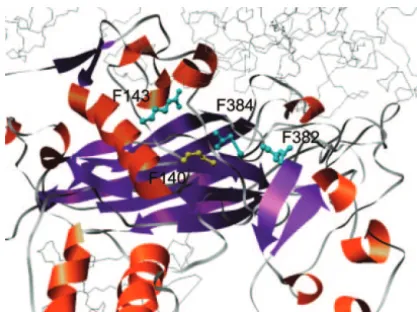
the multiple occurrence of three different intragenic mutations (C144T, G265A, and T367C) in 11 replicate populations fixed for the deleterious mutation G232C (Table 2) implies that sampling of mutations is near saturation. In other words, we infer that additional novel mutations are unlikely to appear with further sampling. On the other hand, the four compensated replicate populations fixed for T3288C had each acquired a unique intragenic compensatory mutation, implying that other mutations are possible. A likelihood model based on this property of random sampling can deter-mine what hypothetical distribution ofCintrabest explains the data. This likelihood analysis was developed pre-viously for a study on estimating the overall statistical Figure 3.—Compensatory mutations of G1423C mapped
distribution of C for a wide range of genes and taxa
to residues in the F protein structure. The residue affected
(Poonet al.2005, this issue). Here, our
maximum-likeli-by the deleterious mutation G1423C (i.e., F140) is highlighted
in yellow, and compensatory residues are highlighted in blue. hood estimate for the distribution ofCintrais described Each pair of residues is no more than 15 A˚ apart. These by anL-shaped gamma distribution function (␣ ⫽0.383, residues form a group on the external face of the F protein, ⫽23.41) that predicts an average of E[C
intra]⫽8.96 located above the -barrel indicated by the purple ribbon.
intragenic mutations. This analysis assumes uniform
This image was generated in UCSF Chimera v. 1.2 (Computer
mutation rates among sites within a gene and will
under-Graphics Laboratory, UCSF) using the published structure
PDB ID 1AL0 (seematerials and methods). estimateCintrawhen this assumption is violated. Using a randomization analysis, we determined that this distributional estimate predicts that the replicate affected by the deleterious or compensatory mutation populations in our experiment would acquire intra-by the gene letter followed intra-by residue number (e.g., genic compensatory mutations instead of back muta-F140 refers to residue 140 in gene F). In the folded tions with an average frequency of 54.4% (95% C.I.: structure of the procapsid, many compensatory muta- 40.6 and 68.2%). We expect improved concordance tions are located closer to the deleterious mutation than with our observed frequency of 67.7% if we incorporate implied by the pairwise distance in the linear sequence. extragenic compensatory mutation and variation in mu-Figure 3 illustrates a particular instance of this structural tation rates. The shape of the distribution ofCplays an clustering in which compensatory mutations (at posi- important role in relating the average, E[C], to the tions F143, F382, and F384) that interact with the delete- frequency of compensatory mutation in replicate popu-rious mutation G1423C (F140) map to residues that lations. A bell-shaped distribution with low variation in form a tight cluster in the folded F protein structure. the number of compensatory mutations would constrain In this case, the clustering test statistic for G1423C is the average to only two or three, to be consistent with an misleadingly high (0.382). Of course, not all compensa- observed frequency ofⵑ70%. In contrast, anL-shaped tory mutations cluster around the deleterious mutation distribution stipulates greater variation inCand thereby in protein structures. For example, the deleterious mu- predicts a greater averageE[C] for the same observed tation A1624T (F207), which maps to an␣-helix in the frequency of compensatory mutations.
EF insertion (as described above), is affected by five Compensatory mutations are deleterious: When we compensatory mutations that modify residues located classify fitness-recovering mutations that occur at sites on or near this ␣-helix (e.g., at positions F143, F202, apart from the deleterious mutation as compensatory, F208, F324, and F344) and three other mutations on we implicitly assume that there is a strong epistatic inter-the far end of inter-the insertion (e.g., at positions F84 and action that is principally responsible for the recovery of F92). Because this structure is implicated in establishing fitness. However, an alternate possibility is that fitness contacts with neighboring F proteins in the pentameric is being recovered by mutations that are beneficial irre-unit, it is possible that the latter group of mutations spective of their genetic context, which can be indistin-represent compensatory interactions between subunits. guishable from compensatory mutations. As an initial
will acquire a compensatory mutation instead of a back mutation in the bacteriophage φX174. Moreover, our analysis of the diversity of intragenic compensatory mu-tations, unearthed by sequencing evolved genotypes from the replicate populations, predicts that any delete-rious mutation can be compensated by at least nine other mutations on average. We note that there is sub-stantial variance around this mean value (described by anL-shaped gamma distribution); indeed, some delete-rious mutations in our study evidently cannot be com-pensated for. Our results make a strong overall case Figure4.—Fitness estimates for sets of deleterious and
com-that compensatory mutation plays an important, and as
pensatory mutant genotypes, with respect to average yield per
yet neglected, role in biological evolution. For example,
plaque. Each set of genotypes for a pair of deleterious and
compensatory mutations is denoted by the location of the Levinet al. (2000) have demonstrated that bottlenecked
deleterious mutation and replicate population designation populations tend to fix compensatory mutations, in-letter. Specifically, 3524arefers to the deleterious mutation
stead of back mutations, when the rate of compensatory
G3524C and the intragenic compensatory mutation G3562A,
mutation exceeds the back mutation rate by at least an
which appeared in replicate populationa. The other
compen-order of magnitude. There is an important stipulation,
satory mutations are as follows: 3524h, T3696C; 2746a,
A2652T; 1757b, A2404G (an extragenic mutation in geneG however, to formulating a direct analogy from our ex-isolated in two independent replicates); and 5337b, A121G. perimental populations to biological reality: deleterious Fitness estimates are averaged over six or more replicate assays
mutations as severe as those used in our experiment
for each genotype. The symbol “⫹” denotes the wild-type allele
are unlikely to become fixed under most natural
condi-that occupies the site of either the deleterious (d) or the
tions. In spite of this, our experiment reveals a
remark-compensatory (c) mutation. Fitness of the ancestor 300aI
(⫹⫹) is represented by a solid bar. Open bars represent dele- able abundance and diversity of epistatic interactions terious mutations (d⫹), thinly hatched columns are compen- that not only engender compensatory mutations under sated deleterious genotypes (dc), and thickly hatched columns
artificial conditions, but also represent multiple
alterna-are isolated compensatory mutations (⫹c).
tive solutions to adaptation under natural conditions. In other words, a deleterious mutation is genetically equivalent to the absence of a beneficial mutation. A identified as containing both deleterious and
compensa-tory mutations. In other words, we moved the putative natural population will therefore be placed in a situation analogous to our experiment following a change in the compensatory mutations into the ancestral (300aI)
ge-netic background. Subsequently, we measured the aver- environment that necessitates adaptation. For instance, pathogens can rapidly acquire a mutation that confers age yield per plaque for all four combinations of two
biallelic loci: namely, the ancestor 300aI(⫹⫹), the dele- resistance to an inhibitory drug, but the mutation often becomes deleterious when the population is returned terious mutation with (dc) and without (d⫹) the
com-pensatory mutation, and the comcom-pensatory mutation to the drug-free environment (Maisnier-Patin and Andersson2004).
itself (⫹c). The results of this assay are presented in
Figure 4. In all cases, the compensatory mutation has Our results have several implications for the genetic complexity of adaptation. First, we predict that popula-a deleterious or negligible effect on fitness when plpopula-aced
in the ancestral background. This is consistent with the tions recently derived from a common ancestor will tend to respond to selection in the same novel environment recovery of fitness being caused by an epistatic
interac-tion with the deleterious mutainterac-tion, rather than by an by acquiring divergent sets of mutations. A corollary of this prediction is that when a population is returned to unconditionally beneficial effect of the second mutation
itself. To address the possibility that this result was due the ancestral environment, it is less likely to return to the ancestral genotype. Second, we predict that cases to the spontaneous occurrence of mutations during
re-version of deleterious mutations by site-directed muta- of adaptation that involve mutations with large effects are more likely to promote genetic divergence among genesis, fitness estimates were assayed for multiple
phage isolates from the transformation mixture. No sig- populations. Finally, we predict that genetic divergence will involve mutations in different genes almost as often nificant difference in fitness estimates was observed
among replicate transformation isolates (data not as in the same gene. Presently, few experimental studies can unambiguously verify or contradict these predic-shown).
tions (Porterand Crandall2003). One notable ex-ception is a study byCrillet al.(2000) in which
popula-DISCUSSION
tions of φX174 were subjected to alternating host environments (E. coliandSalmonella enterica). One site
Adaptation and compensatory mutations:We estimate
determined to have a major effect on the rate of host- T495C, respectively. Therefore, we infer that for the range of fitness effects in our study, the detection thresh-specific growth. However, only three of seven mutations
acquired in the initial adaptation of the ancestral popu- old is not the principal cause of the observed severity-compensability relationship. Also, the compensatory lation toS. entericawere reverted in both replicate
popu-lations that were subsequently derived from the ancestor mutations that fall below the detection threshold are the least likely to contribute to the evolution of fitness (Crillet al.2000). Unfortunately, it is unclear whether
the absence of correlated reversions in this study is because they cannot compete against the back muta-tion, as noted above.
caused by compensatory mutations. Further
experi-ments will be required to elucidate how often epistasis Notwithstanding experimental biases, what could be the biological cause by which more severe deleterious drives the divergence of populations during adaptation.
Mutation severity and compensability:We have deter- mutations tend to create a greater number of potential sites for compensatory mutation? One intriguing possi-mined that the frequency at which populations ofφX174
acquire compensatory mutations instead of back muta- bility is that deleterious mutations with large effects on fitness may tend to affect a broader range of phenotypic tions to recover fitness is a significantly increasing
func-tion of the severity of the deleterious mutafunc-tion. This components. Severely deleterious mutations would therefore generate a larger mutational target for com-trend evidently extends to the total number of
intra-genic compensatory mutations, which also increases pensatory interactions. This notion conceivably applies at any biological level of organization. For instance, a with deleterious mutation severity. It is possible,
how-ever, that the observed relationship between mutation mutation that causes a stronger perturbation in the over-all structure of a folded protein may interact with a severity and frequency of compensatory mutation is an
artifact of our experimental design. First of all, muta- larger number of residues. Similarly, a mutation at a node of a gene network with higher connectivity by tions that recover fitness in a population fixed for a
weakly deleterious mutation are difficult to detect. Be- definition interacts with subsequent mutations at a larger number of nodes. An increase in the number of cause it may be necessary to evolve such populations for
a greater number of generations, there may be greater compensatory mutations with increasing distance from a fitness optimum is also predicted byFisher’s (1930) opportunity for a back mutation to occur and
out-com-pete the compensatory mutation. Second, if the effect geometric model of adaptation. When a population is close to a fitness optimum, its fitness can be improved size distribution of compensatory mutation scales with
the severity of the deleterious mutation, then for weaker only by a narrow range of mutations of small effect. However, if the population is far from an optimum, deleterious mutations a greater proportion of
compen-satory mutations could drop below the detection thres- then it may indiscriminately select from a wide range of mutations, even from those associated with deleterious hold.
We have been unable to recover either back or com- pleiotropic side effects. This relationship between muta-tion severity and compensability has an unfortunate im-pensatory mutations for the weakly deleterious
muta-tions A3582G and G4970T. However, we have been able plication, however, in that the deterioration of fitness from the accumulation of deleterious mutations is to isolate a small number of back and compensatory
muta-tions from two other deleterious mutamuta-tions, C1280T and largely caused by mutations of slight effect ( Kondra-shov1995). Consequently, compensatory mutation may T1631C, with comparably weak effects on fitness.
Be-cause these were isolated after⬍25 growth cycles, there be unable to prevent the mutational meltdown of all but the smallest populations. On the other hand, com-was insufficient time for a back mutation to arise and
interfere with the spread of a compensatory mutation pensatory mutation represents an extreme form of an-tagonistic epistasis. If an overall decline in anan-tagonistic (GerrishandLenski1998). Note that we did not
re-quire mutations to become fixed in the population. epistasis with the effect size of deleterious mutations is accompanied by an increase in synergistic epistasis, then Furthermore, even if all fitness-recovering mutations
isolated for C1280T or T1631C were caused by compen- a lack of compensatory mutations may be offset by an increased efficiency of selection for removing slightly satory mutations, the regression would remain highly
significant. On the other hand, the deleterious muta- deleterious mutations (Kondrashov1994).
The intragenic-extragenic ratio:A substantial propor-tions T489C and T495C have a strong influence on our
regression. We have recovered only back mutations for tion (ⵑ46%) of our replicate populations have evidently acquired extragenic compensatory mutations to recover these two mutations, which have weak effects on fitness
with respect to the average yield per plaque. However, fitness. It is also conceivable that some of the intragenic mutations that we have identified by sequencing are in both T489C and T495C also create plaques that are
disproportionately small (Table 1), so that the range of fact neutral in effect, causing us to underestimate the proportion of compensatory mutations that are ex-plaque size above the detection threshold is comparable
to most other mutations in our study. Moreover, no tragenic. Because we isolate fitness-recovered plaques as soon as they are detected, however, there is very more than 10 and 22 growth cycles were required to
frequency sufficiently high for this to occur. Further- tion restrict the ability for viral genes to functionally specialize, which could limit the number of extragenic more, the significant degree of clustering and multiple
independent occurrences implies that at least most of interactions in higher organisms.
Future directions: Our understanding of adaptation the observed intragenic mutations are indeed
compen-satory. The high frequency of extragenic compensatory and the evolutionary consequences of mutation will ben-efit greatly from further empirical investigations into mutation that we have observed is corroborated by
sev-eral studies of suppressor mutations in the bacterio- the phenomenon of compensatory mutation. Can popu-lations that have acquired a compensatory mutation in phageφX174. These suppressor mutations reveal
func-tional interactions within and among gene products, lieu of reverting a deleterious mutation recover fitness completely, or are they trapped on an inferior “fitness particularly the proteins that participate in the assembly
of the viral procapsid (i.e., genesB,D,F, andG;Dok- peak”? What is the effect size distribution of compensa-tory mutations, and does this differ between mutations
land et al. 1997). For example, although the internal
scaffolding gene B is essential, deletion of nearly half located intragenically and extragenically? Does the accu-mulation of deleterious mutations enhance or impede of B can yield viable, albeit defective, bacteriophage,
demonstrating functional redundancy among genes the recruitment of potential sites for compensatory mu-tations in the genome? The bacteriophageφX174 pro-(NovakandFane2004). Indeed, the remaining
defec-tive phenotype in deletion mutants can be ameliorated vides an ideal experimental system in which to address these and other problems in evolutionary biology. Both by extragenic suppressor mutations in geneD.
Further-more,BandDmay represent an evolutionary partition this study and previous work with suppressor mutations (e.g.,JenningsandFane1997) demonstrate the versatil-of functions carried out by a single scaffolding protein in
other systems (FaneandPrevelige2003). Extragenic ity of site-directed mutagenesis in this system. However, because φX174 exhibits rudimentary gene regulation suppressor mutations are also common among other
gene products in φX174. Mutations that disrupt the (Hayashiet al. 1988), studies of epistatic interactions in this bacteriophage are limited to those within or DNA-binding function of the J gene product are
sup-pressed by mutations in the major capsid geneF(Jen- among structural gene products. To address the nature of compensatory mutations in a regulatory gene net-nings and Fane 1997;Hafenstein et al.2004).
Simi-larly, suppressors of a cold-sensitive mutation in gene work will require the development of a similar experi-mental system in a more biologically complex model
or-Dwere located in either gene F or geneJ (Faneet al.
1993). Hence, there is a multitude of associations ganism.
A promising extension of our investigations in com-among different gene products that participate in the
procapsid. pensatory mutation is found in recent theoretical work
on the effect size distribution of beneficial mutations Extragenic suppressor mutations are also frequently
observed in organisms other than bacteriophage. A sur- available for adaptation (Orr2003). By assuming that genotypes in natural populations tend to occupy the vey of the suppressor mutation literature estimates that
the overall proportion of mutations that are extragenic upper limit of a fitness distribution,Orr(2003) could apply extreme value theory to demonstrate that the differ-isⵑ10% for all taxa (Poonet al.2005, this issue). This
proportion, however, increases to ⵑ35% if calculated ence in fitness separating adjacent genotypes ranked by fitness is exponentially distributed. This provides a testable specifically for mutations in viruses; hence, our result
is consistent with observations in other viral systems. hypothesis that can be evaluated for compensatory muta-tions in bacteriophage φX174 (Rokytaet al. 2005). To Why are extragenic mutations evidently more common
in viruses than in prokaryotes or eukaryotes? We would provide a deeper understanding of the adaptive land-scape,Orr’s (2003) result might also be combined with expect the opposite trend, because prokaryotic and
euk-aryotic genomes generally consist of a considerably our observation that the number of compensatory muta-tions available for evolution is a decreasing function of greater number of genes, potentially conferring a larger
mutational target for extragenic interactions. On one the distance from the fitness optimum.
hand, extragenic mutations may be underreported in We thank B. A. Fane for generously providing the wild-typeφX174 studies of prokaryotes and eukaryotes. However, such andE. coli Chost strains and protocols; H. Hoekstra and R. Burton for providing sequencing resources; Lawrence K. Chao for laboratory
studies are principally motivated to identify and
charac-assistance; and B. H. Davis, H. Hoekstra, D. M. Weinreich, J. J. Bull,
terize functional interactions among different proteins
and an anonymous reviewer for their insightful comments on previous
(Sujatha andChatterji 2000). On the other hand,
versions of this article. This work was supported by a grant from the
this trend could reflect a lesser degree of compartmen- National Institutes of Health (GM-60916) to L.C. talization of biological function among genes in viruses
than in prokaryotes or eukaryotes. Viruses are under
strong selection for genomic compactness; for instance, LITERATURE CITED
several genes in the bacteriophage φX174 overlap or
Berman, H. M., J. Westbrook, Z. Feng, G. Gilliland, T. N. Bhat are nested within one another (Hayashiet al. 1988). et al., 2000 The Protein Data Bank. Nucleic Acids Res.28:235–
242.
organiza-Burch, A. D., andB. A. Fane, 2000 Foreign and chimeric scaffolding Levin, B. R., V. PerrotandN. Walker, 2000 Compensatory muta-tions, antibiotic resistance and the population genetics of adap-proteins as inhibitors ofMicroviridaemorphogenesis. J. Virol.74:
tive evolution in bacteria. Genetics154:985–997. 9347–9352.
Maisnier-Patin, S., andD. I. Andersson, 2004 Adaptation to the
Burch, C. L., andL. Chao, 1999 Evolution by small steps and rugged
deleterious effects of antimicrobial drug resistance mutations by landscapes in the RNA virusφ6. Genetics151:921–927.
compensatory evolution. Res. Microbiol.155:360–369.
Burch, C. L., andL. Chao, 2004 Epistasis and its relationship to
McKenna, R., D. Xia, P. Willingmann, L. L. Ilag, S. Krishnaswamy
canalization in the RNA virusφ6. Genetics167:559–567.
et al., 1992 Atomic structure of single-stranded DNA
bacterio-Chao, L., T. T. TranandT. T. Tran, 1997 The advantage of sex
phageφX174 and its functional implications. Nature355:137– in the RNA virusφ6. Genetics147:953–959.
143.
Crill, W. D., H. A. WichmanandJ. J. Bull, 2000 Evolutionary
Novak, C. R., andB. A. Fane, 2004 The functions of the N terminus reversals during viral adaptation to alternating hosts. Genetics
of theφX174 internal scaffolding protein, a protein encoded in
154:27–37.
an overlapping reading frame in a two scaffolding protein system.
Dokland, T., R. McKenna, L. L. Ilag, B. R. Bowman, N. L.
Incar-J. Mol. Biol.335:383–390.
donaet al., 1997 Structure of a viral procapsid with molecular
Orr, H. A., 2003 The distribution of fitness effects among beneficial scaffolding. Nature389:308–313.
mutations. Genetics163:1519–1526.
Fane, B. A., and M. Hayashi, 1991 Second-site suppressors of a
Orr, H. A., andJ. A. Coyne, 1992 The genetics of adaptation: a cold-sensitive prohead accessory protein of bacteriophageφX174. reassessment. Am. Nat.140:725–742.
Genetics128:663–671. Pettersen, E. F., T. D. Goddard, C. C. Huang, G. S. Couch, D. M.
Fane, B. A., andP. E. Prevelige, Jr., 2003 Mechanism of scaffolding- Greenblattet al., 2004 UCSF Chimera—a visualization system assisted viral assembly. Adv. Protein Chem.64:259–299. for exploratory research and analysis. J. Comput. Chem.25:1605–
Fane, B. A., S. ShienandM. Hayashi, 1993 Second-site suppressors 1612.
of a cold- sensitive external scaffolding protein of bacteriophage Poon, A., B. H. DavisandL. Chao, 2005 The coupon collector and
φX174. Genetics134:1003–1011. the suppressor mutation: estimating the number of compensatory
Fisher, R. A., 1930 The Genetical Theory of Natural Selection, Ed 2. mutations by maximum likelihood. Genetics170:1323–1332. Dover Publications, New York. Porter, M. L., andK. A. Crandall, 2003 Lost along the way: the
Gerrish, P. J., andR. E. Lenski, 1998 The fate of competing benefi- significance of evolution in reverse. Trends Ecol. Evol.18:541– 547.
cial mutations in an asexual population. Genetica102/103:127–
Read, K. L. Q., 1998 A lognormal approximation for the collector’s 144.
problem. Am. Stat.52:175–180.
Hafenstein, S. L., M. Chenand B. A. Fane, 2004 Genetic and
Rokyta, D. R., P. Joyce, S. B. CaudleandH. A. Wichman, 2005 An functional analysis of theφX174 DNA binding protein: the effects
empirical test of the mutational landscape model of adaptation of substitutions for amino acid residues that spatially organize
using a single-stranded DNA virus. Nat. Genet.37:441–444. the two DNA binding domains. Virology318:204–213.
Sambrook, J., E. F. FritschandT. Maniatis, 1989 Molecular
Clon-Hayashi, M., A. Aoyama, D. L. Richardson, Jr. andM. N. Hayashi,
ing: A Laboratory Manual, Ed 2. Cold Spring Harbor Laboratory 1988 Biology of the bacteriophageφX174, pp. 1–71 inThe
Bacte-Press, Cold Spring Harbor, NY. riophages, edited by R.Calendar. Plenum Press, New York.
Sanger, F., A. R. Coulson, T. Friedmann, G. M. Air, B. G. Barrell Jennings, B., andB. A. Fane, 1997 Genetic analysis of theφX174
et al., 1978 The nucleotide sequence of bacteriophageφX174. DNA binding protein. Virology227:370–377.
J. Mol. Biol.125:225–246.
Kimura, M., 1985 The role of compensatory neutral mutations in
Sujatha, S., andD. Chatterji, 2000 Understanding protein-pro-molecular evolution. J. Genet.64:7–19. tein interactions by genetic suppression. J. Genet.79:125–129.
Kondrashov, A. S., 1994 Muller’s ratchet under epistatic selection. Whitlock, M. C., andS. P. Otto, 1999 The panda and the phage: Genetics136:1469–1473. compensatory mutations and the persistence of small
popula-Kondrashov, A. S., 1995 Contamination of the genome by very tions. Trends Ecol. Evol.14:295–296. slightly deleterious mutations: Why have we not died 100 times